Inverse Trigonometric Functions and Derivatives
Click here for a printable version of this page.In this section we are going to look at the derivatives of the inverse trig functions. In order to derive the derivatives of inverse trig functions we’ll need the formula from the last section relating the derivatives of inverse functions.
Inverse Function Theorem
Suppose $f(x)$ is a function which has an inverse, $f^{-1}(x)$, and both $f$ and $f^{-1}$ are differentiable. Then for all $x$ such that $f'\left(f^{-1}(x)\right)\neq0$,
$$(f^{-1})'(x)=\frac{1}{f'\left(f^{-1}(x)\right)}.$$Inverse Sine
Let’s start with inverse sine. For a comprehensive review, check out our trig textbook. Here is the definition of the inverse sine function.
$$\textcolor{Maroon}{y} = {\sin ^{ - 1}}(\textcolor{MidnightBlue}{x})\hspace{0.5in} \Leftrightarrow \hspace{0.5in}\sin (\textcolor{Maroon}{y}) = \textcolor{MidnightBlue}{x}\hspace{0.25in}{\mbox{for}}\,\,\,\,\,\,\,\,\, - \frac{\pi }{2} \le y \le \frac{\pi }{2}$$Sometimes instead of the -1 superscript, we name the inverse sine function arcsine, so the above information can be annotated as follows:
$$\textcolor{Maroon}{y} = {\arcsin}(\textcolor{MidnightBlue}{x})\hspace{0.5in} \Leftrightarrow \hspace{0.5in}\sin (\textcolor{Maroon}{y}) = \textcolor{MidnightBlue}{x}\hspace{0.25in}{\mbox{for}}\,\,\,\,\,\,\,\,\, - \frac{\pi }{2} \le y \le \frac{\pi }{2}$$So, evaluating an inverse trig function is the same as asking what angle (i.e. $y$) did we plug into the sine function to get $x$. The restrictions on $y$ given above are there to make sure that we get a consistent answer out of the inverse sine. We know that there are in fact an infinite number of angles that will work and we want a consistent value when we work with inverse sine. Using the range of angles above gives all possible values of the sine function exactly once. If you’re not sure of that sketch out a unit circle and you’ll see that that range of angles (the $y$’s) will cover all possible values of sine.
Note as well that since $−1\leq\sin(y)\leq 1$ we also have $−1\leq x\leq 1$.
We have the following relationship between the inverse sine function and the sine function.
$$\begin{align*} \sin \left( {{{\sin }^{ - 1}}(x)} \right) = x \hspace{1em} & \text{for } -1\leq x\leq 1 \\ {\sin ^{ - 1}}\left( {\sin (x)} \right) = x \hspace{1em} & \text{for } -\frac{\pi}{2}\leq x\leq \frac{\pi}{2} \end{align*}$$In other words sine and inverse sine are inverses of each other. This means that we can use the fact above to find the derivative of inverse sine. Let’s start with,
$$f\left( x \right) = \sin (x)\hspace{0.5in}f^{-1}\left( x \right) = {\sin ^{ - 1}}(x).$$Following the Inverse Function Theorem, we get
$$\frac{d}{dx}\left[\sin^{-1}(x)\right]=\frac{1}{f'\left(f^{-1}(x)\right)}=\frac{1}{\cos\left(\sin^{-1}(x)\right)}.$$While this is correct, it is not a very useful formula. Let’s see if we can get a better formula. Let’s start by recalling the definition of the inverse sine function.
$$\textcolor{MidnightBlue}{\theta} = {\sin ^{ - 1}}\left( \textcolor{Maroon}{x} \right)\hspace{0.5in} \Rightarrow \hspace{0.5in}\textcolor{Maroon}{x} = \sin \left( \textcolor{MidnightBlue}{\theta} \right)$$Using the first part of this definition the denominator in the derivative becomes,
$$\cos \left( {{{\sin }^{ - 1}}x} \right) = \cos \left( \theta \right).$$To get a better idea of what we are looking at, let's look at a right triangle as if it were sitting in the unit circle in standard postion. For now, we may act as if it is sitting in the first quadrant.
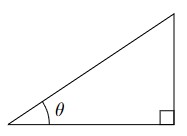
What we really want to know is what $\cos(\theta)$ is, which can be determined by
$$\cos(\theta)=\frac{\text{adjacent}}{\text{hypotenuse}}.$$As $\sin(\theta)=x=\dfrac{x}{1}=\dfrac{\text{opposite}}{\text{hypotenuse}}$, we can fill in some of the side lengths of this triangle.
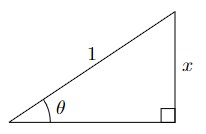
We will need to know the adjacent side to find $\cos(\theta)$, which may find by using the Pythagorean Theorem.
$$(\text{adjacent})^2+x^2=1^2\hspace{.5em}\Rightarrow\hspace{.5em}\text{adjacent}=\pm\sqrt{1-x^2}$$Note that $\theta$ is restricted by $-\frac{\pi}{2}\leq\theta\leq\frac{\pi}{2}$. Therefore, This triangle can only be viewed as if in quadrant 1 or 4. In either case, the adjacent side falls along the postive $x$-axis, meaning the adjacent side is positive. So we can finalize our triangle.

Finally, we can see that $$\cos(\theta)=\dfrac{\text{adjacent}}{\text{hypotenuse}}=\dfrac{\sqrt{1-x^2}}{1}=\sqrt{1-x^2}.$$ Thus $\cos \left( {{{\sin }^{ - 1}}x} \right) = \cos \left( \theta \right)=\sqrt{1-x^2}$ and
$$\frac{d}{dx}\left[\sin^{-1}(x)\right]=\frac{1}{\cos\left(\sin^{-1}(x)\right)}=\frac{1}{\sqrt{1-x^2}}.$$Derivative of Inverse Sine
$$\frac{d}{dx}(\sin^{-1}) = \frac{1}{\sqrt{1-x^2}}$$Let's practice a few problems with the derivative of the inverse sine function.
Differentiate the following.
- $v(z)=4\sin^{-1}(3z)$
- $g(x)=5x-\arcsin(1+x)$
Notice that this problem will require the use of the chain rule where the inside is $3z$. The derivative is
$$\begin{align*} v'(z) &= 4\cdot\frac{1}{\sqrt{1-(\textcolor{MidnightBlue}{3z})^2}}\cdot\textcolor{Plum}{\underbrace{\frac{d}{dz}(3z)}_{\mbox{Chain!}}}\\ &=4\cdot\frac{1}{\sqrt{1-(3z)^2}}\cdot \textcolor{Plum}{3} \\ &\\ &= \frac{12}{\sqrt{1-9z^2}}. \end{align*}$$When doing the chain rule with this we remember that we’ve got to leave the inside function alone. That means that where we have the $\textcolor{MidnightBlue}{x}^2$ in the derivative of $\sin^{-1}(x)$ we will need to have $(\textcolor{MidnightBlue}{\text{inside function}})^2$.
Again we will need to use the chain rule on the arcsine function, with the inside being $1+x$.
$$\begin{align*} g'(x) &= 5-\frac{1}{\sqrt{1-(\textcolor{MidnightBlue}{1+x})^2}}\cdot\textcolor{Plum}{\underbrace{\frac{d}{dx}(1+x)}_{\mbox{Chain!}}}\\ &=5-\frac{1}{\sqrt{1-(1+x)^2}}\cdot \textcolor{Plum}{1} \\ &= 5-\frac{1}{\sqrt{1-(1+2x+x^2)}} \\ &= 5-\frac{1}{\sqrt{-2x-x^2}} \end{align*}$$We see again how we need to be careful substitute the "inside" function ($1+x$) into the arcsine derivative formula in place of the $x$!
Now try some on your own.
Inverse Cosine
Now recall some information about inverse cosine. Again, for a comprehensive review, check out our trig textbook. First, here is the definition of the inverse cosine function.
$$\textcolor{Maroon}{y} = {\cos ^{ - 1}}(\textcolor{MidnightBlue}{x})\hspace{0.5in} \Leftrightarrow \hspace{0.5in}\cos (\textcolor{Maroon}{y}) = \textcolor{MidnightBlue}{x}\hspace{0.25in}{\mbox{for}}\,\,\,\,\,\,\,\,\, 0 \le y \le \pi$$Once more, we could write arccosine instead of the superscript of -1 to indicate that we're dealing with the inverse of cosine, so the above information can also be written as
$$\textcolor{Maroon}{y} = {\arccos}(\textcolor{MidnightBlue}{x})\hspace{0.5in} \Leftrightarrow \hspace{0.5in}\cos (\textcolor{Maroon}{y}) = \textcolor{MidnightBlue}{x}\hspace{0.25in}{\mbox{for}}\,\,\,\,\,\,\,\,\, 0 \le y \le \pi.$$As with the inverse sine we’ve got a restriction on the angles, $y$, that we get out of the inverse cosine function. Again, if you’d like to verify this a quick sketch of a unit circle should convince you that this range will cover all possible values of cosine exactly once. Also, we also have $−1\leq x\leq 1$ because $−1\leq \cos(y)\leq 1$.
We have the following relationship between the inverse cosine function and the cosine function.
$$\begin{align*} \cos \left( {{{\cos }^{ - 1}}(x)} \right) = x \hspace{1em} & \text{for } -1\leq x\leq 1 \\ {\cos ^{ - 1}}\left( {\cos (x)} \right) = x \hspace{1em} & \text{for } 0\leq x\leq \pi \end{align*}$$In other words they are inverses of each other. This means that we can use the fact above to find the derivative of inverse cosine. As we did with the inverse sine function, let’s start with,
$$f\left( x \right) = \cos x\hspace{0.5in}f^{-1}\left( x \right) = {\cos ^{ - 1}}x.$$Using the Inverse Function Theorem again, we get
$$\frac{d}{dx}\left[\cos^{-1}(x)\right]=\frac{1}{f'\left(f^{-1}(x)\right)}=\frac{1}{-\sin\left(\cos^{-1}(x)\right)}=\frac{-1}{\sin\left(\cos^{-1}(x)\right)}.$$We could have left the negative in the denominator, but we move it here to have a slightly easier denominator to simplify.
And so, similar to the derivative for inverse sine, we can simplify $\sin(\cos^{-1}(x))$ and find that $\sin(\cos^{-1}(x))=\sqrt{1-x^2}$. We leave the details of this as an exercise.
Thus we can conclude,
$$\frac{d}{dx}\left[\cos^{-1}(x)\right]=\frac{-1}{\sqrt{1-x^2}}.$$Derivative of Inverse Cosine
$$\frac{d}{dx}(\cos^{-1}) = \frac{-1}{\sqrt{1-x^2}}$$Let's work with this derivative.
Compute the following.
$$\frac{d}{dt}\left[(t^3-5)\cos^{-1}(t^2+2)\right]$$First note that this is a product and so we will need to follow the product rule initially. In doing so, we will need to use the chain rule once we get to the derivative of the inverse cosine function. Let's see what just the derivative of the inverse cosine piece gives us:
$$\begin{align*} \frac{d}{dt}\left[\cos^{-1}(t^2+2)\right] &= \frac{-1}{\sqrt{1-(\textcolor{MidnightBlue}{t^2+2})^2}}\cdot\textcolor{Plum}{\frac{d}{dt}(t^2+2)}\\ &= \frac{-1}{\sqrt{1-(t^2+2)^2}}\cdot \textcolor{Plum}{2t} \\ &= \frac{-2t}{\sqrt{-t^2-4t-3}} \end{align*}$$When doing the chain rule with this we remember that we’ve got to leave the inside function alone. That means that where we have the $\textcolor{MidnightBlue}{x}^2$ in the derivative of $\cos^{-1}(x)$ we will need to have $(\textcolor{MidnightBlue}{\text{inside function}})^2$. Now we can use this as we follow with the product rule for our overall derivative.
$$\begin{align*} \frac{d}{dt}\left[(t^3-5)\cos^{-1}(t^2+2)\right] &= \frac{-2t}{\sqrt{-t^2-4t-3}}(t^3-5)+3t^2\cos^{-1}(t^2+2) \\ &= \frac{-2t^4+10t}{\sqrt{-t^2-4t-3}}+3t^2\cos^{-1}(t^2+2) \end{align*}$$Now try some on your own.
Inverse Tangent
The last of these derivatives that we will cover in detail is that of the inverse tangent function. Check out a more comprehensive review of this function here. Recall the definition of the inverse tangent function.
$$\textcolor{Maroon}{y} = {\tan ^{ - 1}}(\textcolor{MidnightBlue}{x})\hspace{0.5in} \Leftrightarrow \hspace{0.5in}\tan (\textcolor{Maroon}{y}) = \textcolor{MidnightBlue}{x}\hspace{0.25in}{\mbox{for}}\,\,\,\,\,\,\,\,\, - \frac{\pi }{2} \lt y \lt \frac{\pi }{2}$$We can annotate this using arctangent instead of the -1 superscript, so the above information is the same as writing
$$\textcolor{Maroon}{y} = {\arctan}(\textcolor{MidnightBlue}{x})\hspace{0.5in} \Leftrightarrow \hspace{0.5in}\tan (\textcolor{Maroon}{y}) = \textcolor{MidnightBlue}{x}\hspace{0.25in}{\mbox{for}}\,\,\,\,\,\,\,\,\, - \frac{\pi }{2} \lt y \lt \frac{\pi }{2}$$Again, we have a restriction on $y$, but notice that we can’t let $y$ be either of the two endpoints in the restriction above since tangent isn’t even defined at those two points. To convince yourself that this range will cover all possible values of tangent do a quick sketch of the tangent function and we can see that in this range we do indeed cover all possible values of tangent. Also, in this case there are no restrictions on $x$ because tangent can take on all possible values.
We have the following relationship between the inverse tangent function and the tangent function.
$$\begin{align*} \tan \left( {{{\tan }^{ - 1}}(x)} \right) = x \hspace{1em} & \text{for all } x \\ {\tan ^{ - 1}}\left( {\tan (x)} \right) = x \hspace{1em} & \text{for } -\frac{\pi}{2} \lt x\lt \frac{\pi}{2} \end{align*}$$As these are inverses of each other, to find the derivative of the inverse tangent function we can start with
$$f\left( x \right) = \tan x\hspace{0.5in}f^{-1}\left( x \right) = {\tan ^{ - 1}}x.$$By the Inverse Function Theorem, we have
$$\frac{d}{dx}\left[\tan^{-1}(x)\right]=\frac{1}{f'\left(f^{-1}(x)\right)}=\frac{1}{\sec^2\left(\tan^{-1}(x)\right)}.$$While we can use a right triangle as before to simplify $\sec^2\left(\tan^{-1}(x)\right)$, we can do so without. What we really need here is to use a Pythagorean Identity: $1+\tan^2(\theta)=\sec^2(\theta)$.
Firstly, let $\theta=\tan^{-1}(x)$; and so $\tan(\theta)=x$. So we see that
$$\sec^2\left(\tan^{-1}(x)\right)=\sec^2(\theta)=1+\tan^2(\theta)=1+x^2.$$Therefore, we have the following derivative.
$$\frac{d}{{dx}}\left( {{{\tan }^{ - 1}}x} \right) = \frac{1}{{1 + {x^2}}}$$We also point out the alternate notion for the inverse tangent function.
$$\tan^{-1}(x)=\arctan(x)$$Derivative of Inverse Tangent
$$\frac{d}{dx}(\tan^{-1}) = \frac{1}{1+x^2}$$Let's work with this derivative.
Compute the following.
$$\frac{d}{dy}\left[\arctan(e^y)\right]$$We see that this will require use of the chain rule, where the inside is the exponential and the outside is the arctangent (inverse tangent) function.
$$\begin{align*} \frac{d}{dy}\left[\arctan(e^y)\right] &= \frac{1}{1+(\textcolor{MidnightBlue}{e^y})^2}\cdot \textcolor{Plum}{\underbrace{\frac{d}{dy}(e^y)}_{\mbox{Chain Rule!}}}\\ &= \frac{1}{1+\left( e^y\right)^2}\cdot \textcolor{Plum}{e^y} \\ &= \frac{e^y}{1+e^{2y}} \end{align*}$$Now try some on your own.
Inverse Secant, Cosecant, and Cotangent
There are three more inverse trig functions but the three shown above the most common ones. Here are the definitions of the remaining inverse trigonometric functions.
$$\begin{align*} y = {\sec ^{ - 1}}(x)\hspace{.5em} &\Leftrightarrow \hspace{0.5em}\sec(y)=x \hspace{0.75em}\text{for}\hspace{0.75em} 0\le y \lt \frac{\pi}{2} \hspace{0.75em}\text{or}\hspace{0.75em} \frac{\pi}{2}\lt y\leq \pi \\ y = {\csc ^{ - 1}}(x)\hspace{.5em} &\Leftrightarrow \hspace{0.5em}\csc(y)=x \hspace{0.75em}\text{for}\hspace{0.75em} -\frac{\pi}{2} \le y \lt 0 \hspace{0.75em}\text{or}\hspace{0.75em} 0\lt y\leq \frac{\pi}{2} \\ y = {\cot ^{ - 1}}(x)\hspace{.5em} &\Leftrightarrow \hspace{0.5em}\cot(y)=x \hspace{0.75em}\text{for}\hspace{0.75em} 0\lt y \lt \pi \\ \end{align*}$$We point out that some authors use differe restrictions on the values of $y$ for the inverse secant and inverse cosecant functions. Specifically, they use $0\le y \lt \frac{\pi}{2} \hspace{0.75em}\text{or}\hspace{0.75em} \pi \le y\lt \frac{3\pi}{2}$ for inverse secant and $-\pi\lt y \le -\frac{\pi}{2} \hspace{0.75em}\text{or}\hspace{0.75em} 0 \lt y\le \frac{\pi}{2}$. For this course, we use the restrictions given above.
These three functions also have similar alternate notations as the previous three functions.
$$\begin{array}{l} \sec^{-1}(x)=\mathop{\rm arcsec}(x) \\ \csc^{-1}(x)=\mathop{\rm arccsc}(x) \\ \cot^{-1}(x)=\mathop{\rm arccot}(x) \end{array}$$Formulas for the derivatives of these three could be derived by a similar process as we did with the inverse sine, cosine, and tangent functions. We give those derivatives and recap the derivatives of all inverse trigonometric functions.
Derivatives of Inverse Trigonometric Functions
$$\begin{array}{ll} \dfrac{d}{{dx}}\left( {{{\sin }^{ - 1}}x} \right) = \dfrac{1}{{\sqrt {1 - {x^2}} }} & \hspace{1em}\dfrac{d}{{dx}}\left( {{{\cos }^{ - 1}}x} \right) = \dfrac{-1}{{\sqrt {1 - {x^2}} }}\\ \dfrac{d}{{dx}}\left( {{{\tan }^{ - 1}}x} \right) = \dfrac{1}{{1 + {x^2}}} & \hspace{1em}\dfrac{d}{{dx}}\left( {{{\cot }^{ - 1}}x} \right) = \dfrac{-1}{{1 + {x^2}}}\\ \dfrac{d}{{dx}}\left( {{{\sec }^{ - 1}}x} \right) = \dfrac{1}{{\left| x \right|\sqrt {{x^2} - 1} }} & \hspace{1em}\dfrac{d}{{dx}}\left( {{{\csc }^{ - 1}}x} \right) = \dfrac{-1}{{\left| x \right|\sqrt {{x^2} - 1} }} \end{array}$$Practice Problems
For problems 1 – 7 differentiate the given function.
- $T\left( z \right) = 2\cos \left( z \right) + 6{\cos ^{ - 1}}\left( z \right)$
- $g\left( t \right) = {\csc ^{ - 1}}\left( t \right) - 4{\cot ^{ - 1}}\left( t \right)$
- $y = 5{x^6} - {\sec ^{ - 1}}\left( x \right)$
- $f\left( w \right) = \sin \left( w \right) + {w^2}{\tan ^{ - 1}}\left( w \right)$
- $\displaystyle h\left( x \right) = \frac{{{{\sin }^{ - 1}}\left( x \right)}}{{1 + x}}$
- $u\left( t \right) = {\tan ^{ - 1}}\left( {3t - 1} \right)$
- $g\left( x \right) = {\left( {\ln \left( {{x^2} + 1} \right) - {{\tan }^{ - 1}}\left( {6x} \right)} \right)^{10}}$
Not much to do here other than take the derivative using the formulas.
$$T'\left( z \right) = - 2\sin \left( z \right) - \frac{6}{{\sqrt {1 - {z^2}} }}$$Not much to do here other than take the derivative using the formulas.
$$g'\left( t \right) = - \frac{1}{{\left|t\right|\sqrt {{t^2} - 1} }} + \frac{4}{{{t^2} + 1}}$$Not much to do here other than take the derivative using the formulas.
$$\frac{{dy}}{{dx}} = 30{x^5} - \frac{1}{{\left|x\right|\sqrt {{x^2} - 1} }}$$Other than following the derivative formulas, we will need to use the product rule with the second term of the function.
$$f'\left( w \right) = \cos \left( w \right) + 2w{{\tan }^{ - 1}}\left( w \right) + \frac{{{w^2}}}{{1 + {w^2}}}$$Note that the function is a quotient, thus we will need to use the quotient rule overall. We will also simplify the complex fraction that results from the quotient rule and derivative of the inverse sine function.
$$h'\left( x \right) = \frac{{\frac{{1 + x}}{{\sqrt {1 - {x^2}} }} - {{\sin }^{ - 1}}\left( x \right)}}{{{{\left( {1 + x} \right)}^2}}} = \frac{{1 + x - \sqrt {1 - {x^2}} {{\sin }^{ - 1}}\left( x \right)}}{{\sqrt {1 - {x^2}} {{\left( {1 + x} \right)}^2}}}$$For this problem, we will use the chian rule where the outside function is the inverse tangent and the inside function is the stuff inside of the inverse tangent.
$$u'\left( t \right) = \frac{3}{{{{\left( {3t - 1} \right)}^2} + 1}}$$This problem will require multiple uses of the Chain Rule and so we’ll step though the derivative process to make each use clear.
$$\begin{align*} g'\left( x \right) &= 10{\left( {\ln \left( {{x^2} + 1} \right) - {{\tan }^{ - 1}}\left( {6x} \right)} \right)^9}\frac{d}{{dx}}\left( {\ln \left( {{x^2} + 1} \right) - {{\tan }^{ - 1}}\left( {6x} \right)} \right) \\ &= 10{{\left( {\ln \left( {{x^2} + 1} \right) - {{\tan }^{ - 1}}\left( {6x} \right)} \right)}^9}\left( {\frac{{2x}}{{{x^2} + 1}} - \frac{6}{{36{x^2} + 1}}} \right) \end{align*}$$Assignment Problems
For problems 1 – 15 differentiate the given function.
- $f\left( x \right) = \sin \left( x \right) + 9{\sin ^{ - 1}}\left( x \right)$
- $C\left( t \right) = 5{\sin ^{ - 1}}\left( t \right) - {\cos ^{ - 1}}\left( t \right)$
- $g\left( z \right) = {\tan ^{ - 1}}\left( z \right) + 4{\cos ^{ - 1}}\left( z \right)$
- $h\left( t \right) = {\sec ^{ - 1}}\left( t \right) - {t^3}{\cos ^{ - 1}}\left( t \right)$
- $f\left( w \right) = \left( {w - {w^2}} \right){\sin ^{ - 1}}\left( w \right)$
- $y = \left( {x - {{\cot }^{ - 1}}\left( x \right)} \right)\left( {1 + {{\csc }^{ - 1}}\left( x \right)} \right)$
- $\displaystyle Q\left( z \right) = \frac{{z + 1}}{{{{\tan }^{ - 1}}\left( z \right)}}$
- $\displaystyle A\left( t \right) = \frac{{1 + {{\sin }^{ - 1}}\left( t \right)}}{{1 - {{\cos }^{ - 1}}\left( t \right)}}$
- $f\left( v \right) = {\tan ^{ - 1}}\left( {3 - 2v} \right)$
- $h\left( t \right) = {\sin ^{ - 1}}\left( {9t} \right)$
- $R(x)=\ln\left(\cos^{-1}(x)\right)$
- $b(z)=\sqrt{3z+2}\arccos(4z)$
- $k(w)=\tan^{-1}\left(\sec^{2}(w)\right)$
- $v(t)=\arcsin\left(t\ln(t)\right)$
- $g(x)=\arctan\left(\dfrac{e^t}{t+1}\right)$
- Find the tangent line to $f(x)=5\tan^{-1}\left(\dfrac{x}{2}\right)$ at $x=2$.
- Find the tangent line to $h(x)=\dfrac{\arcsin(3x)}{x}$ at $x=-\dfrac{\sqrt{3}}{6}$.
Note: The following content is adapted from OpenStax and is licensed under a Creative Commons Attribution-NonCommercial-ShareAlike 4.0 International License.
Access for free at https://openstax.org/books/calculus-volume-1/pages/1-introduction.

Differentiate each function.
- $y = \arcsin(x^2)$
- $y=\arccos(\sqrt{x})$
- $y= \sqrt{\csc^{-1}(x)}$
- $y = \cot^{-1}\left(\sqrt{4-x^2}\right)$
- $ y = \left(1+\arctan(x)\right)^3$
- $y = \arccos(2x)\cdot\arcsin(2x)$