The Precise Definition of the Limit
Click here for a printable version of this page.In this section we're going to be taking a look at the precise, mathematical definition of the three kinds of limits we looked at in this chapter. We'll be looking at the precise definition of limits at finite points that have finite values, limits that are infinity and limits at infinity.
Let's start by recalling our informal definition of a limit from the Introduction to Limits section: we say $\lim\limits_{x\to a}f(x) = L$ provided we can make $f(x)$ as close to $L$ as we want for all $x$ sufficiently close to $a$, from both sides, without actually letting $x$ be $a$.
What makes this informal, or mathematically imprecise, is that we haven't defined what it means for $f(x)$ to be "close" to $L$ or $x$ to be "close" to $a$. But there is a very closely related formula, the distance formula, which we can use to measure how close to values are to each other on the number line.
Recall that the distance between two real numbers $a$ and $b$ is $|b-a|$ (or equivalently $|a-b|$). As an aside, you may also recall the distance formula between two points, $(x_0,y_0)$ and $(x_1,y_1)$, as $\sqrt{(x_1-x_0)^2+(y_1-y_0)^2}$. If we think of $a$ and $b$ as the points $(a,0)$ and $(b,0)$ on the $x$-axis, then we can use the fact that $\sqrt{x^2} = |x|$ to show that the distance formula becomes \[\sqrt{(x_1-x_0)^2+(y_1-y_0)^2} = \sqrt{(b-a)^2+(0-0)^2} = \sqrt{(b-a)^2} = |b-a|.\]
The next thing to point out from our definition of a limit is that we are measuring the closeness of two pairs of values: how close $f(x)$ is to $L$, and how close $x$ is to $a$. We are going to introduce the variable $\epsilon$ (the Greek lowercase letter "epsilon") to measure how close $f(x)$ is to $L$ and the variable $\delta$ (the Greek lowercase letter "delta") to measure how close $x$ is to $a$.
With these ideas in mind, let's state the formal definition of a limit and then continue to unpack it.
Precise Definition of a Limit
We say $\lim\limits_{x\to a}f(x) = L$ if for every real number $\epsilon > 0$, there is a real number $\delta > 0$ so that $|f(x)-L| \lt \epsilon$ whenever $0 \lt |x-a| \lt \delta$.
There is a lot here, so let's start unpacking this from the end and try to understand what exactly $0 \lt |x-a| \lt \delta$ is saying.
The distance between $x$ and $a$ is $|x-a|$, so this part of the definition is saying that the distance between $x$ and $a$ is less than $\delta$ and greater than $0$. Let's show this on a graph:

So in essence, the statement $0 \lt |x-a| \lt \delta$ is requiring that $x$ be a value within a distance of $\delta$ away from $a$, but also that $x \not= a$. This is what we want for limits to get the $x$ values that are close to $a$ but not equal to $a$.
The next part of the definition we'll look at is $|f(x)-L| \lt \epsilon$. This is very similar to what we just looked, but this time we are saying that the distance between $f(x)$ and $L$ is less than some number $\epsilon$.
We can visualize both $0 \lt |x-a| \lt \delta$ and $|f(x)-L|\lt \epsilon$ on the graph of $y = f(x)$, noting that $x$ and $a$ are values on the $x$-axis, while $f(x)$ and $L$ are output values, and hence values on the $y$-axis.

So the definition is saying that in order for $\lim\limits{x\to a} f(x)$ to equal $L$, for any real number $\epsilon$ (which is measuring how close $f(x)$ is to $L$, and hence $\epsilon > 0$), we can find a real number $\delta$ (which is measuring how close $x$ is to $a$), so that as long as $x$ is within a distance of $\delta$ from $a$ (and $x \not = a$), the values of $f(x)$ are within a distance of $\epsilon$ to $L$. These ranges are shaded on the graph, with the yellow region showing the desired range of $y$-values for one specific value of $\epsilon$, and the pink region showing an example of $x$ values that are all close enough
In other words, as long as the $x$ values are close to $a$, the corresponding $y$ values of $f(x)$ are likewise close to $L$, and we can do this for any $\epsilon$, that is, any measure of desired closeness between $f(x)$ and $L$.
Let's do an example now, and in that example we'll give some specific examples of values for $\epsilon$ and $\delta$ to help make this more concrete.
Use the precise definition of a limit to prove $\lim\limits_{x\to3} (2x+5) = 11$.
In order to figure out how to prove something is true using a mathematical definition, we often start with the definition itself and write it out using our specific values and formulas. Our function is $f(x) = 2x+5$, and our other constants are $a = 3$ and $L = 11$, so the definition of a limit becomes the following: for every $\epsilon > 0$, there is a $\delta > 0$ so that $|(2x+5)-11| \lt \epsilon$ whenever $0 \lt |x-3| \lt \delta$.
The variables here are the epsilon and the delta, so before we proceed with the general case, let's do a specific example. Suppose $\epsilon = 1$. Then let's try and find the $\delta$, i.e., how close $x$ has to be to $3$ so that $|(2x+5)-11| \lt 1$.
Since we want $|(2x+5) - 11| \lt 1$, that's where will start and then work backwards towards $|x-3| \lt \delta$ to figure out a possible value for $\delta$. Let's simplify this inequality. $$\begin{align*} |(2x+5) - 11| &\lt1\\ |2x-6| & \lt 1 \hspace{3em} \text{factor out the }2 \\ |2(x-3)| & \lt 1 \hspace{3em} \text{use } |ab| = |a||b|\\ |2||x-3| & \lt 1 \hspace{3em} \text{use } |2| = 2 \text{ and divide by } 2\\ |x-3| &\lt \frac12 \end{align*}$$
So the first inequality, where $f(x) = 2x+5$ is within a distance of $\epsilon = 1$ of the limit value $L = 1$, is true whenever $|x-3| lt \frac12$, in other words, when $x$ is within a distance of $\frac12$ of $3$. This can be seen on the below graph.
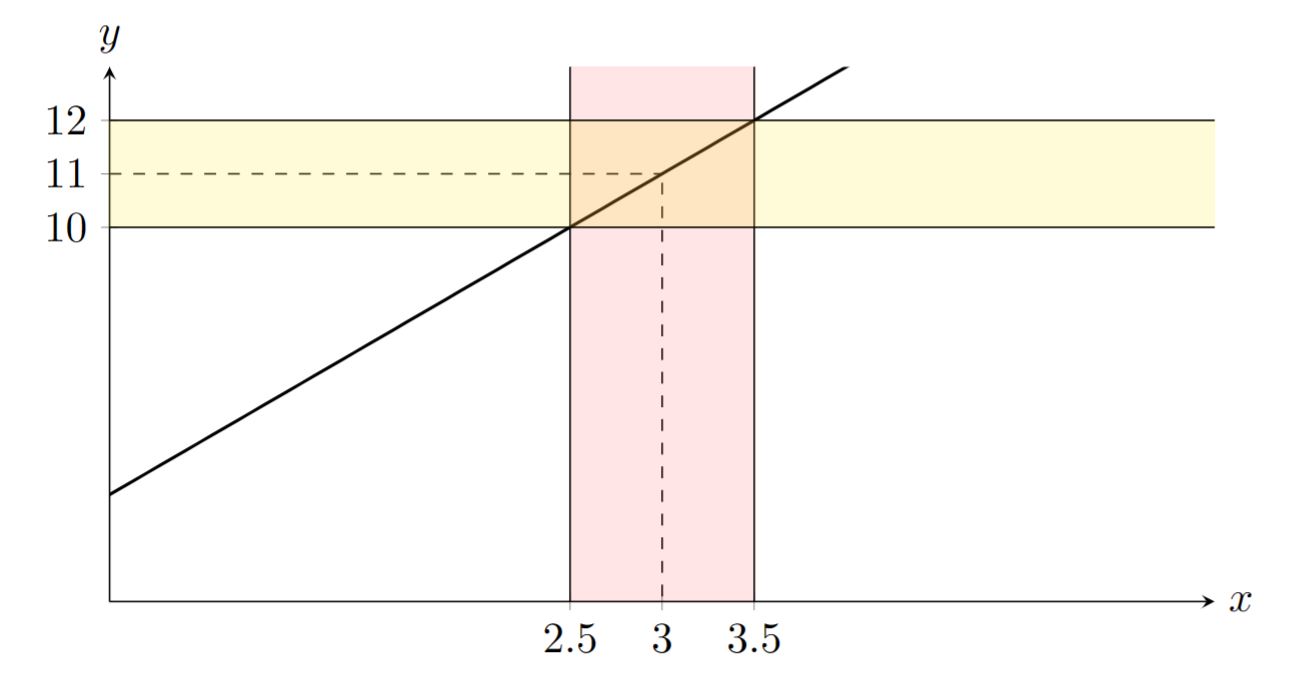
This graph shows us what we figured out algebraically: as long as $x$ is between $2.5$ and $3.5$ (within a distance of $\frac12$ of $3$), the $y$-values of $f(x) = 2x+5$ will be between $10$ and $12$ (within a distance of $1$ of $11$).
This is great, but we only showed how to find $\delta$ for one value of $\epsilon$, $\epsilon = 1$. The limit definition requires us to find a way to do this for every value of $\epsilon$. For $\epsilon = 1$, we narrowed down the value of the limit to be between $10$ and $12$. If we can do it for $\epsilon = 0.1$, then we can narrow down the value of the limit to be between $10.9$ and $11.1$. If we keep going and do it for every possible $\epsilon >0$, we'll narrow it down so that $11$ is the only possible value for the limit.
Fortunately, variables are our mathematical tool for handling many values at once. Let's figure out how to find $\delta$ any value for $\epsilon$, once again by starting with the desired inequality $|2x+5 - 11| \lt \epsilon$. The algebra will be very similar to what we already did. $$\begin{align*} |(2x+5) - 11| &\lt\epsilon\\ |2x-6| & \lt \epsilon \hspace{3em} \text{factor out the }2 \\ |2(x-3)| & \lt \epsilon \hspace{3em} \text{use } |ab| = |a||b|\\ |2||x-3| & \lt \epsilon \hspace{3em} \text{use } |2| = 2 \text{ and divide by } 2\\ |x-3| &\lt \frac\epsilon2 \end{align*}$$
This last inequality we may recognize as saying the distance between $x$ and $3$ is less than $\frac\epsilon2$. Since we are looking for a value for $\delta$ to compare the distance between $x$ and $3$ to, this is exactly what we are looking for. The right side of the inequality becomes our value for $\delta$, namely $\delta = \frac\epsilon2$.
So if we want $f(x)$ to be within $\epsilon = 0.1$ distance from $11$ (i.e., $f(x)$ between $10.9$ and $11.1$), then this will be true as long as $x$ is within $\delta = \frac{0.1}2 = 0.05$ distance from $3$ (i.e., $x$ is between $2.95$ and $3.05$).
We have now done all the work, and we could stop if the only thing we were looking for was a formula for finding $\delta$. But the problem asked us to prove$\lim\limits_{x\to3}(2x+5) = 11$. A proof is a formal mathematical argument to show something is true. We have all the information needed for the proof above, but we haven't organized it into a step-by-step proof yet. It's like doing the research for an essay without actually writing the essay.
Writing a proof well takes a lot of practice and experience, and teaching how to write proofs is not the focus of this text, but we can show at least one style of proof that you can become familiar with now and imitate for these kinds of problems.
Proof:Suppose $\epsilon > 0$ is given. Then we want to give a formula for $\delta$ so that if $0 \lt |x-3| \lt \delta$, then $|2x+5-11| \lt \epsilon$. Choose $\delta = \frac\epsilon2$. Then if $0 \lt |x-3| \lt \delta$, the following must be true. $$\begin{align*} |x-3| &\lt \frac\epsilon2 \\ 2|x-3| &\lt \epsilon \\ |2(x-3)| &\lt \epsilon \\ |2x-6| &\lt \epsilon \\ |2x + 5 - 11| &\lt\epsilon \end{align*}$$ Thus we showed that $|2x+5-11| \lt \epsilon$ when $\delta = \frac\epsilon2$, so by the definition of a limit, $\lim\limits_{x\to3}(2x+5) = 11 \blacksquare$.
Let's note a couple things about the proof structure. First, it began with the word "Proof" to indicate when the formal proof began, and it ended with $\blacksquare$ to indicate the proof was over. Next, we wrote down at the beginning what we wanted to show from the definition of a limit, and then we worked from assuming $x$ is close enough to $3$ and then showed that $f(x)=2x+5$ was close enough to $11$. Here, we essentially worked the inequality algebra backwards from our work before the proof.
Another thing to note is that we never needed to use $|x-3| > 0$. This is because $f(x) = 2x+5$ is continuous at $x = 3$, so we don't actually have to take advantage of the fact that the limit ignores what happens $x = 3$.
If you want to see more complex proofs, see the Proof Of Various Limit Properties section at the end of this chapter. For the purpose of this section, we will stick with the most straightforward proofs as a way of helping you get used to this proof structure and definition.
Let's try at least one more example before presenting some practice problems and moving on to the definitions of the other types of limits we've seen.
Use the precise definition of a limit to prove $\lim\limits_{x\to-4} (x+4)^2+1 = 1$.
This will be rather similar to the last problem, so it will go much faster. Once again, let's start by stating what we want to show is true by rewriting the definition of a limit for our specific case. We have $f(x) = (x+4)^2+1$, $a = -4$, and $L = 1$, so we want to show that we can find a $\delta>0$ for any $\epsilon > 0$ so that $|((x+4)^2+1)-1| \lt \epsilon$ whenever we $0 \lt |x-1| \lt \delta$. Let's start our inequality work from what we want, $|((x+4)^2+1) - 1| \lt \epsilon$, with the knowledge that want to end up at $|x-(-4)| \lt \delta$, or equivalently, $|x+4|\lt \delta$.
$$\begin{align*} |((x+4)^2+1)-1| &\lt \epsilon\\ |(x+4)^2| & \lt \epsilon \hspace{3em} \text{take a square root of both sides} \\ |x+4| & \lt \sqrt{\epsilon} \hspace{3em} \text{ } \\ \end{align*}$$And just like that, we are already at an expression that looks like $|x- (-4)| \lt \delta$, so we can choose $\delta = \sqrt{\epsilon}$.
For instance, if $\epsilon = 0.25$, then $\delta = \sqrt{0.25} = 0.5$. Let's graph that just to remind ourselves what this all means.

Here we can see that as long as $x$ is in the red region, between $-4.5$ and $-3.5$ (i.e., $x$ is within $\delta = 0.5$ distance of $-4$), we get that the output values of $f(x) = (x+4)^2+1$ are between $0.75$ and $1.25$ (i.e., $f(x)$ is within $\epsilon = 0.25$ distance of $1$).
Now we are ready to organize our work into a proof, again beginning stating "Proof", ending with $\blacksquare$, and starting from $0 \lt |x+4| \lt \delta$ to show that $|((x+4)^2+1)-1| \lt \epsilon$ for $\delta = \sqrt\epsilon$.
Proof: Suppose $\epsilon > 0$ is given. Then we want to give a formula for $\delta$ so that if $0 \lt |x+4| \lt \delta$, then $|(x+4)^2+1)-1| \lt \epsilon$. Choose $\delta = \sqrt{\epsilon}$. Then if $0 \lt |x+4| \lt \delta$, the following must be true. $$\begin{align*} |x+4| &\lt \sqrt{\epsilon}\\ |(x+4)^2| &\lt \epsilon \\ |(x+4)^2+1-1| &\lt \epsilon \\ \end{align*}$$ Thus $|(x+4)^2+1-1| \lt \epsilon$ when $\delta = \sqrt{\epsilon}$, so by the definition of a limit, $\lim\limits_{x\to4}((x+4)^2+1) = 1.\blacksquare$
Use the precise definition of a limit to prove $\lim\limits_{x\to-4} (x^2+x-11) = 9$.
Let's start by writing out the definition of a limit for this specific problem. We have $f(x) = x^2+x-11$, $a = 4$, and $L = 9$. So we want to show that for any $\epsilon > 0$, we can find a value for $\delta > 0$ so that $|(x^2+x-11)-9| \lt \epsilon$ whenever $0 \lt |x-4| \lt \delta$. So let's start from $|(x^2+x-11)-9| \lt \epsilon$ and see if we can work towards $|x-4| \lt \delta$ to try and find a value for $\delta$.
$$\begin{alignat*}{3} |(x^2+x-11)-9| &< \epsilon\\ |x^2+x-20| &< \epsilon \hspace{3em}&&\text{factor the quadratic}\\ |(x-4)(x+5)| &<\epsilon \end{alignat*}$$At this point, we might be tempted to divide by $|x+5|$ and get $\delta = \frac\epsilon{|x+5|}$, but then $\delta$ depends on $x$ rather than having a single value (based only on whatever value $\epsilon$ has). Instead, we're going to have to use a new technique to estimate roughly how big $|x+5|$ based on the fact that $x$ is getting close to $4$ in the limit. For example, suppose that $x$ is within a distance of $1$ from $x = 4$, then the numbers that are a distance $1$ away from $x = 4$ are $x = 3$ and $x = 5$, so we know that $3 \leq x \leq 5$. From this, we can then estimate what $x+5$ is between by adding $5$ to $3 \leq x \leq 5$ to get $8 \leq x+5 \leq 10$. If we use $x+5 = |x+5|$ (since $x+5$ is between $8$ and $10$, it is positive and equal to its own absolute value), then we get $|x+5| \lt 10$ and we can use this below to continue solving the inequalities for $|x-4|$.
$$\begin{alignat*}{3} |(x-4)(x+5)| &\lt\epsilon \hspace{3em}&&\text{replace } |x+5| \text{ with its biggest possible value} \\ 10|x-4| & \lt\epsilon &&\text{divide by } 10\\ |x-4| & \lt\dfrac\epsilon{10}\\ \end{alignat*}$$Thus we at last have $\delta = \frac\epsilon{10}$. But remember that we wanted $\delta \leq 1$ to guarantee that $|x+5| \leq 10$. We can do this by simply choosing $\delta$ to be the smaller value of $\frac\epsilon{10}$ and $1$ using the $\min$ function: $\delta = \min(1,\frac\epsilon{10})$. Now that we have a strategy for picking $\delta$ based on $\epsilon$, let's organize this work into a proof!
Proof: Let $\epsilon > 0$ be given. Then we want to describe a method for picking $\delta$ so that $|(x^2+x-11)-9| \lt \epsilon$ whenever $0 \lt |x-4| \lt \delta$. Choose $\delta = \min(1,\frac\epsilon{10})$. Since $\delta \leq 1$, if $0 \lt |x-4| \lt \delta$, it must be true that $-1 \lt x-4 \lt 1$, and hence $8 \lt x + 5 \lt 10$. In particular, since $x+5$ is positive (it is greater than $8$), $|x+5| = x+5 \lt 10$. Using all this, let's show $|(x^2+x-11)-9| \lt \epsilon$ by starting from $|x-4| \lt \delta$. Since $\delta \leq \frac\epsilon{10}$, we can write the following.
$$\begin{alignat*}{3} |x-4| &\lt\dfrac\epsilon{10} \hspace{3em} &&\text{multiply by } 10\\ 10|x-4| &\lt \epsilon &&\text{since } 10 \lt |x+5|\text{, replacing } 10 \text{ with }|x-4| \\ &&&\text{makes the left side smaller, so the inequality remains true} \\ |x+5||x-4| &\lt\epsilon &&\text{distribute the multiplication} \\ |x^2+x-20|&\lt\epsilon &&\text{split } -20 \text{ into } -11-9\\ |(x^2+x-11)-9| &\lt\epsilon \end{alignat*}$$Thus $|(x^2+x-11) -9| \lt \epsilon$ whenever $0 \lt |x-4| \lt \delta$, so by the definition of a limit, $\lim\limits_{x\to4}(x^2+x-11) = 9 \blacksquare$.
One-Sided Limits
Next, let's give the precise definitions for one-sided limits.
Precise Definition of a One-Sided Limit
Right-Sided Limits: We say $\lim\limits_{x\to a^+}f(x) = L$ if for every real number $\epsilon > 0$, there is a real number $\delta > 0$ so that $|f(x)-L| \lt \epsilon$ whenever $0 \lt x-a \lt \delta$ (equivalently, whenever $a \lt x \lt a+ \delta$).
Left-Sided Limits: We say $\lim\limits_{x\to a^-}f(x) = L$ if for every real number $\epsilon > 0$, there is a real number $\delta > 0$ so that $|f(x)-L| \lt \epsilon$ whenever $0 \lt a-x \lt \delta$ (equivalently, whenever $a - \delta \lt x \lt a$).
You may notice that these are nearly identical the first definition of a limit we saw in this section, with one difference each. Instead of $0 \lt |x-a| \lt \delta$, we want to require $x$ to be on a specific side of $a$. If $x - a > 0$, then $x > a$, hence $x$ is on the right side of $a$. If $a - x > 0$, then $a > x$, and hence $x$ is on the left side of $a$.
Let's do an example of one of these, and notice how similar it is to the limits we just did.
Use the definition of a one-sided limit to prove $\lim\limits_{x\to0^+}\sqrt{x} = 0$.
Once again, let's rewrite the definition of the limit for our specific situation: $f(x) = \sqrt{x}$, $a = 0$, and $L = 0$. Then for any $\epsilon > 0$, we want to find a $\delta > 0$ so that $|\sqrt{x} - 0| \lt \epsilon$ whenever $0 \lt x - 0 \lt \delta$. We'll start with the $|\sqrt{x} - 0| \lt \epsilon$ and work backwards towards $0 \lt x - 0 \lt \delta$.
$$\begin{alignat*}{3} |\sqrt{x} - 0| &\lt \epsilon \hspace{3em} &&\text{since } \sqrt{x} > 0 \text{, eliminate the absolute value} \\ \sqrt{x} & \lt \epsilon \hspace{3em}&&\text{square both sides}\\ x &\lt\epsilon^2 \hspace{3em} &&\text{rewrite } x \text{ as } x - 0\\ x - 0 &\lt \epsilon^2 \end{alignat*}$$So it looks like we can choose $\delta = \epsilon^2$. Note that we will also need the assumption that $x > 0$ when we take the square root of both sides. After all, $\sqrt{x}$ is only defined for positive values of $x$. Now let's organize our work into a proof.
Proof: Suppose $\epsilon > 0$ is given. Then we want to give a formula for $\delta$ so that if $0 \lt x - 0 \lt \delta$, then $|\sqrt{x}-0| \lt \epsilon$. Choose $\delta = \epsilon^2$. Then if $0 \lt x - 0 \lt \delta$, the following must be true. $$\begin{alignat*}{3} x - 0 &\lt \epsilon^2 \\ x &\lt \epsilon^2 \hspace{3em} &&\text{ square root both sides, possible since } x > 0\\ \sqrt{x} &\lt \epsilon \hspace{3em} &&\text{ since } \sqrt{x} > 0, \sqrt{x} = |\sqrt{x}| \text{, and rewrite } \sqrt{x} \text{ as } \sqrt{x} - 0\\ |\sqrt{x} - 0| &\lt \epsilon \\ \end{alignat*}$$ Thus, by the definition of a one-sided limit, $\lim\limits_{x\to0^+}\sqrt{x} = 0\blacksquare$.
Infinite Limits
Let's now move onto the definition of infinite limits. Here are the two definitions that we need to cover both possibilities, limits that are positive infinity and limits that are negative infinity.
We say $\lim\limits_{x\to a}f(x) = \infty$ if for every real number $N > 0$, there is a real number $\delta > 0$ so that $f(x) > N$ whenever $0 \lt |x-a| \lt \delta$.
We say $\lim\limits_{x\to a}f(x) = -\infty$ if for every real number $N \lt 0$, there is a real number $\delta > 0$ so that $f(x) \lt N$ whenever $0 \lt |x-a| \lt \delta$.
Notice here the primary thing that has changed. Since the value of $f(x)$ is going to $\infty$ or $-\infty$ in the limit, we can't use the same distance formula that we used before. It would be meaningless to try and measure $|f(x) - \infty|$ for example. Instead, this definition tells us that the value of the limit is $\infty$ if $f(x)$ can be made larger any positive number $N$ provided $x$ is close enough to $a$ (but not equal to $a$). The larger $N$ is, the closer $x$ is going to going to need to be to $a$.
Likewise for the limit to have a value of $-\infty$, $f(x)$ needs to be able to be made smaller (i.e., more negative) than every negative number for $x$ close enough to $a$.
Here's a quick sketch showing an example where $\lim\limits_{x\to a}f(x) = \infty$, with a sample value of $y = N$ graphed, as well as the range of $x$ values close enough to $a$ for $f(x)$ to be bigger than $N$.

Like with our first precise definition of a limit, requiring $|x-a| > 0$ is the same as requiring that $x \not = a$. While this is relevant for all limits we've defined in this section, it's especially relevant here, since quite often $f(x)$ will not even be defined at $x = a$ when it has an infinite limit at $x = a$.
Let's do an example to show how this definition can be used in a proof.
Use the definition of an infinite limit to prove $\lim\limits_{x\to1}\dfrac{-4}{(x-1)^2} = -\infty$.
As before, let's write out the definition of the limit for our specific situation. We have $f(x) = \frac{-4}{(x-1)^2}$, $a = 1$, and the limit is going to $-\infty$, so we'll compare $f(x)$ to negative numbers $N$. Then we want to show that for any $N \lt 0$, we can find a $\delta$ so that $\frac{-4}{(x-1)^2} \lt N$ whenever $0 \lt |x-1| \lt \delta$. As usual, we start from the condition on $f(x)$ and work backwards to the condition on $x$, so let's start with $\frac{-4}{(x-1)^2} \lt N$. \begin{alignat*}{3} \dfrac{-4}{(x-1)^2} &\lt N \hspace{3em} &&\text{multiply by }(x-1)^2 \text{, which is positive, and divide by } N \text{, } \\[-1em] & \phantom{{}\ltN} \hspace{3em} &&\text{which is negative and hence flips the inequality} \\ \dfrac{-4}{N} &> (x-1)^2 \hspace{3em}&&\text{flip the inequality left-to-right and take a square root}\\ \sqrt{(x-1)^2} &\lt \sqrt{\dfrac{-4}N} \hspace{3em} &&\text{simplify with } \sqrt{(x-1)^2} = |x-1| \\ |x-1| &\lt \sqrt{\dfrac{-4}N} \end{alignat*}
Thus as long as $|x-1| \lt \sqrt{\frac{-4}N}$ (and $x\not 1$ so that $f(x)$ avoids division by $0$), we know $\frac{-4}{(x-1)^2}$ will be smaller (i.e., more negative) than $N$.
Now let's organize this into a proper proof!
Proof: Let $N > 0$ be given. Then we want to find a formula for $\delta$ so that $\frac{-4}{(x-1)^2} \lt N$ whenever $0 \lt |x-1| \lt \delta$. Choose $\delta = \sqrt{\frac{-4}N}$. Then if $0 \lt |x-1| \lt \delta$, the following must also be true. $$\begin{alignat*}{3} |x-1| &\lt \sqrt{\dfrac{-4}N} \hspace{3em}&&\text{simplify with } \sqrt{(x-1)^2} = |x-1| \\ \sqrt{(x-1)^2} &\lt \sqrt{\dfrac{-4}N} \hspace{3em}&&\text{flip the inequality left-to-right and take a square root}\\ \dfrac{-4}{N} &> (x-1)^2 \hspace{3em} &&\text{divide by }(x-1)^2 \text{, which is positive, and multiply by } N \text{, } \\[-1em] & \phantom{{}\ltN} \hspace{3em} &&\text{which is negative and hence flips the inequality} \\ \dfrac{-4}{(x-1)^2} &\lt N \\ \end{alignat*}$$
Thus $\lim\limits_{x\to1}\dfrac{-4}{(x-1)^2} = -\infty \blacksquare$.
For our next set of limit definitions let's take a look at the two definitions for limits at infinity. Again, we need one for a limit at plus infinity and another for negative infinity.
We say $\lim\limits_{x\to \infty}f(x) = L$ if for every real number $\epsilon > 0$, there is a real number $M > 0$ so that $|f(x)-L| \lt \epsilon$ whenever $x > M$.
We say $\lim\limits_{x\to -\infty}f(x) = L$ if for every real number $\epsilon > 0$, there is a real number $M \lt 0$ so that $|f(x)-L| \lt \epsilon$ whenever $x \lt M$,
Notice that we are back to checking if the distance between $f(x)$ and $L$ is smaller than $\epsilon$, but since $x$ is going to $\infty$ (or $-\infty$), we are now requiring $x$ to be large enough (or small enough) by comparing it to a positive (or negative) number $M$, in much the same way that $f(x)$ was compared to $N$ when the value of the limit went to $\infty$ or $-\infty$.
Here is a quick sketch showing an example of $f(x)$ within a distance $\epsilon$ of $L$ for $x$ larger than $M$.

Finally, note that the smaller we make epsilon the larger we'll probably need to make M .
Here's an example of one of these limits.
Use definition of a limit at infinity to prove $\lim\limits_{x\to\infty}\dfrac{2}{5+x} = 0$.
As always, let's start by writing out the definition of the limit for this specific problem. We have $f(x) = \frac{2}{5+x}$, $L = 0$, and $x$ is going to $\infty$ so we'll compare $x$ to positive numbers $M$. We want to show that for any $\epsilon > 0$, we can find a large positive number $M$ so that $|\frac2{5+x} - 0| \lt \epsilon$ for $x > M$. So let's start from $|\frac2{5+x} - 0| \lt \epsilon$ and work towards $x > M$ to find a formula for $M$. One thing we'll use in this work is that we'll be eventually assuming $x > M$ and $M > 0$, so $x$ is positive and hence $|5+x| = 5+x$. $$\begin{alignat*}{3} |\dfrac2{5+x}-0| &\lt \epsilon && \text{simplify the left side}\\ \dfrac{2}{|5+x|} &\lt \epsilon &&\text{multiply by } |5+x| \text{ and divide by }\epsilon\\ \dfrac{2}{\epsilon} &\lt |5+x| \hspace{3em} &&\text{use } |5+x| = 5+x\\ \dfrac{2}{\epsilon} &\lt 5+x \hspace{3em} &&\text{subtract } 5 \text{ and flip the inequality left-to-right}\\ x & > \dfrac{2}{\epsilon} - 5 \end{alignat*}$$ $$Thus it looks like our value for $M$ will be $M = \frac2\epsilon - 5$. There is a very small complication here though, as this definition of a limit requires $M$ to be positive, and we have no guarantee that $\frac2\epsilon - 5$ is a positive number unless $\epsilon$ is small enough. But there is an easy fix: require that $M$ has to be at least as big as $1$ (any positive number will do, we are using $1$ for simplicity), which we can do formally with the "max" function. So we're going to choose $M = \max(1,\frac2\epsilon - 5)$, which will guarantee two things: $M \geq 1$ (and hence $M > 0$) and $M \geq \frac2\epsilon-5$.
And now we are ready to organize this work into a proof.
Proof: Let $\epsilon > 0$ be given. Then we want to find a positive value for $M$ so that $|\frac2{5+x} - 0| \lt \epsilon$ whenever $x > M$. Choose $M = \max(1,\frac2\epsilon - 5)$. Then $M > 0$ since $M \geq 1$ and $M \geq \frac2\epsilon - 5$, so if $x > M$, it must also be true that $x > 0$ and $x > \frac2\epsilon -5$. The following must also therefore be true.
$$\begin{alignat*}{3} x & > \dfrac{2}{\epsilon} - 5 \hspace{3em}&&\text{add } 5 \text{ and flip the inequality left-to-right}\\ \dfrac{2}{\epsilon} &\lt 5+x &&\text{use } 5+x = |5+x| \\ \dfrac{2}{\epsilon} &\lt |5+x| &&\text{divide by } |5+x| \text{ and multiply by } \epsilon \\ \dfrac{2}{|5+x|} &\lt \epsilon &&\text{bring the } 2 \text{ inside the absolute value and subtract } 0\\ |\dfrac2{5+x}-0| &\lt \epsilon \end{alignat*}$$Thus $\lim\limits_{x\to\infty}\dfrac2{5+x} = 0~\blacksquare$.
Whew, almost done with precise definitions of limits! The last types of limits we to define are infinite limits at infinity, and there isn't really much new here, just combining what we saw about infinity from the definitions of infinite limits and limits at infinity.
We say $\lim\limits_{x\to \infty}f(x) = \infty$ if for every real number $N > 0$, there is a real number $M > 0$ so that $f(x) > N$ whenever $x > M$.
We say $\lim\limits_{x\to \infty}f(x) = -\infty$ if for every real number $N \lt 0$, there is a real number $M > 0$ so that $f(x) \lt N$ whenever $x > M$.
We say $\lim\limits_{x\to -\infty}f(x) = \infty$ if for every real number $N > 0$, there is a real number $M \lt 0$ so that $f(x) > N$ whenever $x \lt M$.
We say $\lim\limits_{x\to -\infty}f(x) = -\infty$ if for every real number $N \lt 0$, there is a real number $M \lt 0$ so that $f(x) \lt N$ whenever $x \lt M$.
Let's finish up this section with one last example.
Use definition of a limit at infinity to prove $\lim\limits_{x\to-\infty}4-3x = \infty$.
As always, let's write out the definition of the limit for the values of this problem. We have $f(x) = 4-3x$, the value of the limit going to $\infty$ so we'll compare $f(x)$ with positive numbers $N$, and $x$ going to $-\infty$ so we'll compare $x$ to negative numbers $M$. Thus we want to show that for any $N > 0$, we can find a large negative number $M$ so that $4-3x > N$ for $x \lt M$. So let's start from $4-3x > N$ and work towards $x > M$ to find a formula for $M$.
$$\begin{alignat*}{3} 4-3x &> N && \text{subtract 4}\\ -3x &> N-4 \hspace{3em} && \text{divide by } -3 \text{, which will flip the inequality direction}\\ x &< \dfrac{N-4}{-3} \end{alignat*}$$Thus it looks like our value for $M$ will be $M = \frac{N-4}{-3}$. Once again, there is a small complication with making sure that $M$ is negative. This time, since we want $M$ to be negative, let's pick $M = \min(\frac{N-4}{-3},-1)$. Then we know two things are true: $M \leq -1$ and $M \leq \frac{N-4}{-3}$.
Let's organize this work into a proof.
Proof: Let $N > 0$ be given. We want to find a negative value for $M$ so that $4-3x > N$ whenever $x \lt M$. Choose $M = \min(\frac{N-4}{-3},-1)$, then we know that $M \lt 0$ (since $M \leq -1$) and $M \leq \frac{N-4}{-3}$. Therefore, if $x \lt M$, the following must also be true.\lt/p\gt $$\begin{alignat*}{3} x &\lt \dfrac{N-4}{-3} \hspace{3em} &&\text{multiply by } -3 \text{, which will flip the inequality direction}\\ -3x &\gt N-4 &&\text{add 4 to both sides}\\ 4-3x &\gt N \end{alignat*}$$
Thus $\lim\limits_{x\to-\infty}4-3x = \infty~\blacksquare$.
Practice Problems
Use the definition of the limit to prove the following limits.
- $\lim\limits_{x\to 3}x = 3$
- $\lim\limits_{x\to -1}(x+7) = 6$
- $\lim\limits_{x\to 2}x^2 = 4$
- $\lim\limits_{x\to -3}(x^2+4x+1) = -2$
- $\lim\limits_{x\to1}\frac{1}{(x-1)^2}=\infty$
- $\lim\limits_{x\to 0^-}\frac{1}{x}=-\infty$
- $\lim\limits_{x\to \infty}\frac{1}{x^2}=0$
First, let’s just write out what we need to show.
Let $\epsilon \gt 0$ be any number. We need to find a number $\delta \gt 0$ so that, $$|x-3|\lt \epsilon~~~~~\text{whenever}~~~~~ 0\lt |x-3| \lt \delta.$$
This problem can look a little tricky since the two inequalities both involve $|x-3|$. Just keep in mind that the first one is really $|f(x)-L| \lt \epsilon$ where $f(x) = x$ and $L = 3$ and the second is really $0 \lt |x-a| \lt \delta$ where $a = 3$.
In this case, despite the “trickiness” of the statement we need to prove in Step 1, this is really a very simple problem.
We need to determine a $\delta$ that will allow us to prove the statement in Step 1. However, because both inequalities involve exactly the same absolute value statement so all we need to do is choose $\delta = \epsilon$.
So, let’s see if this works.
Start off by first assuming that $\epsilon \gt 0$ is any number and choose $\delta = \epsilon$. We can now assume that $$0 < \left| {x - 3} \right| < \delta = \varepsilon \hspace{0.25in} \Rightarrow \hspace{0.5in}0 < \left| {x - 3} \right| < \varepsilon.$$
However, if we just look at the right portion of the double inequality we see that this assumption tells us that, $$|x-3|\lt \epsilon$$ which is exactly what we needed to show given our choice of $\delta$.
Therefore, according to the definition of the limit we have just proved that, $$\lim\limits_{x\to3}x = 3.$$
First, let’s just write out what we need to show.
Let $\epsilon \gt 0$ be any number. We need to find a number $\delta \gt 0$ so that, $$|(x+7)-6|\lt \epsilon~~~~~\text{whenever}~~~~~ 0\lt |x-(-1)| \lt \delta.$$
With a little simplification, this becomes, $$|x+1|\lt \epsilon~~~~~\text{whenever}~~~~~ 0\lt |x+1| \lt \delta.$$
This problem is very similar to Problem 1 from this point on.
We need to determine a $\delta$ that will allow us to prove the statement in Step 1. However, because both inequalities involve exactly the same absolute value statement all we need to do is choose $\delta=\epsilon$.
So, let’s see if this works.
Start off by first assuming that $\epsilon \gt 0$ is any number and choose $\delta = \epsilon$. We can now assume that $$0 < \left| {x - (-1)} \right| < \delta = \varepsilon \hspace{0.25in} \Rightarrow \hspace{0.5in}0 < \left| {x +1} \right| < \varepsilon.$$
This gives, $$\begin{align*}\left| {\left( {x + 7} \right) - 6} \right| & = \left| {x + 1} \right| & & \hspace{0.25in}{\mbox{simplify things up a little}}\\ & < \varepsilon & & \hspace{0.25in}{\mbox{using the information we got by assuming }}\delta = \varepsilon \end{align*}.$$
So, we’ve shown that, $$\left| {\left( {x + 7} \right) - 6} \right| < \varepsilon \hspace{0.5in}{\mbox{whenever}}\hspace{0.5in}0 < \left| {x - \left( { - 1} \right)} \right| < \varepsilon.$$
Therefore, according to the definition of the limit we have just proved that, $$\lim\limits_{x\to-1}(x+7) = 6.$$
First, let’s just write out what we need to show.
Let $\epsilon \gt 0$ be any number. We need to find a number $\delta \gt 0$ so that, $$|x^2-4|\lt \epsilon~~~~~\text{whenever}~~~~~ 0\lt |x-2| \lt \delta.$$
Let’s start with a little simplification of the first inequality. $$\left| {{x^2} - 4} \right| = \left| {\left( {x + 2} \right)\left( {x - 2} \right)} \right| = \left| {x + 2} \right|\left| {x - 2} \right| < \varepsilon.$$
We have the $|x-2| we expect to see, but we also have an $|x+2| that we'll need to deal with.
Let's first assume that $$|x-2|\lt 1.$$
As we noted in a similar example in the notes for this section this is a legitimate assumption because the limit is $x\to 2$ and so $x$’s will be getting very close to $2$. Therefore, provided $x$ is close enough to $2$ we will have $|x-2|\lt 1$.
Starting with this assumption we get that, $$- 1 < x - 2 < 1\hspace{0.25in} \to \hspace{0.25in}\,\,1 < x < 3.$$ If we now add $2$ to all parts of this inequality we get, $$3 \lt x + 2 \lt 5.$$
Noticing that $3 \gt 0$, we can see that we then also know that $x+2 \gt 0$ and so provided $|x-2|\lt 1$, we will have $x+2 = |x+2|.$
All this means is that, provided $|x-2| \lt 1$, we will also have, $$\left| {x + 2} \right| = x + 2 < 5\hspace{0.5in} \to \hspace{0.5in}\left| {x + 2} \right| < 5.$$
This in turn means that we have, $$\left| {x + 2} \right|\left| {x - 2} \right| < 5\left| {x - 2} \right|\hspace{0.25in}\,\,\,\,\,\,{\mbox{because }}\left| {x + 2} \right| < 5.$$
Therefore, if we were to further assume, for some reason, that we wanted $5|x-2|\lt \epsilon$, this would tell us that, $$|x-2|\lt \frac{\epsilon}{5}.$$
Okay, even though it doesn’t seem like it we actually have enough to make a choice for $\delta$.
Given any number $\epsilon \gt 0$, let's choose, $$\delta = \min\{1, \frac{\epsilon}{5}\}.$$
Again, this means that $\delta$will be the smaller of the two values which in turn means that, $$\delta \le 1\hspace{0.5in}{\mbox{AND}}\hspace{0.5in}\delta \le \frac{\varepsilon }{5}.$$
Now assume that $0 < \left| {x - 2} \right| < \delta = \min \left\{ {1,\frac{\varepsilon }{5}} \right\}.$
So, let's see if this works.
Given the assumption $0 \lt |x-2| \lt \delta = \min\{1, \frac{\epsilon}{5}\}$ we know two things. First, we know that $|x-2| \lt \frac{\epsilon}{5}$. Second, we also know that $|x-2| \lt 1$ which in turn implies that $|x+2| \lt 5$ as we saw in Step 3.
Now, let's do the following, $$\begin{align*}\left| {{x^2} - 4} \right| & = \left| {x + 2} \right|\left| {x - 2} \right| & & \hspace{0.25in}{\mbox{factoring}}\\ & < 5\left| {x - 2} \right| & & \hspace{0.2in}\,{\mbox{because we know }}\left| {x + 2} \right| < 5\\ & < 5\left( {\frac{\varepsilon }{5}} \right) & & \hspace{0.25in}\,{\mbox{because we know }}\left| {x - 2} \right| < \frac{\varepsilon }{5}\\ & = \varepsilon & & \end{align*}.$$
So, we've shown that, $$\left| {{x^2} - 4} \right| < \varepsilon \hspace{0.5in}{\mbox{whenever}}\hspace{0.5in}0 < \left| {x - 2} \right| < \min \left\{ {1,\frac{\varepsilon }{5}} \right\}.$$
Therefore by the definition of the limit we have proved that $\lim\limits_{x\to 2}x^2 = 4$.
First, let’s just write out what we need to show.
Let $\epsilon \gt 0$ be any number. We need to find a number $\delta \gt 0$ so that, $$|x^2=4x+1-(-2)|\lt \epsilon~~~~~\text{whenever}~~~~~ 0\lt |x-(-3)| \lt \delta.$$
Simplify8ing this a little gives, $$\left| {{x^2} + 4x + 3} \right| < \varepsilon \hspace{0.5in}{\mbox{whenever}}\hspace{0.5in}0 < \left| {x + 3} \right| < \delta.$$
Let’s start with a little simplification of the first inequality. $$\left| {{x^2} + 4x + 3} \right| = \left| {\left( {x + 1} \right)\left( {x + 3} \right)} \right| = \left| {x + 1} \right|\left| {x + 3} \right| < \varepsilon.$$
We have the $|x+3| we expect to see, but we also have an $|x+1| that we'll need to deal with.
Let's first assume that $$|x+3|\lt 1.$$
As we noted in a similar example in the notes for this section this is a legitimate assumption because the limit is $x\to -3$ and so $x$’s will be getting very close to $-3$. Therefore, provided $x$ is close enough to $2$ we will have $|x+3|\lt 1$.
Starting with this assumption we get that, $$- 1 < x +3 < 1\hspace{0.25in} \to \hspace{0.25in}\,\,-4 < x < -2.$$ If we now add $1$ to all parts of this inequality we get, $$-3 \lt x + 2 \lt -1.$$
Noticing that $-1 \lt 0 0$, we can see that we then also know that $x+1 \lt 0$ and so provided $|x+3|\lt 1$, we will have $x+1 = (-x+1)$. Also, from the inequality above we see that, $$1 \lt -(x+1) \lt 3.$$
All this means is that, provided $|x+3| \lt 1$, we will also have, $$\left| {x + 1} \right| = - \left( {x + 1} \right) < 3\hspace{0.5in} \to \hspace{0.5in}\left| {x + 1} \right| < 3.$$
This in turn means that we have, $$\left| {x + 1} \right|\left| {x + 3} \right| < 3\left| {x + 3} \right|\hspace{0.25in}\,\,\,\,\,\,{\mbox{because }}\left| {x + 1} \right| < 3.$$
Therefore, if we were to further assume, for some reason, that we wanted $3|x+3|\lt \epsilon$, this would tell us that, $$|x+3|\lt \frac{\epsilon}{3}.$$
Okay, even though it doesn’t seem like it we actually have enough to make a choice for $\delta$.
Given any number $\epsilon \gt 0$, let's choose, $$\delta = \min\{1, \frac{\epsilon}{3}\}.$$
Again, this means that $\delta$will be the smaller of the two values which in turn means that, $$\delta \le 1\hspace{0.5in}{\mbox{AND}}\hspace{0.5in}\delta \le \frac{\varepsilon }{3}.$$
Now assume that $0 < \left| {x +3} \right| < \delta = \min \left\{ {1,\frac{\varepsilon }{3}} \right\}.$
So, let's see if this works.
Given the assumption $0 \lt |x+3| \lt \delta = \min\{1, \frac{\epsilon}{3}\}$ we know two things. First, we know that $|x+3| \lt \frac{\epsilon}{3}$. Second, we also know that $|x+3| \lt 1$ which in turn implies that $|x+1| \lt 3$ as we saw in Step 3.
Now, let's do the following, $$\begin{align*}\left| {{x^2} + 4x + 3} \right| & = \left| {x + 1} \right|\left| {x + 3} \right| & & \hspace{0.25in}{\mbox{factoring}}\\ & < 3\left| {x + 3} \right| & & \hspace{0.25in}{\mbox{because we know }}\left| {x + 1} \right| < 3\\ & < 3\left( {\frac{\varepsilon }{3}} \right) & & \hspace{0.25in}\,{\mbox{because we know }}\left| {x + 3} \right| < \frac{\varepsilon }{3}\\ & = \varepsilon & & \end{align*}.$$
So, we've shown that, $$\left| {{x^2} + 4x + 3} \right| < \varepsilon \hspace{0.5in}{\mbox{whenever}}\hspace{0.5in}0 < \left| {x + 3} \right| < \min \left\{ {1,\frac{\varepsilon }{3}} \right\}.$$
Therefore by the definition of the limit we have proved that $\lim\limits_{x\to -3}(x^2+4x+1) = -2$.
First, let’s just write out what we need to show.
Let $M \gt 0$ be any number. We need to find a number $\delta \gt 0$ so that, $$\frac{1}{{{{\left( {x - 1} \right)}^2}}} > M\hspace{0.5in}{\mbox{whenever}}\hspace{0.5in}0 < \left| {x - 1} \right| < \delta.$$
Let’s do a little rewrite the first inequality above a little bit.
$$\frac{1}{{{{\left( {x - 1} \right)}^2}}} > M\hspace{0.25in}\,\, \to \hspace{0.25in}\,\,\,\,\,{\left( {x - 1} \right)^2} < \frac{1}{M}\hspace{0.25in}\,\,\,\,\,\,\, \to \hspace{0.25in}\,\,\,\,\left| {x - 1} \right| < \frac{1}{{\sqrt M }}$$From this it looks like we can choose $\delta = \frac{1}{\sqrt{M}}$.
So, let’s see if this works.
We'll start by assuming that $M\gt 0$ is any nubmer and choose $\delta = \frac{1}{\sqrt{M}}$. We can now assume that, $$0 < \left| {x - 1} \right| < \delta = \frac{1}{{\sqrt M }}\hspace{0.5in} \Rightarrow \hspace{0.5in}0 < \left| {x - 1} \right| < \frac{1}{{\sqrt M }}.$$
So, if we start with the second inequality we get, $$\begin{align*}\left| {x - 1} \right| & < \frac{1}{{\sqrt M }} & & \\ & {\left| {x - 1} \right|^2} < \frac{1}{M} & & \hspace{0.25in}{\mbox{squaring both sides}}\\ & {\left( {x - 1} \right)^2} < \frac{1}{M} & & \hspace{0.25in}\,\,{\mbox{because }}{\left| {x - 1} \right|^2} = {\left( {x - 1} \right)^2}\\ & \frac{1}{{{{\left( {x - 1} \right)}^2}}} > M & & \hspace{0.25in}{\mbox{ rewriting things a little bit}}\end{align*}.$$
So we've shown that $$\frac{1}{{{{\left( {x - 1} \right)}^2}}} > M\hspace{0.5in}{\mbox{whenever}}\hspace{0.5in}0 < \left| {x - 1} \right| < \delta$$ and so by the definition of the limit, we have just proved that $\lim\limits_{x\to 1}\frac{1}{(x-1)^2} = \infty$.
First, let’s just write out what we need to show.
Let $N \lt 0$ be any number. Remember that because our limit is going to negative infinity here we need $N$ to be negative. Now, we need to find a number $\delta \gt 0$ so that, $$\frac{1}{x} < N\hspace{0.5in}{\mbox{whenever}}\hspace{0.5in} - \delta < x - 0 < 0.$$
Let’s do a little rewrite on the first inequality above to get, $$\frac{1}{x} < N\hspace{0.25in}\,\, \to \hspace{0.25in}\,\,\,\,\,x > \frac{1}{N}.$$
Now, keep in mind that $N$ is negative and so $\frac{1}{N}$ is also negative. From this it looks like we can choose $\delta = -\frac{1}{N}$. Again, because $N$ is negative this makes $\delta$ positive, which we need!
So, let’s see if this works.
We’ll start by assuming that $N \lt 0$ is any number and chose $\delta = -\frac{1}{N}$. We can now assume that, $$- \delta < x - 0 < 0\hspace{0.5in} \Rightarrow \hspace{0.5in}\frac{1}{N} < x < 0.$$
So, if we start with the second inequality we get, $$\begin{align*}x & > \frac{1}{N} & & \\ & \frac{1}{x} < N & & \hspace{0.25in}{\mbox{ rewriting things a little bit}}\end{align*}.$$
So, we’ve shown that, $$\frac{1}{x} < N\hspace{0.5in}{\mbox{whenever}}\hspace{0.5in}\frac{1}{N} < x < 0$$ and so by the definition of the limit we have just proved that, $\lim\limits_{x\to 0^-}\frac{1}{x}=-\infty$.
First, let’s just write out what we need to show.$
Let $\epsilon\gt 0$ be any number. We need to find a number $M \gt 0$ so that, $$\left| {\frac{1}{{{x^2}}} - 0} \right| < \varepsilon \hspace{0.5in}{\mbox{whenever}}\hspace{0.5in}x > M.$$
Or, with a little simplification this becomes, $$\left| {\frac{1}{{{x^2}}}} \right| < \varepsilon \hspace{0.5in}{\mbox{whenever}}\hspace{0.5in}x > M.$$
Let’s start with the inequality on the left and do a little rewriting on it. $$\left| {\frac{1}{{{x^2}}}} \right| < \varepsilon \hspace{0.25in} \to \hspace{0.25in}\frac{1}{{{{\left| x \right|}^2}}} < \varepsilon \hspace{0.25in}\, \to \hspace{0.25in}{\left| x \right|^2} > \frac{1}{\varepsilon }\hspace{0.25in} \to \hspace{0.25in}\,\left| x \right| > \frac{1}{{\sqrt \varepsilon }}.$$
From this it looks like we can choose $M = \frac{1}{\sqrt{\epsilon}}$.
So, let’s see if this works.
Start off by first assuming that $\epsilon \gt 0$ is any number and choose $M = \frac{1}{\sqrt{\epsilon}}$. We can now assume that, $$x\gt \frac{1}{\sqrt{\epsilon}}.$$
Starting with this inequality we get, $$\begin{align*}x & > \frac{1}{{\sqrt \varepsilon }} & & \\ & \frac{1}{x} < \sqrt \varepsilon & & \hspace{0.25in}{\mbox{do a little rewrite}}\\ & \frac{1}{{{x^2}}} < \varepsilon & & \hspace{0.25in}{\mbox{square both sides}}\\ & \left| {\frac{1}{{{x^2}}}} \right| < \varepsilon & & \hspace{0.25in}{\mbox{because }}\frac{1}{{{x^2}}} = \left| {\frac{1}{{{x^2}}}} \right|\end{align*}.$$
So, we’ve shown that, $$\left| {\frac{1}{{{x^2}}} - 0} \right| < \varepsilon \hspace{0.5in}{\mbox{whenever}}\hspace{0.5in}x > M$$ and so by the definition of the limit we have just proved that $\lim\limits_{x\to \infty}\frac{1}{x^2}=0$.
Assignment Problems
Use the definition of the limit to prove the following limits.
- $\mathop {\lim }\limits_{x \to - 4} \left( {2x} \right) = - 8$
- $\mathop {\lim }\limits_{x \to 1} \left( { - 7x} \right) = - 7$
- $\mathop {\lim }\limits_{x \to 3} \left( {2x + 8} \right) = 14$
- $\mathop {\lim }\limits_{x \to 2} \left( {5 - x} \right) = 3$
- $\mathop {\lim }\limits_{x \to \,\, - 2} {x^2} = 4$
- $\mathop {\lim }\limits_{x \to \,\,4} {x^2} = 16$
- $\mathop {\lim }\limits_{x \to 1} \left( {{x^2} + x + 6} \right) = 8$
- $\mathop {\lim }\limits_{x \to - 2} \left( {{x^2} + 3x - 1} \right) = - 3$
- $\mathop {\lim }\limits_{x \to \,1} {x^4} = 1$
- $\displaystyle \mathop {\lim }\limits_{x \to - 6} \frac{1}{{{{\left( {x + 6} \right)}^2}}} = \infty$
- $\displaystyle \mathop {\lim }\limits_{x \to 0} \frac{{ - 3}}{{{x^2}}} = - \infty$
- $\displaystyle \mathop {\lim }\limits_{x \to {0^ + }} \frac{1}{x} = \infty$
- $\displaystyle \mathop {\lim }\limits_{x \to {1^ - }} \frac{1}{{x - 1}} = - \infty$
- $\displaystyle \mathop {\lim }\limits_{x \to - \infty } \frac{1}{{{x^2}}} = 0$
- $\displaystyle \mathop {\lim }\limits_{x \to \infty } \frac{1}{{{x^3}}} = 0$