Related Rates
Click here for a printable version of this page.Introduction
In this section we are going to look at an application of implicit differentiation. Most of the applications of derivatives are in the next chapter, however there are a couple of reasons for placing these problems in this chapter as opposed to grouping them with the other applications.
The first reason is that a related rates problem is an application of implicit differentiation, which we just learned in the last section. Practicing implicit differentiation now in the context of some applied problems will help us cement the technique in our memories. The other reason is simply that after doing all these derivatives for their own sake, we should remind ourselves that there really are actual applications to derivatives. Sometimes it's easy to forget that there is a reason for what we're learning.
Let's jump right into some problems and see how they work.
Examples
Air is being pumped into a spherical balloon at a rate of 5 cm3/min. Determine the rate at which the radius of the balloon is increasing when the diameter of the balloon is 20 cm.
The first thing we need to do is to identify what information we've been given and what we want to find. Before we do that, notice that both the volume of the balloon and the radius of the balloon will vary with time and so are really functions of time, $V(t)$ and $r(t).$
We know that air is being pumped into the balloon at a rate of 5 cm3/min. This is the rate at which the volume is increasing. Recall that rates of change are nothing more than derivatives and so we know that $$V'(t) = 5$$
We want to determine the rate at which the radius is changing. Again, rates are derivatives and so it looks like we want to determine $r'(t)$ when $r(t) = \frac{d}{2} = 10$ cm. Note that since we are asked about the rate of change of radius, we want to convert the given diameter value to a radius value.
Now that we've identified what we have been given and what we want to find, we need to relate these two quantities to each other. In this case we can relate the volume and the radius with the formula for the volume of a sphere. $$V(t) = \frac43 \pi[r(t)]^3$$
As in the previous section when we looked at implicit differentiation, we will typically not use the $(t)$ part of functions in formulas, but since this is the first time through one of these problems we will do that to remind ourselves that they are really function of $t.$
Now we don't just want a relationship between the volume and the radius. What we really want is a relationship between their derivatives. We can do this by differentiating both sides of the formula with respect to $t.$ This requires us to use implicit differentiation. Doing this gives $$V'(t) = 4\pi [r(t)]^2 r'(t)$$ Now all we need to do is substitute what we know into the derivative and solve for what we want to find.
$$5=4\pi(10^2)r' \hspace{.15in} \Rightarrow \hspace{.15in} r'=\frac{1}{80\pi}\text{cm/min}$$We can find the units of the derivative by recalling that $$r'(t) = \frac{dr}{dt}$$ The units of the derivative will be the units of the numerator divided by the units of the denominator.
In this last example, we used a familiar formula (volume of a sphere) to relate the two changing quantities. In the next example, we will use a familiar theorem, the Pythagorean Theorem, to express the relationship we need. This theorem is used in many examples that involve right triangles.
A 15 foot ladder is resting against a wall. The bottom is initially 10 feet away from the wall and is being pushed towards the wall at a rate of $\frac14$ ft/sec. How fast is the top of the ladder moving up the wall 12 seconds after we start pushing?
The first thing to do in this problem is to create a sketch that shows us what is happening.

An important step in creating a sketch for a related rates problem is to decide which quantities are fixed and which are changing. In this situation, we drew a right triangle and labeled its sides. Two of the sides represent the distance of the bottom of the ladder from the wall and the distance of the top of the ladder from the floor. These quantities are changing, so we labeled them with variables, $x$ and $y.$ Since they change over time, they are really functions of $t$, we have just chosen not to include the $(t)$ for simplicity. The hypotenuse is the ladder itself, and since the length of the ladder is fixed, we labeled this side with a constant.
Next, we need to identify what we know and what we want to find. We know that the rate at which the bottom of the ladder is moving towards the wall. This is $$\frac{dx}{dt} = -\frac14$$ Note as well that the rate is negative since the ladder is moving towards the wall so the distance from the wall, $x$, is decreasing. We always need to be careful with signs in these problems.
We want to find the rate at which the top of the ladder is moving away from the floor. This is $\frac{dy}{dt}.$ Note as well that this quantity should be positive since $y$ is increasing.
As with the first example, we need a relationship between $x$ and $y.$ We can use the Pythagorean Theorem to write this relationship. $$x^2+y^2 = (15)^2 = 225$$ All we need to do at this point is to differentiate both sides with respect to $t$, remembering that $x$ and $y$ are really functions of $t$, and so we will need to do implicit differentiation. Doing this gives an equation that shows the relationship between the derivatives. $$2x\frac{dx}{dt} + 2y\frac{dy}{dt} = 0$$ Next, we want to substitute any known quantities and rates into this equation, then solve for the rate we were asked to find. We were given $\frac{dx}{dt}$ and were asked to find $\frac{dy}{dt}.$ That leaves $x$ and $y$ as quantities that we need to find values for.
Determining $x$ and $y$ is actually fairly simple. We know that initially $x=10$ and the bottom of the ladder is being pushed in towards the wall at a rate of $\frac14$ ft/sec. We are interested in what has happened after 12 seconds. We know that
So the end of the ladder has been pushed in 3 fee t and so after 12 seconds we must have $x=7.$ Note that we could have computed this in one step as follows: $$x = 10 - \frac14(12) = 7$$ To find $y$ (after 12 seconds) all that we need to do is reuse the Pythagorean Theorem with the value of $x$ that we just found above: $$y=\sqrt{225 - x^2} = \sqrt{225 - 49} = \sqrt{176}$$ Now all we need to do is substitute $\frac{dx}{dt}$, $x$ and $y$ into the derivative above and solve for $\frac{dy}{dt}.$
$$2(7)\left(-\frac14\right)+2\sqrt{176}\hspace{1pt} \frac{dy}{dt} = 0\Rightarrow \frac{dy}{dt}=\frac{7/4}{\sqrt{176}} = \frac{7}{4\sqrt{176}}\approx 0.1319 \text{ ft/sec}$$Note that the rate is positive here because the top of the ladder is moving up the wall as the bottom of the ladder is being pushed towards the wall.
Before working another example, we need to make a quick comment about the set up of the previous problem. As we observed already, we labeled the hypotenuse of the triangle as a constant rather than with a letter, like $z.$ We did this because the length of the ladder is fixed.
If we had labeled the hypotenuse $z$, we could still have worked the problem correctly, but it would have taken a little more work. In this case, the equation given by the Pythagorean Theorem and its derivative would have been $$x^2+y^2 = z^2\hspace{1in} 2x\frac{dx}{dt}+2y\frac{dy}{dt}=2z\frac{dz}{dt}$$ There is nothing wrong with this, but it does require that we find the values of $z$ and $\frac{dz}{dt}.$ Because $z$ is just the length of the ladder, we have $z=15.$ The problem some students run into then is with finding $\frac{dz}{dt}.$ We have to remember that because the ladder has a fixed length, the rate of change of the length is zero. So $\frac{dz}{dt} = 0.$
When we put these values into the derivative, we end up with the same equation that we found in the example. It just took more work to get there. In general, if we label a fixed quantity with a letter, it may be easy to forget that it is a constant and that its derivative is therefore zero. If you don't remember this, then there is an "extra" rate left in the problem. So, in any problem with a quantity that is fixed and that will never change over the course of the problem, it is best to just label it with its value rather than with a letter.
Of course, if we'd had a sliding ladder that was allowed to change its length, then we would have had to label it with a letter. In a problem like that, where all three sides of the right triangle are changing, we would need some additional information in order to actually do the problem. The practice problems in this section have several problems like this. Be sure you try them.
Two people are 50 feet apart. One of them starts walking north at a rate that makes the angle shown in the diagram below change at the rate of $0.01$ radians per minute. At what rate is the distance between the two people changing when $\theta = 0.5$ radians?

This example is not as tricky as it might at first appear. Let's call the distance between the people at any point in time $x$, as noted on the diagram. We have also labeled the angle between the people $\theta.$ Note that as the moving person walks north, both $x$ and $\theta$ change. Since the given rate is the rate of change of one of the angles in the triangle, we will use a trigonometric identity rather than the Pythagorean Theorem to relate the quantities in the problem. Also, since the two rates we wish to relate are $\frac{dx}{dt}$ and $\frac{d\theta}{dt}$, we want an identity that relates $x$ and $\theta.$ There are two that will work: $$\cos\theta = \frac{50}{x}\hspace{.25in}\text{OR}\hspace{.25in}\sec\theta = \frac{x}{50}$$ Either identity will work, but it turns out the if we use secant, things work out a little more simply. Taking the derivative using implicit differentiation gives $$\sec\theta\tan\theta\hspace{2pt}\frac{d\theta}{dt} = \frac{1}{50}\frac{dx}{dt}$$ Notice that there are no $x$'s in this equation. Since we have been asked to find $\frac{dx}{dt}$ and we were given $\theta$ and $\frac{d\theta}{dt}$, all we have to do is substitute and solve. Before we do that, though, we have one decision to make. We were told that $\theta$ is changing at the rate of $0.01$ rad/min, but we were not told whether this quantity should be positive (i.e. $\theta$ is increasing) or negative (i.e. $\theta$ is decreasing). In fact, based on the diagram, we know that $\theta$ is increasing and so we should enter its rate into the equation as a positive quantity. We have $$(50)(0.01)\sec(0.5)\tan(0.5) = \frac{dx}{dt}\hspace{.15in}\Rightarrow\hspace{.15in} \frac{dx}{dt} \approx 0.311254 \text{ ft/min}$$
So far we have seen three related rates problems. While each one looked different, the process was essentially the same in each. In each problem, we identified what we were given and what we wanted to find. We next wrote down a relationship among all the various quantities and used implicit differentiation to arrive at a relationship among the various rates in the problem. Finally, we substituted the known quantities into the equation to find the value we needed.
So, in a general sense, each problem was worked in pretty much the same manner. The only real difference was in coming up with the relationship among the quantities. This is often the hardest part of the problem. In many problems, the best way to come up with the relationship is to sketch a diagram that shows the situation. This often seems like a silly step, but it can make all the difference in whether we can find the relationship or not.
Let's work another problem that uses some different ideas and shows some of the different kinds of things that can show up in related rates problems.
Related Rates:
1. Identify givens and what we're solving for.
2. Write a formula that describes the relationship. Implicitly differentiate (usually with respect to $t$, time).
3. Substitute in known quantities to solve for unknown.
A tank of water in the shape of a cone is leaking water at a constant rate of 2 cubic feet per hour. The base radius of the tank is 5 feet and the height of the tank is 14 feet.
At what rate is the depth of the water in the tank changing when the depth of the water is 6 feet?
At what rate is the radius of the top of the water in the tank changing when the depth of the water is 6 feet?
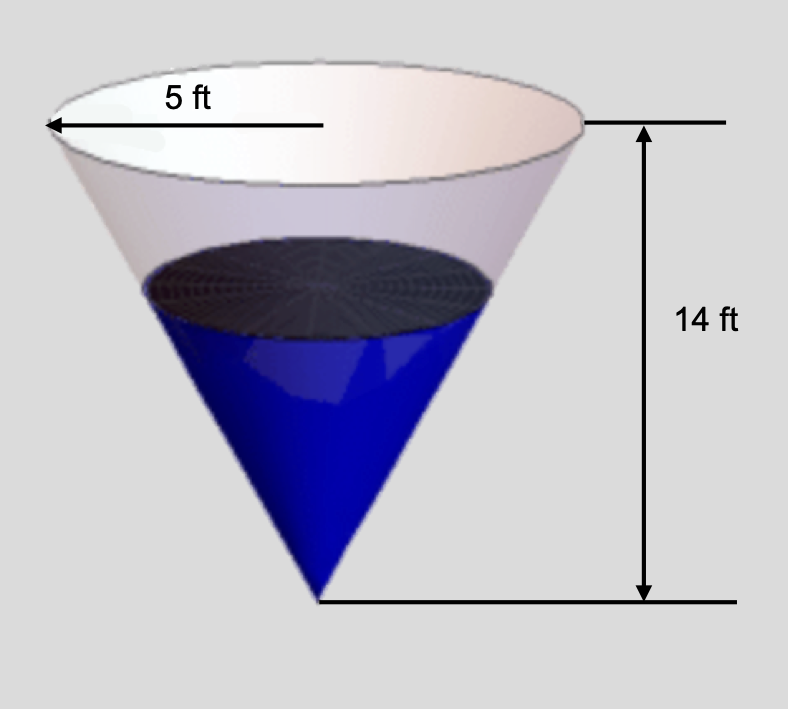
Even though we have a picture of the tank, we should probably start with a sketch that shows all the various quantities involved here. We will draw the sketch as if we were looking at the tank from directly in front of it (i.e. we'll sketch a cross-section of the tank).

As we can see, the water in the tank actually forms a smaller cone/triangle (depending on which image we are looking at) with the same central angle as the tank itself. The radius of the "water cone" at any time is given by $r$ and the height of the "water cone" at any time is given by $h.$ The volume of water in the tank at any time $t$ is then given by $$V = \frac13\pi r^2 h$$ and we've been given that $V'(t) = -2.$
For this part we need to determine $h'$ when $h = 6.$ Now since $V'$ is the given rate and $h'$ is the desired rate, we need a relationship between $V$ and $h.$ Taking the derivative of the volume formula, we have $$V' = \frac23\pi r r' h + \frac13 \pi r^2 h'$$ This equation certainly relates $h'$ to $V'$, but it also includes both $r$ and $r'$, neither of which is known. Since we really have no way of finding $r'$ (without knowing $h'$), we will find a way to eliminate $r$ from the volume formula, so that it relates only $h$ to $V$ and then take the derivative.
This is easier than it might look at first. If we go back to our sketch above and look at just the right half of the tank, we see that we have two similar triangles. Recall that two triangles are similar if their angles are identical, which is the case here. When we have two similar triangles, the ratios of any pair of sides are equal. So we have $$\frac{r}{h} = \frac{5}{14}\hspace{.15in}\Rightarrow\hspace{.15in} r=\frac{5}{14}h$$ Substituting this back into the volume formula yields $$V = \frac13\pi r^2 h = \frac13\pi\left(\frac{5}{14} h\right)^2 h = \frac{25}{588}\pi h^3$$ So now we have a volume formula that only involves the volume and the height of the water. Note, though, that this volume formula is only valid for the cone in this problem, so don't be tempted to use it for other cones! If we differentiate this volume formula we have $$V' = \frac{25}{196}\pi h^2 h'$$ At this point all we need to do is substitute what we know and solve for $h'.$
$$-2=\frac{25}{196}\pi(6^2)h'\hspace{.15in}\Rightarrow\hspace{.15in} h'=-\frac{98}{225\pi}\approx -0.1386$$So it looks like the depth of the water is decreasing at a rate of approximately $0.1386$ feet per hour.
Now we are being asked for $r'.$ There are two ways we can approach this, an easier way and a (slightly) more difficult way. The "difficult" way is to redo the work in part (a) only this time use the similar triangles to find $h$ in terms of $r$, $$\frac{h}{r} = \frac{14}{5} \hspace{.15in}\Rightarrow\hspace{.15in} h=\frac{14}{5}r$$ and then write the volume formula in terms of $V$ and $r$ and proceed as before.
That's not too difficult, but it is more work than we need to do. Recall from the first part that we have $$r=\frac{5}{14}h$$ and so we can find that $$r' = \frac{5}{14}h'$$ So, if we use the relationship between $h$ and $r$ that we found in part (a), we can differentiate it to find a relationship between $h'$ and $r'.$ At this point all we need to do is use the result from part (a) to find $$r' = \frac{5}{14}\left(-\frac{98}{225\pi}\right) = -\frac{7}{45\pi}\approx -0.04951$$ So the radius is decreasing at the rate of approximately $0.04951$ feet per hour.
This was much quicker than redoing all the work from the first part. Note, though, that we were only able to do this because we were being asked for $r'$ at exactly the same time that we were asked for $h'$ in the first part. If we hadn't been using the same time, then we would have had no choice but to do this the "difficult" way.
In the second part of the previous problem we saw an important idea in dealing with related rates. In order to find the desired rate, all we need is an equation that relates the rate we're looking for to a rate that we already know. Sometimes there are multiple equations that we can use and sometimes one will be easier than another.
Also, this problem showed us that we will often have an equation that contains more variables than the two we need to relate. In these cases, we will need to eliminate one (or more) of the variables. In this problem we eliminated the extra variable using a property of similar triangles. This will not always be how we do this, but many of these problems do use similar triangles, so make sure you are familiar with them.
A trough of water is 8 meters in length, and its ends are in the shape of isosceles triangles whose width is 5 meters and height is 2 meters. If water is being pumped in at a constant rate of 6 m3/sec, at what rate is the height of the water changing when the water has a height of 120 cm? At what rate is the width of the water changing when the water has a height of 120 cm?

Note that an isosceles triangle is just a triangle in which two of the sides are the same length. In our case, the sides of the tank have the same length.
Let's add some dimensions for the water to the sketch from above.

Now, in this problem, we know that $V' = 6$ m3/sec and we want to determine $h'$ when $h = 1.2$ m. Note that because $V'$ is in terms of meters we converted $h$ into meters as well. We need an equation that will relate these two quantities, and the volume of the tank will do that.
Recall that for this kind of shape (called a "prism"), the volume is the area of the end times the depth. The ends of the trough (and therefore of the water in the trough) are isosceles triangles, so their area is $\frac12$ (base)$\times$ (height). For our problem, the volume of the water in the trough is then
\begin{align} V&= \frac12 hw (8)\\ &= 4hw\\ \end{align}As with the previous example, we have an extra quantity, $w$, which is also changing with time. To eliminate it from the volume equation, we will again make use of two similar triangles. If we look at one end of the trough, we see the triangles that are the end of the trough itself, and the water in the trough. These triangles have the same angles and are therefore similar. This means that the ratios of any pair of sides must be equal. In this case we have $$\frac{w}{5} = \frac{h}{2}\hspace{.15in}\Rightarrow\hspace{.15in} w=\frac52 h$$ Putting this into the volume equation gives us a formula for the volume of the water in this trough (and only for this trough!) that depends only on the height of the water. $$V=4hw = 4h\left(\frac52 h\right) = 10h^2$$ We can now differentiate this to find $$V'=20hh'$$ Finally, all we need to do is substitute what we know and solve for $h'.$ $$6=20(1.2)h'\hspace{.15in}\Rightarrow\hspace{.15in} h'=0.25$$ So the height of the water is rising at a rate of 0.25 m/sec.
To answer the second part of this question, we can use everything we have already set up. Since we need $w'$, we can use the relationship between $h$ and $w$ from the similar triangles to give us a relationship between $w'$ and $h'.$ $$w = \frac52 h\hspace{.15in}\Rightarrow\hspace{.15in} w'=\frac52 h'$$ From our work above, we know the value of $h'$ when $h$ is 120 cm, so all we need to do is substitute this into the equation and we'll have the answer. $$w'=\frac52(0.25) = 0.625$$ Therefore, the width is increasing at the rate of 0.625 m/sec.
A light is on the top of a 12 foot tall pole, and a 5 foot 6 inch tall person is walking away from the pole at a rate of 2 ft/sec.
At what rate is the tip of the shadow moving away from the pole when the person is 25 feet from the pole?
At what rate is the tip of the shadow moving away from the person when the person is 25 feet from the pole?
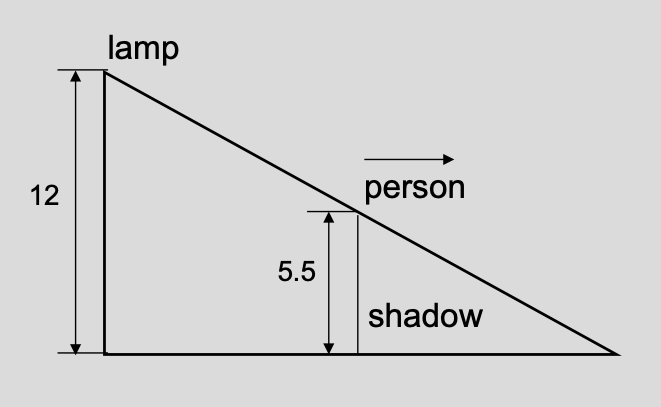
Let's start by adding all the relevant quantities to the sketch above.
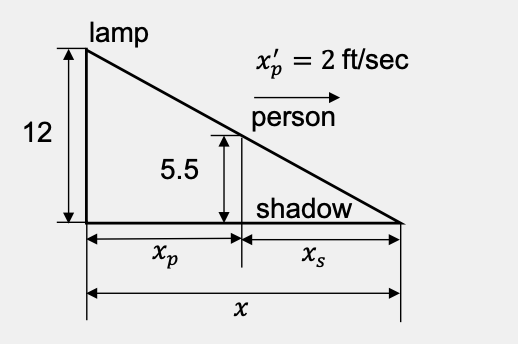
Here $x$ is the distance from the tip of the shadow to the pole, $x_p$ is the distance from the person to the pole, and $x_s$ is the length of the shadow. Also note that we converted the person's height to 5.5 feet, since all the other measurements are in feet.
The tip of the shadow is defined by the rays of light that just pass the person's head. As we see in the diagram, this creates a pair of similar triangles, which will be useful to us in a little bit.
In this question, we want to determine $x'$ when $x_p = 25$, given that $x'_p = 2.$ From the diagram, we see that $x = x_p + x_s$, which relates $x$ to $x_p.$ We will need to eliminate the extra variable, $x_s$, though. To do this, we can make use of the similar triangles. They give us $$\frac{5.5}{12} = \frac{x_s}{x}$$ Note that $$\frac{5.5}{12} = \frac{\frac{11}{2}}{12} = \frac{11}{24},$$ so we have $$x_s = \frac{11}{24}x$$ We can then substitute this into the equation above and solve for $x$ as follows: $$x = x_p+x_s = x_p +\frac{11}{24}x \hspace{.15in}\Rightarrow\hspace{.15in} x = \frac{24}{13}x_p$$ Now all we need to do is differentiate this, substitute in values and solve for $x'.$ $$x' = \frac{24}{13}x'_p \hspace{.15in}\Rightarrow\hspace{.15in} x' = \frac{24}{13}(2)\approx 3.6923$$ The tip of the shadow is then moving away from the pole at an approximate rate of 3.6923 ft/sec. Notice as well that we never had to use the fact that $x_p = 25$ for this problem. This will happen on rare occasions.
This part is actually pretty straightforward if we have the answer from (a) in hand, which we do, of course. In this case, we know that $x_s$ represents the length of the shadow, or the distance from the tip of the shadow to the person. It looks like we want to determine $x'_s$ when $x_p = 25.$
Again, we can use $x = x_p + x_s.$ Unlike in the first part, though, we now know that $x'_p = 2$ and $x'\approx 3.6923$ ft/sec. So all we need to do is differentiate the equation and substitute in the known values.
\begin{align} x' &= x'_p + x'_s\\ 3.6923 &= 2 + x'_s \hspace{.15in}\Rightarrow\hspace{.15in} x'_s \approx 1.6923\\ \end{align}The tip of the shadow is moving away from the person at an approximate rate of 1.6923 ft/sec.
A spot light is on the ground 20 feet away from a wall, and a 6 foot tall person is walking towards the wall at a rate of 2.5 ft/sec. How fast is the height of the person's shadow changing when the person is 8 feet from the wall? Is the shadow increasing or decreasing in height at this time?

We first add all the relevant quantities to the sketch, as shown below. As with the previous problem, since the rays of light passing just over the head of the person define the person's shadow, we again have a pair of similar triangles.

In this problem, we want to determine $y'$ when the person is 8 feet from the wall. Using the distances labeled on the sketch, this is equivalent to $x = 12$ feet. Also, if the person is moving towards the wall at 2.5 ft/sec, then the person must be moving away from the spotlight at 2.5 ft/sec. So we also know that $x'=2.5.$
In all the previous problems in which we made use of similar triangles, we did so to eliminate a variable from the main equation we were working with. In this case, however, we can create the equation that relates $x$ and $y$ directly from the similar triangles. $$\frac{y}{6} = \frac{20}{x} \hspace{.15in}\Rightarrow\hspace{.15in} y = \frac{120}{x}$$ Now all we need to do is differentiate and substitute values to solve for $y'.$ $$y'=-\frac{120}{x^2} x' \hspace{.15in}\Rightarrow\hspace{.15in}y' = -\frac{120}{12^2}(2.5) \approx -2.0833$$
The height of the shadow is then decreasing at a rate of approximately 2.0833 ft/sec.
We've worked quite a few problems that involved similar triangles, and you can see how they might arise in other problems. Be sure you can do these kinds of problems.
The next example is similar to the problems we've done, but is sufficiently different that it can cause problems until you've seen how to do it.
Two people on bikes are separated by 350 meters. Person A starts riding north at a rate of 5 m/sec and 7 minutes later, Person B starts riding south at 3 m/sec. At what rate is the distance separating the two people changing 25 minutes after Person A starts riding?

There is a lot to digest in the statement of this problem. Let's start with a sketch of the situation that shows each person's location sometime after both people start riding.

Now, we know $x' = 5$ and $y'=3$ and we are asked to find $z'$ after Person A has been riding for 25 minutes and Person B has been riding for 25 - 7 = 18 minutes. After converting these times to seconds (because all the given rates are in meters per second), this means that at the time we're interested in, each of the bike riders has ridden $$x = 5(25\times 60) = 7500 \text{ meters} \hspace{.2in} y= 3(18\times 60) = 3240 \text{ meters}$$ Next, the Pythagorean Theorem tells us that $$z^2 = (x+y)^2 + 350^2$$ Therefore, 25 minutes after Person A starts riding, the two bike riders are $$z = \sqrt{(x+y)^2 + 350^2} = \sqrt{(7500 + 3240)^2 + 350^2} \approx 10,745.7015$$ meters apart.
To determine the rate at which the two riders are moving apart all we need to do is differentiate the equation above and substitute all the quantities that we know to find $z'.$ \begin{align} 2zz' &= 2(x+y)(x'+y')\\ 2(10745.7015) z' &= 2(7500 + 3240)(5+3)\\ z' &= 7.9958\\ \end{align}
So, the two riders are moving apart at a rate of approximately 7.9958 m/sec.
Every problem we have worked to this point has come down to needing a geometric formula. Let's do one that is not geometric in nature.
Suppose that we have two resistors connected in parallel with resistances $R_1$ and $R_2$, measured in ohms (denoted $\Omega$). The total resistance, $R$, is then given by $$\frac{1}{R} = \frac{1}{R_1} + \frac{1}{R_2}$$ Suppose that $R_1$ is increasing at a rate of $0.4\hspace{2pt} \Omega$/min and $R_2$ is decreasing at a rate of $0.7 \hspace{2pt}\Omega$/min. At what rate is $R$ changing when $R_1 = 80\hspace{2pt} \Omega$ and $R_2 = 105\hspace{2pt} \Omega$?
We are asked to find $R'$, given that $R'_1 = 0.4$ and $R'_2 = -0.7.$ As always, we need to be careful with the signs when we write rates as values of a derivative.
We will use the given formula as the relation among $R$, $R_1$ and $R_2.$ After we take the derivative, we will need to substitute for $R$, so let's go ahead and find its value at the time we're interested in.
$$\frac{1}{R} = \frac{1}{80}+\frac{1}{105} = \frac{37}{1680}\hspace{.15in}\Rightarrow\hspace{.15in} R = \frac{1680}{37}\approx 45.4054\hspace{2pt}\Omega$$Now let's differentiate the equation given in the problem statement.
\begin{align} -\frac{1}{R^2}R' &= -\frac{1}{(R_1)^2}R'_1 - \frac{1}{(R_2)^2}R'_2\\ R' &= R^2\left(\frac{1}{(R_1)^2} R'_1 + \frac{1}{(R_2)^2} R'_2\right)\\ \end{align}Finally, we just need to substitute into this and do some calculations. $$R' \approx (45.4054)^2\left(\frac{1}{80^2}(0.4) + \frac{1}{105^2}(-0.7)\right)\approx -0.002045$$ So $R$ is decreasing at a rate of approximately $0.002045\hspace{2pt}\Omega$/min.
Summary
We've seen quite a few related rates problems that cover a wide variety of possible problems. There are still many more different kinds of related rates problems out there, but they all have the following structure.
There are two or more changing quantities that are related in some way.
The rates at which some of the quantities are changing are known and at least one of the rates is unknown. The goal is to find one of the unknown rates at a particular point in time.
To find the unknown rate, we first find an equation that relates the changing quantities to each other. If there is more than one quantity in the equation whose rate is unknown, we use a secondary equation (like one given by similar triangles) to eliminate it from the equation.
We differentiate the equation using implicit differentiation, substitute all the known values and solve for the unknown rate.
Practice Problems
In the following, assume that $x$ and $y$ are both functions of $t.$ Given $x = -2, y = 1$ and $x' = -4,$ determine $y'$ for the following equation: $$6y^2 + x^2 = 2-x^3 \text{e}^{4-4y}$$
We are being asked to find $y'$ and are given $x'$ and the relationship between $x$ and $y.$ So the first thing we need to do is use implicit differentiation to differentiate the equation with respect to $t.$ $$12yy'+2xx' = -3x^2x'\text{e}^{4-4y}+4x^3\text{e}^{4-4y}y'$$ Then we substitute the given information and solve for $y'$: $$12y'+16=48-32y'\hspace{.15in}\Rightarrow\hspace{.15in} y' = \frac{8}{11}$$
In the following, assume that $x, y$ and $z$ are all functions of $t.$ Given $x=4$, $y=-2,$ $z = 1$, $x' = 9$ and $y'=-3,$ determine $z'$ for the following equation: $$x(1-y) + 5z^3 = y^2z^2 + x^2 - 3$$
Since we were given the relationship among all the variables, we just need to differentiate with respect to $t$, using implicit differentiation. $$x'(1-y)-xy'+15z^2z' = 2yy'z^2 + 2y^2zz'+2xx'$$ Then we substitute the given information and solve for $z'$: $$27+12+15z'=12+8z'+72 \hspace{.15in}\Rightarrow\hspace{.15in} z'=\frac{45}{7}$$
For a certain rectangle, the length of one side is always three times the length of the other side.
If the shorter side is decreasing at a rate of 2 inches/minute, at what rate is the longer side decreasing?
At what rate is the enclosed area decreasing when the shorter side is 6 inches long and is decreasing at a rate of 2 inches/minute?
-
Let's call the shorter side $x$ and the longer side $y.$ We are given that $x' = -2$, and have been asked to find $y'.$
We need an equation that relates these two quantities. From the problem statement, we know that the length of the longer side is three times that of the shorter side, so an equation that relates $x$ and $y$ is $$y = 3x$$ Differentiating this with respect to $t$ yields $$y'=3x'$$ Finally, we substitute the known quantity and solve for what we want: $y'=-6.$ So the longer side is decreasing at the rate of 6 in/min.
Again, we will call the shorter side $x$ and the longer side $y.$ Since we are asked to find the rate of change of the area, we will use the area equation $$A = xy$$
Since we are finding the rate at the same time as we did in part (a), we have two paths we can take here. We can either take the derivative now or we can first substitute $y = 3x$ to eliminate $y$ from the area equation.
If we do this, we find $$A(x) = 3x^2$$ Then differentiating gives us $$A' = 6xx'$$ If we use the equation in terms of both $x$ and $y$, then we have $$A' = xy'+x'y$$ Now all we need to do is substitute the known quantities and solve for $A'.$ Using the equation in terms of only $x$ is simplest because we already have all the needed quantities from the problem statement itself. Doing this gives $$A' = (6)(6)(-2) = -72$$ If we wish to use the equation in terms of both $x$ and $y$, we need to find $y$ and $y'.$ From part (a), we know that $y' = -6.$ Also, since $x=6$ and $y=3x$, we find that $y=18.$ Substituting these into the equation $A' = xy'+x'y$ gives us the same answer: $$A' = (6)(-6)+(-2)(18) = -72$$ Therefore, the area is decreasing at the rate of 72 in2/min.
A thin sheet of ice is in the form of a circle. If the ice is melting in such a way that the area of the sheet is decreasing at a rate of 0.5 m2/sec, at what rate is the radius decreasing when the area of the sheet is 12 m2?
Calling the area of the ice $A$ and the radius $r$, we relate them with the area equation $$A = \pi r^2$$ We are given that $A'=-0.5$ and have been asked to find $r'$ when $A=12.$
When we differentiate the area equation with respect to $t$, we find $$A'=2\pi r r'$$ Since this equation includes $r$, we need to find the value of the radius at the given time. At this time, the area is 12 m2, so we can solve for $r$ as follows: $$12 = \pi r^2 \hspace{.15in}\Rightarrow\hspace{.15in} r=\sqrt{\frac{12}{\pi}}$$ Now we can substitute and solve for $r'$: $$-0.5 = 2\pi\sqrt{\frac{12}{\pi}} r' \hspace{.15in}\Rightarrow\hspace{.15in} r'=-\frac14\sqrt{\frac{1}{12\pi}}\approx -0.040717$$ Therefore, the radius is decreasing at the rate of approximately 0.040717 m/sec.
A person is standing 350 feet away from a model rocket that is fired straight up into the air at a rate of 15 ft/sec.
- At what rate is the distance between the person and the rocket increasing 20 seconds after liftoff?
- At what rate is the distance between the person and the rocket increasing 1 minute after liftoff?
It is a good idea to create a sketch for this problem, showing the relative positions of the person and the rocket. We'll let $y$ be the height of the rocket, and $z$ the distance between the person and the rocket.
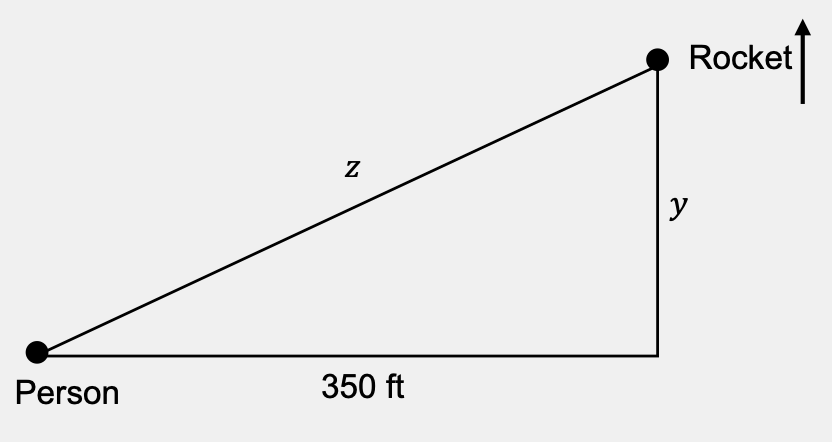
In both parts of the question, we know that $y'=15$ and we want to determine $z'.$ So we need an equation that relates $y$ and $z.$ From the diagram, we see that the Pythagorean Theorem applies here, giving us $$z^2 = y^2 + 350^2$$ Let's differentiate this with respect to $t$ and solve for $z'.$ $$2zz'=2yy' \hspace{.15in}\Rightarrow\hspace{.15in} z'=\frac{yy'}{z}$$ We have now reached a point where the process will differ for each part.
To answer the first question, we need to determine $y$ (from the speed of the rocket and given time) and $z$ (from the Pythagorean Theorem).
\begin{align} y &= (15)(20) = 300\\ z &= \sqrt{300^2+350^2} = \sqrt{212500} = 50\sqrt{85}\approx 460.9772\\ \end{align}Then we find $$z'\approx\frac{(300)(15)}{460.9772} = 9.76187$$
The distance is increasing at approximately 9.76187 ft/sec.
This part is nearly identical to the first part, except that the time is now 60 seconds after liftoff. Note that since the given rate is in feet per second, we must convert the time to seconds.
As we did in the first part, we first need to solve for $y$ and $z$ before we can substitute into the derivative.
\begin{align} y &= (15)(60) = 900\\ z &= \sqrt{900^2+350^2} = \sqrt{932500} = 50\sqrt{373}\approx 965.6604\\ \end{align}We now find $$z' \approx \frac{(900)(15)}{965.6604} = 13.98007$$ Therefore, the distance is increasing at approximately 13.98007 ft/sec.
A plane is 750 meters in the air flying parallel to the ground at a speed of 100 m/s, and is initially 2.5 kilometers away from a radar station. At what rate is the distance between the plane and the radar station changing (a) initially and (b) 30 seconds after it passes over the radar station?
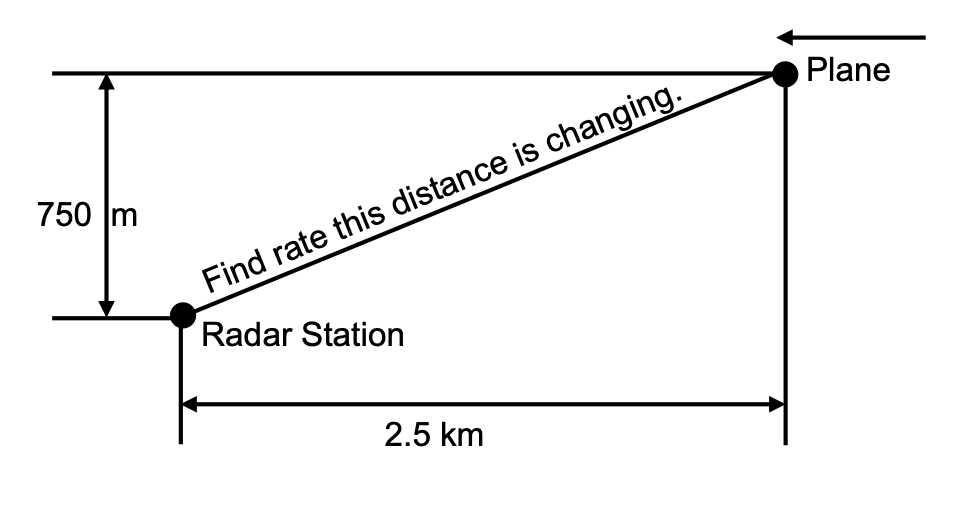
Let $x$ stand for the horizontal distance between the plane and the radar station and let $z$ stand for the straight-line distance between the plane and the radar station. Notice that, since the plane is approaching the radar station, the horizontal distance is decreasing. So $x'$ must be negative. We are given that $x' = -100$ m/s when $x = 2500$ m. Also notice that we converted $x$ to meters, since all the other quantities are in meters.
Here is the sketch for this part.

We want to determine $z'$ in this part, so we will use the Pythagorean Theorem to relate $x$ and $z.$ This gives $$z^2=x^2+750^2 = x^2 + 562,500$$ We differentiate with respect to $t$ using implicit differentiation then solve for $z'$ to find: $$2zz'=2xx' \Rightarrow z'=\frac{xx'}{z}$$ We know the value of $x'$ and $x$ at the moment we are interested in, but we still need to find the value of $z.$ We use the Pythagorean Theorem to do this: $$z=\sqrt{x^2 + 750^2} = \sqrt{2500^2 +750^2} = \sqrt{6812500}=250\sqrt{109}\approx 2,610.0766$$ Now we can find that $$z' \approx \frac{(2500)(-100)}{2610.0766}\approx -95.7826$$ Therefore, the distance between the plane and the radar station is decreasing at approximately 95.7826 meters per second.
Again, we'll let $x$ be the horizontal distance between the plane and the radar station, and $z$ the straight-line distance between them. The sketch for this part is

Notice in this part that since the plane is moving away from the radar station, the horizontal distance between them is increasing and $x'$ is positive.
We wish to determine $z'.$ We can use the Pythagorean Theorem to do this, just as we did above. In fact, the equations are the same: \begin{align} z^2=x^2+750^2 &= x^2 + 562,500\\ 2zz'=2xx'\hspace{.25in} &\Rightarrow \hspace{.25in}z'=\frac{xx'}{z}\\ \end{align} This time, we are not given $x$, so we must find both $x$ and $z.$ We know that the speed of the plane is 100 m/s and we have the fact that it has flown for 30 seconds after passing over the radar station. So $$x=(100)(30)=3000$$ To find $z$, we will use the Pythagorean Theorem again. $$z=\sqrt{3000^2+750^2} = \sqrt{9562500}=750\sqrt{17}\approx 3092.3292$$ Now we can find that $$z'\approx\frac{(3000)(100)}{3092.3292}\approx 97.0143$$ Therefore, the distance between the plane and the radar station is increasing at approximately 97.0143 meters per second.
Two people are at an elevator. At the same time, one person starts to walk away from the elevator at a rate of 2 ft/sec, and the other person starts going up in the elevator at a rate of 7 ft/sec. At what rate is the distance between the two people changing 15 seconds later?
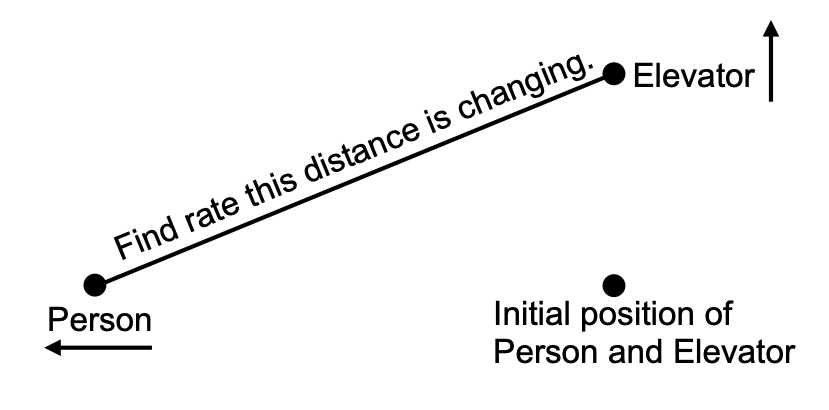
Let $x$ be the horizontal distance between the person walking and the initial position of the elevator, let $y$ be the height of the elevator above ground level, and let $z$ be the distance between the two people. Since both the person and the elevator are moving, all three of these distances are changing.
Here is the sketch:

We want to determine $z'$ after 15 seconds, given that $x'=2, y'=7$ and assuming that the person and the elevator start at the same time.
Using the Pythagorean Theorem and taking the derivative with respect to $t$ gives us \begin{align} z^2 &= x^2 + y^2\\ 2zz'=2xx'+2yy'\hspace{.25in} &\Rightarrow\hspace{.25 in} z'=\frac{xx'+yy'}{z}\\ \end{align} Before we can find $z'$ we need to find the values of $x, y$ and $z.$ We know the speed of the person and the elevator, and we have the fact that 15 seconds have passed. We also have the Pythagorean Theorem, which will help us find $z.$ $$x=(2)(15)=30 \hspace{.5in} y=(7)(15)=105$$ $$z=\sqrt{30^2+105^2}=\sqrt{11925}=15\sqrt{53}\approx 109.2016$$ Substituting, we find $z'$: $$z'\approx\frac{(30)(2)+(105)(7)}{109.2016}\approx 7.2801$$ Therefore, the distance between the two people is increasing at the approximate rate of 7.2801 feet per second.
Two people on bikes are at the same place. One of the bikers starts riding directly north at a rate of 8 m/sec. Five seconds after the first biker started riding north, the second starts to ride directly east at a rate of 5 m/sec. At what rate is the distance between the two riders increasing 20 seconds after the second person started riding?

Let $x$ be the distance the person riding east has traveled,let $y$ be the distance the person riding north has traveled, and let $z$ be the distance between the two people. Since both people are moving, all three of these distances are changing. Further, since the two people are moving away from each other as well as away from their starting point, all three rates of change are positive.
Here is the sketch:
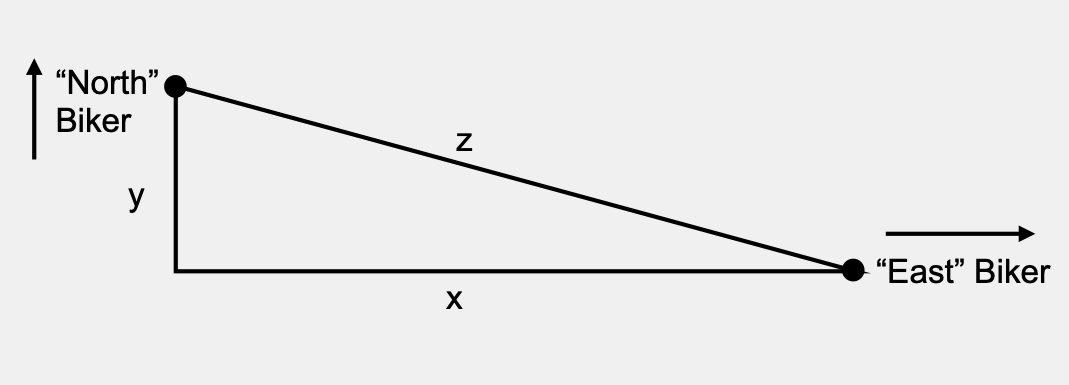
We want to determine $z'$ 20 seconds after the second biker starts riding east, given that $x' = 5$ m/sec, $y'=8$ m/sec, and assuming that they start at the same point.
It should be clear from the sketch that we need the Pythagorean Theorem. As in the previous problems, we will differentiate with respect to $t$, then solve for $z'.$
\begin{align} z^2 &= x^2 + y^2\\ 2zz'=2xx'+2yy' \hspace{.25in} &\Rightarrow \hspace{.25in} z'=\frac{xx'+yy'}{z}\\ \end{align}To find the value of $z'$, we need to find the values of $x$, $y$, and $z.$ We can use the given rates and the times to find $x$ and $y$, and then use the Pythagorean Theorem to solve for $z.$ Note that the biker riding east has been riding for 20 seconds, while the biker riding north has been riding for 25 seconds because that person started 5 seconds earlier.
$$x=(5)(20)=100 \hspace{.5in} y = (8)(25) = 200$$ $$z=\sqrt{100^2+200^2} = \sqrt{50000}=100\sqrt{5} \approx 223.5=6068$$A light is mounted on a wall 5 meters above the ground. A two meter tall person is initially 10 meters from the wall, and is moving towards the wall at a rate of 0.5 m/sec. After 4 seconds, is the tip of the person's shadow moving (a) towards or away from the person, and (b) towards or away from the wall?

The quantities that are changing in this situation are the distance between the person and the wall, the length of the person's shadow, and the distance between the tip of the shadow and the wall. We will name these $x_p, x_s$ and $x$, respectively. Note that since the person is walking towards the wall, $x_p$ is decreasing. Hence $x'_p = -0.5$ m/sec for both parts.
Here is a sketch of the situation that will work for both parts.
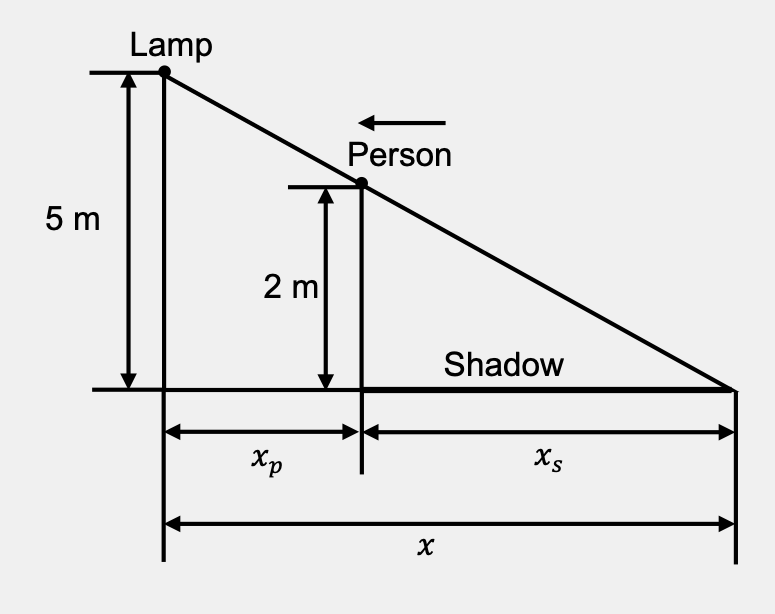
The tip of the shadow is moving towards the person if $x'_s$ is negative and is moving away from the person if $x'_s$ is positive. So we need to find $x'_s.$
The two right triangles in the sketch are similar triangles, so we can use proportions of corresponding sides to create an equation.
$$\frac25 = \frac{x_s}{x} = \frac{x_s}{x_p+x_s}$$If we solve this for $x_s$ we arrive at
\begin{align} \frac25 (x_p+x_s) &= x_s\\ \frac25 x_p +\frac25 x_s &= x_s\\ x_s &= \frac23 x_p\\ \end{align}This equation relates $x_s$, whose rate we need, to $x_p$, whose rate we know. Differentiation with respect to $t$ will give us $$x'_s=\frac23 x'_p$$ Thus, $$x'_s=\frac23 (-0.5) = -\frac13$$ Because this rate is negative, we see that the tip of the shadow is moving towards the person (at a rate of $\frac13$ m/s).
In this part we want to determine the sign of $x'.$ From the sketch, we see that $x = x_p+x_s$, which works perfectly for us. Differentiation with respect to $t$ gives $$x' = x'_p+x'_s$$ We were given that $x'_p = -\frac12$ in the problem statement, and we found in part (a) that $x'_s = -\frac13.$ Substituting these into the equation above yields $$x' = -\frac12 + \left( -\frac13\right) = -\frac56$$ Because this rate is negative, we see that the tip of the shadow is moving towards the wall (at a rate of $\frac56$ m/s).
A tank of water in the shape of a cone is being filled with water at a rate of 12 m3/sec. The base radius of the tank is 26 meters and the height of the tank is 8 meters. At what rate is the depth of the water in the tank changing when the radius of the top of the water is 10 meters?
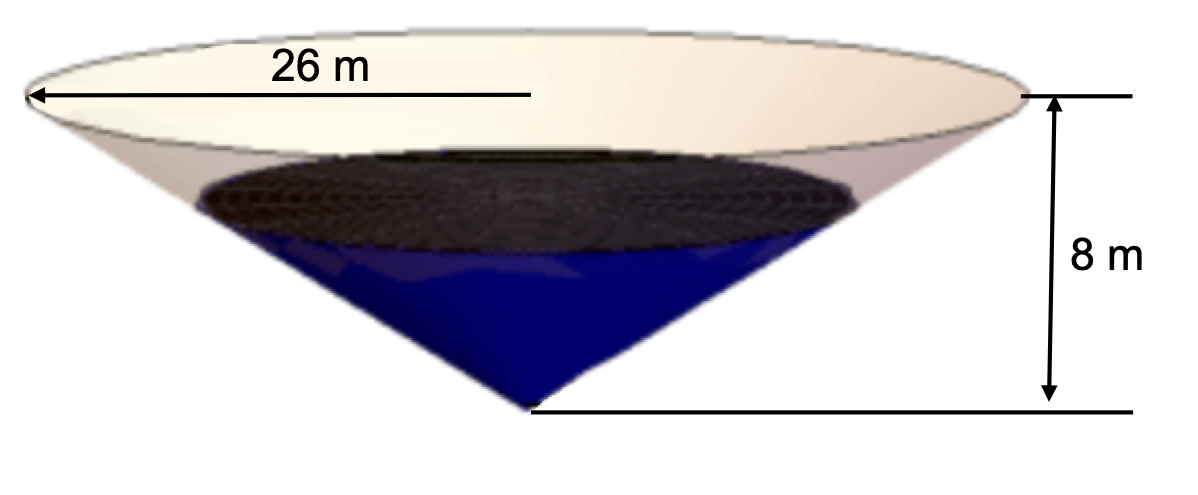
Let's let $r$ be the radius of the water in the tank and let $h$ be the height of the water in the tank. Here is a sketch (not to scale) of the cross section of the cone showing the related quantities.
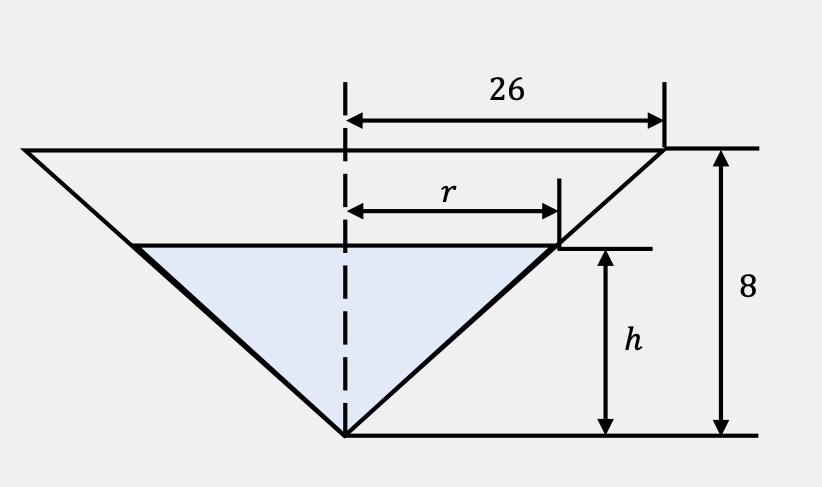
We want to determine $h'$ when $r = 10$ and we know that $V' = 12.$ We will need to use the formula for the volume of a cone: $$V = \frac13\pi r^2 h$$ Since this formula relates $V$ to both $h$ and $r$ but we only want to find $h',$ we would like to eliminate $r$ from it. We can do this if we have another equation that relates only $r$ and $h.$
We can use the fact that the two triangles in the cross section sketch are similar triangles to do this. By equating ratios of corresponding sides we have $$\frac{r}{h} = \frac{26}{8} \Rightarrow r = \frac{13}{4}h$$ Substituting this into the volume equation then gives $$V=\frac{169}{48}\pi h^3$$ When we differentiate this with respect to $t$ we find $$V'=\frac{169}{16}\pi h^2 h'$$ To finish this problem, we need to find the value of $h$ at the time we are interested in. This can be done using the equation from the similar triangles and the fact that at this time, $r = 10.$
$$h=\frac{4}{13}r = \frac{4}{13}(10) = \frac{40}{13}$$The rate of change of the height of the water is then \begin{align} V' &= \frac{169}{16}\pi h^2 h'\\ 12 &= \frac{169}{16}\pi \left(\frac{40}{13}\right)^2 h'\\ &= 100\pi h'\\ \end{align} $$\Rightarrow h'=\frac{3}{25\pi}$$ The depth of the water is increasing at the rate of $\frac{3}{25\pi}$ meters per second.
The angle of elevation is the angle formed by a horizontal line and a line joining the observer's eye to an object above the horizontal line.
A person is 500 feet away from the launch point of a hot air balloon. The hot air balloon is starting to come back down at a rate of 15 ft/sec. At what rate is the angle of elevation, $\theta$, changing when the hot air balloon is 200 feet above the ground?

Let $y$ stand for the height of the balloon. We are given that $y$ is decreasing at the rate of 15 ft/sec, so $y'=-15.$ We are also given that the distance between the person and the launch point of the balloon is 500 feet. We summarize all of this on the sketch below.

We want to determine $\theta'$ when $y=200$, and we are given that $y'=-15.$
There are a variety of equations that we could use to relate $y$ and $\theta$, but perhaps the easiest one is $$\tan(\theta) = \frac{y}{500}$$ Differentiating with respect to $t$ gives $$\sec^2(\theta) \theta' = \frac{y'}{500}\hspace{.25in} \Rightarrow \hspace{.25in} \theta' = \frac{y'}{500}\cos^2(\theta)$$ Now we need to determine the value of $\theta$ at the time in question. We can either use the original equation to do this, or we could acknowledge that we really need $\cos(\theta).$ We can use right triangle trigonometry to do that.
Option 1: Use the original equation to find an approximate value for theta.
$$\tan(\theta) = \frac{200}{500}\hspace{.25in} \Rightarrow \hspace{.25in} \theta = \arctan\left(\frac25\right) \approx 0.38051 \text{ radians}$$ Then $$\theta' \approx \frac{-15}{500}\cos^2(0.38051)\approx -0.02586$$Option 2: Use the right triangle in the sketch to find $\cos(\theta).$
For this option, we first need to use the Pythagorean Theorem to find the hypotenuse of the triangle.
$$c^2 = 500^2 + y^2\hspace{.25in}\Rightarrow c = \sqrt{250000 + y^2}$$We then substitute this into the equation above to write \begin{align} \theta' &= \frac{y'}{500}\cdot\frac{500^2}{250000+y^2}\\ \theta' &= \frac{-15}{500}\cdot\frac{500^2}{250000+40000} = \frac{-3}{116}\approx -0.02586\\ \end{align}
Whichever option we choose, we find that the angle of elevation is decreasing at a rate of approximately 0.02586 radians per second.
Assignment Problems
In the following, assume that $x$ and $y$ are both functions of $t.$ Given $x=3,$ $y=2$ and $y' = 7,$ determine $x'$ for the following equation: $$x^3 - y^4 = x^2y - 7$$
In the following, assume that $x$ and $y$ are both functions of $t.$ Given $x = \frac{\pi}{6}$, $y = -4$ and $x' = 12,$ determine $y'$ for the following equation: $$x^2(y^2 - 16) -6\cos(2x) = 1 + y$$
In the following, assume that $x$, $y$ and $z$ are all functions of $t.$ Given $x=-1$, $y=8,$ $z=2,$ $x'=-4,$ and $y' = 7,$ determine $z'$ for the following equation: $$x^4 + \frac{y}{z} = 2x^2z^2 - 3$$
In the following, assume that $x, y$ and $z$ are all functions of $t.$ Given $x=-2, y=3, z=4, y'=6,$ and $z' = 0,$ determine $x'$ for the following equation: $$xy^2z^2=x^3-z^4-8y$$
The sides of a square are increasing at a rate of 10 cm/sec. How fast is the area enclosed by the square increasing when the area is 150 cm2?
The sides of an equilateral triangle are decreasing at a rate of 3 in/hr. How fast is the area enclosed by the triangle decreasing when the sides are 2 feet long?
A spherical balloon is being filled in such a way that the surface area is increasing at a rate of 20 cm2/sec when the radius is 2 meters. At what rate is air being pumped into the balloon when the radius is 2 meters?
A cylindrical tank of radius 2.5 feet is being drained of water at a rate of 0.25 ft3/sec. How fast is the height of the water decreasing?
A hot air balloon is attached to a spool of rope that is 125 feet away from the balloon when it is on the ground. The hot air balloon rises straight up in such a way that the length of rope between the balloon and the spool increases at a rate of 15 ft/sec. How fast is the hot air balloon rising 20 seconds after it lifts off?

A rock is dropped straight off a bridge that is 50 meters above the ground and falls at a speed of 10 m/sec. Another person is 7 meters away on the same bridge. At what rate is the distance between the rock and the second person increasing just as the rock hits the ground?

A person is 550 meters away from a road, and there is a car that is initially 800 meters away, approaching the person at a speed of 45 m/sec.
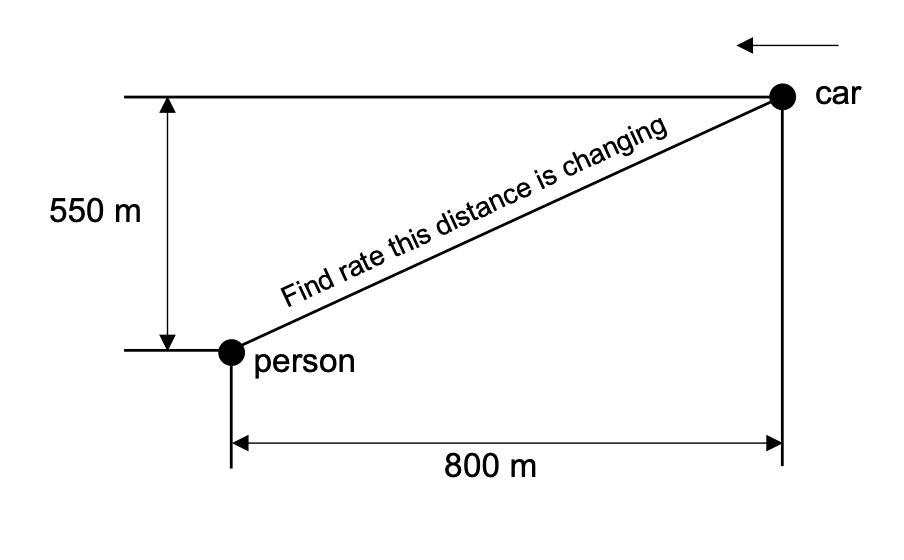
Find the rate at which the distance between the person and the car is changing
5 seconds after the start,
when the car is directly in front of the person, and
10 seconds after the car has passed the person.
Two cars are initially 1200 miles apart. At the same time Car A starts driving at 35 mph to the east, Car B starts driving at 55 mph to the north. (See the sketch below for the initial setup.)

At what rate is the distance between the two cars changing
after 5 hours of travel?
after 20 hours of travel?
after 40 hours of travel?
Two cars are initially 1200 miles apart. Four hours after Car B starts driving at 55 mph to the north, Car A starts driving at 35 mph to the east. (See the sketch in the previous problem for the initial setup.)
At what rate is the distance between the two cars changing
5 hours after Car B starts?
20 hours after Car B starts?
40 hours after Car B starts?
Two people are on a city block. See the sketch below for their relative positions and distances.
Person A is on the northeast corner and Person B is on the southwest corner. Person A starts walking towards the southeast corner at a rate of 3 ft/sec. Four seconds later, Person B starts walking towards the southeast corner at a rate of 2 ft/sec.
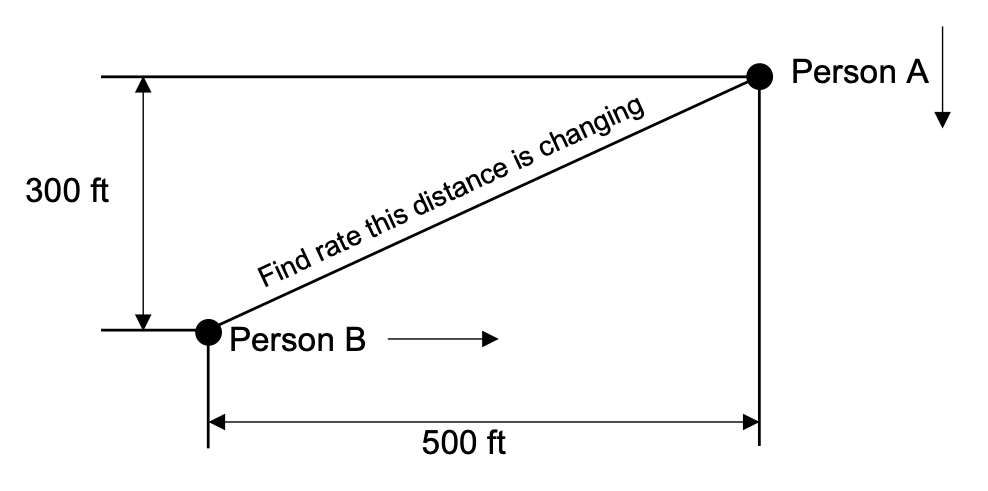
At what rate is the distance between them changing
10 seconds after Person A starts walking?
after Person A has covered half the distance to the southeast corner?
A person is standing 75 meters away from a kite and has a spool of string attached to the kite. The kite starts to rise straight up in the air at a rate of 2 m/sec and at the same time the person starts to move towards the kite's launch point at a rate of 0.75 m/sec.
Is the length of the string increasing or decreasing
after 4 seconds?
after 20 seconds?
A person lights the fuse on a model rocket and starts to move away from the rocket at a rate of 3 ft/sec. Five seconds after lighting the fuse, the rocket launches straight up into the air at a rate of 10 ft/sec.
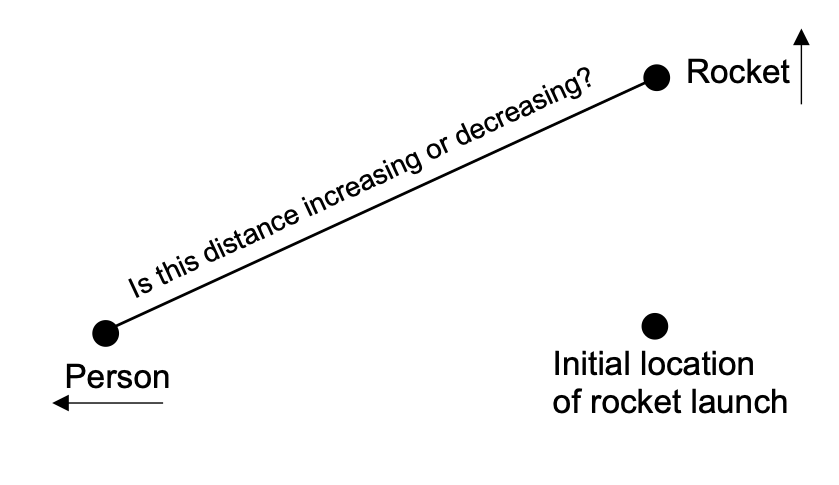
Is the distance between the person and rocket increasing or decreasing
6 seconds after launch?
12 seconds after launch?
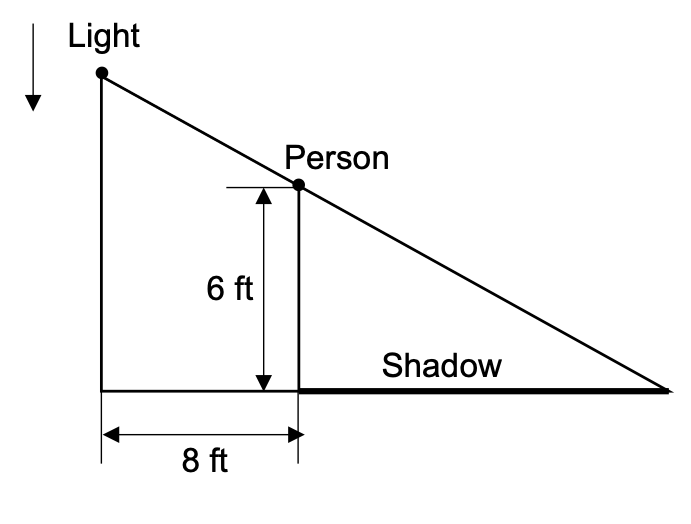
A light is on a pole and is being lowered towards the ground at a rate of 9 in/sec. A 6 foot tall person is on the ground and is 8 feet away from the pole. At what rate is the person's shadow increasing when the light is 15 feet above the ground?
A light is fixed on a wall 10 meters above the floor. Twelve meters away from the wall a pole is being raised straight up at a rate of 45 cm/sec.

When the pole is 6 meters tall,
at what rate is the tip of the shadow moving away from the pole?
at what rate is the tip of the shadow moving away from the wall?
A light is on top of a 15 foot pole. A five-foot tall person starts at the pole and moves away from the pole at a rate of 2.5 ft/sec.
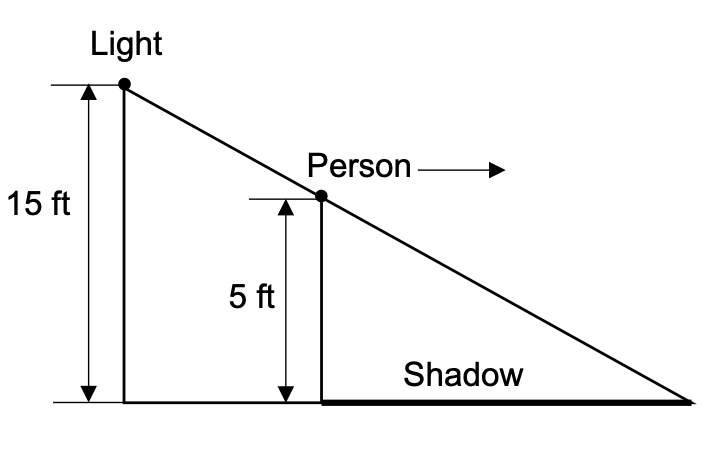
After moving for 8 seconds,
at what rate is the tip of the shadow moving away from the person?
at what rate is the tip of the shadow moving away from the pole?
A tank of water is in the shape of a cone with the vertex of the cone pointing downwards (see the sketch) and is leaking water at a rate of 35 cm3/sec. The base radius of the tank is 1 meter and the height of the tank is 2.5 meters.

When the depth of the water is 1.25 meters,
at what rate is the depth changing?
at what rate is the radius of the top of the water changing?
A trough of water is 20 meters in length and its ends are in the shape of an isosceles triangle whose width is 7 meters and whose height is 10 meters. Assume that the two equal length sides of the triangle are the sides of the water trough, and the other side of the triangle is the top of the trough, and is parallel to the ground. Water is being pumped into the trough at a rate of 2 m3/min.

When the water is 6 meters deep,
at what rate is the depth of water changing?
at what rate is the width of the top of the water changing?
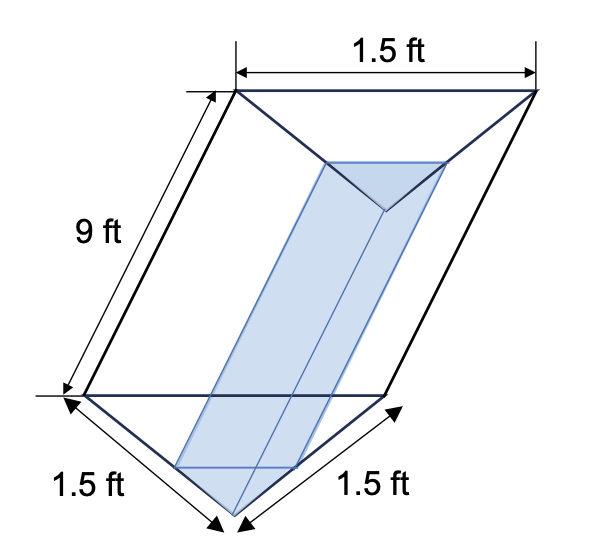
A trough of water is 9 feet long and its ends are in the shape of an equilateral triangle whose sides are 1.5 feet long. Assume that the top of the trough is parallel to the ground. If water is being pumped out of the trough at a rate of 2 ft3/sec, at what rate is the depth of the water changing when the depth is 0.75 feet?
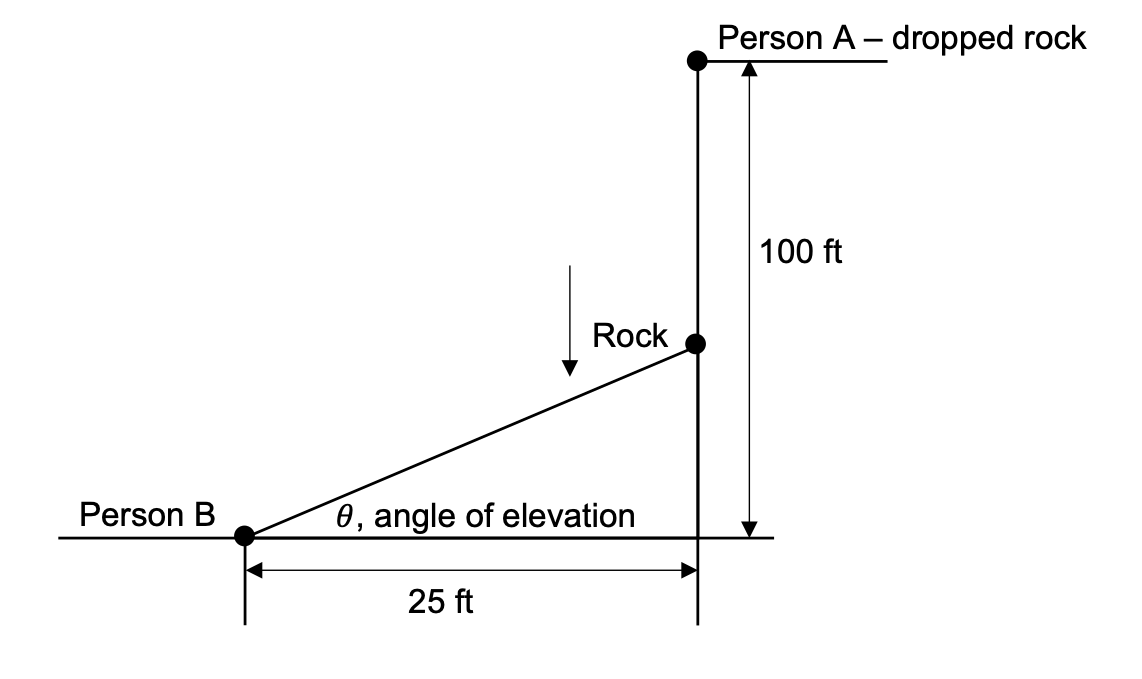
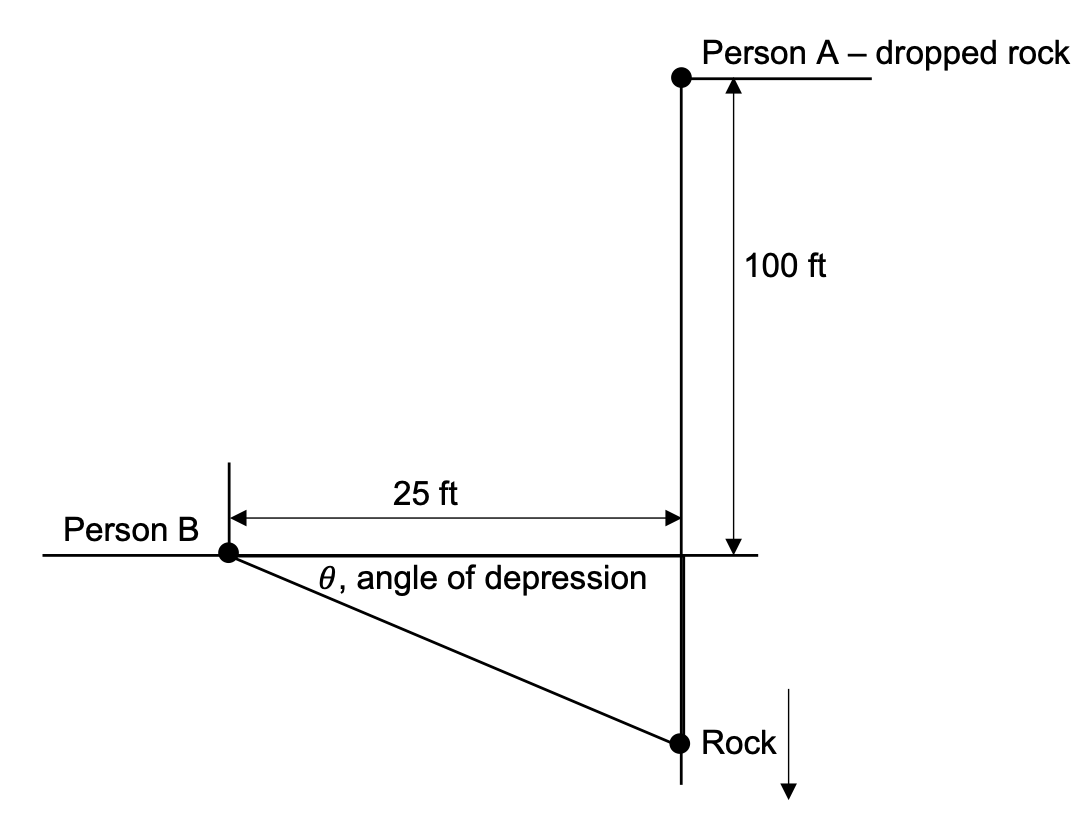
The angle of elevation (depression) is the angle formed by a horizontal line and a line joining the observer's eye to an object above (below) the horizontal line. Two people are on the roofs of buildings separated by a 25 foot wide road. Person A is 100 feet above Person B and drops a rock off the roof of their building. The rock falls at a rate of 3 ft/sec.
At what rate is the angle of elevation changing when the rock is 35 feet above Person B? (Note that the sketch below is not to scale).
At what rate is the angle of depression changing when the rock is 65 feet below Person B? (Note that the sketch below is not to scale).
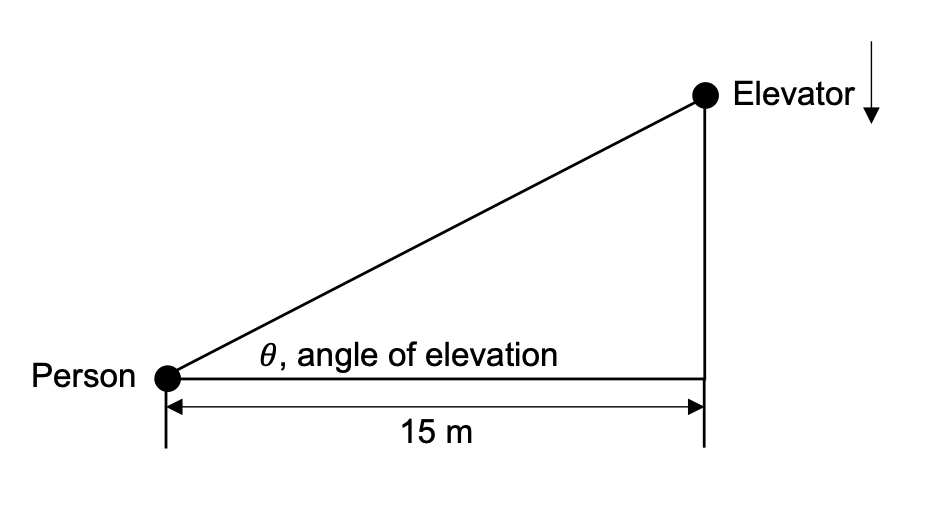
The angle of elevation is the angle formed by a horizontal line and a line joining the observer's eye to an object above the horizontal line. A person is standing 15 meters away from a building, watching an outside elevator move down the face of the building. When the angle of elevation is 1 radian, it is changing at a rate of 0.15 radians/sec. At this point in time, what is the speed of the elevator?
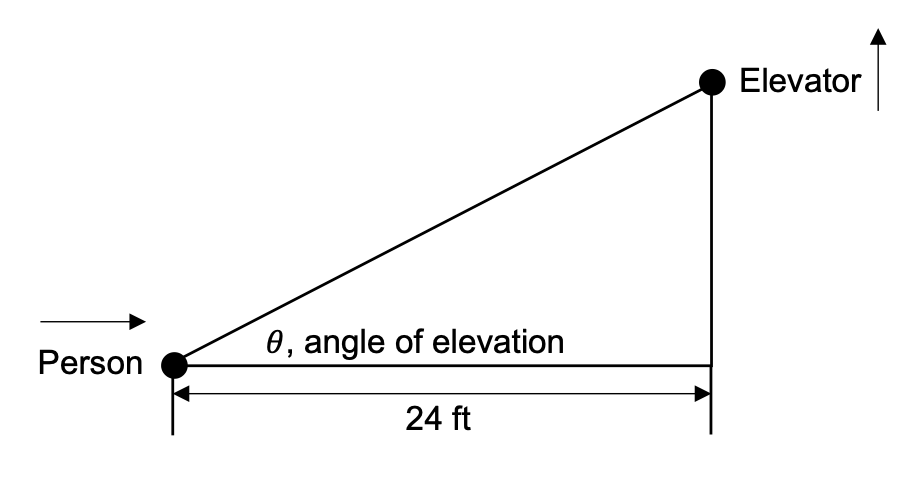
The angle of elevation is the angle formed by a horizontal line and a line joining the observer's eye to an object above the horizontal line. A person is 24 feet away from a building, watching an outside elevator move up the face of the building. The elevator is moving up at a rate of 4 ft/sec and the person is moving towards the building at a rate of 0.75 ft/sec.
Assuming that the elevator started moving from the ground at the same time that the person started walking, is the angle of elevation increasing or decreasing after 10 seconds?