Section 5.1: The Unit Circle
Learning Objectives
In this section you will:
- Build the unit circle using special right reference triangles
- Create basic trigonometric identities using the geometry of the unit circle
Looking for a thrill? Then consider a ride on the Singapore Flyer, the world’s tallest Ferris wheel. Located in Singapore, the Ferris wheel soars to a height of 541 feet—a little more than a tenth of a mile! Described as an observation wheel, riders enjoy spectacular views as they travel from the ground to the peak and down again in a repeating pattern. In this section, we will examine this type of revolving motion around a circle. To do so, we need to define the type of circle first, and then place that circle on a coordinate system. Then we can discuss circular motion in terms of the coordinate pairs.
The Unit Circle
We have already defined the trigonometric functions in terms of right triangles. In this section, we will redefine them in terms of the unit circle.
Unit Circle
The Unit Circle is a circle centered at the origin with radius 1. Therefore, the equation of the Unit Circle is $$(x-0)^2 + (y-0)^2 = 1^2$$ $$x^2 + y^2 = 1$$.
For a point on the unit circle, we can create a reference triangle by connecting the point to the origin and dropping a perpendicular side down to the x-axis:

Using that reference triangle, we can figure out the sine and cosine of $\theta$: $$\sin(\theta) = \frac{y}{1} \Rightarrow y = \sin(\theta)$$ $$\cos(\theta) = \frac{x}{1} \Rightarrow x = \cos(\theta)$$
This gives us a new way of defining and thinking about sine and cosine: we can say that if a point on the unit circle, $(x,y)$ corresponds to a central angle of $\theta$, then $\cos(\theta) = x$ and $\sin(\theta) = y$.
By associating the point $P=(x,y)$ with the angle $\theta$, we are assigning a position on the Unit Circle to the angle $\theta$. Since for each angle $\theta$, the terminal side of $\theta$, when graphed in standard position, intersects The Unit Circle only once, the mapping of $\theta$ to $P$ is a function. Since there is only one way to describe a point using rectangular coordinates, the mappings of $\theta$ to each of the $x$ and $y$ coordinates of $P$ are also functions. When we break the sine and cosine free from triangles this way and instead define them in regards to the unit circle, we call them Circular Functions.
This new definition works for angles in the other quadrants as well, and it corresponds to what we learned in Section 4.3. For a point in quadrant II, for example, we could draw a reference triangle like this:

Now, because this triangle is in quadrant II, the value of the $x$-coordinate will be negative, meaning the cosine of our reference angle will take on a negative value, as we know it should in quadrant II.
The Unit Circle
The Unit Circle is a circle centered at the origin with radius 1 and equation $x^2 + y^2 = 1$.
The Circular Functions
Suppose an angle $\theta$ is graphed in standard position. Let $P(x,y)$ be the point of intersection of the terminal side of $P$ and the Unit Circle.
- The $x$-coordinate of $P$ is called the cosine of $\theta$, written $\cos(\theta)$.
- The $y$-coordinate of $P$ is called the sine of $\theta$, written $\sin(\theta)$.
Using this new definition of sine and cosine, we can break out of a right triangle and find sine and cosine values of "big" angles, negative angles, even angles like $90^\circ$ and $180^\circ$! First, we'll work with angles on the axes, which we will call Quadrantal Angles.
Using the unit circle, find the sine and cosine of $90^\circ$
If we were stuck inside a triangle, this wouldn't make much sense. Using SOHCAHTOA, we can only find sine and cosine of reference angles, not the $90^\circ$ angle. If we think about the unit circle, though, we can think about the coordinates which correspond to a $90^\circ$ reference angle:
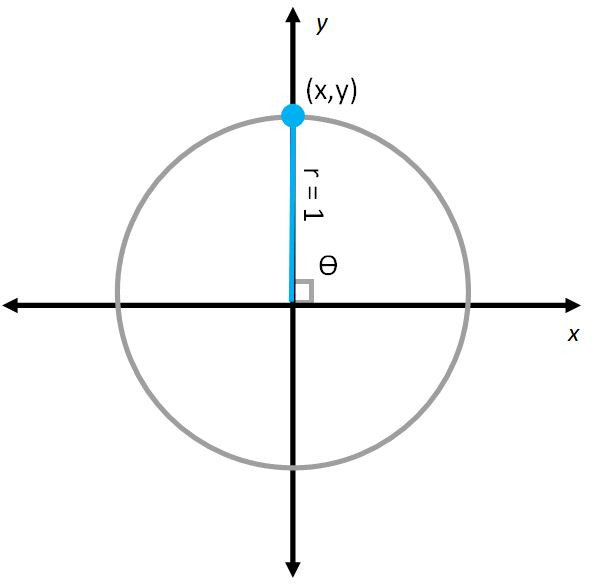
Since the length of the radius is 1, the point that corresponds to our central angle of $90^\circ$ is (0,1). Therefore $$\cos(\theta) = x$$ $$\Rightarrow \cos(90^\circ) = 0$$ and $$\sin(\theta) = y$$ $$\Rightarrow \sin(90^\circ) = 1$$
Find the sine and cosine of $180^\circ$.
Let's jump right into our picture on the unit circle:

So, the coordinates that correspond with our $180^\circ$ central angle are $(-1,0)$, meaning $$\cos(180^\circ) = -1$$ and $$\sin(180^\circ) = 0$$
To help with visualizing the relationships between the sine and cosine of reference triangles and sine and cosine defined as circular functions, you can play around with this interactive demonstration:
In particular, look at what happens with a central angle of $0^\circ$. Drag the point on the unit circle down until it rests on the positive x-axis, watching the reference triangle as you go. Think about the cosine of $\theta$ in that triangle, the ratio of the adjacent side and the hypotenuse. As we drag the point down, the hypotenuse and adjacent sides get closer and closer to the same length until they are the same length. Therefore, we end up with a cosine of 1!
Similarly, if we think about the sine of that reference angle, we look at the opposite side and the hypotenuse. As we drag that point towards the positive x-axis, the opposite side gets smaller and smaller until it vanishes to 0. Therfore the sine ends up being 0!
Special Right Triangles
Now we turn towards a large memorization task. In Section 4.2, we learned about the sines and cosines of some special angles ($30^\circ$, $60^\circ$, and $45^\circ$).
Sines and Cosines of Special Angles
$$\sin(30^\circ) = \sin\left(\frac{\pi}{6}\right) = \frac{1}{2}$$ $$\cos(30^\circ) = \cos\left(\frac{\pi}{6}\right) = \frac{\sqrt{3}}{2}$$
$$\sin(60^\circ) = \sin\left(\frac{\pi}{3}\right) = \frac{\sqrt{3}}{2}$$ $$\cos(60^\circ) = \cos\left(\frac{\pi}{3}\right) = \frac{1}{2}$$
$$\sin(45^\circ) = \sin\left(\frac{\pi}{4}\right) = \frac{\sqrt{2}}{2}$$ $$\cos(45^\circ) = \cos\left(\frac{\pi}{4}\right) = \frac{\sqrt{2}}{2}$$
We're going to use these special values and the properties of the unit circle to construct a cheat sheet of sorts with all of the most common angles and their sine and cosine values. Let's begin with the $30^\circ$ (aka $\frac{\pi}{6}$) angle values:

From the properties of special triangles, we know that the $\cos(30^\circ) = \frac{\sqrt{3}}{2}$ and $\sin(30^\circ) = \frac{1}{2}$, so we can label the point of intersection of the terminal side and the unit circle as $\left(\frac{\sqrt{3}}{2}, \frac{1}{2}\right)$. That also tells us that the length of the horizontal leg is $\frac{\sqrt{3}}{2}$ and the length of the vertical leg is $\frac{1}{2}$.

Now, let's reflect that triangle across the y-axis. We'll then have a reference angle of $30^\circ$ in QII, which corresponds to an angle of $180-30 = 150^\circ$ in standard position. Because of the reflection, we know that the point of intersection of the terminal side and the unit circle will be $\left(-\frac{\sqrt{3}}{2}, \frac{1}{2}\right)$, since our point is to the left of the origin and above the x-axis! So, then, we know $\cos(150^\circ) = -\frac{\sqrt{3}}{2}$ and $\sin(150^\circ) = \frac{1}{2}$. Convert to radians, and we have $\cos\left(\frac{5\pi}{6}\right) = -\frac{\sqrt{3}}{2}$ and $\sin\left(\frac{5\pi}{6}\right) = \frac{1}{2}$.

We continue reflecting this triangle around to quadrants III and IV, and we have the beginnings of our special values cheat sheet! In Quadrant III, our reference of $30^\circ$ gives us a standard angle of $180+30 = 210^\circ$, which is $\frac{7\pi}{6}$ radians. In Quadrant IV, we have $360 - 30 = 330^\circ$ or $\frac{11\pi}{6}$ radians. Using the fact that the x- and y-coordinates are both negative in QIII, and only the y's are negative in QIV, we then have $$\cos(210^\circ) = \cos\left(\frac{7\pi}{6}\right) = -\frac{\sqrt{3}}{2}$$ $$\sin(210^\circ) = \sin\left(\frac{7\pi}{6}\right) = -\frac{1}{2}$$ $$\cos(330^\circ) = \cos\left(\frac{11\pi}{6}\right) = \frac{\sqrt{3}}{2}$$ $$\sin(330^\circ) = \sin\left(\frac{11\pi}{6}\right) = -\frac{1}{2}$$

As we continue building up our key unit circle values, the unit circle itself will become a shortcut way of remembering these important cosine and sine values. Eventually, we want to commit all of these important values to memory for quickier and easier calculations in our math futures.
Using the properties of the unit circle, find the cosine and sine values of the angles with a $60^\circ$ reference angle in each quadrant

Using the properties of the unit circle, find the cosine and sine values of the angles with a $45^\circ$ reference angle in each quadrant

Now we can put this information all together, along with what we've learned about quadrantal angles, to create our Unit Circle with common trigonometric values!
The Unit Circle with Trigonometric Values for Special Angles

For a more interactive (and accessible for screen readers) version of this information, check out this geogebra illustration.
Note that in the coming sections, we will be shifting our focus to thinking in terms of radians rather than in degrees, so all of the angles in this reference unit circle are labelled with radians, while only the quadrantal and QI angles also are labelled with their degree measures.
For some tips about how to efficiently memorize these special trigonometric values, check out this video:
Once we have these special angles memorized on the unit circle, we can quickly figure out their cosine and sine values. For instance, consider $\frac{7\pi}{4}$. Find that spoke on the unit circle; the corresonding coordinates are $\left(\frac{\sqrt{2}}{2}, -\frac{\sqrt{2}}{2}\right)$, so $\cos\left(\frac{7\pi}{4}\right) = \frac{\sqrt{2}}{2}$ and $\sin\left(\frac{7\pi}{4}\right) = -\frac{\sqrt{2}}{2}$.
Practice as many special unit circle values as you can!
Moving Beyond the Unit Circle
Now that we have these basic special angles memorized (or on the way to being memorized), we can work on finding the values of trigonometric functions of coterminal angles.
Find the exact value of $\sin\left(\frac{14\pi}{3}\right)$
$\frac{14\pi}{3}$ is simply too big for us to deal with right now, so let's find a smaller coterminal angle: $$\frac{14\pi}{3} - 2\pi$$ $$=\frac{14\pi}{3} - \frac{6\pi}{3}$$ $$= \frac{11\pi}{3}$$ Still too big! Let's go smaller... $$\frac{11\pi}{3} - \frac{6\pi}{3}$$ $$= \frac{5\pi}{3}$$ That's an angle we recognize from our common unit circle values! Since this is coterminal with our original angle, $$\sin\left(\frac{14\pi}{3}\right) = \sin\left(\frac{5\pi}{3}\right) = -\frac{\sqrt{3}}{2}$$
Find the exact value of $\cos\left(-\frac{5\pi}{6}\right)$
Again, we start with finding a positive coterminal angle: $$-\frac{5\pi}{6}+2\pi$$ $$=-\frac{5\pi}{6}+\frac{12\pi}{6}$$ $$= \frac{7\pi}{6}$$ So we have $$\cos\left(-\frac{5\pi}{6}\right) = \cos\left(\frac{7\pi}{6}\right) = -\frac{\sqrt{3}}{2}$$
So far, we define the sine and cosine functions using the Unit Circle, $x^2+y^2=1$. It turns out that we can use any circle centered at the origin to determine the sine and cosine values of angles. To show this, we essentially recycle the same similarity arguments to show the trigonometric ratios described so far are independent of the choice of right triangle used.
Consider for the moment the acute angle $\theta$ drawn below in standard position. Let $Q(x,y)$ be the point on the terminal side of $\theta$ which lies on the circle $x^2+y^2 = r^2$, and let $P(x',y')$ be the point on the terminal side of $\theta$ which lies on the Unit Circle. Now consider dropping perpendiculars from $P$ and $Q$ to create two right triangles, $\Delta OPA$ and $\Delta OQB$. These triangles are similar, thus it follows that $\frac{x}{x'} = \frac{r}{1} = r$, so $x = r x'$ and, similarly, we find $y = r y'$. Since, by definition, $x' = \cos(\theta)$ and $y' = \sin(\theta)$, we get the coordinates of $Q$ to be $x = r \cos(\theta)$ and $y = r \sin(\theta)$. By reflecting these points through the $x$-axis, $y$-axis and origin, we obtain the result for all non-quadrantal angles $\theta$, and we leave it to the reader to verify these formulas hold for the quadrantal angles as well.
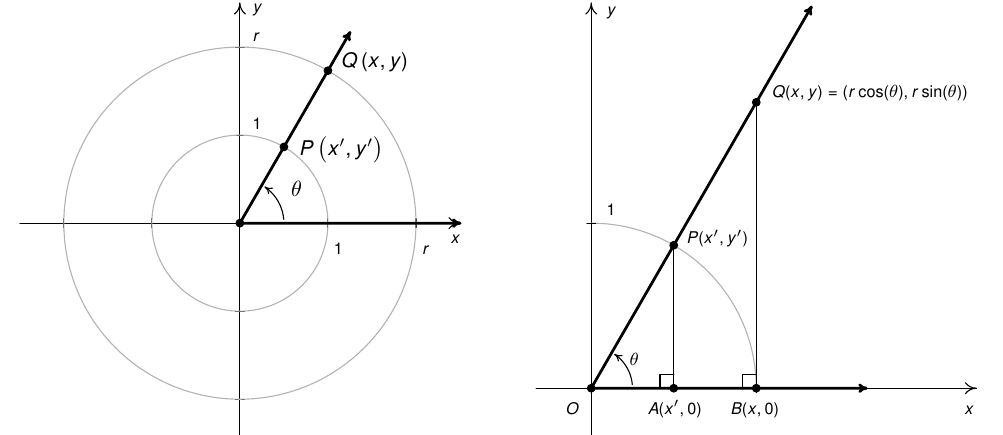
Not only can we describe the coordinates of $Q$ in terms of $\cos(\theta)$ and $\sin(\theta)$ but since the radius of the circle is $r = \sqrt{x^2 + y^2}$, we can also express $\cos(\theta)$ and $\sin(\theta)$ in terms of the coordinates of $Q$. These results are summarized in the following theorem.
If $Q(x,y)$ is the point on the terminal side of an angle $\theta$, plotted in standard position, which lies on the circle $x^2+y^2 = r^2$ then $x = r \cos(\theta)$ and $y = r \sin(\theta)$. Moreover,
\[\begin{array}{ccc} \cos(\theta)= \dfrac{x}{r} = \dfrac{x}{\sqrt{x^2+y^2}} & \text{and} & \sin(\theta) = \dfrac{y}{r} = \dfrac{y}{\sqrt{x^2+y^2}} \\ \end{array} \]
Suppose that the terminal side of an angle $\theta$, when plotted in standard position, contains the point $Q(4,-2)$. Find $\sin(\theta)$ and $\cos(\theta)$.
Since we are given both the $x$ and $y$ coordinates of a point on the terminal side of this angle, we can use our theorem directly. First, we find $r = \sqrt{x^2+y^2} = \sqrt{(-2)^2+4^2} = \sqrt{20} = 2\sqrt{5}$. This means the point $Q$ lies on a circle of radius $2\sqrt{5}$ units as seen below on the left. Hence, $\cos(\theta) = \frac{x}{r} = \frac{4}{2 \sqrt{5}} = \frac{2 \sqrt{5}}{5}$ and $\sin(\theta) = \frac{y}{r} = \frac{-2}{2 \sqrt{5}} = -\frac{\sqrt{5}}{5}$.
Suppose $\frac{\pi}{2} \lt \theta \lt \pi$ with $\sin(\theta) = \frac{8}{17}$. Find $\cos(\theta)$.
We are told $\frac{\pi}{2} \lt \theta \lt \pi$, so, in particular, $\theta$ is a Quadrant II angle. Per our theorem, $\sin(\theta) = \frac{8}{17} = \frac{y}{r}$ where $y$ is the $y$-coordinate of the intersection point of the circle $x^2+y^2 = r^2$ and the terminal side of $\theta$ (when plotted in standard position, of course!) For convenience, we choose $r=17$ so that $y = 8$, and we get the diagram below on the right. Since $x^2+y^2 = r^2$, we get $x^2 + 8^2 = 17^2$. We find $x = \pm 15$, and since $\theta$ is a Quadrant II angle, we get $x = -15$. Hence, $\cos(\theta) = -\frac{15}{17}$.
Fundamental Trigonometric Identities
Now with the Unit Circle in hand, we can go about establishing some fundamental identities. Recall that the equation for the unit circle is $x^2+y^2=1$. Because $x = \cos(\theta)$ and $y = \sin(\theta)$, we can substitute these trigonometric functions into the equation of the unit circle for $x$ and $y$: $$\textcolor{blue}{x^2}+\textcolor{red}{y^2} = 1$$ $$\textcolor{blue}{(\cos(\theta))^2}+\textcolor{red}{(\sin(\theta))^2} = 1$$
It is common practice to write structures like $(\cos(\theta))^2$ as $\cos^2(\theta))$, so we finish by rewriting this equation as $$\textcolor{blue}{\cos^2(\theta)}+\textcolor{red}{\sin^2(\theta)} = 1$$
The nifty, revolutionary, thing about this equation is that it's true for any real value of $\theta$! So, we know that $$\cos^2\left(\frac{\pi}{6}\right)+\sin^2\left(\frac{\pi}{6}\right) = 1$$ and $$\cos^2\left(\sqrt{87}\right) + \sin^2\left(\sqrt{87}\right) = 1$$ and so on.
Because it's so revolutionary, we name this identity; since we can connect it to the Pythagorean Theorem when we're thinking about right triangles, we call it the Pythagorean Identity.
The Pythagorean Identity
For any real number $\theta$, $$\cos^2(\theta) + \sin^2(\theta) = 1$$
If $\sin(\theta) = \frac{3}{7}$, and the terminal side of $\theta$ is in the second quadrant, find $\cos(\theta)$.
According to the Pythagorean Identity, $$\cos^2(\theta) + \sin^2(\theta) = 1$$ So, we can substitute in $\frac{3}{7}$ in place of $\sin(\theta)$: $$\cos^2(\theta) + \left(\frac{3}{7}\right)^2 = 1$$ $$\cos^2(\theta) + \frac{9}{49} = 1$$ $$\cos^2(\theta) = 1 - \frac{9}{49}$$ $$\cos^2(\theta) = \frac{40}{49}$$ Now things get a little interesting. If we apply the square root to both sides of this equation, we have: $$\sqrt{\cos^2(\theta)} = \sqrt{\frac{40}{49}}$$ $$|\cos(\theta)| = \frac{\sqrt{40}}{7}$$ $$\cos(\theta) = \frac{\sqrt{40}}{7} \text{ or } -\frac{\sqrt{40}}{7}$$ Well which one is it? We're talking about a specific angle $\theta$ here, so the cosine can't be both positive and negative $\frac{\sqrt{40}}{7}$; cosine is a function afterall. We need to look at the other piece of given information to make a decision: the terminal side of $\theta$ is in the second quadrant. In the second quadrant, the cosine of an angle is always negative (think about the fact that x-coordinates are negative in the second quadrant), so our final answer is $$\cos(\theta) = -\frac{\sqrt{40}}{7}$$
Using the Pythagorean Identity to solve for a $\sin(\theta)$ given $\cos(\theta)$ or vice versa
- Substitute the known value into the Pythagorean Identity.
- Solve for the unknown value.
- Choose the appropriate sign for the solution based on the quadrant in which the terminal side of the angle is located.
If $\cos(t) = \frac{4}{5}$ and the terminal side of $t$ is located in the fourth quadrant, find $\sin(t)$.
1. Substitute the known value into the Pythagorean Identity. $$\left(\frac{4}{5}\right)^2 + \sin^2(t) = 1$$ 2. Solve for the unknown value. $$\frac{16}{25} + \sin^2(t) = 1$$ $$\sin^2(t) = \frac{9}{25}$$ $$\sin(t) = \pm \frac{3}{5}$$ 3. Choose the appropriate sign for the solution based on the quadrant in which the terminal side of the angle is located.
Since the terminal side of $t$ is located in the fourth quadrant, the sine (y-values) should be negative, so our final answer is $$\sin(t) = -\frac{3}{5}$$
Practice Problems
1. Describe the unit circle.
2. What do the x- and y-coordinates of the points on the unit circle represent?
For the following exercises, use the given sign of the sine and cosine functions to find the quadrant in which the terminal point determined by $\theta$ lies.
3. $\sin(\theta) \lt 0$ and $\cos(\theta)\lt 0$
4. $\sin(\theta) \gt 0$ and $\cos(\theta) \gt 0$
5. $\sin(\theta) \gt 0$ and $\cos(\theta) \lt 0$
6. $\sin(\theta) \lt 0$ and $\cos(\theta) \gt 0$
3. QIII
4. QI
5. QII
6. QIV
In the following exercises, find the exact value of the cosine and sine of the given angle.
7. $\theta = 0$
8. $\theta = \dfrac{\pi}{4}$
9. $\theta = \dfrac{\pi}{3}$
10. $\theta = \dfrac{\pi}{2}$
11. $\theta = \dfrac{2\pi}{3}$
12. $\theta = \dfrac{3\pi}{4}$
13. $\theta = \pi$
14. $\theta = \dfrac{7\pi}{6}$
15. $\theta = \dfrac{5\pi}{4}$
16. $\theta = \dfrac{4\pi}{3}$
17. $\theta = \dfrac{3\pi}{2}$
18. $\theta = \dfrac{5\pi}{3}$
19. $\theta = \dfrac{7\pi}{4}$
20. $\theta = \dfrac{23\pi}{6}$
21. $\theta = -\dfrac{13\pi}{2}$
22. $\theta = -\dfrac{43\pi}{6}$
23. $\theta = -\dfrac{3\pi}{4}$
24. $\theta = -\dfrac{\pi}{6}$
25. $\theta = \dfrac{10\pi}{3}$
26. $\theta = 117\pi$
7. $\cos(0) = 1$, $\; \sin(0) = 0$
8. $\cos \left(\dfrac{\pi}{4} \right) = \dfrac{\sqrt{2}}{2}$, $\; \sin \left(\dfrac{\pi}{4} \right) = \dfrac{\sqrt{2}}{2}$
9. $\cos \left(\dfrac{\pi}{3}\right) = \dfrac{1}{2}$, $\; \sin \left(\dfrac{\pi}{3}\right) = \dfrac{\sqrt{3}}{2}$
10. $\cos \left(\dfrac{\pi}{2}\right) = 0$, $\; \sin \left(\dfrac{\pi}{2}\right) = 1$
11. $\cos\left(\dfrac{2\pi}{3}\right) = -\dfrac{1}{2}$, $\; \sin \left(\dfrac{2\pi}{3}\right) = \dfrac{\sqrt{3}}{2}$
12. $\cos \left(\dfrac{3\pi}{4} \right) = -\dfrac{\sqrt{2}}{2}$, $\; \sin \left(\dfrac{3\pi}{4} \right) = \dfrac{\sqrt{2}}{2}$
13. $\cos(\pi) = -1$, $\; \sin(\pi) = 0$
14. $\cos\left(\dfrac{7\pi}{6}\right) = -\dfrac{\sqrt{3}}{2}$, $\; \sin\left(\dfrac{7\pi}{6}\right) = -\dfrac{1}{2}$
15. $\cos \left(\dfrac{5\pi}{4} \right) = -\dfrac{\sqrt{2}}{2}$, $\; \sin \left(\dfrac{5\pi}{4} \right) = -\dfrac{\sqrt{2}}{2}$
16. $\cos\left(\dfrac{4\pi}{3}\right) = -\dfrac{1}{2}$, $\; \sin \left(\dfrac{4\pi}{3}\right) = -\dfrac{\sqrt{3}}{2}$
17. $\cos \left(\dfrac{3\pi}{2}\right) = 0$, $\; \sin \left(\dfrac{3\pi}{2}\right) = -1$
18. $\cos\left(\dfrac{5\pi}{3}\right) = \dfrac{1}{2}$, $\; \sin \left(\dfrac{5\pi}{3}\right) = -\dfrac{\sqrt{3}}{2}$
19. $\cos \left(\dfrac{7\pi}{4} \right) = \dfrac{\sqrt{2}}{2}$, $\; \sin \left(\dfrac{7\pi}{4} \right) = -\dfrac{\sqrt{2}}{2}$
20. $\cos\left(\dfrac{23\pi}{6}\right) = \dfrac{\sqrt{3}}{2}$, $\; \sin\left(\dfrac{23\pi}{6}\right) = -\dfrac{1}{2}$
21. $\cos \left(-\dfrac{13\pi}{2}\right) = 0$, $\; \sin \left(-\dfrac{13\pi}{2}\right) = -1$
22. $\cos\left(-\dfrac{43\pi}{6}\right) = -\dfrac{\sqrt{3}}{2}$, $\; \sin\left(-\dfrac{43\pi}{6}\right) = \dfrac{1}{2}$
23. $\cos \left(-\dfrac{3\pi}{4} \right) = -\dfrac{\sqrt{2}}{2}$, $\; \sin \left(-\dfrac{3\pi}{4} \right) = -\dfrac{\sqrt{2}}{2}$
24. $\cos\left(-\dfrac{\pi}{6}\right) = \dfrac{\sqrt{3}}{2}$, $\; \sin\left(-\dfrac{\pi}{6}\right) = -\dfrac{1}{2}$
25. $\cos\left(\dfrac{10\pi}{3}\right) = -\dfrac{1}{2}$, $\; \sin \left(\dfrac{10\pi}{3}\right) = -\dfrac{\sqrt{3}}{2}$
26. $\cos(117\pi) = -1$, $\; \sin(117\pi) = 0$
In the following exercises, let $\theta$ be the angle in standard position whose terminal side contains the given point then compute $\cos(\theta)$ and $\sin(\theta)$.
27. $P(-7, 24)$
28. $Q(3, 4)$
29. $R(5, -9)$
30. $T(-2, -11)$
27. $\cos(\theta) = -\dfrac{7}{25}, \; \sin(\theta) = \dfrac{24}{25}$
28. $\cos(\theta) = \dfrac{3}{5}, \; \sin(\theta) = \dfrac{4}{5}$
29. $\cos(\theta) = \dfrac{5\sqrt{106}}{106}, \; \sin(\theta) = -\dfrac{9\sqrt{106}}{106}$
30. $\cos(\theta) = -\dfrac{2\sqrt{5}}{25}, \; \sin(\theta) = -\dfrac{11\sqrt{5}}{25}$
31. If $\sin(\theta) = -\dfrac{7}{25}$ with $\theta$ in Quadrant IV, what is $\cos(\theta)$?
32. If $\cos(\theta) = \dfrac{4}{9}$ with $\theta$ in Quadrant I, what is $\sin(\theta)$?
33. If $\sin(\theta) = \dfrac{5}{13}$ with $\theta$ in Quadrant II, what is $\cos(\theta)$?
34. If $\cos(\theta) = -\dfrac{2}{11}$ with $\theta$ in Quadrant III, what is $\sin(\theta)$?
35. If $\sin(\theta) = -\dfrac{2}{3}$ with $\theta$ in Quadrant III, what is $\cos(\theta)$?
36. If $\cos(\theta) = \dfrac{28}{53}$ with $\theta$ in Quadrant IV, what is $\sin(\theta)$?
37. If $\sin(\theta) = \dfrac{2\sqrt{5}}{5}$ and $\dfrac{\pi}{2} \lt \theta \lt \pi$, what is $\cos(\theta)$?
38. If $\cos(\theta) = \dfrac{\sqrt{10}}{10}$ and $2\pi \lt \theta \lt \dfrac{5\pi}{2}$, what is $\sin(\theta)$?
39. If $\sin(\theta) = -0.42$ and $\pi \lt \theta \lt \dfrac{3\pi}{2}$, what is $\cos(\theta)$?
40. If $\cos(\theta) = -0.98$ and $\dfrac{\pi}{2} \lt \theta \lt \pi$, what is $\sin(\theta)$?
31. If $\sin(\theta) = -\dfrac{7}{25}$ with $\theta$ in Quadrant IV, then $\cos(\theta) = \dfrac{24}{25}$.
32. If $\cos(\theta) = \dfrac{4}{9}$ with $\theta$ in Quadrant I, then $\sin(\theta) = \dfrac{\sqrt{65}}{9}$.
33. If $\sin(\theta) = \dfrac{5}{13}$ with $\theta$ in Quadrant II, then $\cos(\theta) = -\dfrac{12}{13}$.
34. If $\cos(\theta) = -\dfrac{2}{11}$ with $\theta$ in Quadrant III, then $\sin(\theta) = -\dfrac{\sqrt{117}}{11}$.
35. If $\sin(\theta) = -\dfrac{2}{3}$ with $\theta$ in Quadrant III, then $\cos(\theta) = -\dfrac{\sqrt{5}}{3}$.
36. If $\cos(\theta) = \dfrac{28}{53}$ with $\theta$ in Quadrant IV, then $\sin(\theta) = -\dfrac{45}{53}$.
37. If $\sin(\theta) = \dfrac{2\sqrt{5}}{5}$ and $\dfrac{\pi}{2} \lt \theta \lt \pi$, then $\cos(\theta) = -\dfrac{\sqrt{5}}{5}$.
38. If $\cos(\theta) = \dfrac{\sqrt{10}}{10}$ and $2\pi \lt \theta \lt \dfrac{5\pi}{2}$, then $\sin(\theta) = \dfrac{3 \sqrt{10}}{10}$.
39. If $\sin(\theta) = -0.42$ and $\pi \lt \theta \lt \dfrac{3\pi}{2}$, then $\cos(\theta) = -\sqrt{0.8236} \approx -0.9075$.
40. If $\cos(\theta) = -0.98$ and $\dfrac{\pi}{2} \lt \theta \lt \pi$, then $\sin(\theta) = \sqrt{0.0396} \approx 0.1990$.
Homework Set
Evaluate using the unit circle. Give exact answers.
- $\sin\left(\frac{3\pi}{4}\right)$
- $\cos\left(\frac{5\pi}{6}\right)$
- $\tan\left(\frac{2\pi}{3}\right)$
- $\csc\left(\frac{3\pi}{4}\right)$
- $\sin\left(0\right)$
- $\sin\left(\frac{\pi}{3}\right)$
- $\cos\left(\frac{\pi}{4}\right)$
- $\sin\left(\frac{3\pi}{2}\right)$
- $\sin\left(\frac{7\pi}{6}\right)$
- $\cos\left(\frac{4\pi}{3}\right)$
- $\cot\left(\frac{4\pi}{3}\right)$
- $\cos\left(\frac{\pi}{2}\right)$
- $\sec\left(\frac{7\pi}{6}\right)$
- $\cos\left(\frac{\pi}{6}\right)$
- $\cos\left(\pi\right)$
- $\sin\left(-\frac{3\pi}{4}\right)$
- $\cos\left(\frac{25\pi}{6}\right)$
- $\cos\left(-\frac{\pi}{3}\right)$