Section 6.3: Double and Half Angle Identities
Learning Objectives
In this section you will:
- Derive and Apply the Double Angle Identities
- Derive and Apply the Angle Reduction Identities
- Derive and Apply the Half Angle Identities
The Double Angle Identities
We'll dive right in and create our next set of identities, the double angle identities. All of these can be found by applying the sum identities from last section.Let's start with cosine.
$$\cos(2\theta)$$ $$\cos(2\theta)=\cos(\theta+\theta)$$ $$\cos(2\theta)=\cos(\theta)\cos(\theta) - \sin(\theta)\sin(\theta)$$ $$\cos(2\theta)=\cos^2(\theta) - \sin^2(\theta)*$$
It's quite common to also use the Pythagorean identity to rewrite this in a couple of other ways. If we take $\cos^2(\theta) + \sin^2(\theta) = 1$ and solve for $\sin^2(\theta)$, we have $\sin^2(\theta) = 1 - \cos^2(\theta)$. Substituting this into our double angle formula (marked with a *), we get $$\cos(2\theta) = \cos^2(\theta) - (1 - \cos^2(\theta)$$ $$\cos(2\theta)= \cos^2(\theta) - 1 + \cos^2(\theta)$$ $$\cos(2\theta)=2\cos^2(\theta) - 1.$$
We can also rearrange the Pythagorean identity by solving for $\cos^2(\theta)$ to get $\cos^2(\theta) = 1 - \sin^2(\theta)$. Then * becomes $$\cos(2\theta) = 1 - \sin^2(\theta) - \sin^2(\theta)$$ $$\cos(2\theta) = 1 - 2\sin^2(\theta).$$
The sine double angle identity has less variety. We again start with the sum identity to build this new double angle identity.
$$\sin(2\theta)$$ $$\sin(2\theta)=\sin(\theta+\theta)$$ $$\sin(2\theta)=\sin(\theta)\cos(\theta)+\cos(\theta)\sin(\theta)$$ $$\sin(2\theta)=2\sin(\theta)\cos(\theta)$$
We summarize the identities here. Next we'll work on using them!
The Double Angle Identities
For all angles $\theta$...
$\cos(2\theta) = \left\{ \begin{array}{l} \cos^{2}(\theta) - \sin^{2}(\theta)\\ 2\cos^{2}(\theta) - 1 \\ 1-2\sin^{2}(\theta) \end{array} \right.$
$\sin(2\theta) = 2\sin(\theta)\cos(\theta)$
Suppose $P(-3,4)$ lies on the terminal side of $\theta$ when $\theta$ is plotted in standard position. Find $\cos(2\theta)$ and $\sin(2\theta)$ and determine the quadrant in which the terminal side of the angle $2\theta$ lies when it is plotted in standard position.
We sketch the terminal side of $\theta$ below. We think of a reference triangle formed with $x = -3$ and $y = 4$, so the hypotenuse is $$(-3)^2+4^2 = r^2$$ $$9 + 16 = r^2$$ $$r^2 = 25$$ $$r = 5$$ Hence, $\cos(\theta) = -\frac{3}{5}$ and $\sin(\theta) = \frac{4}{5}$.
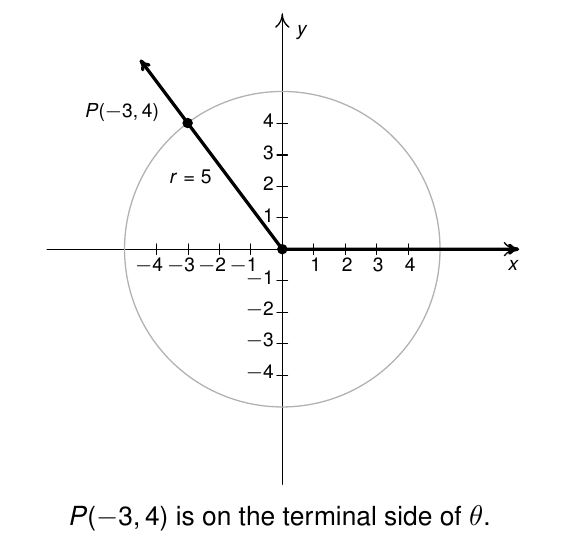
Our cosine double angle identities give us three different formulas to choose from to find $\cos(2\theta)$. Using the first formula, we get: $\cos(2\theta) = \cos^{2}(\theta) - \sin^{2}(\theta) = \left(-\frac{3}{5}\right)^2 - \left(\frac{4}{5}\right)^2 = -\frac{7}{25}$. For $\sin(2\theta)$, we get $\sin(2\theta) = 2 \sin(\theta) \cos(\theta) = 2 \left(\frac{4}{5}\right)\left(-\frac{3}{5}\right) = -\frac{24}{25}$.
Since both cosine and sine of $2\theta$ are negative, the terminal side of $2\theta$, when plotted in standard position, lies in Quadrant III.
Given that $\tan(\theta) = -\frac{3}{4}$ and $\frac{\pi}{2}<\theta<\pi$, find the following:
a. $\sin(2\theta)$
b. $\cos(2\theta)$
c. $\tan(2\theta)$
We can draw a reference triangle with this tangent and use it to find the sine and cosine of $\theta$. Not that since $\frac{\pi}{2}<\theta<\pi$, the terminal side of $\theta$ falls in QII.

The hypotenuse of this triangle is $$r^2 = (-4)^2+3^2$$ $$r^2 = 16 +9$$ $$r^2 = 25$$ $$r = 5$$ so $\sin(\theta) = \frac{3}{5}$ and $\cos(\theta) = -\frac{4}{5}$. Now we have everything we need to answer the rest of the question.
$$\sin(2\theta) = 2\sin(\theta)\cos(\theta)$$ $$\sin(2\theta=2\left(\frac{3}{5}\right)\left(-\frac{4}{5}\right)$$ $$\sin(2\theta=-\frac{24}{25}$$
$$\cos(2\theta) = \cos^2(\theta) - \sin^2(\theta)$$ $$\cos(2\theta) = \left(-\frac{4}{5}\right)^2 - \left(\frac{3}{5}\right)^2$$ $$\cos(2\theta) = \frac{16}{25}-\frac{9}{25}$$ $$\cos(2\theta) = \frac{7}{25}$$
$$\tan(2\theta) = \frac{\sin(2\theta)}{\cos(2\theta)}$$ $$\tan(2\theta) = \frac{-24/25}{7/25}$$ $$\tan(2\theta) = \frac{-24}{7}$$
Evaluate $\sin\left(2\arccos\left(\frac{1}{6}\right)\right)$
In order to wrap our heads around what's going on here, we'll first rename the arctrig portion of the expression. Let $x = \arccos\left(\frac16\right)$. That tells us a few things:
- The angle $x$ must be between $0$ and $\pi$.
- $\cos(x) = \frac16$
- Since the cosine is positive and $x$ is between $0$ and $\pi$, we can narrow our range to conclude that $x$ falls in quadrant I, that is, $0 \leq x \leq \frac{\pi}{2}$.
Now, let's return to our original question. We want to find $\sin\left(2\textcolor{blue}{\arccos\left(\frac16\right)}\right)$, and since we let $\textcolor{blue}{x = \arccos\left(\frac16\right)}$, we can rewrite our question as $\sin\left(2\textcolor{blue}{x}\right)$. According to our shiny new double angle identities, $\sin(2x) = 2\sin(x)\cos(x)$. We know that $\cos(x) = \frac16$, but we still need to find the value of $\sin(x)$. Since $x$ falls in quadrant I, we at least know that this sine value should be positive. We can draw a triangle or use the Pythagorean Identity to find the value of $\sin(x)$. $$\cos^2(x) + \sin^2(x) = 1$$ $$\left(\frac16\right)^2 + \sin^2(x) = 1$$ $$\frac{1}{36} + \sin^2(x) = \frac{36}{36}$$ $$\sin^2(x) = \frac{35}{36}$$ $$\sin(x) = \pm \sqrt{\frac{35}{36}}$$ $$\sin(x) = + \frac{\sqrt{35}}{6} \text{ (positive since x falls in QI)}$$ It's time to wrap this up! $$\sin\left(2\textcolor{blue}{\arccos\left(\frac16\right)}\right)$$ $$= \sin\left(2\textcolor{blue}{x}\right)$$ $$=2\sin(x)\cos(x)$$ $$=2\left(\frac{\sqrt{35}}{6}\right)\left(\frac16\right)$$ $$=\frac{2\sqrt{35}}{36}$$
Simplify.
$$\frac{2\tan(\theta)}{1+\tan^2(\theta)}$$$$\begin{array}{ll} \frac{2\tan(\theta)}{1+\tan^2(\theta)} &\\ &\\ =\frac{2\tan(\theta)}{\sec^2(\theta)} &\text{Pythagorean Identity}\\ &\\ =\frac{2\sin(\theta)/\cos(\theta)}{1/\cos^2(\theta)} &\text{Quotient & Reciprocal Identities}\\ &\\ =\frac{2\sin(\theta)}{\cos(\theta)}\cdot \frac{\cos^2(\theta)}{1} &\text{Fraction division}\\ &\\ =\frac{2\sin(\theta)}{\cancel{\cos(\theta)}}\cdot \frac{\cos^\cancel{2}(\theta)}{1} &\text{Simplify}\\ &\\ =2\sin(\theta)\cos(\theta)&\\ &\\ =\sin(2\theta) &\text{Sine double angle identity}\\ \end{array}$$
Verify the identity.
$$\frac{\sin(2x)}{1+\cos(2x)}\tan^2(x)=\tan^3(x)$$$$\begin{array}{ll} \frac{\textcolor{blue}{\sin(2x)}}{1+\textcolor{red}{\cos(2x)}}\tan^2(x) &\\ &\\ =\frac{\textcolor{blue}{2\sin(x)\cos(x)}}{1+\textcolor{red}{2\cos^2(x) - 1}}\tan^2(x) &\text{Double angle identities}\\ &\\ =\frac{2\sin(x)\cos(x)}{2\cos^2(x)}\tan^2(x) &\text{Simplify}\\ &\\ =\frac{\sin(x)}{\cos(x)}\tan^2(x) &\text{Simplify}\\ &\\ =\tan(x)\tan^2(x) &\text{Quotient Identity}\\ &\\ =\tan^3(x) &\text{Simplify}\\ \end{array}$$
Verify the identity.
$$\cos(3x)=4\cos^3(x)-3\cos(x)$$We start with a clever rewrite, and then proceed with actual identities.
$$\begin{array}{ll} \cos(3x) = \cos(2x+x) &\\ &\\ =\cos(2x)\cos(x)-\sin(2x)\sin(x) &\text{cosine of a sum identity}\\ &\\ =(2\cos^2(x)-1)\cos(x)-2\sin(x)\cos(x)\sin(x) &\text{double angle identities}\\ &\\ =2\cos^3(x)-\cos(x)-2\sin^2(x)\cos(x) &\text{simplify}\\ &\\ =2\cos^3(x) - \cos(x) - 2(1-\cos^2(x))\cos(x) &\text{Pythagorean identity}\\ &\\ =2\cos^3(x)-\cos(x)-2\cos(x) + 2\cos^3(x) &\text{distribute}\\ &\\ =4\cos^3(x) - 3\cos(x)&\\ \end{array}$$
Rewrite $\cos(2\arcsin(x))$ as a function of $x$ and state the domain.
Start by writing $t = \arcsin(x)$ so that $t$ lies in the interval $\left[ -\frac{\pi}{2}, \frac{\pi}{2}\right]$ with $\sin(t) = x$. We aim to express $\cos\left(2 \arcsin(x)\right) = \cos(2t)$ in terms of $x$.
Thanks to our double angle identities, we have three choices for rewriting $\cos(2t)$: $\cos(2t) = \cos^{2}(t) - \sin^{2}(t)$, $ \cos(2t) = 2\cos^{2}(t) - 1$ and $\cos(2t) = 1 - 2\sin^{2}(t)$.
Since we know $x = \sin(t)$, we choose: $\cos\left(2 \arcsin(x)\right) = \cos(2t) = 1 - 2\sin^{2}(t) = 1 - 2x^2$. Hence, $g(x) = \cos\left(2 \arcsin(x)\right) = 1 - 2x^2$.
The domain of $\arcsin(x)$ is $[-1,1]$, and since there are no domain restrictions on cosine, the domain of $g$ is $[-1,1]$.
The Angle Reduction Identities
It turns out, an important skill in calculus is going to be taking trigonometric expressions with powers and writing them without powers. We know this is a vague goal right now, but trust us, it will be very valuable later in your math career. To accomplish this goal, we'll start by rewriting some of our double angle identities.
$$\cos(2\theta) = 2\cos^2(\theta) - 1$$
Since the idea here is to take a power and rewrite it as not-a-power, we'll isolate the $\cos^2(\theta)$ in this identity.
$$\cos(2\theta)+1 = 2\cos^2(\theta)$$ $$\cos^2(\theta) = \frac{\cos(2\theta)+1}{2}$$
Similarly, we can start with the double angle identity $\cos(2\theta) = 1 - 2\sin^2(\theta)$ and isolate the $\sin^2(\theta)$.
$$\cos(2\theta) = 1 - 2\sin^2(\theta)$$ $$\cos(2\theta)+2\sin^2(\theta) = 1$$ $$2\sin^2(\theta) = 1-\cos(2\theta)$$ $$\sin^2(\theta) = \frac{1-\cos(2\theta)}{2}$$
Because we start with a squared trig function and end without any powers, we call these the Power Reduction Formulas.
Power Reduction Formulas
For all angles $\theta$
$$\cos^{2}(\theta) = \dfrac{1 + \cos(2\theta)}{2}$$$$\sin^{2}(\theta) = \dfrac{1 - \cos(2\theta)}{2}$$
Let's do a couple of examples so that we can see these formulas in action.
Rewrite $\sin^{2}(\theta) \cos^{2}(\theta)$ as a sum and difference of cosines to the first power.
We begin with a straightforward application of the power reduction formulas:
\[ \begin{array}{rcl} \sin^{2}(\theta) \cos^{2}(\theta) & = & \left( \dfrac{1 - \cos(2\theta)}{2} \right) \left( \dfrac{1 + \cos(2\theta)}{2} \right) \\ & = & \dfrac{1}{4}\left(1 - \cos^{2}(2\theta)\right) \\ & = & \dfrac{1}{4} - \dfrac{1}{4}\cos^{2}(2\theta) \\ \end{array} \]
Next, we apply the power reduction formula to $\cos^{2}(2\theta)$ to finish the reduction
\[ \begin{array}{rcl} \sin^{2}(\theta) \cos^{2}(\theta) & = & \dfrac{1}{4} - \dfrac{1}{4}\cos^{2}(2\theta) \\ & = & \dfrac{1}{4} - \dfrac{1}{4} \left(\dfrac{1 + \cos(2(2\theta))}{2}\right) \\ & = & \dfrac{1}{4} - \dfrac{1}{8} - \dfrac{1}{8}\cos(4\theta) \\ & = & \dfrac{1}{8} - \dfrac{1}{8}\cos(4\theta) \\ \end{array} \]
Rewrite $\cos^4(x)$ as a sum and difference of cosines to the first power.
Again, we'll start with a clever rewrite, then apply the reduction formula for cosine twice.
\[\begin{array}{rclr} \cos^4(x) & = & (\cos^2(x))^2&\\ &&&\\ &=&\left(\frac{1+\cos(2x)}{2}\right)^2 &\text{Reduction Formula}\\ &&&\\ &=&\frac{1}{4}+\frac{1}{2}\cos(2x)+\frac{1}{4}\cos^2(2x) &\text{Expand}\\ \end{array}\]
We still have a power of a cosine, so we need to apply a reduction formula again. Here, we want to think of the $\theta$ as being 2x, so $\cos^2(\theta) = \frac{1+\cos(2\theta)}{2}$ will be $\cos^2(2x) = \frac{1+\cos(2\cdot 2x)}{2}$ when we apply the reduction formula.
\[\begin{array}{rclr} &=&\frac{1}{4}+\frac{1}{2}\cos(2x)+\frac{1}{4}\left(\frac{1+\cos(4x)}{2}\right)&\text{reduction formula}\\ &&&\\ &=&\frac{1}{4}+\frac{1}{2}\cos(2x)+\frac{1}{8}+\frac{1}{8}\cos(4x)&\text{distribute}\\ &&&\\ &=&\frac{3}{8}+\frac{1}{2}\cos(2x)+\frac{1}{8}\cos(4x)&\text{Combine like terms}\\ \end{array}\]
The Half Angle Identities
Another application of the Power Reduction Formulas is the Half Angle Formulas. To start, we apply the Power Reduction Formula to$\cos^{2}\left(\frac{\theta}{2}\right)$ \[ \cos^{2}\left(\dfrac{\theta}{2}\right) = \dfrac{1 + \cos\left(2 \left(\frac{\theta}{2}\right)\right)}{2} = \dfrac{1 + \cos(\theta)}{2}.\]
We can obtain a formula for $\cos\left(\frac{\theta}{2}\right)$ by extracting square roots. In a similar fashion, we may obtain a half angle formula for sine, and by using a quotient formula, obtain a half angle formula for tangent.
Half Angle Identities
For all angles $\theta$,
$$\cos\left(\dfrac{\theta}{2}\right) = \pm \sqrt{\dfrac{1 + \cos(\theta)}{2}}$$ $$\sin\left(\dfrac{\theta}{2}\right) = \pm \sqrt{\dfrac{1 - \cos(\theta)}{2}}$$where the choice of $\pm$ depends on the quadrant in which the terminal side of $\dfrac{\theta}{2}$ lies.
Use a half angle formula to find the exact value of $\cos\left(\frac{\pi}{12}\right)$.
To use the half angle formula, we note that $\frac{\pi}{12}= \frac{\frac{\pi}{6}}{2}$ and since $\frac{\pi}{12}$ is a Quadrant I angle, its cosine is positive. Thus we have
\[ \begin{array}{rcl} \cos\left(\frac{\pi}{12}\right) & = & + \sqrt{\dfrac{1+\cos\left(\frac{\pi}{6}\right)}{2}} = \sqrt{\dfrac{1+\frac{\sqrt{3}}{2}}{2}}\\ & = & \sqrt{\dfrac{1+\frac{\sqrt{3}}{2}}{2}\cdot \dfrac{2}{2}} = \sqrt{\dfrac{2+\sqrt{3}}{4}} = \dfrac{\sqrt{2+\sqrt{3}}}{2}\\ \end{array}\]
Back in Section 6.2, we found $\cos\left(15^{\circ}\right) = \frac{\sqrt{6}+ \sqrt{2}}{4}$ by using the difference formula for cosine. The reader is encouraged to prove that these two expressions are equal algebraically.
Suppose $-\pi\leq t \leq 0$ with $\cos(t) = -\frac{3}{5}$. Find $\sin\left(\frac{t}{2}\right)$.
If $-\pi \leq t \leq 0$, then $-\frac{\pi}{2} \leq \frac{t}{2} \leq 0$, which means $ \frac{t}{2}$ corresponds to a Quadrant IV angle. Hence, $\sin\left(\frac{t}{2}\right) < 0$, so we choose the negative root formula from our half angle identities: \[ \begin{array}{rcl} \sin\left(\dfrac{t}{2} \right) & = & -\sqrt{\dfrac{1-\cos\left(t \right)}{2}} = -\sqrt{\dfrac{1- \left(-\frac{3}{5}\right)}{2}}\\ & = & -\sqrt{\dfrac{1 + \frac{3}{5}}{2} \cdot \dfrac{5}{5}} = -\sqrt{\dfrac{8}{10}} = -\dfrac{2\sqrt{5}}{5}\\ \end{array}\]
Given that $\tan(\alpha) = \frac{8}{15}$ and that the terminal side of $\alpha$ lies in QIII, find the exact value of $\sin\left(\frac{\alpha}{2}\right)$.
Using the given information, we can draw the triangle shown below. Using the Pythagorean Theorem, we find the hypotenuse to be 17.

Therefore, $\sin(\alpha) = -\frac{8}{17}$ and $\cos(\alpha) = -\frac{15}{17}$.
Before we continue, we must remember that although $\alpha$ is in QIII, we need to locate $\frac{\alpha}{2}$. Since $$\pi < \alpha <\frac{3\pi}{2}$$ then $$\frac{\pi}{2}<\frac{\alpha}{2} < \frac{3\pi}{4}$$ so $\frac{\alpha}{2}$ is in QII. That means $\sin\left(\frac{\alpha}{2}\right)$ will be positive. We finish with the sine half angle identity, taking the positive root.
\[\sin\left(\frac{\alpha}{2}\right) = \sqrt{\frac{1-\cos(\alpha)}{2}}\] \[=\sqrt{\frac{1-(-15/17)}{2}}\] \[=\sqrt{\frac{32/17}{2}}\] \[=\sqrt{\frac{16}{17}}\] \[=\frac{4}{\sqrt{17}}\] \[=\frac{4\sqrt{17}}{17}\]
Evaluate $\sin\left(\frac{\arccos\left(-\frac35\right)}{2}\right)$.
First let's rename that arctrig function so that we can think of this problems in simpler terms. If we let $x = \arccos\left(-\frac35\right)$, then the problem becomes $\sin\left(\frac{\arccos\left(-\frac35\right)}{2}\right) \Rightarrow \sin\left(\frac{x}{2}\right)$. This way, we can see we're going to need a half angle identity. Now, we know that $$\sin\left(\frac{x}{2}\right) = \pm \sqrt{\frac{1-\cos(x)}{2}}$$ but how can we tell whether that final answer should be positive or negative? Hang on for the ride here. We know that the range of the arccosine function is $[0, \pi]$, so our angle $x$ must be between 0 and $\pi$. It follows then that $$0\leq x \leq \pi$$ $$\frac{0}{2} \leq \frac{x}{2} \leq \frac{\pi}{2}$$ $$0 \leq \frac{x}{2} \leq \frac{\pi}{2}$$ so our $\frac{x}{2}$ angle is in quadrant I, and its sine should be positive.
Now, if $x = \arccos\left(-\frac35\right)$, then by the definition of the arccosine, $\cos(x) = -\frac35$, so our final answer is: $$\sin\left(\frac{\arccos\left(-\frac35\right)}{2}\right) = \sin\left(\frac{x}{2}\right) = +\sqrt{\frac{1-(-\frac35)}{2}}$$ If we simplify, we have $$\sqrt{\frac{1+\frac35}{2}\cdot\frac{5}{5}}$$ $$=\sqrt{\frac{5+3}{10}}$$ $$=\sqrt{\frac{8}{10}}$$ $$\sin\left(\frac{\arccos\left(-\frac35\right)}{2}\right)=\sqrt{\frac{4}{5}}$$.
Evaluate $\cos\left(\frac{\arcsin\left(-\frac35\right)}{2}\right)$.
Practice Problems
In the following exercises, use the given information about $\theta$ to find the exact values of
- $\sin(2\theta)$
- $\sin\left(\frac{\theta}{2}\right)$
- $\cos(2\theta)$
- $\cos\left(\frac{\theta}{2}\right)$
- $\tan(2\theta)$
- $\tan\left(\frac{\theta}{2}\right)$
1. $\sin(\theta) = -\frac{7}{25}$ where $\frac{3\pi}{2} < \theta < 2\pi$
2. $\cos(\theta) = \frac{28}{53}$ where $0 < \theta < \frac{\pi}{2}$
3. $\tan(\theta) = \frac{12}{5}$ where $\pi < \theta < \frac{3\pi}{2}$
4. $\csc(\theta) = 4$ where $\frac{\pi}{2} < \theta < \pi$
5. $\cos(\theta) = \frac{3}{5}$ where $0 < \theta < \frac{\pi}{2}$
6. $\sin(\theta) = -\frac{4}{5}$ where $\pi < \theta < \frac{3\pi}{2}$
7. $\cos(\theta) = \frac{12}{13}$ where $\frac{3\pi}{2} < \theta < 2\pi$
8. $\sin(\theta) = \frac{5}{13}$ where $\frac{\pi}{2} < \theta < \pi$
9. $\sec(\theta) = \sqrt{5}$ where $\frac{3\pi}{2} < \theta < 2\pi$
10. $\tan(\theta) = -2$ where $\frac{\pi}{2} < \theta < \pi$
- $\sin(2\theta) = -\frac{336}{625}$
- $\sin\left(\frac{\theta}{2}\right) = \frac{\sqrt{2}}{10}$
- $\cos(2\theta) = \frac{527}{625}$
- $\cos\left(\frac{\theta}{2}\right) = -\frac{7\sqrt{2}}{10}$
- $\tan(2\theta) = -\frac{336}{527}$
- $\tan\left(\frac{\theta}{2}\right) = -\frac{1}{7}$
- $\sin(2\theta) = \frac{2520}{2809}$
- $\sin\left(\frac{\theta}{2}\right) = \frac{5\sqrt{106}}{106}$
- $\cos(2\theta) = -\frac{1241}{2809}$
- $\cos\left(\frac{\theta}{2}\right) = \frac{9\sqrt{106}}{106}$
- $\tan(2\theta) = -\frac{2520}{1241}$
- $\tan\left(\frac{\theta}{2}\right) = \frac{5}{9}$
- $\sin(2\theta) = \frac{120}{169}$
- $\sin\left(\frac{\theta}{2}\right) = \frac{3\sqrt{13}}{13}$
- $\cos(2\theta) = -\frac{119}{169}$
- $\cos\left(\frac{\theta}{2}\right) = -\frac{2\sqrt{13}}{13}$
- $\tan(2\theta) = -\frac{120}{119}$
- $\tan\left(\frac{\theta}{2}\right) = -\frac{3}{2}$
- $\sin(2\theta) = -\frac{\sqrt{15}}{8}$
- $\sin\left(\frac{\theta}{2}\right) =\frac{\sqrt{8+2\sqrt{15}}}{4}$
- $\cos(2\theta) = \frac{7}{8}$
- $\cos\left(\frac{\theta}{2}\right) = \frac{\sqrt{8-2\sqrt{15}}}{4}$
- $\tan(2\theta) = -\frac{\sqrt{15}}{7}$
- $\tan\left(\frac{\theta}{2}\right) = \sqrt{\frac{8+2\sqrt{15}}{8-2\sqrt{15}}}$
- $\sin(2\theta) = \frac{24}{25}$
- $\sin\left(\frac{\theta}{2}\right) = \frac{\sqrt{5}}{5}$
- $\cos(2\theta) = -\frac{7}{25}$
- $\cos\left(\frac{\theta}{2}\right) = \frac{2\sqrt{5}}{5}$
- $\tan(2\theta)=-\frac{24}{7} $
- $\tan\left(\frac{\theta}{2}\right) = \frac{1}{2}$
- $\sin(2\theta) = \frac{24}{25}$
- $\sin\left(\frac{\theta}{2}\right) = \frac{2\sqrt{5}}{5}$
- $\cos(2\theta) = -\frac{7}{25}$
- $\cos\left(\frac{\theta}{2}\right) = -\frac{\sqrt{5}}{5}$
- $\tan(2\theta)=-\frac{24}{7} $
- $\tan\left(\frac{\theta}{2}\right) = -2$
- $\sin(2\theta) = -\frac{120}{169}$
- $\sin\left(\frac{\theta}{2}\right) = \frac{\sqrt{26}}{26}$
- $\cos(2\theta) = \frac{119}{169}$
- $\cos\left(\frac{\theta}{2}\right) = -\frac{5\sqrt{26}}{26}$
- $\tan(2\theta)=-\frac{120}{119}$
- $\tan\left(\frac{\theta}{2}\right) = -\frac{1}{5}$
- $\sin(2\theta) = -\frac{120}{169}$
- $\sin\left(\frac{\theta}{2}\right) = \frac{5\sqrt{26}}{26}$
- $\cos(2\theta) = \frac{119}{169}$
- $\cos\left(\frac{\theta}{2}\right) = \frac{\sqrt{26}}{26}$
- $\tan(2\theta)=-\frac{120}{119}$
- $\tan\left(\frac{\theta}{2}\right) = 5$
- $\sin(2\theta) = -\frac{4}{5}$
- $\sin\left(\frac{\theta}{2}\right) = \frac{\sqrt{50-10\sqrt{5}}}{10}$
- $\cos(2\theta) = -\frac{3}{5}$
- $\cos\left(\frac{\theta}{2}\right)= -\frac{\sqrt{50+10\sqrt{5}}}{10}$
- $\tan(2\theta)=\frac{4}{3}$
- $\tan\left(\frac{\theta}{2}\right) = -\sqrt{\frac{5-\sqrt{5}}{5+\sqrt{5}}} $
- $\sin(2\theta) = -\frac{4}{5}$
- $\sin\left(\frac{\theta}{2}\right) = \frac{\sqrt{50+10\sqrt{5}}}{10}$
- $\cos(2\theta) = -\frac{3}{5}$
- $\cos\left(\frac{\theta}{2}\right)= \frac{\sqrt{50-10\sqrt{5}}}{10}$
- $\tan(2\theta)=\frac{4}{3}$
- $\tan\left(\frac{\theta}{2}\right) = \sqrt{\frac{5+\sqrt{5}}{5-\sqrt{5}}}$
In the following exercises, use the Half Angle Identities to find the exact value. You may have need of the Quotient, Reciprocal or Even / Odd Identities as well.
11. $\cos\left( \frac{7\pi}{12} \right)$
12. $\sin\left( \frac{\pi}{12} \right)$
13. $\cos \left( \frac{\pi}{8} \right)$
14. $\sin \left( \frac{5\pi}{8} \right)$
15. $\tan \left( \frac{7\pi}{8} \right)$
11. $\cos\left( \frac{7\pi}{12} \right) = -\frac{\sqrt{2-\sqrt{3}}}{2}$
12. $\sin\left( \frac{\pi}{12} \right) = \frac{\sqrt{2-\sqrt{3}}}{2}$
13. $\cos \left( \frac{\pi}{8} \right) = \frac{\sqrt{2 + \sqrt{2}}}{2}$
14. $\sin\left( \frac{5\pi}{88} \right) = \frac{\sqrt{2+\sqrt{2}}}{2}$
15. $\tan \left( \frac{7\pi}{8} \right) = -\frac{\sqrt{1-\sqrt{2}/2}}{\sqrt{1+\sqrt{2}/2}}$
In the following exercises, find the exact value or state that it is undefined.
16. $\sin\left(2\arcsin\left(-\dfrac{4}{5}\right)\right)$
17. $\sin\left(2\text{arccsc}\left(\dfrac{13}{5}\right)\right)$
18. $\sin\left(2\arctan\left(2\right)\right)$
19. $\cos\left(2 \arcsin\left(\dfrac{3}{5}\right)\right)$
20. $\cos\left(2 \text{arcsec}\left(\dfrac{25}{7}\right)\right)$
21. $\cos\left(2 \text{arccot}\left(-\sqrt{5}\right)\right)$
22. $\sin\left( \dfrac{\arctan(2)}{2} \right)$
16. $\sin\left(2\arcsin\left(-\dfrac{4}{5}\right)\right)= -\dfrac{24}{25}$
17. $\sin\left(2\text{arccsc}\left(\dfrac{13}{5}\right)\right) = \dfrac{120}{169}$
18. $\sin\left(2\arctan\left(2\right)\right) = \dfrac{4}{5}$
19. $\cos\left(2 \arcsin\left(\dfrac{3}{5}\right)\right) = \dfrac{7}{25}$
20. $\cos\left(2 \text{arcsec}\left(\dfrac{25}{7}\right)\right) = -\dfrac{527}{625}$
21. $\cos\left(2 \text{arccot}\left(-\sqrt{5}\right)\right) = \dfrac{2}{3}$
22. $\sin\left( \dfrac{\arctan(2)}{2} \right) = \sqrt{\dfrac{5-\sqrt{5}}{10}}$
In the following exercises, rewrite each of the following composite functions as algebraic functions of $x$ and state the domain.
23. $f(x) = \sin \left( 2\arctan \left( x \right) \right)$
24. $f(x) = \sin \left( 2\arccos \left( x \right) \right)$
25. $f(x) = \cos \left( 2\arctan \left( x \right) \right)$
26. $f(x) = \sin(\arccos(2x))$
27. $f(x) = \sin\left(\arccos\left(\dfrac{x}{5}\right)\right)$
28. $f(x) = \cos\left(\arcsin\left(\dfrac{x}{2}\right)\right)$
29. $f(x) = \cos\left(\arctan\left(3x\right)\right)$
23. $f(x) =\sin \left( 2\arctan \left( x \right) \right) = \dfrac{2x}{x^{2} + 1}$ for all $x$
24. $f(x) =\sin \left( 2\arccos \left( x \right) \right) = 2x\sqrt{1-x^2}$ for $-1 \leq x \leq 1$
25. $f(x) =\cos \left( 2\arctan \left( x \right) \right) = \dfrac{1 - x^{2}}{1 + x^{2}}$ for all $x$
26. $f(x) =\sin(\arccos(2x)) = \sqrt{1-4x^2}$ for $-\frac{1}{2} \leq x \leq \frac{1}{2}$
27. $f(x) =\sin\left(\arccos\left(\dfrac{x}{5}\right)\right) = \dfrac{\sqrt{25-x^2}}{5}$ for $-5 \leq x \leq 5$
28. $f(x) =\cos\left(\arcsin\left(\dfrac{x}{2}\right)\right) = \dfrac{\sqrt{4-x^2}}{2}$ for $-2 \leq x \leq 2$
29. $f(x) =\cos\left(\arctan\left(3x\right)\right) = \dfrac{1}{\sqrt{1+9x^{2}}}$ for all $x$
In the following exercises, verify the identity. Assume all quantities are defined.
30. $(\cos(\theta) + \sin(\theta))^2 = 1 + \sin(2\theta)$
31. $(\cos(\theta) - \sin(\theta))^2 = 1 - \sin(2\theta)$
32. $\tan(2t) = \frac{1}{1-\tan(t)} - \frac{1}{1+\tan(t)}$
33. $\csc(2\theta) = \frac{\cot(\theta) + \tan(\theta)}{2}$
34. $8 \sin^{4}(x) = \cos(4x) - 4\cos(2x)+3$
35. $8 \cos^{4}(x) = \cos(4x) + 4\cos(2x)+3$
36. $\sin(3\theta) = 3\sin(\theta) - 4\sin^{3}(\theta)$
37. $\sin(4\theta) = 4\sin(\theta)\cos^{3}(\theta) - 4\sin^{3}(\theta)\cos(\theta)$
38. $32\sin^{2}(t) \cos^{4}(t) = 2 + \cos(2t) - 2\cos(4t) - \cos(6t)$
39. $32\sin^{4}(t) \cos^{2}(t) = 2 - \cos(2t) - 2\cos(4t) + \cos(6t)$
40. $\cos(4\theta) = 8\cos^{4}(\theta) - 8\cos^{2}(\theta) + 1$
41. $\cos(8\theta) = 128\cos^{8}(\theta)-256\cos^{6}(\theta)+160\cos^{4}(\theta)-32\cos^{2}(\theta)+1$
42. $\sec(2x) = \dfrac{\cos(x)}{\cos(x) + \sin(x)} + \dfrac{\sin(x)}{\cos(x)-\sin(x)}$
43. $\dfrac{1}{\cos(\theta) - \sin(\theta)} + \dfrac{1}{\cos(\theta) + \sin(\theta)} = \dfrac{2\cos(\theta)}{\cos(2\theta)}$
44. $\dfrac{1}{\cos(\theta) - \sin(\theta)} - \dfrac{1}{\cos(\theta) + \sin(\theta)} = \dfrac{2\sin(\theta)}{\cos(2\theta)}$
45. $\sin(2x) = \frac{2\tan(x)}{1+\tan^2(x)}$
46. $\cos(2\alpha) = \frac{1-\tan^2(\alpha)}{1+\tan^2(\alpha)}$
47. $\tan(2x) = \frac{2\sin(x)\cos(x)}{2\cos^2(x)-1}$
48. $\left(\sin^2(x)-1\right)^2 = \cos(2x)+\sin^4(x)$
49. $\sin(3x) = 3\sin(x)\cos^2(x)-\sin^3(x)$
50. $\cos(3x) = \cos^3(x)-3\sin^2(x)\cos(x)$
51. $\frac{1+\cos(2t)}{\sin(2t)-\cos(t)} = \frac{2\cos(t)}{2\sin(t)-1}$
Suppose $\theta$ is a Quadrant I angle with $\sin(\theta) = x$. Verify the following formulas
52. $\cos(\theta) = \sqrt{1-x^2}$
53. $\sin(2\theta) = 2x\sqrt{1-x^2}$
54. $\cos(2\theta) = 1 - 2x^2$
Suppose $\theta$ is a Quadrant I angle with $\tan(\theta) = x$. Verify the following formulas
55. $\cos(\theta) = \dfrac{1}{\sqrt{x^2+1}}$
56. $\sin(\theta) = \dfrac{x}{\sqrt{x^2+1}}$
57. $\sin(2\theta) = \dfrac{2x}{x^2+1}$
58. $\cos(2\theta) = \dfrac{1-x^2}{x^2+1}$
Homework Set
- If $\sin(x)=\frac{1}{\sqrt{5}}$ and $x$ falls in QII, find $\sin(2x)$ exactly.
- If $\cos(x)=\frac18$ and $\sin(x)\lt 0$, find the exact value of $\tan(2x)$.
- If $\csc(x)=-\sqrt{2}$ and $x$ falls in QIII, find $\cos(2x)$ exactly.
- Suppose $(-3, -4)$ lies on the terminal side of angle $x$ when $x$ is drawn in standard position. Find the following exactly
- $\sin(2x)$
- $\cos(2x)$
- In what quadrant does the terminal side of angle $2x$ lie?
- Simplify $\cos^2(x+7)-\sin^2(x+7)$
- Find the exact value of $\sin\left(2\cos^{-1}\left(\frac57\right)\right)$
- Find the exact value of $\cos(2\arctan(-2))$
- Simplify $\frac{(\sin(t)+\cos(t))^2-(\sin(t)-\cos(t))^2}{\csc(t)(2\sin(2t)}$
- Simplify $\frac{1+\cos(2t)}{\sin(2t)}$
- Verify $(\sin(x)-\cos(x))^2=1-\sin(2x)$
- Verify $\csc(2x)=\frac{\sec(x)\csc(x)}{2}$
- Verify $\cot(x)-\tan(x)=2\cot(2x)$
- Verify $\frac{1+\cos(2t)}{\sin(2t)-\cos(t)}=\frac{2\cos(t)}{2\sin(t)-1}$
- $\cos^2(5t)$
- $\sin^4(6+x)$
- Let $\theta$ be an angle such that $0\lt \theta \lt \frac{\pi}{2}$ with $\cos(\theta) = \frac{\sqrt{10}}{7}$. Find the exact value of $\sin\left(\frac{\theta}{2}\right)$.
- Let $\theta$ be an angle such that $\frac{\pi}{2}\lt \theta \lt \pi$ with $\cos(\theta) =- \frac{\sqrt{3}}{5}$. Find the exact value of $\cos\left(\frac{\theta}{2}\right)$.
- Let $\theta$ be an angle such that $\pi\lt \theta \lt \frac{3\pi}{2}$ with $\cos(\theta) = -\frac{\sqrt{11}}{4}$. Find the exact value of $\sin\left(\frac{\theta}{2}\right)$.
- Find the exact value of $\cos\left(\frac12\arctan(5)\right)$
- Find the exact value of $\sin\left(\frac{\arcsin\left(\frac15\right)}{2}\right)$
- Verify $\sin(\theta) = -2\sin\left(-\frac{\theta}{2}\right)\cos\left(\frac{\theta}{2}\right)$