ENSC/PES 1500 Introduction to Energy Science I Fall 2019
last updated on: Monday, October 7, 2019 11:08 AM
sr. instr. prof. ramon tirado
class hours: MW 09:25 am - 10:40 pm Osborne Center A 416
office & class hours: tbd
office: Osborne Center 416 A
phone: 719 255 3560
website: www.uccs.edu/~rtirado
e-mail: [email protected]
Course Description:
Brief history of human energy use; rudimentary energy concepts and fundamental dimensions; automobiles; solar energy; wind energy; other alternative energy approaches; environmental effects of energy production and use; and solid waste management.
Approved for LAS Natural Science area requirement.
1. The lecture content of a GT Pathways science course (GT-SC1 or GT-SC2):
a. Develop foundational knowledge in specific field(s) of science.
b. Develop an understanding of the nature and process of science.
c. Demonstrate the ability to use scientific methodologies.
d. Examine quantitative approaches to study natural phenomena.
Inquiry & Analysis:
4. Select or Develop a Design Process
a. Select or develop elements of the methodology or theoretical framework to solve problems in a given discipline.
5. Analyze and Interpret Evidence
a. Examine evidence to identify patterns, differences, similarities, limitations, and/or implications related to the focus.
b. Utilize multiple representations to interpret the data.
6. Draw Conclusions
a. State a conclusion based on findings. Quantitative Literacy:
1. Interpret Information
a. Explain information presented in mathematical forms (e.g., equations, graphs, diagrams, tables, words).
2. Represent Information
a. Convert information into and between various mathematical forms (e.g., equations, graphs, diagrams, tables, words).
Textbook:
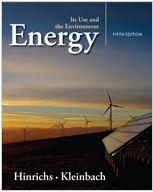
Energy: Its Use and the Environment, 5th Edition
Roger A. Hinrichs - State University of New York, Oswego; Merlin H. Kleinbach - State University of New York, Oswego
ISBN-13: 9781111990831; © 2013 Published
ENERGY: ITS USE AND THE ENVIRONMENT, Fifth Edition, emphasizes the physical principles behind energy and its effects on our environment. The text explains the basic physical principles behind the use of energy, including the study of mechanics, electricity and magnetism, thermodynamics, and atomic and nuclear physics. It also covers crucial environmental questions that currently are receiving much public attention, such as global warming, radioactive waste, municipal solid waste, and nuclear energy production materials.
Chapters: ENSC / PES 1500
1. Introduction.
2. Energy Mechanics.
3. Conservation of Energy.
4. Heat and Work.
5. Home Energy Conservation and Heat-Transfer Control.
6. Solar Energy: Characteristics and Heating.
7. Energy from Fossil Fuels.
8. Air Pollution and Energy Use.
9. Global Warming and Thermal Pollution.
Appendix A: Units of Measurement and Powers of Ten Notation.
Appendix B: Conversions and Equivalencies.
Appendix C: Home Heating Analysis.
Appendix D: Insolation and Temperature Data for Selected U.S. Cities.
Appendix E: World Energy Consumption, 2009.
Appendix F: U.S. Consumption of Energy by Source, 1949–2009.
Appendix G: U.S. Energy Intensity, 1970–2009.
Glossary.
Index.
About the Authors:
Roger A. Hinrichs
Roger Hinrichs has been Professor of Physics and department chair at SUNY-Oswego, where he taught energy related courses for over 25 years. His training is in experimental nuclear physics, and his research involves studies of trace materials in environmental and biological samples using PIXE with Oswego's Van de Graaff particle accelerator. He has an interest in energy use in developing countries, and spent time in Kenya and India as well as a year as a Fulbright Scholar in the sultanate of Oman. He co-directs the Institute in Energy Education, a program for secondary school science and technology teachers. In its 20 years, this program has impacted over 500,000 students and has won numerous awards. Dr. Hinrichs also supports active inquiry-based learning in the classroom; some of the activities in this text come from, or are part of, his course "Physics for Elementary Education Majors." He has worked as a consultant at local, state, and national levels on matters of energy policy and energy technologies. Presently, he is a visiting professor at the Weill Cornell Medical College in Qatar.Merlin H. Kleinbach
Merlin H. Kleinbach received his Bachelor's degree from Westmar College, IA; his Masters degree from Colorado State College, 1955; and a doctorate in education from the University of Missouri in 1959. He has taught high school science and industrial arts in Colorado, and college courses in woodworking technology, metals technology, and basic electronics as well as Professional Education graduate courses for seven years at Wayne State College in Nebraska. Given an opportunity to teach and travel overseas, he took a position at Haile Selassie I University in Addis Ababa, Ethiopia, for four years (1966-1970), assisting in developing a teacher education program to prepare technology teachers for the newly developed comprehensive school program there. The University employed faculty from several dozen different countries from around the world, providing real insights into other cultures, their concerns, and potential. During this period, he and his family traveled extensively to countries in Europe, Africa, and Asia.
Suggested Calculators:
Texas Instruments Solar 30 X series...
Grading Policy:
Homework / attendance = 25%
Test 1 = 20%
Test 2 = 20%
Test 3 = 20%
Test 4 = 25%
95 - 100 % A
94 - 90 % A-
89 - 87 % B+
86 - 83 % B
82 - 80 % B-
79 - 77 % C+
76 - 73 % C
72 - 70 % C-
69 - 67 % D+
66 - 63 % D
62 - 59 % D-
below 58 % F
Attendance:
Attendance is mandatory and may be monitored via a sign in sheet. It is each student’s responsibility to cover any material due to missed lectures.Student Conduct:
Students enrolled in this course are expected to conform to university rules of Student Conduct. These may be found online at: http://web.uccs.edu/studentconduct/Cell phones, i-Phones, i-Pads, Droids, Pagers, etc... & Talking:
Please show respect to the other members of the class by turning off the sound on cell phones and pagers. Imperative phone calls should be taken outside the classroom. Also, keep conversation to a minimum during the lecture so that others can hear clearly.
E-Mail Policy
E-mail is the official means of communicating with students. To assure the reliability and dependability of using e-mail for communication with students, all enrolled students have been assigned an official campus e-mail account. Students are expected to check their campus e-mail account on a daily basis, as this is the method the University uses to communicate with them. Please encourage students in your class to use and check their e-mail accounts. Information about campus e-mail and forwarding the account can be found at http://www.uccs.edu/~helpdesk/.
Miscellaneous:
If you are a student with a disability and believe you will need accommodations for this class, it is your responsibility to register with Disability Services and provide them with documentation of your disability. They will work with you to determine what accommodations are appropriate for your situation. To avoid any delay, you should contact Disability Services as soon as possible. Please note that accommodations are not retroactive and disability accommodations cannot be provided until a Faculty Letter has been given to me. Please contact Disability Services for more information at Main Hall room 105, 719-255-3354 or [email protected].
Military students who have the potential to participate in military activities including training and deployment should consult with faculty prior to registration for a course, but no later than the end of the first week of classes, to determine the class attendance policy. At this time, the student should provide the instructor with a schedule of planned absences, preferably signed by the student’s commander, in order to allow the instructor to evaluate and advise the student on the possible impact of the absences. In this case, faculty will consider absences due to participation in verified military activities to be excused absences, on par with those due to other unavoidable circumstances such as illness. Faculty judge the validity of student absences from class and may require documentation for excused absences. For classes requiring mandatory attendance incompatible with the number of planned absences, students will be advised to register, if possible, during a semester in which they will not be participating in these activities. As with any academic issue, students may exercise their right to appeal adverse attendance decisions. Should the faculty member and student be unable to agree on appropriate accommodation under this policy, either party shall have the right to request mediation from (in order) the department chair, the academic dean, and the vice chancellor for academic affairs.
Please see the Military Students website for more information: http://www.uccs.edu/~military/
Additional information on university policies may be found in the Schedule of Courses/ Registration Instructions and the Course Bulletin.
updated: Monday, 07-Oct-2019 11:08 AM