UCCS ENSC / PES 1600: Introduction to Solar Energy Fall 2019

last updated on: Tuesday, August 27, 2019 12:20
sr. instr. prof. ramon tirado
class hours: Mondays & Wednesdays from: 12:15 pm - 13:30 pm
room: ENGR 109
office: Osborne Center A 416
e-mail: [email protected]
phone: 719 255 3560
1. The lecture content of a GT Pathways science course (GT-SC1 or GT-SC2):
a. Develop foundational knowledge in specific field(s) of science.
b. Develop an understanding of the nature and process of science.
c. Demonstrate the ability to use scientific methodologies.
d. Examine quantitative approaches to study natural phenomena.
Inquiry & Analysis:
4. Select or Develop a Design Process
a. Select or develop elements of the methodology or theoretical framework to solve problems in a given discipline.
5. Analyze and Interpret Evidence
a. Examine evidence to identify patterns, differences, similarities, limitations, and/or implications related to the focus.
b. Utilize multiple representations to interpret the data.
6. Draw Conclusions
a. State a conclusion based on findings. Quantitative Literacy:
1. Interpret Information
a. Explain information presented in mathematical forms (e.g., equations, graphs, diagrams, tables, words).
2. Represent Information
a. Convert information into and between various mathematical forms (e.g., equations, graphs, diagrams, tables, words).
Textbook:
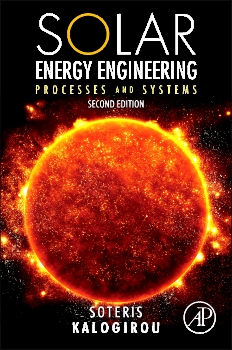
Solar Energy Engineering, 2nd Edition Processes and Systems
Soteris A. Kalogirou,Print Book ISBN : 9780123972705
eBook ISBN : 9780123972569Release Date: 14 Nov 2013
Imprint: Academic PressTable of Contents:
Chapter 1 - Introduction
Chapter 2 - Environmental Characteristics;
Chapter 3 - Solar Energy Collectors
Chapter 4 - Performance of Solar Collectors
Chapter 5 - Solar Water-Heating Systems
Chapter 6 - Solar Space Heating And Cooling
Chapter 7 - Industrial Process Heat, Chemical Applications, and Solar Dryers
Chapter 8 - Solar Desalination Systems
Chapter 9 - Photovoltaic Systems
Chapter 10 - Solar Thermal Power Systems
Chapter 11 - Design and Modeling Of Solar Systems
Chapter 12 - Solar Energy Analysis
Chapter 13 - Wind Energy Systems
Appendices
Energy policy promoting sustainable development is transforming global energy markets. Solar power, the most abundant of all renewable resources, is crucial to greater achieving energy security and sustainability. This new edition of Solar Energy Engineering: Processes and Systems from Prof. Soteris Kalogirou, a renowned expert with over thirty years of experience in renewable energy systems and applications, includes revised and updated chapters on all areas of solar energy engineering from the fundamentals to the highest level of current research. The book includes high interest topics such as solar collectors, solar water heating, solar space heating and cooling, industrial process heat, solar desalination, photovoltaic technology, solar thermal power systems, modeling of solar energy systems and includes a new chapter on wind energy systems. As solar energy’s vast potential environmental and socioeconomic benefits are broadly recognized, the second edition of Solar Energy Engineering: Processes and Systems will provide professionals and students with a resource on the basic principles and applications of solar energy systems and processes and can be used as a reference guide to practicing engineers who want to understand how solar systems operate and how to design the systems.
Assignments:
Please turn in class assignments only on the night they are due. Late assignments will be accepted, but will be marked down one grade for every week that passes by.
Final Test:
You will be responsible for all the material covered on the class,exercises, dvd’s shown in class, hand-outs, and lectures.
There will be three exams given during the semester. In addition to the exams there will be a final exam on: tbd
The Final will be comprehensive, but will emphasize the material covered after the third exam.
Unless arrangements have been made PRIOR to any exam, THERE WILL BE NO MAKE-UP EXAMS. MISSED EXAMS WILL RECEIVE A SCORE OF ZERO.The final test in this class will be on the scheduled day of finals according to the UCCS schedule.
Grading Policy:
Homework/Attendance = 20 %
Test 1 = 20 %
Test 2 = 20 %
Test 3 = 20 %
Test 4 = 20 %,
95 - 100 % A
94 - 90 % A-
89 - 87 % B+
86 - 83 % B
82 - 80 % B-
79 - 77 % C+
76 - 73 % C
72 - 70 % C-
69 - 67 % D+
66 - 63 % D
62 - 59 % D-
below 58 % F
Suggested Calculators:
Texas Instrument Solar 30X type
Attendance:
Attendance is mandatory, and may be monitored via a sign in sheet. It is each student’s responsibility to cover any material due to missed lectures.Student Conduct:
Students enrolled in this course are expected to conform to university rules of Student Conduct. These may be found online at: http://web.uccs.edu/studentconduct/Cell phones, i-Phones, i-Pads, Droids, BB8's, Pokemoning, CB Radios, Pagers, etc... & Talking:
Please show respect to the other members of the class by turning off the sound on cell phones and pagers. Imperative phone calls should be taken outside the classroom. Also, keep conversation to a minimum during the lecture so that others can hear clearly.
E-Mail Policy
E-mail is the official means of communicating with students. To assure the reliability and dependability of using e-mail for communication with students, all enrolled students have been assigned an official campus e-mail account. Students are expected to check their campus e-mail account on a daily basis, as this is the method the University uses to communicate with them. Please encourage students in your class to use and check their e-mail accounts. Information about campus e-mail and forwarding the account can be found at http://www.uccs.edu/~helpdesk/.
Miscellaneous:
If you are a student with a disability and believe you will need accommodations for this class, it is your responsibility to register with Disability Services and provide them with documentation of your disability. They will work with you to determine what accommodations are appropriate for your situation. To avoid any delay, you should contact Disability Services as soon as possible. Please note that accommodations are not retroactive and disability accommodations cannot be provided until a Faculty Letter has been given to me. Please contact Disability Services for more information at Main Hall room 105, 719-255-3354 or [email protected].
Military Students:
Military students who have the potential to participate in military activities including training and deployment should consult with faculty prior to registration for a course, but no later than the end of the first week of classes, to determine the class attendance policy. At this time, the student should provide the instructor with a schedule of planned absences, preferably signed by the student’s commander, in order to allow the instructor to evaluate and advise the student on the possible impact of the absences. In this case, faculty will consider absences due to participation in verified military activities to be excused absences, on par with those due to other unavoidable circumstances such as illness. Faculty judge the validity of student absences from class and may require documentation for excused absences. For classes requiring mandatory attendance incompatible with the number of planned absences, students will be advised to register, if possible, during a semester in which they will not be participating in these activities. As with any academic issue, students may exercise their right to appeal adverse attendance decisions. Should the faculty member and student be unable to agree on appropriate accommodation under this policy, either party shall have the right to request mediation from (in order) the department chair, the academic dean, and the vice chancellor for academic affairs.
Please see the Military Students website for more information: http://www.uccs.edu/~military/
Additional information on university policies may be found in the Schedule of Courses/ Registration Instructions and the Course Bulletin.
updated: Tuesday, 27-Aug-2019 12:20 PM