Continuity
Click here for a printable version of this page.Defining Continuity
We'll begin with an example, using our "working" definition of continuity as we understand it so far. That is, a function is continuous on an interval if we can draw the graph from start to finish without ever once picking up our pencil. In other words, a function is continuous if its graph has no holes or breaks in it.
Given the graph of $f(x)$ shown below, determine each of the indicated values.
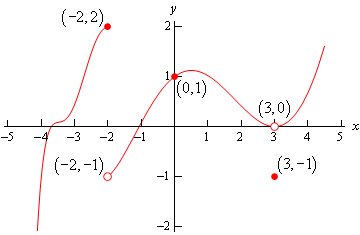
- Is $f(x)$ continuous at $x=-2$?
- $\lim\limits_{x\to -2}f(x)$
- $f(-2)$
- Is $f(x)$ continuous at $x=0$?
- $\lim\limits_{x\to 0}f(x)$
- $f(0)$
- Is $f(x)$ continuous at $x=3$?
- $\lim\limits_{x\to 3}f(x)$
- $f(3)$
- Is $f(x)$ continuous at $x=-2$?
- $\lim\limits_{x\to -2}f(x)$ Note that $\lim\limits_{x\to-2^-}f(x) = 2$ but $\lim\limits_{x\to-2^+}f(x) = -1$, so $\lim\limits_{x\to-2}f(x)$ does not exist.
- $f(-2)$ The function value $f(-2)$ occurs at the solid dot where $x=-2$, so $f(-2) = 2$.
- Is $f(x)$ continuous at $x=0$? Here, the graph can be drawn through $x=0$ with no lift of the pencil, so the function is continuous at $x=0$.
- $\lim\limits_{x\to 0}f(x)$ $\lim\limits_{x\to 0}f(x) = 1$
- $f(0)$ $f(0) = 1$
- Is $f(x)$ continuous at $x=3$? Because of the open circle at $(3,0)$, there is a tiny break in the graph, so we would have to lift our pencil to draw it. Therefore, $f(x)$ is discontinuous at $x=3$.
- $\lim\limits_{x\to 3}f(x)$ $\lim\limits_{x\to 3}f(x) = 0$
- $f(3)$ $f(3) = -1$
Using our current, before calculus notion of continuity, we see that we have to pick up our pencil at $x=-2$ to continue drawing the graph, so the function is discontinuous (not continuous) at $x=-2$.
Now, let's take a moment to look at the relationships between function values and limit values in the previous example. When the function was discontinuous, the limit value was not equal to the function value. When the function was continuous, the limit value was equal to the function value. This becomes our calculus definition of continuity!
Continuity
A function $f(x)$ is said to be continuous at $x=a$ if $$\lim_{x\to a}f(x) = f(a).$$
Note that this definition is also implicitly assuming that both $f(a)$ and $\lim\limits_{x\to a}f(x)$ exist. If either of these do not exist, the function will not be continuous at $x=a$.
Let's do another example using our new calculus notion of continuity to justify our responses.

For each value of $x$, we want to find the limit value and the function value and compare them.
At $x = -4$, the $\lim\limits_{x\to -4}f(x) = -2$, but $f(-4)$ does not exist. Therefore, the limit value is not equal to the function value ($\lim\limits_{x\to-4}f(x) \neq f(-4)$), so the function is discontinuous at $x=-4$.
At $x = 2$, we have $\lim\limits_{x\to 2}f(x) = 0$, and $f(2) = 0$. Therefore $\lim\limits_{x\to 2}f(x) = f(2)$, so the function is continuous at $x = 2$.
At $x = 3$, we have $\lim\limits_{x\to 3}f(x) = \infty$, but $\lim\limits_{x\to 3^+}f(x) = -2$. Since the limit does not exist, it cannot equal the function value (which happens to be -2 in this case), so the function is discontinuous at x = 3.
Just like with limits, it's possible to talk about continuity from either the right or the left, as follows.
Continuous from the right or left
A function $f(x)$ is said to be continuous from the right at $x=a$ if $$\lim_{x\to a^+}f(x) = f(a).$$
A function $f(x)$ is said to be continuous from the left at $x=a$ if $$\lim_{x\to a^-}f(x) = f(a).$$
Using only the limit definition of continuity and properties of limits, determine whether $g(x)$ is continuous at the indicated values of $x$.
$$g(x) = \begin{cases} 2x & x \lt 6\\ x - 1 & x \geq 6\\ \end{cases}$$- $x=4$
- $x = 6$
- x=4
- x = 6
Before starting off with the solution to this part notice that we CAN NOT do what we’ve commonly done to evaluate limits to this point. In other words, we can’t just plug in the point to evaluate the limit. Doing this implicitly assumes that the function is continuous at the point and that is what we are being asked to determine here.
Therefore, the only way for us to compute the limit is to go back to the properties from the Limit Properties section and compute the limit as we did back in that section. We won’t be putting all the details here so if you need a little refresher on doing this you should go back to the problems from that section and work a few of them.
For this part, we can notice that because there are values of $x$ on both sides of $x=4$ in the range $x \lt 6$, we won't need to worry about one-sided limits here. We can just use the piece of the function described for $x \lt 6$. $$\begin{align} \lim_{x\to 4} g(x) &= \lim_{x\to 4}(2x)\\ &= 2\lim_{x\to 4} x\\ &=2(4)\\ &=g(4)\\ \end{align}$$
So we can see that $$\lim_{x\to 4}g(x) = g(4)$$ and so the function is continuous at $x=4$.
For justification on why we can’t just plug in the number here check out the comment at the beginning of the solution to (a).
For this part we have the added complication that the point we’re interested in is also the “cut-off” point of the piecewise function and so we’ll need to take a look at the two one sided limits to compute the overall limit and again because we are being asked to determine if the function is continuous at this point we’ll need to resort to basic limit properties to compute the one-sided limits and not just plug in the point (which assumes continuity again…).
Here is the work for this part.
$$\begin{align} \lim_{x\to 6^-}g(x) &= \lim_{x\to 6^-}(2x)\\ &= 2\lim_{x\to 6^-}x\\ &=2(6)\\ &= 12\\ \end{align}$$ $$\begin{align} \lim_{x\to 6^+} g(x) &= \lim_{x\to 6^+}(x-1)\\ &= \lim_{x\to 6^+}x - \lim_{x\to 6^+}1\\ &=6-1\\ &=5 \end{align}$$We can now see that $\lim\limits_{x\to 6^-}g(x) \neq \lim\limits_{x\to 6^+}g(x)$ and so $\lim\limits_{x\to 6}g(x)$ does not exist.
Now, as discussed in the notes for this section, in order for a function to be continuous at a point both the function and the limit must exist. Therefore, this function is not continuous at $x=6$.
These ideas are particularly important when it comes to defining the intervals on which a particular function is continuous.
Continuous on an interval
A function is said to be continuous on the interval if it is continuous at each point in the interval.
At endpoints, we'll agree to define continuous to mean that the function is continuous from the right or continuous from the left of that endpoint.
For many functions it’s easy to determine where it won’t be continuous. Functions won’t be continuous where we have things like division by zero or logarithms of non-positive values. Let’s take a quick look at an example of determining where a function is not continuous.
Rational functions are continuous everywhere except where we have division by zero. So all that we need to is determine where the denominator is zero and exclude that from our answer. That’s easy enough to determine by setting the denominator equal to zero and solving.
$$\begin{align} t^2-2t-15 &=0\\ (t-5)(t+3) &=0\\ \end{align}$$The denominator is a quadratic, and factorable, so we factor and use the zero product property to finish solving. Either $t-5 = 0$ or $t+3 = 0$, so $t=5, -3$ are the values that will cause us to have a 0 in the denominator. Therefore, the intervals on which the function is continuous are: $$(-\infty, -3)\cup (-3, 5) \cup (5, \infty)$$
For a square root function, we need to ensure that our inputs are 0 or positive, so we want to find values of $x$ such that $$4-x^2 \geq 0.$$ To solve a quadratic inequality, we must first solve the corresponding equation $$\begin{align} 4-x^2 &= 0\\ (2+x)(2-x) &= 0\\ x &= -2, 2\\ \end{align}$$ These $x$-values help us to create potential regions, but we still need to figure out whether $f(x)=4-x^2$ is positive or negative in each of these regions. We can use a sign chart to help. $$\begin{array}{|c|c|c||c|} \hline \text{Region} & (2-x) & (2+x) & f(x) \\ \hline x \lt -2 &+ & - & -\\ \hline -2 \lt x \lt 2 & + & + & +\\ \hline x \gt 2 & - & + & - \\ \hline \end{array}$$ So we see that $4-x^2$ is non-negative, and therefore $\sqrt{4-x^2}$ is continuous on the region $[-2,2]$. Not that the function itself is not defined outside of that interval, so when we include -2 in our interval, we mean that the function is continuous from the right at -2.
In general, we will be able to say that the following functions are continuous on their domains.
A List of Functions which are continuous on their domains.
- Polynomials
- Rational Functions (in the form $\frac{f(x)}{g(x)}$)
- Radical (Root) Functions
- Trig Functions
- Exponential Functions
- Logarithmic Functions
- Combinations and compositions of the above functions
Continuity and limits
A nice consequence of continuity is the following fact.
To see a proof of this fact see the Proof of Various Limit Properties section in the Extras chapter. With this fact we can now do limits like the following example.
Let's check our conditions first. Is our outer function continuous? Well, $e^x$ is continuous for all real numbers, so it is definitely continuous at $\lim\limits_{x\to 0}\sin(x) = \sin(0) = 0$. Therefore $$\lim_{x\to 0}e^{\sin(x)} = e^{\lim\limits_{x\to 0}\sin(x)} = e^0 = 1.$$
The Intermediate Value Theorem
Another very nice consequence of continuity is the Intermediate Value Theorem.
To get a feel for the Intermediate Value Theorem, try the following:
- On a coordinate plane, draw a point.
- Draw another point to the right, at a different height.
- Choose a height that falls between your two dots. Draw a dotted horizontal line at that height.
- Now, you want to connect your two points. The only rule is you must connect them with a continuous function. Is there any way to connect the dots and not cross your horizontal line?
If we restrict ourselves to drawing continuous functions, we must cross that horizontal line in order to connect our dots. This is what the Intermediate Value Theorem says.
The Intermediate Value Theorem (IVT)
Suppose that $f(x)$ is continuous on the interval $[a,b]$ and let $M$ be any number between $f(a)$ and $f(b)$. Then there exists a number $c$ such that
- $a \lt c \lt b$
- $f(c) = M$
Another way of thinking about the IVT is that it says that a continuous function will take on all values between $f(a)$ and $f(b)$. Below is a graph of a continuous function that illustrates the Intermediate Value Theorem.
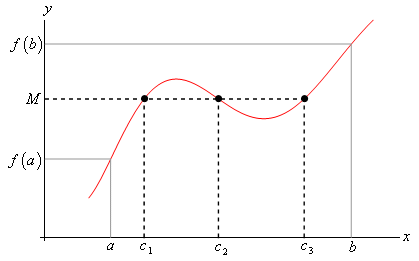
As we can see from this image if we pick any value, $M$, that is between the value of $f(a)$ and the value of $f(b)$ and draw a line straight out from this point the line will hit the graph in at least one point. In other words, somewhere between $a$ and $b$, the function will take on the value of $M$. Also, as the figure shows the function may take on the value at more than one place.
It’s also important to note that the Intermediate Value Theorem only says that the function will take on the value of $M$ somewhere between $a$ and $b$. It doesn’t say just what that value will be. It only says that it exists.
So, the Intermediate Value Theorem tells us that a function will take the value of $M$ somewhere between $a$ and $b$ but it doesn’t tell us where it will take the value nor does it tell us how many times it will take the value. These are important ideas to remember about the Intermediate Value Theorem.
- $f(x)$ will equal $M$ somewhere (but it doesn't tell us where).
- $f(x)$ will equal $M$ at least once, but maybe more than once!
A nice use of the Intermediate Value Theorem is to prove the existence of roots of equations as the following example shows.
Show that $p(x) = 2x^3 - 5x^2 - 10x + 5$ has a root somewhere in the interval $[-1,2]$.
What we’re really asking here is whether or not the function will take on the value $p(x) = 0$ somewhere between -1 and 2. In other words, we want to show that there is a number $c$ such that $-1\lt c \lt 2$ and $p(c) = 0$.
Let's line this up with the language of the IVT. We can name $a = -1$, $b = 2$, and $M = 0$, so we're looking to draw the conclusion stated in the IVT. In order to draw this conclusion, though, we have to make sure our conditions are met. That is, we need to know that $p(x)$ is continuous on $[-1,2]$, and we need to know that our $M=0$ is between $p(-1)$ and $p(2)$.
First, since $p(x)$ is a polynomial, it is continuous for all real values of $x$, and therefore it's continuous on $[-1,2]$.
Now we check the second condition by calculating $p(-1)$ and $p(2)$: $$p(-1) = 2(-1)^3-5(-1)^2-10(-1)+5 = 8$$ $$p(2) = 2(2)^3-5(2)^2-10(2)+5 = -19$$ therefore $$-19=p(2) \lt 0 \lt p(-1) = 8$$ and the second condition is met. So, by the Intermediate Value Theorem, there must be a number $c$ such that $-1 \lt c \lt 2$ and $p(c) = 0$. This means the polynomial does have a root between -1 and 2.
Notice that we don't know exactly what value $c$ is the root, we just know it's something between -1 and 2! A solution exists, and we've done our job.
If possible, determine if $f(x) = 20\sin(x+3)\cos\left(\frac{x^2}{2}\right)$ takes the following values in the interval $[0,5]$.
- Does $f(x) = 10?$
- Does $f(x) = -10?$
Okay, so as with the previous example, we’re being asked to determine, if possible, if the function takes on either of the two values above in the interval [0,5]. Before invoking the IVT, though, we need to check that this is a continuous function, and that 10 (and -10) falls between $f(0)$ and $f(5)$.
For the continuity question, we know that sine, cosine, $x+3$, and $\frac{x^2}{2}$ are all continuous for all real numbers, so the product and composition of these functions remains continuous for all real numbers.
Now, we calculate (in radians!) the values of $f(0)$ and $f(5)$. $$f(0) = 2.8224 ~~~~~~~~f(5) = 19.7436$$ So we can see that $$f(0) = 2.8224 \lt 10 \lt 19.7436=f(5).$$ Therefore, by the Intermediate Value Theorem, there must be a number $c$ such that $0\leq c \leq 5$ and $f(c) = 10$.
However, for part b, we see that -10 does not fall between $f(0)$ and $f(5)$. So what does this mean for us? Doe sit mean that $f(x)$ cannot be -10 in the interval $[0,5]$?
Unfortunately for us, we can't make that conclusion. It is possible that $f(x) \neq -10$ for all $x$ in the interval, but it is also possible still that $f(x) = -10$ somewhere in the interval!
The Intermediate Value Theorem will only tell us that $c$’s will exist. The theorem will NOT tell us that $c$’s don’t exist.
Okay, as the previous example has shown, the Intermediate Value Theorem will not always be able to tell us what we want to know. Sometimes we can use it to verify that a function will take some value in a given interval and in other cases we won’t be able to use it.
For completeness' sake, here is the graph of $f(x) = 20\sin(x+3)\cos\left(\frac{x^2}{2}\right)$ on the interval $[0,5]$.
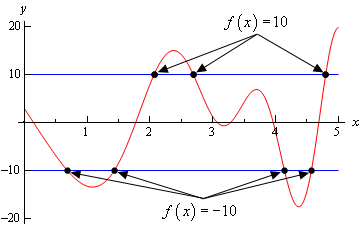
From this graph we can see that not only does $f(x)=-10$ in [0,5] it does so a total of 4 times! Also note that as we verified in the first part of the previous example $f(x) = 10$ in [0,5] and in fact it does so a total of 3 times.
So, remember that the Intermediate Value Theorem will only verify that a function will take on a given value. It will never exclude a value from being taken by the function. Also, if we can use the Intermediate Value Theorem to verify that a function will take on a value it never tells us how many times the function will take on the value, it only tells us that it does take the value.
Practice Problems
- The graph of $f(x)$ is given below. Based on this graph, and using the the limit definition of continuity, determine where the function is discontinuous.
- The graph of $f(x)$ is given below. Based on this graph, and using the the limit definition of continuity, determine where the function is discontinuous.
- $f(x) = \frac{4x+5}{9-3x}$
- $x=-1$
- $x=0$
- $x=3$
- $x=-1$
- $x=0$
- $x=3$
- $g(z) = \frac{6}{z^2-3z-10}$
- $z = -2$
- $z = 0$
- $z = 5$
- $z = -2$
- $z = 0$
- $z = 5$
- $h(t) = \begin{cases} t^2 & t \lt -2\\ t+6 & t \geq -2\\ \end{cases}$
- $t = -2$
- $t = 10$
- $g(x) = \begin{cases} 1 - 3x & x \lt -6\\ 7 & x = -6\\ x^3 & -6 \lt x \lt 1\\ 1 & x = 1\\ 2 - x & x\gt 1\\ \end{cases}$
- $x=-6$
- $x=1$
- $f(x) = \frac{x^2-9}{3x^2+2x-8}$
- $R(t)=\frac{8t}{t^2-9t-1}$
- $h(z)=\frac{1}{2-4\cos(3z)}$
- $y(x)=\frac{x}{7-e^{(2x+3)}}$
- $g(x) = \tan(2x)$
- $25 - 8x^2 - x^3 = 0$ on $[-2,4]$
- $w^2 - 4\ln(5w+2)=0$ on $[0,4]$
- $4t+10e^t-e^{2t}=0$ on $[1,3]$
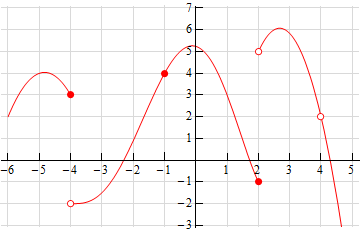
Before starting the solution, recall that in order for a function to be continuous at $x=a$, we must have $$\lim_{x\to a}f(x) = f(a)$$ and therefore both $f(a)$ and $\lim\limits_{x\to a} f(x)$ must exist.
Using this idea it should be fairly clear where the function is not continuous.
First notice that at $x=-4$ we have $$\lim_{x\to-4^-}f(x)=3\neq -2 = \lim_{x\to-4^+}f(x)$$ and therefore $\lim\limits_{x\to-4}f(x)$ doesn't exist. We can therefore conclude that $f(x)$ is discontinuous at $x=-4$.
Likewise, at $x=2$, we have $$\lim_{x\to2^-}f(x) = -1 \neq 5 = \lim_{x\to2^+}f(x)$$ and therefore $\lim\limits_{x\to 2}f(x)$ doesn't exist. So again, because the limit does not exist, we can see that $f(x)$ is discontinuous at $x=2$.
Finally let's take a look at $x=4$. Here we can see that $$\lim_{x\to4^-}f(x) = 2 = \lim_{x\to 4^+}f(x)$$ and therefore we also know that $\lim\limits_{x\to 4}f(x)=2$. However, we can also see that $f(4)$ doesn't exist, and so $f(x)$ is discontinuous at $x = 4$ because the function value is not equal to the limit value.
In summary then the points of discontinuity for this graph are $x = -4, 2,$ and $4$.
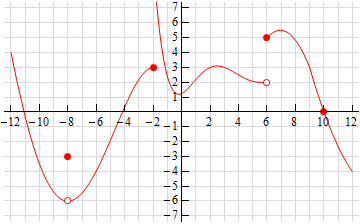
Before starting the solution, recall that in order for a function to be continuous at $x=a$, we must have $$\lim_{x\to a}f(x) = f(a)$$ and therefore both $f(a)$ and $\lim\limits_{x\to a} f(x)$ must exist.
Using this idea it should be fairly clear where the function is not continuous.
First notice that at $x=-8$ we have $$\lim_{-8^-}f(x) = -6 = \lim_{x\to-8^+}f(x)$$ and therefore we also know that $\lim\limits_{x\to-8}f(x) = -6$. We can also see that $f(-8) = -3$ and so we have $$-6=\lim\limits_{x\to-8}f(x)\neq f(-8)=-3.$$ Because the function and limit have different values we can conclude that $f(x)$ is discontinuous at $x=-8$.
Next let's take a look at $x=-2$. We have, $$\lim_{x\to-2^-}f(x) = 3 \neq \infty = \lim_{x\to-2^+}f(x)$$ and therefore $\lim_{x\to -2}f(x)$ doesn't exist. We can therefore conclude that $f(x)$ is discontinuous at $x=-2$.
Finally let's take a look at $x=6$. Here we can see we have $$\lim_{x\to 6^-}f(x) = 2 \neq 5 = \lim_{x\to 6^+}f(x)$$ and therefore $\lim\limits_{x\to 6}f(x)$ doesn't exist. So, once again, because the limit does not exist, we can conclude that $f(x)$ is discontinuous at $x=6$.
In summary then the points of discontinuity for this graph are $x=-8, x=-2,$ and $x=6$.
For problems 3-7, using only Properties 1-9 from the Limit Properties section, one-sided limit properties (if needed), and the definition of continuity, determine if the given function is continuous or discontinuous at the indicated points.
Before starting off with the solution to this part notice that we CAN NOT do what we’ve commonly done to evaluate limits to this point. In other words, we can’t just plug in the point to evaluate the limit. Doing this implicitly assumes that the function is continuous at the point and that is what we are being asked to determine here.
Therefore, the only way for us to compute the limit is to go back to the properties from the Limit Properties section and compute the limit as we did back in that section. We won’t be putting all the details here so if you need a little refresher on doing this you should go back to the problems from that section and work a few of them.
So here we go.
$$\begin{align} \lim\limits_{x\to-1} f(x) &= \lim\limits_{x\to-1}\frac{4x+5}{9-3x}\\ &=\frac{\lim\limits_{x\to-1}(4x+5)}{\lim\limits_{x\to-1}(9-3x)}\\ &=\frac{4\lim\limits_{x\to-1}(x)+\lim\limits_{x\to-1}5}{\lim\limits_{x\to-1}9 - 3\lim\limits_{x\to-1} x}\\ &=\frac{4(-1)+5}{9-3(-1)}\\ &=f(-1)\\ \end{align}$$So we can see that $\lim\limits_{x\to-1}f(x) = f(-1)$ and so the function is continuous at $x=-1$.
For justification on why we can’t just plug in the number here check out the comment at the beginning of the solution to (a).
$$\begin{align} \lim\limits_{x\to0}f(x) &= \lim\limits_{x\to0}\frac{4x+5}{9-3x}\\ &=\frac{\lim\limits_{x\to0}(4x+5)}{\lim\limits_{x\to0}(9-3x)}\\ &=\frac{4\lim\limits_{x\to0}x + \lim\limits_{x\to0}5}{\lim\limits_{x\to0}9-3\lim\limits_{x\to0}x}\\ &=\frac{4(0)+5}{9-3(0)}\\ &=f(0)\\ \end{align}$$So we can see that $\lim\limits_{x\to0}f(x) = f(0)$ and so the function is continuous at $x=0$.
For justification on why we can’t just plug in the number here check out the comment at the beginning of the solution to (a). Although there is also of course the problem here that $f(3)$ doesn’t exist and so we couldn’t plug in the value even if we wanted to.
Furthermore, as $x\to 3^-$, $9-3x\to 0$ and $9-3x \gt 0$. Also as $x\to 3^-$, $4x+5 \to 17$. Therefore, $$\begin{align} \lim\limits_{x\to3^-}f(x) &= \lim\limits_{x\to3^-}\frac{4x+5}{9-3x}\\ &=\frac{12}{\text{very small positive number near 0}}\\ &\Rightarrow \infty\\ \end{align}$$
Similarly, as $x\to 3^+$, $9-3x\to 0$ and $9-3x \lt 0$. Also as $x\to 3^+$, $4x+5 \to 17$. Therefore, $$\begin{align} \lim\limits_{x\to3^+}f(x) &= \lim\limits_{x\to3^+}\frac{4x+5}{9-3x}\\ &=\frac{12}{\text{very small negative number near 0}}\\ &\Rightarrow -\infty\\ \end{align}$$
Therefore the limit does not exist, and the function value also does not exist, so the function is necessarily discontinuous at $x = 3$.
Before starting off with the solution to this part notice that we CAN NOT do what we’ve commonly done to evaluate limits to this point. In other words, we can’t just plug in the point to evaluate the limit. Doing this implicitly assumes that the function is continuous at the point and that is what we are being asked to determine here.
Of course, even if we had tried to plug in the point we would have run into problems as $g(-2)$ doesn’t exist and this tell us all we need to know. As noted in the notes for this section if either the function or the limit do not exist then the function is not continuous at the point. Therefore, we can see that the function is not continuous at $z=-2$.
For practice you might want to verify that, $$\lim_{z\to-2^-}g(z) = \infty ~~~~~~~~ \lim_{z\to-2^+}g(z)=-\infty$$ and so $\lim\limits_{z\to-2}g(z)$ also doesn't exist.
For justification on why we can’t just plug in the number here check out the comment at the beginning of the solution to (a).
Therefore, because we can’t just plug the point into the function, the only way for us to compute the limit is to go back to the properties from the Limit Properties section and compute the limit as we did back in that section. We won’t be putting all the details here so if you need a little refresher on doing this you should go back to the problems from that section and work a few of them.
$$\begin{align} \lim_{z\to0}g(z) &= \lim_{z\to0}g(z)\frac{6}{z^2-3z-10}\\ &=\frac{\lim\limits_{z\to0}6}{\lim\limits_{z\to0}(z^2-3z-10)}\\ &=\frac{\lim\limits_{z\to0}6}{\lim\limits_{z\to0}z^2 - 3\lim\limits_{z\to0}z - \lim\limits_{z\to0}10}\\ &=\frac{6}{0^2-3(0)-10}\\ &= g(0)\\ \end{align}$$So we can see that $\lim\limits_{z\to 0}g(z)=g(0)$ and so the function is continuous at $z = 0$.
For justification on why we can’t just plug in the number here check out the comment at the beginning of the solution to (a). Although there is also of course the problem here that $g(5)$ doesn’t exist and so we couldn’t plug in the value even if we wanted to.
This also tells us what we need to know however. As noted in the notes for this section if either the function of the limit do not exist then the function is not continuous at the point. Therefore, we can see that the function is not continuous at $z=5$.
For practice you might want to verify that, $$\lim_{z\to5^-} g(z) = -\infty ~~~~~~ \lim_{z\to 5^+}g(z) = \infty$$ and so $\lim\limits_{z\to 5}g(z)$ also doesn't exist.
Before starting off with the solution to this part notice that we CAN NOT do what we’ve commonly done to evaluate limits to this point. In other words, we can’t just plug in the point to evaluate the limit. Doing this implicitly assumes that the function is continuous at the point and that is what we are being asked to determine here.
Therefore, the only way for us to compute the limit is to go back to the properties from the Limit Properties section and compute the limit as we did back in that section. We won’t be putting all the details here so if you need a little refresher on doing this you should go back to the problems from that section and work a few of them.
Also notice that for this part we have the added complication that the point we’re interested in is also the “cut-off” point of the piecewise function and so we’ll need to take a look at the two one sided limits to compute the overall limit and again because we are being asked to determine if the function is continuous at this point we’ll need to resort to basic limit properties to compute the one-sided limits and not just plug in the point (which assumes continuity again…).
Here is the work for this part.
$$\begin{align} \lim_{t\to-2^-}h(t) &= \lim_{t\to-2^-}t^2\\ &=(-2)^2\\ &= 4\\ \end{align}$$ $$\begin{align} \lim_{t\to-2^+}h(t) &= \lim_{t\to-2^+}(t+6)\\ &= \lim_{t\to-2^+}t + \lim_{t\to-2^+}6\\ &= -2 + 6\\ &=4\\ \end{align}$$So we can see that $\lim\limits_{t\to-2^-}h(t) = \lim\limits_{t\to-2^+}h(t) = 4$ and so $\lim\limits_{t\to-2}h(t) = 4$.
Next, a quick computation shows us that $h(-2) = -2 + 6 = 4$ and so we can see that $$\lim_{t\to-2}h(t) = h(-2)$$ and so the function is continuous at $t = -2$.
For justification on why we can’t just plug in the number here check out the comment at the beginning of the solution to (a).
For this part we can notice that because there are values of $t$ on both sides of $t=10$ in the range $t\geq -2$ we won’t need to worry about one-sided limits here. Here is the work for this part.
Here is the work for this part.
$$\begin{align} \lim_{t\to10}h(t) &= \lim_{t\to10}(t+6)\\ &= \lim_{t\to10}t + \lim_{t\to10}6\\ &=10 + 6\\ &=h(10)\\ \end{align}$$So we can see that $\lim\limits_{t\to10}h(t) = h(10)$ and so the function is continuous at $t=10$.
Before starting off with the solution to this part notice that we CAN NOT do what we’ve commonly done to evaluate limits to this point. In other words, we can’t just plug in the point to evaluate the limit. Doing this implicitly assumes that the function is continuous at the point and that is what we are being asked to determine here.
Therefore, the only way for us to compute the limit is to go back to the properties from the Limit Properties section and compute the limit as we did back in that section. We won’t be putting all the details here so if you need a little refresher on doing this you should go back to the problems from that section and work a few of them.
Also notice that for this part we have the added complication that the point we’re interested in is also the “cut-off” point of the piecewise function and so we’ll need to take a look at the two one sided limits to compute the overall limit and again because we are being asked to determine if the function is continuous at this point we’ll need to resort to basic limit properties to compute the one-sided limits and not just plug in the point (which assumes continuity again…).
Here is the work for this part.
$$\begin{align} \lim_{x\to-6^-}g(x) &= \lim_{x\to-6^-}(1-3x)\\ &=\lim_{x\to-6^-}1 - 3\lim_{x\to-6^-} x\\ &=1-3(-6)\\ &=19\\ \end{align}$$ $$\begin{align} \lim_{x\to-6^+}g(x) &= \lim_{x\to-6^+} x^3\\ &=(-6)^3\\ &=-216\\ \end{align}$$We can see that $\lim\limits_{x\to-6^-}g(x) \neq \lim\limits_{x\to-6^+}g(x)$ and so $\lim\limits_{x\to-6}g(x)$ does not exist.
Now, as discussed in the notes for this section, in order for a function to be continuous at a point both the function and the limit must exist. Therefore, this function is not continuous at $x=-6$.
For justification on why we can’t just plug in the number here check out the comment at the beginning of the solution to (a).
Again, note that we are dealing with another “cut-off” point here so we’ll need to use one-sided limits again as we did in the previous part.
Here is the work for this part.
$$\begin{align} \lim_{x\to1^-}g(x) &=\lim_{x\to1^-} x^3\\ &= (1)^3\\ &=1\\ \end{align}$$ $$\begin{align} \lim_{x\to1^+}g(x) &=\lim_{x\to1^+}(2-x)\\ &=\lim_{x\to1^+}2 - \lim_{x\to1^+}x\\ &=2 - 1\\ &=1\\ \end{align}$$Therefore $\lim\limits_{x\to 1}g(x) = 1$.
Next, a quick computation shows us that $g(1)=1$ and so we can see that $\lim\limits_{x\to1}g(x) = g(1)$ and so the function is continuous at $x=1$/
Determine where each of the following functions is discontinuous.
When dealing with a rational expression in which both the numerator and denominator are continuous (as we have here since both are polynomials) the only points in which the rational expression will be discontinuous will be where we have division by zero.
Therefore, all we need to do is determine where the denominator is zero and that is fairly easy for this problem.
$$\begin{align} 3x^2+2x-8 &=0\\ (3x-4)(x+2) &=0\\ x &= 4/3, -2\\ \end{align}$$This means the function will be discontinuous at $x = \frac43$ and $x=-2$.
When dealing with a rational expression in which both the numerator and denominator are continuous (as we have here since both are polynomials) the only points in which the rational expression will be discontinuous will be where we have division by zero.
Therefore, all we need to do is determine where the denominator is zero and that is fairly easy for this problem.
$$t^2 - 9t-1=0$$Using the quadratic formula, we have $$t = \frac{9\pm\sqrt{(-9)^2-4(1)(-1)}}{2(1)} = \frac{9\pm \sqrt{85}}{2}.$$
The function will therefore be discontinuous at the points $t=\frac{9\pm \sqrt{85}}{2}$.
As noted in the hint for this problem when dealing with a rational expression in which both the numerator and denominator are continuous (as we have here since the numerator is just a constant and the denominator is a sum of continuous functions) the only points in which the rational expression will be discontinuous will be where we have division by zero.
Therefore, all we need to do is determine where the denominator is zero. If you don’t recall how to solve equations involving trig functions you can check out this section of our trig textbook.
Here is the solution work for determining where the denominator is zero. This is one of the few trig equations that could be solved exactly if you know your basic unit circle.
$$\begin{array}{rclr} 2 - 4\cos(3z) & = & 0 & \\ \cos(3z) &=& \frac12 &\text{Isolate the cosine}\\ 3z &= & \frac{\pi}{3}+2\pi n \text{ or } \frac{5\pi}{3} + 2\pi n &\text{Solve by inspection}\\ z &=& \frac{\pi}{9}+\frac{2\pi}{3}n, \frac{5\pi}{9} + \frac{2\pi}{3}n &\text{Isolate z}\\ \end{array}$$ Therefore our points of disctontinuity occur at $z = \frac{\pi}{9}+\frac{2\pi}{3}n, \frac{5\pi}{9} + \frac{2\pi}{3}n$ where $n = 0, \pm 1, \pm 2,...$.
As noted in the hint for this problem when dealing with a rational expression in which both the numerator and denominator are continuous (as we have here since the numerator is a polynomial and the denominator is a sum of two continuous functions) the only points in which the rational expression will be discontinuous will be where we have division by zero.
Therefore, all we need to do is determine where the denominator is zero and that is fairly easy for this problem.
$$\begin{align} 7-e^{(2x+3)} &= 0\\ e^{(2x+3)} &= 7\\ \Rightarrow 2x + 3 &= \ln(7)\\ x &= \frac12(\ln(7)-3) \approx -0.5270\\ \end{align}$$The function will therefore be discontinuous at $x = \frac12(\ln(7)-3) \approx -0.5270$.
As noted in the hint for this problem when dealing with a rational expression in which both the numerator and denominator are continuous the only points in which the rational expression will not be continuous will be where we have division by zero.
Also, writing the function as, $$g(x) = \frac{\sin(2x)}{\cos(2x)}$$ we can see that we really do have a rational expression here. Therefore, all we need to do is determine where the denominator (i.e. cosine) is zero. If you don’t recall how to solve equations involving trig functions you should check out this section of our trig textbook.
Here is the solution work for determining where the denominator is zero. Using our basic unit circle knowledge we know where cosine will be zero so we have, $$2x = \frac{\pi}{2}+2\pi n \text{ OR } 2x = \frac{3\pi}{2}+2\pi n, n=0, \pm 1, \pm 2,...$$
The denominator will therefore be zero, and the function will be discontinuous, at, $$x = \frac{\pi}{4}+\pi n \text{ OR } x = \frac{3\pi}{4}+\pi n, n = 0, \pm 1, \pm 2,...$$
For problems 13 – 15 use the Intermediate Value Theorem to show that the given equation has at least one solution in the indicated interval. Note that you are NOT asked to find the solution only show that at least one must exist in the indicated interval.
Let $f(x) = 25-8x^2-x^3$ and $M = 0$. The problem is then asking us to show that there is a $c$ in $[-2,4]$ such that $f(c) = 0 = M$.This is exactly the second conclusion of the Intermediate Value Theorem. So, let’s see that the “requirements” of the theorem are met.
First, the function is a polynomial and so is continuous everywhere and in particular is continuous on the interval $[-2,4]$. Note that this IS a requirement that MUST be met in order to use the IVT and it is the one requirement that is most often overlooked. If we don’t have a continuous function the IVT simply can’t be used.
Now all that we need to do is verify that $M$ is between the function values as the endpoints of the interval. So, $$f(-2) = 1 ~~~~~~~ f(4) = -167.$$ Therefore, we have, $$f(4) = -167 \lt 0 \lt 1 = f(-2).$$ So, by the Intermediate Value Theorem there must be a number $c$ such that $-2 \lt c \lt 4$ and $f(c) = 0$, and we have shown what we were asked to show.
Let $f(w)=w^2-4\ln(5w+2)$ and $M = 0$. The problem is then asking us to show that there is a $c$ in $[0,4]$ such that $f(c) = 0 = M$.This is exactly the second conclusion of the Intermediate Value Theorem. So, let’s see that the “requirements” of the theorem are met.
First, the function is a sum of a polynomial (which is continuous everywhere) and a natural logarithm (which is continuous on $w\gt -\frac25$ - i.e. where the argument is positive) and so is continuous on the interval $[0,4]$. Note that this IS a requirement that MUST be met in order to use the IVT and it is the one requirement that is most often overlooked. If we don’t have a continuous function the IVT simply can’t be used.
Now all that we need to do is verify that $M$ is between the function values as the endpoints of the interval. So, $$f(0) = -2.7726 ~~~~~~~ f(4) = 3.6358.$$ Therefore, we have, $$f(0) = -2.7726 \lt 0 \lt 3.6358 = f(4).$$ So, by the Intermediate Value Theorem there must be a number $c$ such that $0 \lt c \lt 4$ and $f(c) = 0$, and we have shown what we were asked to show.
Let $f(t) = 4t+10e^t-e^{2t}$ and $M = 0$. The problem is then asking us to show that there is a $c$ in $[-2,4]$ such that $f(c) = 0 = M$.This is exactly the second conclusion of the Intermediate Value Theorem. So, let’s see that the “requirements” of the theorem are met.
First, the function is a sum and difference of a polynomial and two exponentials (all of which are continuous everywhere) and so is continuous on the interval $[1,3]$. Note that this IS a requirement that MUST be met in order to use the IVT and it is the one requirement that is most often overlooked. If we don’t have a continuous function the IVT simply can’t be used.
Now all that we need to do is verify that $M$ is between the function values as the endpoints of the interval. So, $$f(1) = 23.7938 ~~~~~~~ f(3) = -190.5734.$$ Therefore, we have, $$f(3) = -190.5734 \lt 0 \lt 23.7938 = f(1).$$ So, by the Intermediate Value Theorem there must be a number $c$ such that $1 \lt c \lt 3$ and $f(c) = 0$, and we have shown what we were asked to show.
Assignment Problems
- The graph of $f(x)$ is given below. Based on this graph determine where the function is discontinuous.
- The graph of $f(x)$ is given below. Based on this graph determine where the function is discontinuous.
- The graph of $f(x)$ is given below. Based on this graph determine where the function is discontinuous.
- $f(x) = \frac{6+2x}{7x-14}$
- $x=-3$
- $x=0$
- $x=2$
- $R(y)=\frac{2y}{y^2-25}$
- $y=-5$
- $y=-1$
- $y=3$
- $g(z)=\frac{5z-20}{z^2-12z}$
- $z=-1$
- $z=0$
- $z=4$
- $W(x)=\frac{2+x}{x^2+6x-7}$
- $x=-7$
- $x=0$
- $x=1$
- $h(z)=\begin{cases} 2z^2 & z\lt -1\\ 4z+6 & z\geq -1\\ \end{cases}$
- $z=-6$
- $z=-1$
- $g(x) = \begin{cases} x+e^x & x\lt 0\\ x^2 x \geq 0\\ \end{cases}$
- $x=0$
- $x=4$
- $Z(t) = \begin{cases} 8 & t\lt 5\\ 1 - 6t & t\geq 5\\ \end{cases}$
- $t=0$
- $t=5$
- $h(z) = \begin{cases} z+2 & z \lt -4\\ 0 & z = -4\\ 18-z^2 & z\gt -4\\ \end{cases}$
- $z=-4$
- $z=2$
- $f(x) = \begin{cases} 1 - x^2 & x \lt 2\\ -3 & x = 2\\ 2x - 7 & 2 \lt x \lt 7\\ 0 & x = 7\\ x^2 & x \gt 7\\ \end{cases}$
- $x=2$
- $x=7$
- $g(w) = \begin{cases} 3w & w \lt 0\\ 0 & w = 0\\ w + 6 & 0 \lt w \lt 8\\ 14 & w = 8\ 22 - w & w\gt 8\\ \end{cases}$
- $w=0$
- $w=8$
- $f(x) = \frac{11-2x}{2x^2-13x-7}$
- $Q(z) = \frac{3}{2z^2+3z-4}$
- $h(t) = \frac{t^2-1}{t^3+6t^2+t}$
- $f(z) = \frac{4z+1}{5\cos\left(\frac{z}{2}\right) + 1}$
- $h(x) = \frac{1-x}{x\sin(x-1)}$
- $f(x) = \frac{3}{4e^{x-7}-1}$
- $R(w) = \frac{e^{w^2+1}}{e^2-2e^{1-w}}$
- $g(x) = \cot(4x)$
- $f(t) = \sec(\sqrt{t})$
- $1 + 7x^3 - x^4 = 0$ on $[4,8]$
- $z^2 + 11z = 3$ on $[-15,-5]$
- $\frac{t^2+t-15}{t-8}=0$ on $[-5,1]$
- $\ln(2t^2+1)-\ln(t^2+4) = 0$ on $[-1,2]$
- $10=w^3+w^2e^{-w}-5$ on $[0,4]$
- $f(-5) = 12$ and $f(0) = -3$ on the interval $[-5,0]$.
- $f(1) = 30$ and $f(9) = 6$ on the interval $[1,9]$.
- $f(20) = -100$ and $f(40) = -100$ on the interval $[20,40]$
- $f(-4) = -10$, $f(5) = 17$, $\lim\limits_{x\to1^-}f(x) = -2$, and $\lim\limits_{x\to 1^+} f(x) = 4$ on the interval $[-4,5]$.
- $f(-8) = 2, f(1) = 23, \lim\limits_{x\to-4^-}f(x) = 35$, and $\lim\limits_{x\to-4^+}f(x) = 1$ on the interval $[-8,1]$.
- $f(0)=-1, f(9)=10, \lim\limits_{x\to 2^-}f(x) = -12, $ and $\lim\limits_{x\to 2^+}f(x) = -3$ on the interval $[0,9]$.
- $f(t) = \frac{2}{e^t - e^{-t}}$ is continuous everywhere.
- If the left- and right-side limits of $f(x)$ as $x \to a$ both exist and are equal, the $f$ cannot be discontinuous at $x = a$.
- If a function is not continuous at a point, then it is not defined at that point.
- If $f(x)$ is continuous and $f(a)$ and $f(b)$ have opposite signs, then $f(x) = 0$ has exactly one solution in the interval $[a,b]$.
- If $f(x)$ is continuous everywhere and $f(a)\gt 0$ and $f(b)\gt 0$, then there is no root of $f(x)$ in the interval $[a,b]$.
- To simplify the calculation of a model with many interacting particles, after some threshold value $r=R$, we approximate $F$ as zero.
- Explain the physical reasoning behind this assumption.
- What is the force equation?
- Evaluate the force F using both Coulomb’s law and our approximation, assuming two protons with a charge magnitude of $1.6022$×$10^{−19}$ coulombs (C), and the Coulomb constant $k_e=8.988$×$10^9$ $Nm^2/C^2$ are 1 m apart. Also, assume $R\lt 1$ m. How much inaccuracy does our approximation generate? Is our approximation reasonable?
- Is there any finite value of $R$ for which this system remains continuous at $R$?

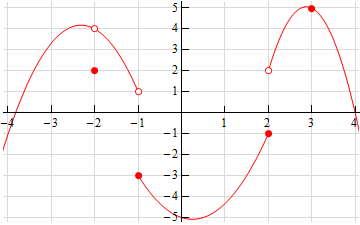
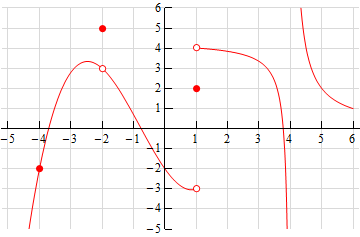
For problems 4 – 13 using only Properties 1- 9 from the Limit Properties section, one-sided limit properties (if needed) and the definition of continuity determine if the given function is continuous or discontinuous at the indicated points.
For problems 14 – 22 determine where the given function is discontinuous.
For problems 23 – 27 use the Intermediate Value Theorem to show that the given equation has at least one solution in the indicated interval. Note that you are NOT asked to find the solution only show that at least one must exist in the indicated interval.
For problems 28 – 33 assume that $f(x)$s is continuous everywhere unless otherwise indicated in some way. From the given information is it possible to determine if there is a root of $f(x)$ in the given interval?
If it is possible to determine that there is a root in the given interval clearly explain how you know that a root must exist. If it is not possible to determine if there is a root in the interval sketch a graph of two functions each of which meets the given information and one will have a root in the given interval and the other will not have a root in the given interval.
Note: The following content is adapted from OpenStax and is licensed under a Creative Commons Attribution-NonCommercial-ShareAlike 4.0 International License.
Access for free at https://openstax.org/books/calculus-volume-1/pages/1-introduction.
Determine whether each statement is true or false. Justify your answer.
The following problems consider the scalar form of Coulomb’s law, which describes the electrostatic force between two point charges, such as electrons. It is given by the equation $F(r) = k_e\frac{|q_1q_2|}{r^2}$, where $k_e$ is Coulomb's constant, $q_1$ and $q_2$ are the magnitudes of the charges of the two particles, and $r$ is the distance between the two particles.