Limits at Infinity Part I
Click here for a printable version of this page.In the previous section we saw limits whose values were infinite, that is, the output values of a function went towards $\infty$ or $-\infty$. Now it's now time to take a look at limits at infinity, that is, when the input values of a function go towards $\infty$ or $-\infty$. So every limit we'll study in this section will look like one of the following two limits. \[\lim\limits_{x\to\infty}f(x) \hspace{5em} \lim\limits_{x\to-\infty}f(x).\] As we'll soon see, these limits may also have a value of $\infty$ or $-\infty$, or not exist in some other way, or they may simply approach a particular value.
First, let's take a look at a graph and a table of values to build some intuition behind these limits.
Evaluate $\lim\limits_{x\to\infty} \dfrac1x$ and $\lim\limits_{x\to\infty} \dfrac1x$.
First, let's remind ourselves what the graph of $f(x) = \dfrac1x$ looks like.

Let's also make two table of values, one where we plug in $x$-values that are becoming larger and larger positive numbers (going towards $\infty$) and the other where we plug in $x$-values that are becoming larger and larger negative numbers (going towards $-\infty$).
The graph and the table show us the same thing: when we plug in values of $x$ that are becoming larger positive numbers (on the graph, $x$ is going as far right on the $x$-axis as it can go), the output values of $f(x) = \dfrac1x$ are getting closer and closer to $0$.
Likewise when we plug in values of $x$ that are becoming larger negative numbers (on the graph, $x$ is going as far left on the $x$-axis as it can go), the output values of $f(x) = \dfrac1x$ are getting also closer and closer to $0$.
Thus we can estimate that \[\lim\limits_{x\to\infty} \dfrac1x = 0 \hspace{2em} \text{ and } \hspace{2em} \lim\limits_{x\to-\infty} \dfrac1x = 0.\]
Properties of limits at infinity
A lot of the limits at infinity that we want to compute will use the following properties that generalize what we learned from this example.
Properties of limits at infinity
- If $r$ is any positive rational number and $c$ is any real number, then \[\lim\limits_{x\to\infty}\dfrac{c}{x^r} = 0.\]
- If $r$ is any positive rational number, $c$ is any real number, and $x^r$ is defined for $x \lt 0$, then \[\lim\limits_{x\to-\infty}\dfrac{c}{x^r} = 0.\]
The first property is similar to the above example, because the numerator is staying fixed at some number $c$, while the denominator is growing larger and larger (since $r$ is a positive rational number). Dividing by something that grows larger and larger is like dividing an apple into more and more pieces. The more pieces you are required to cut from the apple, the smaller each piece will be, until eventually the size of each piece is almost nothing at all. This is why the first limit has a value of $0$.
Dividing a number by increasingly huge numbers results in something very, very small (close to 0).
The second property is nearly identical, but we have an extra restriction to ensure all values stay real. Since $x$ is taking on negative values as it goes to $-\infty$, we have to be careful to avoid things, like $\sqrt{-100}$ (in this case, $r = 1/2$). So requiring $x^r$ be defined for negative values of $x$ is just making sure that we aren't trying to evaluate even roots of negative numbers. Otherwise, the bottom is becoming larger and larger and again causing the whole fraction to become smaller and smaller, going towards a value of $0$.
Dividing a number by increasingly huge negative numbers also results in something very, very small (close to 0).
To see a formal proof of these properties, see the Proof of Various Limit Properties section in the Extras chapter.
Next, let's note that the set of properties at the end of the Infinite Limit section are still true if we replace $\lim\limits_{x\to c}f(x)$ with $\lim\limits_{x\to\infty}f(x)$ or $\lim\limits_{x\to-\infty}f(x)$. The proof of this is nearly identical to the proof of the original set of properties with only minor modifications to handle the change in the limit and so is left to you. We won't need these properties much over the next couple of sections, but they will be useful on occasion.
Examples
Let's do some examples, beginning with one that showcases a handy algebraic technique that we'll frequently use to simplify limits at infinity involving polynomials.
- $\lim\limits_{x\to\infty} (2x^4-x^2-8x)$
- $\lim\limits_{t\to-\infty} \left(\frac13 t^5+2t^3-t^2+8\right)$
- As always, let's try reasoning with our infinities (in combination with the properties from the end of the last section on infinite limits). We can think about what happens as we plug really large numbers in for each of our $t$-values, and try to think about what happens to the overall result. This thinking will allow us to only get to a certain point: \[2(\infty)^4 - \infty^2 - 8(\infty) \Rightarrow \infty - \infty -\infty.\] At this point, we cannot simplify the $\infty - \infty$ portion. We didn't address this in our list of properties because this turns out to be another indeterminate form (like the $0/0$ indeterminate form we saw in the section on computing limits, where the limit might have $\infty$, $-\infty$, any real number, or "DNE" as its value. To figure out which of these answers applies, we have to do some kind of simplifying algebra.
- If we try simply using the properties of infinite limits, this time we manage to avoid the $\infty-\infty$ indeterminate form: \[\lim\limits_{x\to-\infty} \left(\frac13 t^5+2t^3-t^2+8\right) \to (-\infty)^5+2(-\infty)^3-(-\infty)^2+8 \to -\infty-\infty-\infty + 8.\] Therefore \[ \lim\limits_{x\to-\infty} \left(\frac13 t^5+2t^3-t^2+8\right)=-\infty.\] This is why we try using limit properties first, as it can often save us from unnecessary algebraic simplification.
Note: you might be tempted to claim that $\infty - \infty$ equals $0$, but this is faulty logic. The problem here is that $\infty$ is a placeholder for saying that the value of the function is growing without bound, but what it doesn't say is how quickly the function is growing, and so the two different $\infty$ symbols are incomparable without doing more work like the algebra we are about to demonstrate.
With that in mind, we are going to factor out the largest power of $x$, since that will be causing the function to grow the fastest. In this case, that means factoring out $x^4$ inside the limit: \[\lim\limits_{x\to\infty} (2x^4-x^2-8x) = \lim\limits_{x\to\infty} \left[x^4\left(\dfrac{2x^4}{x^4}-\dfrac{x^2}{x^4}-\dfrac{8x}x^4\right)\right] = \lim\limits_{x\to\infty} \left[ x^4\left(2-\dfrac1{x^2}-\dfrac{8}{x^3}\right)\right].\] This kind of factoring may seem foreign to you at first, but you can verify it quickly by redistributing the $x^4$ and simplifying. An easy way to remember how to do this kind of factoring is note that factoring a term out of a polynomial is equivalent to dividing each term of the polynomial by the term we factored out. This can be thought of as multiplying by $\frac{x^4}{x^4}$, keeping the $x^4$ in the numerator outside the original polynomial, and distributing the $x^4$ in the denominator through:\[2x^4-x^2-8x = \dfrac{x^4}{x^4}\left(2x^4-x^2-8x\right) = x^4\left(\dfrac{2x^4}{x^4}-\dfrac{x^2}{x^4}-\dfrac{8x}x^4\right) = x^4\left(2-\dfrac1{x^2}-\dfrac{8}{x^3}\right).\]
Regardless, once you are convinced that the above algebra is valid, the rest of limit is done by using our properties for infinite limits. \[\text{Since }\lim\limits_{x\to\infty}\frac{1}{x^2} = 0 \text{ and } \lim\limits_{x\to \infty}\frac{8}{x^3} = 0, \hspace{5em} \lim\limits_{x\to\infty} \left(2-\dfrac1{x^2}-\dfrac{8}{x^3}\right) = 2 - 0 - 0 = 2\] Thus we can combine this information to get \[\lim\limits_{x\to\infty} (2x^4-x^2-8x) = \lim\limits_{x\to\infty} \left[ x^4\left(2-\dfrac1{x^2}-\dfrac{8}{x^3}\right)\right] \to \infty\cdot2\] therefore \[\lim\limits_{x\to\infty} (2x^4-x^2-8x) = \infty .\]
Let's move on to some more complicated limits at infinity.
First, notice that the only difference between these two limits is that in one x is going to positive infinity and in the other x is going to negative infinity. Sometimes this small difference will affect the value of the limit, and other times it won't.
Let's start with the first limit, and as usual, let's attempt to reason through based on only the infinities.\[\lim\limits_{x\to\infty} \dfrac{2x^4-x^2+8x}{-5x^4+7} \to \dfrac{\infty-\infty+\infty}{-\infty+7}\]
Thus we see the indeterminate form $\infty - \infty$ in the numerator, while the denominator simplifies to just $-\infty$. We could try the algebra technique we just learned to simplify the numerator, but we've seen this numerator before in Example 2 and we already know that we can show the numerator goes to $\infty$. This leads us to a new indeterminate form:\[\lim\limits_{x\to\infty} \dfrac{2x^4-x^2+8x}{-5x^4+7} \to \dfrac{\infty-\infty+\infty}{-\infty+7} \to \dfrac{\infty}{-\infty} \to -\dfrac{\infty}\infty.\]
It turns out that $\infty/\infty$ is also indeterminate (and hence $-\infty/\infty$ as well). You might be tempted to conclude that $\infty/\infty = 1$, but this is not true in general, and there are many possibilities for this limit. When we see indeterminate forms, our job is to pick an appropriate algebraic technique we can use to circumvent this form and uncover the value of the limit.
Fortunately, the algebraic technique we just learned works well for this kind of function as well. We are going to factor the largest power of $x$ out of the numerator and the denominator, in this case, $x^4$. \[\lim\limits_{x\to\infty} \dfrac{2x^4-x^2+8x}{-5x^4+7} = \lim\limits_{x\to\infty} \dfrac{x^4\left(2-\frac{1}{x^2}+\frac8{x^3}\right)}{x^4\left(-5+\frac{7}{x^4}\right)}\]
We are almost done! All that's left is to cancel the common terms of $x^4$ that we've factored out of both the numerator and denominator of the fraction, and then try reasoning with our infinities again.\[\lim\limits_{x\to\infty} \dfrac{2x^4-x^2+8x}{-5x^4+7} = \lim\limits_{x\to\infty} \dfrac{x^4\left(2-\frac{1}{x^2}+\frac8{x^3}\right)}{x^4\left(-5+\frac{7}{x^4}\right)} = \lim\limits_{x\to\infty} \dfrac{2-\frac{1}{x^2}+\frac8{x^3}}{-5+\frac{7}{x^4}} = \dfrac{2-0+0}{-5+0} = -\dfrac25\]
Notice how limit initially had the indeterminate form $-\infty/\infty$ but we managed to show that the value of the limit was $-2/5$. This is why we have to be so careful and not simply assume that $\infty/\infty = 1$. For the second limit, the exact same algebra provides us what we need.\[\lim\limits_{x\to-\infty} \dfrac{2x^4-x^2+8x}{-5x^4+7} = \lim\limits_{x\to-\infty} \dfrac{x^4\left(2-\frac{1}{x^2}+\frac8{x^3}\right)}{x^4\left(-5+\frac{7}{x^4}\right)} = \lim\limits_{x\to-\infty} \dfrac{2-\frac{1}{x^2}+\frac8{x^3}}{-5+\frac{7}{x^4}} = \dfrac{2-0-0}{-5+0} = -\dfrac25\]In the previous example the infinity that $x$ approached in the limit didn't change the answer. This will not always be the case. Let's take a look at an example that shows this.
Evaluate each of the following limits. \[\lim\limits_{x\to\infty} \dfrac{\sqrt{3x^2+6}}{5-2x} \hspace{2em} \text{and}\hspace{2em} \lim\limits_{x\to-\infty} \dfrac{\sqrt{3x^2+6}}{5-2x}\]
The square root in this problem doesn't mean we'll need a different algebraic technique, but it will make the work a little more complex.
Let's start with the first limit. If we try reasoning with the infinities, we get \[\lim\limits_{x\to\infty} \dfrac{\sqrt{3x^2+6}}{5-2x} \to \dfrac{\sqrt{3(\infty)^2+6}}{5-2(\infty)} \to \dfrac{\infty}{-\infty}.\]
Once again, we find an indeterminate form, because again the infinities may not indicate the same rate of growth of the function, and so we cannot simplify them as we would numbers. So let's simplify by factoring the $x^2$ out from polynomial under the square root in the numerator and the $x$ out from the polynomial in the denominator.\[\lim\limits_{x\to\infty} \dfrac{\sqrt{3x^2+6}}{5-2x} = \lim\limits_{x\to\infty} \dfrac{\sqrt{x^2\left(3+\frac6{x^2}\right)}}{x\left(\frac5x-2\right)} = \lim\limits_{x\to\infty} \dfrac{\sqrt{x^2}{\sqrt{3+\frac6{x^2}}}}{x\left(\frac5x-2\right)}\]
This is the slightly more complex part, as before we can cancel the powers of $x$ on top and bottom, we need to simplify $\sqrt{x^2}$. Recall that $\sqrt{x^2} = |x|$. As $x$ is approaching $\infty$, $x$ is specifically taking on larger and larger positive values. Thus for this first limit, we can use the formula $|x| = x$ for $x > 0$. Thus the limit becomes \[\lim\limits_{x\to\infty} \dfrac{\sqrt{3x^2+6}}{5-2x} = \lim\limits_{x\to\infty} \dfrac{x{\sqrt{3+\frac6{x^2}}}}{x\left(\frac5x-2\right)}\] Now we can cancel the $x$ on top and bottom and finish evaluating the limit.\[\lim\limits_{x\to\infty} \dfrac{\sqrt{3x^2+6}}{5-2x} = \lim\limits_{x\to\infty} \dfrac{x{\sqrt{3+\frac6{x^2}}}}{x\left(\frac5x-2\right)} = \lim\limits_{x\to\infty} \dfrac{{\sqrt{3+\frac6{x^2}}}}{\frac5x-2} = \dfrac{\sqrt{3+0}}{0-2} = -\dfrac{\sqrt{3}}2\]
Now let's try the second limit and see what changes. First, we if we try reasoning with the infinities, we get \[\lim\limits_{x\to-\infty} \dfrac{\sqrt{3x^2+6}}{5-2x} \to \dfrac{\sqrt{3(-\infty)^2+6}}{5-2(-\infty)} \to \dfrac{\infty}{\infty}.\]
Already we can see one difference. The first limit had an initial negative indeterminate form of $-\infty/\infty$, while this limit has the positive indeterminate form $\infty/\infty$.
Since it is a similar indeterminate form, let's try the same algebra we did before. \[\lim\limits_{x\to-\infty} \dfrac{\sqrt{3x^2+6}}{5-2x} = \lim\limits_{x\to-\infty} \dfrac{\sqrt{x^2\left(3+\frac6{x^2}\right)}}{x\left(\frac5x-2\right)} = \lim\limits_{x\to-\infty} \dfrac{\sqrt{x^2}{\sqrt{3+\frac6{x^2}}}}{x\left(\frac5x-2\right)}\]
This is where the simplification changes slightly. Since $x$ is approaching $-\infty$, $x$ is specifically taking larger and larger negative values. As before, we'll use $\sqrt{x^2} = |x|$, but now we'll use the formula $|x| = -x$ for $x \lt 0$. Using this, we can now complete the second limit similar to the first one.
\[\lim\limits_{x\to-\infty} \dfrac{\sqrt{3x^2+6}}{5-2x} = \lim\limits_{x\to-\infty} \dfrac{\sqrt{x^2}{\sqrt{3+\frac6{x^2}}}}{x\left(\frac5x-2\right)} = \lim\limits_{x\to-\infty} \dfrac{-x{\sqrt{3+\frac6{x^2}}}}{x\left(\frac5x-2\right)} = \lim\limits_{x\to-\infty} \dfrac{-{\sqrt{3+\frac6{x^2}}}}{\frac5x-2} = \dfrac{-\sqrt{3+0}}{0-2} = \dfrac{\sqrt{3}}2\]Notice how our answer is the opposite sign for the second limit compared to the first limit, similar to how both limits had opposite sign indeterminate forms.
As we saw in the last couple examples, sometimes the infinity that $x$ approaches in the limit will affect the answer and other times it won't. Note as well that it doesn't always just change the sign of the number. It can also completely change the value, and we'll see an example or two of this in the next section.
Horizontal Asymptotes
Before moving on to a couple of more examples let's revisit the idea of asymptotes that we first saw in the previous section, as this is a common place for limits at infinity to show up. Just as we can define vertical asymptotes using limits, we can define horizontal asymptotes using limits.
The function $f(x)$ has a horizontal asymptote at $y = L$ (where $L$ is some finite real number) if either of the following are true: \[\lim\limits_{x\to\infty}f(x) = L \hspace{2em} \text{or} \hspace{2em} \lim\limits_{x\to-\infty}f(x) = L.\]
We're not going to be doing much with asymptotes here, but it's an easy fact to give and we can use the previous example to illustrate all the asymptote ideas we've seen in the both this section and the previous section. The function in the last example will have two horizontal asymptotes. It will also have a vertical asymptote. Here is a graph of $y = \dfrac{\sqrt{3x^2+6}}{5-2x}$ showing these asymptotes.
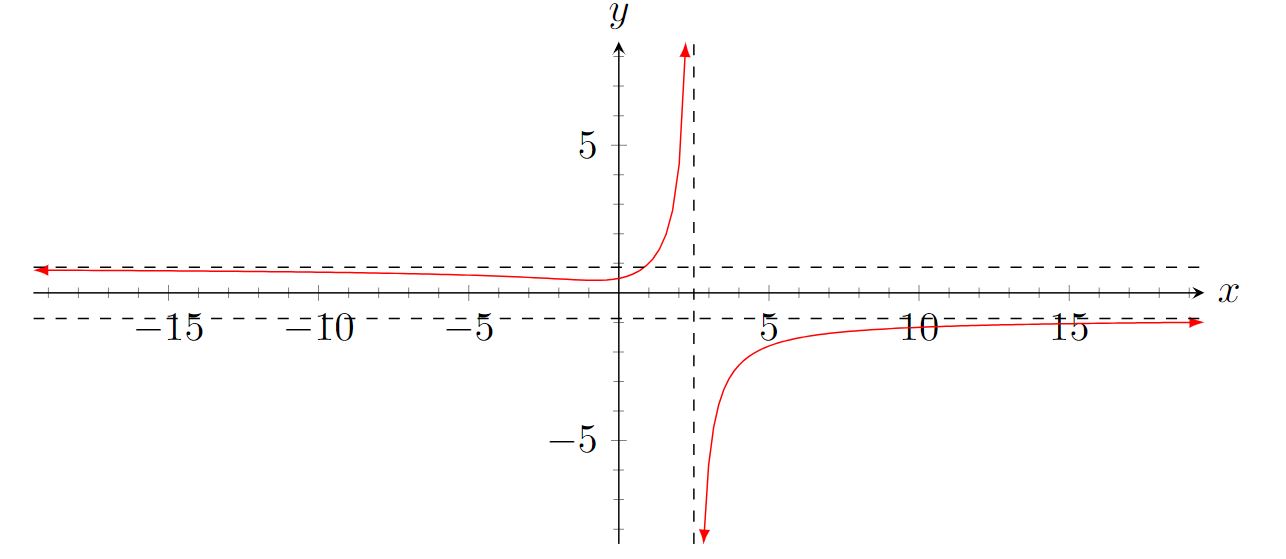
One important thing to notice from this graph example and our definition: no part of the definition of a horizontal asymptote requires the graph to not cross the asymptote. You may have heard in previous classes that graphs cannot cross asymptotes, but this is an incorrect simplification to explain the idea of what it means for a function to approach a value on either of its ends. It is true that a function of $x$ cannot cross its vertical asymptotes (to do so would be to force the function to backtrack to approach the vertical asymptote, and then the function would fail the vertical line test), but it can cross its horizontal asymptotes any number of times. The only requirement for there to be a horizontal asymptote $y=L$ is that one of the two limits at infinity for the function have the same value as the horizontal asymptote.
Functions may cross their horizontal asymptotes any number of times!
Let's do two last examples together.
Use limits to find all horizontal asymptotes (if any) of the function $g(z) = \dfrac{4z^2+z^6}{1-5z^3}$.
First, let's write down the limits that need to be checked for horizontal asymptotes. \[\lim\limits_{z\to\infty} \dfrac{4z^2+z^6}{1-5z^3} \hspace{2em} \text{and} \hspace{2em} \lim\limits_{z\to-\infty} \dfrac{4z^2+z^6}{1-5z^3}\]
If we try reasoning with infinity, we get \[\lim\limits_{z\to\infty} \dfrac{4z^2+z^6}{1-5z^3} \to \dfrac{\infty}{-\infty} \hspace{2em} \text{and} \hspace{2em} \lim\limits_{z\to-\infty} \dfrac{4z^2+z^6}{1-5z^3} \to \dfrac{\infty}{\infty}.\]
So both limits have indeterminate forms. Let's do some algebra to simplify the first limit. The largest power in the numerator is $z^6$, while the largest power in the denominator is $z^3$, so let's factor those out from their respective expressions.\[\lim\limits_{z\to\infty} \dfrac{4z^2+z^6}{1-5z^3} = \lim\limits_{z\to\infty} \dfrac{z^6\left(\frac4{z^4}+1\right)}{z^3\left(\frac1{z^3}-5\right)} = \lim\limits_{z\to\infty} \dfrac{z^3\left(\frac4{z^4}+1\right)}{\frac1{z^3}-5}\] Now, because $\lim\limits_{z\to\infty}z^3 = \infty$, in the numerator we have something in the form of $\infty\cdot(0+1) = \infty$. In the denominator we have $0-5$. So essentially, the value of our limit becomes \[\dfrac{\infty(0+1)}{0-5} = \dfrac{\infty}{-5} = -\infty\] and therefore $$\lim\limits_{z\to\infty} \dfrac{4z^2+z^6}{1-5z^3}=-\infty.$$
Since this limit is not a finite real number, $g(z)$ has no horizontal asymptote on its right side, that is, as $z$ approaches $\infty$. Let's check the other limit, and since the algebra is the same, we can shorten the process a little.\[\lim\limits_{z\to-\infty} \dfrac{4z^2+z^6}{1-5z^3} = \lim\limits_{z\to-\infty} \dfrac{z^3\left(\frac4{z^4}+1\right)}{\frac1{z^3}-5} \Rightarrow\dfrac{-\infty(0+1)}{0-5} \Rightarrow \dfrac{-\infty}{-5} = \infty\] Notice that the answer for this limit is positive since a negative quantity divided by a negative quantity becomes positive.
Neither limit gave us a finite value, so we conclude that $g(z)$ has no horizontal asymptotes.
Use limits to find all horizontal asymptotes (if any) of the function $h(t) = \dfrac{t^2-5t-9}{2t^4+3t^3}$.
Once again, let's write down the limits that need to be checked for horizontal asymptotes. \[\lim\limits_{t\to\infty} \dfrac{t^2-5t-9}{2t^4+3t^3} \hspace{2em} \text{and} \hspace{2em} \lim\limits_{t\to-\infty} \dfrac{t^2-5t-9}{2t^4+3t^3}\]
If we try reasoning with infinities, we get \[\lim\limits_{t\to\infty} \dfrac{t^2-5t-9}{2t^4+3t^3} \to \dfrac{\infty-\infty-9}{\infty+\infty} \hspace{2em} \text{and} \hspace{2em} \lim\limits_{t\to-\infty} \dfrac{t^2-5t-9}{2t^4+3t^3} \to \dfrac{\infty+\infty-9}{\infty-\infty}.\]
So both limits have indeterminate forms. Let's do some algebra to simplify the first limit. The largest power in the numerator is $t^2$, while the largest power in the denominator is $t^4$, so let's factor those out from their respective expressions.\[\lim\limits_{t\to\infty} \dfrac{t^2-5t-9}{2t^4+3t^3} = \lim\limits_{t\to\infty} \dfrac{t^2\left(1-\frac5t - \frac9{t^2}\right)}{t^4\left(2+\frac3t\right)} = \lim\limits_{t\to\infty} \dfrac{1-\frac5t - \frac9{t^2}}{t^2\left(2+\frac3t\right)} \to \dfrac{1-0-0}{\infty(2+0)} \to \dfrac{1}{\infty} = 0\]
Since this limit evaluates to the finite real number $0$, we can immediately conclude that $y = h(t)$ has a horizontal asymptote of $y = 0$, specifically on the right side of its graph (as $t$ approaches $\infty$).
Let's check the other limit, and since the algebra is the same, we can shorten the process a little.\[\lim\limits_{t\to-\infty} \dfrac{t^2-5t-9}{2t^4+3t^3} = \lim\limits_{t\to-\infty} \dfrac{1-\frac5t - \frac9{t^2}}{t^2\left(2+\frac3t\right)} \to\dfrac{1+0-0}{\infty(2-0)} \to \dfrac{1}{\infty} \to 0\]
Since this limit evaluates to the finite real number $0$, we can immediately conclude that $y = h(t)$ has a horizontal asymptote of $y = 0$, this time on the left side of its graph (as $t$ approaches $-\infty$).
Both limits gave us the same value of $0$, so we can conlude the $y = h(t)$ has one horizontal asymptote, $y = 0$, and this is an asymptote on both the left and right side of the graph.
In this section we concentrated on limits at infinity with functions that involved polynomials, rational expressions, and roots. There are many more types of functions that we could study, and we'll see limits at infinity involving more functions in the next section.
To see a precise and mathematical definition of this kind of limit see the The Definition of the Limit section at the end of this chapter.
Practice Problems
- For $f(x) = 4x^7 - 18x^3+9$ evaluate each of the following limits.
- $\lim\limits_{x\to-\infty}f(x)$
- $\lim\limits_{x\to\infty}f(x)$
To do this all we need to do is factor out the largest power of $x$ from the whole polynomial and then use basic limit properties along with Fact 1 from this section to evaluate the limit.
$$\begin{align*}\mathop {\lim }\limits_{x \to \, - \infty } \left( {4{x^7} - 18{x^3} + 9} \right) & = \mathop {\lim }\limits_{x \to \, - \infty } \left[ {{x^7}\left( {4 - \frac{{18}}{{{x^4}}} + \frac{9}{{{x^7}}}} \right)} \right]\\ & = \left( {\mathop {\lim }\limits_{x \to \, - \infty } {x^7}} \right)\left[ {\mathop {\lim }\limits_{x \to \, - \infty } \left( {4 - \frac{{18}}{{{x^4}}} + \frac{9}{{{x^7}}}} \right)} \right] = \left( { - \infty } \right)\left( 4 \right) = \require{bbox} \bbox[2pt,border:1px solid black]{{ - \infty }}\end{align*}$$For this part all of the mathematical manipulations we did in the first part did not depend upon the limit itself and so don’t need to be redone here. We can pick up the problem right before we actually took the limits and then proceed.
$$\mathop {\lim }\limits_{x \to \,\infty } \left( {4{x^7} - 18{x^3} + 9} \right) = \left( {\mathop {\lim }\limits_{x \to \,\infty } {x^7}} \right)\left[ {\mathop {\lim }\limits_{x \to \,\infty } \left( {4 - \frac{{18}}{{{x^4}}} + \frac{9}{{{x^7}}}} \right)} \right] = \left( \infty \right)\left( 4 \right) = \require{bbox} \bbox[2pt,border:1px solid black]{\infty }$$- For $h(t)=\sqrt[3]{t}+12t-2t^2$ evaluate each of the following limits.
- $\lim\limits_{t\to-\infty}h(t)$
- $\lim\limits_{t\to\infty}h(t)$
To do this all we need to do is factor out the largest power of $t$ from the whole polynomial and then use basic limit properties along with Fact 1 from this section to evaluate the limit.
Note as well that we’ll convert the root over to a fractional exponent in order to allow it to be easier to deal with. Also note that this limit is a perfectly acceptable limit because the root is a cube root and we can take cube roots of negative numbers! We would only have run into problems had the index on the root been an even number.
$$\begin{align*}\mathop {\lim }\limits_{t \to \, - \infty } \left( {{t^{\frac{1}{3}}} + 12t - 2{t^2}} \right) & = \mathop {\lim }\limits_{t \to \, - \infty } \left[ {{t^2}\left( {\frac{1}{{{t^{\frac{5}{3}}}}} + \frac{{12}}{t} - 2} \right)} \right]\\ & = \left( {\mathop {\lim }\limits_{t \to \, - \infty } {t^2}} \right)\left[ {\mathop {\lim }\limits_{t \to \, - \infty } \left( {\frac{1}{{{t^{\frac{5}{3}}}}} + \frac{{12}}{t} - 2} \right)} \right] = \left( \infty \right)\left( { - 2} \right) = \require{bbox} \bbox[2pt,border:1px solid black]{{ - \infty }}\end{align*}$$For this part all of the mathematical manipulations we did in the first part did not depend upon the limit itself and so don’t need to be redone here. We can pick up the problem right before we actually took the limits and then proceed.
$$\mathop {\lim }\limits_{t \to \,\infty } \left( {{t^{\frac{1}{3}}} + 12t - 2{t^2}} \right) = \left( {\mathop {\lim }\limits_{t \to \,\infty } {t^2}} \right)\left[ {\mathop {\lim }\limits_{t \to \,\infty } \left( {\frac{1}{{{t^{\frac{5}{3}}}}} + \frac{{12}}{t} - 2} \right)} \right] = \left( \infty \right)\left( { - 2} \right) = \require{bbox} \bbox[2pt,border:1px solid black]{{ - \infty }}$$- For $f(x) = \frac{8-4x^2}{9x^2+5x}$ evaluate each of the following limits.
- $\lim\limits_{x\to-\infty}f(x)$
- $\lim\limits_{x\to\infty}f(x)$
- Write down the equation(s) of any horizontal asymptotes for the function.
To do this all we need to do is factor out the largest power of $x$ that is in the denominator from both the denominator and the numerator. Then all we need to do is use basic limit properties along with Fact 1 from this section to evaluate the limit.
$$\mathop {\lim }\limits_{x \to \, - \infty } \frac{{8 - 4{x^2}}}{{9{x^2} + 5x}} = \mathop {\lim }\limits_{x \to \, - \infty } \frac{{{x^2}\left( {\frac{8}{{{x^2}}} - 4} \right)}}{{{x^2}\left( {9 + \frac{5}{x}} \right)}} = \mathop {\lim }\limits_{x \to \, - \infty } \frac{{\frac{8}{{{x^2}}} - 4}}{{9 + \frac{5}{x}}} = \require{bbox} \bbox[2pt,border:1px solid black]{{\frac{{ - 4}}{9}}}$$For this part all of the mathematical manipulations we did in the first part did not depend upon the limit itself and so don’t really need to be redone here. However, it is easy enough to add them in so we’ll go ahead and include them.
$$\mathop {\lim }\limits_{x \to \,\infty } \frac{{8 - 4{x^2}}}{{9{x^2} + 5x}} = \mathop {\lim }\limits_{x \to \,\infty } \frac{{{x^2}\left( {\frac{8}{{{x^2}}} - 4} \right)}}{{{x^2}\left( {9 + \frac{5}{x}} \right)}} = \mathop {\lim }\limits_{x \to \,\infty } \frac{{\frac{8}{{{x^2}}} - 4}}{{9 + \frac{5}{x}}} = \require{bbox} \bbox[2pt,border:1px solid black]{{\frac{{ - 4}}{9}}}$$We know that there will be a horizontal asymptote for $x\to-\infty$ if $\lim\limits_{x\to-\infty}f(x)$ exists and is a finite number. Likewise, we’ll have a horizontal asymptote for $x \to \infty$ if $\lim\limits_{x\to\infty}f(x)$ exists and is a finite number.
Therefore, from the first two parts, we can see that we will get the horizontal asymptote $y = -\frac49$ for both $x\to\infty$ and $x\to-\infty$.
- For $f(x) = \frac{3x^7-4x^2+1}{5-10x^2}$ evaluate each of the following limits.
- $\lim\limits_{x\to-\infty}f(x)$
- $\lim\limits_{x\to\infty}f(x)$
- Write down the equation(s) of any horizontal asymptotes for the function.
To do this all we need to do is factor out the largest power of $x$ that is in the denominator from both the denominator and the numerator. Then all we need to do is use basic limit properties along with Fact 1 from this section to evaluate the limit.
$$\mathop {\lim }\limits_{x \to \, - \infty } \frac{{3{x^7} - 4{x^2} + 1}}{{5 - 10{x^2}}} = \mathop {\lim }\limits_{x \to \, - \infty } \frac{{{x^2}\left( {3{x^5} - 4 + \frac{1}{{{x^2}}}} \right)}}{{{x^2}\left( {\frac{5}{{{x^2}}} - 10} \right)}} = \mathop {\lim }\limits_{x \to \, - \infty } \frac{{3{x^5} - 4 + \frac{1}{{{x^2}}}}}{{\frac{5}{{{x^2}}} - 10}} = \frac{{ - \infty }}{{ - 10}} = \require{bbox} \bbox[2pt,border:1px solid black]{\infty }$$For this part all of the mathematical manipulations we did in the first part did not depend upon the limit itself and so don’t really need to be redone here. However, it is easy enough to add them in so we’ll go ahead and include them.
$$\mathop {\lim }\limits_{x \to \,\infty } \frac{{3{x^7} - 4{x^2} + 1}}{{5 - 10{x^2}}} = \mathop {\lim }\limits_{x \to \,\infty } \frac{{{x^2}\left( {3{x^5} - 4 + \frac{1}{{{x^2}}}} \right)}}{{{x^2}\left( {\frac{5}{{{x^2}}} - 10} \right)}} = \mathop {\lim }\limits_{x \to \,\infty } \frac{{3{x^5} - 4 + \frac{1}{{{x^2}}}}}{{\frac{5}{{{x^2}}} - 10}} = \frac{\infty }{{ - 10}} = \require{bbox} \bbox[2pt,border:1px solid black]{{ - \infty }}$$We know that there will be a horizontal asymptote for $x\to-\infty$ if $\lim\limits_{x\to-\infty}f(x)$ exists and is a finite number. Likewise, we’ll have a horizontal asymptote for $x \to \infty$ if $\lim\limits_{x\to\infty}f(x)$ exists and is a finite number.
Therefore, from the first two parts, we can see that the function will have no horizontal asymptotes since neither of the two limits are finite.
- For $f(x) = \frac{20x^4-7x^3}{2x+9x^2+5x^4}$ evaluate each of the following limits.
- $\lim\limits_{x\to-\infty}f(x)$
- $\lim\limits_{x\to\infty}f(x)$
- Write down the equation(s) of any horizontal asymptotes for the function.
To do this all we need to do is factor out the largest power of $x$ that is in the denominator from both the denominator and the numerator. Then all we need to do is use basic limit properties along with Fact 1 from this section to evaluate the limit.
$$\mathop {\lim }\limits_{x \to \, - \infty } \frac{{20{x^4} - 7{x^3}}}{{2x + 9{x^2} + 5{x^4}}} = \mathop {\lim }\limits_{x \to \, - \infty } \frac{{{x^4}\left( {20 - \frac{7}{x}} \right)}}{{{x^4}\left( {\frac{2}{{{x^3}}} + \frac{9}{{{x^2}}} + 5} \right)}} = \mathop {\lim }\limits_{x \to \, - \infty } \frac{{20 - \frac{7}{x}}}{{\frac{2}{{{x^3}}} + \frac{9}{{{x^2}}} + 5}} = \frac{{20}}{5} = \require{bbox} \bbox[2pt,border:1px solid black]{4}$$For this part all of the mathematical manipulations we did in the first part did not depend upon the limit itself and so don’t really need to be redone here. However, it is easy enough to add them in so we’ll go ahead and include them.
$$\mathop {\lim }\limits_{x \to \,\infty } \frac{{20{x^4} - 7{x^3}}}{{2x + 9{x^2} + 5{x^4}}} = \mathop {\lim }\limits_{x \to \,\infty } \frac{{{x^4}\left( {20 - \frac{7}{x}} \right)}}{{{x^4}\left( {\frac{2}{{{x^3}}} + \frac{9}{{{x^2}}} + 5} \right)}} = \mathop {\lim }\limits_{x \to \,\infty } \frac{{20 - \frac{7}{x}}}{{\frac{2}{{{x^3}}} + \frac{9}{{{x^2}}} + 5}} = \frac{{20}}{5} = \require{bbox} \bbox[2pt,border:1px solid black]{4}$$We know that there will be a horizontal asymptote for $x\to-\infty$ if $\lim\limits_{x\to-\infty}f(x)$ exists and is a finite number. Likewise, we’ll have a horizontal asymptote for $x \to \infty$ if $\lim\limits_{x\to\infty}f(x)$ exists and is a finite number.
Therefore, from the first two parts, we can see that the function will have a horizontal asymptote at $y = 4$ for both $x\to\infty$ and $x\to-\infty$.
- For $f(x) = \frac{x^3-2x+11}{3-6x^5}$ evaluate each of the following limits.
- $\lim\limits_{x\to-\infty}f(x)$
- $\lim\limits_{x\to\infty}f(x)$
- Write down the equation(s) of any horizontal asymptotes for the function.
To do this all we need to do is factor out the largest power of $x$ that is in the denominator from both the denominator and the numerator. Then all we need to do is use basic limit properties along with Fact 1 from this section to evaluate the limit.
$$\mathop {\lim }\limits_{x \to \, - \infty } \frac{{{x^3} - 2x + 11}}{{3 - 6{x^5}}} = \mathop {\lim }\limits_{x \to \, - \infty } \frac{{{x^5}\left( {\frac{1}{{{x^2}}} - \frac{2}{{{x^4}}} + \frac{{11}}{{{x^5}}}} \right)}}{{{x^5}\left( {\frac{3}{{{x^5}}} - 6} \right)}} = \mathop {\lim }\limits_{x \to \, - \infty } \frac{{\frac{1}{{{x^2}}} - \frac{2}{{{x^4}}} + \frac{{11}}{{{x^5}}}}}{{\frac{3}{{{x^5}}} - 6}} = \frac{0}{{ - 6}} = \require{bbox} \bbox[2pt,border:1px solid black]{0}$$For this part all of the mathematical manipulations we did in the first part did not depend upon the limit itself and so don’t really need to be redone here. However, it is easy enough to add them in so we’ll go ahead and include them.
$$\mathop {\lim }\limits_{x \to \,\infty } \frac{{{x^3} - 2x + 11}}{{3 - 6{x^5}}} = \mathop {\lim }\limits_{x \to \,\infty } \frac{{{x^5}\left( {\frac{1}{{{x^2}}} - \frac{2}{{{x^4}}} + \frac{{11}}{{{x^5}}}} \right)}}{{{x^5}\left( {\frac{3}{{{x^5}}} - 6} \right)}} = \mathop {\lim }\limits_{x \to \,\infty } \frac{{\frac{1}{{{x^2}}} - \frac{2}{{{x^4}}} + \frac{{11}}{{{x^5}}}}}{{\frac{3}{{{x^5}}} - 6}} = \frac{0}{{ - 6}} = \require{bbox} \bbox[2pt,border:1px solid black]{0}$$We know that there will be a horizontal asymptote for $x\to-\infty$ if $\lim\limits_{x\to-\infty}f(x)$ exists and is a finite number. Likewise, we’ll have a horizontal asymptote for $x \to \infty$ if $\lim\limits_{x\to\infty}f(x)$ exists and is a finite number.
Therefore, from the first two parts, we can see that the function will have a horizontal asymptote at $y = 0$ for both $x\to\infty$ and $x\to-\infty$.
- For $f(x) = \frac{x^6-x^4+x^2-1}{7x^6+4x^3+10}$ evaluate each of the following limits.
- $\lim\limits_{x\to-\infty}f(x)$
- $\lim\limits_{x\to\infty}f(x)$
- Write down the equation(s) of any horizontal asymptotes for the function.
To do this all we need to do is factor out the largest power of $x$ that is in the denominator from both the denominator and the numerator. Then all we need to do is use basic limit properties along with Fact 1 from this section to evaluate the limit.
$$\mathop {\lim }\limits_{x \to \, - \infty } \frac{{{x^6} - {x^4} + {x^2} - 1}}{{7{x^6} + 4{x^3} + 10}} = \mathop {\lim }\limits_{x \to \, - \infty } \frac{{{x^6}\left( {1 - \frac{1}{{{x^2}}} + \frac{1}{{{x^4}}} - \frac{1}{{{x^6}}}} \right)}}{{{x^6}\left( {7 + \frac{4}{{{x^3}}} + \frac{{10}}{{{x^6}}}} \right)}} = \mathop {\lim }\limits_{x \to \, - \infty } \frac{{1 - \frac{1}{{{x^2}}} + \frac{1}{{{x^4}}} - \frac{1}{{{x^6}}}}}{{7 + \frac{4}{{{x^3}}} + \frac{{10}}{{{x^6}}}}} = \require{bbox} \bbox[2pt,border:1px solid black]{{\frac{1}{7}}}$$For this part all of the mathematical manipulations we did in the first part did not depend upon the limit itself and so don’t really need to be redone here. However, it is easy enough to add them in so we’ll go ahead and include them.
$$\mathop {\lim }\limits_{x \to \,\infty } \frac{{{x^6} - {x^4} + {x^2} - 1}}{{7{x^6} + 4{x^3} + 10}} = \mathop {\lim }\limits_{x \to \,\infty } \frac{{{x^6}\left( {1 - \frac{1}{{{x^2}}} + \frac{1}{{{x^4}}} - \frac{1}{{{x^6}}}} \right)}}{{{x^6}\left( {7 + \frac{4}{{{x^3}}} + \frac{{10}}{{{x^6}}}} \right)}} = \mathop {\lim }\limits_{x \to \,\infty } \frac{{1 - \frac{1}{{{x^2}}} + \frac{1}{{{x^4}}} - \frac{1}{{{x^6}}}}}{{7 + \frac{4}{{{x^3}}} + \frac{{10}}{{{x^6}}}}} = \require{bbox} \bbox[2pt,border:1px solid black]{{\frac{1}{7}}}$$We know that there will be a horizontal asymptote for $x\to-\infty$ if $\lim\limits_{x\to-\infty}f(x)$ exists and is a finite number. Likewise, we’ll have a horizontal asymptote for $x \to \infty$ if $\lim\limits_{x\to\infty}f(x)$ exists and is a finite number.
Therefore, from the first two parts, we can see that the function will have a horizontal asymptote at $y = \frac17$ for both $x\to\infty$ and $x\to-\infty$.
- For $f(x) = \frac{\sqrt{7+9x^2}}{1-2x}$ evaluate each of the following limits.
- $\lim\limits_{x\to-\infty}f(x)$
- $\lim\limits_{x\to\infty}f(x)$
- Write down the equation(s) of any horizontal asymptotes for the function.
To do this all we need to do is factor out the largest power of $x$ that is in the denominator from both the denominator and the numerator. Then all we need to do is use basic limit properties along with Fact 1 from this section to evaluate the limit.
In this case the largest power of $x$ in the denominator is just $x$ and so we will need to factor an $x$ out of both the denominator and the numerator. Recall as well that this means we’ll need to factor an $x^2$ out of the root in the numerator so that we’ll have an $x$ in the numerator when we are done.
So, let’s do the first couple of steps in this process to get us started.
$$\mathop {\lim }\limits_{x \to \, - \infty } \frac{{\sqrt {7 + 9{x^2}} }}{{1 - 2x}} = \mathop {\lim }\limits_{x \to \, - \infty } \frac{{\sqrt {{x^2}\left( {\frac{7}{{{x^2}}} + 9} \right)} }}{{x\left( {\frac{1}{x} - 2} \right)}} = \mathop {\lim }\limits_{x \to \, - \infty } \frac{{\sqrt {{x^2}} \sqrt {\frac{7}{{{x^2}}} + 9} }}{{x\left( {\frac{1}{x} - 2} \right)}} = \mathop {\lim }\limits_{x \to \, - \infty } \frac{{\left| x \right|\sqrt {\frac{7}{{{x^2}}} + 9} }}{{x\left( {\frac{1}{x} - 2} \right)}}$$Recall from the discussion in this section that $\sqrt{x^2}=|x|$, and we do need to be careful about that.
Now, because we are looking at the limit $x\to-\infty$ it is safe to assume that $x\lt 0$. Therefore, from the definition of the absolute value we get, $|x| = -x$, and the limit is then $$\mathop {\lim }\limits_{x \to \, - \infty } \frac{{\sqrt {7 + 9{x^2}} }}{{1 - 2x}} = \mathop {\lim }\limits_{x \to \, - \infty } \frac{{ - x\sqrt {\frac{7}{{{x^2}}} + 9} }}{{x\left( {\frac{1}{x} - 2} \right)}} = \mathop {\lim }\limits_{x \to \, - \infty } \frac{{ - \sqrt {\frac{7}{{{x^2}}} + 9} }}{{\frac{1}{x} - 2}} = \frac{{ - \sqrt 9 }}{{ - 2}} = \require{bbox} \bbox[2pt,border:1px solid black]{{\frac{3}{2}}}.$$
For this part all of the mathematical manipulations we did in the first part up to dealing with the absolute value did not depend upon the limit itself and so don’t really need to be redone here. So, up to that part we have.
$$\mathop {\lim }\limits_{x \to \,\infty } \frac{{\sqrt {7 + 9{x^2}} }}{{1 - 2x}} = \mathop {\lim }\limits_{x \to \,\infty } \frac{{\left| x \right|\sqrt {\frac{7}{{{x^2}}} + 9} }}{{x\left( {\frac{1}{x} - 2} \right)}}$$In this part we are looking at the limit $x\to\infty$ and so it will be safe to assume in this part that $x\gt 0$. Therefore, from the definition of the absolute value we get, $|x|=x$ and the limit is then $$\mathop {\lim }\limits_{x \to \,\infty } \frac{{\sqrt {7 + 9{x^2}} }}{{1 - 2x}} = \mathop {\lim }\limits_{x \to \,\infty } \frac{{x\sqrt {\frac{7}{{{x^2}}} + 9} }}{{x\left( {\frac{1}{x} - 2} \right)}} = \mathop {\lim }\limits_{x \to \,\infty } \frac{{\sqrt {\frac{7}{{{x^2}}} + 9} }}{{\frac{1}{x} - 2}} = \frac{{\sqrt 9 }}{{ - 2}} = \require{bbox} \bbox[2pt,border:1px solid black]{{ - \frac{3}{2}}}.$$
We know that there will be a horizontal asymptote for $x\to-\infty$ if $\lim\limits_{x\to-\infty}f(x)$ exists and is a finite number. Likewise, we’ll have a horizontal asymptote for $x \to \infty$ if $\lim\limits_{x\to\infty}f(x)$ exists and is a finite number.
Therefore, from the first two parts, we can see that the function will have a horizontal asymptote at $y = \frac32$ for $x\to-\infty$ and $y=-\frac32$ for $x\to\infty$.
- For $f(x) = \frac{x+8}{\sqrt{2x^2+3}}$ evaluate each of the following limits.
- $\lim\limits_{x\to-\infty}f(x)$
- $\lim\limits_{x\to\infty}f(x)$
- Write down the equation(s) of any horizontal asymptotes for the function.
To do this all we need to do is factor out the largest power of $x$ that is in the denominator from both the denominator and the numerator. Then all we need to do is use basic limit properties along with Fact 1 from this section to evaluate the limit.
For the denominator we need to be a little careful. The power of $x$ in the denominator needs to be outside of the root so it can cancel against the $x$’s in the numerator. The largest power of $x$ outside of the root that we can get (and leave something we can deal with in the root) will be just $x$. We get this by factoring an $x^2$ out of the root.
So, let’s do the first couple of steps in this process to get us started.
$$\mathop {\lim }\limits_{x \to \, - \infty } \frac{{x + 8}}{{\sqrt {2{x^2} + 3} }} = \mathop {\lim }\limits_{x \to \, - \infty } \frac{{x\left( {1 + \frac{8}{x}} \right)}}{{\sqrt {{x^2}\left( {2 + \frac{3}{{{x^2}}}} \right)} }} = \mathop {\lim }\limits_{x \to \, - \infty } \frac{{x\left( {1 + \frac{8}{x}} \right)}}{{\sqrt {{x^2}} \sqrt {2 + \frac{3}{{{x^2}}}} }} = \mathop {\lim }\limits_{x \to \, - \infty } \frac{{x\left( {1 + \frac{8}{x}} \right)}}{{\left| x \right|\sqrt {2 + \frac{3}{{{x^2}}}} }}$$Recall from the discussion in this section that $\sqrt{x^2}=|x|$, and we do need to be careful about that.
Now, because we are looking at the limit $x\to-\infty$ it is safe to assume that $x\lt 0$. Therefore, from the definition of the absolute value we get, $|x| = -x$, and the limit is then $$\mathop {\lim }\limits_{x \to \, - \infty } \frac{{x + 8}}{{\sqrt {2{x^2} + 3} }} = \mathop {\lim }\limits_{x \to \, - \infty } \frac{{x\left( {1 + \frac{8}{x}} \right)}}{{ - x\sqrt {2 + \frac{3}{{{x^2}}}} }} = \mathop {\lim }\limits_{x \to \, - \infty } \frac{{1 + \frac{8}{x}}}{{ - \sqrt {2 + \frac{3}{{{x^2}}}} }} = \require{bbox} \bbox[2pt,border:1px solid black]{{\frac{1}{{ - \sqrt 2 }}}}.$$
For this part all of the mathematical manipulations we did in the first part up to dealing with the absolute value did not depend upon the limit itself and so don’t really need to be redone here. So, up to that part we have.
$$\mathop {\lim }\limits_{x \to \,\infty } \frac{{x + 8}}{{\sqrt {2{x^2} + 3} }} = \mathop {\lim }\limits_{x \to \,\infty } \frac{{x\left( {1 + \frac{8}{x}} \right)}}{{\left| x \right|\sqrt {2 + \frac{3}{{{x^2}}}} }}$$In this part we are looking at the limit $x\to\infty$ and so it will be safe to assume in this part that $x\gt 0$. Therefore, from the definition of the absolute value we get, $|x|=x$ and the limit is then $$\mathop {\lim }\limits_{x \to \,\infty } \frac{{x + 8}}{{\sqrt {2{x^2} + 3} }} = \mathop {\lim }\limits_{x \to \,\infty } \frac{{x\left( {1 + \frac{8}{x}} \right)}}{{x\sqrt {2 + \frac{3}{{{x^2}}}} }} = \mathop {\lim }\limits_{x \to \,\infty } \frac{{1 + \frac{8}{x}}}{{\sqrt {2 + \frac{3}{{{x^2}}}} }} = \require{bbox} \bbox[2pt,border:1px solid black]{{\frac{1}{{\sqrt 2 }}}}.$$
We know that there will be a horizontal asymptote for $x\to-\infty$ if $\lim\limits_{x\to-\infty}f(x)$ exists and is a finite number. Likewise, we’ll have a horizontal asymptote for $x \to \infty$ if $\lim\limits_{x\to\infty}f(x)$ exists and is a finite number.
Therefore, from the first two parts, we can see that the function will have a horizontal asymptote at $y = -\frac{1}{\sqrt{2}}$ for $x\to-\infty$ and $y=\frac{1}{\sqrt{2}}$ for $x\to\infty$.
- For $f(x) = \frac{8+x-4x^2}{\sqrt{6+x^2+7x^4}}$ evaluate each of the following limits.
- $\lim\limits_{x\to-\infty}f(x)$
- $\lim\limits_{x\to\infty}f(x)$
- Write down the equation(s) of any horizontal asymptotes for the function.
To do this all we need to do is factor out the largest power of $x$ that is in the denominator from both the denominator and the numerator. Then all we need to do is use basic limit properties along with Fact 1 from this section to evaluate the limit.
For the denominator we need to be a little careful. The power of $x$ in the denominator needs to be outside of the root so it can cancel against the $x$’s in the numerator. The largest power of $x$ outside of the root that we can get (and leave something we can deal with in the root) will be just $x$. We get this by factoring an $x^2$ out of the root.
So, let’s do the first couple of steps in this process to get us started.
$$\begin{align*}\mathop {\lim }\limits_{x \to \, - \infty } \frac{{8 + x - 4{x^2}}}{{\sqrt {6 + {x^2} + 7{x^4}} }} & = \mathop {\lim }\limits_{x \to \, - \infty } \frac{{{x^2}\left( {\frac{8}{{{x^2}}} + \frac{1}{x} - 4} \right)}}{{\sqrt {{x^4}\left( {\frac{6}{{{x^4}}} + \frac{1}{{{x^2}}} + 7} \right)} }}\\ & = \mathop {\lim }\limits_{x \to \, - \infty } \frac{{{x^2}\left( {\frac{8}{{{x^2}}} + \frac{1}{x} - 4} \right)}}{{\sqrt {{x^4}} \sqrt {\frac{6}{{{x^4}}} + \frac{1}{{{x^2}}} + 7} }} = \mathop {\lim }\limits_{x \to \, - \infty } \frac{{{x^2}\left( {\frac{8}{{{x^2}}} + \frac{1}{x} - 4} \right)}}{{\left| {{x^2}} \right|\sqrt {\frac{6}{{{x^4}}} + \frac{1}{{{x^2}}} + 7} }}\end{align*}$$Recall from the discussion in this section that $\sqrt{x^2}=|x|$. So in this case we'll have $\sqrt{x^4} = |x^2| = x^2$. Note that we can get rid of the absolute value bars because we know that $x^2\geq 0$. So, let’s finish the limit up.
$$\mathop {\lim }\limits_{x \to \, - \infty } \frac{{8 + x - 4{x^2}}}{{\sqrt {6 + {x^2} + 7{x^4}} }} = \mathop {\lim }\limits_{x \to \, - \infty } \frac{{{x^2}\left( {\frac{8}{{{x^2}}} + \frac{1}{x} - 4} \right)}}{{{x^2}\sqrt {\frac{6}{{{x^4}}} + \frac{1}{{{x^2}}} + 7} }} = \mathop {\lim }\limits_{x \to \, - \infty } \frac{{\frac{8}{{{x^2}}} + \frac{1}{x} - 4}}{{\sqrt {\frac{6}{{{x^4}}} + \frac{1}{{{x^2}}} + 7} }} = \require{bbox} \bbox[2pt,border:1px solid black]{{\frac{{ - 4}}{{\sqrt 7 }}}}$$Unlike the previous two problems with roots in them all of the mathematical manipulations in this case did not depend upon the actual limit because we were factoring an $x^2$ out which will always be positive and so there will be no reason to redo all of that work.
Here is this limit (with most of the work excluded).
$$\mathop {\lim }\limits_{x \to \,\infty } \frac{{8 + x - 4{x^2}}}{{\sqrt {6 + {x^2} + 7{x^4}} }} = \mathop {\lim }\limits_{x \to \,\infty } \frac{{{x^2}\left( {\frac{8}{{{x^2}}} + \frac{1}{x} - 4} \right)}}{{{x^2}\sqrt {\frac{6}{{{x^4}}} + \frac{1}{{{x^2}}} + 7} }} = \mathop {\lim }\limits_{x \to \,\infty } \frac{{\frac{8}{{{x^2}}} + \frac{1}{x} - 4}}{{\sqrt {\frac{6}{{{x^4}}} + \frac{1}{{{x^2}}} + 7} }} = \require{bbox} \bbox[2pt,border:1px solid black]{{\frac{{ - 4}}{{\sqrt 7 }}}}$$We know that there will be a horizontal asymptote for $x\to-\infty$ if $\lim\limits_{x\to-\infty}f(x)$ exists and is a finite number. Likewise, we’ll have a horizontal asymptote for $x \to \infty$ if $\lim\limits_{x\to\infty}f(x)$ exists and is a finite number.
Therefore, from the first two parts, we can see that the function will have a horizontal asymptote at $y = -\frac{4}{\sqrt{7}}$ for both $x\to-\infty$ and $x\to\infty$.
Assignment Problems
- For $f(x) = 8x+9x^3-11x^5$ evaluate each of the following limits.
- $\lim\limits_{x\to-\infty}f(x)$
- $\lim\limits_{x\to\infty}f(x)$
- For $h(t)=10t^2+t^4+6t-2$ evaluate each of the following limits.
- $\lim\limits_{t\to-\infty}h(t)$
- $\lim\limits_{t\to\infty}h(t)$
- For $g(z)=7+8z+\sqrt[3]{z^4}$ evaluate each of the following limits.
- $\lim\limits_{z\to-\infty}g(z)$
- $\lim\limits_{z\to\infty}g(z)$
- Evaluate $\lim\limits_{x\to -\infty}f(x)$.
- Evaluate $\lim\limits_{x\to \infty}f(x)$.
- Write down the equation(s) of any horizontal asymptotes for the function.
- $\displaystyle f\left( x \right) = \frac{{10{x^3} - 6x}}{{7{x^3} + 9}}$
- $\displaystyle f\left( x \right) = \frac{{12 + x}}{{3{x^2} - 8x + 23}}$
- $\displaystyle f\left( x \right) = \frac{{5{x^8} - 9}}{{{x^3} + 10{x^5} - 3{x^8}}}$
- $\displaystyle f\left( x \right) = \frac{{2 - 6x - 9{x^2}}}{{15{x^2} + x - 4}}$
- $\displaystyle f\left( x \right) = \frac{{5x + 7{x^4}}}{{4 - {x^2}}}$
- $\displaystyle f\left( x \right) = \frac{{4{x^3} - 3{x^2} + 2x - 1}}{{10 - 5x + {x^3}}}$
- $\displaystyle f\left( x \right) = \frac{{5 - {x^8}}}{{2{x^3} - 7x + 1}}$
- $\displaystyle f\left( x \right) = \frac{{1 + 4\sqrt[3]{{{x^2}}}}}{{9 + 10x}}$
- $\displaystyle f\left( x \right) = \frac{{25x + 7}}{{\sqrt {5{x^2} + 2} }}$
- $\displaystyle f\left( x \right) = \frac{{\sqrt {8 + 11{x^2}} }}{{ - 9 - x}}$
- $\displaystyle f\left( x \right) = \frac{{\sqrt {9{x^4} + 2{x^2} + 3} }}{{5x - 2{x^2}}}$
- $\displaystyle f\left( x \right) = \frac{{6 + {x^3}}}{{\sqrt {8 + 4{x^6}} }}$
- $\displaystyle f\left( x \right) = \frac{{\sqrt[3]{{2 - 8{x^3}}}}}{{4 + 7x}}$
- $\displaystyle f\left( x \right) = \frac{{1 + x}}{{\sqrt[4]{{5 + 2{x^4}}}}}$
- If $\lim\limits_{x\to\infty}f(x)$ does not exist, then $\lim\limits_{x\to\infty}f(x)$ must be $\infty$ or $-\infty$.
- It is possible for $\lim\limits_{x\to\infty}f(x) = -\lim\limits_{x\to-\infty}f(x)$.
- If $\lim\limits_{x\to\infty}f(x) = 3$, then there can be no value of $a$ for which $f(a) = 3$.
For problems 4-17, answer each of the following questions:
Determine whether each of the following statements is true or false. Justify your answer.