Limits At Infinity, Part II
Click here for a printable version of this page.Exponential Functions
In this section we’re going to review one of the more common functions in both calculus and the sciences. However, before getting to this function let’s take a much more general approach to things.
Let’s start with $b\gt 0, b\neq 1$. An exponential function is then a function in the form, $$f(x) = b^x.$$
Note that we avoid $b=1$ because that would give the constant function, $f(x)=1$, and we avoid $b=0$ since this would also give a constant function. We avoid negative values of $b$ for the following reason.
Let’s, for a second, suppose that we did allow $b$ to be negative and look at the following function.
$$g(x) = (-4)^x$$Let's do some evaluation.
$$\begin{array}{c|c} ~~~~~x~~ & g(x) = (-4)^x\\ \hline 2 & (-4)^2 = 16\\ \frac{1}{2} & (-4)^{1/2} = \sqrt{-4} = 2i\\ \end{array}$$So, for some values of $x$ we will get real numbers and for other values of $x$ we will get complex numbers. We want to avoid this, so if we require $b\gt 0$, this will not be a problem.
Let’s take a look at a couple of exponential functions.
When in doubt, we can create a table of values. We'll work on $f(x) = 2^x$ first.
$$\begin{array}{c|c} x & f(x) = 2^x\\ \hline -2 & 2^{-2} = \frac{1}{2^2} = \frac14\\ -1 & 2^{-1} = \frac{1}{2^1} = \frac12\\ 0 & 2^0 = 1\\ 1 & 2^1 = 2\\ 2 & 2^2 = 4\\ \end{array}$$We can sketch these points and connect the dots with a smooth line to reveal the classic exponential growth shape:
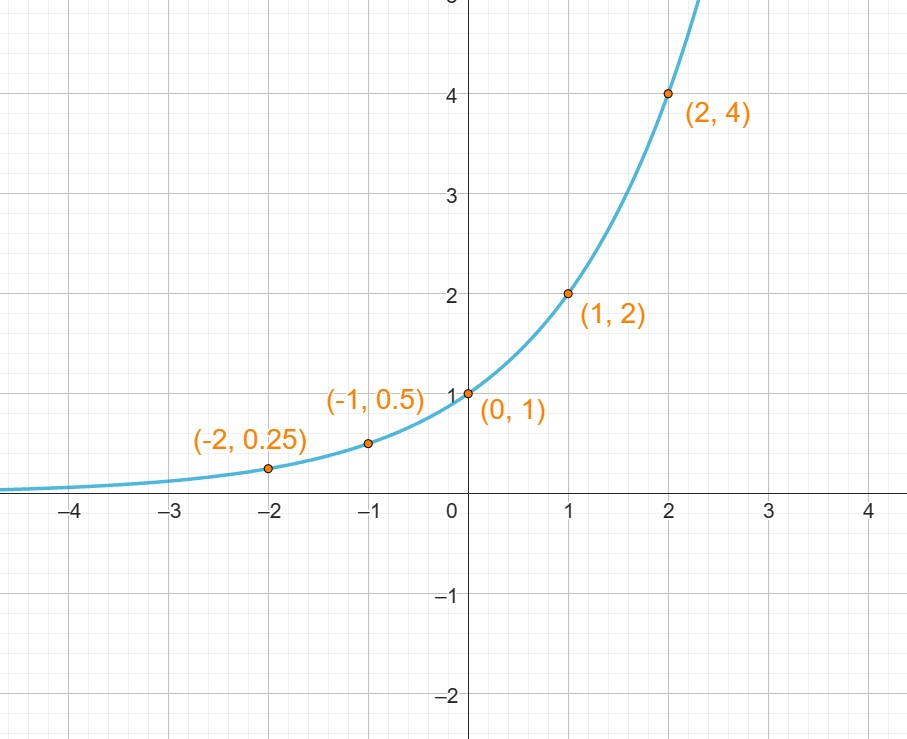
Now, let's investigate $g(x) = \left(\frac12\right)^x$ with its own table of values.
$$\begin{array}{c|c} x & g(x) = \left(\frac12\right)^x\\ \hline -2 & \left(\frac12\right)^{-2} = \frac{1^{-2}}{2^{-2}} = \frac{2^2}{1^2} = 4\\ -1 & \left(\frac12\right)^{-1} = \frac{1^{-1}}{2^{-1}} = \frac{2}{1} = 2\\ 0 & \left(\frac12\right)^0 = 1\\ 1 & \left(\frac12\right)^1 = \frac12\\ 2 & \left(\frac12\right)^2 = \frac14\\ \end{array}$$Again, we'll sketch these ordered pairs and connect the dots with a smooth line to see exponential decay:

These graphs illustrates some very nice properties about exponential functions in general.
Properties of Exponential Functions, $f(x) = b^x$ where $b\gt 0$ and $b \neq 1$
- $f(0) = 1$. The function will always take the value of 1 at $x = 0$.
- The range of an exponential function is $(0, \infty)$.
- That is, $f(x) \neq 0$. A basic exponential function, $b^x$ will never have an output (height) of 0.
- Also, $f(x) \gt 0$. A basic exponential function, $b^x$, is always has positive outputs (heights).
- The domain of an exponential function is $(-\infty, \infty)$. In other words, every real number $x$ can be an input into an exponential function.
- If $0 \lt b \lt 1$ then
- $\lim\limits_{x\to \infty}b^x = 0$
- $\lim\limits_{x\to -\infty}b^x = \infty$
- In other words, the graph looks like this:
- If $b \gt 1 $ then
- $\lim\limits_{x\to \infty}b^x = \infty$
- $\lim\limits_{x\to -\infty}b^x = 0$
- In other words, the graph looks like this:


But why are we allowed to connect those dots?
Note: The following content is adapted from OpenStax and is licensed under a Creative Commons Attribution-NonCommercial-ShareAlike 4.0 International License.
Access for free at https://openstax.org/books/calculus-volume-1/pages/1-introduction.

When we create those graphs, we're working off of an assumption that $2^x$ is defined for any real number that we could choose to substitute in for $x$. Why should that be true, though?
When we first learn about exponential functions, we think of what happens with $b^x$ when $x$ is a positive integer (a positive whole number). That is, $b^x$ is the product of $b$ multiplied by itself $n$ times. Under that definition, we can start to establish a pattern:

As our $x$-values decrease by 1, our $y$-values are divided by a factor of $b$. This is why we end up with the properties that $b^0 = 1$; it must follow from that pattern. This is also why a negative integer "flips" the position of $b$ over the fraction bar. We must again divide by $b$, so we have $\frac{1}{b}$.
Part of our beginning notions of exponential functions also include the following:
These ideas allow us to evaluate $b^x$ for any rational (fraction) value of $x$, but what about other real numbers? For instance, what is the value of $4^\pi$? The number $\pi$ is irrational, so it cannot be expressed as a fraction, so we cannot use any of these other ideas of how to evaluate $4^\pi$, but we'd like to be able to find a value for it. What we can do is set up a sequence of relationships.
We know that the number $\pi \approx 3.14159265...$ is between 3.1 and 3.2, so $4^{3.1}\lt 4^\pi \lt 4^{3.2}$. What if we want to get a little closer to the $4^\pi$ in the middle? We could then say that $\pi$ is between 3.14 and 3.15, so $4^{3.14} \lt 4^\pi \lt 4^{3.15}$ to get a more precise idea of what that value of $4^\pi$ might be. In fact, we can create a little sequence that gets closer and closer to sandwiching in that $4^\pi$ with each iteration to create a slightly better approximation each time: $$\begin{array}{rcl} 4^3 = 64 &\lt ~~4^\pi &\lt 4^4 = 256\\ 4^{3.1}\approx 73.5166947198 &\lt~~ 4^\pi &\lt 4^{3.2}\approx 84.4485062895\\ 4^{3.14} \approx 77.7084726013 &\lt ~~4^\pi &\lt 4^{3.15}\approx 78.7932424541\\ 4^{3.141}\approx 77.8162741237 &\lt ~~4^\pi &\lt 4^{3.142}\approx 77.9242251944\\ 4^{3.1415}\approx 77.8702309526 &\lt ~~4^\pi &\lt 4^{3.1416}\approx 77.9242251944\\ 4^{3.14159} \approx 77.8799471543 &\lt~~ 4^\pi &\lt 4^{3.141593} \approx 77.8802710486\\ \end{array}$$ So, we can see that $4^\pi \approx 77.88$.
It is possible to show, though it is beyond the scope of this course, that $4^\pi$ is the only number that is greater than all of this pattern: $4^3, 4^{3.1}, 4^{3.14}, 4^{3.141}, 4^{3.1415}, ...$ and less than all of this pattern: $4^4, 4^{3.2}, 4^{3.15}, 4^{3.142}, 4^{3,1416}, ...$. The reason then that we can take a table like this: $$\begin{array}{c|c} x & 4^x\\ \hline -2 & \frac{1}{16}\\ -1 & \frac{1}{4}\\ 0 & 1\\ 1 & 4\\ 2 & 16\\ \end{array}$$ and connect those ordered pairs to make a continuous graph of $4^x$ is by allowing ourselves to define $b^r$ for any real value of $r$ by using similar patterns of approximation. In general, we can say
Note also that exponential functions satisfy the general laws of exponents. To remind you of these laws, we state them as rules.
Laws of Exponents
For any constants $a\gt 0, b\gt 0,$ and for all $x$ and $y$,- $b^x\cdot b^y = b^{x+y}$
- $\frac{b^x}{b^y} = b^{x-y}$
- $(b^x)^y = b^{xy}$
- $(ab)^x = a^x b^x$
- $\left(\frac{a}{b}\right)^x = \frac{a^x}{b^x}$
- $a^{-x} = \frac{1}{a^x}$ and $\frac{1}{a^{-x}} = a^x$
In the spirit of a thorough review, let's practice applying these laws to simplify expressions.
This example only truly works once we know that quantities like $x^{-\pi}$ are actually well-defined, using the definition above. Since we have that definition, we can use our exponent properties to simplify.
$$\begin{array}{c|cl} \left(\frac{9x^{-\pi}}{x^{3\pi}}\right)^{1/2} &~~ & x^{n/m} = \sqrt[m]{x^n}, \text{ so }\\ &&\sqrt{\text{stuff}} = \sqrt[2]{\text{stuff}^1} = (\text{stuff})^{1/2}\\ &&\\ =\frac{(9x^{-\pi})^{1/2}}{(x^{3\pi})^{1/2}} &&\text{Property 5} \\ &&\\ =\frac{9^{1/2}(x^{-\pi})^{1/2}}{(x^{3\pi})^{1/2}} &&\text{Property 4}\\ &&\\ =\frac{9^{1/2}x^{(-\pi)(1/2)}}{x^{(3\pi)(1/2)}} &&\text{Property 3}\\ &&\\ =\frac{3x^{-\pi/2}}{x^{3\pi/2}} &&\text{Simplify}\\ &&\\ =3x^{-\pi/2 - 3\pi/2} &&\text{ Property 2}\\ &&\\ =3x^{-4\pi/2} = 3x^{-2\pi} &&\text{ Simplify}\\ &&\\ =\frac{3}{x^{2\pi}} &&\text{Property 6}\\ \end{array}$$The number e
A special type of exponential function appears frequently in real-world applications. To describe it, consider the following example of exponential growth, which arises from compounding interest in a savings account. Suppose a person invests $P$ dollars in a savings account with an annual interest rate $r$, compounded annually. This means that after a year, we'll calculate the interest and add it in to the account. The next year, then, we'll calculated the interest based on the total amount in the account (the original principal plust the interest).
The amount of money after 1 year is $$A(1) = P + rP = P(1+r).$$
The amount of money after 2 year is $$A(2) = A(1)+rA(1) = P(1+r)+rP(1+r) = P(1+r)^2.$$
More generally, the amount after $t$ years is $$A(t)= P(1+r)^t.$$
Interest rates are listed on an annual basis, so if the money is compounded 2 times per year, we'll only add in half of the stated interest rate each time. Therefore, the amount of money after half a year is $$A\left(\frac12\right) = P+\left(\frac{r}{2}\right)P = P\left(1+\frac{r}{2}\right).$$
The amount of money after 1 year is $$A(1) = A\left(\frac12\right) + \left(\frac{r}{2}\right)A\left(\frac12\right)$$ $$= P\left(1+\frac{r}{2}\right)+\frac{r}{2}\left(P\left(1+\frac{r}{2}\right)\right) = P\left(1+\frac{r}{2}\right)^2.$$
After $t$ years, the amount of money in the account is $$A(t) = P\left(1+\frac{r}{2}\right)^{2t}.$$
More generally, if the money is compounded $n$ times per year, the amount of money in the account after $t$ years is given by the function $$A(t) = P\left(1+\frac{r}{n}\right)^{nt}.$$
Now, let's look at what happens to this quantity if we let $r = 1$ (that's a 100\% interest rate), let $t = 1$ (we'll only look at one year), let $P = 1$ (we'll invest one dollar), and let $n$ become very large. Letting $n$ go to infinity in this manner is called continuously compounding interest. Here is what we find:
$$\begin{array}{c|c} n & \left(1+\frac{1}{n}\right)^n\\ \hline 10 & 2.5937\\ 100 & 2.7048\\ 1000 & 2.71692\\ 10,000 & 2.71815\\ 100,000 & 2.718268\\ 1,000,000 & 2.718280\\ \end{array}$$Investigating the table, it looks like we have $$\lim_{n\to\infty}\left(1+\frac{1}{n}\right)^n \approx 2.718282.$$
This turns out to be a special, irrational number, named e.
The number e
$$e = \lim_{n\to\infty}\left(1+\frac{1}{n}\right)^n \approx 2.718282...$$The letter $e$ was first used to represent this number by the Swiss mathematician Leonhard Euler during the 1720s. Although Euler did not discover the number, he showed many important connections between $e$ and logarithmic functions. We still use the notation $e$ today to honor Euler’s work because it appears in many areas of mathematics and because we can use it in many practical applications.
Returning to our savings account example, we can conclude that if a person puts $P$ dollars in an account at an annual interest rate $r$, compounded continuously, then $A(t)=Pe^{rt}$. This function may be familiar. Since functions involving base $e$ arise often in applications, we call the function $f(x)=e^x$ the natural exponential function. Not only is this function interesting because of the definition of the number $e$, but also, as discussed next, its graph has an important property.
Since $e\gt 1$, we know $e^x$ is increasing on $(-\infty, \infty)$. In the graph below, we show a graph of $f(x)=e^x$ along with a tangent line to the graph of at $x=0$. We give a precise definition of tangent line in the next chapter; but, informally, we say a tangent line to a graph of $f$ at $x=a$ is a line that passes through the point $(a,f(a))$ and has the same “slope” as $f$ at that point.
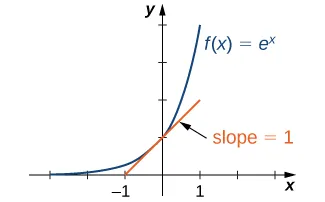
The function $f(x)=e^x$ is the only exponential function $b^x$ with tangent line at $x=0$ that has a slope of 1. As we see later in the text, having this property makes the natural exponential function the most simple exponential function to use in many instances.
Limits of Exponential Functions
Note: The following content is adapted from Paul's Online Math Notes, with permission, and is not shared under the Creative Commons license.
Now that we've reviewed and filled in some concepts on how exponential functions work, let's examine the limits of exponential functions.
For these limits, we start by relying on the our knowledge of the graphs of exponential functions. Since $e\gt 1$, its graph will exhibit exponential growth:
Now, what to do about $e^{-x}$? Let's suppose we forgot how to create a graph for $e^{-x}$. One thing we can do is a bit of substitution. Let's let $t = -x$. Then as $x \to \infty$, $t \to -\infty$, so we can rewrite our next limit as such: $$\lim_{\textcolor{blue}{x\to \infty}}e^{\textcolor{purple}{-x}} \Rightarrow \lim_{\textcolor{blue}{t\to-\infty}}e^{\textcolor{purple}{t}}.$$ The function $e^t$ will still exhibit exponential growth, so $\lim\limits_{t\to-\infty}e^t = 0$, therefore the original limit is $$\lim_{x\to \infty}e^{-x} = 0.$$
For the sake of practice, we'll take the same approach with our final limit. If we let $t = -x$, then as $x\to -\infty$, $t\to \infty$, so $$\lim_{\textcolor{blue}{x\to-\infty}}e^{\textcolor{purple}{-x}} \Rightarrow \lim_{\textcolor{blue}{t\to\infty}}e^{\textcolor{purple}{t}} = \infty.$$
As we hinted, though, we can reach these same conclusions if we remember how graphical transformations work. The graph of $e^{-x}$ is the result of reflecting the graph of $e^{x}$ over the y-axis, so the graph of $e^{-x}$ looks something like this:
The main point of this example was to point out that if the exponent of an exponential goes to infinity in the limit then the exponential function will also go to infinity in the limit. Likewise, if the exponent goes to minus infinity in the limit then the exponential will go to zero in the limit.
Note as well, that in the last section the value of the limit did not depend on whether we went to plus or minus infinity. We’ve already seen in the above example that changing the sign on the infinity can change the answer so do not get locked into any assumptions you may have made from the work in the last section!
In an exponential expression, if the exponent goes to infinity, then the whole function goes to infinity. If the exponent goes to negative infinity, then the whole function goes to 0.
Here’s a quick set of examples to illustrate these ideas.
$$\lim_{x\to\infty}e^{2-4x-8x^2}$$
We're running with the main idea from above: if the exponent of an exponential goes to infinity in the limit then the exponential function will also go to infinity in the limit. Likewise, if the exponent goes to minus infinity in the limit then the exponential will go to zero in the limit. Therefore, our first job is to determine where the exponent is going. We can use a bit of substitution to help us along with our reasoning. Let $t = 2-4x-8x^2$. Since $\lim_{x\to \infty}(2-4x-8x^2) = -\infty$ (using reasoning from the previous section), we know that as $x\to\infty$, $t\to -\infty$. Therefore, we can rewrite our limit as such: $$\lim_{\textcolor{blue}{x\to\infty}}e^{\textcolor{purple}{2-4x-8x^2}} \Rightarrow \lim_{\textcolor{blue}{t\to-\infty}} e^{\textcolor{purple}{t}} = 0.$$ So the answer here is $$\lim_{x\to\infty}e^{2-4x-8x^2} = 0.$$
$$\lim_{t\to-\infty}e^{t^4-5t^2+1}$$
We will rename the exponent $u = t^4 - 5t^2 + 1$. Noting that $\lim_{t\to-\infty}(t^4 - 5t^2 + 1) = \infty$, we see that as $t \to -\infty$, $u \to \infty$. So our limit becomes $$\lim_{\textcolor{blue}{t\to-\infty}}e^{\textcolor{purple}{t^4-5t^2+1}} \Rightarrow \lim_{\textcolor{blue}{u\to\infty}}e^{\textcolor{purple}{u}} = \infty.$$ Therefore $$\lim_{t\to-\infty}e^{t^4-5t^2+1} = \infty.$$
$$\lim_{z\to0^+}e^{1/z}$$
On the surface this part doesn’t appear to belong in this section since it isn’t a limit at infinity. However, it does fit into the ideas we’re examining in this set of examples.
So, let’s first note that using the idea from the previous section we have, $$\lim_{z\to0^+}\frac{1}{z} = \infty.$$
That means that if we let $t = \frac{1}{z}$, as $z\to 0^+, t\to \infty$, so our original limit becomes $$\lim_{\textcolor{blue}{z\to0^+}}e^{\textcolor{purple}{1/z}} \Rightarrow \lim_{\textcolor{blue}{t\to\infty}}e^{\textcolor{purple}{t}} = \infty.$$
Let’s work some more complicated examples involving exponentials. In the following set of examples it won’t be that the exponents are more complicated, but instead that there will be more than one exponential function to deal with.
Let’s start by just taking the limit of each of the pieces and see what we get. Using reasoning similar to the previous example, we see $$\begin{align} \lim_{x\to\infty}e^{10x} &= \infty\\ \lim_{x\to\infty}4e^{6x} &= \infty\\ \lim_{x\to\infty}3e^{x} &= \infty\\ \lim_{x\to\infty}2e^{-2x} &= 0\\ \lim_{x\to\infty}9e^{-15x} &= 0\\ \end{align}$$
The last two terms aren’t any problem, but the first three are a problem as they present us with another indeterminate form.
When dealing with polynomials we factored out the term with the largest exponent in it. Let’s do the same thing here. However, we now have to deal with both positive and negative exponents and just what do we mean by the “largest” exponent. When dealing with these here we look at the terms that are causing the problems and ask “what is the largest exponent in those terms?”. So, since only the first three terms are causing us problems (i.e. they all evaluate to an infinity in the limit) we’ll look only at those.
So, since $10x$ is the largest of the three exponents there, we'll "factor" an e^{10x} out of the whole thing. Just as with polynomials, we do the factoring by, in essence, dividing each term by $e^{10x}$ and remembering that to simplify the division all we need to do is subtract the exponents. For example, let’s just take a look at the last term, $$\frac{-9e^{-15x}}{e^{10x}} = -9e^{-15x-10x} = -9e^{-25x}.$$
Similarly factoring all the terms then gives us $$\lim_{x\to\infty}(e^{10x}-4e^{6x}+3e^x+2e^{-2x}-9e^{-15x}) $$ $$= \lim_{x\to \infty}[e^{10x}(1-4e^{-4x}+3e^{-9x}+2e^{-12x}-9e^{-25x}].$$Notice that in doing this factoring all the remaining exponentials now have negative exponents and we know that for this limit (i.e. going out to positive infinity) these will all be zero in the limit and so will no longer cause problems.
We can now take the limit of the two factors. The first is clearly infinity and the second is clearly a finite number (one in this case) and so the Facts from the Infinite Limits section gives us the following limit, $$\lim_{x\to \infty}[e^{10x}(1-4e^{-4x}+3e^{-9x}+2e^{-12x}-9e^{-25x}]$$ $$=\infty \cdot (1-0+0+0-0) = \infty.$$
Let’s start this one off in the same manner as the first part. Let’s take the limit of each of the pieces. This time note that because our limit is going to negative infinity the first three exponentials will in fact go to zero (because their exponents go to minus infinity in the limit). The final two exponentials will go to infinity in the limit (because their exponents go to plus infinity in the limit).
Taking the limit gives (roughly), $$\lim_{x\to-\infty}(e^{10x}-4e^{6x}+3e^x+2e^{-2x}-9e^{-15x})$$ $$=0-0+0+\infty-\infty.$$
So, the last two terms are the problem here as they once again leave us with an indeterminate form. As with the first example we’re going to factor out the “largest” exponent in the last two terms. This time however, “largest” doesn’t refer to the bigger of the two numbers (-2 is bigger than -15). Instead we’re going to use “largest” to refer to the exponent that is farther away from zero. Using this definition of “largest” means that we’re going to factor an $e^{-15x}$ out.
Again, remember that to factor this out all we really are doing is dividing each term by $e^{-15x}$ and then subtracting exponents. Here’s the work for the first term as an example, $$\frac{e^{10x}}{e^{-15x}} = e^{10x-(-15x)} = e^{25x}.$$ Here's what the entire limit looks like, then, if we factor: $$\lim_{x\to-\infty}(e^{10x}-4e^{6x}+3e^x+2e^{-2x}-9e^{-15x})$$ $$=\lim_{x\to-\infty}[e^{-15x}(e^{25x}-4e^{21x}+3e^{16x}+2e^{13x}-9)]$$ $$=\infty(0-0+0+0-9) = -\infty.$$
So, when dealing with sums and/or differences of exponential functions we look for the exponential with the “largest” exponent and remember here that “largest” means the exponent farthest from zero. Also remember that if we’re looking at a limit at plus infinity only the exponentials with positive exponents are going to cause problems so those are the only terms we look at in determining the largest exponent. Likewise, if we are looking at a limit at minus infinity then only exponentials with negative exponents are going to cause problems and so only those are looked at in determining the largest exponent.
For sums/differences of exponential functions, factor out the exponential that's moving the farthest from zero.
Finally, as you might have been able to guess from the previous example when dealing with a sum and/or difference of exponentials all we need to do is look at the largest exponent to determine the behavior of the whole expression. Again, remembering that if the limit is at plus infinity we only look at exponentials with positive exponents and if we’re looking at a limit at minus infinity we only look at exponentials with negative exponents.
For sums/differences of exponential functions, the largest power determines the behavior of the expression.
Let’s next take a look at some rational functions involving exponentials.
The basic concept involved in working this problem is the same as with rational expressions in the previous section. We look at the denominator and determine the exponential function with the “largest” exponent which we will then factor out from both numerator and denominator. We will use the same reasoning as we did with the previous example to determine the “largest” exponent. In the case since we are looking at a limit at plus infinity we only look at exponentials with positive exponents.
So, we'll factor an $e^{4x}$ out of both then numerator and denominator. Once that is done we can cancel the $e^{4x}$ and then take the limit of the remaining terms. Here is the work for this limit:
$$\begin{align} \lim_{x\to\infty}\frac{6e^{4x}-e^{-2x}}{8e^{4x}-e^{2x}+3e^{-x}} & = \lim_{x\to\infty}\frac{e^{4x}(6-e^{-6x})}{e^{4x}(8-e^{-2x}+3e^{-5x})}\\ &=\lim_{x\to\infty}\frac{6-e^{-6x}}{8-e^{-2x}+3e^{-5x}}\\ &=\lim_{x\to\infty}\frac{6-0}{8-0+0}\\ &=\frac34 \end{align}$$In this case we’re going to minus infinity in the limit and so we’ll look at exponentials in the denominator with negative exponents in determining the “largest” exponent. There’s only one however in this problem so that is what we’ll use.
Again, remember to only look at the denominator. Do NOT use the exponential from the numerator, even though that one is “larger” than the exponential in the denominator. We always look only at the denominator when determining what term to factor out regardless of what is going on in the numerator.
$$\begin{align} \lim_{x\to-\infty}\frac{6e^{4x}-e^{-2x}}{8e^{4x}-e^{2x}+3e^{-x}} &= \lim_{x\to-\infty}\frac{e^{-x}(6e^{5x}-e^{-x})}{e^{-x}(8e^{5x}-e^{3x}+3)}\\ &= \lim_{x\to-\infty}\frac{6e^{5x}-e^{-x}}{8e^{5x}-e^{3x}+3}\\ &= \lim_{x\to-\infty}\frac{0-\infty}{0-0+3}\\ &= -\infty\\ \end{align}$$Logarithmic Functions
Once more, we'll take a break, this tim to look at a function that is related to the exponential functions: logarithms. Logarithms are one of the functions that students fear the most. The main reason for this seems to be that they simply have never really had to work with them. Once they start working with them, students come to realize that they aren’t as bad as they first thought.
Exponents and Logarithms
We'll start with $b \gt 0, b\neq 1$, just as we did when discussing exponential functions. Then we have $$\textcolor{blue}{y} = \log_\textcolor{purple}{b}(\textcolor{red}{x}) ~~~\text{is equivalent to}~~~ \textcolor{red}{x} = \textcolor{purple}{b}^\textcolor{blue}{y}$$ The first is called logarithmic form and the second is called the exponential form. Remembering this equivalence is the key to evaluating logarithms. The number, $b$, is called the base.
We can investigate this relationship using some quick evaluations.
- $\log_2(16)$
- $\log_4(16)$
- $\log_5(625)$
To quickly evaluate logarithms the easiest thing to do is to convert the logarithm to exponential form. So, let’s take a look at the first one.
$$a.~~\log_2(16)$$First, let’s convert to exponential form.
$$\log_\textcolor{purple}{2}(\textcolor{red}{16}) = \textcolor{blue}{?} ~~~\text{is equivalent to}~~~ \textcolor{purple}{2}^\textcolor{blue}{?} = \textcolor{red}{16}$$So, we’re really asking 2 raised to what gives 16. Since 2 raised to 4 is 16 we get, $$\log_\textcolor{purple}{2}(\textcolor{red}{16}) = \textcolor{blue}{4} ~~~\text{because}~~~\textcolor{purple}{2}^\textcolor{blue}{4}=\textcolor{red}{16}$$
b. $\log_4(16)$
Here, we're asking $4^?=16$. Well, $\textcolor{purple}{4}^\textcolor{blue}{2} = \textcolor{red}{16}$, so $\log_\textcolor{purple}{4}(\textcolor{red}{16}) = \textcolor{blue}{2}$.
c. $\log_5(625)$
Sometimes it's useful to list powers of our base, if we don't know a bunch of those powers right away. So, $$\begin{align} 5^2 &=25\\ 5^3 &=125\\ 5^4 &= 625\\ \end{align}$$ So we see that since $\textcolor{purple}{5}^\textcolor{blue}{4} = \textcolor{red}{625}$, then $\log_\textcolor{purple}{5}(\textcolor{red}{625}) = \textcolor{blue}{4}$.
- $\log_9\frac{1}{531441}$
- $\log_\frac16 (36)$
- $\log_{49} (7)$
Let's again list powers of our base, which in this example is 9.
$$\begin{align} 9^2 &= 81\\ 9^3 &= 729\\ 9^4 &= 6561\\ 9^5 &= 59049\\ 9^6 &= 531441\\ \end{align}$$That gets us close to the answer, but we need $\frac{1}{531441}$ as our result. What type of exponent will "flip" the result? A negative exponent, so since $\textcolor{purple}{9}^\textcolor{blue}{-6} = \textcolor{red}{\frac{1}{531441}}$, then $\log_\textcolor{purple}{9}(\textcolor{red}{\frac{1}{531441}}) = \textcolor{blue}{-6}$.
b. $\log_\frac16 (36)$
Here, we have the need to "flip" the fraction again, since $\left(\frac16\right)^2 = \frac{1}{36}$ but $\left(\frac16\right)^{-2} = \frac{1^{-2}}{6^{-2}} = \frac{6^2}{1^2} = 36$. Therefore $$\text{Since } \left(\textcolor{purple}{\frac16}\right)^{\textcolor{blue}{-2}} = \textcolor{red}{36}, ~~~\text{then}~~~ \log_\textcolor{purple}{\frac16}(\textcolor{red}{36}) = \textcolor{blue}{-2}.$$
c. $\log_{49} (7)$
Now we're trying to determine $\textcolor{purple}{49}^\textcolor{blue}{?} = \textcolor{red}{7}$. Here the number isn't ending up in the bottom of a fraction, it's just getting smaller; that means we need some fraction exponents. Since $\sqrt{49} = \sqrt[2]{49^1} = \textcolor{purple}{49}^{\textcolor{blue}{1/2}} = \textcolor{red}{7}$, then $\log_{\textcolor{purple}{49}}(\textcolor{red}{7}) = \textcolor{blue}{\frac12}$.
There are a couple of special logarithms that arise in many places. These are,
In the natural logarithm the base e is the same number as in the natural exponential logarithm that we saw earlier in this section.
Let’s take a look at a couple of more logarithm evaluations, some of which deal with the natural or common logarithm and some of which don’t.
- $\ln(\sqrt[3]{e})$
- $\log(1000)$
- $\log_{16}(16)$
- $\log_{23}(1)$
- $\log_2(\sqrt[7]{32})$
- $\ln(\sqrt[3]{e})$
- $\log(1000)$
- $\log_{16}(16)$
- $\log_{23}(1)$
- $\log_2(\sqrt[7]{32})$
Since $\ln(\sqrt[3]{e})$ is equivalent to $\log_\textcolor{purple}{e}(\textcolor{red}{e^{1/3}})$, we are essentially asking $\textcolor{purple}{e}^\textcolor{blue}{?} = \textcolor{red}{e^{1/3}}$. Therefore, the answer must be $\log_\textcolor{purple}{e}(\textcolor{red}{e^{1/3}}) = \textcolor{blue}{\frac13}$.
Here we have the common log, meaning $\log(1000)$ is the same as $\log_{10}(1000)$. Therefore, we need to figure out $\textcolor{purple}{10}^\textcolor{blue}{?} = \textcolor{red}{1000}$, so the answer must be $\log_{\textcolor{purple}{10}}(\textcolor{red}{1000}) = \textcolor{blue}{3}$.
In this case, we're asking $\textcolor{purple}{16}^\textcolor{blue}{?} = \textcolor{red}{16}$, so the answer is $\log_{\textcolor{purple}{16}}(\textcolor{red}{16}) = \textcolor{blue}{1}$.
This statement asks us to figure out $\textcolor{purple}{23}^\textcolor{blue}{?} = \textcolor{red}{1}$. The power must be 0 for the calculation to result in a 1, so $\log_{\textcolor{purple}{23}}(\textcolor{red}{1}) = \textcolor{blue}{0}$.
This one we can rewrite first as $\log_2((32)^{1/7})$. We notice that $32 = 2^5$, so the statement becomes $\log_2((2^5)^{1/7}) = \log_\textcolor{purple}{2}((\textcolor{red}{2^{5/7}}))$. Therefore, $\log_\textcolor{purple}{2}((\textcolor{red}{2^{5/7}}))= \textcolor{blue}{\frac57}$.
This last set of examples leads us to some of the basic properties of logarithms.
Properties of Logarithms
- The domain of the logarithm function is $(0, \infty)$. In other words, we can only plug positive numbers into a logarithm! No negatives or 0 allowed as inputs!
- The range of the logarithm function is $(-\infty, \infty)$.
- $\log_b(b) = 1$
- $\log_b(1) = 0$
- $\log_b(b^x) = x$
- $b^{\log_b(x)} = x$
The last two properties will be especially useful in the next section. Notice as well that these last two properties tell us that, $$f(x) = b^x ~~~\text{and}~~~g(x) = \log_b(x)$$ are inverses of each other.
Here are some more properties that are useful in the manipulation of logarithms.
More Logarithm Properties
- $\log_b(xy) = \log_b(x)+\log_b(y)$
- $\log_b\left(\frac{x}{y}\right) = \log_b(x)-\log_b(y)$
- $\log_b(x^r) = r\log_b(x)$
- $\log_b(xy) = \log_b(x)+\log_b(y)$
Let $M = \log_b(x)$ and $N = \log_b(y)$. Then, by definition of the logarithm function, $b^M = x$ and $b^N = y$. Then $xy$ is the same as $b^M \cdot b^N \Rightarrow b^{M+N}$ by exponent properties. Therefore $\log_b(xy) = \log_b(b^{M+N}) = M+N$ from property 5 above, which means $\log_b(xy) = \log_b(x)+\log_b(y)$.
The other proofs are left as exercises.
Note that there is no equivalent property to the first two for sums and differences. In other words, $$\log_b(x+y) \text{ IS NOT THE SAME AS } \log_b(x)+\log_b(y).$$ $$\log_b(x-y) \text{ IS NOT THE SAME AS } \log_b(x)-\log_b(y).$$
- $\ln(x^3y^4z^5)$
- $\log_3\left(\frac{9x^4}{\sqrt{y}}\right)$
- $\log\left(\frac{x^2+y^2}{(x-y)^3}\right)$
What the instructions really mean here is to use as many of the properties of logarithms as we can to simplify things down as much as we can.
- $\ln(x^3y^4z^5)$
- $\log_3\left(\frac{9x^4}{\sqrt{y}}\right)$
- $\log\left(\frac{x^2+y^2}{(x-y)^3}\right)$
Property 7 above can be extended to products of more than two functions. Once we’ve used Property 7 we can then use Property 9.
$$\begin{align} \ln(x^3y^4z^5) &= \ln(x^3)+\ln(y^4)+\ln(z^5)\\ &=3\ln(x)+4\ln(y)+5\ln(z)\\ \end{align}$$When using property 8 above make sure that the logarithm that you subtract is the one that contains the denominator as its argument. Also, note that that we’ll be converting the root to fractional exponents in the first step.
$$\begin{align} \log_3\left(\frac{9x^4}{\sqrt{y}}\right) &= \log_3(9x^4)-\log_3(y^{1/2})\\ &= \log_3(9)+\log_3(x^4)-\log_3(y^{1/2})\\ &= 2 + 4\log_3(x)-\frac12\log_3(y)\\ \end{align}$$The point to this problem is mostly the correct use of property 9 above.
$$\begin{align} \log\left(\frac{x^2+y^2}{(x-y)^3}\right) &= \log(x^2+y^2) - \log((x-y)^3)\\ &=\log(x^2+y^2) - 3\log(x-y)\\ \end{align}$$You can use Property 9 on the second term because the WHOLE term was raised to the 3, but in the first logarithm, only the individual terms were squared and not the term as a whole so the 2’s must stay where they are!
The last topic that we need to look at in this section is the change of base formula for logarithms. The change of base formula is,
The Change of Base Formula
$$\log_b(x) = \frac{\log_a(x)}{\log_a(b)}$$Let $M = \log_a(x)$ and $N = \log_a(b)$. Then by definition of logarithmic functions, $a^M = x$ and $a^N = b$. This means we can do the following rewrite: $$\log_b(x) \Rightarrow \log_{a^N}(a^M).$$ Now, this logarithm asks the question $(a^N)^? = a^M$. We can use exponent properties to rewrite the question as $a^{N\cdot?} = a^M$. Therefore, it must be true that $N\cdot ? = M$, so $? = \frac{M}{N}$. In other words, $$\log_b(x) = \frac{\log_a(x)}{\log_a(b)}.$$
This is the most general change of base formula and will convert from base $b$ to base $a$. However, the usual reason for using the change of base formula is to compute the value of a logarithm that is in a base that you can’t easily deal with. Using the change of base formula means that you can write the logarithm in terms of a logarithm that you can deal with. The two most common change of base formulas are
In fact, often you will see one or the other listed as THE change of base formula!
In the first part of this section we computed the value of a few logarithms, but we could do these without the change of base formula because all the arguments could be written in terms of the base to a power. For instance,
$$\log_7(49) = 2 ~~~\text{because}~~~7^2 = 49$$However, this only works because 49 can be written as a power of 7. We would need the change of base formula to compute $\log_7(50)$. $$\log_7(50) = \frac{\ln(50)}{\ln(7)} \approx \frac{3.91202300543}{1.94591014906} \approx 2.0103821378$$ OR $$ \log_7(50) = \frac{\log(50)}{\log(7)} \approx \frac{1.69897000434}{0.845098040014} \approx 2.0103821378$$
So, it doesn’t matter which we use, we will get the same answer regardless of the logarithm that we use in the change of base formula.
Graphs and limits of logarithmic functions
In order to see how the graph of a logarithmic function behaves, let's start by comparing it to an exponential function. We'll begin with tables of values:
Notice how the columns of inputs and outputs are flip-flopped? That's a hallmark of inverse functions. The way that relationship shows up graphically is that the graph of $\log_2(x)$ will be a reflection of the graph of $2^x$ about the line $y = x$.

What does this relationship tell us about limits, then? Well, we see on the left side of the exponential graph that $$\lim_{x\to\textcolor{blue}{-\infty}}(2^x) = \textcolor{purple}{0^+},$$ and so on the logarithmic graph, we have $$\lim_{x\to \textcolor{purple}{0^+}} (\log_2(x)) = \textcolor{blue}{-\infty}.$$ Similarly, $$\lim_{x\to\textcolor{blue}{\infty}}(2^x) = \textcolor{purple}{\infty}$$ and therefore $$\lim_{x\to \textcolor{purple}{\infty}}(\log_2(x)) = \textcolor{blue}{\infty}.$$
We'll begin by recalling that $\ln(x)$ is the same as $\log_e(x)$. That means the graph of $\ln(x)$ should be the inverse of the graph of $e^x$. The number $e$ is greater than 1, so we expect these graphs to look like this:

Looking at the graph of $\ln(x)$, then, we see that $$\lim_{x\to0^+}\ln(x) = -\infty~~~~~~~~~\lim_{x\to\infty}\ln(x) = \infty.$$
Note that we had to do a right-handed limit for the first one since we can’t plug negative $x$’s into a logarithm. This means that the normal limit won’t exist since we must look at $x$’s from both sides of the point in question and $x$’s to the left of zero are negative.
From the previous example we can see that if the argument of a log (the stuff we’re taking the log of) goes to zero from the right (i.e. always positive) then the log goes to negative infinity in the limit while if the argument goes to infinity then the log also goes to infinity in the limit.
Note as well that we can’t look at a limit of a logarithm as $x$ approaches minus infinity since we can’t plug negative numbers into the logarithm.
If the inside of a log goes to infinity, then the whole limit goes to ininfity. If the inside of a log goes to zero from the right, then the whole limit goes to negative infinity.
Let’s take a quick look at some logarithm examples.
- $\lim\limits_{x\to\infty}\ln(7x^3-x^2+1)$
- $\lim\limits_{t\to-\infty}\ln\left(\frac{1}{t^2-5t}\right)$
- $\lim\limits_{x\to\infty}\ln(7x^3-x^2+1)$
- $\lim\limits_{t\to-\infty}\ln\left(\frac{1}{t^2-5t}\right)$
Just like we did with exponential limits, we'll look at what the input to the logarithm is doing. If we let $t = 7x^3 - x^2 + 1$, and observe that $\lim\limits_{x\to\infty}(7x^3-x^2+1) = \infty$, then we know that as $x \to \infty$, we also have $t\to\infty$. Then we can rewrite the original limit and evaluate as follows: $$\lim\limits_{\textcolor{blue}{x\to\infty}}\ln(\textcolor{purple}{7x^3-x^2+1})$$ $$\Rightarrow \lim\limits_{\textcolor{blue}{t\to\infty}}\ln(\textcolor{purple}{t}) = \infty.$$
First, note that the limit going to negative infinity here isn’t a violation (necessarily) of the fact that we can’t plug negative numbers into the logarithm. The real issue is whether or not the argument of the log will be negative or not
Using the techniques from earlier in this section we can see that, $$\lim_{t\to-\infty}\frac{1}{t^2-5t} = 0$$
and let’s also note that for negative numbers (which we can assume we’ve got since we’re going to minus infinity in the limit) the denominator will always be positive and so the quotient will also always be positive. Therefore, not only does the argument go to zero, it goes to zero from the right. That means, if we let $u = \frac{1}{t^2-5t}$, we see that as $t\to -\infty$, we have $u\to 0^+$.
So, the answer here is, $$\lim_{\textcolor{blue}{t\to-\infty}}\ln\left(\textcolor{purple}{\frac{1}{t^2-5t}}\right) \Rightarrow \lim_{\textcolor{blue}{u\to 0^+}}\ln(\textcolor{purple}{u}) = -\infty.$$
Arctangent
As a final set of examples let’s take a look at some limits involving inverse tangents.
For a quick review, arctangent (denoted $\arctan(x)$ or $\tan^{-1}(x)$) is the inverse of the tangent function, and so it is the result of reflecting the tangent graph about the line $y=x$ (just like the relationship between exponential and logarithmic functions). We also need to limit the domain of the tangent function before we reflect it, so we don't end up with a weird graph that is no longer a function. We'll talk more about that in later sections, or you can check out this section of our trig textbook.
For our current purposes, here is the graph of arctangent:
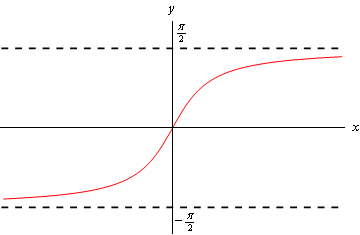
With that in mind, let's try some limits.
- $\lim\limits_{x\to\infty}\tan^{-1}(x)$
- $\lim\limits_{x\to-\infty}\tan^{-1}(x)$
- $\lim\limits_{x\to\infty}\tan^{-1}(x)$
- $\lim\limits_{x\to-\infty}\tan^{-1}(x)$
Here, we'll look to the extreme right side of the arctangent graph to find that $$\lim_{x\to\infty}\tan^{-1}(x) = \frac{\pi}{2}.$$
In this case, look to the extreme left of the graph. We see $$\lim_{x\to-\infty}\tan^{-1}(x) = -\frac{\pi}{2}.$$
We can use the results of the last two examples to help us with some more complicated limits involving the inverse tangent function. Let's try a few.
- $\lim\limits_{x\to\infty}\tan^{-1}(x^3-5x+6)$
- $\lim\limits_{x\to0^-}\tan^{-1}\left(\frac{1}{x}\right)$
Once more using techniques from previous sections, we have $$\lim_{x\to \infty}(x^3-5x+6) = \infty$$ so if we let $t = x^3 - 5x + 6$, we see that as $x\to \infty$, $t\to \infty$. We therefore rewrite and evaluate our limit as follows: $$\lim_{\textcolor{blue}{x\to \infty}}\tan^{-1}(\textcolor{purple}{x^3-5x+6}) \Rightarrow \lim_{\textcolor{blue}{t\to\infty}}\tan^{-1}(\textcolor{purple}{t}) = \frac{\pi}{2}.$$
Even though this limit is not a limit at infinity we’re still looking at the same basic idea here. We’ll use part (b) from above as a guide for this limit. We know from the Infinite Limits section that we have the following limit for the argument of this inverse tangent, $$\lim_{x\to 0^-}\frac{1}{x} = -\infty.$$
So, since the argument goes to minus infinity in the limit we know that this limit must be, $$\lim_{x\to 0^-}\tan^{-1}\left(\frac{1}{x}\right) \Rightarrow \lim_{t\to -\infty}\tan^{-1}(t) = -\frac{\pi}{2}$$
Practice Problems
For the following problems, evaluate (a) $\lim\limits_{x\to-\infty} f(x)$ and (b) $\lim\limits_{x\to \infty} f(x)$.
- $f(x) = e^{8+2x-x^3}$
- Let $t = 8+2x-x^3$. We know that $\lim\limits_{x\to-\infty}(8+2x-x^3) = \infty$, so as $x\to-\infty$, we have $t\to \infty$. Therefore $\lim\limits_{x\to-\infty}e^{8+2x-x^3} = \lim\limits_{t\to\infty}e^t = \infty$.
- Let $t = 8+2x-x^3$. We know that $\lim\limits_{x\to\infty}(8+2x-x^3) = -\infty$, so as $x\to\infty$, we have $t\to -\infty$. Therefore $\lim\limits_{x\to\infty}e^{8+2x-x^3} = \lim\limits_{t\to-\infty}e^t = 0$.
- $f(x) = e^{\left(\frac{6x^2+x}{5+3x}\right)}$
- Let $t = \frac{6x^2+x}{5+3x}$. We can factor out the highest power of $x$ from the denominator to find the limit as $x\to-\infty$: $$\lim_{x\to-\infty}\frac{6x^2+x}{5+3x} = \lim_{x\to-\infty}\frac{x(6x+1)}{x(\frac{5}{x}+3)}$$ $$=\lim_{x\to-\infty}\frac{6x+1}{\frac{5}{x}+3} = \frac{-\infty}{0+3} = -\infty.$$ This tells us that as $x\to-\infty$, $t\to\infty$ as well. So our limit can be rewritten and evaluated as such: $$\lim_{x\to-\infty}e^{\left(\frac{6x^2+x}{5+3x}\right)} = \lim_{t\to-\infty}e^t = 0.$$
- We will again let $t = \frac{6x^2+x}{5+3x}$ and factor out the highest power of $x$ from the denominator to find the limit as $x\to \infty$: $$\lim_{x\to\infty}\frac{6x^2+x}{5+3x} = \lim_{x\to\infty}\frac{x(6x+1)}{x(\frac{5}{x}+3)}$$ $$=\lim_{x\to\infty}\frac{6x+1}{\frac{5}{x}+3} = \frac{\infty}{0+3} = \infty.$$ Therefore, as $x\to\infty$, our $t\to\infty$, so our limit becomes: $$\lim_{x\to\infty}e^{\left(\frac{6x^2+x}{5+3x}\right)} = \lim_{t\to\infty}e^t = \infty.$$
- $f(x) = 2e^{6x}-e^{-7x}-10e^{4x}$
- We'll factor out the power of e that gets us the farthest from 0 as $x\to-\infty$. In this case, that's $e^{7x}$. $$\begin{align} \lim_{x\to-\infty}(2e^{6x}-e^{-7x}-10e^{4x}) &= \lim_{x\to-\infty}(e^{-7x}(2e^{13x}-1-10e^{11x}))\\ \end{align}$$ Here, the e's with positive exponents will go to 0 as $x\to-\infty$, and the $e^{-7x}$ goes to infinity, so we have $$\infty(2\cdot 0 - 1 - 10\cdot 0) = -\infty$$ for our final answer.
- This time we'll factor out the $e^{6x}$, since that will be the largest as $x\to\infty$. $$\begin{align} \lim_{x\to-\infty}(2e^{6x}-e^{-7x}-10e^{4x}) &= \lim_{x\to-\infty}(e^{6x}(2-e^{-13x}-10e^{-2x})) = \infty(2) = \infty \end{align}$$
- $f(x)=3e^{-x}-8e^{-5x}-e^{10x}$
- To see what's happening as $x\to-\infty$, we can factor out the biggest power of e (in that direction), which is $e^{-5x}$: $$\begin{align} \lim_{x\to-\infty}(3e^{-x}-8e^{-5x}-e^{10x}) &= \lim_{x\to-\infty}(e^{-5x}(3e^{4x}-8-e^{15x}))\\ &= \infty(3\cdot 0 - 8 - 0 ) \\ &=-\infty\\ \end{align}$$
- $$\begin{align} \lim_{x\to\infty}(3e^{-x}-8e^{-5x}-e^{10x}) &= \lim_{x\to\infty}(e^{10x}(3e^{-11x}-8e^{-15x}-1))\\ &= \infty(3\cdot 0 - 8\cdot 0 - 1 ) \\ &=-\infty\\ \end{align}$$
- $f(x) = \frac{e^{-3x}-2e^{8x}}{9e^{8x}-7e^{-3x}}$
- The exponential with the negative exponent is the only term in the denominator going to infinity for this limit and so we’ll need to factor the exponential with the negative exponent in the denominator from both the numerator and denominator to evaluate this limit. $$\begin{align} \lim_{x\to-\infty}\frac{e^{-3x}-2e^{8x}}{9e^{8x}-7e^{-3x}} &= \lim_{x\to-\infty}\frac{e^{-3x}(1-2e^{11x})}{e^{-3x}(9e^{11x}-7)}\\ &= \lim_{x\to-\infty}\frac{1-2e^{11x}}{9e^{11x}-7}\\ &=\frac{1-2\cdot0}{9\cdot0 -7}\\ &=-\frac17\\ \end{align}$$
- The exponential with the positive exponent is the only term in the denominator going to infinity for this limit and so we’ll need to factor the exponential with the positive exponent in the denominator from both the numerator and denominator to evaluate this limit. $$\begin{align} \lim_{x\to\infty}\frac{e^{-3x}-2e^{8x}}{9e^{8x}-7e^{-3x}} &= \lim_{x\to\infty}\frac{e^{8x}((e^{-11x}-2)}{e^{8x}(9-7e^{-11x})}\\ &=\lim_{x\to\infty}\frac{e^{-11x}-2}{9-7e^{-11x}}\\ &=\frac{0-2}{9-7\cdot 0}\\ &=-\frac29\\ \end{align}$$
- $f(x) = \frac{e^{-7x}-2e^{3x}-e^x}{e^{-x}+16e^{10x}+2e^{-4x}}$
- The exponentials with the negative exponents are the only terms in the denominator going to infinity for this limit and so we’ll need to factor the exponential with the most negative exponent in the denominator (because it will be going to infinity fastest) from both the numerator and denominator to evaluate this limit. $$\begin{align} \lim_{x\to-\infty}\frac{e^{-7x}-2e^{3x}-e^x}{e^{-x}+16e^{10x}+2e^{-4x}} &= \lim_{x\to-\infty}\frac{e^{-4x}(e^{-3x}-2e^{7x}-e^{5x})}{e^{-4x}(e^{3x}+16e^{14x}+2)}\\ &= \lim_{x\to-\infty}\frac{e^{-3x}-2e^{7x}-e^{5x}}{e^{3x}+16e^{14x}+2}\\ &= \frac{\infty-0-0}{0+0+2}\\ &=\infty\\ \end{align}$$
- The exponentials with the positive exponents are the only terms in the denominator going to infinity for this limit and so we’ll need to factor the exponential with the most positive exponent in the denominator (because it will be going to infinity fastest) from both the numerator and denominator to evaluate this limit. $$\begin{align} \lim_{x\to\infty}\frac{e^{-7x}-2e^{3x}-e^x}{e^{-x}+16e^{10x}+2e^{-4x}} &= \lim_{x\to\infty}\frac{e^{10x}(e^{-17x}-2e^{-7x}-e^{-9x})}{e^{10x}(e^{-11x}+16+2e^{-14x})}\\ &= \lim_{x\to\infty}\frac{e^{-17x}-2e^{-7x}-e^{-9x}}{e^{-11x}+16+2e^{-14x}}\\ &= \frac{0-0-0}{0+16+0}\\ &=0\\ \end{align}$$
- $\lim\limits_{t\to-\infty}\ln(4-9t-t^3)$
- $\lim\limits_{z\to-\infty}\ln\left(\frac{3z^4-8}{2+z^2}\right)$
- $\lim\limits_{x\to\infty}\ln\left(\frac{11+8x}{x^3+7x}\right)$
- $\lim\limits_{x\to-\infty}\tan^{-1}(7-x+3x^5)$
- $\lim\limits_{t\to\infty}\tan^{-1}\left(\frac{4+7t}{2-t}\right)$
- $\lim\limits_{w\to\infty}\tan^{-1}\left(\frac{3w^2-9w^4}{4w-w^3}\right)$
For the following problems, evaluate the given limit.
Let $u = 4 - 9t - t^3$. Since $\lim\limits_{t\to-\infty}(4-9t-t^3) = \infty$, then $u\to \infty$ as $t \to -\infty$. Then our limit becomes $$\lim_{t\to-\infty}\ln(4-9t-t^3) = \lim_{u\to\infty}\ln(u) = \infty.$$
Let $t = \frac{3z^4-8}{2+z^2}$. We want to find what happens to $t$ as $z \to -\infty$: $$\begin{align} \lim_{z\to-\infty}\frac{3z^4-8}{2+z^2} &= \lim_{z\to-\infty}\frac{z^2(3z^2-\frac{8}{z^2})}{z^2(\frac{2}{z^2}+1)}\\ &=\lim_{z\to-\infty}\frac{3z^2-\frac{8}{z^2}}{\frac{2}{z^2}+1}\\ &=\frac{\infty - 0}{0+1}\\ &=\infty\\ \end{align}$$ Therefore, $t\to\infty$. So our original limit can be evaluated as such: $$$\lim\limits_{z\to-\infty}\ln\left(\frac{3z^4-8}{2+z^2}\right) = \lim_{t\to \infty}\ln(t) = \infty.$$
Let $t = \frac{11+8x}{x^3+7x}$. $$\begin{align} \lim_{x\to\infty}\frac{11+8x}{x^3+7x} &= \lim_{x\to\infty}\frac{x^3(\frac{11}{x^3}+\frac{8}{x^2})}{x^3(1+\frac{7}{x^2})}\\ &=\lim_{x\to\infty}\frac{\frac{11}{x^3}+\frac{8}{x^2}}{1+\frac{7}{x^2}}\\ &= \frac{0+ 0}{1+0}\\ &=0\\ \end{align}$$ Also, note that because we are evaluating the limit $x\to\infty$ it is safe to assume that $x\gt 0$ and so we can further say that as $x\to\infty$, $t\to0^+$. Our original limit then becomes $$\lim\limits_{x\to\infty}\ln\left(\frac{11+8x}{x^3+7x}\right) = \lim_{t\to0}\ln(t) = -\infty.$$
We'll let $t = 7-x+3x^5$. We see that $$\begin{align} \lim\limits_{x\to-\infty}(7-x+3x^5) &= \lim_{x\to-\infty}(x^5(\frac{7}{x^5}-\frac{1}{x^4} + 3))\\ &= -\infty(0-0+3)\\ &=-\infty\\ \end{align}$$ so as $x\to-\infty$, we also have $t\to-\infty$. Therefore, our limit is $$\lim\limits_{x\to-\infty}\tan^{-1}(7-x+3x^5) = \lim_{t\to-\infty}\tan^{-1}(t) = -\frac{\pi}{2}.$$
Let $u = \frac{4+7t}{2-t}$. We'll figure out what's happening to that input first. $$\begin{align} \lim_{t\to\infty}\frac{4+7t}{2-t} &= \lim_{t\to\infty}\frac{t(\frac{4}{t}+7)}{t(\frac{2}{t}-1)}\\ &=\lim_{t\to\infty}\frac{\frac{4}{t}+7}{\frac{2}{t}-1}\\ &=\frac{0+7}{0-1}\\ &= -7\\ \end{align}$$ The answer, then, is $$\lim\limits_{t\to\infty}\tan^{-1}\left(\frac{4+7t}{2-t}\right) = \lim_{u\to -7}\tan^{-1}(u) = \tan^{-1}(-7).$$ The inverse tangent function is continuous on its domain, and -7 is in that domain, so we can use direct substitution to evaluate this limit! Do not get so used the “special case” limits that we tend to usually do in the problems at the end of a section that you decide that you must have done something wrong when you run across a problem that doesn’t fall in the “special case” category.
Assignment Problems
For the following problems, evaluate (a)$\lim\limits_{x\to-\infty}f(x)$ and (b)$\lim\limits_{x\to\infty}f(x)$.
- $f(x) = e^{(x^4+8x)}$
- $f(x) = e^{(2x+4x^2+2x^5)}$
- $f(x) = e^{\left(\frac{3-x^3}{x+x^2}\right)}$
- $f(x) = e^{\left(\frac{5-9x}{7+3x}\right)}$
- $f(x) = e^{\left(\frac{5+2x^6}{x-8x^4}\right)}$
- $f(x) = e^x+12e^{-3x}-2e^{-10x}$
- $f(x) = 9e^{2x}-7e^{-14x}-e^x$
- $f(x) = 20e^{-8x}-e^{5x}+3e^{2x}-e^{-7x}$
- $f(x) = \frac{6e^{4x}+e^{-15x}}{11e^{4x}+6e^{-15x}}$
- $f(x) = \frac{e^{3x}+9e^{-x}-4e^{10x}}{2e^{7x}-e^{-x}}$
- $f(x) = \frac{3e^{-14x}-e^{18x}}{e^{-x}-2e^{20x}-e^{-9x}}$
- $\lim\limits_{x\to\infty}\ln(5x^2+12x-6)$
- $\lim\limits_{y\to-\infty}\ln(5-7y^5)$
- $\lim\limits_{x\to\infty}\ln\left(\frac{3+x}{1+5x^3}\right)$
- $\lim\limits_{t\to-\infty}\ln\left(\frac{2t-5t^3}{4+3t^2}\right)$
- $\lim\limits_{z\to\infty}\left(\frac{10z+8z^2}{z^2-1}\right)$
- $\lim\limits_{x\to-\infty}\tan^{-1}(7+4x-x^3)$
- $\lim\limits_{w\to\infty}\tan^{-1}(4w^2-w^6)$
- $\lim\limits_{t\to\infty}\tan^{-1}\left(\frac{4t^3+t^2}{1+3t}\right)$
- $\lim\limits_{z\to-\infty}\tan^{-1}\left(\frac{z^4+4}{3z^2+5z^3}\right)$
For the following problems, evaluate the given limit.