Product and Quotient Rules
Click here for a printable version of this page.Product Rule
Previously, we noted that we had to be careful when differentiating products or quotients. It’s now time to look at products and quotients and see why.
First let’s take a look at why we have to be careful with products and quotients. Suppose that we have the two functions $f\left(x\right)=x^3$ and $g\left(x\right)=x^6$. Let’s start by computing the derivative of the product of these two functions. This is easy enough to do directly.
$$\frac{d}{dx}\left[fg\right]=\frac{d}{dx}\left[x^3x^6\right]=\frac{d}{dx}\left[x^9\right]=9x^8.$$Now let's compare this with the product of the individual derivatives.
$$\frac{d}{dx}\left[f\right]\frac{d}{dx}\left[g\right]=\frac{d}{dx}\left[x^3\right]\frac{d}{dx}\left[x^6\right]=3x^2\cdot 6x^5=18x^7.$$We can certainly see that the product of the individual derivatives is NOT the same as the derivative of the product of the original functions. In other words,
$$\left(fg\right)'\neq f'\cdot g'.$$We need a way to handle taking derivatives of products properly as we can not always simplify every product to a single basic function. Thus we require the Product Rule.
The Product Rule
If two functions, $f\left(x\right)$ and $g\left(x\right)$, are differentiable, then their product is differentiable and
$$\frac{d}{dx}\left[f(x)g(x)\right]=f'\left(x\right)g\left(x\right)+g'\left(x\right)f\left(x\right).$$This proof can be a little tricky when you first see it so let’s be a little careful here. We’ll first use the definition of the derivative on the product.
$$\frac{d}{dx}\left[f(x)g(x)\right] = \mathop {\lim }\limits_{h \to 0} \frac{{f\left( {x + h} \right)g\left( {x + h} \right) - f\left( x \right)g\left( x \right)}}{h}$$On the surface this appears to do nothing for us. We’ll first need to manipulate things a little to get the proof going. What we’ll do is subtract out and add in $f(x+h)g(x)$ to the numerator. Note that we’re really just adding in a zero here since these two terms will cancel. This will give us,
$$\frac{d}{dx}\left[f(x)g(x)\right] = \mathop {\lim }\limits_{h \to 0} \frac{{f\left( {x + h} \right)g\left( {x + h} \right) - f\left( {x + h} \right)g\left( x \right) + f\left( {x + h} \right)g\left( x \right) - f\left( x \right)g\left( x \right)}}{h}.$$Notice that we added the two terms into the middle of the numerator. As written we can break up the limit into two pieces. From the first piece we can factor a $f(x+h)$ out and we can factor a $g(x)$ out of the second piece. Doing this gives,
$$\begin{align*} \frac{d}{dx}\left[f(x)g(x)\right] & = \mathop {\lim }\limits_{h \to 0} \frac{{f\left( {x + h} \right)\left( {g\left( {x + h} \right) - g\left( x \right)} \right)}}{h} + \mathop {\lim }\limits_{h \to 0} \frac{{g\left( x \right)\left( {f\left( {x + h} \right) - f\left( x \right)} \right)}}{h}\\ & = \mathop {\lim }\limits_{h \to 0} f\left( {x + h} \right)\frac{{g\left( {x + h} \right) - g\left( x \right)}}{h} + \mathop {\lim }\limits_{h \to 0} g\left( x \right)\frac{{f\left( {x + h} \right) - f\left( x \right)}}{h}. \end{align*}$$At this point we can use limit properties to write,
$$\frac{d}{dx}\left[f(x)g(x)\right] = \left( {\mathop {\lim }\limits_{h \to 0} f\left( {x + h} \right)} \right)\left( {\mathop {\lim }\limits_{h \to 0} \frac{{g\left( {x + h} \right) - g\left( x \right)}}{h}} \right) + \left( {\mathop {\lim }\limits_{h \to 0} g\left( x \right)} \right)\left( {\mathop {\lim }\limits_{h \to 0} \frac{{f\left( {x + h} \right) - f\left( x \right)}}{h}} \right).$$The individual limits in here are,
$$\begin{align*} \mathop {\lim }\limits_{h \to 0} \frac{{g\left( {x + h} \right) - g\left( x \right)}}{h} & = g'\left( x \right) & \hspace{0.75in} & \mathop {\lim }\limits_{h \to 0} g\left( x \right) = g\left( x \right)\\ \mathop {\lim }\limits_{h \to 0} \frac{{f\left( {x + h} \right) - f\left( x \right)}}{h} & = f'\left( x \right) & \hspace{0.75in} & \mathop {\lim }\limits_{h \to 0} f\left( {x + h} \right) = f\left( x \right). \end{align*}$$The two limits on the left are nothing more than the definition the derivative for $g(x)$ and $f(x)$ respectively. The upper limit on the right seems a little tricky but remember that the limit of a constant is just the constant. In this case since the limit is only concerned with allowing $h$ to go to zero. The key here is to recognize that changing $h$ will not change $x$ and so as far as this limit is concerned $g(x)$ is a constant. Note that the function is probably not a constant, however as far as the limit is concerned the function can be treated as a constant. We get the lower limit on the right we get simply by plugging $h=0$ into the function.
Plugging all these into the last step gives us,
$$\frac{d}{dx}\left[f(x)g(x)\right] = g\left( x \right)f'\left( x \right)+ f\left( x \right)g'\left( x \right)$$as desired.
If we use our functions $f$ and $g$ from before, we can see how the Product Rule gives us the derivative we would expect, that is, $9x^8$:
Taking $\textcolor{MidnightBlue}{f\left(x\right)=x^3}$, we know that $\textcolor{Maroon}{f'\left(x\right)=3x^2}$. And for $\textcolor{Blue}{g\left(x\right)=x^6}$, we know that $\textcolor{Plum}{g'\left(x\right)=6x^5}$. Using the Product Rule to take the derivative of $fg$, we get,
$$\begin{align*} \left(fg\right)'\left(x\right) &=\textcolor{Maroon}{f'\left(x\right)}\textcolor{Blue}{g\left(x\right)}+\textcolor{Plum}{g'\left(x\right)}\textcolor{MidnightBlue}{f\left(x\right)} \\ &=\textcolor{Maroon}{3x^2}\cdot \textcolor{Blue}{x^6}+\textcolor{Plum}{6x^5}\cdot \textcolor{MidnightBlue}{x^3} \\ &=3x^8+6x^8 \\ &=9x^8, \end{align*}$$as expected. Let's see some more examples of using the product rule.
Take the derivative of each function.
- $y=\sqrt[3]{x^2}\left(2x-x^2\right)$
- $f\left(t\right)=t\sin\left(t\right)$
Note that this function is a product of two functions, which we will call $\textcolor{MidnightBlue}{f\left(x\right)=\sqrt[3]{x^2}=\left(x\right)^{\frac{2}{3}}}$ and $\textcolor{Blue}{g\left(x\right)=2x-x^2}$. While we could simplify the equation so that it is no longer a product, we will leave it so we can practice the new rule. Now $\textcolor{Maroon}{f'\left(x\right)=\frac{2}{3}x^{-\frac{1}{3}}}$ and $\textcolor{Plum}{g'\left(x\right)=2-2x}$. We see we now have all the pieces needed to take the derivative of the original equation.
$$\begin{align*} \frac{dy}{dx} &= \textcolor{Maroon}{f'\left(x\right)}\textcolor{Blue}{g\left(x\right)}+\textcolor{Plum}{g'\left(x\right)}\textcolor{MidnightBlue}{f\left(x\right)} \\ &= \textcolor{Maroon}{\frac{2}{3}x^{-\frac{1}{3}}}\textcolor{Blue}{\left(2x-x^2\right)}+\textcolor{Plum}{\left(2-2x\right)}\textcolor{MidnightBlue}{x^{\frac{2}{3}}}. \end{align*}$$While this is a perfectly fine derivative, we should get used to seeing these in different forms. We could fully expand this derivative and combine like terms:
$$\begin{align*} \frac{dy}{dx} &= \frac{2}{3}x^{-\frac{1}{3}}\left(2x-x^2\right)+\left(2-2x\right)x^{\frac{2}{3}} \\ &= \frac{4}{3}x^{\frac{2}{3}}-\frac{2}{3}x^{\frac{5}{3}}+2x^{\frac{2}{3}}-2x^{\frac{5}{3}} \\ &= \frac{10}{3}x^{\frac{2}{3}}-\frac{8}{3}x^{\frac{5}{3}}. \end{align*}$$We could even factor this last version, which may come in helpful later on when we start to
We see that $f\left(t\right)$ is a product of two functions, which we will call $\textcolor{MidnightBlue}{j\left(t\right)=t}$ and $\textcolor{Blue}{k\left(t\right)=\sin\left(x\right)}$. Additionally, $\textcolor{Maroon}{j'\left(t\right)=1}$ and $\textcolor{Plum}{k'\left(t\right)=\cos\left(t\right)}$. Following along with the Product Rule,
$$\begin{align*} f'\left(t\right) &= \textcolor{Maroon}{1}\cdot\textcolor{Blue}{\sin\left(t\right)}+\textcolor{Plum}{\cos\left(t\right)}\cdot \textcolor{MidnightBlue}{t} \\ &= \sin\left(t\right)+t\cos\left(t\right). \end{align*}$$ Note that for our "side work" at the beginning of this problem we did not name any of the individual functions $f\left(t\right)$. This is because $f\left(t\right)$ is already the name of the overall function.It is important to not get too attached to the names of $f$ and $g$ given in the definition of the Product Rule as many overall functions may be given the names of $f$ or $g$, as seen in the last example. Instead, try to realize that the product rule says to take the derivative of the first function times the second function and add that to the derivative of the second function times the first function. The more one keeps this in mind, the easier the product rule will be to use and the more correct a write up of a solution will be.
Derivative of first times second, plus derivative of second times first.
Try to practice some on your own.
Quotient Rule
Just as the derivative of a product is not the same as the product of derivatives, the same can be said for quotients. Take again $f\left(x\right)=x^3$ and $g\left(x\right)=x^6$. First see the derivative of their quoteint:
$$\frac{d}{dx}\left[\frac{f}{g}\right]=\frac{d}{dx}\left[x^{-3}\right]=-3x^{-4}.$$Now look at the quotient of their derivatives:
$$\frac{\frac{d}{dx}\left[f\right]}{\frac{d}{dx}\left[g\right]}=\frac{\frac{d}{dx}\left[x^3\right]}{\frac{d}{dx}\left[x^6\right]}=\frac{3x^2}{6x^5}=\frac{1}{2}x^{-3}.$$And so we see that
$$\left(\frac{f}{g}\right)'\neq\frac{f'}{g'},$$and so we will need a way of appropriately dealing with derivatives of quotients.
The Quotient Rule
If two functions, $f\left(x\right)$ and $g\left(x\right)$, are differentiable and $g\left(x\right)$ is nonzero, then their quotient is differentiable and
$$\frac{d}{dx}\left[\frac{f\left(x\right)}{g\left(x\right)}\right]=\frac{f'\left(x\right)g\left(x\right)-g'\left(x\right)f\left(x\right)}{\left[g\left(x\right)\right]^2}.$$First plug the quotient into the definition of the derivative and rewrite the quotient a little.
$$\begin{align*} \frac{d}{dx}\left[\frac{f\left(x\right)}{g\left(x\right)}\right] & = \mathop {\lim }\limits_{h \to 0} \frac{{\frac{{f\left( {x + h} \right)}}{{g\left( {x + h} \right)}} - \frac{{f\left( x \right)}}{{g\left( x \right)}}}}{h}\\ & = \mathop {\lim }\limits_{h \to 0} \frac{1}{h}\,\,\frac{{f\left( {x + h} \right)g\left( x \right) - f\left( x \right)g\left( {x + h} \right)}}{{g\left( {x + h} \right)g\left( x \right)}} \end{align*}$$To make our life a little easier we moved the $h$ in the denominator of the first step out to the front as a $\frac{1}{h}$. We also wrote the numerator as a single rational expression. This step is required to make this proof work.
Now, for the next step will need to subtract out and add in $f(x)g(x)$ to the numerator.
$$\frac{d}{dx}\left[\frac{f\left(x\right)}{g\left(x\right)}\right] = \mathop {\lim }\limits_{h \to 0} \frac{1}{h}\,\,\frac{{f\left( {x + h} \right)g\left( x \right) - f\left( x \right)g\left( x \right) + f\left( x \right)g\left( x \right) - f\left( x \right)g\left( {x + h} \right)}}{{g\left( {x + h} \right)g\left( x \right)}}$$The next step is to rewrite things a little,
$$\frac{d}{dx}\left[\frac{f\left(x\right)}{g\left(x\right)}\right] = \mathop {\lim }\limits_{h \to 0} \frac{1}{{g\left( {x + h} \right)g\left( x \right)}}\,\,\frac{{f\left( {x + h} \right)g\left( x \right) - f\left( x \right)g\left( x \right) + f\left( x \right)g\left( x \right) - f\left( x \right)g\left( {x + h} \right)}}{h}$$Note that all we did was interchange the two denominators. Since we are multiplying the fractions we can do this. Next, the larger fraction can be broken up as follows.
$$\frac{d}{dx}\left[\frac{f\left(x\right)}{g\left(x\right)}\right] = \mathop {\lim }\limits_{h \to 0} \frac{1}{{g\left( {x + h} \right)g\left( x \right)}}\,\,\left( {\frac{{f\left( {x + h} \right)g\left( x \right) - f\left( x \right)g\left( x \right)}}{h} + \frac{{f\left( x \right)g\left( x \right) - f\left( x \right)g\left( {x + h} \right)}}{h}} \right)$$In the first fraction we will factor a $g(x)$ out and in the second we will factor a $-f(x)$ out. This gives,
$$\frac{d}{dx}\left[\frac{f\left(x\right)}{g\left(x\right)}\right] = \mathop {\lim }\limits_{h \to 0} \frac{1}{{g\left( {x + h} \right)g\left( x \right)}}\,\,\left( {g\left( x \right)\frac{{f\left( {x + h} \right) - f\left( x \right)}}{h} - f\left( x \right)\frac{{g\left( {x + h} \right) - g\left( x \right)}}{h}} \right).$$We can now use the basic properties of limits to write this as,
$$\begin{align*} \frac{d}{dx}\left[\frac{f\left(x\right)}{g\left(x\right)}\right] & = \frac{1}{{\mathop {\lim }\limits_{h \to 0} g\left( {x + h} \right)\mathop {\lim }\limits_{h \to 0} g\left( x \right)}}\,\left( {\left( {\mathop {\lim }\limits_{h \to 0} g\left( x \right)} \right)\left( {\mathop {\lim }\limits_{h \to 0} \frac{{f\left( {x + h} \right) - f\left( x \right)}}{h}} \right) - } \right.\\ & \hspace{2.25in}\left. {\left( {\mathop {\lim }\limits_{h \to 0} f\left( x \right)} \right)\left( {\mathop {\lim }\limits_{h \to 0} \frac{{g\left( {x + h} \right) - g\left( x \right)}}{h}} \right)} \right). \end{align*}$$The individual limits are,
$$\begin{align*} \mathop {\lim }\limits_{h \to 0} \frac{{g\left( {x + h} \right) - g\left( x \right)}}{h} & = g'\left( x \right) & \hspace{0.5in} \mathop {\lim }\limits_{h \to 0} g\left( {x + h} \right) & = g\left( x \right) & \hspace{0.5in} & \mathop {\lim }\limits_{h \to 0} g\left( x \right) = g\left( x \right)\\ \mathop {\lim }\limits_{h \to 0} \frac{{f\left( {x + h} \right) - f\left( x \right)}}{h} & = f'\left( x \right) & \hspace{0.5in} \mathop {\lim }\limits_{h \to 0} f\left( x \right) & = f\left( x \right). & & \end{align*}$$The first two limits in each row are nothing more than the definition the derivative for $g(x)$ and $f(x)$ respectively. The middle limit in the top row we get simply by plugging in $h=0$. The final limit in each row may seem a little tricky. Recall that the limit of a constant is just the constant. Well since the limit is only concerned with allowing $h$ to go to zero as far as its concerned $g(x)$ and $f(x)$ are constants since changing $h$ will not change $x$. Note that the function is probably not a constant, however as far as the limit is concerned the function can be treated as a constant.
Plugging in the limits and doing some rearranging gives,
$$\begin{align*} \frac{d}{dx}\left[\frac{f\left(x\right)}{g\left(x\right)}\right] & = \frac{1}{{g\left( x \right)g\left( x \right)}}\,\,\left( {g\left( x \right)f'\left( x \right) - f\left( x \right)g'\left( x \right)} \right)\\ & = \frac{f'(x)g(x) - g'(x)f(x)}{\left[g(x)\right]^2} \end{align*}$$as desired.
This proof will not use the limit definition. Rather, we will use both the product and chain rules.
Firstly, recognize that $\dfrac{f(x)}{g(x)}=f(x)\left[g(x)\right]^{-1}$. From here, we will use the product rule, realizing that we will need the chain rule when it comes to the derivative of $\left[g(x)\right]^{-1}$.
$$\begin{align*} \frac{d}{dx}\left[\frac{f\left(x\right)}{g\left(x\right)}\right] &= \frac{d}{dx}\left[f(x)\left[g(x)\right]^{-1}\right] \\ &= f'\left(x\right)\left[g(x)\right]^{-1}+(-1)\left[g(x)\right]^{-2}g'\left(x\right)f\left(x\right) \\ &= \frac{f'\left(x\right)}{g(x)}-\frac{g'\left(x\right)f\left(x\right)}{\left[g(x)\right]^{2}} \\ &= \frac{f'(x)g(x) - g'(x)f(x)}{\left[g(x)\right]^2} \end{align*}$$It is important to be
If we use our functions $f$ and $g$ from the beginning of the section, we can see how the Quotient Rule gives us the derivative we would expect, that is, $-3x^{-4}$:
Again, for $\textcolor{MidnightBlue}{f\left(x\right)=x^3}$ and $\textcolor{Blue}{g\left(x\right)=x^6}$, we know that $\textcolor{Maroon}{f'\left(x\right)=3x^2}$ and $\textcolor{Plum}{g'\left(x\right)=6x^5}$. Using the Quotient Rule to take the derivative of $\frac{f}{g}$, we get,
$$\begin{align*} \left(\frac{f}{g}\right)'\left(x\right) &=\frac{\textcolor{Maroon}{f'\left(x\right)}\textcolor{Blue}{g\left(x\right)}-\textcolor{Plum}{g'\left(x\right)}\textcolor{MidnightBlue}{f\left(x\right)}}{\left[\textcolor{Blue}{g\left(x\right)}\right]^2} \\ &=\frac{\textcolor{Maroon}{3x^2}\cdot \textcolor{Blue}{x^6}-\textcolor{Plum}{6x^5}\cdot \textcolor{MidnightBlue}{x^3}}{\left(\textcolor{Blue}{x^6}\right)^2} \\ &=\frac{3x^8-6x^8}{x^{12}} \\ &=\frac{-3x^8}{x^{12}}\\ &=-3x^{-4}, \end{align*}$$as expected. Let's see some more examples of using the quotient rule. In this case, unlike the product rule examples, a couple of these functions will require the quotient rule in order to get the derivative. For the last two however, we can avoid the quotient rule if we’d like to as we’ll see.
- $W(z)=\dfrac{3z+9}{2-z}$
- $h(x)=\dfrac{4\sqrt{x}}{x^2-2}$
- $f(x)=\dfrac{4}{x^6}$
- $y=\dfrac{w^6}{5}$
There isn’t a lot to do here other than to use the quotient rule. Here is the work for this function.
$$\begin{align*} W'(z) &= \frac{3(2-z)-(3z+9)(-1)}{(2-z)^2} \\ &= \frac{15}{(2-z)^2} \end{align*}$$Again, not much to do here other than use the quotient rule. Don’t forget to convert the square root into a fractional exponent.
$$\begin{align*} h'(x) &= \frac{4\left(\frac{1}{2}\right)x^{-\frac{1}{2}}(x^2-2)-4x^{\frac{1}{2}}(2x)}{(x^2-2)^2} \\ &= \frac{2x^{\frac{3}{2}}-4x^{-\frac{1}{2}}-8x^{\frac{3}{2}}}{(x^2-2)^2} \\ &= \frac{-6x^{\frac{3}{2}}-4x^{-\frac{1}{2}}}{(x^2-2)^2}. \end{align*}$$This can be factored and simplified further to yield $h'(x)=\dfrac{-2(3x^2+2)}{(x^2-2)^2\sqrt{x}}$ as an alternate form of this derivative.
It seems strange to have this one here rather than being the first part of this example given that it definitely appears to be easier than any of the previous two. In fact, it is easier. There is a point to doing it here rather than first. In this case there are two ways to do compute this derivative. There is an easy way and a hard way and in this case the hard way is the quotient rule. That’s the point of this example.
Let’s do the quotient rule and see what we get.
$$\begin{align*} f'(x) &= \frac{(0)(x^6)-4(6x^5)}{\left(x^6\right)^2} \\ &= \frac{-24x^5}{x^12} \\ &= -\frac{24}{x^7}. \end{align*}$$Now, that was the “hard” way. So, what was so hard about it? Well actually it wasn’t that hard, there is just an easier way to do it that’s all. However, having said that, a common mistake here is to do the derivative of the numerator (a constant) incorrectly. For some reason many people will give the derivative of the numerator in these kinds of problems as a 1 instead of 0! Also, there is some simplification that needs to be done in these kinds of problems if you do the quotient rule.
The easy way is to do what we did in previous sections.
$$f(x)=4x^{-6}\hspace{2em}f'(x)=-24x^{-7}=-\frac{24}{x^7}.$$Either way will work, but we may rather take the easier route if given the choice.
This problem also seems a little out of place. However, it is here again to make a point. Do not confuse this with a quotient rule problem. While you can do the quotient rule on this function there is no reason to use the quotient rule on this. Simply rewrite the function as
$$y=\frac{1}{5}w^6$$and differentiate as always:
$$\frac{dy}{dx}=\frac{6}{5}x^4.$$Now try some on your own.
Other Trigonometric Derivatives
Recall that we have derivative rules for sine, cosine, secant, and cosecant. All that remains is the rules for taking the derivative of the tangent and cotangent functions. As these can both be described as a quotient with sine and cosine, we can follow the quotient rule to get their derivatives.
Let's take a look at the tangent function. Tangent can be written as
$$\tan(x)=\frac{\sin(x)}{\cos(x)}.$$Since we have the derivatives of sine and cosine all that we need to do is use the quotient rule on this. Let’s do that.
$$\begin{align*} \frac{d}{dx}\left[\tan(x)\right] &= \frac{d}{dx}\left[\frac{\sin(x)}{\cos(x)}\right] \\ &= \frac{\cos(x)\cos(x)-\sin(x)(-\sin(x))}{(\cos^{2}(x))} \\ &= \frac{\cos^{2}(x)+\sin^{2}(x)}{\cos^{2}(x)} \\ &= \frac{1}{\cos^{2}(x)} \\ &= \sec^{2}(x). \end{align*}$$Note that we used information from trigonometry to simplify this; in particular, that $\cos^{2}(x)+\sin^{2}(x)=1$ and the definition of secant in terms of cosine.
Determining the derivative of cotangent is done in a similar way and left as an exercise. Here are the derivatives of all six of the basic trigonometric functions.
Derivatives of Trigonometric Functions
$$\begin{array}{ll} \dfrac{d}{dx}\left[\sin(x)\right]=\cos(x) & \dfrac{d}{dx}\left[\cos(x)\right]=-\sin(x) \\ \dfrac{d}{dx}\left[\sec(x)\right]=\sec(x)\tan(x) & \dfrac{d}{dx}\left[\csc(x)\right]=-\csc(x)\cot(x) \\ \dfrac{d}{dx}\left[\tan(x)\right]=\sec^{2}(x) & \dfrac{d}{dx}\left[\cot(x)\right]=-\csc^{2}(x) \end{array}$$At this point we should work some examples.
Differentiate each of the following functions.
- $g\left( x \right) = 3\sec \left( x \right) - 10\cot \left( x \right)$
- $h\left( w \right) = 3{w^{ - 4}} - {w^2}\tan \left( w \right)$
- $y = 5\sin \left( x \right)\cos \left( x \right) + 4\csc \left( x \right)$
- $P\left( t \right) = \dfrac{{\sin \left( t \right)}}{{3 - 2\cos \left( t \right)}}$
There really isn’t a whole lot to this problem. We’ll just differentiate each term using the formulas from above.
$$\begin{align*} g'\left( x \right) & = 3\sec \left( x \right)\tan \left( x \right) - 10\left( { - {{\csc }^2}\left( x \right)} \right)\\ & = 3\sec \left( x \right)\tan \left( x \right) + 10{\csc ^2}\left( x \right) \end{align*}$$In this part we will need to use the product rule on the second term. We will also need to be careful with the minus sign in front of the second term and make sure that it gets dealt with properly. There are two ways to deal with this. We can use a set of parentheses as follows,
$$\begin{align*} h'\left( w \right) & = - 12{w^{ - 5}} - \left( {2w\tan \left( w \right) + {w^2}{{\sec }^2}\left( w \right)} \right)\\ & = - 12{w^{ - 5}} - 2w\tan \left( w \right) - {w^2}{\sec ^2}\left( w \right). \end{align*}$$Because the second term is being subtracted off of the first term then the whole derivative of the second term must also be subtracted off of the derivative of the first term. The parenthesis make this idea clear.
As with the previous part we’ll need to use the product rule on the first term. We will also think of the 5 as part of the first function in the product to make sure we deal with it correctly. Alternatively, you could make use of a set of parentheses to make sure the 5 gets dealt with properly. Either way will work, but we’ll stick with thinking of the 5 as part of the first term in the product. Here’s the derivative of this function.
$$\begin{align*} y' &= 5\cos \left( x \right)\cos \left( x \right) + 5\sin \left( x \right)\left( { - \sin \left( x \right)} \right) - 4\csc \left( x \right)\cot \left( x \right)\\ & = 5{\cos ^2}\left( x \right) - 5{\sin ^2}\left( x \right) - 4\csc \left( x \right)\cot \left( x \right) \end{align*}$$In this part we’ll need to use the quotient rule to take the derivative.
$$\begin{align*} P'\left( t \right) & = \frac{{\cos \left( t \right)\left( {3 - 2\cos \left( t \right)} \right) - \sin \left( t \right)\left( {2\sin \left( t \right)} \right)}}{{{{\left( {3 - 2\cos \left( t \right)} \right)}^2}}}\\ & = \frac{{3\cos \left( t \right) - 2{{\cos }^2}\left( t \right) - 2{{\sin }^2}\left( t \right)}}{{{{\left( {3 - 2\cos \left( t \right)} \right)}^2}}} \end{align*}$$Be careful with the signs when differentiating the denominator. The negative sign we get from differentiating the cosine will cancel against the negative sign that is already there.
This appears to be done, but there is actually a fair amount of simplification that can yet be done. To do this we need to factor out a "-2" from the last two terms in the numerator and then make use of the fact that $\cos^{2}(\theta)+\sin^{2}(\theta)=1$.
$$\begin{align*} P'\left( t \right) & = \frac{{3\cos \left( t \right) - 2\left( {{{\cos }^2}\left( t \right) + {{\sin }^2}\left( t \right)} \right)}}{{{{\left( {3 - 2\cos \left( t \right)} \right)}^2}}}\\ & = \frac{{3\cos \left( t \right) - 2}}{{{{\left( {3 - 2\cos \left( t \right)} \right)}^2}}} \end{align*}$$Combining Rules
Now that we have the Product and Quotient Rules, we don't want to forget about the Chain Rule. There are many instances where the Product and Quotient Rules need to be used in conjunction with the Chain Rule. Or we may find that the Product and Quotient Rules must be used within one another. Perhaps all three need to be used! The possibilities are truely endless, and so we want to be sure we are comfortable working with these three rules, as well as keep up with our basic rules we've covered so far.
One good way of getting comfortable with these is to just do lots of examples.
Differentiate each of the following.
- $T\left( x \right) = {\tan}\left( {2x} \right)\,\,\sqrt[3]{{1 - 3{x^2}}}$
- $f\left( z \right) = \sin \left( {z\sqrt{z+1}} \right)$
- $\displaystyle y = \frac{{{{\left( {{x^3} + 4} \right)}^5}}}{{{{\left( {1 - 2{x^2}} \right)}^3}}}$
- $\displaystyle h\left( t \right) = {\left( {\frac{{2t + 3}}{{6 - {t^2}}}} \right)^3}$
- $y=\dfrac{3\theta\csc(\theta)}{\sqrt{\theta^{2}+5}}$
Let’s first notice that this problem is first and foremost a product rule problem. This is a product of two functions, the tangent and the root and so the first thing we’ll need to do in taking the derivative is use the product rule. However, in using the product rule and each derivative will require a chain rule application as well.
$$\begin{align*} T'\left( x \right) &= \textcolor{Blue}{\left[\frac{d}{dx}(\tan(2x))\right]}\cdot \sqrt[3]{1-3x^2} + \textcolor{Maroon}{\left[\frac{d}{dx}\sqrt[3]{1-3x^2}\right]}\cdot \tan(2x)\\ &\\ &= \textcolor{Blue}{\sec^{2}\left(2x\right)\underbrace{\cdot\frac{d}{dx}(2x)}_{\mbox{Chain Rule}}}\cdot \sqrt[3]{1-3x^2} + \textcolor{Maroon}{\left[\frac{d}{dx}\underbrace{(1-3x^2)^{1/3}}_{\mbox{Rewrite}}\right]}\cdot \tan(2x)\\ &\\ & = \textcolor{Blue}{\sec^2(2x)\cdot\left( 2 \right)}\,\,{\left( {1 - 3{x^2}} \right)^{\frac{1}{3}}} + \textcolor{Maroon}{\frac13 (1-3x^2)^{-2/3}\cdot\underbrace{\frac{d}{dx}(1-3x^2)}_{\mbox{Chain Rule}}}\cdot\tan(2x)\\ & = \textcolor{Blue}{\sec^2(2x)\cdot\left( 2 \right)}\,\,{\left( {1 - 3{x^2}} \right)^{\frac{1}{3}}} + {\tan}\left( {2x} \right)\left( {\frac{1}{3}} \right){\left( {1 - 3{x^2}} \right)^{ - \frac{2}{3}}}\left( { - 6x} \right)\\ & = 2{{\left( {1 - 3{x^2}} \right)}^{\frac{1}{3}}}\sec^{2}(2x) - 2x{\left( {1 - 3{x^2}} \right)^{ - \frac{2}{3}}}{\tan}\left( {2x} \right) \end{align*}$$Now contrast this with the previous problem. In the previous problem we had a product that required us to use the chain rule in applying the product rule. In this problem we will first need to apply the chain rule and when we go to differentiate the inside function we’ll need to use the product rule.
Here is the chain rule portion of the problem.
$$f'\left( z \right) = \cos \left( {z\sqrt{z+1}} \right)\textcolor{Blue}{\frac{d}{{dz}}\left[ {z\sqrt{z+1}} \right]}$$In this case we did not actually do the derivative of the inside yet. We just left it in the derivative notation to make it clear that in order to do the derivative of the inside function we now have a product rule.
Here is the rest of the work for this problem.
$$\begin{align*} f'\left( z \right) &= \cos \left( {z\sqrt{z+1}} \right)\textcolor{Blue}{\frac{d}{dz}\left[{z\cdot\underbrace{(z+1)^{1/2}}_{\mbox{Rewrite the root}}}\right]}\\ &= \cos \left( {z\sqrt{z+1}} \right)\textcolor{Blue}{\left( 1\cdot\sqrt{z+1} + z\cdot\frac{1}{2}\left(z+1\right)^{-\frac{1}{2}}\underbrace{\cdot\frac{d}{dz}(z+1)}_{\mbox{Chain Rule}} \right)}\\ &= \cos \left( {z\sqrt{z+1}} \right)\textcolor{Blue}{\left( 1\cdot\sqrt{z+1} + z\cdot\frac{1}{2}\left(z+1\right)^{-\frac{1}{2}}\cdot 1 \right)}\\ &= \cos(z\sqrt{z+1})\left(\sqrt{z+1}+\frac{z}{2}(z+1)^{-1/2}\right)\\ \end{align*}$$For this problem we clearly have a rational expression and so the first thing that we’ll need to do is apply the quotient rule. In the process of using the quotient rule we’ll need to use the chain rule when differentiating the numerator and denominator.
$$\begin{align*}y' &= \frac{\textcolor{Blue}{[\frac{d}{dx}((x^3+4))^5)]}\cdot(1-2x^2)^3 - \textcolor{Plum}{[\frac{d}{dx}(1-2x^2)^3]}\cdot (x^3+4)^5}{[(1-2x^2)^3]^2}\\ &= \frac{\textcolor{Blue}{5(x^3+4)^4\cdot\overbrace{\frac{d}{dx}(x^3+4)}^{\mbox{Chain}}}\cdot(1-2x^2)^3 - \textcolor{Plum}{3(1-2x^2)^2\cdot\overbrace{\frac{d}{dx}(1-2x^2)}^{\mbox{Chain}}\cdot (x^3+4)^5}}{[(1-2x^2)^3]^2}\\ &=\frac{{5{{\left( {{x^3} + 4} \right)}^4}\left( {3{x^2}} \right){{\left( {1 - 2{x^2}} \right)}^3} - {{\left( {{x^3} + 4} \right)}^5}\left( 3 \right){{\left( {1 - 2{x^2}} \right)}^2}\left( { - 4x} \right)}}{{{{\left( {{{\left( {1 - 2{x^2}} \right)}^3}} \right)}^2}}}\\ \end{align*}$$These tend to be a little messy. Notice that when we go to simplify that we’ll be able to a fair amount of factoring in the numerator and this will often greatly simplify the derivative.
First, we can factor out the common $(x^3+4)$ from each big term in the numerator. That will leave behind a 1 in the first term, and a single $x^3+4$ in the second.
$$ \frac{5(\textcolor{MidnightBlue}{x^3+4})^4(3x^2)(1-2x^2)^3 - (\textcolor{MidnightBlue}{x^3+4})^5(3)(1-2x^2)^2(-4x)}{\left((1-2x^2)^3\right)^2} $$ $$= \frac{\left(\textcolor{MidnightBlue} {{x^3} + 4} \right)^4\left[5\cdot \textcolor{MidnightBlue}{1}(3x^2)(1-2x^2)^3 - \left( \textcolor{MidnightBlue}{{x^3} + 4 }\right)^1(3)(1-2x^2)^2(-4x)\right]}{(1-2x^2)^6}$$Now we can factor out the common $(1-2x^2)^2$. That will leave an extra $1-2x^2$ in the first term and a 1 in the second term.
$$\frac{(x^3+4)^4\left[5(3x^2)(\textcolor{Maroon}{1-2x^2})^3 - (x^3+4)(3)(\textcolor{Maroon}{1-2x^2})^2(-4x)\right]}{(1-2x^2)^6}$$ $$= \frac{{{{\left( {{x^3} + 4} \right)}^4}{{\left( {\textcolor{Maroon}{1 - 2{x^2}}} \right)}^2}\left[ {5\left( {3{x^2}} \right)\left( {\textcolor{Maroon}{1 - 2{x^2}}} \right) - \left( {{x^3} + 4} \right)\left( 3 \right)\cdot\textcolor{Maroon}{1}\left( { - 4x} \right)} \right]}}{{{{\left( {1 - 2{x^2}} \right)}^6}}}$$Finally, factor out the common $3x$, leaving an $x$ in the first term and a -4 in the second.
$$= \frac{(x^3+4)^4(1-2x^2)^2(3x)\left[5\cdot x\cdot(1-2x^2)-(x^3+4)\cdot 1 \cdot -4\right]}{(1-2x^2)^6}$$ $$= \frac{3x(x^3+4)^4(1-2x^2)^2\left[5x-10x^3+4(x^3+4)\right]}{(1-2x^2)^6}$$ $$= \frac{3x(x^3+4)^4(1-2x^2)^2\left[5x-10x^3+4x^3+16\right]}{(1-2x^2)^6}$$ $$= \frac{{3x{{\left( {{x^3} + 4} \right)}^4}\left[ {5x - 6{x^3} + 16} \right]}}{{{{\left( {1 - 2{x^2}} \right)}^4}}} $$After factoring we were able to cancel some of the terms in the numerator against the denominator. So even though the initial chain rule was fairly messy the final answer is significantly simpler because of the factoring.
Unlike the previous problem the first step for derivative is to use the chain rule and then once we go to differentiate the inside function we’ll need to do the quotient rule.
Here is the work for this problem.
$$\begin{align*} h'\left( t \right) & = 3{\left( {\frac{{2t + 3}}{{6 - {t^2}}}} \right)^2}\frac{d}{{dt}}\left[ {\frac{{2t + 3}}{{6 - {t^2}}}} \right]\\ & = 3{\left( {\frac{{2t + 3}}{{6 - {t^2}}}} \right)^2}\left[ {\frac{{2\left( {6 - {t^2}} \right) - \left( {2t + 3} \right)\left( { - 2t} \right)}}{{{{\left( {6 - {t^2}} \right)}^2}}}} \right]\\ & = 3{\left( {\frac{{2t + 3}}{{6 - {t^2}}}} \right)^2}\left[ {\frac{{2{t^2} + 6t + 12}}{{{{\left( {6 - {t^2}} \right)}^2}}}} \right] \end{align*}$$As with the second part above we did not initially differentiate the inside function in the first step to make it clear that it would be quotient rule from that point on.
For this problem we certainly have a rational expression and so the first thing that we’ll need to do is apply the quotient rule. In the process of using the quotient rule we’ll need to use the product rule when differentiating the numerator. Once appropriate, we will need to use the chain rule on the root function.
$$\begin{align*} \frac{dy}{dx} &= \frac{\textcolor{Blue}{\left[\dfrac{d}{d\theta}\left[3\theta\csc(\theta)\right]\right]}\cdot\sqrt{\theta^2+5} - \textcolor{Plum}{\left[\dfrac{d}{d\theta}(\sqrt{\theta^2+5})\right]}\cdot 3\theta\csc(\theta)}{\left(\sqrt{\theta^2+5}\right)^2}\\ &\\ &= \frac{\left(\overbrace{\textcolor{Blue}{3\csc(\theta)-3\theta\csc(\theta)\cot(\theta)}}^\mbox{Product Rule}\right)\cdot\sqrt{\theta^2+5} - \textcolor{Plum}{\left[\dfrac{d}{d\theta}(\overbrace{(\theta^2+5)^{1/2}}^{\mbox{Rewrite}})\right]}\cdot 3\theta\csc(\theta)}{\theta^2+5}\\ &\\ &=\frac{(3\csc(\theta)-3\theta\csc(\theta)\cot(\theta))\sqrt{\theta^2+5}-\textcolor{Plum}{\frac12(\theta^2+5)^{-1/2}\cdot\overbrace{\frac{d}{d\theta}(\theta^2+5)}^{\mbox{Chain Rule}}}\cdot3\theta\csc(\theta)}{\theta^2+5}\\ &\\ &=\frac{(3\csc(\theta)-3\theta\csc(\theta)\cot(\theta))\sqrt{\theta^2+5}-\textcolor{Plum}{\frac12(\theta^2+5)^{-1/2}\cdot2\theta}\cdot3\theta\csc(\theta)}{\theta^2+5}\\ &\\ &=\frac{\sqrt{\theta^2+5}\left[(3\csc(\theta)-3\theta\csc(\theta)\cot(\theta))\right]-3\theta^2\csc(\theta)\left(\theta^2+5\right)^{-\frac{1}{2}}}{\theta^2+5} \\ \end{align*}$$In a similar manner to previous parts, we did not initially differentiate the numerator in the first step to make it clear that it would the product rule for that piece.
There were several points in the last example. First is to not forget that we’ve still got other derivatives rules that are still needed on occasion. Just because we now have the product and quotient rule does not mean that the chain rule will no longer be needed.
In addition, as the last example illustrated, the order in which they are done will vary as well. Some problems will be product or quotient rule problems that involve the chain rule. Other problems however, will first require the use the chain rule and in the process of doing that we’ll need to use the product and/or quotient rule.
Practice Problems
For problems 1-16, find the derivative of the given function.
- $f\left( t \right) = \left( {4{t^2} - t} \right)\left( {{t^3} - 8{t^2} + 12} \right)$
- $y = \left( {1 + \sqrt {{x^3}} } \right)\,\left( {{x^{ - 3}} - 2\sqrt[3]{x}} \right)$
- $h\left( z \right) = \left( {1 + 2z + 3{z^2}} \right)\left( {5z + 8{z^2} - {z^3}} \right)$
- $\displaystyle g\left( x \right) = \frac{{6{x^2}}}{{2 - x}}$
- $\displaystyle R\left( w \right) = \frac{{3w + {w^4}}}{{2{w^2} + 1}}$
- $\displaystyle f\left( x \right) = \frac{{\sqrt x + 2x}}{{7x - 4{x^2}}}$
- $G\left( x \right) = 2\sin \left( {3x + \tan \left( x \right)} \right)$
- $h\left( u \right) = \tan \left( {4 + 10u} \right)$
- $h\left( t \right) = {t^6}\,\sqrt {5{t^2} - t}$
- $g\left( w \right) = \cos \left( {3w} \right)\sec \left( {1 - w} \right)$
- $\displaystyle y = \frac{{\sin \left( {3t} \right)}}{{1 + {t^2}}}$
- $f\left( x \right) = \cos \left( x^2\tan(x) \right)$
- $z = \sqrt {5x + \cot \left( {4x} \right)}$
- $f\left( w \right) = \tan \left( w \right)\sec \left( w \right)$
- $y = 6 + 4\sqrt x \,\csc \left( x \right)$
- $\displaystyle Z\left( v \right) = \frac{{v + \tan \left( v \right)}}{{1 + \csc \left( v \right)}}$
- If $f(2)=-8$, $f'(2)=3$, $g(2)=17$, and $g'(2)=-4$, determine the value of $\left(fg\right)'(2)$.
- If $f(x)=x^3 g(x)$, $g(-7)=2$, and $g'(-7)=-9$, determine the value of $f'(-7)$.
- Find the tangent line to $f(x)=\tan(x)+9\cos(x)$ at $x=\pi$.
- Find the equation of the tangent line to $f\left( x \right) = \left( {1 + 12\sqrt x } \right)\left( {4 - {x^2}} \right)$ at $x=9$.
- Determine where $\displaystyle f\left( x \right) = \frac{{x - {x^2}}}{{1 + 8{x^2}}}$ is increasing and decreasing.
- Determine where $V\left( t \right) = \left( {4 - {t^2}} \right)\left( {1 + 5{t^2}} \right)$ is increasing and decreasing.
There isn’t much to do here other than take the derivative using the product rule.
$$f'\left( t \right) = \left( {8t - 1} \right)\left( {{t^3} - 8{t^2} + 12} \right) + \left( {4{t^2} - t} \right)\left( {3{t^2} - 16t} \right) = 20{t^4} - 132{t^3} + 24{t^2} + 96t - 12$$Note that we multiplied everything out to get a "simpler" answer.
There isn’t much to do here other than take the derivative using the product rule. We’ll also need to convert the roots to fractional exponents.
$$y = \left( {1 + {x^{\frac{3}{2}}}} \right)\,\left( {{x^{ - 3}} - 2{x^{\frac{1}{3}}}} \right)$$The derivative is then,
$$\frac{{dy}}{{dx}} = \left( {\frac{3}{2}{x^{\frac{1}{2}}}} \right)\,\left( {{x^{ - 3}} - 2{x^{\frac{1}{3}}}} \right) + \left( {1 + {x^{\frac{3}{2}}}} \right)\,\left( { - 3{x^{ - 4}} - \frac{2}{3}{x^{ - \,\,\frac{2}{3}}}} \right) = - 3{x^{ - 4}} - \frac{3}{2}{x^{ - \,\,\frac{5}{2}}} - \frac{2}{3}{x^{ - \,\,\frac{2}{3}}} - \frac{{11}}{3}{x^{\frac{5}{6}}}.$$Note that we multiplied everything out to get a "simpler" answer.
There isn’t much to do here other than take the derivative using the product rule.
$$\begin{align*} h'\left( z \right) & = \left( {2 + 6z} \right)\left( {5z + 8{z^2} - {z^3}} \right) + \left( {1 + 2z + 3{z^2}} \right)\left( {5 + 16z - 3{z^2}} \right)\\ & = 5 + 36z + 90{z^2} + 88{z^3} - 15{z^4} \end{align*}$$Note that we multiplied everything out to get a "simpler" answer.
There isn’t much to do here other than take the derivative using the quotient rule.
$$\begin{align*} g'\left( x \right) &= \frac{{12x\left( {2 - x} \right) - 6{x^2}\left( { - 1} \right)}}{{{{\left( {2 - x} \right)}^2}}} \\ &= \frac{{24x - 6{x^2}}}{{\left( {2 - x} \right)}^2} \end{align*}$$There isn’t much to do here other than take the derivative using the quotient rule.
$$\begin{align*} R'\left( w \right) &= \frac{{\left( {3 + 4{w^3}} \right)\left( {2{w^2} + 1} \right) - \left( {3w + {w^4}} \right)\left( {4w} \right)}}{{{{\left( {2{w^2} + 1} \right)}^2}}} \\ &= \frac{{4{w^5} + 4{w^3} - 6{w^2} + 3}}{{{{\left( {2{w^2} + 1} \right)}^2}}} \end{align*}$$There isn’t much to do here other than take the derivative using the quotient rule.
$$f'\left( x \right) = \frac{{\left( {{\textstyle{1 \over 2}}{x^{-\frac{1}{2}}} + 2} \right)\left( {7x - 4{x^2}} \right) - \left( {{x^{\frac{1}{2}}} + 2x} \right)\left( {7 - 8x} \right)}}{{{{\left( {7x - 4{x^2}} \right)}^2}}}$$For this problem the outside function is the sine function and the inside function is the stuff inside of the sine function. The derivative is then,
$$G'\left( x \right) = 2\left( {3 + {{\sec }^2}\left( x \right)} \right)\cos \left( {3x + \tan \left( x \right)} \right).$$For this problem the outside function is the tangent function and the inside function is the stuff inside of the tangent function. The derivative is then,
$$h'\left( u \right) = 10{{\sec }^2}\left( {4 + 10u} \right).$$For this problem we’ll need to do the Product Rule to start off the derivative. In the process we’ll need to use the Chain Rule when we differentiate the second term. The derivative is then,
$$\begin{align*} h\left( t \right) & = {t^6}\,{\left( {5{t^2} - t} \right)^{\frac{1}{2}}} \\ & = 6{t^5}{\left( {5{t^2} - t} \right)^{\frac{1}{2}}} + {t^6}\left( {\frac{1}{2}} \right){\left( {5{t^2} - t} \right)^{ - \,\,\frac{1}{2}}}\left( {10t - 1} \right) \\ &= 6{t^5}{{\left( {5{t^2} - t} \right)}^{\frac{1}{2}}} + \frac{1}{2}{t^6}\left( {10t - 1} \right){{\left( {5{t^2} - t} \right)}^{ - \,\,\frac{1}{2}}}. \end{align*}$$For this problem we’ll need to do the Product Rule to start off the derivative. In the process we’ll need to use the Chain Rule when we differentiate each term. The derivative is then,
$$\begin{align*} g'\left( w \right) &= - \sin \left( {3w} \right)\left( 3 \right)\sec \left( {1 - w} \right) + \cos \left( {3w} \right)\sec \left( {1 - w} \right)\tan \left( {1 - w} \right)\left( { - 1} \right)\\ &= - 3\sin \left( {3w} \right)\sec \left( {1 - w} \right) - \cos \left( {3w} \right)\sec \left( {1 - w} \right)\tan \left( {1 - w} \right). \end{align*}$$For this problem we’ll need to do the Quotient Rule to start off the derivative. In the process we’ll need to use the Chain Rule when we differentiate the numerator. The derivative is then,
$$\begin{align*} \frac{{dy}}{{dt}} &= \frac{{3\cos \left( {3t} \right)\left( {1 + {t^2}} \right) - \sin \left( {3t} \right)\left( {2t} \right)}}{{{{\left( {1 + {t^2}} \right)}^2}}} \\ &= \frac{{3\cos \left( {3t} \right)\left( {1 + {t^2}} \right) - 2t\sin \left( {3t} \right)}}{{{{\left( {1 + {t^2}} \right)}^2}}}. \end{align*}$$For this problem we’ll start off using the Chain Rule, however when we differentiate the inside function we’ll need to do the Product Rule. The derivative is then,
$$f'\left( x \right) = - \left( 2x\tan(x) + x^2\sec^2(x) \right)\sin \left( {{x^2}\tan(x)} \right).$$This problem will require multiple uses of the Chain Rule and so we’ll step though the derivative process to make each use clear.
Here is the first step of the derivative and we’ll need to use the Chain Rule in this step.
$$\begin{align*} z & = {\left( {5x + \cot \left( {4x} \right)} \right)^{\frac{1}{2}}}\\ \frac{{dz}}{{dx}} &= \frac{1}{2}{\left( {5x + \cot \left( {4x} \right)} \right)^{-\frac{1}{2}}}\frac{d}{{dx}}\left( {5x + \cot \left( {4x} \right)} \right) \end{align*}$$In this step we can see that we’ll need to use the Chain Rule on the second term. The derivative is then,
$$\frac{{dz}}{{dx}} = \frac{1}{2}{{\left( {5x + \cot \left( {4x} \right)} \right)}^{-\frac{1}{2}}}\left( {5 - 4{{\csc }^2}\left( {4x} \right)} \right).$$In this step we were using the Chain Rule on the second term and so when multiplying by the derivative of the inside function we only multiply the second term by the derivative of the inside function and not both terms.
Not much to do here other than take the derivative, which will require the product rule.
$$\begin{align*} f'\left( w \right) &= \left[ {{{\sec }^2}\left( w \right)} \right]\sec \left( w \right) + \tan \left( w \right)\left[ {\sec \left( w \right)\tan \left( w \right)} \right] \\ &= {{\sec }^3}\left( w \right) + \sec \left( w \right){{\tan }^2}\left( w \right) \end{align*}$$Not much to do here other than take the derivative, which will require the product rule for the second term.
$$\begin{align*} y' &= 4\left( {{\textstyle{1 \over 2}}} \right){x^{ -\frac{1}{2}}}\,\csc \left( x \right) + 4\sqrt x \,\left( { - \csc \left( x \right)\cot \left( x \right)} \right) \\ &= 2{x^{ -\frac{1}{2}}}\,\csc \left( x \right) - 4\sqrt x \,\csc \left( x \right)\cot \left( x \right) \end{align*}$$Not much to do here other than take the derivative, which will require the quotient rule.
$$\begin{align*} Z'\left( v \right) & = \frac{{\left( {1 + {{\sec }^2}\left( v \right)} \right)\left( {1 + \csc \left( v \right)} \right) - \left( {v + \tan \left( v \right)} \right)\left( { - \csc \left( v \right)\cot \left( v \right)} \right)}}{{{{\left( {1 + \csc \left( v \right)} \right)}^2}}}\\ & = \frac{{\left( {1 + {{\sec }^2}\left( v \right)} \right)\left( {1 + \csc \left( v \right)} \right) + \csc \left( v \right)\cot \left( v \right)\left( {v + \tan \left( v \right)} \right)}}{{{{\left( {1 + \csc \left( v \right)} \right)}^2}}} \end{align*}$$We know that the product rule is,
$${\left( {f\,g} \right)^\prime }\left( x \right) = f'\left( x \right)g\left( x \right) + f\left( x \right)g'\left( x \right).$$Now, we want to know the value of this at $x=2$ and so all we need to do is plug this into the derivative. Doing this gives,
$${\left( {f\,g} \right)^\prime }\left( 2 \right) = f'\left( 2 \right)g\left( 2 \right) + f\left( 2 \right)g'\left( 2 \right).$$Now, we were given values for all these quantities and so all we need to do is plug these into our "formula" above.
$${\left( {f\,g} \right)^\prime }\left( 2 \right) = \left( 3 \right)\left( {17} \right) + \left( { - 8} \right)\left( { - 4} \right) = 83$$Even though we don’t know what $g(x)$ is we do have a product of two functions here and so we can use the product rule to determine the derivative of $f(x)$.
$$f'\left( x \right) = 3{x^2}g\left( x \right) + {x^3}g'\left( x \right)$$Now all we need to do is plug $x=−7$ into this and use the given information to determine the value of $f′(−7)$.
$$f'\left( { - 7} \right) = 3{\left( { - 7} \right)^2}g\left( { - 7} \right) + {\left( { - 7} \right)^3}g'\left( { - 7} \right) = 3\left( {49} \right)\left( 2 \right) + \left( { - 343} \right)\left( { - 9} \right) =3381$$We know that the derivative of the function will give us the slope of the tangent line so we’ll need the derivative of the function.
$$f'\left( x \right) = {\sec ^2}\left( x \right) - 9\sin \left( x \right)$$Now all we need to do is evaluate the function and the derivative at the point in question.
$$f\left( \pi \right) = \tan \left( \pi \right) + 9\cos \left( \pi \right) = - 9\hspace{2em}f'\left( \pi \right) = {\sec ^2}\left( \pi \right) - 9\sin \left( \pi \right) = 1$$Now all that we need to do is write down the equation of the tangent line.
$$y+9=(1)(x-\pi)\hspace{2em}\text{OR}\hspace{2em}y=x-\pi-9$$We know that the derivative of the function will give us the slope of the tangent line so we’ll need the derivative of the function. We’ll use the product rule to get the derivative.
$$f'\left( x \right) = \left( {6{x^{ - \,\,\frac{1}{2}}}} \right)\left( {4 - {x^2}} \right) + \left( {1 + 12\sqrt x } \right)\left( { - 2x} \right) = \left( {\frac{6}{{\sqrt x }}} \right)\left( {4 - {x^2}} \right) - 2x\left( {1 + 12\sqrt x } \right)$$Note that we didn’t bother to "simplify" the derivative (other than converting the fractional exponent back to a root) because all we really need this for is a quick evaluation.
Speaking of which here are the evaluations that we’ll need for this problem.
$$f\left( 9 \right) = \left( {37} \right)\left( { - 77} \right) = - 2849\hspace{2em}f'\left( 9 \right) = \left( 2 \right)\left( { - 77} \right) - 18\left( {37} \right) = - 820$$Now all that we need to do is write down the equation of the tangent line.
$$y+2849=-820(x-9)\hspace{2em}\text{OR}\hspace{2em}y=-820x+4531$$We’ll first need the derivative, which will require the quotient rule, because we know that the derivative will give us the rate of change of the function. Here is the derivative.
$$f'\left( x \right) = \frac{{\left( {1 - 2x} \right)\left( {1 + 8{x^2}} \right) - \left( {x - {x^2}} \right)\left( {16x} \right)}}{{{{\left( {1 + 8{x^2}} \right)}^2}}} = \frac{{1 - 2x - 8{x^2}}}{{{{\left( {1 + 8{x^2}} \right)}^2}}}$$Next, we need to know where the function is not changing and so all we need to do is set the derivative equal to zero and solve. In this case it is clear that the denominator will never be zero for any real number and so the derivative will only be zero where the numerator is zero. Therefore, setting the numerator equal to zero and solving gives,
$$1 - 2x - 8{x^2} = - \left( {8{x^2} + 2x - 1} \right) = - \left( {4x - 1} \right)\left( {2x + 1} \right) = 0.$$From this it is pretty easy to see that the derivative will be zero, and hence the function will not be changing, at,
$$x = - \frac{1}{2} \hspace{0.25in} x = \frac{1}{4}.$$To get the answer to this problem all we need to know is where the derivative is positive (and hence the function is increasing) or negative (and hence the function is decreasing). Because the derivative is continuous we know that the only place it can change sign is where the derivative is zero. So a quick number line will give us the sign of the derivative for the various intervals.
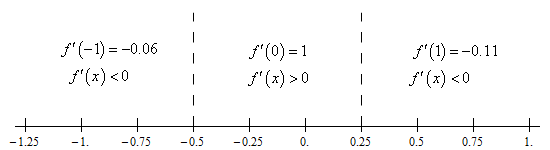
From this we get the following increasing/decreasing information.
$${\begin{align*}{\mbox{Increasing :}} & \,\, - \frac{1}{2} < x < \frac{1}{4}\\ {\mbox{Decreasing :}} & \,\, - \infty < x < - \frac{1}{2},\,\,\,\,\frac{1}{4} < x < \infty \end{align*}}$$We’ll first need the derivative, for which we will use the product rule, because we know that the derivative will give us the rate of change of the function. Here is the derivative.
$$V'\left( t \right) = \left( { - 2t} \right)\left( {1 + 5{t^2}} \right) + \left( {4 - {t^2}} \right)\left( {10t} \right) = 38t - 20{t^3} = 2t\left( {19 - 10{t^2}} \right)$$Next, we need to know where the function is not changing and so all we need to do is set the derivative equal to zero and solve. From the factored form of the derivative it is easy to see that the derivative will be zero at,
$$t = 0 \hspace{2em} t = \pm \sqrt {\frac{{19}}{{10}}} = \pm 1.3784$$To get the answer to this problem all we need to know is where the derivative is positive (and hence the function is increasing) or negative (and hence the function is decreasing). Because the derivative is continuous we know that the only place it can change sign is where the derivative is zero. So a quick number line will give us the sign of the derivative for the various intervals.
Here is the number line for this problem.
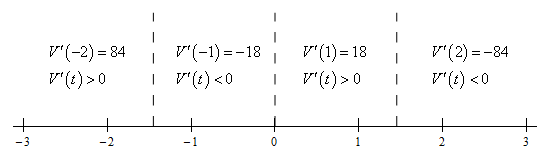
From this we get the following increasing/decreasing information.
$${\begin{align*}{\mbox{Increasing :}} & \,\, - \infty < t < - \sqrt {\frac{{19}}{{10}}} ,\,\,\,\,\,\,0 < t < \sqrt {\frac{{19}}{{10}}} \\ {\mbox{Decreasing :}} & \,\, - \sqrt {\frac{{19}}{{10}}} < t < 0,\,\,\,\,\sqrt {\frac{{19}}{{10}}} < t < \infty \end{align*}}$$For problems 23-25 determine the second derivative of the given function.
- $g\left( x \right) = \sin \left( {2{x^3} - 9x} \right)$
- $\displaystyle Q\left( v \right) = \frac{2}{{{{\left( {6 + 2v - {v^2}} \right)}^4}}}$
- $H\left( t \right) = {\cos ^2}\left( {7t} \right)$
- $h\left( x \right) = {x^4} - 9\sin \left( x \right) + 2\tan \left( x \right)$
- $y = 6\cot \left( w \right) - 8\cos \left( w \right) + 9$
- $h\left( t \right) = 8 - {t^9}\tan \left( t \right)$
- $\displaystyle f\left( w \right) = 3w - \frac{{\sec \left( w \right)}}{{1 + 9\tan \left( w \right)}}$
- $h\left( z \right) = \left( {2 - \sqrt z } \right)\left( {3 + 8\,\,\sqrt[3]{{{z^2}}}} \right)$
- $\displaystyle f\left( x \right) = \left( {x - \frac{2}{x}} \right)\left( {7 - 2{x^3}} \right)$
- $y = \left( {{x^2} - 5x + 1} \right)\left( {12 + 2x - {x^3}} \right)$
- $\displaystyle g\left( x \right) = \frac{{\sqrt[3]{x}}}{{1 + {x^2}}}$
- $\displaystyle Z\left( y \right) = \frac{{4y - {y^2}}}{{6 - y}}$
- $\displaystyle V\left( t \right) = \frac{{1 - 10t + {t^2}}}{{5t + 2{t^3}}}$
- $y = \cot \left( {1 + \cot \left( x \right)} \right)$
- $f\left( x \right) = {\tan ^4}\left( x \right) + \tan \left( {{x^4}} \right)$
- $T\left( x \right) = {\left( {2{x^3} - 1} \right)^5}{\left( {5 - 3x} \right)^4}$
- $w = \left( {{z^2} + 4z} \right)\sin \left( {1 - 2z} \right)$
- $Y\left( t \right) = {t^8}{\cos ^4}\left( t \right)$
- $A\left( z \right) = \sec \left( {4z} \right)\tan \left( {{z^2}} \right)$
- $\displaystyle g\left( x \right) = \frac{{{{\left( {4x + 1} \right)}^3}}}{{{{\left( {{x^2} - x} \right)}^6}}}$
- $\displaystyle V\left( z \right) = \frac{{{{\sin }^2}\left( z \right)}}{{1 + \cos \left( {{z^2}} \right)}}$
- $\displaystyle g\left( t \right) = \frac{{t\cot \left( t \right)}}{{{t^2} + 1}}$
- $\displaystyle f\left( w \right) = \frac{{\left( {1 - 4w} \right)\left( {2 + w} \right)}}{{3 + 9w}}$
- ${\left( {f\,g} \right)^\prime }\left( { - 3} \right)$
- ${\left( {\frac{h}{g}} \right)^\prime }\left( { - 3} \right)$
- $\displaystyle {\left( {\frac{{f\,g}}{h}} \right)^\prime }\left( { - 3} \right)$
- If $y = \left[ {x - f\left( x \right)} \right]h\left( x \right)$, determine $\displaystyle {\left. {\frac{{dy}}{{dx}}} \right|_{x = - 3}}$.
- If $\displaystyle y = \frac{{1 - g\left( x \right)h\left( x \right)}}{{x + f\left( x \right)}}$, determine $\displaystyle {\left. {\frac{{dy}}{{dx}}} \right|_{x = - 3}}$.
- $f\left( x \right) = 2\tan \left( x \right) - 4x$ at $x=0$
- $f\left( x \right) = x\sec \left( x \right)$ at $x=2\pi$
- $f\left( x \right) = \left( {8 - {x^2}} \right)\left( {1 + x + {x^2}} \right)$ at $x=-2$
- $\displaystyle f\left( x \right) = \frac{{4 - {x^3}}}{{x + 2{x^2}}}$ at $x=1$
- Determine where $\displaystyle g\left( z \right) = \frac{{2 - z}}{{12 + {z^2}}}$ is increasing at decreasing.
- Determine where $R\left( x \right) = \left( {3 - x} \right)\left( {1 - 2x + {x^2}} \right)$ is increasing at decreasing.
- Determine where $\displaystyle h\left( t \right) = \frac{{7t - {t^2}}}{{1 + 2{t^2}}}$ is increasing at decreasing.
- Determine where $\displaystyle f\left( x \right) = \frac{{1 + x}}{{1 - x}}$ is increasing at decreasing.
- Determine where $A\left( t \right) = {t^3}{\left( {9 - t} \right)^4}$ is increasing at decreasing.
- Derive the formula for the Product Rule for four functions; $${\left( {f\,g\,h\,w} \right)^\prime } = f'\,g\,h\,w + f\,g'\,h\,w + f\,g\,h'\,w + f\,g\,h\,w'$$
- $Q\left( w \right) = \cos \left( {2 - 7{w^2}} \right)$
- $y = \tan \left( {3x} \right)$
- $z = \csc \left( {8w} \right)$
- $\displaystyle f\left( x \right) = \frac{1}{{\sqrt {6x + {x^4}} }}$
- $f\left( x \right) = {\left[ {3\sin \left( x \right) + 8\cos \left( {2x} \right)} \right]^{ - 3}}$
- $f\left( t \right) = {\sin ^3}\left( {2t} \right)$
- $A\left( w \right) = {\tan ^4}\left( w \right)$
- $g\left( x \right) = \sec \left( {3x} \right)$
- $h\left( w \right) = \cos \left( {w - {w^2}} \right)$
- If $h(x) = xf(x)+4g(x)$, find $h'(1)$.
- If $h(x) = \dfrac{f(x)}{g(x)}$, find $h'(2)$.
- If $h(x) = 2x + f(x)g(x)$, find $h'(3)$.
- If $h(x) = \dfrac{1}{x}+\dfrac{g(x)}{f(x)}$, find $h'(4)$.
- If $h(x) = f(2x)g(3x)$, find $h'(1)$.
- If $h(x) = f(xg(x))$, find $h'(1)$.
Not much to this problem other than to take two derivatives so each step will show each successive derivative until we get to the second. The first derivative is then,
$$g'\left( x \right) = \left( {6{x^2} - 9} \right)\cos \left( {2{x^3} - 9x} \right)$$Do not forget that often we will end up needing to do a product rule in the second derivative even though we did not need to do that in the first derivative. The second derivative is then,
$$g''\left( x \right) = 12x\cos \left( {2{x^3} - 9x} \right) - {{\left( {6{x^2} - 9} \right)}^2}\sin \left( {2{x^3} - 9x} \right).$$Not much to this problem other than to take two derivatives so each step will show each successive derivative until we get to the second. We’ll do a quick rewrite of the function to help with the derivatives and then the first derivative is,
$$\begin{align*} Q\left( v \right) &= 2{\left( {6 + 2v - {v^2}} \right)^{ - \,4}}\\ Q'\left( v \right) & = - 8\left( {2 - 2v} \right){\left( {6 + 2v - {v^2}} \right)^{ - \,5}}. \end{align*}$$Do not forget that often we will end up needing to do a product rule in the second derivative even though we did not need to do that in the first derivative. The second derivative is then,
$$Q''\left( v \right) = 16{{\left( {6 + 2v - {v^2}} \right)}^{ - \,5}} + 40{{\left( {2 - 2v} \right)}^2}{{\left( {6 + 2v - {v^2}} \right)}^{ - \,6}}.$$Not much to this problem other than to take two derivatives so each step will show each successive derivative until we get to the second. The first derivative is then,
$$H'\left( t \right) = - 14\cos \left( {7t} \right)\sin \left( {7t} \right).$$Do not forget that often we will end up needing to do a product rule in the second derivative even though we did not need to do that in the first derivative. The second derivative is then,
$$H''\left( t \right) = 98\sin \left( {7t} \right)\sin \left( {7t} \right) - 98\cos \left( {7t} \right)\cos \left( {7t} \right) = 98{{\sin }^2}\left( {7t} \right) - 98{{\cos }^2}\left( {7t} \right).$$Note that, in this case, if we recall our trig formulas we could have reduced the product in the first derivative to a single trig function which would have then allowed us to avoid the product rule for the second derivative. Can you figure out what the formula is?
Assignment Problems
For problems 1-20, find the derivative of the given function.
For problems 21-25, use the fact that $f(−3)=12$, $f′(−3)=9$, $g(−3)=−4$, $g′(−3)=7$, $h(−3)=−2$ and $h′(−3)=5$, determine the value of the indicated derivative.
For problems 26-29, determine an equation of the tangent line to the given function at the given point.
For problems 36-42 determine the second derivative of the given function.
For problems 43 – 44 determine the third derivative of the given function.
Note: The following content is adapted from OpenStax and is licensed under a Creative Commons Attribution-NonCommercial-ShareAlike 4.0 International License.
Access for free at https://openstax.org/books/calculus-volume-1/pages/1-introduction.

For the following exercises, assume that $f(x)$ and $g(x)$ are both differentiable functions with values as given in the following table. Use the following table to calculate the following derivatives.
$\begin{array}{|c|c|c|c|c|} \hline x&1&2&3&4\\ \hline f(x) & 3 & 5 & -2 & 0\\ \hline g(x) & 2 & 3 & -4 & 6\\ \hline f'(x) & -1 & 7 & 8 & -3\\ \hline g'(x) & 4 & 1 & 2 & 9\\ \hline \end{array}$