Section 2.2: Features of Linear Functions
Horizontal and Vertical Lines
There are two special cases of lines: a horizontal line and a vertical line. In a horizontal line like the one graphed to the right, notice that between any two points, the change in the outputs is 0. In the slope equation, the numerator will be 0, resulting in a slope of 0. Using a slope of 0 in the $f(x)=b+mx$, the equation simplifies to $f(x)=b$.
Notice a horizontal line has a vertical intercept, but no horizontal intercept (unless it’s the line f(x) = 0).

In the case of a vertical line, notice that between any two points, the change in the inputs is zero. In the slope equation, the denominator will be zero, and you may recall that we cannot divide by the zero; the slope of a vertical line is undefined. You might also notice that a vertical line is not a function. To write the equation of vertical line, we simply write input=value, like $x=b$.
Notice a vertical line has a horizontal intercept, but no vertical intercept (unless it’s the line x = 0).

Horizontal and Vertical Lines
Horizontal lines have equations of the form $f(x)=b$. The slope of a horizontal line is 0.
Vertical lines have equations of the form $x = a$. The slope of a vertical line is undefined.
Write an equation for the horizontal line graphed above.
This line would have equation $f(x)=2$
Write an equation for the vertical line graphed above.
This line would have equation $x=2$.
Write an equation for the line through each pair of points:
$(5, 3)$ and $(5, −1)$
$(5, 3)$ and $(−1, 3)$
For any equation of a line, we need to find the slope. We’ll start there and see where we go from there.
$$m = \frac{- 1-3}{5-5}$$ $$=-\frac{4}{0}$$ $$= \text{undefined}$$
This line has an undefined slope, so it is a vertical line. The equation of this line will describe the $x$-value that all the points on the line have in common: $x=5$.
$$m = \frac{3-3}{- 1-5}$$ $$= \frac{0}{- 6}$$ $$= 0$$
The slope of this line is 0, so it is a horizontal line. Its equation describes the constant height of the line, $f(x)=3$.
Parallel and Perpendicular Lines
When two lines are graphed together, the lines will be parallel if they are increasing at the same rate – if the rates of change are the same. In this case, the graphs will never cross (unless they’re the same line).
Parallel Lines
Two lines are parallel if the slopes are equal (or, if both lines are vertical).
Find a line parallel to $f(x)=3x+6$ that passes through the point (3, 0).
We know the line we’re looking for will have the same slope as the given line, m = 3. We readily know the slope and a point on the line, so we can use point-slope form:
$$g(x)=m(x−c)+d$$
$$g(x)=3(x−3)+0$$
$$g(x)=3x − 9$$
If two lines are not parallel, one other interesting possibility is that the lines are perpendicular, which means the lines form a right angle (90 degree angle – a square corner) where they meet. In this case, the slopes when multiplied together will equal -1. Solving for one slope leads us to the definition:
Perpendicular Lines
Given two linear equations $f(x)=m_1x+b_1$ and $g(x)=m_2x+b_2$
The lines will be perpendicular if $m_1m_2=− 1$, and so $$m_{2}=\frac{-1}{m_{1}}$$
We often say the slope of a perpendicular line is the “opposite reciprocal” of the other line’s slope.
Find the slope of a line perpendicular to a line with:
- a slope of 2.
- a slope of -4.
- a slope of $\frac{2}{3}$.
If the original line had slope 2, the perpendicular line’s slope would be $m_{2} = \frac{- 1}{2}$
If the original line had slope -4, the perpendicular line’s slope would be $m_{2}=\frac{-1}{-4} = \frac{1}{4}$
If the original line had slope $\frac23$, the perpendicular line’s slope would be $m_{2} = \frac{- 1}{\frac{2}{3}} = \frac{- 3}{2}$
Find the equation of a line perpendicular to $f(x)=6+3x$ and passing through the point (3, 0).
The original line has slope m = 3. The perpendicular line will have slope $m = \frac{- 1}{3}$. Using this and the given point, we can find the equation for the line in point-slope form.
$$g(x)=-\frac{1}{3}(x-3)+0$$ $$g(x)=-\frac{1}{3}x+1$$
3. Given the line $h(t)=− 4+2t$, find an equation for the line passing through (0, 0) that is: a) parallel to h(t). b) perpendicular to h(t).
A line passes through the points (-2, 6) and (4, 5). Find the equation of a perpendicular line that passes through the point (4, 5).
From the two given points on the reference line, we can calculate the slope of that line:
$$m_{1} = \frac{5-6}{4-(-2)} = \frac{- 1}{6}$$
The perpendicular line will have slope
$$m_{2} = \frac{- 1}{\frac{- 1}{6}} = 6$$
Now we know a point (4, 5) and the slope $m=6$, so we can write the point-slope form of the line:
$$f(x)=6(x−4)+5$$
We can simplify this if we want the slope-intercept form:
$$f(x)=6x − 24+5$$
$$f(x)=6x − 19$$
Intersections of Lines
The graphs of two lines will intersect if they are not parallel. They will intersect at the point that satisfies both equations. To find this point when the equations are given as functions, we can solve for an input value so that $f(x) = g(x)$. In other words, we can set the formulas for the lines equal, and solve for the input that satisfies the equation.
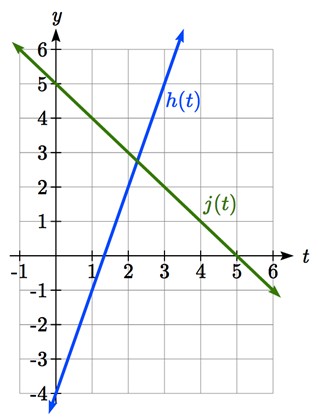
Find the intersection of the lines $h(t)=3t-4$ and $j(t)=5-t$
Setting $h(t)=j(t)$,
$$3t - 4 = 5 - t$$ $$4t = 9$$ $$t = \frac{9}{4}$$
This tells us the lines intersect when the input is $\frac{9}{4}$.
We can then find the output value of the intersection point by evaluating either function at this input
$$j\left( \frac{9}{4} \right) = 5 -\frac{9}{4} = \frac{11}{4}$$
These lines intersect at the point $\left( \frac{9}{4},\frac{11}{4} \right)$. Looking at the graph, this result seems reasonable.
Two parallel lines can also intersect if they happen to be the same line. In that case, they intersect at every point on the lines.
Finding the intersection allows us to answer other questions as well, such as discovering when one function is larger than another.
Using the functions from the previous example, for what values of t is $h(t) \gt j(t)$
To answer this question, it is helpful first to know where the functions are equal, since that is the point where h(t) could switch from being greater to smaller than j(t) or vice-versa. From the previous example, we know the functions are equal at $t = \frac{9}{4}$.
By examining the graph, we can see that h(t), the function with positive slope, is going to be larger than the other function to the right of the intersection. So $h(t) \gt j(t)$ when $t \gt \frac{9}{4}$.
We could also set the formulas of the function so that $h(t) \gt j(t)$ and solve similarly to how we solve equations.
$$\begin{array}{rlc} 3t - 4 & \gt 5 - t & \\ 4t - 4 & \gt 5 & \text{Add t to both sides} \\ 4t & \gt 9 & \text{Add 4 to both sides} \\ t & \gt \frac{9}{4} & \text{Divide by 4 on both sides} \end{array}$$
Again we see that the solution set is all $t$ such that $t \gt \frac{9}{4}$. In interval notation, we say $\left( \frac{9}{4},\ \infty \right)$.
If we are going to take the algebraic approach to solving inequalities, we must be careful about one particular situation: multiplying and dividing by negative numbers.
Let’s take the numbers 2 and 4 for example. We know that $2 \lt 4$, since 2 is to the left of 4 on the number line. If we multiply both sides of this inequality by -1, now we have the numbers -2 and -4. It is no longer correct to say that $− 2 \lt -4$, though, because -4 is to the left of -2 on the number line! The inequality symbol changes directions, and we write that $− 2 \gt -4$.
Solving Linear Inequalities
To solve an inequality in the form $f(x) \lt g(x)$ or $f(x) \gt g(x)$ where $f$ and $g$ are both linear functions
Simplify each side
Move all variable terms to same side
Isolate the variable
CAUTION: If we multiply or divide by a negative number, we must reverse the direction of the inequality symbol!
Given the functions $f(x)=5-3x$ and $g(x)=6x + 2$, find for what values of $x$ is $f(x) \leq g(x)$.
$$\begin{array}{rclc} 5 - 3x & \leq & 6x + 2 & \\ 5 - 9x & \leq & 2 & \text{Subtract 6x from both sides} \\ - 9x & \leq & - 3 & \text{Subtract 5 from both sides} \\ x & \geq & \frac{1}{3} & \begin{array}{cc} \text{Divide by-9 on both sides} \\ \text{and }\text{reverse the inequality!} \end{array} \end{array}$$
We see that $f(x) \leq g(x)$ when $x \geq \frac{1}{3}$; that is, on the interval $\left\lbrack \frac{1}{3},\infty \right)$.
When we observe the graphs of $f$ and $g$, we see that on the left side, $f$ is above $g$. They meet when $x = \frac{1}{3}$, and after that $f$ is below $g$.

Given the functions $f(x)=3(x−1) + 4$ and $g(x)=7-2x$, find
The intersection of $f$ and $g$.
The values of $x$ for which $g(x) \geq f(x)$.
Inverses
Linear functions are great for learning how to algebraically find an inverse of a function. Remember, the heart of the inverse relationship is that we’re swapping inputs and outputs.
Find the inverse of $f(x)=3x-4$.
Before we proceed, we need to make sure our function is one-to-one. We know that $f(x)=3x-4$ will make a line with vertical intercept -4 and slope 3; that’s a picture that passes both the horizontal and vertical line tests, so $f(x)$ is one-to-one.
To find the inverse function, we need to swap inputs ($x$) with outputs $(y=f(x))$. To help make this easier, we’ll start by replacing $f(x)$ with $y$.
$$y=3x-4$$
Then replace all $y$’s with $x$’s and all $x$’s with $y$’s.
$$x=3y-4$$
Now, we want to rearrange the equation so that the $y$ is isolated. This will make the new input/output relationship more clear.
$$\begin{array}{rlc} x + 4 & = 3y & \text{Add }4\ \text{to both sides} \\ \frac{x + 4}{3} & = y & \text{Divide by}\ 3\ \text{on both sides} \\ \frac{1}{3}(x + 4) & = y & \text{Simplify} \end{array}$$
Now we have an inverse! We can rename this function $f^{−1}(x)$.
$$y=f^{-1}(x)=\frac{1}{3}(x+4)$$
Let’s use that example as an opportunity to dig deeper into the function/inverse relationship
Compare the features of $f(x)=3x-4$ with its inverse $f^{-1}(x)=\frac{1}{3}(x+4)$
For both functions, the domain and range remains $(−\infty,\infty).$
For $f(x)$, we see an $x$-intercept at $(\frac{4}{3},0)$; in the inverse, that becomes a $y$-intercept at $\left(0,\frac{4}{3}\right).$ Similarly, in $f(x)$ the $y$-intercept is $(0,−4)$; in the inverse, the $x$-intercept is $(−4, 0)$. This is a great illustration of the fact that the $x$/$y$ relationship is swapped!
In $f(x)$, since the slope is positive, the function is increasing and as $x\to\infty, f(x)\to\infty$, and as $x\to-\infty, f(x)\to-\infty$. In the inverse function, the function is decreasing, so as $x\to\infty, f(x)\to-\infty$ and as $x\to-\infty, f(x)\to\infty.$
Describing an inverse function
Given a function $f(x)$, do the following to find its inverse, $f^{−1}(x)$.
-
Determine whether $f(x)$ is one-to-one. If necessary and possible, limit the domain of $f(x)$ to a one-to-one portion that contains the entire range.
-
Replace $f(x)$ with $y$.
-
Swap all $x$’s with $y$’s and all $y$’s with $x$’s.
-
Isolate $y$ to describe the new input/output relationship
-
Rename the function $f^{−1}(x)$.
Once complete, we’ve not only described the new input/output relationship, but we should also be able to compare $f^{−1}$ to $f$ to see that all the input/output relationships and features have been reversed.
Given $f(x)=5(x−2)$, find the inverse function. Then compare the features of $f$ and its inverse.
Section 2.2 Exercises
Conceptual Questions
- Why is the equation of a vertical line in the form $x=n?$
- If $f(x)$ and $g(x)$ are linear functions, how can we identify the solution to $f(x)\lt g(x)$ using a graph?
- How do we find a formula for the inverse of a linear function?
- True or false: if $f$ is increasing, then $f^{-1}$ must be decreasing.
- True or false: if $f$ and g are perpendicular lines, then one must be increasing and the other must be decreasing.
- True or false: if $f$ is a linear function with slope -1/2, a line perpendicular to $f$ must have slope -2.
Practice Problems
Sketch the graph of each equation
$x=3$
$x=− 2$
$r(x)=4$
$q(x)=3$
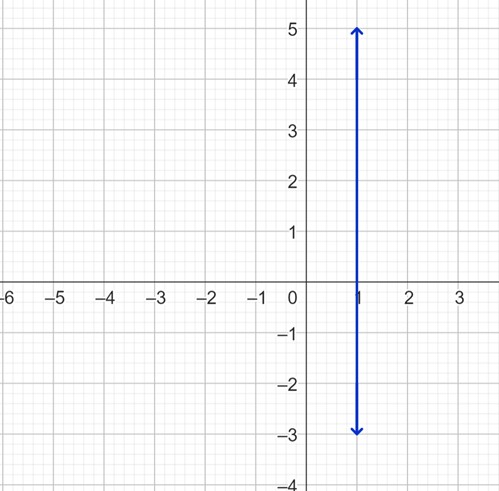
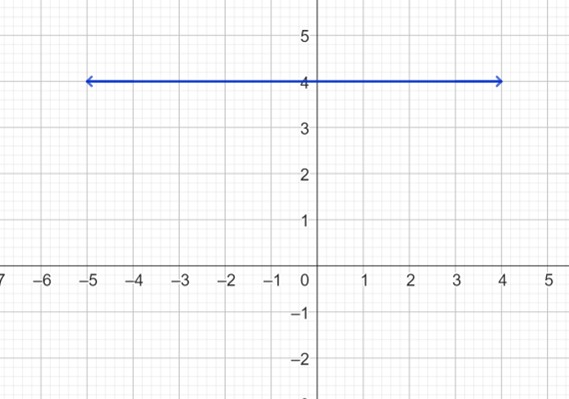
Write the equation of the line shown
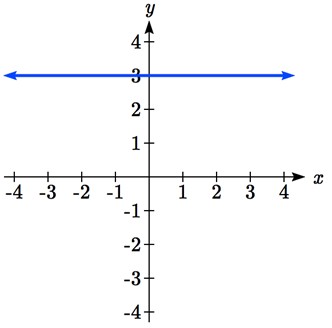
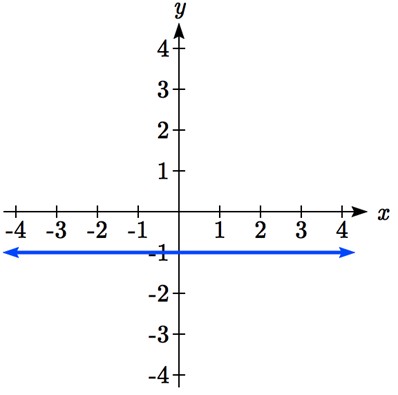

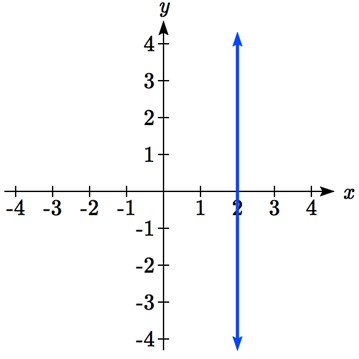
$f(x) = 3$
$x = -3$
Given below are descriptions of two lines. Find the slopes of Line 1 and Line 2. Is each pair of lines parallel, perpendicular or neither?
Line 1: Passes through $(0,6)$ and $(3,−24)$
Line 2: Passes through $(−1,19)$ and $(8,−71)$Line 1: Passes through $(−8, −55)$ and $(10, 89)$
Line 2: Passes through $(9, −44)$ and $(4,−14)$Line 1: Passes through $(2,3)$ and $(4,−1)$
Line 2: Passes through $(6,3)$ and $(8,5)$Line 1: Passes through $(1,7)$ and $(5,5)$
Line 2: Passes through $(-1,-3)$ and $(1,1)$Line 1: Passes through $(0, 5)$ and $(3,3)$
Line 2: Passes through $(1,−5)$ and $(3,−2)$Line 1: Passes through $(2,5)$ and $(5,−1)$
Line 2: Passes through $(−3,7)$ and $(3,−5)$
Parallel
Neither
Perpendicular
Write an equation for a line parallel to $f(x)=− 5x-3$ and passing through the point (2,-12)
Write an equation for a line parallel to $g(x)=3x-1$ and passing through the point (4,9)
Write an equation for a line perpendicular to $h(t)=− 2t+4$ and passing through the point (-4,-1)
Write an equation for a line perpendicular to $p(t)=3t+4$ and passing through the point (3,1)
$g(x) = -5(x−2)-12$
$f(t) = \frac{1}{2}(t + 4) - 1$
Find the point at which the line $f(x)=− 2x-1$ intersects the line $g(x)=− x$
Find the point at which the line $f(x)=2x+5$ intersects the line $g(x)=− 3x-5$
Use algebra to find the point at which the line $f(x)=\ -\frac{4}{5}x\ +\frac{274}{25}$ intersects the line $h(x)=\frac{9}{4}x\ + \frac{73}{10}$
Use algebra to find the point at which the line $f(x)=\frac{7}{4}x\ +\frac{457}{60}$ intersects the line $g(x)=\frac{4}{3}x\ + \frac{31}{5}$
Intersect: $x = -1$; $(−\infty, −1)$
$x = \frac{6}{5}$
Solve each inequality. Write your final answer in inequality notation, on a number line, and in interval notation.
- $4x-7\leq 9$
- $3x+2\geq 7x-1$
- $-2x+3\gt x-5$
- $4(x+3)\geq 2x-1$
- $-\frac12 x\leq -\frac54 +\frac25 x$
- $-5(x-1)+3\gt 3x-4-4x$
- $-3(2x+1)\gt-2(x+4)$
- $\frac{x+3}{8}-\frac{x+5}{5}\leq \frac35$
- $\frac{x+1}{3}-\frac{x+2}{5}\leq\frac35$
$x ≤ 4; (-\infty, 4]$
$x \lt \frac{8}{3};\left( - \infty,\frac{8}{3} \right)$
$x \geq \frac{25}{18};\left\lbrack \frac{25}{18},\ \infty \right)$
$x \lt \frac{5}{4};\left( - \infty,\frac{5}{4} \right)$
$x \leq - \frac{1}{4};\left( - \infty,\ - \frac{1}{4} \right\rbrack$
Find the inverse of each linear function. Then compare the intercepts and end behavior of each function and its inverse.
- $f(x)=5x-1$
- $f(x)=\frac15(x+2)$
- $f(x)=-3(x-1)+2$
- $f(x)=2(x+3)-4$
$f^{−1}(x) = 5x-2$
$f^{- 1}(x) = \frac{x - 6}{2}$
A car rental company offers two plans for renting a car.
Plan A: 30 dollars per day and 18 cents per mile
Plan B: 50 dollars per day with free unlimited mileage
How many miles would you need to drive for plan B to save you money?You’re comparing two cell phone companies.
Company A: \$20/month for unlimited talk and text, and $10/GB for data.
Company B: \$65/month for unlimited talk, text, and data.
Under what circumstances will company A save you money?
Sketch an accurate picture of the line having equation $f(x)=2-\frac{1}{2}x$. Let c be an unknown constant. [UW]
Find the point of intersection between the line you have graphed and the line $g(x)=1+cx$; your answer will be a point in the xy plane whose coordinates involve the unknown c.
Find c so that the intersection point in (a) has x-coordinate 10.
Find c so that the intersection point in (a) lies on the x-axis.
Company A is better if you use less than 4.5 GB of data.