Section 2.7 Quadratic Functions
In this section, we will explore the family of 2nd degree polynomials, the quadratic functions. While they share many characteristics of polynomials in general, the calculations involved in working with quadratics is typically a little simpler, which makes them a good place to start our exploration of short run behavior. In addition, quadratics commonly arise from problems involving area and projectile motion, providing some interesting applications.
A backyard farmer wants to enclose a rectangular space for a new garden. She has purchased 80 feet of wire fencing to enclose 3 sides, and will put the 4th side against the backyard fence. Find a formula for the area enclosed by the fence if the sides of fencing perpendicular to the existing fence have length $L$.
Backyard
In a scenario like this involving geometry, it is often helpful to draw a picture. It might also be helpful to introduce a temporary variable, $W$, to represent the side of fencing parallel to the 4th side or backyard fence.

Since we know we only have 80 feet of fence available, we know that $L+W+L=80$, or more simply, $2L+W=80$. This allows us to represent the width, W, in terms of L: $W=80 − 2L$
Now we are ready to write an equation for the area the fence encloses. We know the area of a rectangle is length multiplied by width, so
$$A=LW=L(80−2L)$$
$$A(L)=80L − 2L^2$$
This formula represents the area of the fence in terms of the variable length $L$.
Describing Quadratics: Vertex
We now explore the interesting features of the graphs of quadratics. In addition to intercepts, quadratics have an interesting feature where they change direction, called the vertex. You probably noticed that all quadratics are related to transformations of the basic quadratic function$ f(x)=x^2$.
Write an equation for the quadratic graphed below as a transformation of $f(x)=x^2$, then expand the formula and simplify terms to write the equation in standard polynomial form.

We can see the graph is the toolkit quadratic shifted to the left 2 and down 3, giving a formula in the form $g(x)=a(x+2)^2-3$. By plugging in a point that falls on the grid, such as (0,-1), we can solve for the stretch factor:
$$- 1 = a(0 + 2)^{2} - 3$$ $$2 = 4a$$ $$a = \frac{1}{2}$$
Written as a transformation, the equation for this formula is $g(x) = \frac{1}{2}(x+2)^{2}-3$. To write this in standard polynomial form, we can expand the formula and simplify terms:
$$g(x) = \frac{1}{2}(x+2)^{2}-3$$ $$g(x) = \frac{1}{2}(x+2)(x+2)-3$$ $$g(x) = \frac{1}{2}(x^{2}+4x+4)-3$$ $$g(x) = \frac{1}{2}x^{2}+2x+2-3$$ $$g(x) = \frac{1}{2}x^{2}+2x-1$$
Notice that the horizontal and vertical shifts of the basic quadratic determine the location of the vertex of the parabola; the vertex is unaffected by stretches and compressions.
A coordinate grid has been superimposed over the quadratic path of a basketball1. Find an equation for the path of the ball. Does he make the basket?

Forms of Quadratic Functions
The standard form of a quadratic function is $f(x)=ax^2+bx+c$
The transformation form of a quadratic function is $f(x)=a(x−h)^2+k$
The vertex of the quadratic function is located at $(h, k)$, where $h$ and $k$ are the numbers in the transformation form of the function. Because the vertex appears in the transformation form, it is often called the vertex form.
In the previous example, we saw that it is possible to rewrite a quadratic function given in transformation form and rewrite it in standard form by expanding the formula. It would be useful to reverse this process, since the transformation form reveals the vertex.
One way of approaching that challenge is by completing the square.
Find the vertex of the quadratic $f(x)=2x^2-6x+7$ by rewriting the quadratic into transformation form (vertex form) using the strategy of completing the square. Determine whether the vertex gives a maximum or minimum value.
When completing the square in this context, we’ll focus only on the $2x^2-6x$ portion of the expression. The $+7$ will be there, but not involved in the completing the square process.
First, we’ll factor out $a=2$:
$$f(x)=2(x^2−3x)+7$$
Now, we determine $n$. Since $2n=-3$, we know $n =-\frac{3}{2}$.
Therefore, $$n^{2} = \left(-\frac{3}{2} \right)^{2} = \frac{9}{4}.$$ We need to add a fancy form of 0 inside the parentheses to make our perfect square.
$$f(x) = 2\left(x^{2}-3x+\frac{9}{4} - \frac{9}{4} \right)+7$$
Now we factor the perfect square part:
$$f(x) = 2\left(\left( x-\frac{3}{2} \right)^{2}-\frac{9}{4} \right)+7$$
And we’ll finish by distributing the 2 and simplifying.
$$f(x) = 2\left(x-\frac{3}{2} \right)^{2}-2 \cdot \frac{9}{4}+7$$
$$= 2\left( x-\frac{3}{2} \right)^{2} - \frac{9}{2}+\frac{14}{2}$$
$$= 2\left( x-\frac{3}{2} \right)^{2} + \frac{5}{2}$$
Now we see that the vertex of the parabola is at $$\left( \frac{3}{2},\frac{5}{2} \right).$$
We notice that because the a-value of 2 causes a vertical stretch, but no reflection. That tells us that the general shape of our graph will be an upward-opening parabola, so the vertex is a minimum.
There’s another way of finding that vertex as well, if we compare the vertex and standard forms of the quadratic.
Expanding out the general transformation form of a quadratic gives:
$$f(x)=a(x−h)^2+k$$ $$=a(x−h)(x−h)+kf(x)$$ $$=a(x^2−2xh+h^2)+k$$ $$=ax^2-2ahx+ah^2+k$$
This should be equal to the standard form of the quadratic:
$$ax^2-2ahx+ah^2+k$$ $$=ax^2+bx+c$$
The second degree terms are already equal. For the linear terms to be equal, the coefficients must be equal:
This provides us a method to determine the horizontal shift of the quadratic from the standard form. We could likewise set the constant terms equal to find:
In practice, though, it is usually easier to remember that k is the output value of the function when the input is h, so $k=f(h)$.
Finding the Vertex of a Quadratic
For a quadratic given in standard form, the vertex $(h, k)$ is located at:
$$h =-\frac{b}{2a}$$, $$k=f(h)=f\left( \frac{- b}{2a} \right)$$
Find the vertex of the quadratic $f(x)=2x^2-6x+7$. Rewrite the quadratic into transformation form (vertex form).
The horizontal coordinate of the vertex will be at $$h =-\frac{b}{2a} =-\frac{- 6}{2(2)} = \frac{6}{4}=\frac{3}{2}$$
The vertical coordinate of the vertex will be at $$f\left( \frac{3}{2} \right)=2\left( \frac{3}{2} \right)^{2}-6\left( \frac{3}{2} \right)+7=\frac{5}{2}$$
Rewriting into transformation form, the stretch factor will be the same as the a in the original quadratic. Using the vertex to determine the shifts,
$$f(x)=2\left( x-\frac{3}{2} \right)^{2}+\frac{5}{2}$$
We notice that because the a-value of 2 causes a vertical stretch, but no reflection. That tells us that the general shape of our graph will be an upward-opening parabola, so the vertex is a minimum.
Given the equation $g(x)=13+x^2-6x$ write the equation in standard form and then in transformation/vertex form.
Features of a Quadratic
In addition to enabling us to more easily graph a quadratic written in standard form, finding the vertex serves another important purpose – it allows us to determine the maximum or minimum value of the function, depending on which way the graph opens.
Recall from transformations that the $a$-value will determine not only the vertical stretch, but also whether the parabola has been flipped vertically. Therefore, if we know the $a$-value of a quadratic, we can deduce a lot of additional information.
Features of a Quadratic
For a quadratic in either standard (\( f(x) = ax^2 + bx + c \)) or vertex (\( f(x) = a(x - h)^2 + k \)) form,
If \( a \gt 0 \), the parabola opens up, so
- The vertex \( (h,k) = \left( -\frac{b}{2a}, f\left(-\frac{b}{2a} \right) \right) \) gives the location of a minimum.
- The range of the quadratic is \( [k, \infty) \).
- The end behavior is as \( x \to \pm\infty \), \( f(x) \to \infty \).
- The function is decreasing on \( (-\infty, h) \) and increasing on \( (h, \infty) \).
- The graph is concave up on \( (-\infty, \infty) \).
If \( a \lt 0 \), the parabola opens down, so
- The vertex \( (h,k) = \left( -\frac{b}{2a}, f\left(-\frac{b}{2a} \right) \right) \) gives the location of a maximum.
- The range of the quadratic is \( (-\infty, k] \).
- The end behavior is as \( x \to \pm\infty \), \( f(x) \to -\infty \).
- The function is increasing on \( (-\infty, h) \) and decreasing on \( (h, \infty) \).
- The graph is concave down on \( (-\infty, \infty) \).
Given the function $f(x)=− x^{2}+2x+3$, describe its domain and range, end behavior, intervals of increasing and decreasing, concavity, maximum or minimum, and intercepts.
Once we figure out the vertex, we’ll know almost everything we need to know. This quadratic is in standard form, so $a=− 1$, $b = 2$, and $c = 3$. That means the vertex is at
$$h = \frac{- 2}{2( - 1)} = \frac{- 2}{- 2} = 1$$
$$k = f(h)=− (1)^{2}+2(1)+3 = 4$$
$(1,4).$$
Since $a$ is negative, the parabola opens down, so we create a rough picture in our minds that looks something like this:

That’s plenty of information to describe the majority of the features of the function.
Domain: $(−\infty,\infty)$
Range: $( − \infty, 4]$
End behavior: as $x\to\pm\infty, f(x)\to − \infty$
Increasing on $(−\infty, 1)$, decreasing on $(1, \infty)$
Maximum value of 4 when $x = 1$
Concave down on $(−\infty,\infty)$
The only things that require slightly more work are the intercepts. To find the $x$-intercepts, we’ll set the function equal to 0 and solve.
$$ − x^{2}+2x+3 = 0$$
$$ − (x^{2}−2x−3) = 0$$
$$ − (x−3)(x+1) = 0$$
$$x = 3, − 1$$
To find the $y$-intercept, we substitute in $x = 0$:
$$f(0)=− (0)^{2}+2(0)+3$$
$$ = 3$$
Given the function $f(x) = 2x^{2}+16x$, describe its domain and range, end behavior, intervals of increasing and decreasing, concavity, maximum or minimum, and intercepts.
Returning to our backyard farmer from the beginning of the section, what dimensions should she make her garden to maximize the enclosed area?
Earlier we determined the area she could enclose with 80 feet of fencing on three sides was given by the equation $A(L)=80L-2L^2$. Notice that quadratic has been vertically reflected, since the coefficient on the squared term is negative, so the graph will open downwards, and the vertex will be a maximum value for the area.
In finding the vertex, we take care since the equation is not written in standard polynomial form with decreasing powers. But we know that a is the coefficient on the squared term, so $a=-2, b=80$, and $c=0$.
Finding the vertex:
$$h =-\frac{80}{2(-2)}=20,$$ $$k=A(20)=80(20)-2(20)^2=800$$
The maximum value of the function is an area of 800 square feet, which occurs when $L=20$ feet. When the shorter sides are 20 feet, that leaves 40 feet of fencing for the longer side. To maximize the area, she should enclose the garden so the two shorter sides have length 20 feet, and the longer side parallel to the existing fence has length 40 feet.
A local newspaper currently has 84,000 subscribers, at a quarterly charge of \$30. Market research has suggested that if they raised the price to \$32, they would lose 5,000 subscribers. Assuming that subscriptions are linearly related to the price, what price should the newspaper charge for a quarterly subscription to maximize their revenue?
Revenue is the amount of money a company brings in. In this case, the revenue can be found by multiplying the charge per subscription times the number of subscribers. We can introduce variables, C for charge per subscription and S for the number subscribers, giving us the equation
Since the number of subscribers changes with the price, we need to find a relationship between the variables. We know that currently $S=84,000$ and $C=30$, and that if they raise the price to \$32 they would lose 5,000 subscribers, giving a second pair of values, $C=32$ and $S=79,000$. From this we can find a linear equation relating the two quantities. Treating C as the input and S as the output, the equation will have form $S=mC+b$. The slope will be
$$m=\frac{79,000-84,000}{32-30} = \frac{- 5,000}{2} =-2,500$$
This tells us the paper will lose 2,500 subscribers for each dollar they raise the price. We can then solve for the vertical intercept
$$S=-2500C+b$$ Plug in the point $S=84,000$ and $C=30$
$$84, 000=-2500(30)+b$$ Solve for b
$$b=159, 000$$
This gives us the linear equation $S=-2, 500C+159, 000$ relating cost and subscribers. We now return to our revenue equation.
$$\text{Revenue}=C(−2,500C+159,000)$$ Expanding
$$\text{Revenue}=-2, 500C^2+159, 000C$$
We now have a quadratic equation for revenue as a function of the subscription charge. To find the price that will maximize revenue for the newspaper, we can find the vertex:
$$h =-\frac{159,000}{2(-2,500)} = 31.8$$
The model tells us that the maximum revenue will occur if the newspaper charges \$31.80 for a subscription. To find what the maximum revenue is, we can evaluate the revenue equation:
Short run Behavior: Intercepts
As with any function, we can find the vertical intercepts of a quadratic by evaluating the function at an input of zero, and we can find the horizontal intercepts by solving for when the output will be zero. Notice that depending upon the location of the graph, we might have zero, one, or two horizontal intercepts.
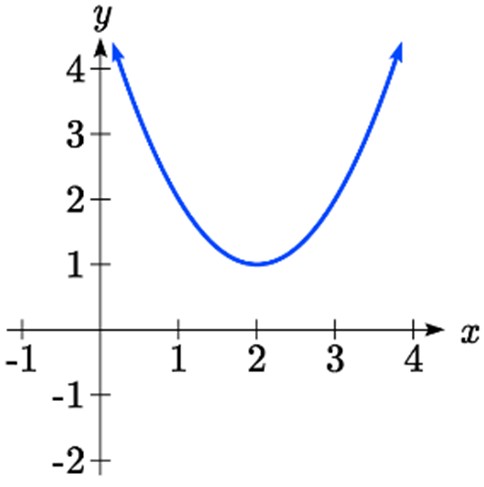


Find the vertical and horizontal intercepts of the quadratic $f(x)=3x^2+5x-2$
We can find the vertical intercept by evaluating the function at an input of zero:
$$f(0)=3(0)^2+5(0)-2=-2$$ Vertical intercept at (0,-2)
For the horizontal intercepts, we solve for when the output will be zero
$$0=3x^2+5x-2$$
In this case, the quadratic can be factored easily, providing the simplest method for solution
$$0=(3x−1)(x+2)$$
$$\begin{array}{cc} 3x-1=0 & x+2=0 \\ 3x=1 & x =-2 \\ x=\frac{1}{3} &\\ \end{array}$$
Horizontal intercepts at $\left( \frac{1}{3},0 \right)$ and $(-2,0).$
Notice that in the standard form of a quadratic, the constant term $c$ reveals the vertical intercept of the graph.
Find the horizontal intercepts of the quadratic $f(x)=2x^2+4x-4$
Again we will solve for when the output will be zero
$$0=2x^2+4x-4$$
Since the quadratic is not easily factorable in this case, we solve for the intercepts by first rewriting the quadratic into transformation form.
$$h =-\frac{b}{2a} =-\frac{4}{2(2)}=- 1$$ $$k=f(−1)=2(−1)^2+4(−1)-4=-6$$
$$f(x)=2(x+1)^2-6$$
Now we can solve for when the output will be zero
$$0=2(x+1)^{2}-6$$ $$6=2(x+1)^{2}$$ $$3=(x+1)^{2}$$ $$x+1=\pm\sqrt{3}$$ $$x =-1\pm\sqrt{3}$$
The graph has horizontal intercepts at $( - 1-\sqrt{3},0)$ and $(-1 + \sqrt{3},0)$
In Try it Now problem 2 we found the standard & transformation form for the function $g(x)=13+x^2-6x$. Now find the Vertical & Horizontal intercepts (if any).
The process in the last example is done commonly enough that sometimes people find it easier to solve the problem once in general and remember the formula for the result, rather than repeating the process each time. Based on our previous work we showed that any quadratic in standard form can be written into transformation form as:
$$f(x)=a\left( x+\frac{b}{2a} \right)^{2}+c-\frac{b^{2}}{4a}$$
Solving for the horizontal intercepts using this general equation gives:
$$0=a\left( x+\frac{b}{2a} \right)^{2} + c-\frac{b^{2}}{4a}$$ start to solve for x by moving the constants to the other side
$$\frac{b^{2}}{4a}-c=a\left( x + \frac{b}{2a} \right)^{2}$$ divide both sides by a
$$\frac{b^{2}}{4a^{2}}-\frac{c}{a} = \left( x+\frac{b}{2a} \right)^{2}$$ find a common denominator to combine fractions
$$\frac{b^{2}}{4a^{2}}-\frac{4ac}{4a^{2}} = \left( x+\frac{b}{2a} \right)^{2}$$ combine the fractions on the left side of the equation
$$\frac{b^{2}-4ac}{4a^{2}}=\left( x + \frac{b}{2a} \right)^{2}$$ take the square root of both sides
$$\pm \sqrt{\frac{b^{2}-4ac}{4a^{2}}}=x + \frac{b}{2a}$$ subtract b/2a from both sides
$$- \frac{b}{2a} \pm \frac{\sqrt{b^{2} - 4ac}}{2a}=x$$ combining the fractions
$$x=\frac{- b \pm \sqrt{b^{2} - 4ac}}{2a}$$ Notice that this can yield two different answers for x.
Quadratic Formula
For a quadratic function given in standard form $f(x)=ax^2+bx+c$, the quadratic formula gives the horizontal intercepts of the graph of this function.
$$x=\frac{- b \pm \sqrt{b^{2} - 4ac}}{2a}$$
A ball is thrown upwards from the top of a 40-foot-tall building at a speed of 80 feet per second. The ball’s height above ground can be modeled by the equation $H(t)=-16t^2+80t+40$.
What is the maximum height of the ball?
When does the ball hit the ground?
To find the maximum height of the ball, we would need to know the vertex of the quadratic.
$$h =-\frac{80}{2(-16)}=\frac{80}{32} = \frac{5}{2}$$, $$k=H\left( \frac{5}{2} \right) =-16\left( \frac{5}{2} \right)^{2}+80\left( \frac{5}{2} \right)+40=140$$
The ball reaches a maximum height of 140 feet after 2.5 seconds.
To find when the ball hits the ground, we need to determine when the height is zero – when $H(t)=0$. While we could do this using the transformation form of the quadratic, we can also use the quadratic formula:
$$t=\frac{-80 \pm \sqrt{80^{2}-4(-16)(40)}}{2(-16)}=\frac{-80 \pm \sqrt{8960}}{-32}$$
Since the square root does not simplify nicely, we can use a calculator to approximate the values of the solutions:
$$t=\frac{-80-\sqrt{8960}}{-32} \approx 5.458$$ or $$t=\frac{-80 + \sqrt{8960}}{-32} \approx-0.458$$
The second answer is outside the reasonable domain of our model, so we conclude the ball will hit the ground after about 5.458 seconds.
For these two equations determine if the vertex will be a maximum value or a minimum value.
$g(x)=-8x+x^2+7$
$g(x)=-3(3−x)^2+2$
Solving Equations and Inequalities
We’ll end with some examples of solving equations and inequalities involving quadratic functions. The graphs of the functions can help to ground these tasks and make sense of the answers.
Find the values for which $f(x)=g(x)$ given $f(x)=x^{2} − 15$ and $g(x)=7x − 7$. Then, find the solution to $f(x)\leq g(x)$.
We know quite a few things about the graphs of $f(x)$ and $g(x)$. For $f(x),$ we’ll have a parabola which has been shifted down 15, and which opens upward. We know $g(x)$ is a line with $y$-intercept -7 and slope $7/1$. Creating a rough sketch to get our bearings, we see:

This sketch shows us we can expect 2 real solutions to $f(x)=g(x)$. Let’s solve.
$$f(x)=g(x)$$
$$x^{2}-15=7x-7$$
This is a quadratic equation. We’ll move all the terms to the left side so the equation equals 0, then see if we can factor.
$$x^{2}-7x-15 + 7=0$$
$$x^{2}-7x-8=0$$
$$(x−8)(x+1)=0$$
From the ZPP, we see that $x=8, -1$, so the two functions intersect at these locations.
Now, if we want to solve $f(x)\leq g(x)$, our sketch will be very helpful. Let’s add in the information that the functions intersect at $x=-1$ and 8, and investigate what we know from there:

We are looking for the places where the height of $f$ is lower than the height of $g$. That’s the middle region of the graph where the blue parabola is beneath the orange line. We know that region starts and ends where the two shapes intersect, so the solution to $f(x)\leq g(x)$ is $[-1, 8]$.
Given the functions $f(x)=x^{2}-9x + 5$ and $g(x)= -4x + 5$, find where $f(x)=g(x)$. Then, find where $f(x)\gt g(x).$
Important Topics of this Section
Quadratic functions
Standard form
Transformation form/Vertex form
Vertex as a maximum / Vertex as a minimum
Short run behavior
Vertex / Horizontal & Vertical intercepts
Quadratic formula
Section 2.7 Exercises
Conceptual Questions
- Describe how to find the maximum or minimum of a quadratic function. How do you know whether it’s a max or min?
- Describe how to find the end behavior of a quadratic function.
- Describe how to find the intercepts of a quadratic function.
- Describe the meaning of x-intercepts in a real world situation of your choosing.
- Describe the meaning of a maximum in a real world situation of your choosing.
- True or false: a quadratic function may have no x-intercepts.
- True or false: a quadratic function may have no y-intercepts.
- True or false: the domain and range of a quadratic function are both $(-\infty,\infty).$
Practice Problems
Write an equation for the quadratic function graphed.

.


$f(x) = (x−2)^{2}-3$
$f(x) = -2(x−2)^{2}+7$
$f(x) = \frac{1}{2}(x - 3)^{2} - 1$
Graph each quadratic function. Then describe the intercepts, domain and range, intervals of increasing and decreasing, maximum or minimum, and end behavior.
$f(x)=-(x+4)^2-5$
$g(x)=2x^2+2$
$h(x)=3(x−2)^2+1$
$j(x)=-2(x+2)^2+2$

y-intercept at -21, no x-intercepts; Domain: $(−\infty,\infty )$; Range: $(-\infty, -5]$; Increasing on $(−\infty, −4)$, decreasing on $(−4, \infty)$, concave down on $(−\infty,\infty )$; Maximum of -5 at $x = -4$; As $x \to \pm \infty, f(x) \to -\infty$
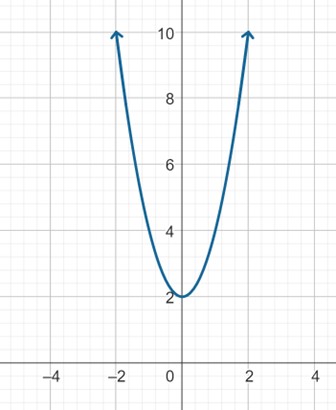
y-intercept at 2, no x-intercepts; Domain: $(−\infty,\infty )$; Range:$[2, \infty)$ Increasing on $(0,\infty)$ decreasing on $(−\infty,0)$ concave up on $(−\infty,\infty )$; Minimum of 2 at $x = 0$; As $x \to \pm \infty, h(x) \to \infty$
For each of the follow quadratic functions, find a) the vertex, b) the vertical intercept, and c) the horizontal intercepts.
$y(x)=2x^2+10x+12$
$z(p)=3x^2+6x-9$
$f(x)=2x^2-10x+4$
$g(x)=-2x^2-14x+12$
$h(t)=-4t^2+6t-1$
$k(t)=2x^2+4x-15 $
Vertex: $\left( - \frac{10}{4}, - \frac{1}{2} \right)$ x-intercepts: $(−3,0)(−2,0)$ y-intercept: $(0,12)$
Vertex: $\left( \frac{10}{4}, - \frac{29}{2} \right)$ x-intercepts: $(5,0)(−1,0)$ y-intercept: $(0,4)$
Vertex: $\left( \frac{3}{4},1.25 \right)$ x-intercepts: $\pm \sqrt{5}$ y-intercept: $(0,−1)$
Rewrite the quadratic function into vertex form. Then graph each quadratic function. Finally, describe the intercepts, domain and range, intervals of increasing and decreasing, maximum or minimum, and end behavior.
$f(x)=x^2-12x+32$
$g(x)=x^2+2x-3$
$h(x)=2x^2+8x-10$
$k(x)=3x^2-6x-9$
$f(x) = (x−6)^{2}-4$
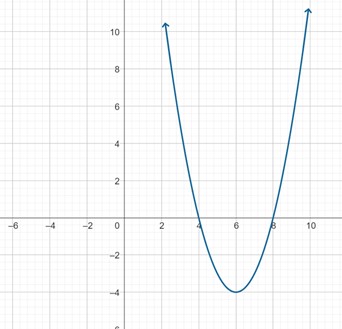
y-intercept at 32, x-intercepts at 4 and 8; Domain: $(−\infty,\infty )$; Range:$[-4, \infty)$ Increasing on $(6,\infty)$ decreasing on $(−\infty,−4)$ concave up on $(−\infty,\infty )$; Minimum of -4 at $x = 6$; As $x \to \pm \infty, f(x) \to \infty$
$h(x) = 2(x+2)^{2}-18$
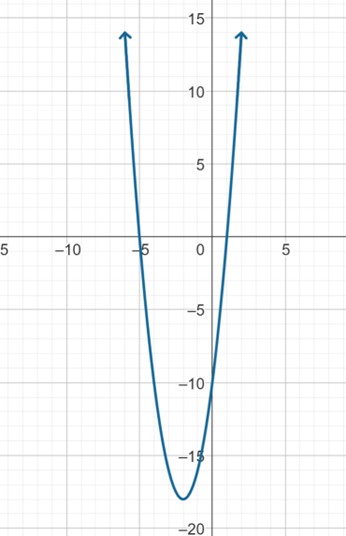
$y$-intercept at -10, x-intercepts at -5 and 1; Domain: $(−\infty,\infty )$; Range:$[-18, \infty)$ Increasing on $(−2,\infty)$ decreasing on $(−\infty,−2)$ concave up on $(−\infty,\infty )$; Minimum of -18 at $x = -2$; As $x \to \pm \infty, h(x) \to \infty$
Find the values of b and c so $f(x)=-8x^2+bx+c$ has vertex $(2, −7)$
Find the values of b and c so $f(x)=6x^2+bx+c$ has vertex $(7, −9)$
$b = 32, c = -39$
Write an equation for a quadratic with the given features
x-intercepts (-3, 0) and (1, 0), and y intercept (0, 2)
x-intercepts (2, 0) and (-5, 0), and y intercept (0, 3)
x-intercepts (2, 0) and (5, 0), and y intercept (0, 6)
x-intercepts (1, 0) and (3, 0), and y intercept (0, 4)
Vertex at (4, 0), and y intercept (0, -4)
Vertex at (5, 6), and y intercept (0, -1)
Vertex at (-3, 2), and passing through (3, -2)
Vertex at (1, -3), and passing through (-2, 3)
$f(x) = - \frac{2}{3}x^{2} - \frac{4}{3}x + 2$
$f(x) = \frac{3}{5}x^{2} - \frac{21}{5x} + 6$
$y = - \frac{1}{4}x^{2} + 2x - 4$
$y = - \frac{1}{9}x^{2} - \frac{2}{3}x + 1$
Given $f(x)=x^2-4x+3$ and $g(x)=8-8x$, find where the functions intersect. Then find where $f(x)\leq g(x).$
Given $f(x)=5x$ and $g(x)=-7x^2$, find where the functions intersect. Then find where $f(x)\gt g(x).$
Given $f(x)=5x^2+7x$ and $g(x)=8x+4x^2$, find where the functions intersect. Then find where $f(x)\lt g(x).$
Given $f(x)=9x^2+16x-11$ and $g(x)=6x$, find where the functions intersect. Then find where $f(x)\geq g(x).$
Given $f(x)=11x^2-9x$ and $g(x)=-5+10x^2$, find where the functions intersect. Then find where $f(x)\gt g(x).$
Intersect at $x = -5, 1$; solution to inequality is $[-5, 1]$
Intersect at $x = 0, 1$; solution to inequality is $(0,1)$
Intersect at $x = \frac{9}{2} \pm \frac{\sqrt{61}}{2}$; solution to inequality is $\left( - \infty,\frac{9}{2} - \frac{\sqrt{61}}{2} \right) \cup (\frac{9}{2} + \frac{\sqrt{61}}{2},\ \infty)$
A rocket is launched in the air. Its height, in meters above sea level, as a function of time, in seconds, is given by $h(t)=-4.9t^2+229t+234$.
From what height was the rocket launched?
How high above sea level does the rocket reach its peak?
Assuming the rocket will splash down in the ocean, at what time does splashdown occur?
A ball is thrown in the air from the top of a building. Its height, in meters above ground, as a function of time, in seconds, is given by $h(t)=-4.9t^2+24t+8$.
From what height was the ball thrown?
How high above ground does the ball reach its peak?
When does the ball hit the ground?
The height of a ball thrown in the air is given by $h(x) =-\frac{1}{12}x^{2}+6x+3$, where x is the horizontal distance in feet from the point at which the ball is thrown.
How high is the ball when it was thrown?
What is the maximum height of the ball?
How far from the thrower does the ball strike the ground?
A javelin is thrown in the air. Its height is given by $h(x) =-\frac{1}{20}x^{2}+8x+6$, where x is the horizontal distance in feet from the point at which the javelin is thrown.
How high is the javelin when it was thrown?
What is the maximum height of the javelin?
How far from the thrower does the javelin strike the ground?
A box with a square base and no top is to be made from a square piece of cardboard by cutting 4 in. squares out of each corner and folding up the sides. The box needs to hold 2700 in^3. How big a piece of cardboard is needed?
A box with a square base and no top is to be made from a square piece of cardboard by cutting 6 in. squares out of each corner and folding up the sides. The box needs to hold 1000 in^3. How big a piece of cardboard is needed?
A farmer wishes to enclose two pens with fencing, as shown. If the farmer has 500 feet of fencing to work with, what dimensions will maximize the area enclosed?
A farmer wishes to enclose three pens with fencing, as shown. If the farmer has 700 feet of fencing to work with, what dimensions will maximize the area enclosed?
You have a wire that is 71 cm long. You wish to cut it into two pieces. One piece will be bent into the shape of a right triangle with legs of equal length. The other piece will be bent into the shape of a circle. Let A represent the total area enclosed by the triangle and the circle. What is the circumference of the circle when A is a minimum?
You have a wire that is 56 cm long. You wish to cut it into two pieces. One piece will be bent into the shape of a square. The other piece will be bent into the shape of a circle. Let A represent the total area enclosed by the square and the circle. What is the circumference of the circle when A is a minimum?
A farmer finds that if she plants 75 trees per acre, each tree will yield 20 bushels of fruit. She estimates that for each additional tree planted per acre, the yield of each tree will decrease by 3 bushels. How many trees should she plant per acre to maximize her harvest?
A soccer stadium holds 62,000 spectators. With a ticket price of \$11, the average attendance has been 26,000. When the price dropped to \$9, the average attendance rose to 31,000. Assuming that attendance is linearly related to ticket price, what ticket price would maximize revenue?
A hot air balloon takes off from the edge of a plateau. Impose a coordinate system as pictured below and assume that the path the balloon follows is the graph of the quadratic function $$f(x)=- \frac{4}{2500}x^{2}+\frac{4}{5}x$$. The land drops at a constant incline from the plateau at the rate of 1 vertical foot for each 5 horizontal feet. [UW]

What is the maximum height of the balloon above plateau level?
What is the maximum height of the balloon above ground level?
Where does the balloon land on the ground?
Where is the balloon 50 feet above the ground?
A hot air balloon takes off from the edge of a mountain lake. Impose a coordinate system as pictured and assume that the path of the balloon follows the graph of $$f(x) =-\frac{2}{2500}x^{2} + \frac{4}{5}x$$. The land rises at a constant incline from the lake at the rate of 2 vertical feet for each 20 horizontal feet. [UW]

What is the maximum height of the balloon above water level?
What is the maximum height of the balloon above ground level?
Where does the balloon land on the ground?
Where is the balloon 50 feet above the ground?
(a) 8 meters; (b) 120/49 meters; (c) about 5.2 seconds
(a) 6 feet; (b) 326 feet; (c) about 160.75 feet
The volume of the box can be expressed as $V = 6 * x * x or V = 6x^{2}.$ So if we want the volume to be 1000, we end up with the expression $6x^{2}-1000 = 0.$ Solving this equation for $x$ using the quadratic formula we get $= \pm 10\sqrt{\frac{5}{3}}$ . Because we cannot have negative length, we are left with $x = 10\sqrt{\frac{5}{3}} \approx 12.90$. So the length of the side of our box is $12+12.90 = 24.90.$ So, our piece of cardboard is $24.90 * 24.90 = 620.$
The vertical side should be 87.5 and the whole horizontal side should be 175 feet
$24.6344 cm$
A ticket price of $10.70 would maximize revenue.
(a) 632809.375 ft; (b) 632812.5 ft; (c) 56125 ft; (d) 1.11 ft
From http://blog.mrmeyer.com/?p=4778, © Dan Meyer, CC-BY↩︎