Section 2.8 Polynomial Graphs
In the previous section, we explored the short run behavior of quadratics, a special case of polynomials. In this section, we will explore the short run behavior of polynomials in general.
Short run Behavior: Intercepts
As with any function, the vertical intercept can be found by evaluating the function at an input of zero. Since this is evaluation, it is relatively easy to do it for a polynomial of any degree.
To find horizontal intercepts, we need to solve for when the output will be zero. For general polynomials, this can be a challenging prospect. While quadratics can be solved using the relatively simple quadratic formula, the corresponding formulas for cubic and 4th degree polynomials are not simple enough to remember, and formulas do not exist for general higher-degree polynomials. Consequently, we will limit ourselves to three cases:
The polynomial can be factored using known methods: greatest common factor and trinomial factoring.
The polynomial is given in factored form.
Technology is used to determine the intercepts.
Other techniques for finding the intercepts of general polynomials will be explored later sections.
Find the horizontal intercepts of $f(x)=x^6-3x^4+2x^2$.
We can attempt to factor this polynomial to find solutions for $f(x)=0.$
$$x^6-3x^4+2x^2=0$$ Factoring out the greatest common factor
$$x^2(x^4−3x^2+2)=0$$ Factoring the inside as a quadratic in $x^2$
$$x^2(x^2−1)(x^2−2)=0$$ Then break apart to find solutions
$$\begin{array}{c} x^{2}=0 \\ x=0 \end{array}\ \ \text{ or }\ \ \begin{array}{c} x^{2} -1=0 \\ x^{2}=1 \\ x=\pm 1 \end{array}\ \ \ \text{ or }\ \ \ \begin{array}{c} x^{2} -2=0 \\ x^{2}=2 \\ x=\pm \sqrt{2} \end{array}$$
This gives us 5 horizontal intercepts.
Find the vertical and horizontal intercepts of $g(t)=(t−2)^2(2t+3)$
The vertical intercept can be found by evaluating $g(0).$
$$g(0)=(0−2)^2(2(0)+3)=12$$
The horizontal intercepts can be found by solving $g(t) = 0$.
$$(t−2)^2(2t+3)=0$$
Since this is already factored, we can break it apart using the ZPP:
$$\begin{array}{c} (t -2)^{2}=0 \\ t -2=0 \\ t=2 \end{array}\ \ \text{ or }\ \ \ \begin{array}{c} 2t + 3=0 \\ t=-\frac{3}{2} \end{array}$$
We can always check our answers are reasonable by graphing the polynomial.
Find the horizontal intercepts of $h(t)=t^3+4t^2+t-6$
Since this polynomial is not in factored form, has no common factors, and does not appear to be factorable using techniques we know, we can turn to technology to find the intercepts.
Graphing this function, it appears there are horizontal intercepts at $t = -3, -2$, and 1.
We could check these are correct by plugging in these values for t and verifying that $h(−3)=h(−2)=h(1)=0$.

Find the vertical and horizontal intercepts of the function$f(t)=t^4-4t^2$.
Graphical Behavior at Intercepts
If we graph the function $f(x)=(x+3)(x−2)^2(x+1)^3$, notice that the behavior at each of the horizontal intercepts is different.
At the horizontal intercept $x = -3$, coming from the $(x+3)$ factor of the polynomial, the graph passes directly through the horizontal intercept.
The factor $(x+3)$ is linear (has a power of 1), so the behavior near the intercept is like that of a line -it passes directly through the intercept. We call this a single zero, since the zero corresponds to a single factor of the function.

At the horizontal intercept $x=2$, coming from the $(x−2)^2$ factor of the polynomial, the graph touches the axis at the intercept and changes direction. The factor is quadratic (degree 2), so the behavior near the intercept is like that of a quadratic – it bounces off the horizontal axis at the intercept. Since $(x−2)^2=(x−2)(x−2)$, the factor is repeated twice, so we call this a double zero. We could also say the zero has multiplicity 2.
At the horizontal intercept $x=-1$, coming from the $(x+1)^3$ factor of the polynomial, the graph passes through the axis at the intercept, but flattens out a bit first. This factor is cubic (degree 3), so the behavior near the intercept is like that of a cubic, with the same “S” type shape near the intercept that the toolkit $x^3$ has. We call this a triple zero. We could also say the zero has multiplicity 3.
By utilizing these behaviors, we can sketch a reasonable graph of a factored polynomial function without needing technology.
Multiplicity
If a function $f$ is fully factored, and $(x−r)^m$ is one of those factors, then $x=r$ is a horizontal intercept with multiplicity $m$.
Graphical Behavior of Polynomials at Horizontal Intercepts
If a polynomial contains a factor of the form $(x−r)^p$, the behavior near the horizontal intercept r is determined by the power on the factor, that is, the multiplicity of the intercept.
$p=1$
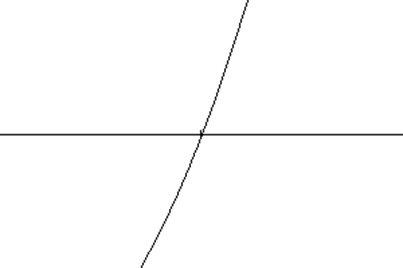
Multiplicity 1
$p=2$

Multiplicity 2
$p=3$
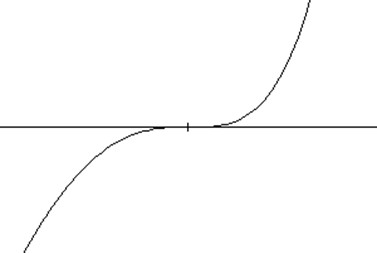
Multiplicity 3
For higher even powers 4,6,8 etc.… the graph will still bounce off the horizontal axis but the graph will appear flatter with each increasing even power as it approaches and leaves the axis.
For higher odd powers, 5,7,9 etc… the graph will still pass through the horizontal axis but the graph will appear flatter with each increasing odd power as it approaches and leaves the axis.
Sketch a graph of $f(x)=-2(x+3)^2(x−5)$.
This graph has two horizontal intercepts. At $x = -3$, the factor is squared, indicating the graph will bounce at this horizontal intercept. At $x = 5$, the factor is not squared, indicating the graph will pass through the axis at this intercept.
Additionally, we can see the leading term, if this polynomial were multiplied out, would be $-2x^3$, so the long-run behavior is that of a vertically reflected cubic, with the outputs decreasing as the inputs get large positive, and the inputs increasing as the inputs get large negative.
To sketch this we consider the following:
As $x\to -\infty$ the function $f(x)\to\infty$ so we know the graph starts in the 2nd quadrant and is decreasing toward the horizontal axis.
At (-3, 0) the graph bounces off the horizontal axis and so the function must start increasing.
At (0, 90) the graph crosses the vertical axis at the vertical intercept.
Somewhere after this point, the graph must turn back down or start decreasing toward the horizontal axis since the graph passes through the next intercept at (5,0).
As $x\to\infty$ the function$f(x)\to -\infty$ so we know the graph continues to decrease and we can stop drawing the graph in the 4th quadrant.
Using technology we can verify the shape of the graph.

Given the function $g(x)=x^3-x^2-6x$ use the methods that we have learned so far to find the vertical & horizontal intercepts, determine where the function is negative and positive, describe the long run behavior and sketch the graph without technology.
Solving Polynomial Inequalities
One application of our ability to find intercepts and sketch a graph of polynomials is the ability to solve polynomial inequalities. It is a very common question to ask when a function will be positive and negative. We can solve polynomial inequalities by either utilizing the graph, or by using test values.
Solve $(x+3)(x+1)^2(x−4) \gt 0$
As with all inequalities, we start by solving the equality $(x+3)(x+1)^2(x−4)=0$, which has solutions at $x = -3, -1$, and 4.
We can sketch the function to help us determine where its height is greater than 0. We know that the function has the following intercepts and corresponding multiplicities:
$$\begin{array}{ccc} x=-3 & \text{multiplicity}\ 1 & \text{pass through} \\ x=-1 & \text{multiplicity}\ 2 & \text{bounce} \\ x=4 & \text{multiplicity}\ 1 & \text{pass through} \end{array}$$
This is a degree 4 polynomial with a positive leading coefficient, so as $x\to\infty, f(x)\to\infty$ and as $x\to-\infty, f(x)\to\infty$. Therefore, the graph looks something like this:
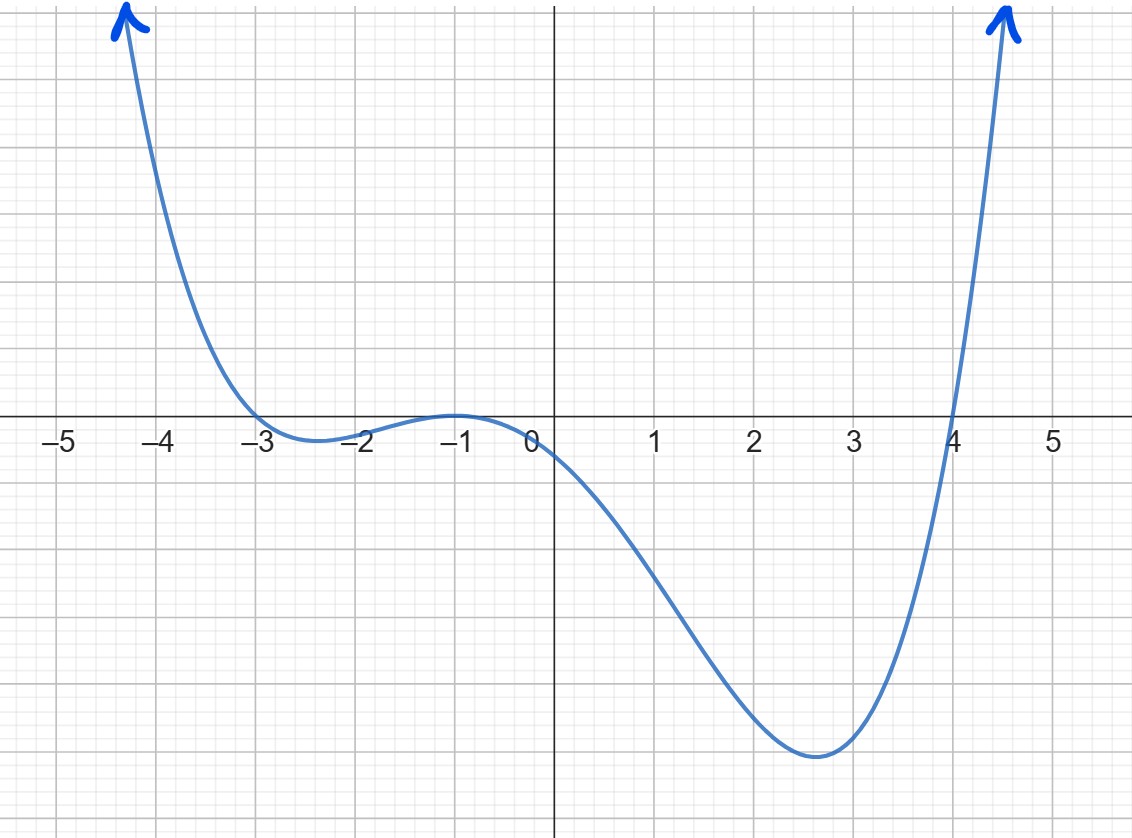
Therefore, the function is greater than 0 (has heights above the $x$-axis) when $x \lt -3 $ or when $x \gt 4$. In interval notation, that’s $(−\infty,−3) ∪ (4,\infty)$.
Alternatively, we know the function can only change from positive to negative at $x=-3, -1,$ and 4, so these divide the inputs into 4 intervals.
We could choose a test value in each interval and evaluate the function $f(x)=(x+3)(x+1)^2(x−4)$ at each test value to determine if the function is positive or negative in that interval
| Interval | Test x in interval | f( test value) | $\gt 0$ or $\lt0$ ? |
|---|---|---|---|
| $x \lt -3$ | -4 | 72 | $\gt 0$ |
| $-3 \lt x \lt -1$ | -2 | -6 | $\lt 0$ |
| $-1 \lt x \lt 4$ | 0 | -12 | $\lt 0$ |
| $x \gt 4$ | 5 | 288 | $\gt 0$ |
On a number line this would look like:

From our test values, we can determine this function is positive when $x\lt-3$ or $x\gt 4$, or in interval notation, $(−\infty,−3) \cup (4,\infty)$.
Solve $6-5t-t^2 \geq 0.$
We start by solving the equality $6-5t-t^2=0$. While we could use the quadratic formula, this equation factors nicely to $(6+t)(1−t)=0$, giving horizontal intercepts $t=1$ and $t=-6$.
Sketching a graph of this quadratic will allow us to determine when it is positive.
From the graph we can see this function is positive for inputs between the intercepts. So $6-5t-t^2 \geq 0$ for $-6 \leq t \leq 1$.

Writing Equations using Intercepts
Since a polynomial function written in factored form will have a horizontal intercept where each factor is equal to zero, we can form a function that will pass through a set of horizontal intercepts by introducing a corresponding set of factors.
Writing an Equation for a Polynomial from Intercepts
If we know the horizontal intercepts and the behavior or multiplicity at those intercepts, we can write a polynomial of minimal degree with those intercepts.
Determine the horizontal intercepts $x=x_1, x_2, …, x_k$
Examine the behavior at each intercept to determine the corresponding multiplicity of each intercept, $p_1, p_2, …, p_k$
Write the polynomial in factored form $f(x)=a(x−x_1)^{p_1}(x−x_2)^{p_2}⋯(x−x_k)^{p_k}$
Use another point on the graph to solve for the stretch factor a
Notice the degree of the polynomial will be the sum of the multiplicities $p_i$.
Write a formula for the polynomial function graphed here.

This graph has three horizontal intercepts: $x=-3, 2$, and $5$. At $x=-3$ and $5$ the graph passes through the axis, suggesting the corresponding factors of the polynomial will be linear. At $x=2$ the graph bounces at the intercept, suggesting the corresponding factor of the polynomial will be 2^nd degree (quadratic).
Together, this gives us:
$$f(x)=a(x+3)(x−2)^2(x−5)$$
To determine the stretch factor, we can utilize another point on the graph. Here, the vertical intercept appears to be $(0,-2)$, so we can plug in those values to solve for a:
$$-2=a(0+3)(0-2)^{2}(0-5)$$ $$-2=-60a$$ $$a=\frac{1}{30}$$
The graphed polynomial appears to represent the function
$$f(x)=\frac{1}{30}(x+3)(x-2)^{2}(x -5).$$
Given the graph, write a formula for the function shown.

Estimating Extrema
With quadratics, we were able to algebraically find the maximum or minimum value of the function by finding the vertex. For general polynomials, finding these turning points is not possible without more advanced techniques from calculus. Even then, finding where extrema occur can still be algebraically challenging. For now, we will estimate the locations of turning points using technology to generate a graph.
An open-top box is to be constructed by cutting out squares from each corner of a 14cm by 20cm sheet of plastic then folding up the sides. Find the size of squares that should be cut out to maximize the volume enclosed by the box.

We will start this problem by drawing a picture, labeling the width of the cut-out squares with a variable, $w$.
Notice that after a square is cut out from each end, it leaves a $(14−2w)$ cm by $(120−2w)$ cm rectangle for the base of the box, and the box will be $w$ cm tall. This gives the volume:
$$V(w)=(14−2w)(20−2w)w=280w-68w^2+4w^3$$
Using technology to sketch a graph allows us to estimate the maximum value for the volume, restricted to reasonable values for w: values from 0 to 7.
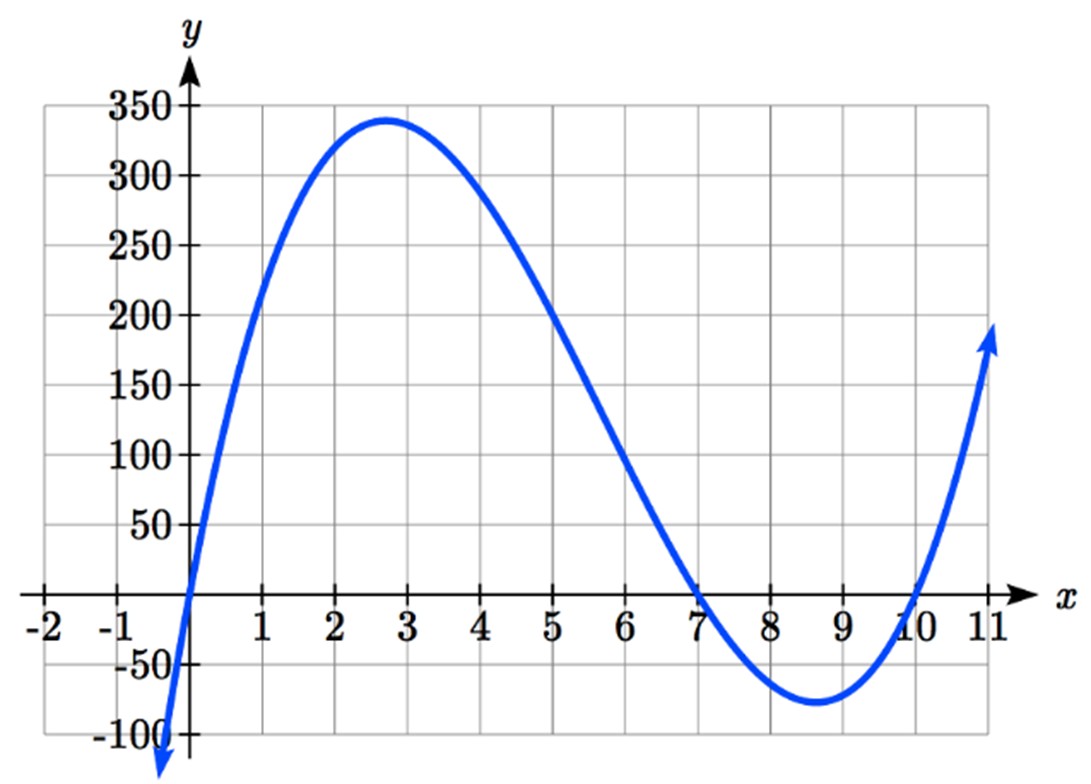
From this graph, we can estimate the maximum value is around 340, and occurs when the squares are about 2.85cm square. To improve this estimate, we could use advanced features of our technology, if available, or simply change our window to zoom in on our graph.

From this zoomed-in view, we can refine our estimate for the max volume to about 339, when the squares are 2.8cm square.
Use technology to find the maximum and minimum values on the interval [-1, 4] of the function $f(x)=-0.2(x−2)^3(x+1)^2(x−4)$.
Important Topics of this Section
Short Run Behavior
Intercepts (Horizontal & Vertical)
Methods to find Horizontal intercepts
Factoring Methods
Factored Forms
Technology
Graphical Behavior at intercepts
Single, Double and Triple zeros (or multiplicity 1, 2, and 3 behaviors)
Solving polynomial inequalities using test values & graphing techniques
Writing equations using intercepts
Estimating extrema
Section 2.8 Exercises
Conceptual Questions
- A fully-factored polynomial has factors including $(x-r)^2$ and $(x-s)^3.$ Describe how the graph will differ at the roots $x=r$ and $x=s.$
- Describe how to find the solution to $f(x)\geq 0$ using the graph of $f,$ a polynomial.
- True or false: A polynomial of degree 3 must have at least one root.
- True or false: A polynomial of degree 4 must have four roots.
Practice Problems
Find the C and t intercepts of each function.
$C(t)=2(t−4)(t+1)(t−6)$
$C(t)=3(t+2)(t−3)(t+5)$
$C(t)=4t(t−2)^2(t+1)$
$C(t)=2t(t−3)(t+1)^2$
$C(t)=2t^4-8t^3+6t^2$
$C(t)=4t^4+12t^3-40t^2$
(a) C intercept at (0, 48)
(b) $t$ intercepts at (4,0), (-1,0), (6,0)
(a) C intercept at (0,0)
(b) $t$ intercepts at (2,0), (-1,0), (0,0)
$C(t) = 2t^{4}-8t^{3}+6t^{2} = 2t^{2}(t^{2}−4t+3) = 2t^{2}(t−1)(t−3)$.
(a) C intercept at (0,0)
(b) $t $intercepts at (0,0), (3,0) (1,0)
Use your calculator or other graphing technology to solve graphically for the zeros of the function.
$f(x)=x^3-7x^2+4x+30$
$g(x)=x^3-6x^2+x+28$
Zeros: $x\approx -1.65, x\approx 3.64, x\approx 5$.
Find the end behavior of each function as $t\to\infty$ and $t\to-\infty$
$h(t)=3(t−5)^3(t−3)^3(t−2)$
$k(t)=2(t−3)^2(t+1)^3(t+2)$
$p(t)=-2t(t−1)(3−t)^2$
$q(t)=-4t(2−t)(t+1)^3$
(a) as $t \to \infty, h(t) \to \infty.$
(b) as $t \to -\infty, h(t) \to -\infty$
(a) as $t \to \infty, p(t) \to -\infty$
(b) as $t \to -\infty, p(t) \to -\infty$
Sketch a graph of each equation.
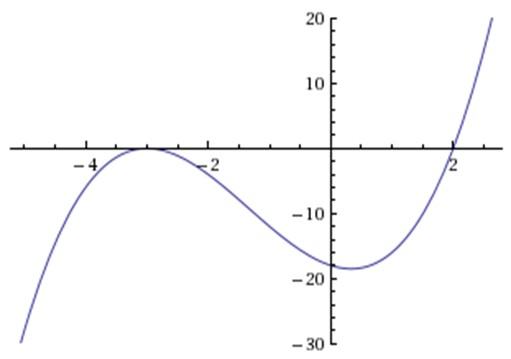
$f(x)=(x+3)^2(x−2)$
$g(x)=(x+4)(x−1)^2$
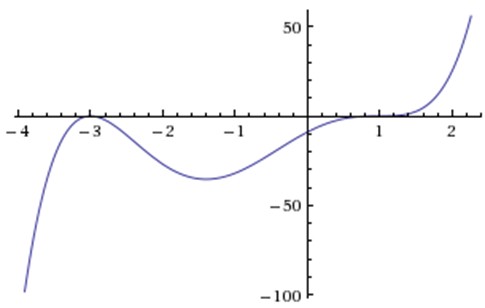
$h(x)=(x−1)^3(x+3)^2$
$k(x)=(x−3)^3(x−2)^2$
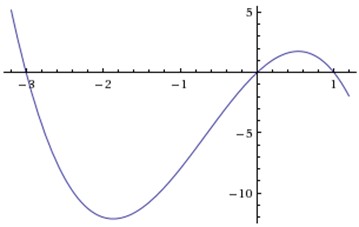
$m(x)=-2x(x−1)(x+3)$
$n(x)=-3x(x+2)(x−4)$
Solve each inequality.
$(x−3)(x−2)^2 \gt 0$
$(x−5)(x+1)^2 \gt 0$
$(x−1)(x+2)(x−3) \lt 0$
$(x−4)(x+3)(x+6) \lt 0$
$-42+19x- 2x^{2}\gt 0$
$28-17x- 3x^{2}\leq 0$
$4-5x + x^{2}\geq$
$2+7x + 3x^{2}\lt 0$
$(x-3)(x + 2)^{2}\gt 0$
$(x-1)^{2}(x + 3)\leq 0$
$(3, \infty)$
$(−2, 1) ∪ (3, \infty)$
$(\frac{7}{2},6)$
$(−\infty, 1]∪[4, \infty)$
$[3, \infty)$
Write an equation for a polynomial the given features.
Degree 3. Zeros at x=-2, x=1, and x=3. Vertical intercept at (0,-4)
Degree 3. Zeros at x=-5, x=-2, and x=1. Vertical intercept at (0, 6)
Degree 5. Roots of multiplicity 2 at x=3 and x=1, and a root of multiplicity 1 at x=-3. Vertical intercept at (0, 9)
Degree 4. Root of multiplicity 2 at x=4, and a roots of multiplicity 1 at x=1 and x=-2. Vertical intercept at (0,-3)
Degree 5. Double zero at x=1, and triple zero at x=3. Passes through the point (2, 15)
Degree 5. Single zero at x=-2 and x=3, and triple zero at x=1. Passes through the point (2, 4)
$f(x) = - \frac{2}{3}(x + 2)(x - 1)(x - 3)$
$f(x) = \frac{1}{3}(x - 3)^{2}(x - 1)^{2}(x + 3)$
$f(x) = -15(x−1)^{2}(x−3)^{3}$
Write a formula for each polynomial function graphed.


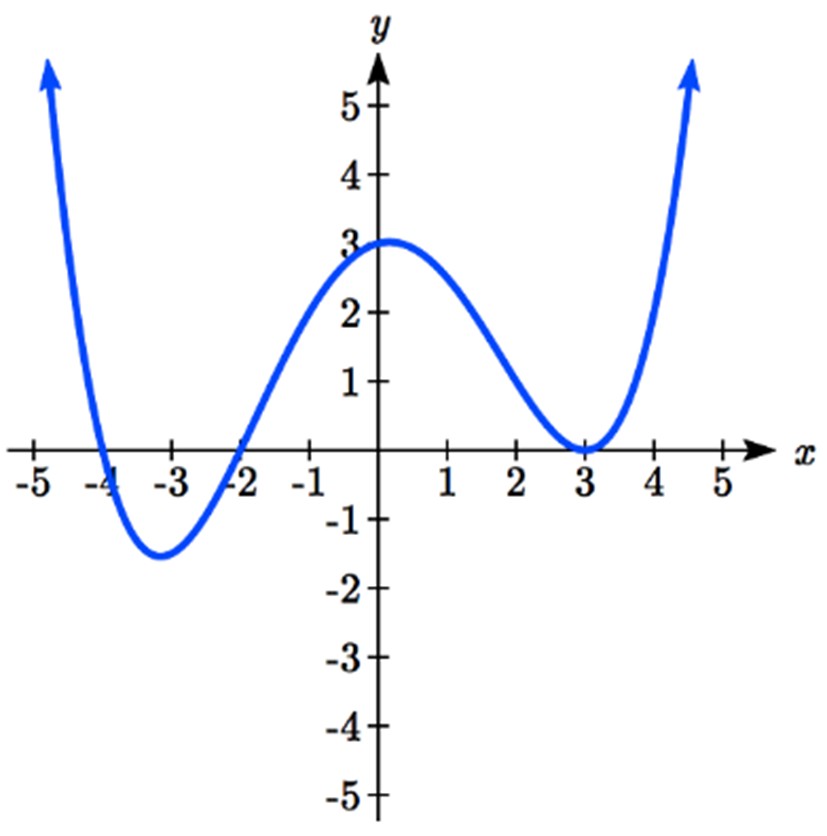


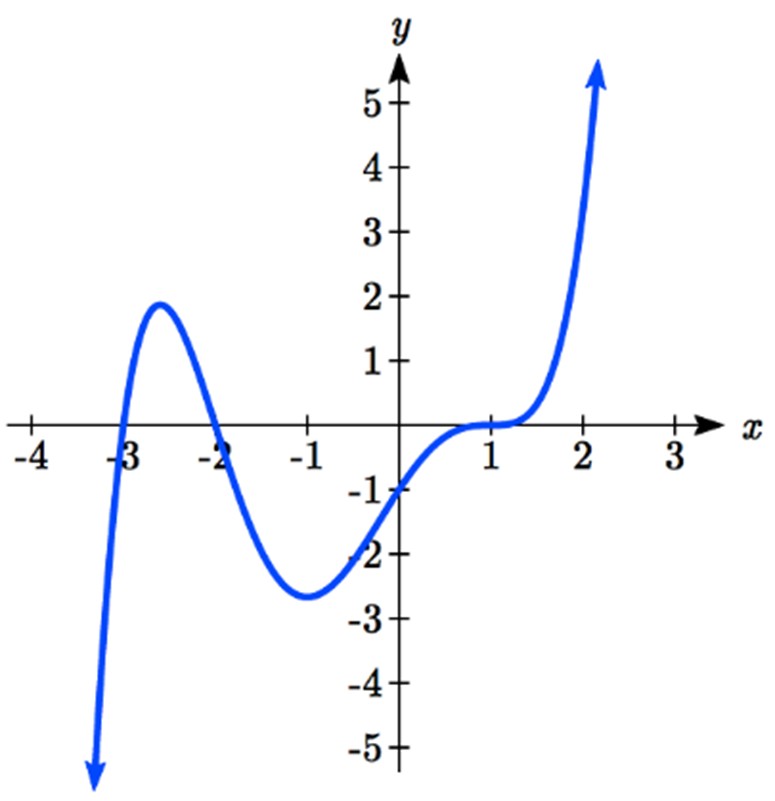


$f(x) = \frac{1}{2}(x + 2)(x - 1)(x - 3)$.
$f(x) = -(x+1)^{2}(x−2)$
$f(x) = - \frac{1}{24}(x + 3)(x + 2)(x - 2)(x - 4)$
$f(x) = \frac{1}{24}(x + 4)(x + 2)(x - 3)^{2}$
$f(x) = \frac{3}{32}(x + 2)^{2}(x - 3)^{2}$
$f(x) = \frac{1}{6}(x + 3)(x + 2)(x - 1)^{3}$
$f(x) = - \frac{1}{16}(x + 3)(x + 1)(x - 2)^{2}(x - 4)$
A rectangle is inscribed with its base on the x axis and its upper corners on the parabola $y=5-x^2$. What are the dimensions of such a rectangle that has the greatest possible area?
Base = 2.58, height = 3.34
A rectangle is inscribed with its base on the x axis and its upper corners on the curve $y=16-x^4$. What are the dimensions of such a rectangle that has the greatest possible area?