Section 2.9 Inverses and Radical Functions
In this section, we will explore the inverses of polynomial and rational functions, and in particular the radical functions that arise in the process.
A water runoff collector is built in the shape of a parabolic trough as shown below. Find the surface area of the water in the trough as a function of the depth of the water.

Since it will be helpful to have an equation for the parabolic cross-sectional shape, we will impose a coordinate system at the cross section, with $x$ measured horizontally and $y$ measured vertically, with the origin at the vertex of the parabola.

From this we find an equation for the parabolic shape. Since we placed the origin at the vertex of the parabola, we know the equation will have form $y(x)=ax^2$. Our equation will need to pass through the point $(6,18)$, from which we can solve for the stretch factor $a$:
$$18 = a6^{2}$$ $$a = \frac{18}{36} = \frac{1}{2}$$
Our parabolic cross section has equation $y(x)=\frac{1}{2}x^{2}$
Since we are interested in the surface area of the water, we are interested in determining the width at the top of the water as a function of the water depth. For any depth $y$ the width will be given by $2x$, so we need to solve the equation above for $x$. However notice that the original function is not one-to-one, and indeed given any output there are two inputs that produce the same output, one positive and one negative.
To find an inverse, we can restrict our original function to a limited domain on which it is one-to-one. In this case, it makes sense to restrict ourselves to positive x values. On this domain, we can find an inverse by solving for the input variable:
$$y=\frac{1}{2}x^{2}$$ $$2y=x^{2}$$
$$x=\pm\sqrt{2y}$$
This is not a function as written. Since we are limiting ourselves to positive $x$ values, we eliminate the negative solution, giving us the inverse function we’re looking for
$$x(y)=\sqrt{2y}$$
Since $x$ measures from the center out, the entire width of the water at the top will be $2x$. Since the trough is 3 feet (36 inches) long, the surface area will then be $36(2x)$, or in terms of $y$:
$$\text{Area}=72x=72\sqrt{2y}$$
The previous example illustrated two important things:
When finding the inverse of a quadratic, we have to limit ourselves to a domain on which the function is one-to-one.
The inverse of a quadratic function is a square root function. Both are toolkit functions and different types of power functions.
Functions involving roots are often called radical functions.
Tookit Function
Square Root Toolkit Function
The toolkit power function with an exponent of $\frac{1}{2}$ is
$$f(x)=x^{\frac{1}{2}} = \sqrt{x}$$
It is called the square root function.
This function passes through the points
$$\begin{array}{|c|c|} \hline x & f(x)\\ \hline 0 & 0\\ \hline 1 & 1\\ \hline 4 & 2\\ \hline 9 & 3\\ \hline \end{array}$$and its graph looks as follows:

The square root function has the following features:
Domain: $[0, \infty)$
Range: $[0, \infty)$
Intercepts: $x$ and $y$ intercepts at (0,0).
End behavior: As $x\to\infty, f(x)\to\infty$
Increasing on $(0, \infty)$
Symmetry: no symmetry
Graph the function $$g(x)=- 2\sqrt{- x + 1}$$ using transformations. Then describe the function’s domain, range, intercepts, end behavior, and intervals of increasing/decreasing.
We see the square root in our function, telling us we should use the parent function $f(x)=\sqrt{x}.$ We need to identify our $a, b, c,$ and $d$ values for $$g(x)=af(bx+c)+d=a\sqrt{bx+c}+d$$.
Starting with $c=1$, we have a shift left 1. Then since $b= − 1$, there is a horizontal reflection. Finally, with $a= − 2$, there is a vertical reflection and a vertical stretch by a factor of 2. Applying these transformations, we produce the following table and graph:
| $X=-1 (x-1) $ | $X= x -1$ | $ \leftarrow x $ | $ y=f(x) \rightarrow $ | $ -2\cdot y $ |
|---|---|---|---|---|
| $1 $ | $-1$ | $ 0 $ | $ 0 $ | $ 0 $ |
| $0 $ | $ 0$ | $ 1 $ | $ 1 $ | $ -2 $ |
| $-3 $ | $ 3$ | $ 4 $ | $ 2 $ | $ -4 $ |
| $-8 $ | $ 8$ | $ 9 $ | $ 3 $ | $ -6 $ |
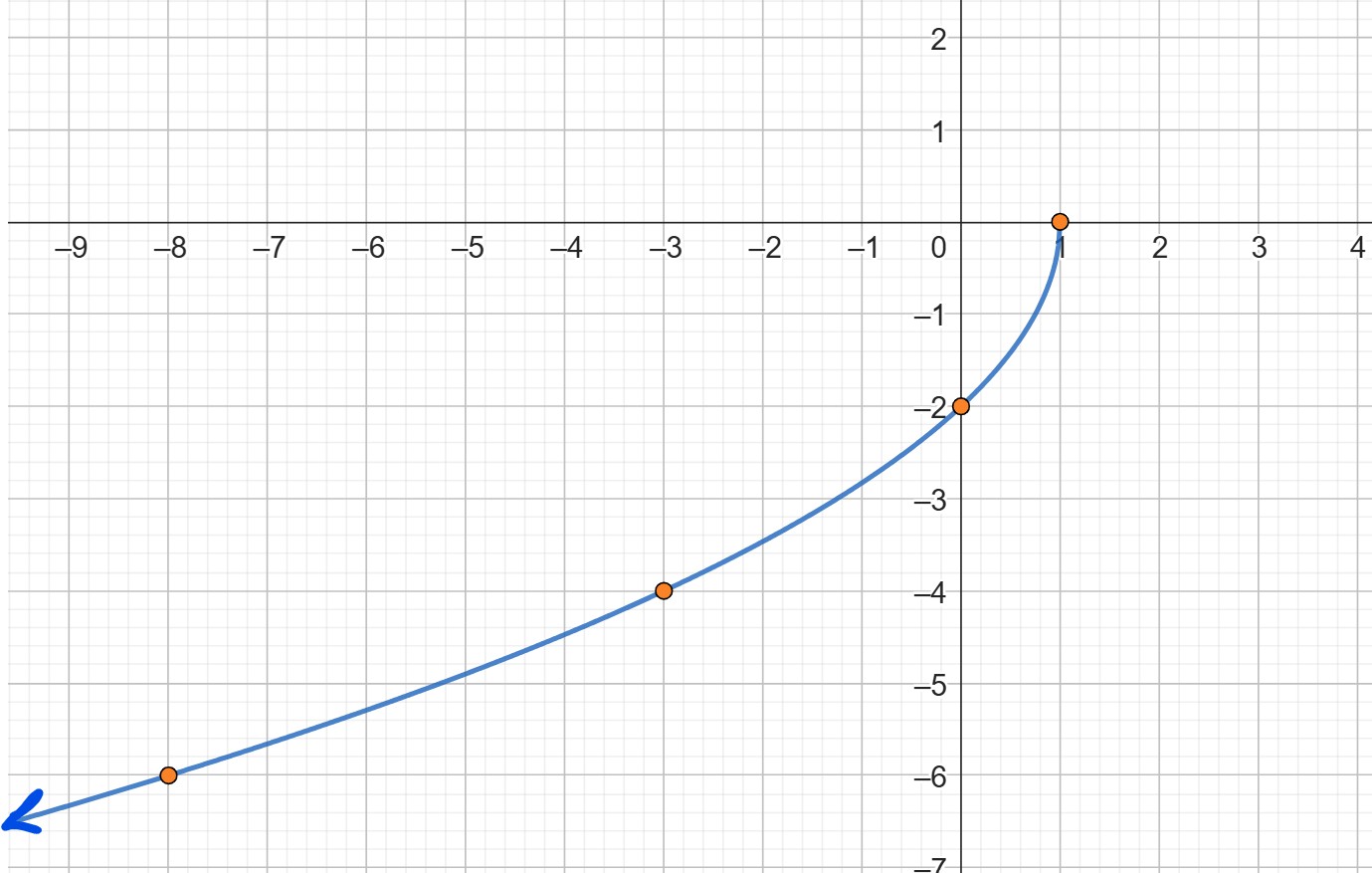
This function has the following features:
Domain: $(-\infty, 1]$
Range: $(-\infty, 0]$
Intercepts: $x$-intercept $(1,0)$, $y$-intercept $(0,−2)$
End behavior: As $x\to-\infty, f(x)\to-\infty$
Increasing on $(-\infty, 1]$
Notice that square root functions are the first functions we’re seeing where the domain is not $(−\infty,\infty)$. If we sketch the graph, we can identify the domain, but that’s not always the easiest way to proceed if all we need is the domain.
If we want to algebraically consider the domain, we must remember that the square root of a negative number is not a real number. That means, to find the domain of a square root function, we need to only include input values which make the inside of the square root 0 or positive.
Domain of Square Root functions
To find the domain of a square root function in the form
$$\sqrt{\text{stuff}}$$
Solve the inequality
$$\text{stuff}\geq 0$$
Find the domain of $f(x)=\sqrt{3 - 2x}$.
We want to ensure that we’re only trying to square root 0 or a positive number, so we want to find the solution to
$$3-2x\geq 0$$
This is a linear inequality, so we’ll isolate $x$. BUT we’ll reverse the inequality if we multiply or divide by a negative!
$$3-2x\geq 0$$
$$-2x\geq-3$$
$$x \leq \frac{3}{2}$$
Therefore, the domain of $f(x)$ is $\left( - \infty,\frac{3}{2} \right\rbrack$.
Find the domain of $f(x)=\sqrt{x^{2} - 4}$.
Again, we want to ensure that the inputs to the square root are 0 or positive, so
$$x^2-4\geq 0$$
This time, we have a polynomial (quadratic) inequality. Let’s find where $x^2-4=0$ and strategize from there.
$$x^2-4=0$$
$$x^2=4$$
$$x=\pm 2$$
So, we know we have a parabola with $x$-intercepts at 2 and -2. We also know the parabola opens up, since the $a$-value is positive 1.

We want to know when this function is greater than or equal to 0; that happens when the parabola is above the $x$-axis, so the solution to $x^2-4\geq 0$ is $(−\infty,−2]\cup [2,\infty)$.
Therefore, the domain of $f(x) = \sqrt{x^{2} - 4}$ is $(−\infty, −2]\cup [2,\infty)$.
Square Roots as Inverses of Quadratics
Find the inverse of $f(x)=(x−2)^2-3=x^2-4x + 1$
From the transformation form of the function, we can see this is a transformed quadratic with vertex at $(2,-3)$ that opens upwards. Since the graph will be decreasing on one side of the vertex, and increasing on the other side, we can restrict this function to a domain on which it will be one-to-one by limiting the domain to $x\geq 2$.
To find the inverse, we will use the vertex form of the quadratic. We start by replacing the $f(x)$ with a simple variable $y$, swap $x$ and $y$, and solve for $y$.
$$\begin{array}{rlc} y &=(x - 2)^{2} - 3 & \text{Replace}\ f(x)\text{with}\ y \\ x &=(y - 2)^{2} - 3 & \text{Swap}\ x^{'}\text{s and}\ y's \\ x+3 &=(y - 2)^{2} & \text{Add}\ 3\ \text{to both sides} \\ \pm \sqrt{x+3} &=y - 2 & \text{square root both sides} \\ 2 \pm \sqrt{x+3} &=y & \text{Add}\ 2\ \text{to both sides} \end{array}$$
As currently written, this is not a function. Since we restricted our original function to a domain of $x\geq 2$, the outputs of the inverse should be the same, telling us to utilize the positive case:
$$y=2+\sqrt{x+3}$$
Now, we finish by writing this as an inverse function, $$f^{- 1}(x)=2+\sqrt{x+3}$$
Compare the features of the functions $f(x)=(x−2)^2-3$ and its inverse $f^{-1}(x)=\sqrt{x+3}-2$.
Let’s start with the graphical transformations. The function $f(x)$ has a shift right 2 and down 3. The inverse $f^{−1}(x)$ has a shift down 2 and left 3. This makes some intuitive sense if we think about the fact that the function-inverse relationship means we have swapped all inputs and outputs; horizontal moves become vertical and vice versa.
Let’s look at domains and ranges next. The domain of $f(x)$ is $(−\infty,\infty)$, but we limited that to $[2, \infty)$ to make it a one-to-one function. The range is $[-3, \infty)$. The domain of $f^{−1}(x)$ is $[-3, \infty)$ and its range is $[2, \infty)$. Again, we see the swapping of the input/output relationship, since the domains and ranges have swapped!
Finding an inverse of a quadratic function
To find the inverse of a quadratic, $f(x)$:
-
Limit the domain to a one-to-one portion, which still contains the full range.
-
Replace $f(x)$ with a $y$.
-
Swap all $x$’s for $y′s$ and all $y′s$ for $x$’s.
-
Isolate $y$
-
Rename the final function as $f^−1(x)$
The inverse of a quadratic will be a square root function.
While it is not possible to find an inverse of most polynomial functions, some other basic polynomials are invertible.
Find the inverse of the function $f(x)=5x^3 + 1$.
This is a transformation of the basic cubic toolkit function, and based on our knowledge of that function, we know it is one-to-one. Solving for the inverse by swapping the $x$’s and $y$’s, then solving for $y$.
$$y=5x^3 + 1$$
$$x=5y^{3}+1$$ $$x-1=5y^{3}$$ $$\frac{x-1}{5}=y^{3}$$ $$y=f^{- 1}(x)=\sqrt[3]{\frac{x-1}{5}}$$
Notice that this inverse is also a transformation of a power function with a fractional power, $x^{1/3}$.
Besides being important as an inverse function, radical functions are common in important physical models.
The velocity, $v$ in feet per second, of a car that slammed on its brakes can be determined based on the length of skid marks that the tires left on the ground. This relationship is given by
$$v(d)=\sqrt{2gfd}$$
In this formula, $g$ represents acceleration due to gravity (32 ft/sec2), $d$ is the length of the skid marks in feet, and $f$ is a constant representing the friction of the surface. A car lost control on wet asphalt, with a friction coefficient of 0.5, leaving 200 foot skid marks. How fast was the car travelling when it lost control?
Using the given values of $f=0.5$ and $d=200$, we can evaluate the given formula:
$$v(200)=\sqrt{2(32)(0.5)(200)}=80\text{ ft/sec},$$ which is about 54.5 miles per hour.
Solving Radical Equations
To solve radical equations, we’ll follow an approach similar to absolute value equations. That is, we’ll isolate the square root first, then undo it, then proceed with solving.
Find the $x$-intercepts of the function $f(x)=\sqrt{-2x-14}-6$.
To answer this question, we could graph the function, or we could solve $$\sqrt{-2x-15}-6=0$$. This is a radical equation, so we’ll isolate the radical, then square both sides of the equation to undo the root.
$$\begin{array}{rlc} \sqrt{-2x-14}-6 &=0 & \\ \sqrt{-2x-14} &=6 & \text{Add }6\ \text{to both sides} \\ \left( \sqrt{-2x-14} \right)^{2} &=6^{2} & \text{Square both sides} \\ -2x-14 &=36 & \end{array}$$
Now that the root is gone, we reassess. This is now a linear equation, so our only remaining job is to isolate $x$.
$$-2x-14=36$$
$$-2x=50$$
$$x=-25$$
So, the function $f(x)=\sqrt{-2x-14} - 6$ has an $x$-intercept at $(−25,0)$.
Find the intersection of $f(x)=\sqrt{15 - 2x}$ and $g(x)=x$.
Here we have a root function that’s been shifted left 15, horizontally shrunk by a factor of 2, and horizontally reflected. We want to see where that function will intersect with a straight line, $x$. The situation looks something like this:

To find where these functions intersect, we must solve $\sqrt{15-2x}=x$. Let’s ask our solving questions.
What type of equation is this? A radical (root) equation.
What are our solving strategies? We must isolate the root, square both sides to undo the square root, then reassess the situation.
The root is already alone on the left hand side, so let’s proceed with squaring.
$$\left( \sqrt{15-2x} \right)^{2} = x^{2}$$
$$15-2x=x^2$$
Now, we ask our questions again!
What type of equation is this? Quadratic
How can we solve? This equation is a good candidate for either factoring or the quadratic formula. Either way, we should move all the terms to one side so we have an =0.
$$0=x^2 + 2x-15$$
$$0=(x−3)(x+5)$$
$$\begin{array}{c} x-3=0 \\ x=3 \end{array}\ \ \ \text{or}\ \ \ \ \begin{array}{c} x+5=0 \\ x=-5 \end{array}$$
Now, wait a second. Our original sketch only had one intersection, but we’re finding two answers. What happened?
Well, when we squared both sides of the equation, we changed the picture. Now we have $15-2x$, a straight line, and $x^2$, a quadratic. The picture looks like this:
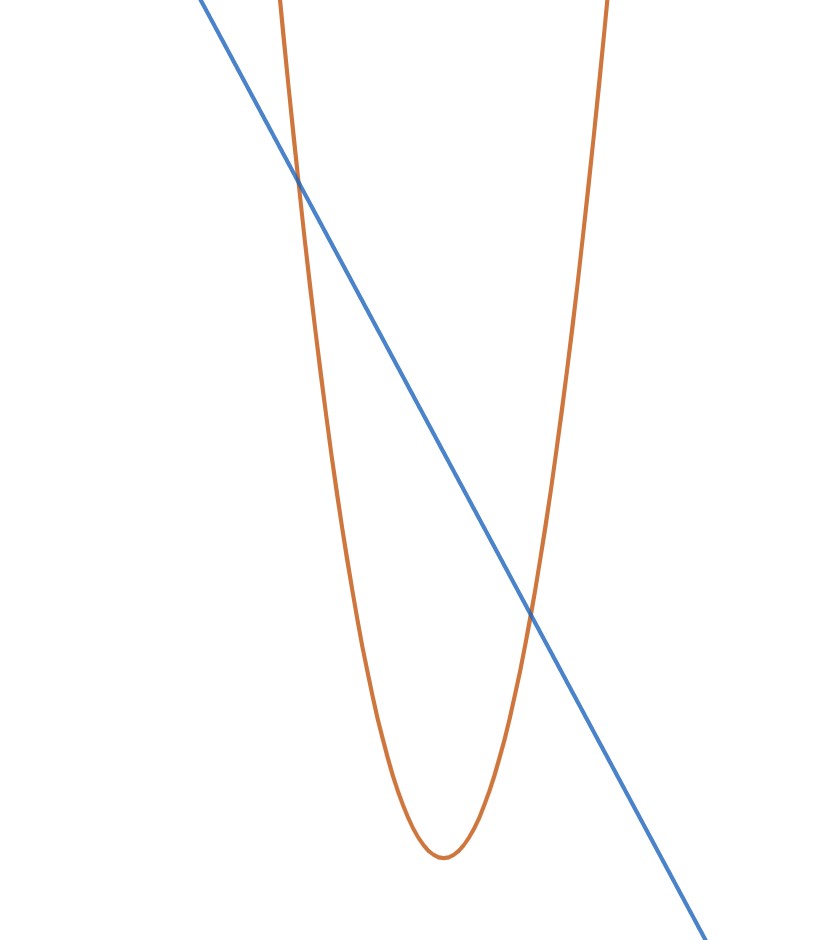
So, in our solving process, we accidentally invented a whole second solution that we shouldn’t have! To figure out which of our solutions is the extra one, we’ll check our answers in the original equation.
Check $x=3$ as a solution for $$\sqrt{15-2x}=x:$$
$$\begin{array}{rl} \sqrt{15-2 \cdot 3} & ?=3 \\ \sqrt{15-6} & ?=3 \\ \sqrt{9} &=3 \end{array}$$
This solution checks out!
Now, check $x=-5$:
$$\begin{array}{rl} \sqrt{15-2 \cdot-5} & ?=\ -5 \\ \sqrt{15+10} & ?=\ -5 \\ \sqrt{25} & ?=\ -5 \\ 5 & \neq-5 \end{array}$$
We ended with a false statement, so $x=-5$ is not a solution to the original equation! We call this an extraneous solution.
The final solution, and $x$-value for the intersection of our functions, is $x=3$.
The full point of intersection is $(3,3).$
We learned a couple of important things in those last two examples. Let’s summarize before we solve more.
Solving Square Root Equations
To solve an equation where the variable is under the square root:
-
Isolate the root if possible
-
Square both sides to undo the root
-
Solve the resulting equation.
When solving a square root equation, we must always check for extraneous solutions!
Solve $\sqrt{x+3}=3x-1$
What type of equation is it? Radical (square root)
How can we solve? Isolate the root, square both sides to undo the root
$$\begin{array}{rl} \sqrt{x+3} &=3x-1 \\ \left( \sqrt{x+3} \right)^{2} &=(3x-1)^{2} \\ x+3 &=(3x-1)^{2} \end{array}$$
Before we proceed, it’s a good idea to simplify the right hand side. Keep in mind, that square tells us to multiply the full $3x-1$ by itself!
$$\begin{array}{rl} x+3 &=(3x-1)(3x-1) \\ x+3 &=9x^{2}-6x+1 \end{array}$$
Now, we reassess the situation!
What type of equation is this now? Quadratic.
How can we solve? Get =0, then use factoring or the quadratic formula
$$0=9x^2-7x-2$$
$$0=9x^2-9x + 2x-2$$
$$0=9x(x−1) + 2(x−1)$$
$$0=(x−1)(9x+2)$$
$$\begin{array}{c} x-1=0 \\ x=1 \end{array}\ \ \text{or}\ \ \ \begin{array}{c} 9x+2=0 \\ 9x=-2 \\ x=-\frac{2}{9} \end{array}$$
Don’t forget to check for extraneous solutions!
Check $x=1$ in $\sqrt{x+3}=3x-1.$
$$\begin{array}{rl} \sqrt{1+3} & ?=3 \cdot 1-1 \\ \sqrt{4} & ?=3-1 \\ 2 &=2 \end{array}$$
Check $x=-\frac{2}{9}$
$$\begin{array}{rl} \sqrt{-\frac{2}{9}+3} & ?=3 \cdot-\frac{2}{9}-1 \\ \sqrt{-\frac{2}{9}+\frac{27}{9}} & ?=-\frac{2}{3} - \frac{3}{3} \\ \sqrt{\frac{25}{9}} & ?=-\frac{5}{3} \\ \frac{5}{3} & \neq-\frac{5}{3} \end{array}$$
The only solution to the equation is $x=1$.
Important Topics of this Section
Imposing a coordinate system
Finding an inverse function
Restricting the domain
Invertible toolkit functions
Radical Functions
Finding Intercepts of Radical Functions
Solving Radical Equations
Section 2.9 Exercises
Conceptual Questions
- Why must we limit the domain of a quadratic function in order to find its inverse?
- How does our toolkit function for the square root differ from our other toolkit functions so far?
- Why do we sometimes find extraneous solutions when solving square root equations?
- What is the general strategy for solving radical equations?
- True or false: a square root function can never have a maximum.
- True or false: a square root function must always have exactly one x-intercept
- True or false: a square root function must always have exactly one y-intercept.
Practice Problems
Graph each function using transformation techniques. Then describe the domain, range, intercepts, end behavior, and intervals of increasing/decreasing.
$g(x)=4\sqrt{x}$
$h(x)=\sqrt{4x}$
$j(x)=\sqrt{x+4}$
$k(x)=\sqrt{x}-4$
$f(x)=-\sqrt{x-2}$
$g(x)=2\sqrt{-x}$
$h(x)=-\sqrt{2x+1} - 3$
$j(x)=2\sqrt{-x+1} + 3$
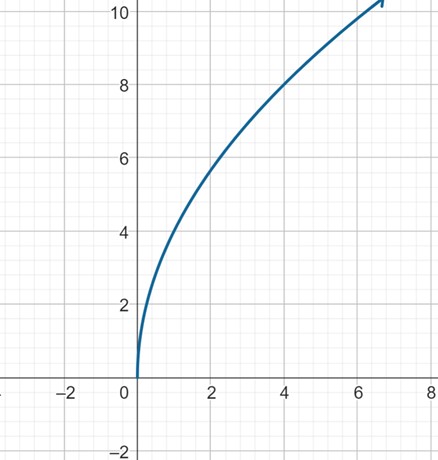
Domain: $[0, \infty)$; Range: $[0, \infty)$; x- and y-intercept at (0,0); As $x \to \infty, g(x) \to \infty$; Increasing on $(0, \infty)$; concave down on $(0,\infty)$
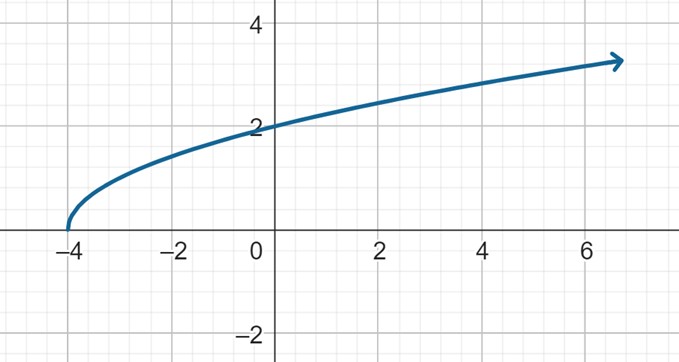
Domain: $[-4, \infty)$; Range: $[0, \infty)$; x-intercept -4; y-intercept 2; As $x \to \infty, j(x) \to \infty$; Increasing on $(−4, \infty)$; concave down on $(−4,\infty)$

Domain: $[4, \infty)$; Range: $(-\infty, 0]$; x-intercept 4, no y-intercept; As $x \to \infty, f(x) \to -\infty$; decreasing on $(4, \infty)$; concave up on $(4,\infty)$

Domain: $\lbrack - \frac{1}{2},\ \infty)$; Range: $(-\infty, -3]$; no x-intercept; y-intercept -4; As $x \to \infty, h(x) \to -\infty$; decreasing on $( - \frac{1}{2},\ \infty)$; concave up on $( - \frac{1}{2},\infty)$
For each function, find a domain on which the function is one-to-one and non-decreasing, then find an inverse of the function on this domain.
$f(x)=(x−4)^2$
$f(x)=(x+2)^2$
$f(x)=12-x^2$
$f(x)=9-x^2$
$f(x)=3x^3 + 1$
$f(x)=4-2x^3$
Restrict domain to $[4, \infty)$; $f^{- 1}(x) = \ - 4 + \sqrt{x}$
Restrict domain to $(-\infty, 0]$; $f^{- 1}(x) = - \sqrt{12 - x}$
Domain $(−\infty,\infty)$; $f^{- 1}(x) = \sqrt[3]{\frac{x - 1}{3}}$
Find the inverse of each function.
$f(x)=9+\sqrt{4x - 4}$
$f(x)=\sqrt{6x-8} + 5$
$f(x)=9 + 2\sqrt[3]{x}$
$f(x)=3 - \sqrt[3]{x}$
$f^{- 1}(x) = \frac{(x - 9)^{2}}{4} + 1$
$f^{- 1}(x) = \left( \frac{x - 9}{2} \right)^{3}$
Find the $x$-intercept(s) of each function.
$h(x)=\sqrt{\frac{x}{3}}-3$
$g(x)=-3+\sqrt{x+1}$
$k(x) =\frac{1}{2}\sqrt{\frac{x}{3}}$
$f(x)=\sqrt{-5x-9}-6$
$g(x)=\sqrt{9x+1}-8$
$k(x)=\sqrt{9-x}-3$
$x = 27$
$x = 0$
$x = 7$
Find the intersection of each pair of functions.
$f(x)=\sqrt{30-x}$ and $g(x) = x$
$f(x)=\sqrt{-1+2x}$ and $g(x) = x$
$f(x)=\sqrt{x}$ and $g(x)=x$
$f(x)=\sqrt{2x-2}$ and $g(x) = x-1$
$f(x)=\sqrt{2x+1}$ and $g(x) = x + 1$
$f(x)=\sqrt{11-2x}$ and $g(x)=x-4$
$x = 5$
$x = 0, 1$
$x = 0$
Police use the formula $v = \sqrt{20L}$ to estimate the speed of a car, v, in miles per hour, based on the length, L, in feet, of its skid marks when suddenly braking on a dry, asphalt road.
At the scene of an accident, a police officer measures a car's skid marks to be 215 feet long. Approximately how fast was the car traveling?
At the scene of an accident, a police officer measures a car's skid marks to be 135 feet long. Approximately how fast was the car traveling?
$v\approx 65.57 mph$.
The formula $v=\sqrt{2.7r}$ models the maximum safe speed, v, in miles per hour, at which a car can travel on a curved road with radius of curvature r, in feet.
A highway crew measures the radius of curvature at an exit ramp on a highway as 430 feet. What is the maximum safe speed?
A highway crew measures the radius of curvature at a tight corner on a highway as 900 feet. What is the maximum safe speed?
$v\approx 34.07 mph$
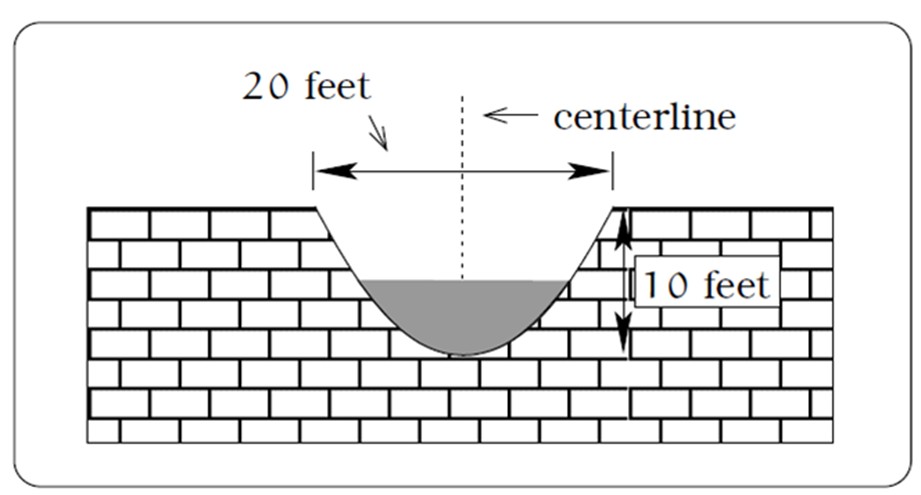
A drainage canal has a cross-section in the shape of a parabola. Suppose that the canal is 10 feet deep and 20 feet wide at the top. If the water depth in the ditch is 5 feet, how wide is the surface of the water in the ditch? [UW]
Brooke is located 5 miles out from the nearest point A along a straight shoreline in her sea kayak. Hunger strikes and she wants to make it to Kono’s for lunch; see picture. Brooke can paddle 2 mph and walk 4 mph. [UW]
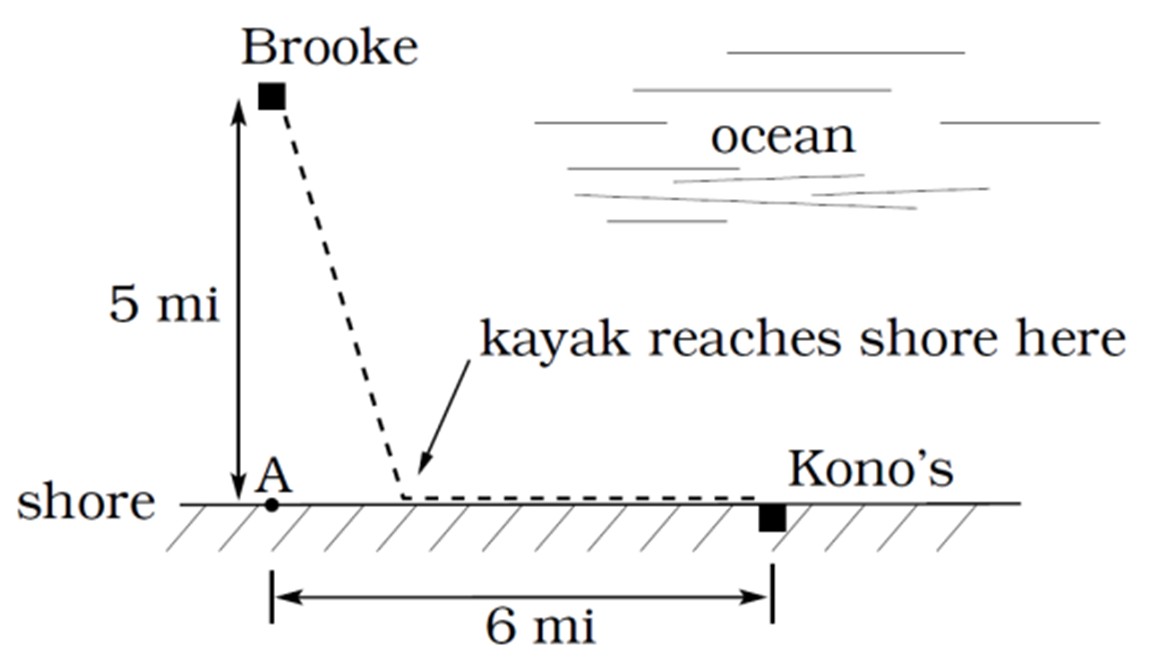
If she paddles along a straight line course to the shore, find an expression that computes the total time to reach lunch in terms of the location where Brooke beaches her kayak.
Determine the total time to reach Kono’s if she paddles directly to the point A.
Determine the total time to reach Kono’s if she paddles directly to Kono’s.
Do you think your answer to b or c is the minimum time required for Brooke to reach lunch?
Determine the total time to reach Kono’s if she paddles directly to a point on the shore half way between point A and Kono’s. How does this time compare to the times in parts b or c? Do you need to modify your answer to part d?
Clovis is standing at the edge of a dropoff, which slopes 4 feet downward from him for every 1 horizontal foot. He launches a small model rocket from where he is standing. With the origin of the coordinate system located where he is standing, and the x-axis extending horizontally, the path of the rocket is described by the formula $y=-2x^2 + 120x$. [UW]
Give a function $h=f(x)$ relating the height h of the rocket above the sloping ground to its x-coordinate.
Find the maximum height of the rocket above the sloping ground. What is its x-coordinate when it is at its maximum height?
Clovis measures the height h of the rocket above the sloping ground while it is going up. Give a function $x=g(h)$ relating the x-coordinate of the rocket to h.
Does the function from (c) still work when the rocket is going down? Explain.
-
A trough has a semicircular cross section with a radius of 5 feet. Water starts flowing into the trough in such a way that the depth of the water is increasing at a rate of 2 inches per hour. [UW]

Give a function $w=f(t)$ relating the width w of the surface of the water to the time t, in hours. Make sure to specify the domain and compute the range too.
After how many hours will the surface of the water have width of 6 feet?
Give a function $t=f^−1(w)$ relating the time to the width of the surface of the water. Make sure to specify the domain and compute the range too.
14.14 feet
(a) $h = -2x^{2}+124x$ and $y = -4x$ (b) 1922 ft; (c) $\frac{62 - \sqrt{3,844 - 2h}}{2}\ $; (d) The function given in (c) does not work when the function is going down. We would have had to choose the positive root in the numerator to give the right half of the parabola.