Section 2.10 Factor Theorem and Remainder Theorem and Zeros
In the last section, we limited ourselves to finding the intercepts, or zeros, of polynomials that factored simply, or we turned to technology. In this section, we will look at algebraic techniques for finding the zeros of polynomials like $h(t)=t^{3}+4t^{2}+t-6$.
Long Division
In the last section we saw that we could write a polynomial as a product of factors, each corresponding to a horizontal intercept. If we knew that x = 2 was an intercept of the polynomial $x^{3}+4x^{2}-5x-14$, we might guess that the polynomial could be factored as $x^{3}+4x^{2}-5x-14=(x−2)(\text{something})$. To find that "something," we can use polynomial division.
Divide $x^{3}+4x^{2}-5x-14$ by $x-2$
Start by writing the problem out in long division form
$$x-2 ~~)\overline{x^{3}+4x^{2}-5x-14}$$
Now we divide the leading terms: $x^{3}\div x=x^{2}$. It is best to align it above the same-powered term in the dividend. Now, multiply that $x^{2}$ by $x-2$ and write the result below the dividend.
$$ \begin{array}{r} \begin{array}{c} &\\ x - 2 \\ &\\ \end{array} \begin{array}{cccc} & x^2 & &\\ \hline ) x^3 &+4x^2 & -5x & -14\\ x^3 & -2x^2 &&\\ \end{array} \end{array} $$
Now subtract that expression from the dividend.
$$ \begin{array}{r} \begin{array}{c} &\\ x - 2 \\ &\\ &\\ \end{array} \begin{array}{cccc} & x^2 & &\\ \hline ) x^3 &+4x^2 & -5x & -14\\ -(x^3 & -2x^2) &&\\ \hline 0 & 6x^2 & -5x & - 14\\ \end{array} \end{array} $$
Again, divide the leading term of the remainder by the leading term of the divisor. $6x^{2}\div x=6x$. We add this to the result, multiply $6x$ by $x-2$, and subtract.
$$ \begin{array}{r} \begin{array}{c} &\\ x - 2 \\ &\\ &\\ &\\ &\\ \end{array} \begin{array}{cccc} & x^2 & +6x & \\ \hline ) x^3 &+4x^2 & -5x & -14\\ -(x^3 & -2x^2) &&\\ \hline 0 & 6x^2 & -5x & - 14\\ &-(6x^2 & -12x) & \\ \hline & & 7x & -14\\ \end{array} \end{array} $$
Repeat the process one last time.
$$ \begin{array}{r} \begin{array}{c} &\\ x - 2 \\ &\\ &\\ &\\ &\\ &\\ \end{array} \begin{array}{cccc} & x^2 &+6x &+7\\ \hline ) x^3 &+4x^2 & -5x & -14\\ -(x^3 & -2x^2) &&\\ \hline 0 & 6x^2 & -5x & - 14\\ &-(6x^2 & -12x) & \\ \hline & & 7x & -14\\ && -(7x & -14)\\ \hline &&&0\\ \end{array} \end{array} $$This tells us $x^{3}+4x^{2}-5x-14$ divided by $x-2$ is $x^{2}+6x+7$, with a remainder of zero. This also means that we can factor $x^{3}+4x^{2}-5x-14$ as $(x−2)(x^{2}+6x+7)$.
This factored form gives us a way to find the horizontal intercepts of this polynomial.
Find the horizontal intercepts of $h(x)=x^{3}+4x^{2}-5x-14$.
To find the horizontal intercepts, we need to solve $h(x) = 0$. From the previous example, we know the function can be factored as $h(x)=(x−2)(x^{2}+6x+7)$.
$h(x)=(x−2)(x^{2}+6x+7)=0$ when $x = 2$ or when $x^{2}+6x+7=0$. This second equation doesn't factor nicely, but we could use the quadratic formula to find the remaining two zeros.
$$x = \frac{-6 \pm \sqrt{6^{2} - 4(1)(7)}}{2(1)} =-3 \pm \sqrt{2}.$$
The horizontal intercepts will be at $(2,0)$, $$\left(-3 -\sqrt{2},0 \right),$$ and $$\left(-3 + \sqrt{2},0 \right).$$
Divide $2x^{3}-7x+3$ by $x+3$ using long division.
The Factor and Remainder Theorems
When we divide a polynomial, $p(x)$ by some divisor polynomial $d(x)$, we will get a quotient polynomial $q(x)$ and possibly a remainder $r(x)$. In other words, $p(x)=d(x)q(x)+r(x).$
Because of the division, the remainder will either be zero, or a polynomial of lower degree than $d(x)$. Because of this, if we divide a polynomial by a term of the form $x-c$, then the remainder will be zero or a constant.
If $p(x)=(x−c)q(x)+r$, then $p(c)=(c−c)q(c)+r=0+r=r$, which establishes the Remainder Theorem.
The Remainder Theorem
If $p(x)$ is a polynomial of degree 1 or greater and c is a real number, then when $p(x)$ is divided by $x-c$, the remainder is $p(c)$.
If $x-c$ is a factor of the polynomial $p$, then $p(x)=(x−c)q(x)$ for some polynomial q. Then $p(c)=(c−c)q(c)=0$, showing $c$ is a zero of the polynomial. This shouldn't surprise us — we already knew that if the polynomial factors it reveals the roots.
If $p(c)=0$, then the remainder theorem tells us that if $p$ is divided by $x-c$, then the remainder will be zero, which means $x-c$ is a factor of $p$.
The Factor Theorem
If $p(x)$ is a nonzero polynomial, then the real number c is a zero of $p(x)$ if and only if $x-c$ is a factor of $p(x)$.
Synthetic Division
Since dividing by $x-c$ is a way to check if a number is a zero of the polynomial, it would be nice to have a faster way to divide by $x-c$ than having to use long division every time. Happily, quicker ways have been discovered.
Let's look back at the long division we did in Example 1 and try to streamline it. First, let's change all the subtractions into additions by distributing through the negatives.
$$ \begin{array}{r} \begin{array}{c} &\\ x - 2 \\ &\\ &\\ &\\ &\\ &\\ &\\ \end{array} \begin{array}{cccc} & x^2 &+6x &+7\\ \hline ) x^3 &+4x^2 & -5x & -14\\ -x^3 & +2x^2 &&\\ \hline 0 & 6x^2 & -5x & - 14\\ &-6x^2 & +12x & \\ \hline & & +7x & -14\\ && -7x & +14\\ \hline &&&0\\ \end{array} \end{array} $$
Next, observe that the terms $-x^{3}$, $-6x^{2}$, and $-7x$ are the exact opposite of the terms above them. The algorithm we use ensures this is always the case, so we can omit them without losing any information. Also note that the terms we ‘bring down’ (namely the $-5x$ and −14) aren’t really necessary to recopy, so we omit them, too.
$$ \begin{array}{r} \begin{array}{c} &\\ x - 2 \\ &\\ &\\ &\\ &\\ &\\ &\\ \end{array} \begin{array}{cccc} & x^2 &+6x &+7\\ \hline ) x^3 &+4x^2 & -5x & -14\\ & +2x^2 &&\\ \hline & 6x^2 & & \\ & & +12x & \\ \hline & & +7x & \\ &&& +14\\ \hline &&&0\\ \end{array} \end{array} $$$
Now, let’s move things up a bit and, for reasons which will become clear in a moment, copy the $x^3$ into the last row.
$$ \begin{array}{r} \begin{array}{c} &\\ x - 2 \\ &\\ &\\ \end{array} \begin{array}{cccc} & x^2 & +6x& +7\\ \hline )x^3 & 4x^2 & -5x & -14\\ & 2x^2 & 12x & 14\\ \hline x^3 & 6x^2 & 7x & 0\\ \end{array} \end{array} $$
Note that by arranging things in this manner, each term in the last row is obtained by adding the two terms above it. Notice also that the quotient polynomial can be obtained by dividing each of the first three terms in the last row by x and adding the results. If you take the time to work back through the original division problem, you will find that this is exactly the way we determined the quotient polynomial.
This means that we no longer need to write the quotient polynomial down, nor the x in the divisor, to determine our answer.
$$ \begin{array}{r} \begin{array}{c} x - 2 \\ &\\ &\\ \end{array} \begin{array}{cccc} \hline )x^3 & 4x^2 & -5x & -14\\ & 2x^2 & 12x & 14\\ \hline x^3 & 6x^2 & 7x & 0\\ \end{array} \end{array} $$
We’ve streamlined things quite a bit so far, but we can still do more. Let’s take a moment to remind ourselves where the $2x^{2}$, $12x$ and $14$ came from in the second row. Each of these terms was obtained by multiplying the terms in the quotient, $x^{2}$, $6x$ and $7$, respectively, by the $−2$ in $x−2$, then by $−1$ when we changed the subtraction to addition. Multiplying by $−2$ then by $−1$ is the same as multiplying by $2$, so we replace the $−2$ in the divisor by $2$. Furthermore, the coefficients of the quotient polynomial match the coefficients of the first three terms in the last row, so we now take the plunge and write only the coefficients of the terms to get
$$\begin{array}{r} 2|\\ &\\ &\\ \end{array} \begin{array}{cccc} 1 & 4 &-5 &-14\ \\ & 2 & 12 & 14 \\ \hline 1 & 6 & 7 & 0 \end{array}$$
We have constructed a synthetic division tableau for this polynomial division problem. Let’s re-work our division problem using this tableau to see how it greatly streamlines the division process. To divide $x^{3}+4x^{2}-5x-14$ by $x-2$, we write 2 in the place of the divisor and the coefficients of $x^{3}+4x^{2}-5x-14 $in for the dividend. Then "bring down" the first coefficient of the dividend.
Next, take the 2 from the divisor and multiply by the 1 that was "brought down" to get 2. Write this underneath the 4, then add to get 6.
Now take the 2 from the divisor times the 6 to get 12, and add it to the −5 to get 7.
Finally, take the 2 in the divisor times the 7 to get 14, and add it to the −14 to get 0.
The first three numbers in the last row of our tableau are the coefficients of the quotient polynomial. Remember, we started with a third degree polynomial and divided by a first degree polynomial, so the quotient is a second degree polynomial. Hence the quotient is $x^{2}+6x+7$. The number in the box is the remainder. Synthetic division is our tool of choice for dividing polynomials by divisors of the form $x − c$. It is important to note that it works only for these kinds of divisors. Also take note that when a polynomial (of degree at least 1) is divided by $x − c$, the result will be a polynomial of exactly one less degree. Finally, it is worth the time to trace each step in synthetic division back to its corresponding step in long division.
Use synthetic division to divide $5x^{3}-2x^{2}+1$ by $x-3$.
When setting up the synthetic division tableau, we need to enter 0 for the coefficient of x in the dividend. Doing so gives
$$ \begin{array}{c} 3|\\ &\\ &\\ \end{array} \begin{array}{cccc} 5 &-2 & 0 & 1 \\ \downarrow & 15 & 39 & 117 \\ \hline 5 & 13 & 39 & \boxed{118} \end{array}$$
Since the dividend was a third degree polynomial, the quotient is a quadratic polynomial with coefficients 5, 13 and 39. Our quotient is $q(x)=5x^{2}+13x+39$ and the remainder is $r(x) = 118$. This means
$5x^{3}-2x^{2}+1=(x−3)(5x^{2}+13x+39)+118$.
It also means that $x-3$ is not a factor of $5x^{3}-2x^{2}+1$.
Divide $x^{3}+8$ by $x+2$
For this division, we rewrite $x+2$ as $x-(−2)$ and proceed as before.
$$\begin{array}{c} -2 |\\ &\\ &\\ \end{array} \begin{array}{cccc} 1 & 0 & 0 & 8 \\ \downarrow &-2 & 4 &-8 \\ \hline 1 &-2 & 4 & \boxed{0} \end{array}$$
The quotient is $x^{2}-2x+4$ and the remainder is zero. Since the remainder is zero, $x+2$ is a factor of $x^{3}+8$.
$x^{3}+8=(x+2)(x^{2}−2x+4)$
Divide $4x^{4}-8x^{2}-5x$ by $x-3$ using synthetic division.
Using this process allows us to find the real zeros of polynomials, presuming we can figure out at least one root. We'll explore how to do that in the next section.
The polynomial $p(x)=4x^{4}-4x^{3}-11x^{2}+12x-3$ has a horizontal intercept at $x = \frac{1}{2}$ with multiplicity 2. Find the other intercepts of $p(x)$.
Since $x = \frac{1}{2}$ is an intercept with multiplicity 2, then $x - \frac{1}{2}$ is a factor twice. Use synthetic division to divide by $x-\frac{1}{2}$ twice.
$$\begin{array}{c} 1/2 | \\ &\\ &\\ \end{array} \begin{array}{ccccc} 4 &-4 &-11 & 12 &-3 \\ \downarrow & 2 &-1 &-6 & 3 \\ \hline 4 &-2 &-12 & 6 & \boxed{0} \end{array}$$
$$\begin{array}{c} 1/2 |\\ &\\ &\\ \end{array} \begin{array} 4 &-2 &-12 & 6 \\ \downarrow & 2 & 0 &-6 \\ \hline 4 & 0 &-12 & \boxed{0} \end{array}$$
From the first division, we get $$4x^{4} - 4x^{3}-11x^{2}+12x-3 = \left( x-\frac{1}{2} \right)\left( 4x^{3} -2x^{2}-12x-6 \right)$$
The second division tells us
$$4x^{4}-4x^{3}-11x^{2}+12x-3 = \left( x-\frac{1}{2} \right)\left( x-\frac{1}{2} \right)\left( 4x^{2}-12 \right).$$
To find the remaining intercepts, we set $4x^{2}-12=0$ and get $$x = \pm \sqrt{3}.$$
Note this also means $$4x^{4}-4x^{3} - 11x^{2}+12x-3 $$ $$= 4\left( x-\frac{1}{2} \right)\left( x - \frac{1}{2} \right)\left( x-\sqrt{3} \right)\left( x+\sqrt{3} \right).$$
Finding Possible Real Zeros
So far in this section, we have seen how to determine if a real number was a zero of a polynomial. Now we will learn how to find good candidates to test using synthetic division. In the days before graphing technology was commonplace, mathematicians discovered a lot of clever tricks for determining the likely locations of zeros. Technology has provided a much simpler approach to narrow down potential candidates, but it is not always sufficient by itself. For example, the function shown to the right does not have any clear intercepts.

There are two results that can help us identify where the zeros of a polynomial are. The first gives us an interval on which all the real zeros of a polynomial can be found.
Cauchy's Bound
Given a polynomial $f(x)=a_{n}x^{n}+a_{n-1}x^{n-1}+⋯+a_{1}x+a_{0}$, let M be the largest of the coefficients in absolute value. Then all the real zeros of $f(x)$ lie in the interval
$$\left\lbrack-\frac{M}{\left| a_{n} \right|}-1,\quad\frac{M}{\left| a_{n} \right|}+1 \right\rbrack$$
Let $f(x)=2x^{4}+4x^{3}-x^{2}-6x-3$. Determine an interval which contains all the real zeros of f.
To find the M from Cauchy's Bound, we take the absolute value of the coefficients and pick the largest, in this case $|−6|=6$. Divide this by the absolute value of the leading coefficient, 2, to get 3. All the real zeros of f lie in the interval
$$\left\lbrack-\frac{6}{|2|} - 1,\quad\frac{6}{|2|}+1 \right\rbrack = \lbrack-3-1,\quad 3 + 1\rbrack = \lbrack-4,\mspace{6mu} 4\rbrack.$$
Knowing this bound can be very helpful when using a graphing calculator, since we can use it to set the display bounds. This helps avoid missing a zero because it is graphed outside of the viewing window.
Determine an interval which contains all the real zeros of $f(x)=3x^{3}-12x^{2}+6x-8$
Now that we know where we can find the real zeros, we still need a list of possible real zeros. The Rational Roots Theorem provides us a list of potential integer and rational zeros.
Rational Roots Theorem
Given a polynomial $f(x)=a_{n}x^{n}+a_{n-1}x^{n-1}+⋯+a_{1}x+a_{0}$ with integer coefficients, if r is a rational zero of f, then r is of the form $$r = \pm \frac{p}{q},$$ where p is a factor of the constant term $a_{0}$, and q is a factor of the leading coefficient, $a_{n}$.
This gives us a list of numbers to try in our synthetic division, which is a nicer place to start than simply guessing. If none of the numbers in the list are zeros, then either the polynomial has no real zeros at all, or all the real zeros are irrational numbers.
Let $f(x)=2x^{4}+4x^{3}-x^{2}-6x-3$. Use the Rational Roots Theorem to list all the possible rational zeros of $f(x).$
To generate a complete list of rational zeros, we need to take each of the factors of the
constant term, $a_{0}=-3$, and divide them by each of the factors of the leading coefficient $a_{4}=2$. The factors of −3 are $\pm 1$ and $\pm 3$. Since the Rational Roots Theorem tacks on a $\pm$ anyway, for the moment, we consider only the positive factors 1 and 3. The factors of 2 are 1 and 2, so the Rational Roots Theorem gives the list
$$\left\{ \pm \frac{1}{1}, \pm \frac{1}{2}, \pm \frac{3}{1}, \pm \frac{3}{2} \right\},$$ or $$\left\{ \pm 1, \pm \frac{1}{2}, \pm 3, \pm \frac{3}{2} \right\}$$
Now we can use synthetic division to test these possible zeros. To narrow the list first, we could use graphing technology to help us identify some good possibilities.
Find the horizontal intercepts of $f(x)=2x^{4}+4x^{3}-x^{2}-6x-3$.
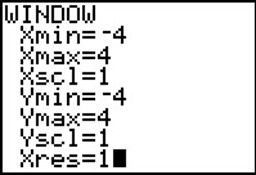
From Example 1, we know that the real zeros lie in the interval [-4,4]. Using a graphing calculator, we could set the window accordingly and get the graph below.

In the previous example, we learned that any rational zero must be on the list $$\left\{ \pm 1, \pm \frac{1}{2}, \pm 3, \pm \frac{3}{2} \right\}.$$ From the graph, it looks like −1 is a good possibility, so we try that using synthetic division.
$$\begin{array}{c} -1 |\\ &\\ &\\ \end{array} \begin{array}{ccccc} 2 & 4 &-1 &-6 &-3 \\ \downarrow &-2 &-2 & 3 & 3 \\ \hline 2 & 2 &-3 &-3 & \boxed{0} \end{array}$$
Success! Remembering that $f$ was a fourth degree polynomial, we know that our
quotient is a third degree polynomial. If we can do one more successful division, we will have knocked the quotient down to a quadratic, and, if all else fails, we can use the quadratic formula to find the last two zeros. Since there seems to be no other rational zeros to try, we continue with −1. Also, the shape of the crossing at $x = -1$ leads us to wonder if the zero $x=-1$ has multiplicity 3.
$$\begin{array}{c} -1 |\\ &\\ &\\ \end{array} \begin{array}{cccc} 2 & 2 &-3 &-3 \\ \downarrow &-2 & 0 & 3 \\ \hline 2 & 0 &-3 & \boxed{0} \end{array}$$
Success again! Our quotient polynomial is now $2x^{2}-3$. Setting this to zero gives $2x^{2}-3=0$, giving $$x = \pm \sqrt{\frac{3}{2}} = \pm \frac{\sqrt{6}}{2}.$$ Since a fourth degree polynomial can have at most four zeros, including multiplicities, then the intercept $x = -1$ must only have multiplicity 2, which we had found through division, and not 3 as we had guessed.
It is interesting to note that we could greatly improve on the graph of $y=f(x)$ in the previous example given to us by the calculator. For instance, from our determination of the zeros of f and their multiplicities, we know the graph crosses at $x =-\frac{\sqrt{6}}{2} \approx \ -1.22$ then turns back upwards to touch the x−axis at $x = -1$. This tells us that, despite what the calculator showed us the first time, there is a relative maximum occurring at $x=-1$ and not a "flattened crossing" as we originally believed.
After resizing the window, we see not only the relative maximum but also a relative minimum just to the left of $x=-1$.

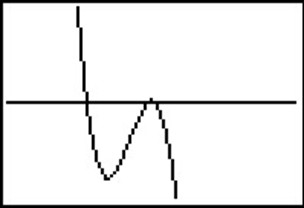
In this case, mathematics helped reveal something that was hidden in the initial graph.
Find the real zeros of $f(x)=4x^{3}-10x^{2}-2x+2$.
Cauchy's Bound tells us that the real zeros lie in the interval $\left\lbrack-\frac{10}{|4|} - 1,\quad\frac{10}{|4|}+1 \right\rbrack = \lbrack-3.5,\mspace{6mu} 3.5\rbrack.$
Graphing on this interval reveals no clear integer zeros. Turning to the rational roots theorem, we need to take each of the factors of the constant term, $a_{0}=2$, and divide them by each of the factors of the leading coefficient $a_{3}=4$. The factors of 2 are 1 and 2. The factors of 4 are 1, 2, and 4, so the Rational Roots Theorem gives the list
$\left\{ \pm \frac{1}{1}, \pm \frac{1}{2}, \pm \frac{1}{4}, \pm \frac{2}{1}, \pm \frac{2}{2}, \pm \frac{2}{4} \right\},$ or $\left\{ \pm 1, \pm \frac{1}{2}, \pm \frac{1}{4}, \pm 2 \right\}.$
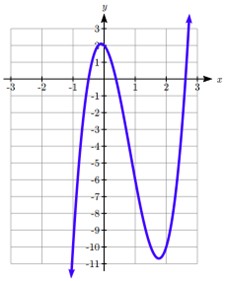
The two most likely candidates are $\pm \frac{1}{2}.$
Trying $\frac{1}{2},$
$$\begin{array}{c} 1/2 |\\ &\\ &\\ \end{array} \begin{array}{cccc} 4 &-10 &-2 & 2 \\ \downarrow & 2 &-4 &-3 \\ \hline &4 &-8 &-6 &-1 \end{array}$$
The remainder is not zero, so this is not a zero. Trying $-\frac{1}{2},$
$$\begin{array}{c} -1/2\\ &\\ &\\ \end{array} \begin{array}{cccc} 4 &-10 &-2 & 2 \\ \downarrow &-2 & 6 &-2 \\ \hline 4 &-12 & 4 & 0 \end{array}$$
Success! This tells us $4x^{3}-10x^{2} - 2x+2 = \left( x+\frac{1}{2} \right)\left( 4x^{2}-12x+4 \right),$ and that the graph has a horizontal intercept at $x =-\frac{1}{2}.$
To find the remaining two intercepts, we can use the quadratic equation, setting $4x^{2}-12x+4=0$. First, we might pull out the common factor, $4(x^{2}−3x+1)=0$.
$$x = \frac{3 \pm \sqrt{(-3)^{2} - 4(1)(1)}}{2(1)} = \frac{3 \pm \sqrt{5}}{2} \approx 2.618,\mspace{6mu}\mspace{6mu} 0.382$$
Find the real zeros of $f(x)=3x^{3}-x^{2}-6x+2$
Important Topics of this Section
Long division of polynomials
Remainder Theorem
Factor Theorem
Synthetic division of polynomials
Cauchy’s Bound for all real zeros of a polynomial
Rational Roots Theorem
Finding real zeros of a polynomial
Section 2.10 Exercises
Conceptual Questions
- Describe the process to divide polynomials using long division.
- If we divide two polynomials and get a remainder of zero, what does that tell us?
- Explain Cauchy’s Bound.
- Describe how to use Cauchy’s Bound and the Rational Roots Theorem to find roots of a polynomial.
Practice Problems
Use polynomial long division to perform the indicated division.
$(4x^{2}+3x−1)\div(x−3)$
$(2x^{3}−x+1)\div(x^{2}+x+1)$
$(5x^{4}−3x^{3}+2x^{2}−1)\div(x^{2}+4)$
$(−x^{5}+7x^{3}−x)\div(x^{3}−x^{2}+1)$
$(9x^{3}+5)\div(2x−3)$
$(4x^{2}−x−23)\div(x^{2}−1)$
$4x^{2}+3x-1 = (x−3)(4x+15)+44$
$5x^{4}-3x^{3}+2x^{2}-1 = (x^{2}+4)(5x^{2}−3x−18)+(12x+71)$
$9x^{3} + 5 = (2x - 3)\left( \frac{9}{2}x^{2} + \frac{27}{4}x + \frac{81}{8} \right) + \frac{283}{8}$
Use synthetic division to perform the indicated division.
$(3x^{2}−2x+1)\div(x−1)$
$(x^{2}−5)\div(x−5)$
$(3−4x−2x^{2})\div(x+1)$
$(4x^{2}−5x+3)\div(x+3)$
$(x^{3}+8)\div(x+2)$
$(4x^{3}+2x−3)\div(x−3)$
$\left( 18x^{2}-15x-25 \right) \div \left( x-\frac{5}{3} \right)$
$\left( 4x^{2}-1 \right) \div \left( x-\frac{1}{2} \right)$
$\left( 2x^{3}+x^{2}+2x+1 \right) \div \left( x+\frac{1}{2} \right)$
$\left( 3x^{3}-x+4 \right) \div \left( x-\frac{2}{3} \right)$
$\left( 2x^{3}-3x+1 \right) \div \left( x-\frac{1}{2} \right)$
$\left( 4x^{4}-12x^{3}+13x^{2} - 12x+9 \right) \div \left( x-\frac{3}{2} \right)$
$\left( x^{4}-6x^{2}+9 \right) \div (x-\sqrt{3})$
$\left( x^{6}-6x^{4}+12x^{2}-8 \right) \div (x+\sqrt{2})$
$(3x^{2}−2x+1) = (x−1)(3x+1)+2$
$(3−4x−2x^{2}) = (x+1)(−2x−2)+5$
$(x^{3}+8) = (x+2)(x^{2}−2x+4)+0$
$\left( 18x^{2} - 15x - 25 \right) = \left( x - \frac{5}{3} \right)(18x + 15) + 0$
$\left( 2x^{3} + x^{2} + 2x + 1 \right) = \left( x + \frac{1}{2} \right)\left( 2x^{2} + 2 \right) + 0$
$\left( 2x^{3} - 3x + 1 \right) = \left( x - \frac{1}{2} \right)\left( 2x^{2} + x - \frac{5}{2} \right) - \frac{1}{4}$
$\left( x^{4} - 6x^{2} + 9 \right) = \left( x - \sqrt{3} \right)\left( x^{3} + \sqrt{3}\ x^{2} - 3x - 3\sqrt{3} \right) + 0$
Below you are given a polynomial and one of its zeros. Use the techniques in this section to find the rest of the real zeros and factor the polynomial.
$x^{3}-6x^{2}+11x-6, c=1$
$x^{3}-24x^{2}+192x-512, c=8$
$3x^{3}+4x^{2}-x-2,c = \frac{2}{3}$
$2x^{3}-3x^{2}-11x+6,c = \frac{1}{2}$
$x^{3}+2x^{2}-3x-6, c=-2$
$2x^{3}-x^{2}-10x+5,c = \frac{1}{2}$
$4x^{4}-28x^{3}+61x^{2}-42x+9,c = \frac{1}{2}$ is a zero of multiplicity 2
$x^{5}+2x^{4}-12x^{3}-38x^{2}-37x-12, c=-1$ is a zero of multiplicity 3
Dividing by $x-1$ leaves $x^{2}-5x-6 = (x−2)(x−3)$.
$x^{3}-6x^{2}+11x-6 = (x−1)(x−2)(x−3)$
Dividing by $x - \frac{2}{3}$ leaves $3x^{2}+6x+3 = 3(x^{2}+2x+1) = 3(x+1)^{2}$
$3x^{3} + 4x^{2} - x - 2 = 3\left( x - \frac{2}{3} \right)(x + 1)^{2}$
Dividing by $x+2$ leaves $x^{2} - 3 = \left( x + \sqrt{3} \right)\left( x - \sqrt{3} \right)$
$x^{3} + 2x^{2} - 3x - 6 = (x + 2)\left( x + \sqrt{3} \right)\left( x - \sqrt{3} \right)$
Dividing by $x - \frac{1}{2}$ twice leaves $4x^{2}-24x+36 = 4(x^{2}−6x+9) = 4(x−3)^{2}$.
$4x^{4} - 28x^{3} + 61x^{2} - 42x + 9 = 4\left( x - \frac{1}{2} \right)^{2}(x - 3)^{2}$
For each of the following polynomials, use Cauchy’s Bound to find an interval containing all the real zeros, then use Rational Roots Theorem to make a list of possible rational zeros.
$f(x)=x^{3}-2x^{2}-5x+6$
$f(x)=x^{4}+2x^{3}-12x^{2}-40x-32$
$f(x)=x^{4}-9x^{2}-4x+12$
$f(x)=x^{3}+4x^{2}-11x+6$
$f(x)=x^{3}-7x^{2}+x-7$
$f(x)=-2x^{3}+19x^{2}-49x+20$
$f(x)=-17x^{3}+5x^{2}+34x-10$
$f(x)=36x^{4}-12x^{3}-11x^{2}+2x+1$
$f(x)=3x^{3}+3x^{2}-11x-10$
$f(x)=2x^{4}+x^{3}-7x^{2}-3x+3$
All of the real zeros lie in the interval $[-7, 7]$. Possible rational zeros are $ \pm 1$, $ \pm 2$, $ \pm 3$
All of the real zeros lie in the interval $[-13, 13]$
Possible rational zeros are $ \pm 1$, $ \pm 2$, $ \pm 3$, $ \pm 4$, $ \pm 6$, $ \pm 12$
All of the real zeros lie in the interval $[-8, 8]$
Possible rational zeros are $ \pm 1$, $ \pm 7$
All of the real zeros lie in the interval $[-3, 3]$
Possible rational zeros are $\pm \frac{1}{17}$, $\pm \frac{2}{17}$, $\pm \frac{5}{17}$, $\pm \frac{10}{17}$, $ \pm 1$, $ \pm 2$, $ \pm 5$, $ \pm 10$
All of the real zeros lie in the interval $\left\lbrack - \frac{14}{3},\frac{14}{3} \right\rbrack$
Possible rational zeros are $\pm \frac{1}{3}$, $\pm \frac{2}{3}$, $\pm \frac{5}{3}$, $\pm \frac{10}{3}$, $ \pm 1$, $ \pm 2$, $ \pm 5$, $ \pm 10$
Find the real zeros of each polynomial.
$f(x)=x^{3}-2x^{2}-5x+6$
$f(x)=x^{4}+2x^{3}-12x^{2}-40x-32$
$f(x)=x^{4}-9x^{2}-4x+12$
$f(x)=x^{3}+4x^{2}-11x+6$
$f(x)=x^{3}-7x^{2}+x-7$
$f(x)=-2x^{3}+19x^{2}-49x+20$
$f(x)=-17x^{3}+5x^{2}+34x-10$
$f(x)=36x^{4}-12x^{3}-11x^{2}+2x+1$
$f(x)=3x^{3}+3x^{2}-11x-10$
$f(x)=2x^{4}+x^{3}-7x^{2}-3x+3$
$f(x)=9x^{3}-5x^{2}-x$
$f(x)=6x^{4}-5x^{3}-9x^{2}$
$f(x)=x^{4}+2x^{2}-15$
$f(x)=x^{4}-9x^{2}+14$
$f(x)=3x^{4}-14x^{2}-5$
$f(x)=2x^{4}-7x^{2}+6$
$f(x)=x^{6}-3x^{3}-10$
$f(x)=2x^{6}-9x^{3}+10$
$f(x)=x^{5}-2x^{4}-4x+8$
$f(x)=2x^{5}+3x^{4}-18x-27$
$f(x)=x^{5}-60x^{3}-80x^{2}+960x+2304$
$f(x)=25x^{5}-105x^{4}+174x^{3}-142x^{2}+57x-9$
Dividing by $x-1$ leaves $x^{2}-x-6 = (x−3)(x+2)$, so
$x^{3}-2x^{2}-5x+6 = (x−1)(x−3)(x+2)$. Real zeros are
$x = -2$, $x = 1$, $x = 3$ (each has mult. 1)
Dividing by $x-1$ leaves $x^{3}+x^{2}-8x-12$.
Dividing again by $x+2$ leaves $x^{2}-x-6 = (x−3)(x+2)$, so
$x^{4}-9x^{2}-4x+12 = (x−1)(x+2)(x−3)(x+2)$ . Real zeros are
$x = -2$ (mult. 2), $x = 1$ (mult. 1), $x = 3$ (mult. 1)
Dividing by $x-7$ leaves $x^{2}+1$, which is not further reducible.
Real zero is $x = 7$ (mult. 1)
Looking at a graph it’s clear there are no integer roots. The first positive root looks near $\frac{1}{4}$ or $\frac{1}{3}$. From our list of possible rational zeros (see #7 above), the value near that is $\frac{5}{17}$. Dividing by $x - \frac{5}{17}$ leaves $- 17x^{2} + 34 = - 17\left( x^{2} - 2 \right) = - 17\left( x + \sqrt{2} \right)\left( x - \sqrt{2} \right)$. So
$- 17x^{3} + 5x^{2} + 34x - 10 = - 17\left( x - \frac{5}{17} \right)\left( x + \sqrt{2} \right)\left( x - \sqrt{2} \right)$.
The real zeros are $x = \frac{5}{17}$, $x = \pm \sqrt{2}$ (each has mult. 1)
Dividing by $x+2$ leaves $3x^{2}-3x-5$. This does not factor nicely, but we can use quadratic equation to solve for the roots. The real zeros are
$x = -2$, $x = \frac{3 \pm \sqrt{69}}{6}$ (each has mult. 1)
We can factor out the common factor $x$, giving $x(9x^{2}−5x−1)$. The quadratic does not factor nicely, but we can use quadratic equation. The real zeros are
$x = 0$, $x = \frac{5 \pm \sqrt{61}}{18}$ (each has mult. 1)
We can factor this as $(x^{2}+5)(x^{2}−3)$. $x^{2}+5 = 0$ has no real solutions, but $x^{2}-3 = 0$ gives the real zeros: $x = \pm \sqrt{3}$ (each has mult. 1)
This can factor as $(3x^{2}+1)(x^{2}−5)$. $3x^{2}+1$ has no real solutions, but $x^{2}-5 = 0$ gives the real zeros: $x = \pm \sqrt{5}$ (each has mult. 1)
This can factor as $(x^{3}−5)(x^{3}+2)$. $x = \sqrt[3]{- 2} = - \sqrt[3]{2}$, $x = \sqrt[3]{5}$ (each has mult. 1)
Dividing by $x-2$ leaves $x^{4}-4 = (x^{2}+2)(x^{2}−2)$. $x^{2}+2$ gives no real solutions, but $x^{2}-2 = 0$ gives $x = \pm \sqrt{2}$. The real zeros are: $x = 2$, $x = \pm \sqrt{2}$ (each has mult. 1)
$x = -4$ (mult. 3), $x = 6$ (mult. 2)