Section 2.11 Rational Functions
In the previous sections, we have built polynomials based on the positive whole number power functions. In this section, we explore functions based on power functions with negative integer powers, called rational functions.
You plan to drive 100 miles. Find a formula for the time the trip will take as a function of the speed you drive.
You may recall that multiplying speed by time will give you distance. If we let $t$ represent the drive time in hours, and $v$ represent the velocity (speed or rate) at which we drive, then $vt=\text{distance}$. Since our distance is fixed at 100 miles, $vt=100$. Solving this relationship for the time gives us the function we desired:
$$t(v)=\frac{100}{v}=100v^{-1}$$
While this type of relationship can be written using the negative exponent, it is more common to see it written as a fraction.
This particular example is one of an inversely proportional relationship – where one quantity is a constant divided by the other quantity, like $$y=\frac{5}{x}.$$
Notice that this is a transformation of the reciprocal toolkit function, $f(x)=\frac{1}{x}.$
Several natural phenomena, such as gravitational force and volume of sound, behave in a manner inversely proportional to the square of another quantity. For example, the volume, V, of a sound heard at a distance d from the source would be related by $V=\frac{k}{d^{2}}$ for some constant value $k$.
These functions are transformations of the reciprocal squared toolkit function $f(x)=\frac{1}{x^{2}}.$
The graphs of these toolkit functions have several important features.
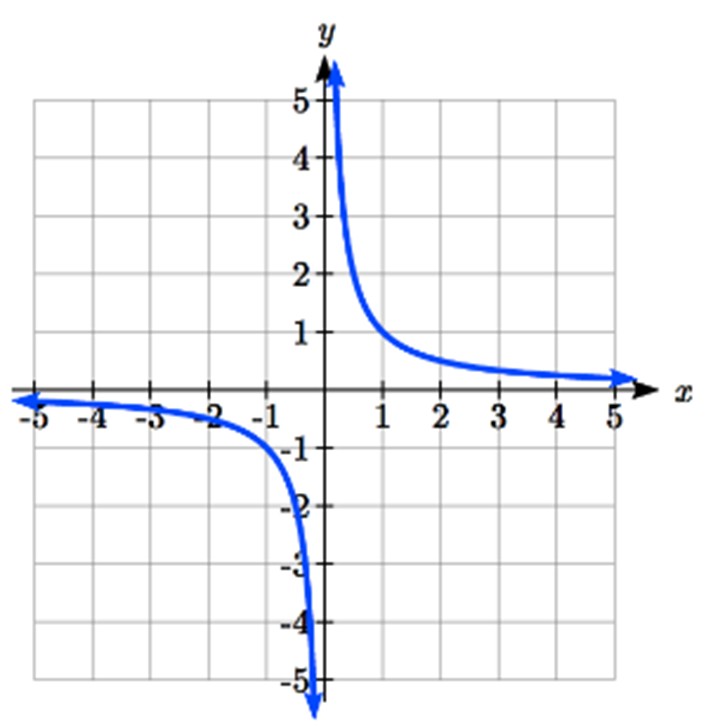
Let’s begin by looking at the reciprocal function, $f(x)=\frac{1}{x}.$ As you well know, dividing by zero is not allowed and therefore zero is not in the domain, and so the function is undefined at an input of zero.
Short run behavior:
As the input values approach zero from the left side (taking on very small, negative values), the function values become very large in the negative direction (in other words, they approach negative infinity).
We write: as $x\to 0^{−},$ $f(x)\to-\infty$.
As we approach zero from the right side (small, positive input values), the function values become very large in the positive direction (approaching infinity).
We write: as $x\to 0^{+}$, $f(x)\to\infty$.
This behavior creates a vertical asymptote. An asymptote is a line that the graph approaches. In this case the graph is approaching the vertical line x=0 as the input becomes close to zero.
Long run behavior:
As the values of x approach infinity, the function values approach 0.
As the values of x approach negative infinity, the function values approach 0.
Symbolically: as $x\to\pm\infty$, $f(x)\to 0.$
Based on this long run behavior and the graph we can see that the function approaches 0 but never actually reaches 0, it just “levels off” as the inputs become large. This behavior creates a horizontal asymptote. In this case the graph is approaching the horizontal line $f(x)=0$ as the input becomes very large in the negative and positive directions.
Vertical and Horizontal Asymptotes
A vertical asymptote of a graph is a vertical line x=c where the graph tends towards positive or negative infinity as the inputs approach c. As $x\to c, f(x)\to\pm\infty$.
A horizontal asymptote of a graph is a horizontal line $y=d$ where the graph approaches the line as the inputs get large. As $x\to\pm\infty, f(x)\to d$.
Use symbolic notation to describe the long run behavior and short run behavior for the reciprocal squared function.
Now we summarize the toolkit information for the reciprocal and reciprocal squared functions.
Toolkit (Parent) Reciprocal Function
The parent function $f(x) = \frac{1}{x}$ can be described with the following table and graph. We will use "HA" to denote a horizontal asymptote and "VA" to denote a vertical asymptote.
The graph has the following features:
Domain: $( − \infty,0 )\cup(0,\infty)$
Range: $(−\infty,0) \cup(0,\infty)$
Intercepts: none
End Behavior: As $x\to\pm\infty, f(x)\to 0$ (Horizontal Asymptote at $y=0$)
Vertical asymptote at $x=0$ (as $x\to 0^{+}, f(x)\to \infty$ and as $x\to 0^{−}, f(x)\to-\infty)$
Decreasing on $(−\infty, 0) \cup(0, \infty)$
Concave down on $(−\infty, 0)$ and concave up on $(0, \infty)$
Toolkit (Parent) Reciprocal Squared Function
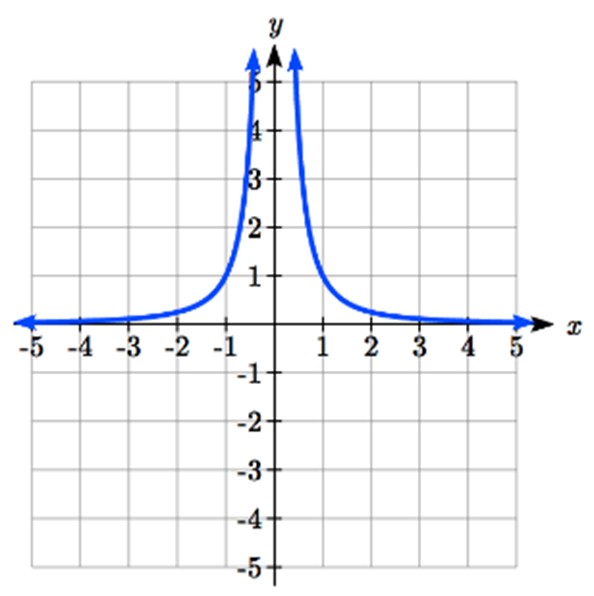
The parent function $f(x)=\frac{1}{x^{2}}$ can be described with the following table and graph.
The graph has the following features:
Domain: $( − \infty, 0) \cup(0,\infty)$
Range: $(0,\infty)$
Intercepts: none
End Behavior: As $x\to\pm\infty, f(x)\to 0$ (Horizontal Asymptote at $y=0$)
Vertical asymptote at $x=0$ (as $x\to 0^{\pm}, f(x)\to\infty)$
Increasing on $(−\infty, 0)$ and decreasing on $(0,\infty)$
Concave up on $(−\infty, 0) \cup(0, \infty)$
Sketch a graph of the reciprocal function shifted two units to the left and up three units. Identify the horizontal and vertical asymptotes of the graph, if any. Then, describe all the features of the graph.
Transforming the graph left 2 and up 3 would result in the function
$$g(x)=\frac{1}{x+2}+3,$$ or equivalently, by giving the terms a common denominator, $$g(x)=\frac{(3x+7)}{x+2}.$$
Working with the first form of the function, though, we can use our C-BAD process to graph, where $c=2$ and $d=3$
$$\begin{array}{|c|c|c|c|} \hline X=x-2 & \leftarrow x & f(x) \rightarrow & g(X)=f(x)+3\\ \hline \text{HA} & \text{HA} & 0 & 3\\ \hline -3 & -1 & -1 & 2\\ \hline -2 & 0 & \text{VA} & \text{VA}\\ \hline -1 & 1 & 1 & 4\\ \hline \end{array}$$
Notice that this equation is undefined at $x=-2$, and the graph also is showing a vertical asymptote at $x=-2$.
As $x\to-2^{−}, g(x)\to-\infty$, and
as $x\to-2^{+}, g(x)\to \infty$
As the inputs grow large, the graph appears to be leveling off at output values of 3, indicating a horizontal asymptote at $y=3$.
As $x\to \pm\infty, g(x)\to 3$
Notice that horizontal and vertical asymptotes get shifted left 2 and up 3 along with the function.
This graph has the following features:
Intercepts: $x$-intercept of about $ − 2.1$ (more on that soon), $y$-intercept of about 3.5
Domain: $(−\infty, −2) \cup(−2,\infty)$
Range: $(−\infty, 3) \cup(3,\infty)$
Decreasing on $(−\infty, −2) \cup(−2, \infty)$
Concave down on $(−\infty, −2)$, concave up on $(−2, \infty)$
Sketch the graph and find the horizontal and vertical asymptotes of the reciprocal squared function that has been shifted right 3 units and down 4 units.
In the previous example, we shifted a toolkit function in a way that resulted in a function of the form $f(x) = \frac{3x+7}{x+2}.$ This is an example of a more general rational function.
Rational Function
A rational function is a function that can be written as the ratio of two polynomials, $P(x)$ and $Q(x).$
$$f(x)=\frac{P(x)}{Q(x)}=\frac{a_{0} + a_{1}x+a_{2}x^{2}+\ldots+a_{p}x^{p}}{b_{0}+b_{1}x+b_{2}x^{2} + \ldots+b_{q}x^{q}}$$
A large mixing tank currently contains 100 gallons of water, into which 5 pounds of sugar have been mixed. A tap will open pouring 10 gallons per minute of water into the tank at the same time sugar is poured into the tank at a rate of 1 pound per minute. Find the concentration (pounds per gallon) of sugar in the tank after $t$ minutes.
Notice that the amount of water in the tank is changing linearly, as is the amount of sugar in the tank. We can write an equation independently for each:
$$\text{water}=100 + 10t$$
$$\text{sugar}=5 + 1t$$
The concentration, $C$, will be the ratio of pounds of sugar to gallons of water
$$C(t)=\frac{5+t}{100+10t}$$
Finding Asymptotes and Intercepts
Given a rational function, as part of investigating the short run behavior we are interested in finding any vertical and horizontal asymptotes, as well as finding any vertical or horizontal intercepts, as we have done in the past.
To find vertical asymptotes, we notice that the vertical asymptotes in our examples occur when the denominator is zero, so the function is undefined. With one exception, a vertical asymptote will occur whenever the denominator is zero.
Find the vertical asymptotes of the function $k(x)=\frac{5+2x^{2}}{2-x-x^{2}}.$
To find the vertical asymptotes, we determine where this function will be undefined by setting the denominator equal to zero:
$$2 − x − x^{2}=0$$
$$(2+x)(1−x)=0$$
$$x= − 2, 1$$
This indicates two vertical asymptotes, which a look at a graph confirms.

The exception to this rule can occur when both the numerator and denominator of a rational function are zero at the same input.
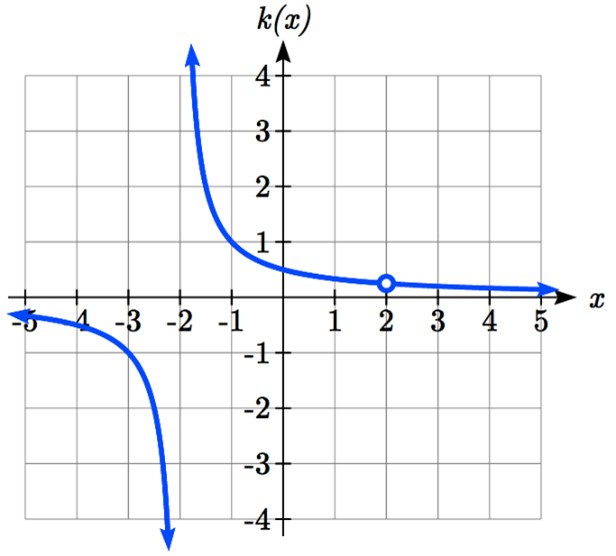
Find the vertical asymptotes of the function $k(x)=\frac{x-2}{x^{2}-4}.$
To find the vertical asymptotes, we determine where this function will be undefined by finding where denominator will be zero. We can do this by factoring:
$$k(x)=\frac{x-2}{x^{2}-4}$$
$$= \frac{x-2}{(x+2)(x-2)}$$
So the denominator is zero at $x=2, − 2.$
However, the numerator of this function is also equal to zero when x=2. The function will still be undefined at 2, since $\frac{0}{0}$ is undefined, but if $x\neq 2$ then $\frac{x-2}{(x-2)(x+2)}=\frac{1}{x+2}$ which does not have a vertical asymptote at $x=2$.
The graph of k(x) will have a vertical asymptote at $x=-2,$ but at $x=2$ the graph will have a hole: a single point where the graph is not defined, indicated by an open circle.
Vertical Asymptotes and Holes of Rational Functions
At points where the denominator of a rational function equals zero and the numerator is not zero, the rational function has a vertical asymptote.
At points where both the numerator and denominator of a rational function equal zero, factor the numerator and denominator and simplify: either the simplified function will have a vertical asymptote (and the original function will as well) or the graph of the original function will have a hole.
To find horizontal asymptotes, we are interested in the behavior of the function as the input grows large, so we consider long run behavior of the numerator and denominator separately. Recall that a polynomial’s long run behavior will mirror that of the leading term. Likewise, a rational function’s long run behavior will mirror that of the ratio of the leading terms of the numerator and denominator functions.
There are three distinct outcomes when this analysis is done:
Case 1: The degree of the denominator $\gt$ degree of the numerator
Example: $f(x)=\frac{3x+2}{x^{2}+4x - 5}$
In this case, the long run behavior is $f(x)\approx \frac{3x}{x^{2}}=\frac{3}{x}.$ This tells us that as the inputs grow large, this function will behave similarly to the function $g(x)=\frac{3}{x}.$ As the inputs grow large, the outputs will approach zero, resulting in a horizontal asymptote at $y=0$.
As $x\to \pm\infty, f(x)\to 0$
Case 2: The degree of the denominator $\lt$ degree of the numerator
Example: $f(x)=\frac{3x^{2}+2}{x-5}$
In this case, the long run behavior is $f(x)\approx \frac{3x^{2}}{x}=3x.$ This tells us that as the inputs grow large, this function will behave similarly to the function $g(x)=3x$. As the inputs grow large, the outputs will grow and not level off, so this graph has no horizontal asymptote.
As $x\to\pm\infty, f(x)\to \pm\infty$, respectively.
Case 3: The degree of the denominator = degree of the numerator
Example: $f(x)=\frac{3x^{2}+2}{x^{2} + 4x-5}$
In this case, the long run behavior is $f(x)\approx\frac{3x^{2}}{x^{2}}=3.$ This tells us that as the inputs grow large, this function will behave like the function $g(x)=3$, which is a horizontal line.
As $x\to\pm\infty, f(x)\to 3$ resulting in a horizontal asymptote at $y=3$.
Horizontal Asymptote of Rational Functions
The horizontal asymptote of a rational function can be determined by looking at the degrees of the numerator and denominator.
Degree of denominator $\gt$ degree of numerator: Horizontal asymptote at $y=0$
Degree of denominator $\lt$ degree of numerator: No horizontal asymptote
Degree of denominator = degree of numerator: Horizontal asymptote at ratio of leading coefficients.
In the sugar concentration problem from earlier, we created the equation
$$C(t)=\frac{5+t}{100 + 10t}.$$
Find the horizontal asymptote and interpret it in context of the scenario.
Both the numerator and denominator are linear (degree 1), so since the degrees are equal, there will be a horizontal asymptote at the ratio of the leading coefficients. In the numerator, the leading term is t, with coefficient 1. In the denominator, the leading term is 10t, with coefficient 10. The horizontal asymptote will be at the ratio of these values: As $t \rightarrow \infty, C(t)\rightarrow\frac{1}{10}.$ This function will have a horizontal asymptote at $y=\frac{1}{10}.$
This tells us that as the input gets large, the output values will approach 1/10. In context, this means that as more time goes by, the concentration of sugar in the tank will approach one tenth of a pound of sugar per gallon of water or 1/10 pounds per gallon.
Find the horizontal and vertical asymptotes of the function
$$f(x)=\frac{(x-2)(x+3)}{(x-1)(x+2)(x-5)}$$First, note this function has no inputs that make both the numerator and denominator zero, so there are no potential holes. The function will have vertical asymptotes when the denominator is zero, causing the function to be undefined. The denominator will be zero at $x=1, -2$, and $5$, indicating vertical asymptotes at these values.
The numerator has degree 2, while the denominator has degree 3. Since the degree of the denominator is greater than that of the numerator, the denominator will grow faster than the numerator, causing the outputs to tend towards zero as the inputs get large, and so as $x\to \pm\infty, f(x)\to 0$. This function will have a horizontal asymptote at $y=0$.
Find the vertical and horizontal asymptotes of the function $f(x)=\frac{(2x-1)(2x+1)}{(x-2)(x+3)}$
Intercepts
As with all functions, a rational function will have a vertical intercept when the input is zero, if the function is defined at zero. It is possible for a rational function to not have a vertical intercept if the function is undefined at zero.
Likewise, a rational function will have horizontal intercepts at the inputs that cause the output to be zero (unless that input corresponds to a hole). It is possible there are no horizontal intercepts. Since a fraction is only equal to zero when the numerator is zero, horizontal intercepts will occur when the numerator of the rational function is equal to zero.
Find the intercepts of $$f(x)=\frac{(x-2)(x+3)}{(x-1)(x+2)(x-5)}.$$
We can find the vertical intercept by evaluating the function at zero
$$f(0)=\frac{(0-2)(0+3)}{(0-1)(0+2)(0-5)}$$
$$= \frac{-6}{10}$$
$$=-\frac{3}{5}$$
The horizontal intercepts will occur when the function is equal to zero:
$$\frac{(x-2)(x+3)}{(x-1)(x+2)(x-5)}=0$$
This is zero when the numerator is zero.
$$(x−2)(x+3)=0$$
$$x=2, − 3$$
Sometimes we’re going to need to do a bit of work to find intercepts of our rational functions. We’ll outline a solving strategy and do a bit of practice just in finding intercepts.
Solving Rational Equations
To solve a rational equation (where the variable is in the denominator):
Create a common denominator for every term
Simplify each side so that we have a fraction equal to a fraction
Set the numerators equal to each other to solve
Set the denominator equal to 0 to find excluded values
Find the $x$- and $y$-intercepts of the function $f(x)=\frac{1}{x+2}+3.$
To find the $x$-intercepts, we must solve $f(x)=0$.
$$\frac{1}{x+2}+3 =0$$
This is a rational equation, since the variable is in the denominator. So, we’ll create a common denominator, add, then finish solving.
$$\begin{array}{rlc} \frac{1}{x+2}+3 &=0 & \\ \frac{1}{x+2}+3 \cdot \frac{x+2}{x+2} &=0 \cdot \frac{x+2}{x+2} & \text{Multiply by a fancy form of}\ 1 \\ \frac{1}{x+2}+\frac{3(x+2)}{x+2} &=\frac{0(x+2)}{x+2} & \\ \frac{1+3(x+2)}{x+2} &=\frac{0(x+2)}{x+2} & \text{Add} \end{array}$$
Now, here’s the idea: the denominators are already the same on both sides of the equation. That means, if we want to solve the equation, we don’t have to worry about the denominator at all! We’ll just set the numerators equal to each other and finish solving.
$$1 + 3(x+2)=0(x+2)$$
This is a linear function, so we’ll simplify, move all the variables to the same side, and then isolate the variable.
$$1 + 3x + 6=0$$
$$3x + 7=0$$
$$3x= − 7$$
$$x=-\frac{7}{3}$$
Now we know our $x$-intercept was exactly $ − 7/3$.
For the $y$-intercept, we’ll still evaluate $f(0)$, so
$$f(0)=\frac{1}{0+2}+3$$
$$= \frac{1}{2}+\frac{6}{2}$$
$$= \frac{7}{2}$$
The $y$-intercept is exactly $7/2$.
Find the intercepts of $$f(x)=\frac{- 2}{x^{3}-3x^{2}}-\frac{1}{x}.$$
To find the $x$ intercepts, we want to solve $f(x)=0$:
$$\frac{-2}{x^{3}-3x^{2}}-\frac{1}{x}=0$$
This is a rational equation, since the variable is in the denominators. We’ll need to choose a common denominator. That will be easier if we first factor our denominators.
$$\frac{-2}{x^{2}(x-3)}-\frac{1}{x}=0$$
The least common denominator is $x^{2}(x−3)$, so we’ll multiply each term by a fancy form of 1 to create that denominator.
$$\frac{-2}{x^{2}(x-3)}-\frac{1}{x} \cdot \frac{x(x-3)}{x(x-3)}=0 \cdot \frac{x^{2}(x-3)}{x^{2}(x - 3)}$$
$$\frac{-2}{x^{2}(x-3)}-\frac{1x(x - 3)}{x^{2}(x-3)}=\frac{0}{x^{2}(x-3)}$$
$$\frac{-2-x(x-3)}{x^{2}(x-3)} = \frac{0}{x^{2}(x-3)}$$
Now the denominators are equal, so we only have to worry about solving for $-2 − x(x−3)=0.$ If we expand a little, we have $-2 − x^{2} + 3x=0$, a quadratic. Let’s rearrange so we can factor and use the Zero Product Property!
$$ − x^{2} + 3x − 2=0$$
$$ − 1(x^{2}−3x+2)=0$$
We’re looking for two numbers which multiply to make 2 and add to make -3. That’s -2 and -1.
$$ − 1(x−2)(x−1)=0$$
$$\begin{array}{c} x-2=0 \\ x=2 \end{array}\ \ \text{ or }\ \ \ \begin{array}{c} x-1=0 \\ x=1 \end{array}$$
Now we check for extraneous solutions (asymptotes or holes). We would have a division by zero error if the denominator was 0, so we need to exclude $x$-values which make $x^{2}(x−3)=0$. This is already factored, so a quick application of the ZPP tells us $x\neq 0, 3$. Our intercepts were 2 and 1, so we don’t have to exclude either of these.
For the $y$-intercept, we evaluate $f(0)$:
$$f(0)=\ -\frac{2}{0^{3}-3\cdot 0^{2}}-\frac{1}{0}$$
Wait a second! Division by zero is undefined. There is no $y$-intercept, since there's a vertical asymptote at $x=0$.
Find the intercepts of each function.
$f(x)=\frac{2}{x+6} - 6$
$g(x)=\frac{x-1}{x} - \frac{1}{x^{2}-x}$
Our solving strategies can also help us to find where rational functions intersect with other functions.
Find where the functions $f(x)=\frac{2}{x-2}$ and $g(x)=x−3$ intersect.
To answer this, we’ll need to solve $f(x)=g(x)$:
$$\frac{2}{x-2}=x-3$$
This qualifies as a rational equation, since we have a fraction with a variable in the denominator.
$$\begin{array}{rlc} \frac{2}{x-2} &=x-3 & \\ \frac{2}{x-2} &=(x-3) \cdot \frac{x-2}{x-2} & \text{Make a common denominator} \\ \frac{2}{x-2} &=\frac{(x-3)(x-2)}{(x-2)} & \end{array}$$
Now, the denominators are equal, so we only need to solve $2=(x−3)(x−2)$.
$$\begin{array}{rlc} 2 &=(x-3)(x-2) & \\ 2 &=x^{2}-5x+6 & \text{Expand} \\ 0 &=x^{2}-5x+4 & \text{Quadratic:get equal to}\ 0 \\ 0 &=(x-4)(x-1) & \text{Factor} \\ x &=4,1 & \text{ZPP} \end{array}$$
We should also solve for $x − 2=0$ to look out for excluded values. The only thing we have to be concerned about is $x=2$, so our solutions of $x=4, 1$ are both valid.
The functions intersect when $x$ is 4 and 1.
Find where the functions $f(x)=\frac{x - 3}{2x-4}-\frac{x+1}{x-3}$ and $g(x)=\frac{1}{2x^{2}-10x+12}$ intersect.
Given the reciprocal squared function that is shifted right 3 units and down 4 units, write this as a rational function and find the horizontal and vertical intercepts and the horizontal and vertical asymptotes.
Graphical Behavior at Intercepts and Vertical Asymptotes
As with polynomials, factors of the numerator may have integer powers greater than one. Happily, the effect on the shape of the graph at those intercepts is the same as we saw with polynomials: if the factor giving the intercept is not squared, the graph passes through the axis; if the factor is squared, the graph will bounce off the axis at that intercept. The behavior at vertical asymptotes also depends on the power on the factor.
Graphical Behavior of Rational Functions at Vertical Asymptotes
If a rational function contains a factor of the form $(x−h)^{p}$ in the denominator, the behavior near the asymptote $h$ is determined by the power on the factor.
$$p=1$$

$$p=1$$

$$p=2$$

$$p=2$$

When the factor is not squared, on one side of the asymptote the graph heads towards positive infinity and on the other side the graph heads towards negative infinity.
When the factor is squared, the graph either heads toward positive infinity on both sides of the vertical asymptote, or heads toward negative infinity on both sides.
For example, the graph of $$f(x)=\frac{(x+1)^{2}(x-3)}{(x+3)^{2}(x-2)}$$ is shown here.

At the horizontal intercept $x=-1$ corresponding to the $(x+1)^{2}$ factor of the numerator, the graph bounces at the intercept, consistent with the quadratic nature of the factor.
At the horizontal intercept $x=3$ corresponding to the $(x−3)$ factor of the numerator, the graph passes through the axis as we’d expect from a linear factor.
At the vertical asymptote $x=-3$ corresponding to the $(x+3)^{2}$ factor of the denominator, the graph heads towards positive infinity on both sides of the asymptote, consistent with the behavior of the $\frac{1}{x^{2}}$ toolkit.
At the vertical asymptote $x=2$ corresponding to the $(x−2)$ factor of the denominator, the graph heads towards positive infinity on the left side of the asymptote and towards negative infinity on the right side, consistent with the behavior of the $\frac{1}{x}$ toolkit.
Sketch a graph of $$f(x)=\frac{(x+2)(x - 3)}{(x+1)^{2}(x-2)}.$$
We can start our sketch by finding intercepts and asymptotes. Evaluating the function at zero gives the vertical intercept:
$$f(0)=\frac{(0+2)(0-3)}{(0+1)^{2}(0-2)}$$
$$=3$$
Looking at when the numerator of the function is zero, we can determine the graph will have horizontal intercepts at $x=-2$ and $x=3$. At each, the behavior will be linear, with the graph passing through the intercept.
Looking at when the denominator of the function is zero, we can determine the graph will have vertical asymptotes at $x=-1$ and $x=2.$
Finally, the degree of denominator is larger than the degree of the numerator, telling us this graph has a horizontal asymptote at $y=0.$
To sketch the graph, we might start by plotting the three intercepts. Since the graph has no horizontal intercepts between the vertical asymptotes, and the vertical intercept is positive, we know the function must remain positive between the asymptotes, letting us fill in the middle portion of the graph.

Since the factor associated with the vertical asymptote at $x=-1$ was squared, we know the graph will have the same behavior on both sides of the asymptote. Since the graph heads towards positive infinity as the inputs approach the asymptote on the right, the graph will head towards positive infinity on the left as well. For the vertical asymptote at $x=2,$ the factor was not squared, so the graph will have opposite behavior on either side of the asymptote.
After passing through the horizontal intercepts, the graph will then level off towards an output of zero, as indicated by the horizontal asymptote.

Given the function $f(x)=\frac{(x+2)^{2}(x-2)}{2(x-1)^{2}(x-3)},$ use the characteristics of polynomials and rational functions to describe its behavior and sketch the function.
Since a rational function written in factored form will have a horizontal intercept where each factor of the numerator is equal to zero, we can form a numerator that will pass through a set of horizontal intercepts by introducing a corresponding set of factors. Likewise, since the function will have a vertical asymptote where each factor of the denominator is equal to zero, we can form a denominator that will produce the vertical asymptotes by introducing a corresponding set of factors.
Writing Rational Functions from Intercepts and Asymptotes
If a rational function has horizontal intercepts at $x=x_{1}, x_{2}, …, x_{n}$, and vertical asymptotes at $x=v_{1}, v_{2}, …, v_{m}$ then the function can be written in the form
$$f(x)=a\frac{\left( x-x_{1} \right)^{p_{1}}\left(x-x_{2}\right)^{p_{2}} \cdot \cdot \cdot \left(x-x_{n} \right)^{p_{n}}}{\left(x-v_{1}\right)^{q_{1}}\left( x-v_{2}\right)^{q_{2}} \cdot \cdot \cdot \left(x-v_{m}\right)^{q_{n}}}$$
where the powers $p_{i}$ or $q_{i}$ on each factor can be determined by the behavior of the graph at the corresponding intercept or asymptote, and the stretch factor a can be determined given a value of the function other than the horizontal intercept, or by the horizontal asymptote if it is nonzero.
Write an equation for the rational function graphed here.

The graph appears to have horizontal intercepts at x=-2 and $x=3$. At both, the graph passes through the intercept, suggesting linear factors.
The graph has two vertical asymptotes. The one at $x=-1$ seems to exhibit the basic behavior similar to $\frac{1}{x},$ with the graph heading toward positive infinity on one side and heading toward negative infinity on the other.
The asymptote at $x=2$ is exhibiting a behavior similar to $\frac{1}{x^{2}},$ with the graph heading toward negative infinity on both sides of the asymptote.
Utilizing this information indicates an function of the form
$$f(x)=a\frac{(x+2)(x-3)}{(x+1)(x - 2)^{2}}$$
To find the stretch factor, we can use another clear point on the graph, such as the vertical intercept (0,-2):
$$-2=a\frac{(0+2)(0-3)}{(0+1)(0-2)^{2}}$$
$$-2=a \cdot-\frac{6}{4}$$
$$a= -2 \div -\frac{6}{4}$$
$$a=- 2 \cdot-\frac{4}{6}=\frac{4}{3}$$
This gives us a final function of $$f(x) = \frac{4(x+2)(x-3)}{3(x+1)(x-2)^{2}}.$$
Oblique Asymptotes
Earlier we saw graphs of rational functions that had no horizontal asymptote, which occurs when the degree of the numerator is larger than the degree of the denominator. We can, however, describe in more detail the long-run behavior of a rational function.
Describe the long-run behavior of $$f(x) = \frac{3x^{2}+2}{x-5}.$$
Earlier we explored this function when discussing horizontal asymptotes. We found the long-run behavior is $f(x)\approx\frac{3x^{2}}{x}=3x,$ meaning that $x\to \pm\infty$, $f(x)\to \pm\infty$, respectively, and there is no horizontal asymptote.
If we were to do polynomial long division, we could get a better understanding of the behavior as $x\to\pm\infty$.
$$\begin{array}{rl} & \begin{array}{ccc} & 3x & +15\\ \end{array}\\ x - 5 & \begin{array}{ccc} \hline )3x^2 & + 0x & + 2\\ \end{array}\\ & \begin{array}{ccc} -(3x^2 & -15x) &\\ \hline & 15x & +2\\ &-(15x & -75)\\ \hline && 77\\ \end{array} \end{array}$$
This means $f(x)=\frac{3x^{2}+2}{x-5}$ can be rewritten as $f(x)=3x+15 +\frac{77}{x-5}.$
As $x\to\pm\infty$, the term $\frac{77}{x-5}$ will become very small and approach zero, becoming insignificant. The remaining $3x+15$ then describes the long-run behavior of the function: as $x\to \pm\infty$, $f(x)\to 3x + 15$.
We call this equation $y=3x + 15$ the oblique asymptote of the function.
In the graph, you can see how the function is approaching the line on the far left and far right.

Oblique Asymptotes
To explore the long-run behavior of a rational function,
1) Perform polynomial long division (or synthetic division)
2) The quotient will describe the asymptotic behavior of the function
When this result is a line, we call it an oblique asymptote, or slant asymptote.
Find the oblique asymptote of $$f(x) = \frac{- x^{2}+2x+1}{x+1}$$
Performing polynomial long division:
$$\begin{array}{rl} & \begin{array}{ccc} & -x & +3\\ \end{array}\\ x +1 & \begin{array}{ccc} \hline )-x^2 & + 2x & + 1\\ \end{array}\\ & \begin{array}{ccc} -(-x^2 & -x) &\\ \hline & 3x & +1\\ &-(3x & 3)\\ \hline && -2\\ \end{array} \end{array}$$
This allows us to rewrite the function as $f(x)=- x+3-\frac{2}{x+1}.$
The quotient, $y= − x + 3$, is the oblique asymptote of $f(x)$. Just like functions we saw earlier approached their horizontal asymptote in the long run, this function will approach this oblique asymptote in the long run.
Find the oblique asymptote of $f(x)=\frac{1+7x-2x^2}{x-2}$.
While we primarily concern ourselves with oblique asymptotes, this same approach can describe other asymptotic behavior.
Describe the long-run shape of $f(x) = \frac{- x^{3}-x^{2}+4x+2}{x+1}$
We could rewrite this using long division as $f(x)=-x^{2}+4+\frac{2}{x+1}.$
Just looking at the quotient gives us the asymptote, $y= − x^{2} + 4$.
This suggests that in the long run, the function will behave like a downwards opening parabola. The function will also have a vertical asymptote at $x= − 1$.

Important Topics of this Section
Inversely proportional; Reciprocal toolkit function
Inversely proportional to the square; Reciprocal squared toolkit function
Horizontal Asymptotes
Vertical Asymptotes
Rational Functions
Finding intercepts, asymptotes, and holes.
Given equation sketch the graph
Identifying a function from its graph
Oblique Asymptotes
Section 3.8 Exercises
Conceptual Questions
- Describe how to find vertical asymptotes of a rational function using its equation.
- Describe how to find horizontal asymptotes of a rational function using its equation.
- Describe how to find intercepts of a rational function using its equation.
- Describe how to sketch a graph of a rational function.
Practice Problems
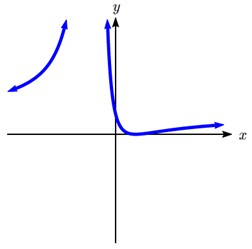
Match each equation form with one of the graphs.
$f(x)=\frac{x-A}{x-B}$
$g(x)=\frac{(x-A)^{2}}{x-B}$
$h(x)=\frac{x-A}{(x-B)^{2}}$
$k(x)=\frac{(x-A)^{2}}{(x-B)^{2}}$



B
A
For each function, find the horizontal intercepts, the vertical intercept, the vertical asymptotes, and the horizontal asymptote. Use that information to sketch a graph.
$p(x)=\frac{2x-3}{x + 4}$
$q(x)=\frac{x-5}{3x - 1}$
$s(x)=\frac{4}{(x - 2)^{2}}$
$r(x)=\frac{5}{(x + 1)^{2}}$
$f(x)=\frac{3x^{2}-14x-5}{3x^{2} + 8x-16}$
$g(x)=\frac{2x^{2}+7x-15}{3x^{2} - 14x+15}$
$a(x)=\frac{x^{2}+2x-3}{x^{2} - 1}$
$b(x)=\frac{x^{2}-x-6}{x^{2} - 4}$
$h(x)=\frac{2x^{2}+x-1}{x - 4}$
$k(x)=\frac{2x^{2}-3x-20}{x - 5}$
$n(x)=\frac{3x^{2}+4x-4}{x^{3} - 4x^{2}}$
$m(x)=\frac{5-x}{2x^{2}+7x + 3}$
$w(x)=\frac{(x-1)(x+3)(x-5)}{(x + 2)^{2}(x-4)}$
$z(x)=\frac{(x+2)^{2}(x-5)}{(x - 3)(x+1)(x+4)}$
Vertical asymptote: $x = −$4, Horizontal asymptote: $y = 2$, Vertical intercept: $(0,\ - \frac{3}{4})$, Horizontal intercept: $(\frac{3}{2},\ 0)$.
Vertical asymptote: $x = 2$, Horizontal asymptote: $y = 0$, Vertical intercept: $(0, 1)$, Horizontal intercept: none.
Vertical asymptotes: $ = -4$ , $\frac{4}{3},\ \ $Horizontal asymptote: $y = 1$, Vertical intercept: $(0,\ \frac{5}{16}),\ $Horizontal intercepts: $\left( - \frac{1}{3},\ 0 \right),\ (5,\ 0)$.
Vertical asymptote: there is no vertical asymptote, Horizontal asymptote: $y = 1$, Vertical intercept: $(0, 3)$, Horizontal intercept:$ (−3, 0)$.
Vertical asymptote: $x = 3$, Horizontal asymptote: There is no horizontal asymptote, Vertical intercept: $(0,\ \frac{1}{4\ })$, Horizontal intercepts: $( - 1,\ 0),\ (\ \frac{1}{2},\ 0)$.
Vertical asymptotes: x = 0, and x = 4, Horizontal asymptote: y = 0, Vertical intercept: none, Horizontal intercepts: $( - 2,\ 0),\ (\frac{2}{3},\ 0)$.
Vertical asymptotes: $x = -2$, 4, Horizontal asymptote: $y = 1$, Vertical intercept: $(0,\ - \frac{15}{16})$ , Horizontal intercepts, (1, 0), (-3, 0), and (5, 0).
Find where each pair of functions intersect
- $f(x)=\frac4{x}$ and $g(x) = 1-\frac{3x-9}{2}$
- $f(x)=\frac{x+2}{x}$ and $g(x)=\frac{3x+3}{x}-\frac13$
- $f(x)=\frac1{4x}-1$ and $g(x)=\frac{x+3}{4x}$
- $f(x)=\frac{-2}{5x^2+x}$ and $g(x) =\frac1{x}$
- $f(x)=\frac1{3x^2}+\frac13$ and $g(x)=\frac{x+3}{3x}$
- $f(x)=\frac4{x^2}-\frac14$ and $g(x)=\frac{x^2-8x+16}{x^2}$
- $f(x)=\frac1{x+2}-1$ and $g(x)=\frac{5}{x^2-3x-10}$
- $f(x)=\frac3{x^2-x}$ and $g(x)=\frac1{x^2-x}+1$
$x = 1,\frac{8}{3}$
$x = - \frac{2}{5}$
$x = \frac{1}{3}$
$x = 0, 4$
Write an equation for a rational function with the given characteristics.
Vertical asymptotes at $x=5$ and $x=-5$.
$x$ intercepts at $(2,0)$ and $(-1,0)$
$y$ intercept at $(0,4)$Vertical asymptotes at $x=-4$ and $x=-1$.
$x$ intercepts at $(1,0)$ and $(5,0)$
$y$ intercept at $(0,7)$Vertical asymptotes at $x=-4$ and $x=-5$.
$x$ intercepts at $(4,0)$ and $(-6,0)$
Horizontal asymptote at $y=7$Vertical asymptotes at $x=-3$ and $x=6$.
$x$ intercepts at $(-2,0)$ and $(1,0)$
Horizontal asymptote at $y=-2$Vertical asymptote at $x=-1$
Double zero at $x=2$
$y$ intercept at $(0,2)$Vertical asymptote at $x=3$
Double zero at $x=1$
$y$ intercept at $(0,4)$
$y = \frac{50(x - 2)(x + 1)}{(x - 5)(x + 5)}$
$y = \frac{7(x - 4)(x + 6)}{(x + 4)(x + 5)}$
See problem 27 and/or problem 29. To get a double zero at $x = 2,$ we need the numerator to be able to be broken down into two factors both of which are zero at $x = 2.$ So, $(x−2)^{2}$ appears in the numerator.
Write an equation for the function graphed.
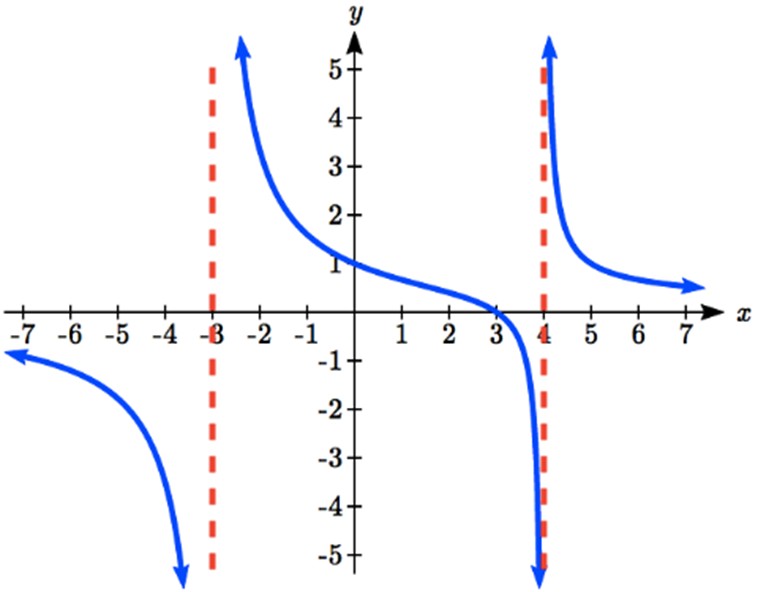
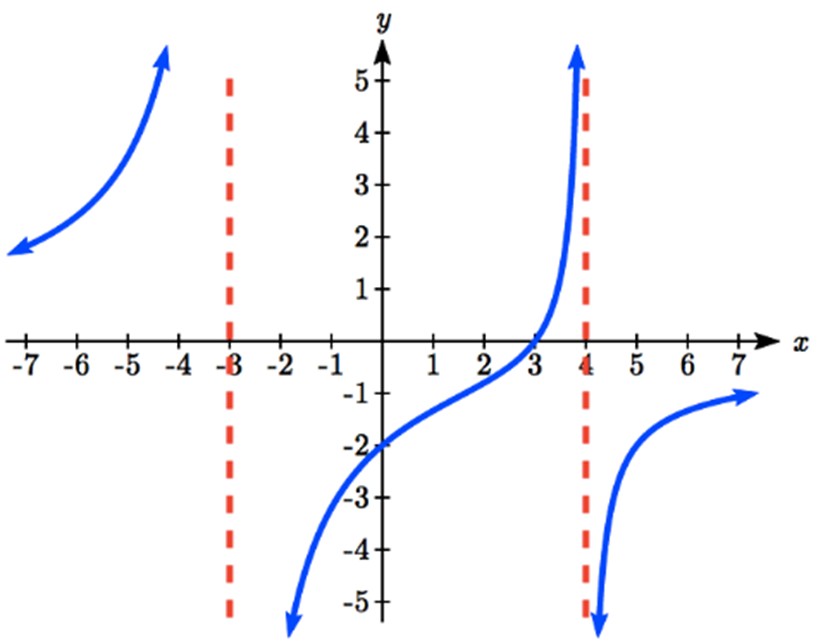
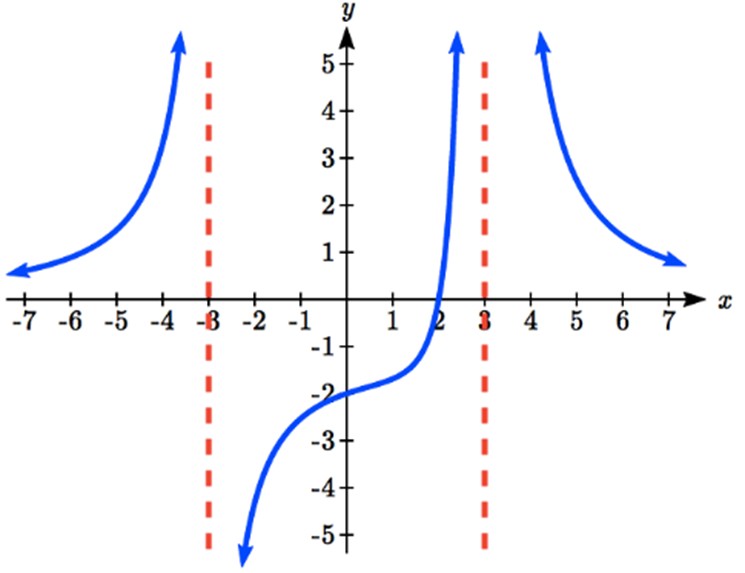


.


$y = \frac{4(x - 3)}{(x - 4)(x + 3)}$
$y = - \frac{27(x - 2)}{(x - 3)^2(x + 3)}$
$y = \frac{(x - 2)(x + 3)}{3(x - 1)}$
$y = \frac{-6(x - 1)^{2}}{(x - 2)^2(x + 3)}$
$y = - \frac{2x(x - 3)}{(x - 4)(x + 3)}$
$y = \frac{2(x - 1)^{3}}{(x + 1)(x - 2)^{2}}$
$y = \frac{(x-2)(x-4)}{(x+1)(x-4)}$
Find the oblique asymptote of each function.
$g(x)=\frac{2x^{2}+3x-8}{x - 1}$
$f(x)=\frac{3x^{2}+4x}{x + 2}$
$k(x)=\frac{5+x-2x^{2}}{2x + 1}$
$h(x)=\frac{x^{2}-x-3}{2x - 6}$
$n(x)=\frac{2x^{3}+x^{2}+x}{x^{2} + x+1}$
$m(x)=\frac{- 2x^{3}+x^{2}-6x + 7}{x^{2}+3}$
$y = 3x-2$
$y = \frac{1}{2}x + 1$
$y = -2x+1$
A scientist has a beaker containing 30 mL of a solution containing 3 grams of potassium hydroxide. To this, she mixes a solution containing 8 milligrams per mL of potassium hydroxide.
Write an equation for the concentration in the tank after adding n mL of the second solution.
Find the concentration if 10 mL of the second solution has been added.
How many mL of water must be added to obtain a 50 mg/mL solution?
What is the behavior as $n\to \infty$, and what is the physical significance of this?
A scientist has a beaker containing 20 mL of a solution containing 20% acid. To dilute this, she adds pure water.
Write an equation for the concentration in the beaker after adding n mL of water.
Find the concentration if 10 mL of water has been added.
How many mL of water must be added to obtain a 4% solution?
What is the behavior as $n\to \infty$, and what is the physical significance of this?
The more you study for a certain exam, the better your performance on it. If you study for 10 hours, your score will be 65%. If you study for 20 hours, your score will be 95%. You can get as close as you want to a perfect score just by studying long enough. Assume your percentage score, $p(n)$, is a function of the number of hours, $n$, that you study in the form $p(n)=\frac{an+b}{cn+d}.$ If you want a score of 80%, how long do you need to study? [UW]
Oscar is hunting magnetic fields with his gauss meter, a device for measuring the strength and polarity of magnetic fields. The reading on the meter will increase as Oscar gets closer to a magnet. Oscar is in a long hallway at the end of which is a room containing an extremely strong magnet. When he is far down the hallway from the room, the meter reads a level of 0.2. He then walks down the hallway and enters the room. When he has gone 6 feet into the room, the meter reads 2.3. Eight feet into the room, the meter reads 4.4. [UW]
Give a rational model of form $m(x) = \frac{ax+b}{cx+d}$ relating the meter reading m(x)$ to how many feet x Oscar has gone into the room.
How far must he go for the meter to reach 10? 100?
Considering your function from part (a) and the results of part (b), how far into the room do you think the magnet is?
A street light is 10 feet north of a straight bike path that runs east-west. Olav is bicycling down the path at a rate of 15 miles per hour. At noon, Olav is 33 feet west of the point on the bike path closest to the street light. (See the picture). The relationship between the intensity C of light (in candlepower) and the distance d (in feet) from the light source is given by $C=\frac{k}{d^{2}},$ where k is a constant depending on the light source. [UW]
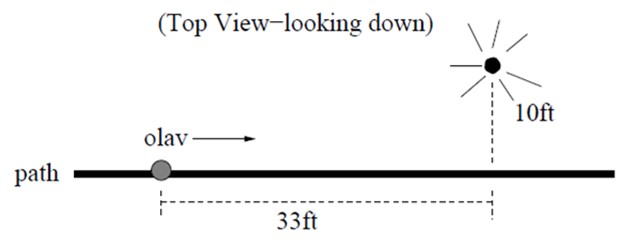
From 20 feet away, the street light has an intensity of 1 candle. What is k?
Find a function which gives the intensity of the light shining on Olav as a function of time, in seconds.
When will the light on Olav have maximum intensity?
When will the intensity of the light be 2 candles?
(a) To get the percentage of water (non-acid) in the beaker we take ($n+16)$ our total amount of water and divide by our total amount of solution ($n+20)$. Then to get the percent of acid, we subtract the percent of water from 1, or $1 - \frac{(n + 16)}{(n + 20)}.$
(b) Using our equation from part (a), we get $1 - \frac{(10 + 16)}{(10 + 20)} = 13.33\%$
(c) To get 4%, we use our equation from part (a) to solve: $4 = 1 - \frac{n + 16}{n + 20} \rightarrow \ - 3 = \frac{(n + 16)}{(n + 20)} \rightarrow \ - 3n - 60 = n + 16 \rightarrow \ \ n = 19mL.$
(d) As $n \to \infty$, $\frac{n + 16}{n + 20} \rightarrow 1,$ because the denominator and numerator have the same degree. So, as $ \to \infty,$ $1 - \frac{n + 16}{n + 20} \rightarrow 0$. This means that our acid becomes insignificant compared to the water.
(a) $m(x) = \frac{0.2x - 10.4}{x - 10}$; (b) $x\approx 9.143, 9.916$; (c) The meter reading increases as Oscar gets closer to the magnet. The graph of the function for (a) has a vertical asymptote at $x = 10$, for which the graph shoots up when approaching from the left, so the magnet is 10 feet into the room. This is consistent with our answers for (b), in which $x$ gets closer to 10 as the meter reading increases.