Section 4.4: The Law of Sines
Learning Objectives
In this section you will:
- Derive the Law of Sines
- Apply the Law of Sines
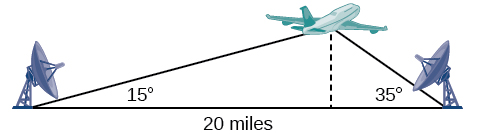
Suppose two radar stations located 20 miles apart each detect an aircraft between them. The angle of elevation measured by the first station is 35 degrees, whereas the angle of elevation measured by the second station is 15 degrees. How can we determine the altitude of the aircraft? We see in Figure 1 that the triangle formed by the aircraft and the two stations is not a right triangle, so we cannot use what we know about right triangles. In this section, we will find out how to solve problems involving non-right triangles.
Deriving the Law of Sines
Before we start building the Law of Sines, a few notes. First, we adhere to the convention that a lower case Greek letter denotes an angle (as well as the measure of said angle) and the corresponding lowercase English letter represents the side (as well as the length of said side) opposite that angle. More specifically, $a$ is the side opposite $\alpha$, $b$ is the side opposite $\beta$ and $c$ is the side opposite $\gamma$. Taken together, the pairs $(\alpha, a)$, $(\beta, b)$ and $(\gamma, c)$ are called angle side opposite pairs.
Second, we will strive to solve for quantities using the original data given in the problem whenever possible. While this is not always the easiest or fastest way to proceed, it minimizes the chances of propagated error (Your Science teachers should thank us for this).
Third, since many of the applications which require solving triangles `in the wild' rely on degree measure (and not radians), we shall adopt this convention for the time being.
The Pythagorean Theorem along with right triangle trigonometric functions (SOHCAHTOA) allow us to easily handle any given right triangle problem, but what if the triangle isn't a right triangle? In certain cases, we can use the Law of Sines.
Law of Sines
Given a triangle with angle-side opposite pairs $(\alpha, a)$, $(\beta, b)$ and $(\gamma, c)$, the following ratios hold: \[ \frac{\sin(\alpha)}{a} = \frac{\sin(\beta)}{b} = \frac{\sin(\gamma)}{c} \qquad \text{or, equivalently,} \qquad \frac{a}{\sin(\alpha)} = \frac{b}{\sin(\beta)} = \frac{c}{\sin(\gamma)} \]
The proof of the Law of Sines can be broken into three cases, and, as we'll see, ultimately relies on what we know about right triangles.
For our first case, consider the triangle $\triangle ABC$ below, all of whose angles are acute, with angle-side opposite pairs $(\alpha, a)$, $(\beta, b)$ and $(\gamma, c)$.

If we drop an altitude from vertex $B$, we divide the triangle into two right triangles: $\triangle ABQ$ and $\triangle BCQ$.
If we call the length of the altitude $h$ (for height), we know that $\sin(\alpha) = \frac{h}{c}$ and $\sin(\gamma) = \frac{h}{a}$ so that $h = c\sin(\alpha) = a \sin(\gamma)$. Rearranging this last equation, we get $\frac{\sin(\alpha)}{a} = \frac{\sin(\gamma)}{c}$.
Dropping an altitude from vertex $A$, we can proceed as above using the triangles $\triangle ABQ$ and $\triangle ACQ$. We find that $\frac{\sin(\beta)}{b} = \frac{\sin(\gamma)}{c}$, so we have shown $\frac{\sin(\alpha)}{a} = \frac{\sin(\beta)}{b} = \frac{\sin(\gamma)}{c}$ as required.
For our next case consider the triangle $\triangle ABC$ below with obtuse angle $\alpha$.

Extending an altitude from vertex $A$ gives two right triangles, as in the previous case: $\triangle ABQ$ and $\triangle ACQ$.
Dropping an altitude from vertex B also generates two right triangles, $\triangle ABQ$ and $\triangle BCQ$.
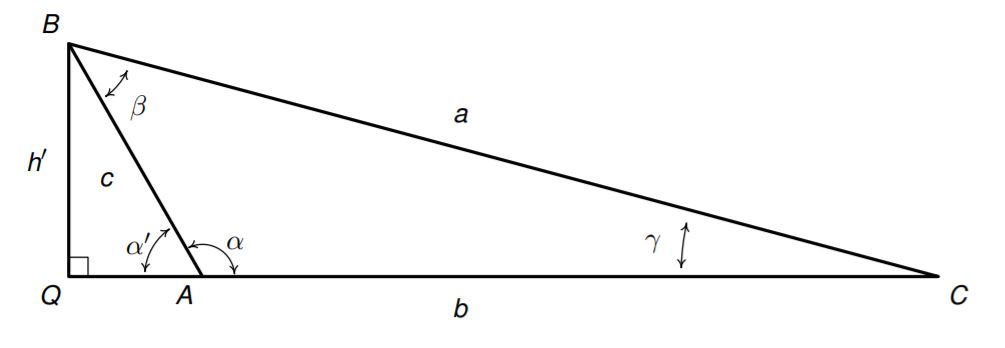
We see $\sin(\alpha') = \frac{h'}{c}$ so that $h' = c \sin(\alpha')$. Since $\alpha' = 180^{\circ} - \alpha$, $\sin(\alpha') = \sin(\alpha)$, so $h' = c\sin(\alpha)$.
Proceeding to $\triangle BCQ$, we get $\sin(\gamma) = \frac{h'}{a}$ so $h' = a \sin(\gamma)$.
As before, we get $\frac{\sin(\gamma)}{c} = \frac{\sin(\alpha)}{a}$, so $ \frac{\sin(\alpha)}{a} = \frac{\sin(\beta)}{b} = \frac{\sin(\gamma)}{c}$ in this case, too.
The remaining case is when $\triangle ABC$ is a right triangle. In this case, the Law of Sines reduces to the formulas given by traditional Right Triangle Trigonometry (SOHCAHTOA) and is left to the reader.
Solving Triangles with the Law of Sines
In order to use the Law of Sines to solve a triangle, we need at least one angle-side opposite pair. The next example showcases some of the power, and the pitfalls, of the Law of Sines.
Solve the following triangle. Give exact answers and decimal approximations (rounded to hundredths) and sketch the triangle.
$$\alpha = 120^\circ, a = 7 \text{ units}, \beta = 45^\circ$$
Knowing an angle-side opposite pair, namely $\alpha$ and $a$, we may proceed in using the Law of Sines.
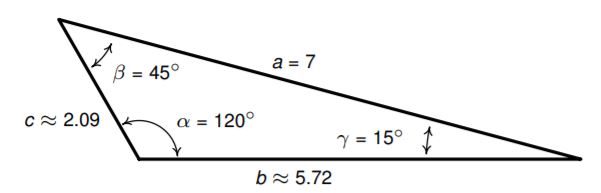
Since $\beta = 45^{\circ}$, we use $\frac{b}{\sin\left(45^{\circ}\right)} = \frac{7}{\sin\left(120^{\circ}\right)}$ so $b = \frac{7\sin\left(45^{\circ}\right)}{\sin\left(120^{\circ}\right)} = \frac{7\sqrt{6}}{3} \approx 5.72$ units.
To find $\gamma$, we use the fact that the sum of the measures of the angles in a triangle is $180^{\circ}$. Hence, $\gamma = 180^{\circ} - 120^{\circ} - 45^{\circ} = 15^{\circ}$.
To find $c$, we have no choice but to used the derived value $\gamma = 15^{\circ}$, yet we can minimize the propagation of error here by using the given angle-side opposite pair $(\alpha, a)$.
The Law of Sines gives us $\frac{c}{\sin\left(15^{\circ}\right)} = \frac{7}{\sin\left(120^{\circ}\right)}$ so that $c = \frac{7\sin\left(15^{\circ}\right)}{\sin\left(120^{\circ}\right)} \approx 2.09$ units
Here is a sketch of this triangle:
Note from the example above that if we are given the measures of two of the angles in a triangle, say $\alpha$ and $\beta$, the measure of the third angle $\gamma$ is uniquely determined using the equation $\gamma = 180^{\circ} - \alpha - \beta$. Knowing the measures of all three angles of a triangle completely determines the triangle's shape. If in addition we are given the length of one of the sides of the triangle, we can then use the Law of Sines to find the lengths of the remaining two sides to determine the size of the triangle.
Solve the following triangle. Give exact answers and decimal approximations (rounded to hundredths) and sketch the triangle.
$$\alpha = 30^\circ, a = 1 \text{ units}, c = 4 \text{ units}$$
Since we are given $(\alpha,a)$ and $c$, we use the Law of Sines to find the measure of $\gamma$.
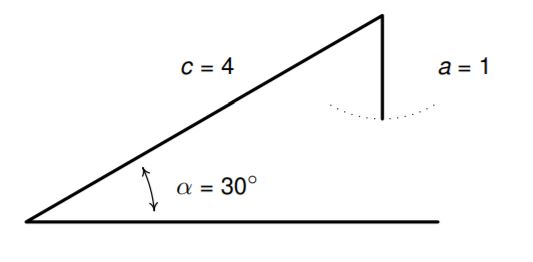
From $\frac{\sin(\gamma)}{4} = \frac{\sin\left(30^{\circ}\right)}{1}$, we get $\sin(\gamma) = 4 \sin\left(30^{\circ}\right) = 2$, which is impossible. If we try to take the inverse sine of 2, we'll get an error. We'll learn more about that soon. As seen below, side $a$ is just too short to make a triangle.
Solve the following triangle. Give exact answers and decimal approximations (rounded to hundredths) and sketch the triangle.
$\alpha = 30^\circ$, $a = 3$ units, $c = 4$ units
Here, we have no option but to use the Law of Sines to solve for an angle. When that happens, warning bells need to go off in our heads, warning us to be cautious! More on that in a moment...
Proceeding as we have in the previous two examples, we use the Law of Sines to find $\gamma$.
In this case, we have $$\frac{\sin(\gamma)}{4} = \frac{\sin\left(30^{\circ}\right)}{3}$$ or $$\sin(\gamma) = \frac{4\sin\left(30^{\circ}\right)}{3} = \frac{2}{3}$$.
Now, here are the warning bells. Recall that the sine of an angle is a positive value for angles from $0^\circ$ to $180^\circ$ (see Section 4.3). So, there are potentially two versions of $\gamma$ which satisfy $\sin(\gamma) = \frac{2}{3}$ and which "fit" inside our triangle.

In this illustration, the reference angle for $\gamma_2$ has the same measure as $\gamma_1$, so $\sin(\gamma_1) = \sin(\gamma_2)$.
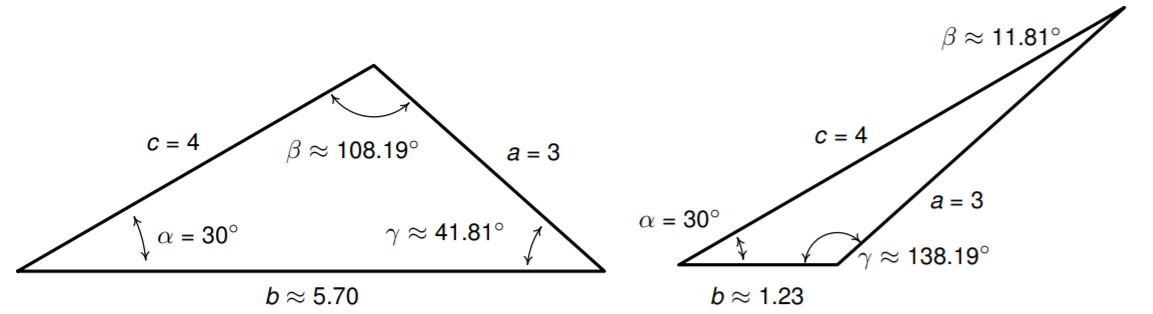
Now, back to our triangle. If $\sin(\gamma) = \frac{2}{3}$, then $\gamma = \sin^{-1}\left(\frac{2}{3}\right) \approx 41.81^\circ$. However, that's only our first, QI angle, so let's say $\gamma_1 = 41.81^\circ$. To find our potential $\gamma_2$, we consider the QII angle with reference angle $41.81^\circ$. To find the actual angle, we subtract that reference from $180^\circ$: $\gamma_2 = 180-41.81 \approx 138.19^\circ$.
Before we go down the path of calculating two separate triangles, let's figure out whether that QII angle actually works. The angles in a triangle should add up to $180^\circ$, and we know taht there has to be a $30^\circ$ angle ($\alpha$) in the triangle. So we check that $$30+138.19 < 180$$
So $138.19^\circ$ isn't too big. We have two distinct triangles that can satisfy these conditions. To finish solving, we'll need to consider both cases.
Case 1: $\gamma_1 = 41.81^\circ$
Since the angles in a triangle add up to $180^\circ$, then
$$\beta_1 \approx 180 - 30 - 41.81 = 108.19^\circ$$Then, we can use the Law of Sines to solve for side b:
$$\frac{a}{\sin{\alpha}} = \frac{b_1}{\sin{\beta}}$$ $$\frac{3}{\sin{30^\circ}} = \frac{b_1}{\sin(108.19^\circ)}$$ $$b_1 = \frac{3}{\sin(30^\circ)}\cdot \sin(108.19^\circ) \approx 5.70$$This triangle is sketched below on the left.
Case 2: $\gamma_2 = 138.19^\circ$
Here, $\beta_2 \approx 180 -30-138.19 = 11.81^\circ$
Then the Law of Sines gives us
$$\frac{a}{\sin{\alpha}} = \frac{b_2}{\sin{\beta}}$$ $$\frac{3}{\sin{30^\circ}} = \frac{b_2}{\sin(11.81^\circ)}$$ $$b_2 = \frac{3}{\sin(30^\circ)}\cdot \sin(11.81^\circ) \approx 1.23$$This triangle is sketched below on the right.
Solve the following triangle. Give exact answers and decimal approximations (rounded to hundredths) and sketch the triangle.
$\alpha = 30^\circ$, $a = 4$ units, $c = 4$ units
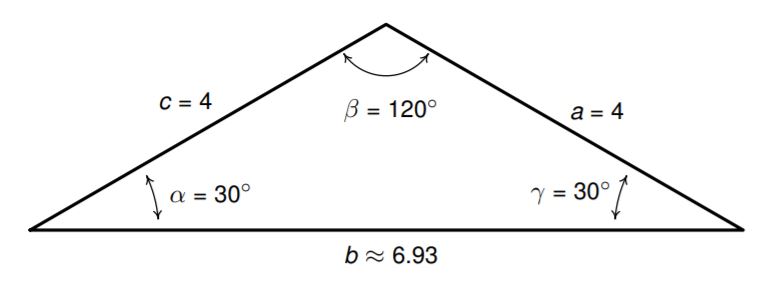
For this last problem, we repeat the usual Law of Sines routine to find that $\frac{\sin(\gamma)}{4} = \frac{\sin\left(30^{\circ}\right)}{4}$ so that $\sin(\gamma) = \frac{1}{2}$. Since $\gamma$ must inhabit a triangle with $\alpha = 30^{\circ}$, we must have $0^{\circ} < \gamma < 150^{\circ}$. If we consider that $\gamma$ may lie in quadrant II, we use $30^\circ$ as the reference and find $\gamma = 180 - 30 = 150^\circ$. But if $\gamma = 150^\circ$, then $\gamma$ and $\alpha$ alone add up to the total $180^\circ$ in a triangle. Hence we do not have to worry about a possible ambiguous second triangle; $\gamma$ can only be $30^\circ$.
Hence, $\beta = 180^{\circ} - 30^{\circ} - 30^{\circ} = 120^{\circ}$. The Law of Sines gives $b = \frac{4\sin\left(120^{\circ}\right)}{\sin\left(30^{\circ}\right)} = 4\sqrt{3} \approx 6.93$ units. We sketch this triangle below.
These latter examples differ from the first because of the type of information that we are initially given. If we are given the measure of just one of the angles in the triangle along with the length of two sides, only one of which is adjacent to the given angle, we are in the `Angle-Side-Side' (ASS) case (In more reputable books, this is called the `Side-Side-Angle' or SSA case). The examples show us that in this case, we may have no triangles, two triangles, or one triangle which may satisfy the given conditions; it's our job to check and determine which of these cases we're dealing with!
Application Problems: Area
In many of the derivations and arguments in this section, we used the height of a given triangle, $h$, as an intermediate variable to prove equivalences. Since the height of a triangle can be used to determine the area enclosed by said triangle, we can use the methods in this section to reformulate area in terms of side lengths and sines of angles.
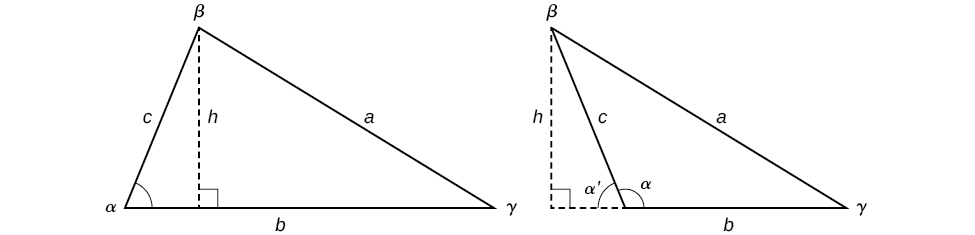
Recall that the area formula for a triangle is given as Area$=\frac{1}{2}bh$, where $b$ is base and $h$ is height. For oblique triangles, we must find $h$ before we can use the area formula. Observing the two triangles in the figure below, one acute and one obtuse, we can drop a perpendicular to represent the height and then apply the trigonometric property $\sin(\alpha)=\frac{\text{opposite}}{\text{hypotenuse}}$ to write an equation for area in oblique triangles. In the acute triangle, we have $\sin(\alpha)=\frac{h}{c}$ or $h = c\sin(\alpha)$.
Thus, in the acute triangle, $$\text{Area} = \frac{1}{2} bh = \frac{1}{2}bc\sin(\alpha)$$
However, in the obtuse triangle, we drop the perpendicular outside the triangle and extend the base $b$ to form a right triangle. The angle used in calculation is α′, or $180−α$. Let's put this back in the coordinate plane for a moment. Since $\alpha$ is obtuse, its terminal side lies in Quadrant II; therefore $180-\alpha$ tells us the measure of the corresponding reference angle. Since our angles' terminal side lies in QII, the sine of the reference is equal to the sine of the angle (that's a fact that we used extensively in Section 4.3). So here $$\sin(\alpha) = \sin(\alpha')=\frac{h}{c}$$ and so $$h = c\sin(\alpha)$$ and we have the same area formula as before $$\text{Area} = \frac{1}{2} bh = \frac{1}{2}bc\sin(\alpha)$$.
This formula can be modified to apply to any pair of sides and their included angle!
Area of a triangle
$$\text{Area} = \frac{1}{2}bc\sin(\alpha)$$ $$=\frac{1}{2}ac\sin(\beta)$$ $$=\frac{1}{2}ab \sin(\gamma)$$
Find the area of a triangle with sides a=90,b=52, and angle γ=102°. Round the area to the nearest integer.
Application Problems: Triangulation
The more we study trigonometric applications, the more we discover that the applications are countless. Some are flat, diagram-type situations, but many applications in calculus, engineering, and physics involve three dimensions and motion.
An aircraft is located between two radio towers 20 miles apart. The angle of elevation from the first tower is 15 degrees; the angle of elevation with the second tower is 35 degrees. What is the height of the aircraft?
We start with a picture:
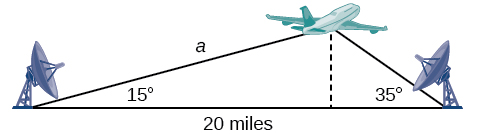
To find the elevation of the aircraft, we first find the distance from one station to the aircraft, such as the side a, and then use right triangle relationships to find the height of the aircraft, h.
Because the angles in the triangle add up to 180 degrees, the unknown angle must be 180°−15°−35°=130°. This angle is opposite the side of length 20, allowing us to set up a Law of Sines relationship.
$$\frac{20}{\sin(130^\circ} = \frac{a}{\sin(35^\circ)}$$ $$a = \frac{20\sin(35^\circ)}{\sin(130^\circ}$$ $$a \approx 14.98 \text{miles}$$
Now that we know a, we can use right triangle relationships to solve for h.
$$\sin(15^\circ) = \frac{h}{a}$$ $$h = a\sin(15^\circ)$$ $$h \approx 3.88$$
The aircraft is at an altitude of approximately 3.9 miles.
A satellite is orbiting Earth. The satellite passes directly over two tracking stations A and B, which are 69 miles apart. When the satellite is on one side of the two stations, the angles of elevation at A and B are measured to be 83.9° and 86.2°, respectively. How far is the satellite from station A and how high is the satellite above the ground? Round answers to the nearest whole mile.
Again, let's start with a picture:

To find how far the satellite is from station A (call that side $b$), we must first find the measure of the angle inside the triangle at B (let's call that angle $\beta$): $$\beta = 180-86.2 = 93.8^\circ$$ That means the angle at the top of the triangle is $$\gamma = 180-93.8-83.9=2.3^\circ$$ The Law of Sines gives us $$\frac{b}{\sin(93.8^\circ)} = \frac{9}{\sin(2.3^\circ)}$$ $$b = \frac{9\sin(93.8^\circ)}{\sin(2.3^\circ)}$$ $$b \approx 223.768 \text{ miles}$$
To work on finding the height of the satellite, let's update our drawing:

Now we use Right Triangle Trigonometry to write $$\sin(83.9^\circ) = \frac{h}{223.768}$$ $$h = 223.768\sin(83.9^\circ) \approx 222.501 \text{ miles}$$
Practice Problems
In these Exercises, solve for the remaining side(s) and angle(s) if possible. As in the text, $(\alpha, a)$, $(\beta, b)$ and $(\gamma, c)$ are angle-side opposite pairs1. $\alpha = 13^{\circ}, \; \beta = 17^{\circ}, \; a = 5$
2. $\alpha = 73.2^{\circ}, \; \beta = 54.1^{\circ}, \; a = 117$
3. $\alpha = 95^{\circ}, \; \beta = 85^{\circ}, \; a = 33.33$
4. $\alpha = 95^{\circ}, \; \beta = 62^{\circ}, \; a = 33.33$
5. $\alpha = 117^{\circ}, \; a = 35, \; b = 42$
6. $\alpha = 117^{\circ}, \; a = 45, \; b = 42$
7. $\alpha = 68.7^{\circ}, \; a = 88, \; b = 92$
8. $\alpha = 42^{\circ}, \; a = 17, \; b = 23.5$
9. $\alpha = 68.7^{\circ}, \; a = 70, \; b = 90$
10. $\alpha = 30^{\circ}, \; a = 7, \; b = 14$
11. $\alpha = 42^{\circ}, \; a = 39, \; b = 23.5$
12. $\gamma = 53^{\circ}, \; \alpha = 53^{\circ}, \; c = 28.01$
13. $\alpha = 6^{\circ}, \; a = 57, \; b = 100$
14. $\gamma = 74.6^{\circ}, \; c = 3, \; a = 3.05$
15. $\beta = 102^{\circ}, \; b = 16.75, \; c = 13$
16. $\beta = 102^{\circ}, \; b = 16.75, \; c = 18$
17. $\beta = 102^{\circ}, \; \gamma = 35^{\circ}, \; b = 16.75$
18. $\beta = 29.13^{\circ}, \; \gamma = 83.95^{\circ}, \; b = 314.15$
1. $\begin{array}{lll} \alpha = 13^{\circ} & \beta = 17^{\circ} & \gamma = 150^{\circ} \\ a = 5 & b \approx 6.50 & c \approx 11.11 \end{array}$
2. $\begin{array}{lll} \alpha = 73.2^{\circ} & \beta = 54.1^{\circ} & \gamma = 52.7^{\circ} \\ a = 117 & b \approx 99.00 & c \approx 97.22 \end{array}$
3. Information does not produce a triangle
4. $\begin{array}{lll} \alpha = 95^{\circ} & \beta = 62^{\circ} & \gamma = 23^{\circ} \\ a = 33.33 & b \approx 29.54 & c \approx 13.07 \end{array}$p>
5. Information does not produce a triangle
6. $\begin{array}{lll} \alpha = 117^{\circ} & \beta \approx 56.3^{\circ} & \gamma \approx 6.7^{\circ} \\ a = 45 & b = 42 & c \approx 5.89 \end{array}$
7. $\begin{array}{lll} \alpha = 68.7^{\circ} & \beta \approx 76.9^{\circ} & \gamma \approx 34.4^{\circ} \\ a = 88 & b = 92 & c \approx 53.36 \end{array}$
$\begin{array}{lll} \alpha = 68.7^{\circ} & \beta \approx 103.1^{\circ} & \gamma \approx 8.2^{\circ} \\ a = 88 & b = 92 & c \approx 13.47\end{array}$
8. $\begin{array}{lll} \alpha = 42^{\circ} & \beta \approx 67.66^{\circ} & \gamma \approx 70.34^{\circ} \\ a = 17 & b = 23.5 & c \approx 23.93 \end{array}$ $\begin{array}{lll} \alpha = 42^{\circ} & \beta \approx 112.34^{\circ} & \gamma \approx 25.66^{\circ} \\ a = 17 & b = 23.5 & c \approx 11.00 \end{array}$
9. Information does not produce a triangle
10. $\begin{array}{lll} \alpha = 30^{\circ} & \beta = 90^{\circ} & \gamma = 60^{\circ} \\ a = 7 & b = 14 & c = 7\sqrt{3} \end{array}$
11. $\begin{array}{lll} \alpha = 42^{\circ} & \beta \approx 23.78^{\circ} & \gamma \approx 114.22^{\circ} \\ a = 39 & b = 23.5 & c \approx 53.15 \end{array}$
12. $\begin{array}{lll} \alpha = 53^{\circ} & \beta = 74^{\circ} & \gamma = 53^{\circ} \\ a = 28.01 & b \approx 33.71 & c = 28.01 \end{array}$
13. $\begin{array}{lll} \alpha = 6^{\circ} & \beta \approx 169.43^{\circ} & \gamma \approx 4.57^{\circ} \\ a = 57 & b = 100 & c \approx 43.45 \end{array}$ $\begin{array}{lll} \alpha = 6^{\circ} & \beta \approx 10.57^{\circ} & \gamma \approx 163.43^{\circ} \\ a = 57 & b = 100 & c \approx 155.51 \end{array}$
14. $\begin{array}{lll} \alpha \approx 78.59^{\circ} & \beta \approx 26.81^{\circ} & \gamma = 74.6^{\circ} \\ a = 3.05 & b \approx 1.40 & c = 3 \end{array}$ $\begin{array}{lll} \alpha \approx 101.41^{\circ} & \beta \approx 3.99^{\circ} & \gamma = 74.6^{\circ} \\ a = 3.05 & b \approx 0.217 & c = 3 \end{array}$
15. $\begin{array}{lll} \alpha \approx 28.61^{\circ} & \beta = 102^{\circ} & \gamma \approx 49.39^{\circ} \\ a \approx 8.20 & b = 16.75 & c = 13 \end{array}$
16. Information does not produce a triangle
17. $\begin{array}{lll} \alpha = 43^{\circ} & \beta = 102^{\circ} & \gamma = 35^{\circ} \\ a \approx 11.68 & b = 16.75 & c \approx 9.82 \end{array}$
18. $\begin{array}{lll} \alpha = 66.92^{\circ} & \beta = 29.13^{\circ} & \gamma = 83.95^{\circ} \\ a \approx 593.69 & b = 314.15 & c \approx 641.75 \end{array}$
19. Find the areas of the triangles given in Exercise 1 and Exercise 12.
19. The area of the triangle from Exercise 1 is about 8.1 square units
The area of the triangle from Exercise 12 is about 377.1 square units.
The Grade of a Road: The grade of a road is much like the pitch of a roof in that it expresses the ratio of rise/run. In the case of a road, this ratio is always positive because it is measured going uphill and it is usually given as a percentage. For example, a road which rises 7 feet for every 100 feet of (horizontal) forward progress is said to have a 7% grade. However, if we want to apply any Trigonometry to a story problem involving roads going uphill or downhill, we need to view the grade as an angle with respect to the horizontal. In Exercises 20-22, we first have you change road grades into angles and then use the Law of Sines in an application.
20. Using a right triangle with a horizontal leg of length 100 and vertical leg with length 7, show that a 7\% grade means that the road (hypotenuse) makes about a $4^{\circ}$ angle with the horizontal. (It will not be exactly $4^{\circ}$, but it's pretty close.)
21. What grade is given by a $9.65^{\circ}$ angle made by the road and the horizontal?
22. Along a long, straight stretch of mountain road with a 7\% grade, you see a tall tree standing perfectly plumb alongside the road. The word `plumb' here means that the tree is perpendicular to the horizontal. From a point 500 feet downhill from the tree, the angle of inclination from the road to the top of the tree is $6^{\circ}$. Use the Law of Sines to find the height of the tree. (Hint: First show that the tree makes a $94^{\circ}$ angle with the road.)
20. $\arctan\left(\frac{7}{100}\right) \approx 0.699$ radians, which is equivalent to $4.004^{\circ}$
21. About 17%
22. About 53 feet
23. Skippy and Sally decide to hunt UFOs. One night, they position themselves 2 miles apart on an abandoned stretch of desert runway. An hour into their investigation, Skippy spies a UFO hovering over a spot on the runway directly between him and Sally. He records the angle of inclination from the ground to the craft to be $75^{\circ}$ and radios Sally immediately to find the angle of inclination from her position to the craft is $50^{\circ}$. How high off the ground is the UFO at this point? Round your answer to the nearest foot. (Recall: 1 mile is 5280 feet.)
24. The angle of depression from an observer in an apartment complex to a gargoyle on the building next door is $55^{\circ}$. From a point five stories below the original observer, the angle of inclination to the gargoyle is $20^{\circ}$. Find the distance from each observer to the gargoyle and the distance from the gargoyle to the apartment complex. Round your answers to the nearest foot. (Use the rule of thumb that one story of a building is 9 feet.)
25. Prove that the Law of Sines holds when $\triangle ABC$ is a right triangle.
26. Discuss with your classmates why knowing only the three angles of a triangle is not enough to determine any of the sides.
27. Discuss with your classmates why the Law of Sines cannot be used to find the angles in the triangle when only the three sides are given. Also discuss what happens if only two sides and the angle between them are given. (Said another way, explain why the Law of Sines cannot be used in the SSS and SAS cases.)
28. Given $\alpha = 30^{\circ}$ and $b = 10$, choose four different values for $a$ so that
- the information yields no triangle
- the information yields exactly one right triangle
- the information yields two distinct triangles
- the information yields exactly one obtuse triangle
Explain why you cannot choose $a$ in such a way as to have $\alpha = 30^{\circ}$, $b = 10$ and your choice of $a$ yield only one triangle where that unique triangle has three acute angles.
23. The UFO is hovering about 9539 feet above the ground.
24. The gargoyle is about 44 feet from the observer on the upper floor.
The gargoyle is about 27 feet from the observer on the lower floor.
The gargoyle is about 25 feet from the other building.
OpenStax is another great source for additional practice problems.