Section 4.3: Trigonometry in the Coordinate Plane
Learning Objectives
In this section you will:
- Find the quadrant in which the terminal side of an angle in standard position falls
- Find reference angles in the coordinate plane
- Use reference triangles to calculate trigonometric ratios in the coordinate plane
- Use reference triangles and special right triangles to calculate trigonometric ratios exactly for common angles.
Reference Angles
So far, we've only defined trigonometric ratios based on what's going on inside of a right triangle. We want to break free of those limitations; for instance, can we define a trigonometric value for an angle that's too big to fit inside a right triangle, like say $190^\circ$? For this, we'll return to our angles in standard position in the coordinate plane and define their reference angles.
To formalize our work, we will begin by drawing angles on an x-y coordinate plane. Angles can occur in any position on the coordinate plane, but for the purpose of comparison, the convention is to illustrate them in the same position whenever possible. An angle is in standard position if its vertex is located at the origin, and its initial side extends along the positive x-axis.

Within this framework, we want to be able to identify in which quadrant a particular angle's terminal side will fall.

As we see in the illustration above, the angles with terminal sides in quadrant I will be between $0^\circ$ and $90^\circ$, that is, between $0$ and $\frac{\pi}{2}$ radians. The angles with terminal sides in quadrant II will be between $90^\circ$ and $180^\circ$, or $\frac{\pi}{2}$ and $\pi$. The angles with terminal sides in quadrant III will be between $180^\circ$ and $270^\circ$, or $\pi$ and $\frac{3\pi}{2}$. Finally, angles with terminal sides in quadrant IV will be between $270^\circ$ and $360^\circ$ or $\frac{3\pi}{2}$ and $2\pi$. Note that there are also many coterminal angles larger or smaller than this first full revolution that may fall in these quadrants, but for our purposes now we will focus only on positive angles within one revolution.
Reference Angles
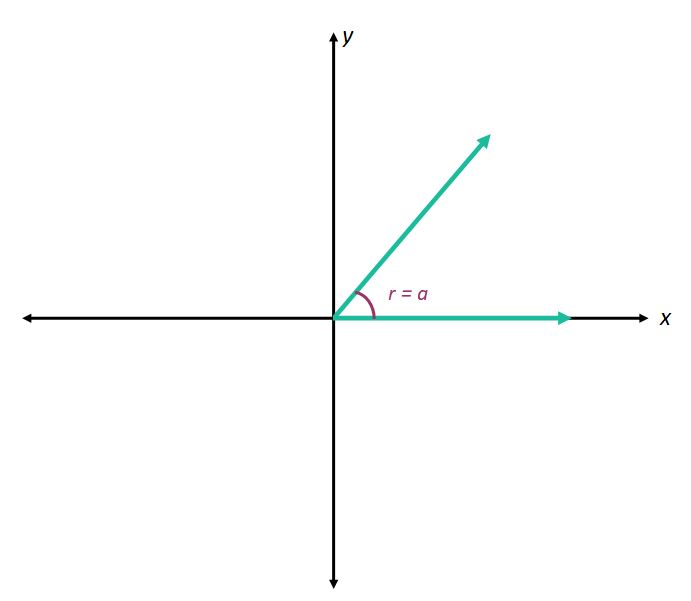
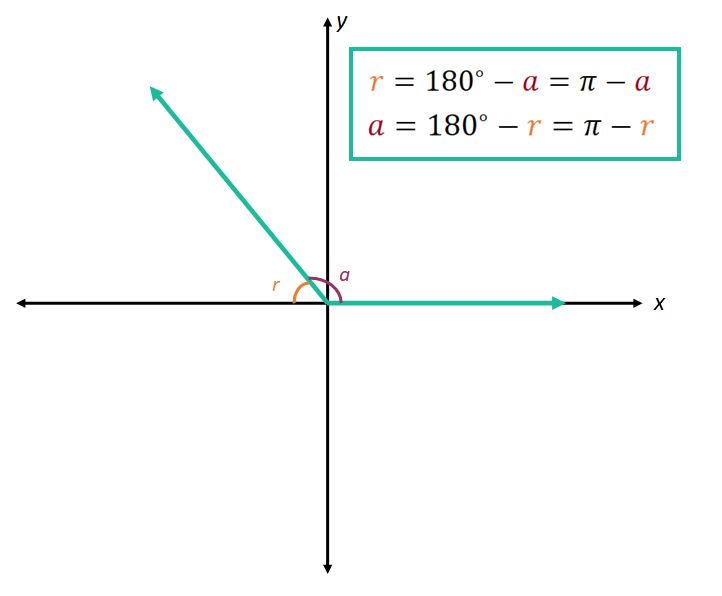
Let $a$ be an angle in standard position in the coordinate plane. The reference angle, $r$, is the smallest angle formed between the terminal side of $a$ and the $x-$axis.
Reference Angles in each quadrant, along with relevant formulas, are pictured below.
Q1
QII
QIII

QIV

We'll practice finding reference angles next. Rather than strictly memorizing the formulas above, it is more useful to think of the geometry of the situation; we're using the fact that a straight line is an angle of $180^\circ$ or $\pi$ radians to help calculate QII and QIII references. Similarly, we're using the fact that a full revolution is an angle of $360^\circ$ or $2\pi$ radians in our QIV calculations.
A. $156^\circ$
First, we must identify which quadrant the terminal side of this angle lies in. $156^\circ$ is between $90^\circ$ and $180^\circ$, so its terminal side lies in QII. To find a reference angle in QII, we subtract the actual angle from the measure of a straight line, $180^\circ$:
\[r = 180^\circ - 156^\circ = 24^\circ \]B. $\frac{5\pi}{4}$
Part of our challenge here is to think in radians, not convert to degrees. To identify the quadrant in which the terminal side of this angle lies, consider that $\frac{5\pi}{4}$ is between $\pi$ and $\frac{3\pi}{2} = \frac{6\pi}{4}$. This tells us that the terminal side of this angle lies in QIII. To find a reference angle in QIII, we subtract the measure of a straight line ($\pi$ radians) from the actual angle:
\[r = \frac{5\pi}{4} - \pi = \frac{5\pi}{4} - \frac{4\pi}{4} = \frac{\pi}{4} \]Reference Triangles
Now that we have a notion of what a reference angle is, we can start building reference right triangles in the coordinate plane. From there, we can start to think about the trigonometric ratios formed by these reference triangles. The most important thing to note as we build these triangles is that, by convention, the hypotenuse is always a positive (distance) value, whereas the signs of the legs will depend on the quadrant.
Reference Triangles
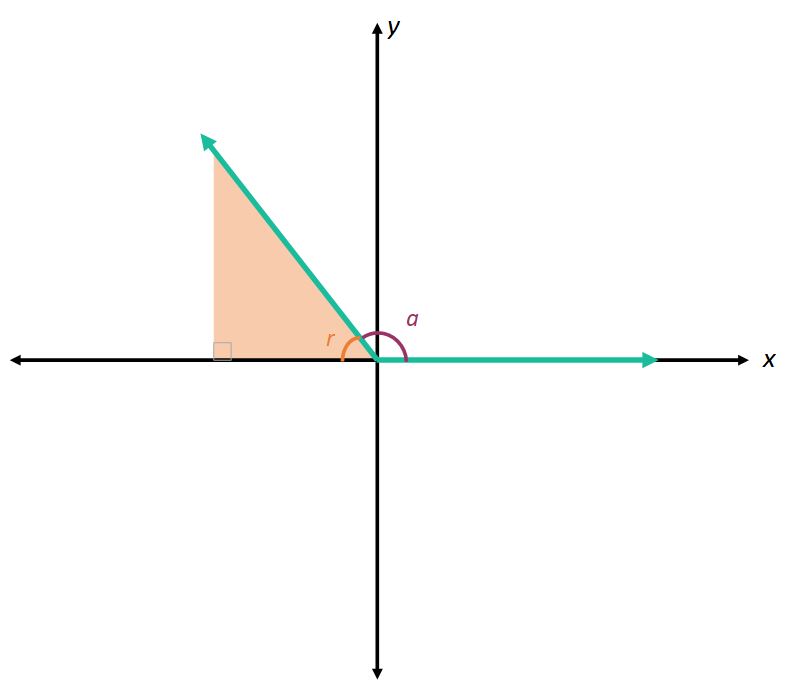
To build a reference triangle for angle $a$ in standard position, we connect the terminal side of angle $a$ to the $x$-axis with a right angle.
Q1

QII
QIII

QIV

Because we are working in the coordinate plane, in the first quadrant, both of the legs of the triangle will have positive values. Hence, the $\sin(r)$ and the $\cos(r)$ will both be positive. In quadrant II, the side adjacent to the reference angle will have a negative value, meaning the $\cos(r)$ will be negative. In this way, we can determine the signs of the trig ratios in each quadrant.
Signs of the Trigonometric Ratios in Each Quadrant

This brings us to how we will define trigonometric ratios on the coordinate plane. Using these reference triangles, we will say, for instance, that the $\sin(a) = \pm \sin(r)$. How that $\pm$ is determined will depend on the quadrant in which our reference triangle lies.
Reference Angle Theorem
Suppose $r$ is the reference angle for $a$. Then $\cos(a) = \pm \cos(r)$ and $\sin(a) = \pm \sin(r)$, where the choice of the ($\pm$) depends on the quadrant in which the terminal side of $a$ lies.
Basically this means we can use the reference triangle to find the sine, cosine, and tangent of any angle $a$ in the coordinate plane, as long as we pay attention to the quadrant that we're working in so that we can figure out the signs! Let's try it out.
The terminal side of angle $\alpha$ in standard position passes through the point $(-2, -4)$. Find the values of the six trigonometric functions of $\alpha$.
It helps immensely to draw a picture of the situation:

The coordinates we are given help us to determine that the side adjacent to the reference angle is labelled -2, and the side opposite the reference angle is labelled -4. To figure out sine and cosine, we also need to find the length of the hypotenuse. We can use the Pythagorean Theorem to figure this out: \[(-2)^2 + (-4)^2 = c^2\] \[4 + 16 = c^2\] \[c = \sqrt{20}\] Since the hypotenuse is always positive, we do not have to worry about considering the $-\sqrt{20}$ for the hypotenuse label. Now that we have all of the lengths, and we know the terminal side is located in QIII, we can find all of the trigonometric ratios for angle $\alpha$.
If $\sin(\theta) = \frac{12}{13}$ and the terminal side of angle $\theta$ is in quadrant II, find $\cos(\theta)$.
Again, it helps us to draw a picture. Remember, trigonometry operates using the properties of similar triangles; we can draw any triangle in QII that has a sine of $\frac{12}{13}$, so let's draw the simplest version of that: a triangle with opposite side 12 and hypotenuse 13.
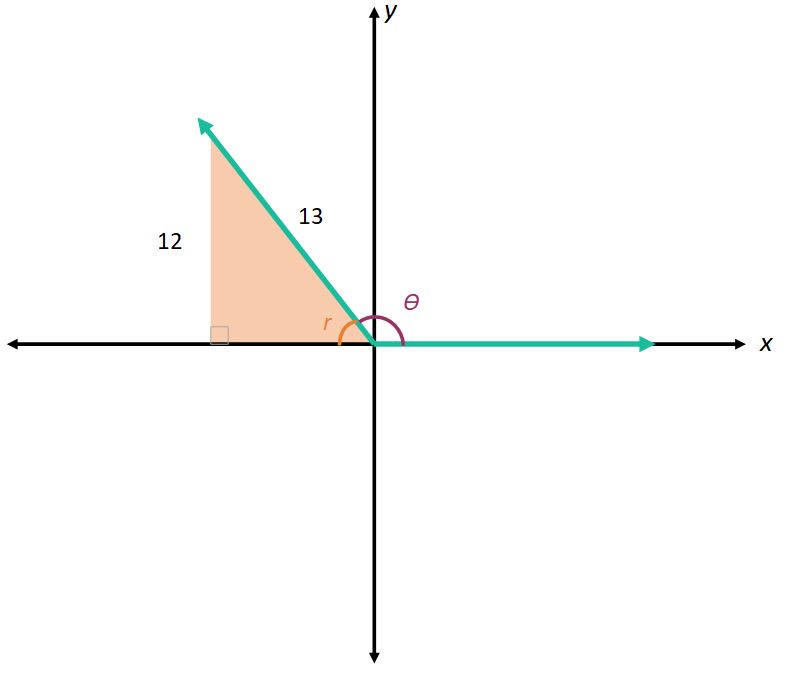
All we need in order to find the cosine is the length of the adjacent side. Again, let's use the Pythagorean Theorem to solve for the length of that side.
\[b^2 + 12^2 = 13^2\] \[b^2 + 144 = 169\] \[b^2 = 25\] \[b = \pm 5\]To decide whether $b = 5$ or $-5$, consider the quadrant; in QII, the adjacent side is negative, so $b = -5$. Therefore
\[\cos(\theta) = -cos(r) = \frac{-5}{13}\]Calculating exact values of special angles
For our next task, it pays to know the cosine and sine values for certain common angles. In the table below, we summarize the values which we consider essential and must be memorized.
A. $\theta = 225^\circ$
We begin by plotting $\theta = 225^{\circ}$ in standard position and find its terminal side overshoots the negative $x$-axis to land in Quadrant III. Hence, we obtain $\theta$'s reference angle $r$ by subtracting: $r = \theta - 180^{\circ} = 225^{\circ} - 180^{\circ} = 45^{\circ}$. Since $\theta$ is a Quadrant III angle, both $\cos(\theta) \lt 0$ and $\sin(\theta) \lt 0$. The Reference Angle Theorem yields: $\cos\left(225^{\circ}\right) = -\cos\left(45^{\circ}\right) = -\frac{\sqrt{2}}{2}$ and $\sin\left(225^{\circ}\right) = - \sin\left(45^{\circ}\right) = -\frac{\sqrt{2}}{2}$.
B. $\theta = \frac{11\pi}{6}$
The terminal side of $\theta = \frac{11\pi}{6}$, when plotted in standard position, lies in Quadrant IV, just shy of the positive $x$-axis. To find $\theta$'s reference angle $r$, we subtract: $r = 2\pi - \theta = 2\pi - \frac{11 \pi}{6} = \frac{\pi}{6}$. Since $\theta$ is a Quadrant IV angle, $\cos(\theta) \gt 0$ and $\sin(\theta) \lt 0$, so the Reference Angle Theorem gives: $\cos\left(\frac{11 \pi}{6} \right) = \cos\left(\frac{\pi}{6} \right) = \frac{\sqrt{3}}{2}$ and $\sin\left(\frac{11\pi}{6}\right) = -\sin\left(\frac{\pi}{6}\right) = -\frac{1}{2}$.
C. $\theta = -\frac{5\pi}{4}$
To plot $\theta = -\frac{5\pi}{4}$, we rotate clockwise an angle of $\frac{5 \pi}{4}$ from the positive $x$-axis. The terminal side of $\theta$, therefore, lies in Quadrant II making an angle of $r = \frac{5 \pi}{4} - \pi = \frac{\pi}{4}$ radians with respect to the negative $x$-axis. Since $\theta$ is a Quadrant II angle, the Reference Angle Theorem gives: $\cos\left(-\frac{5 \pi}{4}\right) = -\cos\left(\frac{\pi}{4}\right) = -\frac{\sqrt{2}}{2}$ and $\sin\left(-\frac{5 \pi}{4}\right) = \sin\left(\frac{\pi}{4}\right) = \frac{\sqrt{2}}{2}$.
D. $\theta = \frac{7\pi}{3}$
Since the angle $\theta = \frac{7 \pi}{3}$ measures more than $2 \pi = \frac{6 \pi}{3}$, we find the terminal side of $\theta$ by rotating one full revolution followed by an additional $r = \frac{7 \pi}{3} - 2\pi = \frac{\pi}{3}$ radians. Since $\theta$ and $r$ are coterminal, $\cos\left(\frac{7\pi}{3}\right) = \cos\left(\frac{\pi}{3}\right) = \frac{1}{2}$ and $\sin\left(\frac{7\pi}{3}\right) = \sin\left(\frac{\pi}{3}\right) = \frac{\sqrt{3}}{2}$.
Practice Exercises
In the following exercises, let $\theta$ be the angle in standard position whose terminal side contains the given point. Compute $\cos(\theta)$ and $\sin(\theta)$.
1. (-7, 24)
2. (3, 4)
3. (5, -9)
4. (-2, -11)
1. $\cos(\theta) = -\frac{7}{25}$, $\sin(\theta) = \frac{24}{25}$
2. $\cos(\theta) = \frac{3}{5}$, $\sin(\theta) = \frac{4}{5}$
3. $\cos(\theta) = \frac{5\sqrt{106}}{106}$, $\sin(\theta) = -\frac{9\sqrt{106}}{106}$
4. $\cos(\theta) = -\frac{2\sqrt{5}}{25}$, $\sin(\theta) = -\frac{11\sqrt{5}}{25}$
In the following exercises, solve for the requested value.
5. If $\sin(\theta) = -\dfrac{7}{25}$ with $\theta$ in Quadrant IV, what is $\cos(\theta)$?
6. If $\cos(\theta) = \dfrac{4}{9}$ with $\theta$ in Quadrant I, what is $\sin(\theta)$?
7. If $\sin(\theta) = \dfrac{5}{13}$ with $\theta$ in Quadrant II, what is $\cos(\theta)$?
8. If $\cos(\theta) = -\dfrac{2}{11}$ with $\theta$ in Quadrant III, what is $\sin(\theta)$?
9. If $\sin(\theta) = -\dfrac{2}{3}$ with $\theta$ in Quadrant III, what is $\cos(\theta)$?
10. If $\cos(\theta) = \dfrac{28}{53}$ with $\theta$ in Quadrant IV, what is $\sin(\theta)$?
11. If $\sin(\theta) = \dfrac{2\sqrt{5}}{5}$ and $\dfrac{\pi}{2} < \theta < \pi$, what is $\cos(\theta)$?
12. If $\cos(\theta) = \dfrac{\sqrt{10}}{10}$ and $2\pi < \theta < \dfrac{5\pi}{2}$, what is $\sin(\theta)$?
5. $\cos(\theta) = \dfrac{24}{25}$
6. $\sin(\theta) = \dfrac{\sqrt{65}}{9}$
7. $\cos(\theta) = -\dfrac{12}{13}$
8. $\sin(\theta) = -\dfrac{\sqrt{117}}{11}$
9. $\cos(\theta) = -\dfrac{\sqrt{5}}{3}$
10. $\sin(\theta) = -\dfrac{45}{53}$
11. $\cos(\theta) = -\dfrac{\sqrt{5}}{5}$
12. $\sin(\theta) = \dfrac{3 \sqrt{10}}{10}$
Find the exact value of the cosine and sine of the given angle (without using a calculator).
13. $\theta = \dfrac{2\pi}{3}$
14. $\theta = \dfrac{3\pi}{4}$
15. $\theta = \dfrac{7\pi}{6}$
16. $\theta = \dfrac{5\pi}{4}$
17. $\theta = \dfrac{4\pi}{3}$
18. $\theta = \dfrac{5\pi}{3}$
19. $\theta = \dfrac{7\pi}{4}$
20. $\theta = \dfrac{23\pi}{6}$
21. $\theta = -\dfrac{43\pi}{6}$
22. $\theta = -\dfrac{3\pi}{4}$
23. $\theta = -\dfrac{\pi}{6}$
24. $\theta = \dfrac{10\pi}{3}$
13. $\cos\left(\dfrac{2\pi}{3}\right) = -\dfrac{1}{2}$, $\; \sin \left(\dfrac{2\pi}{3}\right) = \dfrac{\sqrt{3}}{2}$
14. $\cos \left(\dfrac{3\pi}{4} \right) = -\dfrac{\sqrt{2}}{2}$, $\; \sin \left(\dfrac{3\pi}{4} \right) = \dfrac{\sqrt{2}}{2}$
15. $\cos\left(\dfrac{7\pi}{6}\right) = -\dfrac{\sqrt{3}}{2}$, $\; \sin\left(\dfrac{7\pi}{6}\right) = -\dfrac{1}{2}$
16. $\cos \left(\dfrac{5\pi}{4} \right) = -\dfrac{\sqrt{2}}{2}$, $\; \sin \left(\dfrac{5\pi}{4} \right) = -\dfrac{\sqrt{2}}{2}$
17. $\cos\left(\dfrac{4\pi}{3}\right) = -\dfrac{1}{2}$, $\; \sin \left(\dfrac{4\pi}{3}\right) = -\dfrac{\sqrt{3}}{2}$
18. $\cos\left(\dfrac{5\pi}{3}\right) = \dfrac{1}{2}$, $\; \sin \left(\dfrac{5\pi}{3}\right) = -\dfrac{\sqrt{3}}{2}$
19. $\cos \left(\dfrac{7\pi}{4} \right) = \dfrac{\sqrt{2}}{2}$, $\; \sin \left(\dfrac{7\pi}{4} \right) = -\dfrac{\sqrt{2}}{2}$
20. $\cos\left(\dfrac{23\pi}{6}\right) = \dfrac{\sqrt{3}}{2}$, $\; \sin\left(\dfrac{23\pi}{6}\right) = -\dfrac{1}{2}$
21. $\cos\left(-\dfrac{43\pi}{6}\right) = -\dfrac{\sqrt{3}}{2}$, $\; \sin\left(-\dfrac{43\pi}{6}\right) = \dfrac{1}{2}$
22. $\cos \left(-\dfrac{3\pi}{4} \right) = -\dfrac{\sqrt{2}}{2}$, $\; \sin \left(-\dfrac{3\pi}{4} \right) = -\dfrac{\sqrt{2}}{2}$
23. $\cos\left(-\dfrac{\pi}{6}\right) = \dfrac{\sqrt{3}}{2}$, $\; \sin\left(-\dfrac{\pi}{6}\right) = -\dfrac{1}{2}$
24. $\cos\left(\dfrac{10\pi}{3}\right) = -\dfrac{1}{2}$, $\; \sin \left(\dfrac{10\pi}{3}\right) = -\dfrac{\sqrt{3}}{2}$
Homework Set
- Given that the point $(180, -19)$ is on the terminal side of angle $\theta$ in standard position, find the exact value of each of the following.
- $\sin(\theta)$
- $\cos(\theta)$
- $\tan(\theta)$
- $\csc(\theta)$
- $\sec(\theta)$
- $\cot(\theta)$
- Given that the point $(-5, -7)$ is on the terminal side of angle $\theta$ in standard position, find the exact value of each of the following.
- $\sin(\theta)$
- $\cos(\theta)$
- $\tan(\theta)$
- $\csc(\theta)$
- $\sec(\theta)$
- $\cot(\theta)$
- Given that the point $(-90,56)$ is on the terminal side of angle $\theta$ in standard position, find the exact value of each of the following.
- $\sin(\theta)$
- $\cos(\theta)$
- $\tan(\theta)$
- $\csc(\theta)$
- $\sec(\theta)$
- $\cot(\theta)$
- If $\sin(\theta)=-\frac{12}{13}$ and the terminal side of $\theta$ in standard position falls in quadrant IV, find the exact value of $\cos(\theta)$.
- If $\tan(\theta)=\frac{40}{9}$ and the terminal side of $\theta$ in standard position falls in quadrant III, find the exact value of $\sec(\theta)$.
- If $\csc(\theta)=\frac{\sqrt{29}}{5}$ and the terminal side of $\theta$ in standard position falls in quadrant II, find the exact value of $\tan(\theta)$.
- If $\cot(\theta)=-\frac{6}{11}$ and the terminal side of $\theta$ in standard position falls in quadrant IV, find the exact value of $\sin(\theta)$.
- If $\cos(\theta)=\frac{2}{5}$ and the terminal side of $\theta$ in standard position falls in quadrant IV, find the exact value of $\sin(\theta)$.
- For an angle of $300^\circ$...
- In what quadrant does the terminal side of this angle fall?
- What is the reference angle?
- Using the information above, compute $\sin(300^\circ)$.
- Using the information above, compute $\cos(300^\circ).$
- For an angle of $120^\circ$...
- In what quadrant does the terminal side of this angle fall?
- What is the reference angle?
- Using the information above, compute $\sin(120^\circ)$.
- Using the information above, compute $\cos(120^\circ).$
- For an angle of $225^\circ$...
- In what quadrant does the terminal side of this angle fall?
- What is the reference angle?
- Using the information above, compute $\sin(225^\circ)$.
- Using the information above, compute $\cos(225^\circ).$
- For an angle of $315^\circ$...
- In what quadrant does the terminal side of this angle fall?
- What is the reference angle?
- Using the information above, compute $\csc(315^\circ)$.
- Using the information above, compute $\sec(315^\circ).$
- For an angle of $\frac{5\pi}{4}$...
- In what quadrant does the terminal side of this angle fall?
- What is the reference angle?
- Using the information above, compute $\sin(\left(\frac{5\pi}{4}\right)$.
- Using the information above, compute $\cos(\left(\frac{5\pi}{4}\right).$
- For an angle of $\frac{5\pi}{3}$...
- In what quadrant does the terminal side of this angle fall?
- What is the reference angle?
- Using the information above, compute $\sin(\left(\frac{5\pi}{3}\right)$.
- Using the information above, compute $\cos(\left(\frac{5\pi}{3}\right).$
- For an angle of $\frac{5\pi}{6}$...
- In what quadrant does the terminal side of this angle fall?
- What is the reference angle?
- Using the information above, compute $\sin(\left(\frac{5\pi}{6}\right)$.
- Using the information above, compute $\cos(\left(\frac{5\pi}{6}\right).$
- Using the information above, compute $\sec(\left(\frac{5\pi}{6}\right).$
- Using the information above, compute $\csc(\left(\frac{5\pi}{6}\right).$
- For an angle of $-240^\circ$...
- What is the smallest, positive, coterminal angle?
- In what quadrant does the terminal side of this angle fall?
- What is the reference angle?
- Using the information above, compute $\sin(\left(-240^\circ\right)$.
- Using the information above, compute $\cos(\left(-240^\circ\right).$
- For an angle of $\frac{23\pi}{6}$...
- What is the smallest, positive, coterminal angle?
- In what quadrant does the terminal side of this angle fall?
- What is the reference angle?
- Using the information above, compute $\sin(\left(-\frac{23\pi}{6}\right)$.
- Using the information above, compute $\cos(\left(\frac{23\pi}{6}\right).$