Section 4.2: Right Triangle Trigonometry
Learning Objectives
In this section you will:
- Write proportions using similar triangles
- Use right triangles to evaluate trigonometric functions
- Use trigonometric functions to solve triangles
- Find function values for common angles
- Use right-triangle trigonometry to solve applied problems
Similar Triangles
Two triangles are said to be similar if their corresponding angles have the same measure. In the interactive activity from Geogebra below, triangle ABC is similar to triangle DEF because angles A and D have the same measure, angles B and E have the same measure, and angles C and F have the same measure.
Made with Geogebra
On the blue triangle on the left, drag around points A, B, and/or C. Observe the ratios described beneath the triangles (like c/b and f/e). What do you notice about the ratios between the two similar triangles?
This is the other important property of similar triangles: corresponding sides are proportional. So, as long as we have a pair of similar triangles, ABC and DEF, their corresponding sides are proportional: $\frac{c}{b}=\frac{f}{e}$, $\frac{c}{a}=\frac{f}{d}$, and $\frac{b}{a}=\frac{e}{d}$, to name a few such proportions.
Similar Right Triangles
Now, we're building up to something magical. Recall (from somewhere in the depths of your geometry education) that the angles in a triangle should always add up to $180^\circ$. You can check with the triangles in the applet above. We're going to use this fact to create classes of right triangles. In other words, if we know we have a right triangle (a triangle with a $90^\circ$ angle), we can use one of the other angles in as a reference and create a whole class of similar triangles.
Let's start with a right triangle with another angle that is $28^\circ$. This is enough to describe a class of similar triangles, since the third angle in the triangle must be $180-28-90 = 62^\circ$; therefore, we have defined a group of similar triangles with angle measures of $90^\circ, 28^\circ$, and $62^\circ$. Now, if we create ratios using the sides of those triangles, we know that those ratios will always produce the same value. Check it out in the demo applet below:
Made with Geogebra
If we resize the triangle, but don't change the angles, the ratios of the sides stay the same. This is such a special feature of right triangles that mathematicians decided to name those ratios!
Right Triangle Trigonometry
We can define the trigonometric functions in terms a reference angle $t$ and the lengths of the sides of the triangle. The adjacent side is the leg closest to the reference angle. (Adjacent means “next to.”) The opposite side is the leg across from the angle. The hypotenuse is the side of the triangle opposite the right angle. These sides are labeled in the figure below:

Given a class of right triangles with reference angle $t$, we know that the ratio of, say, the opposite side and the hypotenuse will always be a particular number given a particular value of $t$. So, we're going to name each of those ratios.
The Trigonometric Ratios
Given a right triangle with an acute angle of $t$, we define the following trigonometric ratios:
Sine: $\sin(t)=\frac{\text{opposite}}{\text{hypotenuse}}$
Cosine: $\cos(t)=\frac{\text{adjacent}}{\text{hypotenuse}}$
Tangent: $\tan(t) = \frac{\text{opposite}}{\text{adjacent}}$
A common mnemonic for remembering these relationships is SohCahToa (or as some students like to write it $S\frac{o}{h}C\frac{a}{h}T\frac{o}{a}$), formed from the first letters of “Sine is opposite over hypotenuse, Cosine is adjacent over hypotenuse, Tangent is opposite over adjacent.”
Given the triangle shown below, find the value of the three main trigonometric ratios:

First, we want to label the sides. Since $\alpha$ is our reference, the side adjacent to the angle is 15, and the hypotenuse of the triangle is 17. The opposite side currently has an unknown length. Good news, though, we can use our old friend the Pythagorean Theorem to find the length of the opposite side: $$15^2+x^2 = 17^2$$ $$x^2 = 17^2 - 15^2$$ $$x^2 = 64$$ $$x = 8$$ Now, we find the values of the trigonometric ratios: $$\sin(\alpha) = \frac{\text{opposite}}{\text{hypotenuse}}=\frac{8}{17}$$ $$\cos(\alpha) = \frac{\text{adjacent}}{\text{hypotenuse}}=\frac{15}{17}$$ $$\tan(\alpha) = \frac{\text{opposite}}{\text{adjacent}}=\frac{8}{15}$$
The Reciprocal Trigonometric Functions
In addition to sine, cosine, and tangent, there are three more functions. They can be defined either in terms of the sides of the right triangle, or by their relationship to the three main trigonometric functions.
The Reciprocal Trigonometric Ratios
Given a right triangle with an acute angle of $t$, we define the following trigonometric ratios:
Cosecant: $\csc(t)=\frac{\text{hypotenuse}}{\text{opposite}}=\frac{1}{\sin(t)}$
Secant: $\sec(t)=\frac{\text{hypotenuse}}{\text{adjacent}} = \frac{1}{\cos(t)}$
Cotangent: $\cot(t) = \frac{\text{adjacent}}{\text{opposite}}=\frac{1}{\tan(t)}$
Note the confusing terminology: cosecant is the reciprocal of sine, while secant is the reciprocal of cosine. This is one of those inconvenient math definitions that we have to accept and make our piece with.
Many problems ask for all six trigonometric functions for a given angle in a triangle. A possible strategy to use is to find the sine, cosine, and tangent of the angles first. Then, find the other trigonometric functions easily using the reciprocals.
Using the triangle shown below, evaluate $\sin(\alpha), \cos(\alpha), \tan(\alpha), \csc(\alpha), \sec(\alpha)$, and $\cot(\alpha)$.

Again, we don't know the length of one of the legs, but we can figure that out using the Pythagorean Theorem:
$$3^2 + x^2 = 5^2$$ $$x^2 = 25 - 9$$ $$x^2 = 16$$ $$x = 4$$Now, name the sides of the triangle according to the reference angle:

Next, evaluate the main trig ratios:
$$\sin(\alpha)=\frac{\text{opposite}}{\text{hypotenuse}}=\frac{4}{5}$$ $$\cos(\alpha)=\frac{\text{adjacent}}{\text{hypotenuse}}=\frac{3}{5}$$ $$\tan(\alpha)=\frac{\text{opposite}}{\text{adjacent}}=\frac{4}{3}$$Now, to find the rest, we use the fact that cosecant is the reciprocal of sine: $$\csc(\alpha) = \frac{1}{\sin(\alpha)} = \frac{5}{4}$$ secant is the reciprocal of cosine: $$\sec(\alpha) = \frac{1}{\cos(\alpha)} = \frac{5}{3}$$ and cotangent is the reciprocal of tangent: $$\cot(\alpha) = \frac{1}{\tan(\alpha)} = \frac{3}{4}$$.
Using Trigonometric Functions to Solve Triangles
In previous examples, we evaluated the sine and cosine in triangles where we knew all three sides. But the real power of right-triangle trigonometry emerges when we look at triangles in which we know an angle but do not know all the sides.
Given a right triangle, the length of one side, and the measure of one acute angle, find the remaining sides.
- For each side, select the trigonometric function that has the unknown side as either the numerator or the denominator. The known side will in turn be the denominator or the numerator.
- Write an equation setting the function value of the known angle equal to the ratio of the corresponding sides.
- Using the value of the trigonometric function and the known side length, solve for the missing side length.
Find the unknown sides of the triangle:
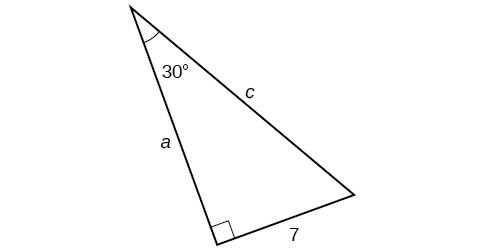
Let's start by naming all of the sides of the triangle. Using the 30 degree angle as a reference, the side labelled a is adjacent, the side labelled 7 is opposite, and the side labelled c is the hypotenuse. If we want to solve for side a, then we are looking for the adjacent side, and we know the lenght of the opposite side. The common trigonometric ratio involving the opposite and adjacent sides is tangent.
Now, we use the tangent ratio to create an equation: $$\tan(\alpha) = \frac{\text{opposite}}{\text{adjacent}}$$ $$\tan(30^\circ) = \frac{7}{a}$$ We want to solve for a, but it's in the denominator. So, we can multiply on both sides of the equation by a, then divide to isolate a: $$a\cdot \tan(30^\circ) = 7$$ $$a = \frac{7}{\tan(30^\circ)}$$ Because of the magical properties of similar right triangles, we know $\tan(30^\circ)$ is always a particular value, and we can use our calculator to get an approximation of this value. Be careful not to round too soon though; it's more accurate to enter $\frac{7}{\tan(30^\circ)}$ all at once in your calculator. If you do so, the approximate answer rounded to four decimal places is $$a \approx 12.1244$$.
Next, let's solve for $c$. To get the most accurate answer, we want to use as much of the original, given information as possible, and avoid using our rounded answer for a if at all possible. So, c is the hypotenuse, and we were given the length of the opposite side. The basic trig ratio involving the opposite side and the hypotenuse is sine, so we create the equation: $$\sin(\alpha) = \frac{\text{opposite}}{\text{hypotenuse}}$$ $$\sin(30^\circ) = \frac{7}{c}$$ $$c = \frac{7}{\sin(30^\circ)}$$ Luckily, this time our answer happens to be exact (no need to round): $$c = 14$$
We can also use trigonometric ratios to solve for missing angles in a right triangle. First, we must gently introduce inverse trigonometric functions. We will study these inverse functions more deeply in a later section. For now, we only need to know the following relationship:
Inverse Trigonometric Functions
$$\text{If } \sin(a) = b \text{ and } -90^\circ \lt a \lt 90^\circ, \text{ then } a = \sin^{-1}(b)$$ $$\text{If } \cos(a) = b \text{ and } 0^\circ \lt a \lt 180^\circ, \text{ then } a = \cos^{-1}(b)$$ $$\text{If } \tan(a) = b \text{ and } -90^\circ \lt a \lt 90^\circ, \text{ then } a = \tan^{-1}(b)$$There are a couple of extremely important caveats to notice and understand. First of all:
$\sin^{-1}(x)$ is not the same as $\frac{1}{\sin(x)}$
$\cos^{-1}(x)$ is not the same as $\frac{1}{\cos(x)}$
$\tan^{-1}(x)$ is not the same as $\frac{1}{\tan(x)}$
In other words, that exponent is not really an exponent. It's rather a tag that means "we want to use the inverse function here." Confusing, we know. If someone would make us monarchs of math, we'd get rid of this confusing notation for good. Alas. If we did want, for example, $\frac{1}{\sin(x)}$, we'd simply use $\csc(x)$.
Also notice that the inverse trigonometric functions swap the inputs and outputs of the trig functions. For example, with $\sin(a) = b$, the input (a) is an angle and the output, b, is the ratio of the opposite side over the hypotenuse of a triangle with reference angle a. With $\sin^{-1}(b) = a$, the input is that ratio of opposite side over hypotenuse, and the output tells us the reference angle we'd need to produce that ratio. Therefore, we'll be able to use these inverse functions to solve for angles.
Finally, notice that these inverse trigonometric functions are defined only for particular intervals of angles. That will be nothing to worry about in this section, since we're dealing in right triangles. Later on, we'll have to be a little bit more careful when interpreting the results after applying an inverse trigonometric function.
Given two sides of a right triangle, solve for an angle.
- Determine which sides of the triangle are involved and the corresponding "main" trigonometric ratio (i.e. sine, cosine, or tangent).
- Write an equation using that trigonometric ratio and the sides involved.
- Rewrite the equation using the corresponding inverse trigonometric function.
- Use a calculator to evaluate approximately.
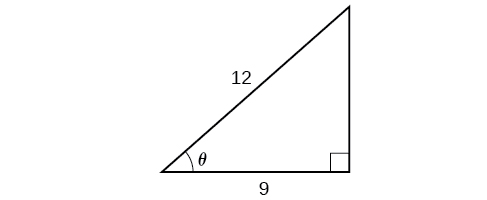
In the picture, the side labeled 9 is adjacent to the reference angle, and the side labeled 12 is the hypotenuse. The common ratio involving adjacent and hypotenuse is cosine, so $$\cos(\theta) = \frac{9}{12}$$ Rewrite as an inverse function: $$\theta = \cos^{-1}\left(\frac{9}{12}\right)$$ Use a calculator to evaluate approximately: $$\theta \approx 41.4096^\circ$$

In the picture, the side labeled 6 is opposite to the reference angle, and the side labeled 10 is the hypotenuse. The common ratio involving opposite and hypotenuse is sine, so $$\sin(\theta) = \frac{6}{10}$$ Rewrite as an inverse function: $$\theta = \sin^{-1}\left(\frac{6}{10}\right)$$ Use a calculator to evaluate approximately: $$\theta \approx 36.8699^\circ$$
Special Right Triangles
$30^\circ-60^\circ-90^\circ$ Triangles
There are some triangles that are so common, and so special, that it's worth knowing the values of sine and cosine that they produce. To build the first type of special right triangle, we'll start with an equilateral triangle. In an equilateral triangle, all the angles are the same measure ($60^\circ$) and all the sides are the same length (we'll call that length $2x$ for now):

To create a right triangle that we can work with, we'll draw an altitude in this triangle. That will split the base exactly in half, and it will split the top angle exactly in half:

Now we can use the Pythagorean Theorem to solve for the height of this triangle: $$x^2+h^2=(2x)^2$$ $$x^2+h^2=4x^2$$ $$h^2= 3x^2$$ $$h = x\sqrt{3}$$
That gives us this reference triangle:

Now we can figure out the sine and cosine of $30^\circ$: $$\sin(30^\circ) = \frac{x}{2x} = \frac{1}{2}$$ $$\cos(30^\circ) = \frac{x\sqrt{3}}{2x} = \frac{\sqrt{3}}{2}$$ and the sine and cosine of $60^\circ$: $$\sin(60^\circ) = \frac{x\sqrt{3}}{2x} = \frac{\sqrt{3}}{2}$$ $$\cos(60^\circ) = \frac{x}{2x} = \frac{1}{2}$$
$45^\circ-45^\circ-45^\circ$ Triangles
There's another set of special sine and cosine values that we want to explore. Our door into these will be an isoscoles right triangle:
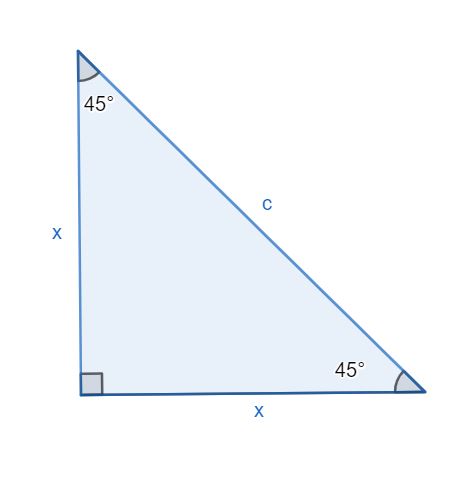
Again, we'll use the Pythagorean Theorem to solve, but this time for the hypotenuse: $$x^2 + x^2 = c^2$$ $$2x^2 = c^2$$ $$c = x\sqrt{2}$$
And then we can find the sine and cosine of $45^\circ$: $$\sin(45^\circ)=\frac{x}{x\sqrt{2}} = \frac{1}{\sqrt{2}}$$ $$\cos(45^\circ)=\frac{x}{x\sqrt{2}} = \frac{1}{\sqrt{2}}$$
Commonly, we'll rationalize the denominator of this fraction: $$\frac{1}{\sqrt{2}}\cdot\frac{\sqrt{2}}{\sqrt{2}} = \frac{\sqrt{2}}{2}$$ $$\sin(45^\circ) = \cos(45^\circ) = \frac{\sqrt{2}}{2}$$
The sines and cosines of these angles are going to become our particular friends in this chapter. We'll also want to get to know them well when we're thinking in terms of radians. We recommend that you commit to memorizing the following (like back in the days when you learned your times tables!).
Sines and Cosines of Special Angles
$$\sin(30^\circ) = \sin\left(\frac{\pi}{6}\right) = \frac{1}{2}$$ $$\cos(30^\circ) = \cos\left(\frac{\pi}{6}\right) = \frac{\sqrt{3}}{2}$$
$$\sin(60^\circ) = \sin\left(\frac{\pi}{3}\right) = \frac{\sqrt{3}}{2}$$ $$\cos(60^\circ) = \cos\left(\frac{\pi}{3}\right) = \frac{1}{2}$$
$$\sin(45^\circ) = \sin\left(\frac{\pi}{4}\right) = \frac{\sqrt{2}}{2}$$ $$\cos(45^\circ) = \cos\left(\frac{\pi}{4}\right) = \frac{\sqrt{2}}{2}$$
Using Right Triangle Trigonometry to Solve Applied Problems
Right-triangle trigonometry has many practical applications. For example, the ability to compute the lengths of sides of a triangle makes it possible to find the height of a tall object without climbing to the top or having to extend a tape measure along its height. We do so by measuring a distance from the base of the object to a point on the ground some distance away, where we can look up to the top of the tall object at an angle. The angle of elevation of an object above an observer relative to the observer is the angle between the horizontal and the line from the object to the observer's eye. The right triangle this position creates has sides that represent the unknown height, the measured distance from the base, and the angled line of sight from the ground to the top of the object. Knowing the measured distance to the base of the object and the angle of the line of sight, we can use trigonometric functions to calculate the unknown height.
Similarly, we can form a triangle from the top of a tall object by looking downward. The angle of depression of an object below an observer relative to the observer is the angle between the horizontal and the line from the object to the observer's eye.

How long a ladder is needed to reach a windowsill 50 feet above the ground if the ladder rests against the building making an angle of $75^\circ$ with the ground? Round to the nearest foot.
First, draw the situation:

We know the side opposite the reference angle is 50 feet, and we want to solve for the hypotenuse (which represents the length of the ladder). Therefore, we'll use a sine function to solve the problem: $$\sin(75^\circ)=\frac{50}{x}$$ $$x = \frac{50}{\sin(75^\circ}$$ $$x \approx 51.76 \text{ ft}$$
A radio tower is located 325 feet from a building. From a window in the building, a person determines that the angle of elevation to the top of the tower is 43°, and that the angle of depression to the bottom of the tower is 31°. How tall is the tower?
Please forgive the author's hand-drawn illustration:
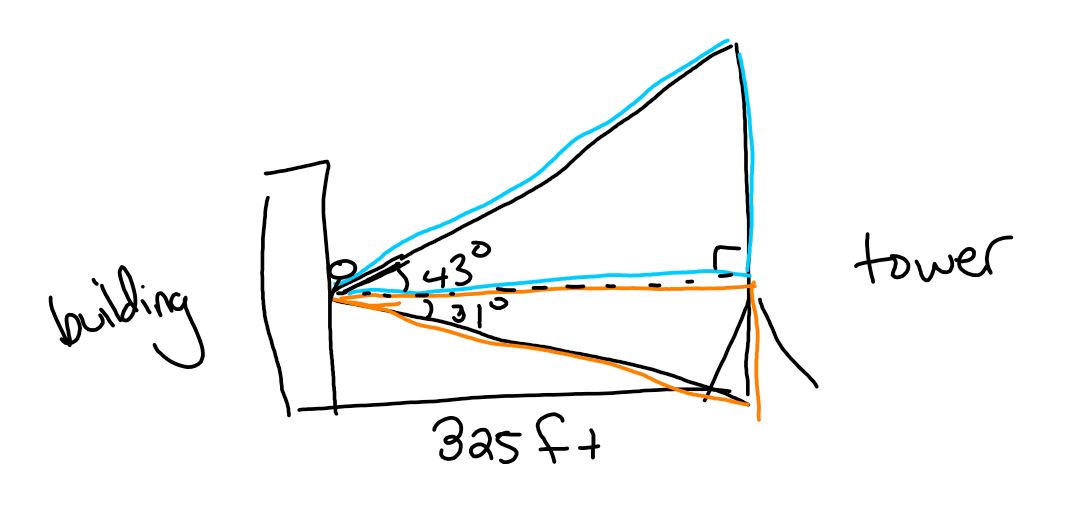
As pictured above, this situation creates two right triangles. We want to solve in each of the opposite side to our reference angles, and we know that the adjacent side is of length 325 ft. Hence, we can use the tangent function: $$\tan(43^\circ) = \frac{x_1}{325}$$ $$x_1 = 325\tan(43^\circ)$$ and $$\tan(31^\circ) = \frac{x_2}{325}$$ $$x_2 = 325\tan(31^\circ)$$ If we add up these values, we have the total height of the tower (remember not to round until the very end!): $$x_1 + x_2 = 325\tan(43^\circ) + 325\tan(31^\circ) \approx 498.35 \text{ ft}$$
Practice Exercises:
In the following exercises, find the requested values.
1. Find $\theta, a,$ and $c$.

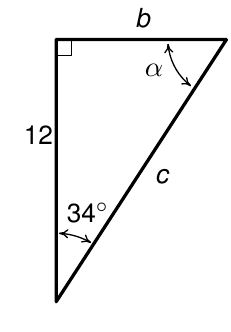
2. Find $\alpha, b$, and $c$.
3. Find $\theta, a$, and $c$.

4. Find $\beta, b$, and $c$.

1. $\theta = 30^{\circ}$,
$a = 3\sqrt{3}$,
$c = \sqrt{108} = 6\sqrt{3}$
2. $\alpha = 56^{\circ}$,
$b = 12 \tan(34^{\circ}) = 8.094$,
$c = 12\sec(34^{\circ}) = \dfrac{12}{\cos(34^{\circ})} \approx 14.475$
3. $\theta = 43^{\circ}$,
$a = 6\cot(47^{\circ}) = \dfrac{6}{\tan(47^{\circ})} \approx 5.595$,
$c = 6\csc(47^{\circ}) = \dfrac{6}{\sin(47^{\circ})} \approx 8.204$
4. $\beta = 40^{\circ}$,
$b = 2.5 \tan(50^{\circ}) \approx 2.979$,
$c = 2.5\sec(50^{\circ}) = \dfrac{2.5}{\cos(50^{\circ})} \approx 3.889$
In the following exercises, answer assuming $\theta$ is an angle in a right triangle.
5. If $\theta = 30^{\circ}$ and the side opposite $\theta$ has length $4$, how long is the side adjacent to $\theta$?
6. If $\theta = 15^{\circ}$ and the hypotenuse has length $10$, how long is the side opposite $\theta$?
7. If $\theta = 87^{\circ}$ and the side adjacent to $\theta$ has length $2$, how long is the side opposite $\theta$?
8. If $\theta = 38.2^{\circ}$ and the side opposite $\theta$ has lengh $14$, how long is the hypoteneuse?
9. If $\theta = 2.05^{\circ}$ and the hypotenuse has length $3.98$, how long is the side adjacent to $\theta$?
10. If $\theta = 42^{\circ}$ and the side adjacent to $\theta$ has length $31$, how long is the side opposite $\theta$?
5. The side adjacent to $\theta$ has length $4\sqrt{3} \approx 6.928$
6. The side opposite $\theta$ has length $10 \sin(15^{\circ}) \approx 2.588$
7. The side opposite $\theta$ is $2\tan(87^{\circ}) \approx 38.162$
8. The hypoteneuse has length $14 \csc(38.2^{\circ}) = \dfrac{14}{\sin(38.2^{\circ})} \approx 22.639$
9. The side adjacent to $\theta$ has length $3.98 \cos(2.05^{\circ}) \approx 3.977$
10. The side opposite $\theta$ has length $31\tan(42^{\circ}) \approx 27.912$
In the following exercises, find the two acute angles in the right triangle whose sides have the given lengths. Express your answers using degree measure rounded to two decimal places.
11. 3, 4, and 5
12. 5, 12, and 13
13. 336, 527, and 625
11. $36.87^{\circ}$ and $53.13^{\circ}$
12. $22.62^{\circ}$ and $67.38^{\circ}$
13. $32.52^{\circ}$ and $57.48^{\circ}$
14. A tree standing vertically on level ground casts a 120 foot long shadow. The angle of elevation from the end of the shadow to the top of the tree is $21.4^{\circ}$. Find the height of the tree to the nearest foot. With the help of your classmates, research the term umbra versa and see what it has to do with the shadow in this problem.
15. The broadcast tower for radio station WSAZ (Home of ``Algebra in the Morning with Carl and Jeff'') has two enormous flashing red lights on it: one at the very top and one a few feet below the top. From a point 5000 feet away from the base of the tower on level ground the angle of elevation to the top light is $7.970^{\circ}$ and to the second light is $7.125^{\circ}$. Find the distance between the lights to the nearest foot.
16. From a firetower 200 feet above level ground in the Sasquatch National Forest, a ranger spots a fire off in the distance. The angle of depression to the fire is $2.5^{\circ}$. How far away from the base of the tower is the fire?
17. The ranger in question 16. sees a Sasquatch running directly from the fire towards the firetower. The ranger takes two sightings. At the first sighting, the angle of depression from the tower to the Sasquatch is $6^{\circ}$. The second sighting, taken just 10 seconds later, gives the the angle of depression as $6.5^{\circ}$. How far did the Saquatch travel in those 10 seconds? Round your answer to the nearest foot. How fast is it running in miles per hour? Round your answer to the nearest mile per hour. If the Sasquatch keeps up this pace, how long will it take for the Sasquatch to reach the firetower from his location at the second sighting? Round your answer to the nearest minute.
18. When I stand 30 feet away from a tree at home, the angle of elevation to the top of the tree is $50^{\circ}$ and the angle of depression to the base of the tree is $10^{\circ}$. What is the height of the tree? Round your answer to the nearest foot.
19. From the observation deck of the lighthouse at Sasquatch Point 50 feet above the surface of Lake Ippizuti, a lifeguard spots a boat out on the lake sailing directly toward the lighthouse. The first sighting had an angle of depression of $8.2^{\circ}$ and the second sighting had an angle of depression of $25.9^{\circ}$. How far had the boat traveled between the sightings?
20. A guy wire 1000 feet long is attached to the top of a tower. When pulled taut it makes a $43^{\circ}$ angle with the ground. How tall is the tower? How far away from the base of the tower does the wire hit the ground?
21. A guy wire 1000 feet long is attached to the top of a tower. When pulled taut it touches level ground 360 feet from the base of the tower. What angle does the wire make with the ground? Express your answer using degree measure rounded to one decimal place.
22. At Cliffs of Insanity Point, The Great Sasquatch Canyon is 7117 feet deep. From that point, a fire is seen at a location known to be 10 miles away from the base of the sheer canyon wall. What angle of depression is made by the line of sight from the canyon edge to the fire? Express your answer using degree measure rounded to one decimal place.
23. Shelving is being built at the Utility Muffin Research Library which is to be 14 inches deep. An 18-inch rod will be attached to the wall and the underside of the shelf at its edge away from the wall, forming a right triangle under the shelf to support it. What angle, to the nearest degree, will the rod make with the wall?
24. A parasailor is being pulled by a boat on Lake Ippizuti. The cable is 300 feet long and the parasailor is 100 feet above the surface of the water. What is the angle of elevation from the boat to the parasailor? Express your answer using degree measure rounded to one decimal place.
25. A tag-and-release program to study the Sasquatch population of the eponymous Sasquatch National Park is begun. From a 200 foot tall tower, a ranger spots a Sasquatch lumbering through the wilderness directly towards the tower. Let $\theta$ denote the angle of depression from the top of the tower to a point on the ground. If the range of the rifle with a tranquilizer dart is 300 feet, find the smallest value of $\theta$ for which the corresponding point on the ground is in range of the rifle. Round your answer to the nearest hundreth of a degree.
26. The rule of thumb for safe ladder use states that the length of the ladder should be at least four times as long as the distance from the base of the ladder to the wall. Assuming the ladder is resting against a wall which is `plumb' (that is, makes a $90^{\circ}$ angle with the ground), determine the acute angle the ladder makes with the ground, rounded to the nearest tenth of a degree.
14. The tree is about 47 feet tall.
15. The lights are about 75 feet apart.
16. The fire is about 4581 feet from the base of the tower.
17. The Sasquatch ran $200\cot(6^{\circ}) - 200\cot(6.5^{\circ}) \approx 147$ feet in those 10 seconds. This translates to $\approx 10$ miles per hour. At the scene of the second sighting, the Sasquatch was $\approx 1755$ feet from the tower, which means, if it keeps up this pace, it will reach the tower in about $2$ minutes.
18. The tree is about 41 feet tall.
19. The boat has traveled about 244 feet.
20. The tower is about 682 feet tall. The guy wire hits the ground about 731 feet away from the base of the tower.
21. $68.9^{\circ}$
22. $7.7^{\circ}$
23. $51^{\circ}$
24. $19.5^{\circ}$
25. $41.81^{\circ}$
26. $75.5^{\circ}$.
Homework Set
- Given then following triangle, find each value exactly.
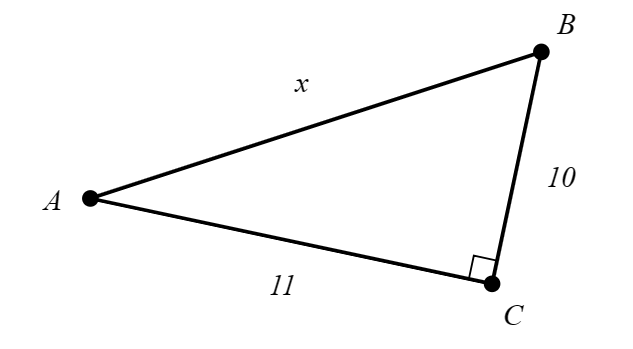
- $\sin(A)=$
- $\cos(A)=$
- $\tan(A)=$
- $\sec(A)=$
- $\csc(A)=$
- $\cot(A)=$
- Find each value. Give answers both exactly and rounded to 4 decimal places. Give angle values in degrees.
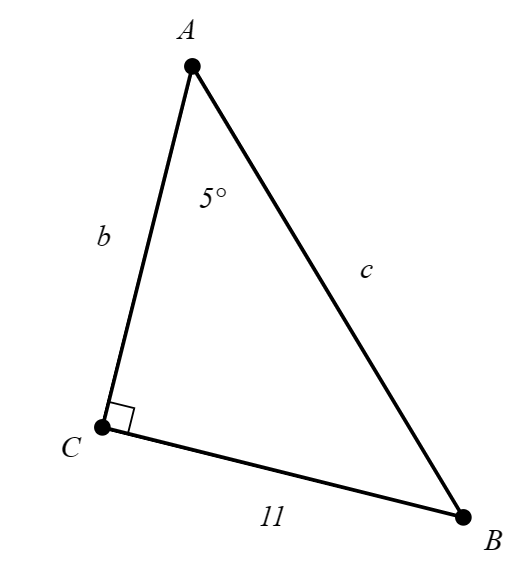
- b
- c
- angle B
- Find each value. Give answers both exactly and rounded to 4 decimal places. Give angle values in degrees.

- a
- c
- angle $\alpha$
- Find each value. Give answers both exactly and rounded to 4 decimal places. Give angle values in degrees.

- x
- angle $\alpha$
- angle $\beta$
- Find each value. Give answers both exactly and rounded to 4 decimal places. Give angle values in degrees.

- y
- x
- angle $\alpha$
- Find each value. Give answers both exactly and rounded to 4 decimal places. Give angle values in degrees.

- x
- angle $\alpha$
- angle $\beta$
- Find each value. Give answers both exactly and rounded to 4 decimal places. Give angle values in degrees.

- x
- angle $\alpha$
- angle $\beta$
- Find each value. Give answers both exactly and rounded to 4 decimal places. Give angle values in degrees.

- x
- y
- angle $\beta$
- A 33 foot ladder leans against a building so that the angle between the ground and the ladder is 75 degrees. How high does the ladder reach on the building? Round your answer to two decimal places and include a correct unit label.
- The angle of elevation to the top of a Building in New York is found to be 9 degrees from the ground at a distance of 1 mile from the base of the building. Using this information, find the height of the building. Round to two decimal places. Hint: 1 mile = 5280 feet.
- From the top of a 300 foot cliff on the coast, a tourist sights a sailboarder. The angle of depression is $32.6^\circ$. How far is the sailboarder from the shoreline? Round to the nearest tenth.
- A radio tower is located 400 feet from a building. From a window in the building, a person determines that the angle of elevation to the top of the tower is $43^\circ$ and that the angle of depression to the bottom of the tower is $22^\circ$ . How tall is the tower? Round your answer to 4 decimal places and include a correct unit label.
- Two paintings are on a wall, one directly above the other. While standing 3 meters from the wall, the angle of elevation to the bottom painting is $35^\circ$, and the angle of elevation to the top painting is $45^\circ$. What is the distance between the two paintings, to the nearest tenth of a meter?
- Two security cameras on a wall are viewing the same racoon on the ground. The angle of depression from the bottom camera to the racoon is $26^\circ$. The angle of depression from the top camera to the racoon is $46^\circ$. The top camera is mounted 34 feet above the bottom camera. What is the horizontal distance from the racoon to the wall?