Section 5.5: Inverses of the Circular Functions
Learning Objectives
In this section you will:
- Review the conditions for a function to be invertible
- Determine the properties of the inverses of the circular functions
- Evaluate inverse circular functions
- Find exact values of composite functions with inverse trigonometric functions.
Inverse is the fancy mathematical term for "undo". In this section, we're looking for ways to undo our trigonometric (circular) functions, but we have to be careful about how we approach this question. We'll start by reviewing conditions for creating inverse functions, then figure out how to apply these concepts to our circular functions.
A Quick Review of Inverse Functions
Before we worry about our inverse trigonometric functions, we must review what an inverse function is, and what conditions we must have in order to create an inverse function. For a comprehensive look at inverse functions you can check out OpenStax.
Inverse functions
f and g are inverses of one another if \[(f\circ g)(x) = x ~~\text{for all $x$ in the domain of $g$}\] and \[(g \circ f)(x) = x ~~\text{for all $x$ in the domain of $f$}\]
That is, $f$, and $g$ undo one another for inputs in their domains.
If $g$ is the inverse of $f$, we notate this as $g = f^{-1}$.
The notation $f^{-1}$ is an unfortunate choice since you've been programmed since Elementary Algebra to think of this as $\frac{1}{f}$. This is most definitely not the case since, for instance, $f(x) = 3x+4$ has as its inverse $f^{-1}(x) = \frac{x-4}{3}$, which is certainly different than $\frac{1}{f(x)} = \frac{1}{3x+4}$.
Notice that $f^{-1}(x)$ undoes any action of $f$. For instance, if $x=5$, then $f(5) = 3(5)+4 = 15+4 = 19$. Taking the output $19$ from $f$, we substitute it into $f^{-1}$ to get $f^{-1}(19) = \frac{19-4}{3} = \frac{15}{3} = 5$, which is our original input to $f$. To check that $f^{-1}$ does the job for all $x$ in the domain of $f$, we take the generic output from $f$, $f(x) = 3x+4$, and substitute that into $f^{-1}$. That is, we simplify $f^{-1}(f(x)) = f^{-1}(3x+4) = \frac{(3x+4)-4}{3} = \frac{3x}{3} = x$, which is our original input to $f$. If we carefully examine the arithmetic as we simplify $f^{-1}(f(x))$, we actually see $f^{-1}$ first `undoing' the addition of $4$, and then `undoing' the multiplication by $3$.
Not only does $f^{-1}$ undo $f$, but $f$ also undoes $f^{-1}$. That is, if we take the output from $f^{-1}$, $f^{-1}(x) = \frac{x-4}{3}$, and substitute that into $f$, we get $f(f^{-1}(x)) = f\left(\frac{x-4}{3}\right) = 3 \left(\frac{x-4}{3}\right) + 4 = (x-4) + 4 = x$.
Conditions for invertibility
In order to find the inverse of a function, that function must be one-to-one. That is, each input must correspond to exactly one output and each output must correspond to exactly one input.
Graphically, to check that a function is invertible, we see if it passes both the Vertical Line Test (to make sure it's a function) and the Horizontal Line Test (to make sure the function is one-to-one). That is, if we draw a vertical or a horizontal line anywhere on the graph, it should only intersect the graph in one location.
Certain functions do not naturally meet these requirements. For instance, a quadratic function, which has a parabola for a graph, does not pass the horizontal line test. The natural candidate for an inverse of $f(x) = x^2$ is $g(x) = \sqrt{x}$. However, if we examine $g(f(-2))$ we notice a problem. In this case, we have $f(-2) = (-2)^2 = 4$, but $g(4) = \sqrt{4} = 2$, not the -2 that we started with. The common practice, then, is to limit the domain of a non-one-to-one function before finding its inverse. In the case of $f(x) = x^2$, we limit the domain of $f$ to $x \geq 0$, and now $g(x) = \sqrt{x}$ is an inverse that works for all of the $x$ values on our limited domain.
Finally, before we see how all of this applies to trigonometric functions, let's review the propoerties of inverse functions.
Properties of Inverse Functions
Suppose $f$ is an invertible function.
- There is exactly one inverse function for $f$, denoted $f^{-1}$ (read `$f$-inverse')
- The range of $f$ is the domain of $f^{-1}$ and the domain of $f$ is the range of $f^{-1}$
- $f(a) = c$ if and only if $a = f^{-1}(c)$
- $(a,c)$ is on the graph of $f$ if and only if $(c,a)$ is on the graph of $f^{-1}$
- $f^{-1}$ is an invertible function and $(f^{-1})^{-1} = f$.
NOTE: In particular, for all $y$ in the range of $f$, the solution to $f(x) = y$ is $x = f^{-1}(y)$.
NOTE: This means graph of $y=f^{-1}(x)$ is the reflection of the graph of $y=f(x)$ across $y=x$.
The Inverse Sine and Inverse Cosine Functions
Now we are ready to turn our attention to the inverses of the circular (trigonometric) functions. Our immediate problem is that, owing to their periodic nature, none of the six circular functions is one-to-one. To remedy this, we restrict the domains of the circular functions in the same way we restricted the domain of the quadratic function in the example above to obtain a one-to-one function.
We start with $f(t) = \sin(t)$ and restrict our domain to $\left[ -\frac{\pi}{2}, \frac{\pi}{2}\right]$ in order to keep the range as $[-1,1]$ as well as the properties of being smooth and continuous.

As we saw in our quick review, the inverse of a function $f$ is typically denoted $f^{-1}$. For this reason, some textbooks use the notation $f^{-1}(t) = \sin^{-1}(t)$ for the inverse of $f(t) = \sin(t)$. The obvious pitfall here is our convention of writing $(\sin(t))^2$ as $\sin^{2}(t)$, $(\sin(t))^3$ as $\sin^{3}(t)$ and so on. It is far too easy to confuse $\sin^{-1}(t)$ with $\frac{1}{\sin(t)} = \csc(t)$ so we will not use this notation in our text. But be aware that many books do! As always, be sure to check the context!
Instead, we use the notation $f^{-1}(t) = \arcsin(t)$, read `arc-sine of $t$'. We'll explain the `arc' in `arcsine' shortly. For now, we graph $f(t) = \sin(t)$ and $f^{-1}(t) = \arcsin(t)$, where we obtain the latter from the former by reflecting it across the line $y=t$
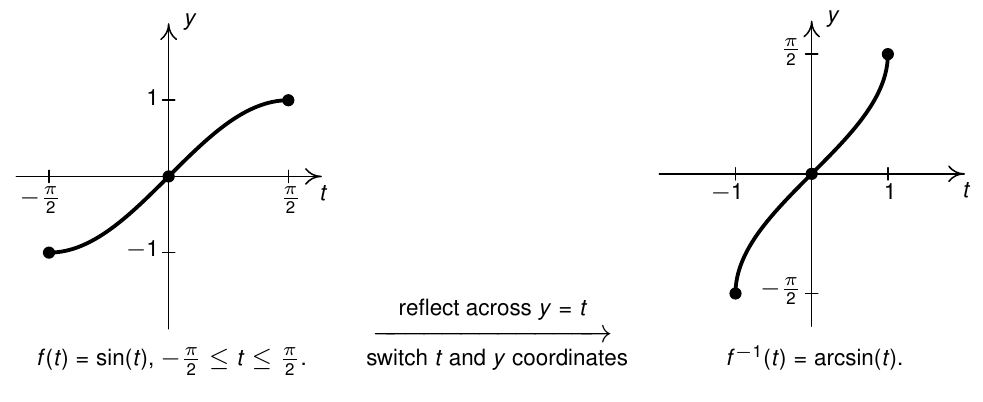
There are a few things to notice here. First, the limited, one-to-one domain of our sine function is $\left[-\frac{\pi}{2}, \frac{\pi}{2}\right]$; that becomes the range of the arcsine function. Similarly, the range of sine, $[-1, 1]$, is the domain of our new arcsine function. This domain and range will have important implications when it comes time for us to calculate special common values using the arcsine function.
Next, we consider $g(t) = \cos(t)$. If we try the same domain restriction as we used for sine, we have a problem; that will only capture y-values from 0 to 1, and that chunk of the cosine graph fails the Horizontal Line Test and hence is not one-to-one. Instead, we select the interval $[0,\pi]$ for our restriction.

Reflecting the across the line $y = t$ produces the graph $y = g^{-1}(t) = \arccos(t)$.

Let's summarize some important properties of these functions.
Properties of the Arccosine and Arcsine Functions
Properties of $F(x) = \arcsin(x)$
- Domain: $[-1,1]$
- Range: $\left[ -\frac{\pi}{2}, \frac{\pi}{2}\right]$
- $\arcsin(x) = t$ if and only if $\sin(t) = x$ and $-\frac{\pi}{2} \leq t \leq \frac{\pi}{2}$
- $\sin(\arcsin(x)) = x$ provided $-1 \leq x \leq 1$
- $\arcsin(\sin(t)) = t$ provided $-\frac{\pi}{2} \leq t \leq \frac{\pi}{2}$
- $F(x) = \arcsin(x)$ is odd
Properties of $G(x)= \arccos(x)$
- Domain: $[-1,1]$
- Range: $[0,\pi]$
- $\arccos(x) = t$ if and only if $\cos(t) = x$ and $0 \leq t \leq \pi$
- $\cos(\arccos(x)) = x$ provided $-1 \leq x \leq 1$
- $\arccos(\cos(t)) = t$ provided $0 \leq t \leq \pi$
Before moving to an example, we take a moment to understand the `arc' in `arcsine.' Consider the figure below which illustrates the specific case of $\arcsin\left(\frac{\sqrt{3}}{2} \right)$.
By definition, the real number $t = \arcsin\left(\frac{\sqrt{3}}{2} \right)$ satisfies $\sin(t) = \frac{\sqrt{3}}{2}$ with $-\frac{\pi}{2} \leq t \leq \frac{\pi}{2}$. In other words, we are looking for angle measuring $t$ radians between $-\frac{\pi}{2}$ and $\frac{\pi}{2}$ with a sine of $\frac{\sqrt{3}}{2}$. Hence, $\arcsin\left(\frac{\sqrt{3}}{2} \right) = \frac{\pi}{3}$.

In general, the function $f(t) = \sin(t)$ takes a real number input $t$, associates it with the angle $\theta = t$ radians, and returns the value $\sin(\theta)$. The value $\sin(\theta) = \sin(t)$ is the $y$-coordinate of the terminal point on the Unit Circle of an oriented arc of length $|t|$ whose initial point is $(1, 0)$.
Hence, we may view the inputs to $f(t) = \sin(t)$ as oriented arcs and the outputs as $y$-coordinates on the Unit Circle. Therefore, the function $f^{-1}$ reverses this process and takes $y$-coordinates on the Unit Circle and return oriented arcs, hence the 'arc' in arcsine. It is high time for some examples, don't you think?
Find the exact values of the following:
a. $\arcsin\left(\frac{\sqrt{2}}{2}\right)$
The best way to approach these problems is to remember that $\arcsin(x)$ and $\arccos(x)$ are real numbers which correspond to the radian measure of angles that fall within a certain prescribed range.
To find $\arcsin\left(\frac{\sqrt{2}}{2}\right)$, we need the angle measuring $t$ radians which lies between $-\frac{\pi}{2}$ and $\frac{\pi}{2}$ with $\sin(t) = \frac{\sqrt{2}}{2}$. Hence, $\arcsin\left(\frac{\sqrt{2}}{2}\right) = \frac{\pi}{4}$.
b. $\arccos\left(\frac{1}{2}\right)$
To find $\arccos\left(\frac{1}{2}\right)$, we are looking for the angle measuring $t$ radians which lies between $0$ and $\pi$ that has $\cos(t) = \frac{1}{2}$. Our answer is $\arccos\left(\frac{1}{2}\right)= \frac{\pi}{3}$.
With positive inputs, arcsine and arccosine are fairly easy to evaluate. What happens, though, when negative inputs get involved? Tread carefully, especially with arcsine!
Find the exact values of the following:
a. $\arcsin\left(-\frac{1}{2}\right)$
For $\arcsin\left(-\frac{1}{2}\right)$, we are looking for an angle measuring $t$ radians which lies between $-\frac{\pi}{2}$ and $\frac{\pi}{2}$ with $\sin(t) = -\frac{1}{2}$. We want to look in QIV of the unit circle, but we need to be sure to give our answer a negative angle name, so that our final answer is between $-\frac{\pi}{2}$ and $\frac{\pi}{2}$ as required. In QIV, we see that the angle $\frac{11\pi}{6}$ has a sine of $-\frac{1}{2}$. The negative angle coterminal with $\frac{11\pi}{6}$ is $-\frac{\pi}{6}$. Hence, $\arcsin\left(-\frac{1}{2}\right) = -\frac{\pi}{6}$.
Alternatively, we could use the fact that the arcsine function is odd, so $\arcsin\left(-\frac{1}{2}\right) = - \arcsin\left(\frac{1}{2}\right)$. We find $\arcsin\left(\frac{1}{2}\right) = \frac{\pi}{6}$, so $\arcsin\left(-\frac{1}{2}\right) = - \arcsin\left(\frac{1}{2}\right) = -\frac{\pi}{6}$.
b. $\arccos\left(-\frac{\sqrt{2}}{2}\right)$
For $\arccos\left(-\frac{\sqrt{2}}{2}\right)$, we need the angle measuring $t$ radians which lies between $0$ and $\pi$ with $\cos(t) = -\frac{\sqrt{2}}{2}$ . Hence, $\arccos\left(-\frac{\sqrt{2}}{2}\right) = \frac{3\pi}{4}$.
Next, we consider how to evaluate compositions of inverse functions and trig functions. It's tempting to take shortcuts when approaching these problems, but we must always carefully consider our (restricted) domains when evaluating these compositions!
Find the exact values of the following:
a. $\arccos\left(\cos\left(\frac{\pi}{6}\right)\right)$
Since $0 \leq \frac{\pi}{6} \leq \pi$, we could simply invoke the properties of inverse trig functions to get $\arccos\left( \cos\left(\frac{\pi}{6}\right)\right) = \frac{\pi}{6}$.
However, in order to make sure we understand why this is the case, we choose to work the example through using the definition of arccosine.
Working from the inside out, $\arccos\left( \cos\left(\frac{\pi}{6}\right)\right) = \arccos\left( \frac{\sqrt{3}}{2}\right)$. To find $\arccos\left( \frac{\sqrt{3}}{2}\right)$, we need an angle measuring $t$ radians which lies between $0$ and $\pi$ that has $\cos(t) = \frac{\sqrt{3}}{2}$. We get $t = \frac{\pi}{6}$, so that $\arccos\left( \cos\left(\frac{\pi}{6}\right)\right) = \arccos\left( \frac{\sqrt{3}}{2}\right) = \frac{\pi}{6}$.
b. $\arccos\left(\cos\left(\frac{11\pi}{6}\right)\right)$
Since $\frac{11\pi}{6}$ does not fall between $0$ and $\pi$, we can't look at the outer arccosine as simply "undoing" the inner cosine. We are forced to work through from the inside out starting with $\arccos\left( \cos\left(\frac{11\pi}{6}\right)\right) = \arccos\left(\frac{\sqrt{3}}{2}\right)$. From the previous problem, we know $\arccos\left(\frac{\sqrt{3}}{2}\right) = \frac{\pi}{6}$. Hence, $\arccos\left( \cos\left(\frac{11\pi}{6}\right)\right) = \frac{\pi}{6}$.
Another interesting application of inverse trig functions is figuring out how we can use them to solve for non-special values. To see what we mean, check out the next example.
Find the exact values of the following:
a. $\sin\left(\arccos\left(-\frac{3}{5}\right)\right)$
First, let's think about what this jumble of information means. When we write $\arccos\left(-\frac{3}{5}\right)$, we mean that there is an angle between $0$ and $\pi$ that has an $x$-coordinate of $-\frac{3}{5}$ on the unit circle. Let's temporarily name that angle $t$, so that $t = \arccos\left(-\frac{3}{5}\right)$. Well then, by definition of arccosine, $\cos(t) = -\frac{3}{5}$. We also know that the terminal side of $t$ must fall in QII, since $t$ must be between $0$ and $\pi$ and its cosine is negative.
Now, we can use our friend the Pythagorean Identity to figure out the sine of $t$.
$$\cos^2(t) + \sin^2(t) = 1$$ $$\left(-\frac{3}{5}\right)^2 + \sin^2(t) = 1$$ $$\frac{9}{25} + \sin^2(t) = 1$$ $$\sin^2(t) = \frac{16}{25}$$ $$\sin(t) = \pm \frac{4}{5}$$Because we know that $t$ is a QII angle, its sine must be positive, so $\sin(t) = \frac{4}{5}$. Therefore, $\sin\left(\arccos\left(-\frac{3}{5}\right)\right) = \frac{4}{5}$.
Note that if you prefer to draw a reference triangle in Quadrant II, you can arrive at the same final answer.
b. $\tan\left(\arcsin\left(\frac{5}{7}\right)\right)$
Again, we let $t =\arcsin\left(\frac{5}{7}\right)$. Then we can start by saying that there is an angle, $t$, between $-\frac{\pi}{2}$ and $\frac{\pi}{2}$ that has a $y$-coordinate of $\frac{5}{7}$ on the Unit Circle. That places our $t$ in QI, and we know that $\sin(t) = \frac{5}{7}$. Using the Pythagorean Identity, then, we have $$\cos^2(t) + \left(\frac{5}{7}\right)^2 = 1$$ $$\cos^2(t) + \frac{25}{49} = 1$$ $$\cos^2(t) = \frac{24}{49}$$ $$\cos(t) = \frac{\sqrt{24}}{7}$$ We have chosen the positive solution, since cosine is positive in QI.
Now, since $t=\arcsin\left(\frac{5}{7}\right)$, our expression $\tan\left(\arcsin\left(\frac{5}{7}\right)\right)$ is equivalent to $\tan(t)$. Now, we know the sine and cosine of our angle, but in the end, we want to know its tangent. Recall that $\tan(t) = \frac{\sin(t)}{\cos(t)}$. So to calculate our tangent, we use the sine and cosine values from above: $$\tan(t) = \frac{5/7}{\sqrt{24}/7}$$ $$=\frac{5}{\sqrt{24}}$$ $$=\frac{5\sqrt{24}}{24}$$ $$=\frac{5\cdot 2\sqrt{6}}{24}$$ $$\tan(t)=\frac{5\sqrt{6}}{12}$$
Rewrite each of the following composite functions as algebraic functions of $x$ and state the domain.
a. $f(x) = \tan(\arccos(x))$
We begin this problem in the same manner we began the previous two problems. We let $t = \arccos(x)$, so our goal is to find a way to express $\tan\left(\arccos\left(x \right)\right) = \tan(t)$ in terms of $x$.
Since $t = \arccos(x)$, we know $\cos(t) = x$ where $0 \leq t \leq \pi$. One approach to finding $\tan(t)$ is to use the quotient identity $\tan(t) = \frac{\sin(t)}{\cos(t)}$. Since we know $\cos(t)$, we just need to find $\sin(t)$.
Using the Pythagorean Identity, we get $\sin^{2}(t) = 1 - \cos^{2}(t) = 1 - x^2$ so that $\sin(t) = \pm \sqrt{1-x^2}$. Since $0 \leq t \leq \pi$, $\sin(t) \geq 0$, so we choose $\sin(t) = \sqrt{1-x^2}$.
Thus, $\tan(t) = \frac{\sin(t)}{\cos(t)} = \frac{\sqrt{1-x^2}}{x}$, so $f(x) = \tan(\arccos(x)) = \frac{\sqrt{1-x^2}}{x}$.
To determine the domain, we consider that the function $f(x) = \tan\left(\arccos\left(x \right)\right)$ can be thought of as a two step process: first, take the arccosine of a number, and second, take the tangent of whatever comes out of the arccosine.
Since the domain of $\arccos(x)$ is $-1 \leq x \leq 1$, the domain of $f$ will be some subset of $[-1,1]$. The range of $\arccos(x)$ is $[0,\pi]$, and of these values, only $\frac{\pi}{2}$ will cause a problem for the tangent function. Since $\arccos(x) = \frac{\pi}{2}$ happens when $x = \cos\left(\frac{\pi}{2} \right) = 0$, we exclude $x=0$ from our domain. Hence, the domain of $f(x) = \tan\left(\arccos\left(x \right)\right) =\frac{\sqrt{1-x^2}}{x}$ is $[-1,0)\cup(0,1]$.
Note that in this particular case, we could have obtained the correct domain of $f$ using its algebraic description: $f(x) = \tan(\arccos(x)) = \frac{\sqrt{1-x^2}}{x}$. This is not always true, however, so proceed with caution!
b. $g(x) = \cos(\arcsin(x))$
We proceed as in the previous problem by writing $t = \arcsin(x)$ so that $t$ lies in the interval $\left[ -\frac{\pi}{2}, \frac{\pi}{2}\right]$ with $\sin(t) = x$. We aim to express $\cos\left( \arcsin(x)\right) = \cos(t)$ in terms of $x$.
Since we know $x = \sin(t)$, then by the Pythagorean Identity we have $$\cos^2(t) + x^2 = 1$$ $$\cos^2(t) = 1- x^2$$ $$\cos(t) = \pm \sqrt{1-x^2}$$
Again, because $t$ lies in the interval $\left[ -\frac{\pi}{2}, \frac{\pi}{2}\right]$, the cosine of $t$ must be positive, so $\cos(t) = \sqrt{1-x^2}$.
To find the domain of $g(x) = \cos\left(\arcsin(x)\right)$, we once again consider the inner function first. The domain of $\arcsin(x)$ is $[-1,1]$, and since there are no domain restrictions on cosine, the domain of $g$ is $[-1,1]$.
Inverse Tangent and Inverse Cotangent
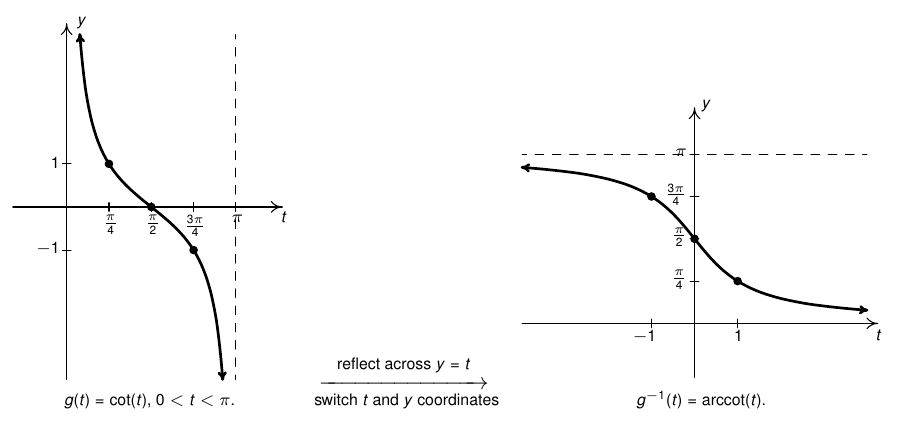
The next pair of functions we wish to discuss are the inverses of tangent and cotangent. First, we restrict $f(t) = \tan(t)$ to its fundamental cycle on $\left(-\frac{\pi}{2}, \frac{\pi}{2}\right)$ to obtain the arctangent function, $f^{-1}(t) = \arctan(t)$. Among other things, note that the vertical asymptotes $t = -\frac{\pi}{2}$ and $t = \frac{\pi}{2}$ of the graph of $f(t) = \tan(t)$ become the horizontal asymptotes $y = -\frac{\pi}{2}$ and $y = \frac{\pi}{2}$ of the graph of $f^{-1}(t) = \arctan(t)$.

Next, we restrict $g(t) = \cot(t)$ to its fundamental cycle on $(0,\pi)$ to obtain $g^{-1}(t) = \mbox{arccot}(t)$, the arccotangent function. Once again, the vertical asymptotes $t=0$ and $t=\pi$ of the graph of $g(t) = \cot(t)$ become the horizontal asymptotes $y = 0$ and $y = \pi$ of the graph of $g^{-1}(t) = \mbox{arccot}(t)$.
Below we summarize the important properties of the arctangent and arccotangent functions.
Properties of the Arctangent and Arcotangent Functions
Properties of $F(x)= \arctan(x)$
- Domain: $(-\infty, \infty)$
- Range: $\left(-\frac{\pi}{2}, \frac{\pi}{2}\right)$
- as $x \rightarrow -\infty$, $\arctan(x) \rightarrow -\frac{\pi}{2}^{+}$; as $x \rightarrow \infty$, $\arctan(x) \rightarrow \frac{\pi}{2}^{-}$
- $\arctan(x) = t$ if and only if $\tan(t) = x$ and $-\frac{\pi}{2} \lt t \lt \frac{\pi}{2}$
- $\arctan(x) = \mbox{arccot}\left(\frac{1}{x}\right)$ for $x \gt 0$
- $\tan\left(\arctan(x)\right) = x$ for all real numbers $x$
- $\arctan(\tan(t)) = t$ provided $-\frac{\pi}{2} \lt t \lt \frac{\pi}{2}$
- $F(x)= \arctan(x)$ is odd
Properties of $G(x) = \mbox{arccot}(t)$
- Domain: $(-\infty, \infty)$
- Range: $(0, \pi)$
- as $x \rightarrow -\infty$, $\mbox{arccot}(x) \rightarrow \pi^{-}$; as $x \rightarrow \infty$, $\mbox{arccot}(x) \rightarrow 0^{+}$
- $\mbox{arccot}(x) = t$ if and only if $\cot(t) = x$ and $0 \lt t \lt \pi$
- $\mbox{arccot}(x) =\arctan\left(\frac{1}{x}\right)$ for $x \gt 0$
- $\cot\left(\mbox{arccot}(x)\right) = x$ for all real numbers $x$
- $\mbox{arccot}(\cot(t)) = t$ provided $0 \lt t \lt \pi$
When it comes time to evaluate inverse trigonometric functions, it's useful to have a list of the common tangent and cotangent values for special angles. You may not be as comfortable with these the corresponding sines and cosines, so we list them for your convenience.
Find the exact values of the following.
a. $\arctan(\sqrt{3})$
To find $\arctan(\sqrt{3})$, we need the angle measuring $t$ radians which lies between $-\frac{\pi}{2}$ and $\frac{\pi}{2}$ with $\tan(t) = \sqrt{3}$. We find $\arctan(\sqrt{3}) = \frac{\pi}{3}$.
b. $\mbox{arccot}(-\sqrt{3})$
To find $\mbox{arccot}(-\sqrt{3})$, we need the angle measuring $t$ radians which lies between $0$ and $\pi$ with $\cot(t) = -\sqrt{3}$. Hence, $\mbox{arccot}(-\sqrt{3}) = \frac{5\pi}{6}$.
Find the exact values of the following.
a. $\mbox{arccot}\left(\cot\left(\frac{7\pi}{6}\right)\right)$
This is another case where we are better off taking things a step at a time, so that we don't make assumptions that result in the wrong answer. In other words, the arccotangent does not directly undo the cotangent here, because the $\frac{7\pi}{6}$ input to the cotangent is not a valid output for the arccotangent function; arccotangent only gives answers between 0 and $\pi$!
First, $\cot\left(\frac{7\pi}{6}\right) = \frac{\cos(7\pi/6)}{\sin(7\pi/6)} = \frac{-\sqrt{3}/2}{-1/2} = \sqrt{3}$. That means we can write $\mbox{arccot}\left(\cot\left(\frac{7\pi}{6}\right)\right)$ as $\mbox{arccot}\left(\sqrt{3}\right)$. The angle between 0 and $\pi$ with a cotangent of $\sqrt{3}$ is $\frac{\pi}{6}$, so our final answer is $\mbox{arccot}\left(\cot\left(\frac{7\pi}{6}\right)\right) = \frac{\pi}{6}$.
Find the exact value of the following.
$\sin\left(\arctan\left(-\frac{4}{3}\right)\right)$
We start simplifying $\sin\left(\arctan\left(-\frac{4}{3}\right)\right)$ by letting $t = \arctan\left(-\frac{4}{3}\right)$. By definition, $\tan(t) = -\frac{4}{3}$ for some angle measuring $t$ radians which lies between $-\frac{\pi}{2}$ and $\frac{\pi}{2}$. Since $\tan(t) \lt 0$, we know, in fact, $t$ corresponds to a Quadrant IV angle.
We are given $\tan(t)$ but wish to know $\sin(t)$. Since there is no direct identity to marry the two, we make a quick sketch of the situation below. Since $\tan(t) = -\frac{4}{3} = \frac{-4}{3}$, we take $P(3,-4)$ as a point on the terminal side of $\theta = t = \arctan\left(-\frac{4}{3}\right)$ radians.
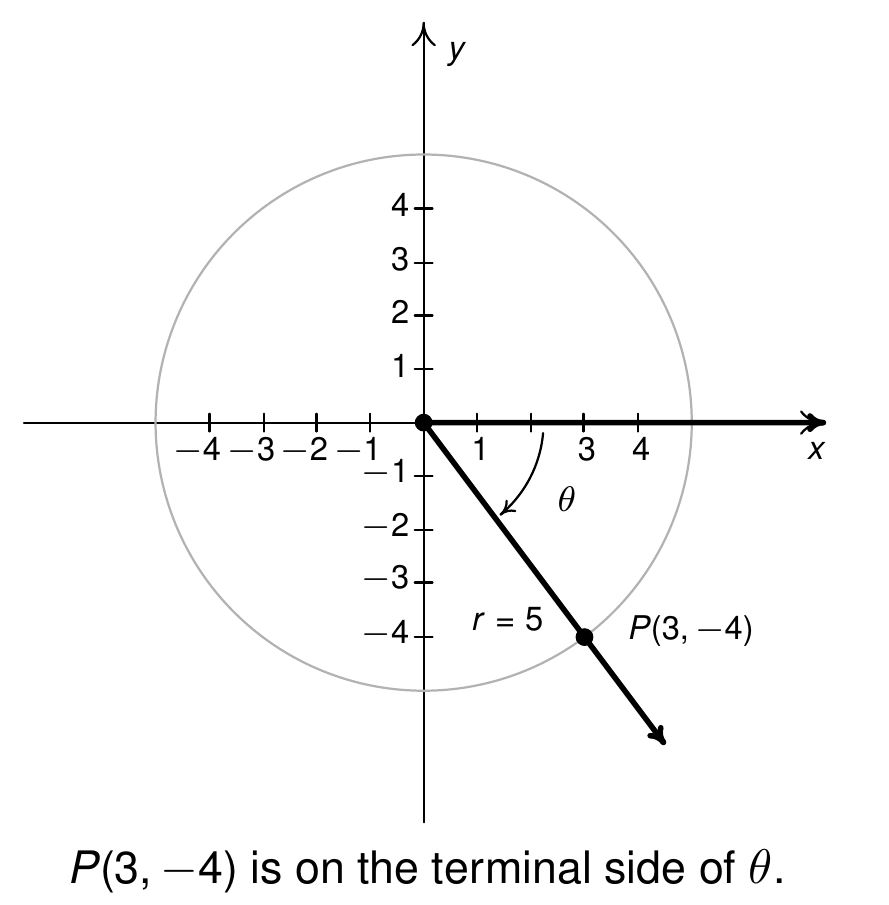
We find $r = \sqrt{x^2+y^2} = \sqrt{(3)^2+(-4)^2} = 5$, so $\sin(t) = -\frac{4}{5}$. Hence, $\sin\left(\arctan\left(-\frac{4}{3}\right)\right) = -\frac{4}{5}$.
Rewrite the following composite function as and algebraic function of $x$ and state the domain.
$\cos(\mbox{arccot}(2x))$
To get started, we let $t = \mbox{arccot}(2x)$ so that $\cot(t) = 2x$ where $0 \lt t \lt \pi$. In terms of $t$, $\cos(\mbox{arccot}(2x)) = \cos(t)$, and our goal is to express the latter in terms of $x$.
Note that if $t = \mbox{arccot}(2x)$, then $\mbox{cot}(t) = 2x$. If we think way back to right triangles, this means we could draw a right triangle with reference angle $t$, where the ratio of the adjacent side to the opposite side is $2x$. The easiest way to make such a triangle is to let the adjacent side be $2x$ and the opposite side be 1.
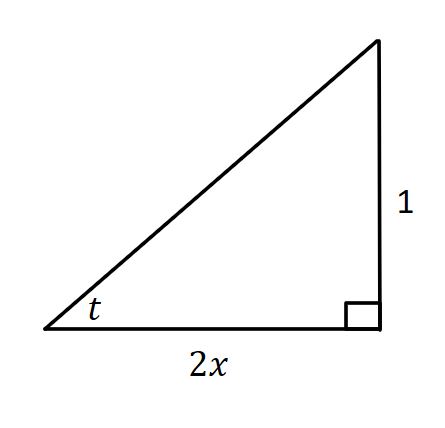
Since we want to find $\cos(t)$, we will need to find an expression for the hypotenuse of this triangle. We can once more lean on the Pythagorean Theorem: $$(2x)^2+1^2 = c^2$$ $$4x^2 + 1 = c^2$$ $$c = \sqrt{4x^2+1}$$
Note: It may be tempting to try to simplify this expression, but the addition inside of the root makes that impossible!
Because $\cos(t)$ is adjacent over hypotenuse, our answer is $$\cos(t) = \frac{2x}{\sqrt{4x^2+1}}$$
To find the domain, viewing $g(x) = \cos(\mbox{arccot}(2x))$ as a sequence of steps, we see we first double the input $x$, then take the arccotangent, and, finally, take the cosine. Since each of these processes are valid for all real numbers, the domain of $g$ is $(-\infty, \infty)$.
Inverse Cosecant and Inverse Secant
The last two functions to invert are secant and cosecant. A portion of each of their graphs are given below with the fundamental cycles highlighted.

It is clear from the graph of secant that we cannot find one single continuous piece of its graph which covers its entire range of $(-\infty, -1] \cup [1, \infty)$ and restricts the domain of the function so that it is one-to-one. The same is true for cosecant.
Thus in order to define the arcsecant and arccosecant functions, we must settle for a piecewise approach wherein we choose one piece to cover the top of the range, namely $[1, \infty)$, and another piece to cover the bottom, namely $(-\infty, -1]$.
There are two generally accepted ways make these choices which restrict the domains of these functions so that they are one-to-one. In this subsection, we restrict the secant and cosecant functions to coincide with the restrictions on cosine and sine, respectively. For $f(t) = \sec(t)$, we restrict the domain to $\left[0, \frac{\pi}{2}\right) \cup \left( \frac{\pi}{2}, \pi\right]$ and we restrict $g(t) = \csc(t)$ to $\left[-\frac{\pi}{2}, 0\right) \cup \left(0, \frac{\pi}{2}\right]$. These choices are arbitrary; in this text, we'll use these domain restrictions because they are, in a sense, the "prettiest." Calculus texts will often choose different domains, but once you've chosen a domain, the rest of the principles we are learning will remain the same.


Properties of the Arcsecant and Arccosecant Functions
Properties of $F(x)= \mbox{arcsec}(x)$
- Domain: $\left\{ x \, | \, |x| \geq 1 \right\} = (-\infty, -1] \cup [1,\infty)$
- Range: $\left[0, \frac{\pi}{2} \right) \cup \left(\frac{\pi}{2}, \pi\right]$
- as $x \rightarrow -\infty$, $\mbox{arcsec}(x) \rightarrow \frac{\pi}{2}^{+}$; as $x \rightarrow \infty$, $\mbox{arcsec}(x) \rightarrow \frac{\pi}{2}^{-}$
- $\mbox{arcsec}(x) = t$ if and only if $\sec(t) = x$ and $0 \leq t \lt \frac{\pi}{2}$ or $ \frac{\pi}{2} \lt t \le \pi$
- $\mbox{arcsec}(x) = \arccos\left(\frac{1}{x}\right)$ provided $|x| \geq 1$
- $\sec\left(\mbox{arcsec}(x)\right) = x$ provided $|x| \geq 1$
- $\mbox{arcsec}(\sec(t)) = t$ provided $0 \leq t \lt \frac{\pi}{2}$ or $\frac{\pi}{2} \lt t \leq \pi$
Properties of $G(x) = \mbox{arccsc}(x)$
- Domain: $\left\{ x \, | \, |x| \geq 1 \right\} = (-\infty, -1] \cup [1,\infty)$
- Range: $\left[-\frac{\pi}{2}, 0 \right) \cup \left(0, \frac{\pi}{2} \right]$
- as $x \rightarrow -\infty$, $\mbox{arccsc}(x) \rightarrow 0^{-}$; as $x \rightarrow \infty$, $\mbox{arccsc}(x) \rightarrow 0^{+}$
- $\mbox{arccsc}(x) = t$ if and only if $\csc(t) = x$ and $-\frac{\pi}{2} \leq t \lt 0$ or $0 \lt t \leq \frac{\pi}{2}$
- $\mbox{arccsc}(x) = \arcsin\left(\frac{1}{x}\right)$ provided $|x| \geq 1$
- $\csc\left(\mbox{arccsc}(x)\right) = x$ provided $|x| \geq 1$
- $\mbox{arccsc}(\csc(t)) = t$ provided $-\frac{\pi}{2} \leq t \lt 0$ or $0 \lt t \leq \frac{\pi}{2}$
- $G(x) = \mbox{arccsc}(x)$ is odd
The particular reason we stick with the ranges here is specifically because of two properties listed in above: $\mbox{arcsec}(x) = \arccos\left(\frac{1}{x}\right)$ and $\mbox{arccsc}(x) = \arcsin\left(\frac{1}{x}\right)$.
These formulas essentially allow us to always convert arcsecants and arccosecants back to arccosines and arcsines, respectively. We see this play out in our next example.
Find the exact values of the following.
a. $\mbox{arcsec}(2)$
Using the property highlighted above, we have $\mbox{arcsec}(2) = \arccos\left(\frac{1}{2}\right) = \frac{\pi}{3}$.
b. $\mbox{arccsc}(-2)$
Once again, we can rewrite in terms of sine, giving $\mbox{arccsc}(-2) = \arcsin\left(-\frac{1}{2}\right) = -\frac{\pi}{6}$.
Find the exact values of the following.
a. $\mbox{arcsec}\left( \sec\left( \frac{5\pi}{4} \right) \right)$
Since $\frac{5\pi}{4}$ doesn't fall between $0$ and $\frac{\pi}{2}$ or $\frac{\pi}{2}$ and $\pi$, we cannot use the inverse property directly. Hence, we work from the 'inside out.'
We get: $\mbox{arcsec}\left( \sec\left( \frac{5\pi}{4} \right) \right) = \mbox{arcsec}(-\sqrt{2}) = \arccos\left(-\frac{1}{\sqrt{2}}\right) =\arccos\left(-\frac{\sqrt{2}}{2}\right) = \frac{3\pi}{4}$.
Evaluate exactly.
$\cot\left(\mbox{arccsc}\left(-3\right)\right)$
We begin simplifying $\cot\left(\mbox{arccsc}\left(-3\right)\right)$ by letting $t = \mbox{arccsc}(-3)$. Then, $\csc(t) = -3$. Since $\csc(t) \lt 0$, $t$ lies in the interval $\left[ -\frac{\pi}{2},0\right)$, so $t$ corresponds to a Quadrant IV angle.
All right, so we know that our angle lies in QIV, with $\csc(t) = -3$. Therefore, $\sin(t) = -\frac{1}{3}$. Again, let's draw a simple triangle with these properties:

In the end we want to know $\cot(t)$, which is the ratio of the adjacent side over the opposite side, so we'll need to solve for the length of the missing leg using the Pythagorean Theorem.
$$x^2 + (-1)^2 =3^2$$ $$x^2 + 1 = 9$$ $$x^2 = 8$$ $$x = \pm \sqrt{8}$$Since our missing side lies on the positive x-axis, we have $x = \sqrt{8} = 2\sqrt{2}$ for this side. Therefore $$\cot(t) = \frac{2\sqrt{2}}{-1}$$ $$\cot(t) = -2\sqrt{2}$$
Rewrite the following composite function as an algebraic function of $x$ and state the domain.
$f(x) = \tan(\mbox{arcsec}(x))$
Proceeding as above, we let $t = \mbox{arcsec}(x)$. Then, $\sec(t) = x$ for $t$ in $\left[0, \frac{\pi}{2}\right) \cup \left(\frac{\pi}{2}, \pi \right]$. We seek a formula for $\tan(\mbox{arcsec}(x)) = \tan(t)$ in terms of $x$.
Since $\sec(t) = x$, then we know that $\cos(t) = \frac{1}{x}$. Here we have to be careful; $t$ can be in $\left[0, \frac{\pi}{2}\right) \cup \left(\frac{\pi}{2}, \pi \right]$, so $\frac{1}{x}$ might be negative or positive depending on the quadrant we find ourselves in. The pictures here can get unneccessarily confusing, so we're going to try a different strategy: rewriting the Pythagorean Identity. If $$\cos^2(t) + \sin^2(t) = 1$$ then we can divide every term by $\cos^2(t)$ to get $$\frac{\cos^2(t)}{\cos^2(t)} + \frac{\sin^2(t)}{\cos^2(t)} = \frac{1}{\cos^2(t)}$$ $$\Rightarrow 1 + \tan^2(t) = \sec^2(t)$$
Now, since $\sec(t) = x$, we have $$1 + \tan^2(t) = x^2$$ $$\tan^2(t) = x^2 - 1$$ $$\tan(t) = \pm \sqrt{x^2 - 1}$$
If $t$ belongs to $\left[0, \frac{\pi}{2}\right)$ then $\tan(t) \geq 0$. On the the other hand, if $t$ belongs to $\left(\frac{\pi}{2}, \pi \right]$ then $\tan(t) \leq 0$. As a result, we get a \textit{piecewise defined} function for $\tan(t)$: \[ \tan(t) = \left\{ \begin{array}{rr} \sqrt{x^2-1}, & \text{if $0 \leq t \lt \frac{\pi}{2}$} \\ -\sqrt{x^2-1}, & \text{if $\frac{\pi}{2} \lt t \leq \pi$} \end{array}\right. \]
Now we need to determine what these conditions on $t$ mean for $x$. Since $x = \sec(t)$, when $0 \leq t \lt \frac{\pi}{2}$, $x \geq 1$, and when $\frac{\pi}{2} \lt t \leq \pi$, $x \leq -1$. Hence, \[f(x) = \tan(\mbox{arcsec}(x)) = \left\{ \begin{array}{rr} \sqrt{x^2-1}, & \text{if $x \geq 1$} \\ -\sqrt{x^2-1}, & \text{if $x \leq -1$} \end{array}\right. \]
To find the domain of $f$, we consider $f(x) = \tan(\mbox{arcsec}(x))$ as a two step process. First, we have the arcsecant function, whose domain is $(-\infty, -1] \cup [1, \infty)$.
Since the range of $\mbox{arcsec}(x)$ is $\left[0, \frac{\pi}{2}\right) \cup \left(\frac{\pi}{2}, \pi \right]$, taking the tangent of any output from $\mbox{arcsec}(x)$ is defined. Hence, the domain of $f$ is $(-\infty, -1] \cup [1, \infty)$.
Rewrite the following composite function as an algebraic function of $x$ and state the domain.
$f(x) = \cos(\mbox{arccsc}(4x))$
Taking a cue from the previous problem, we start by letting $t = \mbox{arccsc}(4x)$. Then $\csc(t) = 4x$ for $t$ in $\left[-\frac{\pi}{2}, 0 \right) \cup \left(0, \frac{\pi}{2}\right]$. Our goal is to rewrite $\cos(\mbox{arccsc}(4x)) = \cos(t)$ in terms of $x$.
From $\csc(t) = 4x$, we get $\sin(t) = \frac{1}{4x}$, so to find $\cos(t)$, we can make use of the Pythagorean Identity: $\cos^{2}(t)= 1- \sin^{2}(t)$. Substituting $\sin(t) = \frac{1}{4x}$ gives $\cos^{2}(t) = 1 - \left(\frac{1}{4x}\right)^2 = 1 - \frac{1}{16x^2}$. Getting a common denominator and extracting square roots, we obtain: \[\cos(t) = \pm \sqrt{\frac{16x^2-1}{16x^2}} = \pm \frac{\sqrt{16x^2-1}}{4|x|}.\]
Since $t$ belongs to $\left[-\frac{\pi}{2}, 0 \right) \cup \left(0, \frac{\pi}{2}\right]$, we know $\cos(t) \geq 0$, so we choose $\cos(t) = \frac{\sqrt{16-x^2}}{4|x|}$. (The absolute values here are necessary, since $x$ could be negative.) Hence, \[g(x) = \cos(\mbox{arccsc}(4x)) = \frac{\sqrt{16-x^2}}{4|x|}.\]
To find the domain of $g(x) = \cos(\mbox{arccsc}(4x))$, as usual, we think of $g$ as a series of processes. First, we take the input, $x$, and multiply it by $4$. Since this can be done to any real number, we have no restrictions here.
Next, we take the arccosecant of $4x$. Using interval notation, the domain of the arccosecant function is written as: $(-\infty, -1] \cup [1, \infty)$. Hence to take the arccosecant of $4x$, the quantity $4x$ must lie in one of these two intervals.\footnote{Alternatively, we can write the domain of $\mbox{arccsc}(x)$ as $|x| \geq 1$, so the domain of $\mbox{arccsc}(4x)$ is $|4x| \geq 1$.} That is, $4x \leq -1$ or $4x \geq 1$, so $x \leq -\frac{1}{4}$ or $x \geq \frac{1}{4}$.
The third and final process coded in $g(x) = \cos(\mbox{arccsc}(4x))$ is to take the cosine of $\mbox{arccsc}(4x)$. Since the cosine accepts any real number, we have no additional restrictions. Hence, the domain of $g$ is $\left( -\infty, -\frac{1}{4} \right] \cup \left[ \frac{1}{4}, \infty \right)$.
Practice Problems
In the following exercises, find the exact value.
1. $\arcsin \left( -1 \right)$
2. $\arcsin \left( -\dfrac{\sqrt{3}}{2} \right)$
3. $\arcsin \left( -\dfrac{\sqrt{2}}{2} \right)$
4. $\arcsin \left( -\dfrac{1}{2} \right)$
5. $\arcsin \left( 0 \right)$
6. $\arcsin \left( \dfrac{1}{2} \right)$
7. $\arcsin \left( \dfrac{\sqrt{2}}{2} \right)$
8. $\arcsin \left( \dfrac{\sqrt{3}}{2} \right)$
9. $\arcsin \left( 1 \right)$
10. $\arccos \left( -1 \right)$
11. $\arccos \left( -\dfrac{\sqrt{3}}{2} \right)$
12. $\arccos \left( -\dfrac{\sqrt{2}}{2} \right)$
13. $\arccos \left( -\dfrac{1}{2} \right)$
14. $\arccos \left( 0 \right)$
15. $\arccos \left( \dfrac{1}{2} \right)$
16. $\arccos \left( \dfrac{\sqrt{2}}{2} \right)$
17. $\arccos \left( \dfrac{\sqrt{3}}{2} \right)$
18. $\arccos \left( 1 \right)$
19. $\arctan \left( -\sqrt{3} \right)$
20. $\arctan \left( -1 \right)$
21. $\arctan \left( -\dfrac{\sqrt{3}}{3} \right)$
22. $\arctan \left( 0 \right)$
23. $\arctan \left( \dfrac{\sqrt{3}}{3} \right)$
24. $\arctan \left( 1 \right)$
25. $\arctan \left( \sqrt{3} \right)$
26. $\mbox{arccot} \left( -\sqrt{3} \right)$
27. $\mbox{arccot} \left( -1 \right)$
28. $\mbox{arccot} \left( -\dfrac{\sqrt{3}}{3} \right)$
29.$\mbox{arccot} \left( 0 \right)$
30. $\mbox{arccot} \left( \dfrac{\sqrt{3}}{3} \right)$
31. $\mbox{arccot} \left( 1 \right)$
32. $\mbox{arccot} \left( \sqrt{3} \right)$
33. $\mbox{arcsec} \left( 2 \right)$
34. $\mbox{arccsc} \left( 2 \right)$
35. $\mbox{arcsec} \left( \sqrt{2} \right)$
36. $\mbox{arccsc} \left( \sqrt{2} \right)$
37.$\mbox{arcsec} \left( \dfrac{2\sqrt{3}}{3} \right)$
38. $\mbox{arccsc} \left( \dfrac{2\sqrt{3}}{3} \right)$
39. $\mbox{arcsec} \left( 1 \right)$
40. $\mbox{arccsc} \left( 1 \right)$
1. $\arcsin \left( -1 \right)=-\frac{\pi}{2}$
2. $\arcsin \left( -\dfrac{\sqrt{3}}{2} \right)=-\frac{\pi}{3}$
3. $\arcsin \left( -\dfrac{\sqrt{2}}{2} \right)=-\frac{\pi}{4}$
4. $\arcsin \left( -\dfrac{1}{2} \right)=-\frac{\pi}{6}$
5. $\arcsin \left( 0 \right)=0$
6. $\arcsin \left( \dfrac{1}{2} \right)=\frac{\pi}{6}$
7. $\arcsin \left( \dfrac{\sqrt{2}}{2} \right)=\frac{\pi}{4}$
8. $\arcsin \left( \dfrac{\sqrt{3}}{2} \right)=\frac{\pi}{3}$
9. $\arcsin \left( 1 \right)=\frac{\pi}{2}$
10. $\arccos \left( -1 \right)=\pi$
11. $\arccos \left( -\dfrac{\sqrt{3}}{2} \right)=\frac{5\pi}{6}$
12. $\arccos \left( -\dfrac{\sqrt{2}}{2} \right)=\frac{3\pi}{4}$
13. $\arccos \left( -\dfrac{1}{2} \right)=\frac{2\pi}{3}$
14. $\arccos \left( 0 \right)=\frac{\pi}{2}$
15. $\arccos \left( \dfrac{1}{2} \right)=\frac{\pi}{3}$
16. $\arccos \left( \dfrac{\sqrt{2}}{2} \right)=\frac{\pi}{4}$
17. $\arccos \left( \dfrac{\sqrt{3}}{2} \right)=\frac{\pi}{6}$
18. $\arccos \left( 1 \right)=0$
19. $\arctan \left( -\sqrt{3} \right)=-\frac{\pi}{3}$
20. $\arctan \left( -1 \right)=-\frac{\pi}{4}$
21. $\arctan \left( -\dfrac{\sqrt{3}}{3} \right)=-\frac{\pi}{6}$
22. $\arctan \left( 0 \right)=0$
23. $\arctan \left( \dfrac{\sqrt{3}}{3} \right)=\frac{\pi}{6}$
24. $\arctan \left( 1 \right)=\frac{\pi}{4}$
25. $\arctan \left( \sqrt{3} \right)=\frac{\pi}{3}$
26. $\mbox{arccot} \left( -\sqrt{3} \right)=\frac{5\pi}{6}$
27. $\mbox{arccot} \left( -1 \right)=\frac{3\pi}{4}$
28. $\mbox{arccot} \left( -\dfrac{\sqrt{3}}{3} \right)=\frac{2\pi}{3}$
29.$\mbox{arccot} \left( 0 \right)=\frac{\pi}{2}$
30. $\mbox{arccot} \left( \dfrac{\sqrt{3}}{3} \right)=\frac{\pi}{3}$
31. $\mbox{arccot} \left( 1 \right)=\frac{\pi}{4}$
32. $\mbox{arccot} \left( \sqrt{3} \right)=\frac{\pi}{6}$
33. $\mbox{arcsec} \left( 2 \right)=\frac{\pi}{3}$
34. $\mbox{arccsc} \left( 2 \right)=\frac{\pi}{6}$
35. $\mbox{arcsec} \left( \sqrt{2} \right)=\frac{\pi}{4}$
36. $\mbox{arccsc} \left( \sqrt{2} \right)=\frac{\pi}{4}$
37.$\mbox{arcsec} \left( \dfrac{2\sqrt{3}}{3} \right)=\frac{\pi}{6}$
38. $\mbox{arccsc} \left( \dfrac{2\sqrt{3}}{3} \right)=\frac{\pi}{3}$
39. $\mbox{arcsec} \left( 1 \right)=0$
40. $\mbox{arccsc} \left( 1 \right)=\frac{\pi}{2}$
In the following exercises, assume that the range of arcsecant is $\left[0, \frac{\pi}{2} \right) \cup \left( \frac{\pi}{2}, \pi \right]$ and that the range of arccosecant is $\left[ -\frac{\pi}{2}, 0 \right) \cup \left(0, \frac{\pi}{2} \right]$ when finding the exact value.
41. $\mbox{arcsec} \left( -2 \right)$
42. $\mbox{arcsec} \left( -\sqrt{2} \right)$
43. $\mbox{arcsec} \left( -\dfrac{2\sqrt{3}}{3} \right)$
44. $\mbox{arcsec} \left( -1 \right)$
45. $\mbox{arccsc} \left( -2 \right)$
46. $\mbox{arccsc} \left( -\sqrt{2} \right)$
47. $\mbox{arccsc} \left( -\dfrac{2\sqrt{3}}{3} \right)$
48. $\mbox{arccsc} \left( -1 \right)$
41. $\mbox{arcsec} \left( -2 \right)=\frac{2\pi}{3}$
42. $\mbox{arcsec} \left( -\sqrt{2} \right)=\frac{3\pi}{4}$
43. $\mbox{arcsec} \left( -\dfrac{2\sqrt{3}}{3} \right)=\frac{5\pi}{6}$
44. $\mbox{arcsec} \left( -1 \right)=\pi$
45. $\mbox{arccsc} \left( -2 \right)=-\frac{\pi}{6}$
46. $\mbox{arccsc} \left( -\sqrt{2} \right)=-\frac{\pi}{4}$
47. $\mbox{arccsc} \left( -\dfrac{2\sqrt{3}}{3} \right)=-\frac{\pi}{3}$
48. $\mbox{arccsc} \left( -1 \right)=-\frac{\pi}{2}$
In the following exercises, find the exact value or state that it is undefined.
49. $\sin\left(\arcsin\left(\dfrac{1}{2}\right)\right)$
50. $\sin\left(\arcsin\left(-\dfrac{\sqrt{2}}{2}\right)\right)$
51. $\sin\left(\arcsin\left(\dfrac{3}{5}\right)\right)$
52. $\sin\left(\arcsin\left(-0.42\right)\right)$
53. $\sin\left(\arcsin\left(\dfrac{5}{4}\right)\right)$
54. $\cos\left(\arccos\left(\dfrac{\sqrt{2}}{2}\right)\right)$
55. $\cos\left(\arccos\left(-\dfrac{1}{2}\right)\right)$
56. $\cos\left(\arccos\left(\dfrac{5}{13}\right)\right)$
57. $\cos\left(\arccos\left(-0.998\right)\right)$
58. $\cos\left(\arccos\left(\pi \right)\right)$
59. $\tan\left(\arctan\left(-1\right)\right)$
60. $\tan\left(\arctan\left(\sqrt{3}\right)\right)$
61. $\tan\left(\arctan\left(\dfrac{5}{12}\right)\right)$
62. $\tan\left(\arctan\left(0.965\right)\right)$
63. $\tan\left(\arctan\left( 3\pi \right)\right)$
64. $\cot\left(\text{arccot}\left(1\right)\right)$
65. $\cot\left(\text{arccot}\left(-\sqrt{3}\right)\right)$
66. $\cot\left(\text{arccot}\left(-\dfrac{7}{24}\right)\right)$
67. $\cot\left(\text{arccot}\left(-0.001\right)\right)$
68. $\cot\left(\text{arccot}\left( \dfrac{17\pi}{4} \right)\right)$
69. $\sec\left(\text{arcsec}\left(2\right)\right)$
70. $\sec\left(\text{arcsec}\left(-1\right)\right)$
71. $\sec\left(\text{arcsec}\left(\dfrac{1}{2}\right)\right)$
72. $\sec\left(\text{arcsec}\left(0.75\right)\right)$
73. $\sec\left(\text{arcsec}\left( 117\pi \right)\right)$
74. $\csc\left(\text{arccsc}\left(\sqrt{2}\right)\right)$
75. $\csc\left(\text{arccsc}\left(-\dfrac{2\sqrt{3}}{3}\right)\right)$
76. $\csc\left(\text{arccsc}\left(\dfrac{\sqrt{2}}{2}\right)\right)$
77. $\csc\left(\text{arccsc}\left(1.0001\right)\right)$
78. $\csc\left(\text{arccsc}\left( \dfrac{\pi}{4} \right)\right)$
49. $\sin\left(\arcsin\left(\dfrac{1}{2}\right)\right)=\frac{1}{2}$
50. $\sin\left(\arcsin\left(-\dfrac{\sqrt{2}}{2}\right)\right)=-\frac{\sqrt{2}}{2}$
51. $\sin\left(\arcsin\left(\dfrac{3}{5}\right)\right)=\frac{3}{5}$
52. $\sin\left(\arcsin\left(-0.42\right)\right)=-0.42$
53. $\sin\left(\arcsin\left(\dfrac{5}{4}\right)\right)$ is undefined
54. $\cos\left(\arccos\left(\dfrac{\sqrt{2}}{2}\right)\right)=\frac{\sqrt{2}}{2}$
55. $\cos\left(\arccos\left(-\dfrac{1}{2}\right)\right)=-\frac{1}{2}$
56. $\cos\left(\arccos\left(\dfrac{5}{13}\right)\right)=\frac{5}{13}$
57. $\cos\left(\arccos\left(-0.998\right)\right)=-0.998$
58. $\cos\left(\arccos\left(\pi \right)\right)$ is undefined
59. $\tan\left(\arctan\left(-1\right)\right)=-1$
60. $\tan\left(\arctan\left(\sqrt{3}\right)\right)$=\sqrt{3}
61. $\tan\left(\arctan\left(\dfrac{5}{12}\right)\right)=\frac{5}{12}$
62. $\tan\left(\arctan\left(0.965\right)\right)=0.965$
63. $\tan\left(\arctan\left( 3\pi \right)\right)=3\pi$
64. $\cot\left(\text{arccot}\left(1\right)\right)=1$
65. $\cot\left(\text{arccot}\left(-\sqrt{3}\right)\right)=-\sqrt{3}$
66. $\cot\left(\text{arccot}\left(-\dfrac{7}{24}\right)\right)=-\frac{7}{24}$
67. $\cot\left(\text{arccot}\left(-0.001\right)\right)=-0.001$
68. $\cot\left(\text{arccot}\left( \dfrac{17\pi}{4} \right)\right)=\frac{17\pi}{4}$
69. $\sec\left(\text{arcsec}\left(2\right)\right)=2$
70. $\sec\left(\text{arcsec}\left(-1\right)\right)=-1$
71. $\sec\left(\text{arcsec}\left(\dfrac{1}{2}\right)\right)$ is undefined
72. $\sec\left(\text{arcsec}\left(0.75\right)\right)$ is undefined
73. $\sec\left(\text{arcsec}\left( 117\pi \right)\right)=117\pi$
74. $\csc\left(\text{arccsc}\left(\sqrt{2}\right)\right)=\sqrt{2}$
75. $\csc\left(\text{arccsc}\left(-\dfrac{2\sqrt{3}}{3}\right)\right)=-\frac{2\sqrt{3}}{3}$
76. $\csc\left(\text{arccsc}\left(\dfrac{\sqrt{2}}{2}\right)\right)$ is undefined
77. $\csc\left(\text{arccsc}\left(1.0001\right)\right)=$ 1.0001
78. $\csc\left(\text{arccsc}\left( \dfrac{\pi}{4} \right)\right)$ is undefinied
In the following exercises, find the exact value or state that it is undefined.
79. $\arcsin\left(\sin\left(\dfrac{\pi}{6}\right) \right)$
80. $\arcsin\left(\sin\left(-\dfrac{\pi}{3}\right) \right)$
81. $\arcsin\left(\sin\left(\dfrac{3\pi}{4}\right) \right)$
82. $\arcsin\left(\sin\left(\dfrac{11\pi}{6}\right) \right)$
83. $\arcsin\left(\sin\left(\dfrac{4\pi}{3}\right) \right)$
84. $\arccos\left(\cos\left(\dfrac{\pi}{4}\right) \right)$
85. $\arccos\left(\cos\left(\dfrac{2\pi}{3}\right) \right)$
86. $\arccos\left(\cos\left(\dfrac{3\pi}{2}\right) \right)$
87. $\arccos\left(\cos\left(-\dfrac{\pi}{6}\right) \right)$
88. $\arccos\left(\cos\left(\dfrac{5\pi}{4}\right) \right)$
89. $\arctan\left(\tan\left(\dfrac{\pi}{3}\right) \right)$
90. $\arctan\left(\tan\left(-\dfrac{\pi}{4}\right) \right)$
91. $\arctan\left(\tan\left(\pi\right) \right)$
92. $\arctan\left(\tan\left(\dfrac{\pi}{2}\right) \right)$
93. $\arctan\left(\tan\left(\dfrac{2\pi}{3}\right) \right)$
94. $\text{arccot}\left(\cot\left(\dfrac{\pi}{3}\right) \right)$
95. $\text{arccot}\left(\cot\left(-\dfrac{\pi}{4}\right) \right)$
96. $\text{arccot}\left(\cot\left(\pi\right) \right)$
97. $\text{arccot}\left(\cot\left(\dfrac{\pi}{2}\right) \right)$
98. $\text{arccot}\left(\cot\left(\dfrac{2\pi}{3}\right) \right)$
79. $\arcsin\left(\sin\left(\dfrac{\pi}{6}\right) \right)=\frac{\pi}{6}$
80. $\arcsin\left(\sin\left(-\dfrac{\pi}{3}\right) \right)=-\frac{\pi}{3}$
81. $\arcsin\left(\sin\left(\dfrac{3\pi}{4}\right) \right)=\frac{\pi}{4}$
82. $\arcsin\left(\sin\left(\dfrac{11\pi}{6}\right) \right)=-\frac{\pi}{6}$
83. $\arcsin\left(\sin\left(\dfrac{4\pi}{3}\right) \right)=-\frac{\pi}{3}$
84. $\arccos\left(\cos\left(\dfrac{\pi}{4}\right) \right)=\frac{\pi}{4}$
85. $\arccos\left(\cos\left(\dfrac{2\pi}{3}\right) \right)=\frac{2\pi}{3}$
86. $\arccos\left(\cos\left(\dfrac{3\pi}{2}\right) \right)=\frac{\pi}{2}$
87. $\arccos\left(\cos\left(-\dfrac{\pi}{6}\right) \right)=\frac{\pi}{6}$
88. $\arccos\left(\cos\left(\dfrac{5\pi}{4}\right) \right)=\frac{3\pi}{4}$
89. $\arctan\left(\tan\left(\dfrac{\pi}{3}\right) \right)=\frac{\pi}{3}$
90. $\arctan\left(\tan\left(-\dfrac{\pi}{4}\right) \right)=-\frac{\pi}{4}$
91. $\arctan\left(\tan\left(\pi\right) \right)=0$
92. $\arctan\left(\tan\left(\dfrac{\pi}{2}\right) \right)$ is undefined
93. $\arctan\left(\tan\left(\dfrac{2\pi}{3}\right) \right)=-\frac{\pi}{3}$
94. $\text{arccot}\left(\cot\left(\dfrac{\pi}{3}\right) \right)=\frac{\pi}{3}$
95. $\text{arccot}\left(\cot\left(-\dfrac{\pi}{4}\right) \right)=\frac{3\pi}{4}$
96. $\text{arccot}\left(\cot\left(\pi\right) \right)$ is undefined
97. $\text{arccot}\left(\cot\left(\dfrac{\pi}{2}\right) \right)=\frac{\pi}{2}$
98. $\text{arccot}\left(\cot\left(\dfrac{2\pi}{3}\right) \right)=\frac{2\pi}{3}$
In the following exercises, assume that the range of arcsecant is $\left[0, \frac{\pi}{2} \right) \cup \left[\pi, \frac{3\pi}{2} \right)$ and that the range of arccosecant is $\left(0, \frac{\pi}{2} \right] \cup \left( \pi, \frac{3\pi}{2} \right]$ when finding the exact value.
99. $\text{arcsec}\left(\sec\left(\dfrac{\pi}{4}\right) \right)$
100. $\text{arcsec}\left(\sec\left(\dfrac{4\pi}{3}\right) \right)$
101. $\text{arcsec}\left(\sec\left( \dfrac{5\pi}{6} \right) \right)$
102. $\text{arcsec}\left(\sec\left(-\dfrac{\pi}{2} \right) \right)$
103. $\text{arcsec}\left(\sec\left(\dfrac{5\pi}{3}\right) \right)$
104. $\text{arccsc}\left(\csc\left(\dfrac{\pi}{6}\right) \right)$
105. $\text{arccsc}\left(\csc\left(\dfrac{5\pi}{4}\right) \right)$
106. $\text{arccsc}\left(\csc\left( \dfrac{2\pi}{3} \right) \right)$
107. $\text{arccsc}\left(\csc\left(-\dfrac{\pi}{2} \right) \right)$
108. $\text{arccsc}\left(\csc\left(\dfrac{11\pi}{6}\right) \right)$
109. $\text{arcsec}\left(\sec\left(\dfrac{11\pi}{12}\right) \right)$
110. $\text{arccsc}\left(\csc\left(\dfrac{9\pi}{8}\right) \right)$
99. $\text{arcsec}\left(\sec\left(\dfrac{\pi}{4}\right) \right)=\frac{\pi}{4}$
100. $\text{arcsec}\left(\sec\left(\dfrac{4\pi}{3}\right) \right)=\frac{2\pi}{3}$
101. $\text{arcsec}\left(\sec\left( \dfrac{5\pi}{6} \right) \right)=\frac{5\pi}{6}$
102. $\text{arcsec}\left(\sec\left(-\dfrac{\pi}{2} \right) \right)$ is undefined
103. $\text{arcsec}\left(\sec\left(\dfrac{5\pi}{3}\right) \right)=\frac{\pi}{3}$
104. $\text{arccsc}\left(\csc\left(\dfrac{\pi}{6}\right) \right)=\frac{\pi}{6}$
105. $\text{arccsc}\left(\csc\left(\dfrac{5\pi}{4}\right) \right)=-\frac{\pi}{4}$
106. $\text{arccsc}\left(\csc\left( \dfrac{2\pi}{3} \right) \right)=\frac{\pi}{3}$
107. $\text{arccsc}\left(\csc\left(-\dfrac{\pi}{2} \right) \right)=-\frac{\pi}{2}$
108. $\text{arccsc}\left(\csc\left(\dfrac{11\pi}{6}\right) \right)-\frac{\pi}{6}$
109. $\text{arcsec}\left(\sec\left(\dfrac{11\pi}{12}\right) \right)=\frac{11\pi}{12}$
110. $\text{arccsc}\left(\csc\left(\dfrac{9\pi}{8}\right) \right)=-\frac{\pi}{8}$
In the following exercises, find the exact value or state that it is undefined.
111. $\sin\left(\arccos\left(-\dfrac{1}{2}\right)\right)$
112. $\sin\left(\arccos\left(\dfrac{3}{5}\right)\right)$
113. $\sin\left(\arctan\left(-2\right)\right)$
114. $\sin\left(\text{arccot}\left(\sqrt{5}\right)\right)$
115. $\sin\left(\text{arccsc}\left(-3\right)\right)$
116. $\cos\left(\arcsin\left(-\dfrac{5}{13}\right)\right)$
117. $\cos\left(\arctan\left(\sqrt{7} \right)\right)$
118. $\cos\left(\text{arccot}\left( 3 \right)\right)$
119. $\cos\left(\text{arcsec}\left( 5 \right)\right)$
120. $\tan\left(\arcsin\left(-\dfrac{2\sqrt{5}}{5}\right)\right)$
121. $\tan\left(\arccos\left(-\dfrac{1}{2}\right)\right)$
122. $\tan\left(\text{arcsec}\left(\dfrac{5}{3}\right)\right)$
123. $\tan\left(\text{arccot}\left( 12 \right)\right)$
124. $\cot\left(\arcsin\left(\dfrac{12}{13}\right)\right)$
125. $\cot\left(\arccos\left(\dfrac{\sqrt{3}}{2}\right)\right)$
126. $\cot\left(\text{arccsc}\left(\sqrt{5}\right)\right)$
127. $\cot\left(\arctan \left( 0.25 \right)\right)$
128. $\sec\left(\arccos\left(\dfrac{\sqrt{3}}{2}\right)\right)$
129. $\sec\left(\arcsin\left(-\dfrac{12}{13}\right)\right)$
130. $\sec\left(\arctan\left(10\right)\right)$
131. $\sec\left(\text{arccot}\left(-\dfrac{\sqrt{10}}{10}\right)\right)$
132. $\csc\left(\text{arccot}\left(9 \right)\right)$
133. $\csc\left(\arcsin\left(\dfrac{3}{5}\right)\right)$
134. $\csc\left(\arctan\left(-\dfrac{2}{3}\right)\right)$
111. $\sin\left(\arccos\left(-\dfrac{1}{2}\right)\right)=\frac{\sqrt{3}}{2}$
112. $\sin\left(\arccos\left(\dfrac{3}{5}\right)\right)=\frac{4}{5}$
113. $\sin\left(\arctan\left(-2\right)\right)=-\frac{2\sqrt{5}}{5}$
114. $\sin\left(\text{arccot}\left(\sqrt{5}\right)\right)=\frac{\sqrt{6}}{6}$
115. $\sin\left(\text{arccsc}\left(-3\right)\right)=-\frac{1}{3}$
116. $\cos\left(\arcsin\left(-\dfrac{5}{13}\right)\right)=\frac{12}{13}$
117. $\cos\left(\arctan\left(\sqrt{7} \right)\right)=\frac{\sqrt{2}}{4}$
118. $\cos\left(\text{arccot}\left( 3 \right)\right)=\frac{3\sqrt{10}}{10}$
119. $\cos\left(\text{arcsec}\left( 5 \right)\right)=\frac{1}{5}$
120. $\tan\left(\arcsin\left(-\dfrac{2\sqrt{5}}{5}\right)\right)=-2$
121. $\tan\left(\arccos\left(-\dfrac{1}{2}\right)\right)=-\sqrt{3}$
122. $\tan\left(\text{arcsec}\left(\dfrac{5}{3}\right)\right)=\frac{4}{3}$
123. $\tan\left(\text{arccot}\left( 12 \right)\right)=frac{1}{12}$
124. $\cot\left(\arcsin\left(\dfrac{12}{13}\right)\right)=\frac{5}{12}$
125. $\cot\left(\arccos\left(\dfrac{\sqrt{3}}{2}\right)\right)=\sqrt{3}$
126. $\cot\left(\text{arccsc}\left(\sqrt{5}\right)\right)=2$
127. $\cot\left(\arctan \left( 0.25 \right)\right)=4$
128. $\sec\left(\arccos\left(\dfrac{\sqrt{3}}{2}\right)\right)=\frac{2\sqrt{3}}{3}$
129. $\sec\left(\arcsin\left(-\dfrac{12}{13}\right)\right)=\frac{13}{5}$
130. $\sec\left(\arctan\left(10\right)\right)=\sqrt{101}$
131. $\sec\left(\text{arccot}\left(-\dfrac{\sqrt{10}}{10}\right)\right)=-\sqrt{11}$
132. $\csc\left(\text{arccot}\left(9 \right)\right)=\sqrt{82}$
133. $\csc\left(\arcsin\left(\dfrac{3}{5}\right)\right)=\frac{5}{3}$
134. $\csc\left(\arctan\left(-\dfrac{2}{3}\right)\right)=-\frac{\sqrt{13}}{2}$
In the following exercises, rewrite each of the following composite functions as algebraic functions of $x$ and state the domain.
135. $f(x) = \sin \left( \arccos \left( x \right) \right)$
136. $f(x) = \cos \left( \arctan \left( x \right) \right)$
137. $f(x) = \tan \left( \arcsin \left( x \right) \right)$
138. $f(x) = \sec \left( \arctan \left( x \right) \right)$
139. $f(x) = \csc \left( \arccos \left( x \right) \right)$
135. $f(x) = \sin \left( \arccos \left( x \right) \right) = \sqrt{1 - x^{2}}$ for $-1 \leq x \leq 1$
136. $f(x) = \cos \left( \arctan \left( x \right) \right) = \dfrac{1}{\sqrt{1 + x^{2}}}$ for all $x$
137. $f(x) =\tan \left( \arcsin \left( x \right) \right) = \dfrac{x}{\sqrt{1 - x^{2}}}$ for $-1 \lt x \lt 1$
138. $f(x) =\sec \left( \arctan \left( x \right) \right) = \sqrt{1 + x^{2}}$ for all $x$
139. $f(x) =\csc \left( \arccos \left( x \right) \right) = \dfrac{1}{\sqrt{1 - x^{2}}}$ for $-1 \lt x \lt 1$
Homework Set
Evaluate each of the following exactly, in radians.
- $\cos^{-1}\left(-\frac{\sqrt{3}}{2}\right)$
- $\arccos\left(\frac{\sqrt{3}}{2}\right)$
- $\tan^{-1}(0)$
- $\arcsin\left(\frac{\sqrt{2}}{2}\right)$
- $\sin^{-1}\left(-\frac{\sqrt{3}}{2}\right)$
- $\arctan(-1)$
Evaluate exactly
- $\arcsin\left(\sin\left(\frac{4\pi}{3}\right)\right)$
- $\cos^{-1}\left(\cos\left(\frac{\pi}{4}\right)\right)$
- $\cos\left(\arccos\left(\frac{\sqrt{2}}{2}\right)\right)$
- $\cos\left(\arcsin\left(\frac5{12}\right)\right)$
- $\csc\left(\cos^{-1}\left(\frac78\right)\right)$
- $\cot\left(\sin^{-1}\left(-\frac7{13}\right)\right)$
- $\cos\left(\tan^{-1}\left(\frac{13}5\right)\right)$
- $\sin\left(\arctan\left(-\frac{11}{6}\right)\right)$
- $\tan(\arcsin(M))$
- $\sin(\arccos(x))$
- Explain why $\arcsin\left(-\frac12\right)$ is not $\frac{11\pi}{6}$.