Section 5.4: Graphs of the Other Trigonometric Functions
Learning Objectives
In this section you will:
- Create Parent Tables and Graphs for Tangent, Cotangent, Secant and Cosecant functions.
- Graph Trigonometric Functions Using Transformations
- Describe the Features of Trigonometric Functions
We know the tangent function can be used to find distances, such as the height of a building, mountain, or flagpole. But what if we want to measure repeated occurrences of distance? Imagine, for example, a police car parked next to a warehouse. The rotating light from the police car would travel across the wall of the warehouse in regular intervals. If the input is time, the output would be the distance the beam of light travels. The beam of light would repeat the distance at regular intervals. The tangent function can be used to approximate this distance. Asymptotes would be needed to illustrate the repeated cycles when the beam runs parallel to the wall because, seemingly, the beam of light could appear to extend forever. The graph of the tangent function would clearly illustrate the repeated intervals. In this section, we will explore the graphs of the tangent and other trigonometric functions.
Parent graphs and tables for Tangent and Cotangent
In Section 5.2 we learned that $\tan(t) = \frac{\sin(t)}{\cos(t)}$. We'll use this fact to help to develop our parent graph (or fundamental cycle) for $\tan(t)$. For reasons that we'll discuss momentarily, we're going to look at common unit circle values from $-\frac{\pi}{2}$ to $\frac{\pi}{2}$ to develop our table.
| $t $ | $ \tan(t) = \frac{\sin(t)}{\cos(t)}$ |
|---|---|
| $-\frac{\pi}{2} $ | $ \tan\left(\frac{-\pi}{2}\right) = \frac{\sin(-\pi/2)}{\cos(-\pi/2)} = \frac{-\sin(\pi/2)}{\cos(\pi/2)} = \frac{-1}{0} = DNE$ |
| $-\frac{\pi}{3} $ | $ \tan\left(\frac{-\pi}{3}\right) = \frac{\sin(-\pi/3)}{\cos(-\pi/3)} = \frac{-\sin(\pi/3)}{\cos(\pi/3)} = \frac{-\sqrt{3}{2}}{1/2} = -\sqrt{3} \approx -1.732...$ |
| $-\frac{\pi}{4} $ | $ \tan\left(\frac{-\pi}{4}\right) = \frac{\sin(-\pi/4)}{\cos(-\pi/4)} = \frac{-\sin(\pi/4)}{\cos(pi/4)} = \frac{-\sqrt{2}/2}{\sqrt{2}/2} = -1$ |
| $-\frac{\pi}{6} $ | $ \tan\left(\frac{-\pi}{6}\right) = \frac{\sin(-\pi/6)}{\cos(-\pi/6)} = \frac{-\sin(\pi/6)}{\cos(pi/6)} = \frac{-1/2}{\sqrt{3}/2} = -\frac{1}{\sqrt{3}} \approx -0.57735 $ |
| $0 $ | $ \tan(0) = \frac{\sin(0)}{\cos(0)} = \frac{0}{1} = 0$ |
| $\frac{\pi}{6} $ | $ \tan\left(\frac{\pi}{6}\right) = \frac{\sin(\pi/6)}{\cos(\pi/6)} = \frac{\sin(\pi/6)}{\cos(pi/6)} = \frac{1/2}{\sqrt{3}/2} = \frac{1}{\sqrt{3}} \approx 0.57735 $ |
| $\frac{\pi}{4} $ | $ \tan\left(\frac{\pi}{4}\right) = \frac{\sin(\pi/4)}{\cos(\pi/4)} = \frac{\sin(\pi/4)}{\cos(pi/4)} = \frac{\sqrt{2}/2}{\sqrt{2}/2} = 1 $ |
| $\frac{\pi}{3} $ | $ \tan\left(\frac{\pi}{3}\right) = \frac{\sin(\pi/3)}{\cos(\pi/3)} = \frac{\sin(\pi/3)}{\cos(\pi/3)} = \frac{\sqrt{3}{2}}{1/2} = \sqrt{3} \approx 1.732...$ |
| $\frac{\pi}{2} $ | $ \tan\left(\frac{\pi}{2}\right) = \frac{\sin(\pi/2)}{\cos(\pi/2)} = \frac{\sin(\pi/2)}{\cos(\pi/2)} = \frac{1}{0} = DNE$ |
| $ (t, \tan(t))$ |
|---|
| $ DNE$ |
| $ \left(-\frac{\pi}{3}, \sqrt{3}\right) \approx \left(-\frac{\pi}{3}, -1.732\right)$ |
| $ \left(-\frac{\pi}{4}, -1 \right)$ |
| $ \left(-\frac{\pi}{6}, -\frac{1}{\sqrt{3}}\right) \approx \left(-\frac{\pi}{6}, -0.57735\right)$ |
| $ (0, 0)$ |
| $ \left(\frac{\pi}{6}, \frac{1}{\sqrt{3}}\right) \approx \left(\frac{\pi}{6}, 0.57735\right)$ |
| $ \left(\frac{\pi}{4}, 1 \right)$ |
| $ \left(\frac{\pi}{3}, \sqrt{3}\right) \approx \left(\frac{\pi}{3}, 1.732\right)$ |
| $ DNE$ |
This table contains some curiousities for us. We see that $\tan(t)$ does not always exist, so what does that mean for its graph? Investigating the behavior near the values excluded from the domain, we find as $t \rightarrow \frac{\pi}{2}^{-}$, $\sin(t) \rightarrow 1^{-}$ and $\cos(t) \rightarrow 0^{+}$. Hence, $\tan(t) = \frac{\sin(t)}{\cos(t)}\rightarrow \infty$ producing a vertical asymptote to the graph at $t = \frac{\pi}{2}$. Similarly, we get that as $t \rightarrow \frac{\pi}{2}^{+}$, $\tan(t) \rightarrow -\infty$. Therefore, rather than simply marking "DNE" in our table, we can specify that there are vertical asymptotes at these locations. Putting all of this information together, and streamlining the table a bit, we can create the fundamental cycle of $\tan(t)$.
The Fundamental Cycle of $\tan(t)$
| $t $ | $ \tan(t)$ |
|---|---|
| $-\frac{\pi}{2} $ | $ \text{Vertical Asymptote (VA)}$ |
| $-\frac{\pi}{4} $ | $ -1 $ |
| $0 $ | $ 0 $ |
| $\frac{\pi}{4} $ | $ 1$ |
| $\frac{\pi}{2} $ | $ \text{VA}$ |

After the usual `copy and paste' procedure, we create the graph of $y = \tan(t)$ below:

The graph of $y = \tan(t)$ suggests symmetry through the origin. Indeed, tangent is odd since sine is odd and cosine is even: $\tan(-t) = \frac{\sin(-t)}{\cos(-t)} = \frac{-\sin(t)}{\cos(t)} = -\tan(t)$.
Moreover, the period of the tangent function is $\pi$, and we see that reflected in the graph. This means we can choose any interval of length $\pi$ to serve as our `fundamental cycle.' Looking at the full graph, we can see that if we chose $(0, \pi)$ for our interval, we would be splitting up the shape of the tangent curve in an odd way, with an asymptote in the middle. To create a nice continuous chunk of the tangent shape, then, we choose our fundamental cycle interval to be $\left(-\frac{\pi}{2}, \frac{\pi}{2}\right)$.
Viewing $\tan(t) = \frac{\sin(t)}{\cos(t)}$, we find the domain of $J$ excludes all values where $\cos(t) = 0$. Hence, the domain of $\tan(t)$ is $\{ t \, | \, t \neq \frac{\pi}{2} + \pi k, \text{for integers $k$} \}$. We also see the graph suggests the range of $\tan(t)$ is all real numbers, $(-\infty, \infty)$. We will summarize all of this in a moment, but first let's look at $\cot(t)$, which is very similar to $\tan(t)$.
Like tangent, the graph of cotangent will have vertical asymptotes, but this time, they will occur where $\sin(t) = 0$ since $\cot(t) = \frac{\cos(t)}{\sin(t)}$. Therefore, to create our fundamental cycle, we can again start at 0 (which will be an asymptote) and proceed to the next asymptote, in this case $\pi$ (since $\sin(\pi) = 0$).
| $t $ | $ \cot(t) $ | $(t, \cot(t))$ | |
|---|---|---|---|
| $0 $ | $ \cot(0) = \frac{\cos(0)}{\sin(0)} = \frac{1}{0} = DNE $ | $ \text{Vertical asymptote (VA)}$ | |
| $\frac{\pi}{4} $ | $ \cot\left(\frac{\pi}{4}\right) = \frac{\cos(\pi/4)}{\sin(\pi/4)} = \frac{\sqrt{2}/2}{\sqrt{2}/2} = 1 $ | $ \left(\frac{\pi}{4}, 1\right)$ | |
| $\frac{\pi}{2} $ | $ \cot\left(\frac{\pi}{2}\right) = \frac{\cos(\pi/2)}{\sin(\pi/2)} = \frac{0}{1} = 0 $ | $ \left(\frac{\pi}{2}, 0 \right)$ | |
| $\frac{3\pi}{4} $ | $ \cot\left(\frac{3\pi}{4}\right) = \frac{\cos(3\pi/4)}{\sin(3\pi/4)} = \frac{-\sqrt{2}/2}{\sqrt{2}/2} = -1 $ | $ \left(\frac{3\pi}{4}, -1\right)$ | |
| $\pi $ | $ \cot(\pi) = \frac{\cos(\pi)}{\sin(\pi)} = \frac{1}{0} = DNE $ | $ \text{Vertical asymptote (VA)}$ |
We summarize below.
The Fundamental Cycle of $\cot(t)$
| $t $ | $ \cot(t)$ |
|---|---|
| $0 $ | $ \text{Vertical Asymptote (VA)}$ |
| $\frac{\pi}{4} $ | $ 1 $ |
| $\frac{\pi}{2} $ | $ 0 $ |
| $\frac{3\pi}{4} $ | $ -1$ |
| $\pi $ | $ \text{VA}$ |

As usual, pasting copies end to end produces the graph of $\cot(t)$ below.

As with $\tan(t)$, the graph of $\cot(t)$ suggests $\cot(t)$ is odd, a fact we leave to the reader to prove in the exercises. Also, we see that the period of cotangent (like tangent) is $\pi$ and the range is $(-\infty, \infty)$.
We take as one fundamental cycle the graph as traced out over the interval $(0,\pi)$, highlighted above, with quarter marks: $t= 0$, $t=\frac{\pi}{4}$, $t=\frac{\pi}{2}$, $t=\frac{3\pi}{4}$ and $t=\pi$.
The features of the $\tan(t)$ and $\cot(t)$ functions
The properties of the tangent and cotangent functions are summarized below. Each of the results below can be traced back to properties of the cosine and sine functions and the definition of the tangent and cotangent functions as quotients thereof.
The Properties of $\tan(t)$ and $\cot(t)$
The function $tan(t)$
- has domain $\left\{ t \, | \, t \neq \frac{\pi}{2} + \pi k, \, \, \text{$k$ is an integer} \right\}$
- as range $(-\infty, \infty)$
- is odd
- has period $\pi$
The function $\cot(t)$
- has domain $\left\{ t \, | \, t \neq \pi k, \, \, \text{$k$ is an integer} \right\}$
- has range $(-\infty, \infty)$
- is odd
- has period $\pi$
Note that the tangent and cotangent functions have different periods than sine and cosine. Moreover, in the case of the tangent function, the fundamental cycle we've chosen starts at $-\frac{\pi}{2}$ instead of $0$. Nevertheless, we can use the same notions graphical transformations to graph transformed tangent and cotangent functions, as long as we have the fundamental cycle and our CBAD strategy.
Graphing Tangent and Cotangent Functions using Transformations Techniques
Now, once again, we'll practice applying our "CBAD" transformation technique on these new functions, and see how those graphs relate to the properties described above.
$f(t) = 1 - \tan(\frac{t}{2} - \pi)$
Let's do a quick rewrite so that we recognize our A, B, C, and D: $$f(t) = -\tan(\frac{1}{2}t - \pi)+1$$ Therefore, we know that $A = -1$, $B = \frac{1}{2}$, $C = -\pi$, and D = 1. Once again, we can create a single table with the fundamental cycle in the middle, and work our way to the outsides in CBAD order.
| $\text{apply B}\leftarrow $ | $ \text{apply C} \leftarrow$ | $ \text{parent} $ | $\text{parent} $ | $\rightarrow\text{apply A}$ | $\rightarrow \text{apply D}$ |
| $\frac{t +pi)}{\frac{1}{2}} = (t +\pi))\cdot 2 $ | $ t - (-\pi) = t + \pi $ | $ t $ | $ y=\tan(t) $ | $ -1\cdot y $ | $ -1\cdot y + 1$ |
| $\frac{\pi}{2}\cdot 2 = \textcolor{blue}{\pi} $ | $-\frac{\pi}{2}+\pi = \frac{\pi}{2}$ | $-\frac{\pi}{2}$ | $\text{VA} $ | $\text{VA} $ | $ \textcolor{blue}{\text{VA}}$ |
| $\frac{3\pi}{4}\cdot 2 = \textcolor{blue}{\frac{3\pi}{2}}$ | $-\frac{\pi}{4} + \pi = \frac{3\pi}{4}$ | $-\frac{\pi}{4}$ | $-1$ | $-1\cdot -1 = 1$ | $ 1 + 1 = \textcolor{blue}{2}$ |
| $\pi \cdot 2 = \textcolor{blue}{2\pi}$ | $0 + \pi= \pi$ | $0 $ | $ 0 $ | $ 0\cdot -1 = 0 $ | $ 0 + 1 = \textcolor{blue}{1}$ |
| $\frac{5\pi}{4}\cdot 2 = \textcolor{blue}{\frac{5\pi}{2}}$ | $\frac{\pi}{4} + \pi = \frac{5\pi}{4}$ | $\frac{\pi}{4} $ | $ 1 $ | $ 1 \cdot -1 = -1 $ | $ -1 + 1 = \textcolor{blue}{0}$ |
| $\frac{3\pi}{2}\cdot 2 = \textcolor{blue}{3\pi}$ | $\frac{\pi}{2} + \pi = \frac{3\pi}{2}$ | $\frac{\pi}{2} $ | $ \text{VA} $ | $ \text{VA} $ | $ \textcolor{blue}{\text{VA}}$ |
Notice that the vertical transformations (A and D) have no effect on the vertical asymptote. If we try to slide up or verticaly stretch a vertical line, nothing really happens! Now, we can take our transformed table and sketch the graph:

The period is $3\pi - \pi = 2\pi$, which is confirmed by the formula $T = \frac{\pi}{B} = \frac{\pi}{1/2} = 2\pi$.
$f(t) = 2\cot(2\pi - \pi t) - 1$
Once again, do a quick rewrite so that we recognize our A, B, C, and D: $$f(t) = 2\cot(-\pi t +2\pi)-1$$ Therefore, we know that $A = 2$, $B = -\pi$, $C = 2\pi$, and D = -1. We can create a single table with the fundamental cycle in the middle, and work our way to the outsides in CBAD order.
| $\text{apply B}\leftarrow $ | $ \text{apply C} \leftarrow$ | $ \text{parent} $ | $\text{parent} $ | $\rightarrow\text{apply A}$ | $\rightarrow \text{apply D}$ |
|---|---|---|---|---|---|
| $\frac{(t + \pi)}{-\pi}$ | $ t - 2\pi $ | $ t $ | $ y=\cot(t) $ | $ 2\cdot y $ | $ 2\cdot y - 1$ |
| $\frac{-2\pi}{-\pi} = \textcolor{blue}{2}$ | $0 - 2\pi = -2\pi$ | $0 $ | $ \text{VA} $ | $ \text{VA}$ | $ \textcolor{blue}{\text{VA}}$ |
| $\frac{-7\pi/4}{-\pi} = \textcolor{blue}{\frac{7}{4}}$ | $\frac{\pi}{4} - 2\pi = -\frac{7\pi}{4}$ | $\frac{\pi}{4} $ | $ 1 $ | $ 2\cdot 1 = 2$ | $ 2 - 1 = \textcolor{blue}{1}$ |
| $\frac{-3\pi/2}{-\pi} = \textcolor{blue}{\frac{3}{2}}$ | $\frac{\pi}{2} - 2\pi = -\frac{3\pi}{2}$ | $\frac{\pi}{2} $ | $ 0 $ | $2\cdot 0 = 0$ | $ 0 - 1 = \textcolor{blue}{-1}$ |
| $\frac{-5\pi/4}{-\pi} = \textcolor{blue}{\frac{5}{4}}$ | $\frac{3\pi}{4} - 2\pi = -\frac{5\pi}{4}$ | $\frac{3\pi}{4} $ | $ -1 $ | $2\cdot -1 = -2$ | $ -2 - 1 = \textcolor{blue}{-3}$ |
| $\frac{-\pi}{-\pi} = \textcolor{blue}{1} $ | $\pi - 2\pi = -\pi$ | $\pi $ | $ \text{VA} $ | $\text{VA}$ | $\textcolor{blue}{\text{VA}}$ |
Because of our negative $B$ value, our $t$ coordinates have been flipped around. To sort things out, let's write the final table with the $t$'s ordered from least to greatest:
| $t $ | $ y $ |
|---|---|
| $1 = \frac{4}{4} $ | $ \text{VA}$ |
| $\frac{5}{4} $ | $ -3$ |
| $\frac{3}{2} = \frac{6}{4} $ | $ -1$ |
| $\frac{7}{4} $ | $ 1 $ |
| $2 = \frac{8}{4} $ | $ \text{VA}$ |
When we graph only this cycle, we have:

Note that this pattern repeats!

The period seen on the graph is $2 - 1 = 1$. If we use the formula, we still find the period is $\frac{\pi}{|-\pi|} = 1$.
Creating Parent Tables and Graphs for Cosecant and Secant
We'll continue to use sine and cosine functions to analyze secant and cosecant. For instance, Rewriting $F(t) = \sec(t)= \frac{1}{\cos(t)}$, we first note that $F(t)$ is undefined whenever $\cos(t) = 0$. That happens when $t = \frac{\pi}{2}, \frac{3\pi}{2}$, and if we continue to sweep around full circles and find coterminal angles, we'll that when $t = \frac{5\pi}{2}, \frac{7\pi}{2}...$ $\cos(t)$ also equals zero. These are odd multiples of $\frac{\pi}{2}$, so $\cos(t) = 0$ whenever $t = \frac{\pi}{2} + \pi k$ for integers $k$. This is a hint that the graph of secant will also have asymptotes all across its domain.
To investigate what's happening around those asymptotes, let's once more create a table of values, this time for secant. We'll use the fact that secant is the reciprocal of cosine to help us along the way.
| $ t $ | $ \cos(t) $ | $ \sec(t) $ | $ (t,\sec(t)) $ | |
| $0 $ | $ 1 $ | $ 1 $ | $ (0,1) $ | |
| $\frac{\pi}{4} $ | $ \frac{\sqrt{2}}{2} $ | $ \sqrt{2} $ | $ \left(\frac{\pi}{4}, \sqrt{2} \right) $ | |
| $\frac{\pi}{2} $ | $ 0 $ | $ \text{undefined} $ | $ \text{VA} $ | |
| $\frac{3\pi}{4} $ | $ -\frac{\sqrt{2}}{2} $ | $ -\sqrt{2} $ | $ \left(\frac{3\pi}{4}, -\sqrt{2} \right) $ | |
| $\pi $ | $ -1 $ | $ -1 $ | $ (\pi, -1) $ | |
| $\frac{5\pi}{4} $ | $ -\frac{\sqrt{2}}{2} $ | $ -\sqrt{2} $ | $ \left(\frac{5\pi}{4}, -\sqrt{2} \right) $ | |
| $\frac{3\pi}{2} $ | $ 0 $ | $ \text{undefined} $ | $\text{VA} $ | |
| $\frac{7\pi}{4} $ | $ \frac{\sqrt{2}}{2} $ | $ \sqrt{2} $ | $ \left(\frac{7\pi}{4}, \sqrt{2} \right) $ | |
| $2\pi $ | $ 1 $ | $ 1$ | $ (2\pi, 1) $ |
We can more closely analyze the behavior of $\sec(t)$ near the values excluded from its domain. We find as $t \rightarrow \frac{\pi}{2}^{-}$, $\cos(t) \rightarrow 0^{+}$, so $\sec(t) \rightarrow \infty$. Similarly, we get as $t \rightarrow \frac{\pi}{2}^{+}$, $\sec(t) \rightarrow -\infty$; as $t \rightarrow \frac{3\pi}{2}^{-}$, $\sec(t) \rightarrow -\infty$; and as $t \rightarrow \frac{3\pi}{2}^{+}$, $\sec(t) \rightarrow \infty$. This helps us to properly graph the behavior of the graph at the asymptotes, as seen below:

To get a graph of the entire secant function, we paste copies of the fundamental cycle end to end to produce the graph below. The graph suggests that $F(t) =\sec(t)$ is even. Indeed, since $\cos(t)$ is even, that is, $\cos(-t) = \cos(t)$, we have $\sec(-t) = \frac{1}{\cos(-t)} = \frac{1}{\cos(t)} = \sec(t)$. Hence, along with its period, the secant function inherits its symmetry from the cosine function.

As one would expect, to graph $G(t) = \csc(t)$ we begin with $y = \sin(t)$ and take reciprocals of the corresponding $y$-values. Here, we encounter issues at $t = 0$, $t = \pi$, $t = 2\pi$, and, in general, at all whole number multiples of $\pi$, so the domain of $G$ is $\{ t \, | \, t \neq \pi k, \text{for integers $k$} \}$. Not surprisingly, these values produce vertical asymptotes.
Proceeding as above, we graph produce the graph of the fundamental cycle of $y = \csc(t)$ below along with the dotted graph of $y=\sin(t)$ for reference.
| $ x $ | $ \sin(x) $ | $ \csc(x) $ | $ (x,\csc(x)) $ | |
| $0 $ | $ 0 $ | $ \text{undefined} $ | $ $ | |
| $\frac{\pi}{4} $ | $ \frac{\sqrt{2}}{2} $ | $ \sqrt{2} $ | $ \left(\frac{\pi}{4}, \sqrt{2} \right) $ | |
| $\frac{\pi}{2} $ | $ 1 $ | $ 1 $ | $ \left(\frac{\pi}{2}, 1 \right) $ | |
| $\frac{3\pi}{4} $ | $ \frac{\sqrt{2}}{2} $ | $ \sqrt{2} $ | $ \left(\frac{3\pi}{4}, \sqrt{2} \right) $ | |
| $\pi $ | $ 0 $ | $ \text{undefined} $ | $ $ | |
| $\frac{5\pi}{4} $ | $ -\frac{\sqrt{2}}{2} $ | $ -\sqrt{2} $ | $ \left(\frac{5\pi}{4}, -\sqrt{2} \right) $ | |
| $\frac{3\pi}{2} $ | $ -1 $ | $ -1 $ | $ \left(\frac{3\pi}{2},-1 \right)$ | |
| $\frac{7\pi}{4} $ | $ -\frac{\sqrt{2}}{2} $ | $ -\sqrt{2} $ | $ \left(\frac{7\pi}{4}, -\sqrt{2} \right) $ | |
| $2\pi $ | $ 0 $ | $ \text{undefined} $ | $ $ |

Pasting copies of the fundamental period of $y = \csc(t)$ end to end produces the graph below. Since the graphs of $y = \sin(t)$ and $y = \cos(t)$ are merely phase shifts of each other, it is not too surprising to find the graphs of $y = \csc(t)$ and $y = \sec(t)$ are as well.

As with the graph of secant, the graph below suggests symmetry. Indeed, since the sine function is odd, that is $\sin(-t) = -\sin(t)$, so too is the cosecant function: $\csc(-t) = \frac{1}{\sin(-t)} = -\frac{1}{\sin(t)} = -\csc(t)$. Hence, the graph of $\csc(t)$ is symmetric about the origin.
Properties of the Secant and Cosecant Functions
The function $F(t) = \sec(t)$...
- has domain $\left\{ t \, | \, t \neq \frac{\pi}{2} + \pi k, \, \, \text{$k$ is an integer} \right\}$
- has range $(-\infty, -1] \cup [1, \infty)$ \
- is even
- has period $2\pi$
The function $G(t) = \csc(t)$...
- has domain $\left\{ t \, | \, t \neq \pi k, \, \, \text{$k$ is an integer} \right\}$
- has range $(-\infty, -1] \cup [1, \infty)$
- is odd
- has period $2\pi$
Graphing Secant and Cosecant Functions Using Transformations Techniques
In the next example, we discuss graphing more general secant and cosecant curves. We make heavy use of the fact they are reciprocals of sine and cosine functions and apply what we learned about the CBAD technique for transformations with one very important caveat: we have to stall applying D until the very last moment!!
$f(t) = 1 - 2\sec(2t)$
First, we want to rearrange so that we can more easily identify our "CBAD" values: $f(t)=-2\sec(2t)+1$. Now we can see that $A = -2$, $B = 2$ and $D = 1$. Below, we create the tranformation table for $f(t) = -2\sec(2t)+1$.
| $\text{apply B}\leftarrow $ | $ \text{parent} $ | $ \text{ parent } $ | $ \rightarrow \text{apply A}$ | $ \rightarrow \text{apply D}$ |
|---|---|---|---|---|
| $\frac{t}{2} = t\cdot\frac{1}{2} $ | $ t $ | $ \cos(t) $ | $ -2\cdot y $ | $ -2y + 1$ |
| $0\cdot \frac{1}{2} = \textcolor{blue}{0}$ | $0$ | $1$ | $-2\cdot 1 = \textcolor{blue}{-2} $ | $ -2+1=\textcolor{blue}{-1}$ |
| $\frac{\pi}{2}\cdot\frac{1}{2} = \textcolor{blue}{\frac{\pi}{4}}$ | $\frac{\pi}{2} $ | $ VA $ | $ VA $ | $ \textcolor{blue}{VA}$ |
| $\pi\cdot\frac{1}{2} = \textcolor{blue}{\frac{\pi}{2}}$ | $\pi$ | $-1$ | $-2\cdot -1 = \textcolor{blue}{2}$ | $ 2+1 = \textcolor{blue}{3}$ |
| $\frac{3\pi}{2}\cdot\frac{1}{2}=\textcolor{blue}{\frac{3\pi}{4}}$ | $\frac{3\pi}{2} $ | $ VA $ | $ VA $ | $\textcolor{blue}{VA}$ |
| $2\pi\cdot\frac{1}{2} = \textcolor{blue}{\pi} $ | $2\pi $ | $ 1 $ | $-2\cdot 1 = \textcolor{blue}{-2}$ | $-2+1=\textcolor{blue}{-1}$ |
Finally, we think back to the structure of the secant graph. We know that there are parabola-like curves extending off the tops of the peaks of the underlying cosine graph, and off of the bottom of the valleys of the underlying cosine graph. We say parabola-like, because these curves are reminiscent of parabolas, but they are constrained by the asymptotes of the secant function. Here, then, we'll want to draw such structures extending up from $\left(\frac{\pi}{2}, 3\right)$, and extending down from $(0, -1)$ and $(\pi, -1)$, and all contained by the asymptotes we detected at $t = \frac{\pi}{4}$ and $\frac{3\pi}{4}$. Therefore, our final secant function looks like this:

From the graph, we can see that the cyclical pattern repeats from 0 to $\pi$, so the period is $\pi$. We can find this same period using the formula $T = \frac{2\pi}{|B|} = \frac{2\pi}{2} = \pi$.
$g(t) = \dfrac{\csc(- \pi t - \pi) - 5}{3}$
Admittedly, this function is a mess. It could definitely do with a rewrite so that we can identify A, B, C, and D: $$g(t) = \frac{1}{3}\csc(-\pi t - \pi) - \frac{5}{3}$$ Now we can tell that $A = \frac{1}{3}, B = -\pi, C = -\pi$, and $D = -\frac{5}{3}$.
We'll want to apply these transformations to our parent values for $\csc(t)$.
| $\text{Apply B} \leftarrow $ | $ \text{Apply C}\leftarrow $ | $ \text{parent} $ | $ \text{parent} $ | $ \rightarrow \text{Apply A} $ | $ \rightarrow \text{Apply D}$ |
| $\frac{t+\pi}{-\pi} $ | $t + \pi $ | $ t $ | $ \csc(t) $ | $ \frac{1}{2}\cdot y $ | $ \frac{1}{3}\cdot y - \frac{5}{3}$ |
| $\frac{\pi}{-\pi} = \textcolor{blue}{-1} $ | $0 + \pi = \pi$ | $0$ | $=VA$ | $VA $ | $\textcolor{blue}{VA}$ |
| $\frac{3\pi/2}{-\pi} = \textcolor{blue}{-\frac{3}{2}}$ | $\frac{\pi}{2} + \pi = \frac{3\pi}{2}$ | $\frac{\pi}{2}$ | $1$ | $\frac{1}{3}\cdot 1 = \frac{1}{3}$ | $\frac{1}{3} - \frac{5}{3} = \textcolor{blue}{-\frac{4}{3}}$ |
| $\frac{2\pi}{-\pi} = \textcolor{blue}{-2}$ | $\pi + \pi = 2\pi$ | $\pi$ | $ VA $ | $ VA $ | $\textcolor{blue}{VA}$ |
| $\frac{5\pi/2}{-\pi} = \textcolor{blue}{-\frac{5}{2}}$ | $\frac{3\pi}{2} + \pi = \frac{5\pi}{2}$ | $\frac{3\pi}{2}$ | $-1$ | $\frac{1}{3}\cdot -1 = -\frac{1}{3}$ | $-\frac{1}{3} - \frac{5}{3} = -\frac{6}{3} = \textcolor{blue}{-2}$ |
| $\frac{3\pi}{-\pi} = \textcolor{blue}{-3}$ | $2\pi+\pi = 3\pi$ | $2\pi$ | $VA$ | $VA$ | $ \textcolor{blue}{VA}$ |
Then we graph the cosecant graph as shown below.

The period is $\frac{2\pi}{|B|} = \frac{2\pi}{|-\pi|} = 2$, which we see on the graph if we look from the start of our cycle at $t = -5/2$ to the end of our cycle at $t = -1/2$: $-\frac{1}{2} - (-\frac{5}{2}) = \frac{4}{2} = 2$.
All that's left is to practice graphing these functions!
Practice Problems
In the following exercises, graph one cycle of the given function. State the period of the function.
1. $y = \tan \left(t - \dfrac{\pi}{3} \right)$
2. $y = 2\tan \left( \dfrac{1}{4}t \right) - 3$
3. $y = \dfrac{1}{3}\tan(-2t - \pi) + 1$
4. $y = \sec \left( t - \dfrac{\pi}{2} \right)$
5. $y = -\csc \left( t + \dfrac{\pi}{3} \right)$
6. $y = -\dfrac{1}{3} \sec \left( \dfrac{1}{2}t + \dfrac{\pi}{3} \right)$
7. $y = \csc (2t - \pi)$
8. $y = \sec(3t - 2\pi) + 4$
9. $y = \csc \left( -t - \dfrac{\pi}{4} \right) - 2$
10. $y = \cot \left( t + \dfrac{\pi}{6} \right)$
11. $y = -11\cot \left( \dfrac{1}{5} t \right)$
12. $y = \dfrac{1}{3} \cot \left( 2t + \dfrac{3\pi}{2} \right) + 1$
1. Period: $\pi$

2. Period: $4\pi$

3. Period: $\frac{\pi}{2}$
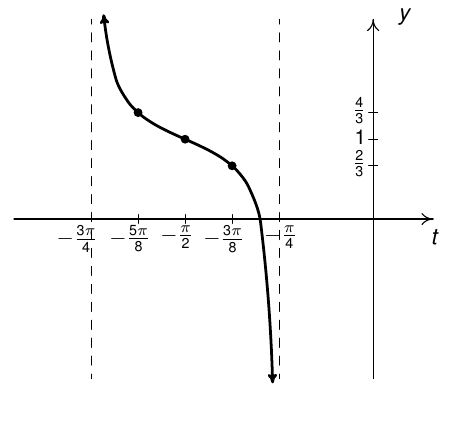
4. Period: $2\pi$

5. Period: $2\pi$

6. Period: $4\pi$

7. Period: $\pi$
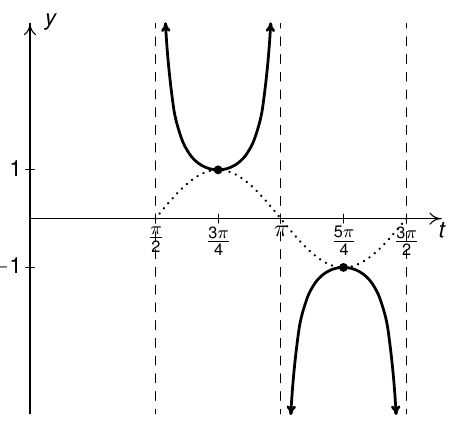
8. Period: $\frac{2\pi}{3}$

9. Period $2\pi$

10. Period: $\pi$

11. Period: $5\pi$

12.Period: $\frac{\pi}{2}$

Homework Set
Graph each of the following functions across at least two periods. Identify the period, phase shift, and describe the location of the asymptotes.
- $f(x) = \tan\left(\frac{\pi}{2} x\right)$
- $g(x) = -\tan\left(x-\frac{\pi}{4}\right)$
- $f(x) = \pi\cot(\pi x - \pi) - \pi$
- $y=4\tan\left(4x+\frac{\pi}{2}\right) - 3$
- $y = 1 + 2\cot(2x-\pi)$
- $ f(x) = 2\csc(x)$
- $f(x) = 2\sec\left(x+\frac{\pi}{4}\right)-1$
- $y = -\sec\left(\frac12 x + \frac{\pi}{2}\right) - 2$
- $ y = -2\csc\left(4x - \frac{3\pi}{2}\right) + 2$