The Definition of the Derivative
Click here for a printable version of this page.In the first section of the Limits chapter, we saw that the computation of the slope of a tangent line, the instantaneous rate of change of a function, and the instantaneous velocity of an object at $x=a$ all require us to compute the following limit: $$\lim_{x\to a} \frac{f(x)-f(a)}{x-a}$$
Note that this is somtimes given the notation $$\lim_{\Delta x\to 0}\frac{\Delta y}{\Delta x}$$ where $\Delta y$ and $\Delta x$ represent the change or difference in $y$ and $x$, respectively. So $\Delta y=f(x)-f(a)$ (the difference of $y$-values or function values) and $\Delta x=x-a$ (the difference of $x$-values).
<-->We also saw that with a small change of notation, this limit could be written as \begin{equation}\lim_{h\to 0}\frac{f(a+h)-f(a)}{h} \end{equation}
Quick Review
- What are we trying to figure out when we calculate $\frac{f(x)-f(a)}{x-a}$?
- What are we trying to find when we take the limit as $x \to a$ of $\frac{f(x)-f(a)}{x-a}$?
- What is the meaning of $\lim\limits_{h\to 0}\frac{f(a+h)-f(a)}{h}$?
This is how we find the slope of a secant line through the points on a function, $(x, f(x))$ and $(a, f(a))$. It also tells us the average rate of change from $x$ to $a$.

When we let $x \to a$, we're moving our $(x,f(x))$ closer and closer to $(a, f(a)$, like what happens if you drag the orange dot closer to the black dot in the demo here.
By calculating this limit, then, we're trying to find an instantaneous rate of change, or the slope of the tangent line.
This limit does the same thing as the $\lim\limits_{x\to a}\frac{f(x)-f(a)}{x-a}$ limit. Now, though, we're thinking about a point at $x=a$ and another point $h$ units away. A little substitution lands us at the $\lim\limits_{h\to0}\frac{f(x+h)-f(x)}{h}$ version of the limit, where $h$ represents the (tiny) distance between the function points that the secant line passes through.
Recall that the expressions in these limits are called difference quotients. This limit is so important, and it arises in so many places, that we give it a name. It is called the derivative of the function $f.$ Here is the formal definition of the derivative.
Definition of the Derivative
The derivative of $f(x)$ with respect to $x$ is the function $f'(x)$ and is defined as $$f'(x) = \lim_{h\to 0}\frac{f(x+h)-f(x)}{h}$$In this definition, we read $f'(x)$ as "f prime of x." Note that we replaced all the a's in the expression with x's to acknowledge the fact that the derivative is itself a function.
Alternate Notation
Before we do some examples, let's look at an alternate way of writing derivatives. The typical derivative notation is the "prime" notation that we introduced above. However, there is another notation that is often used, and is sometimes more convenient than the prime notation.
Given a function $y=f(x),$ all of the following are equivalent and represent the derivative of $f(x)$ with respect to $x$:
The "fractional" notation for the derivative is called the Leibniz notation, after Gottfried Wilhelm Leibniz, one of the acknowledged inventors of calculus. This notation is convenient because it gives us a way of annotating the name of the function (the variable in the numerator) as well as the independent variable (the variable in the denominator) all in one place.
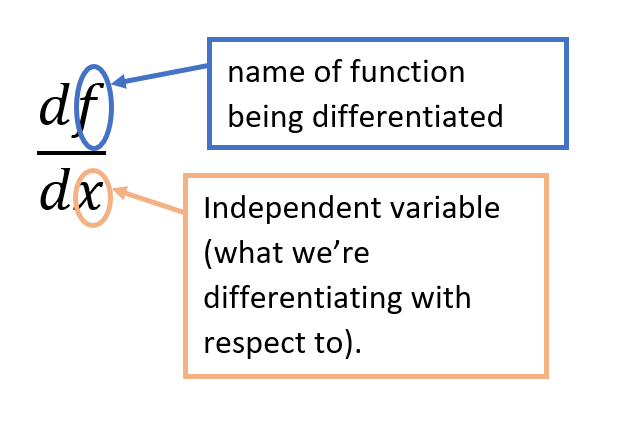
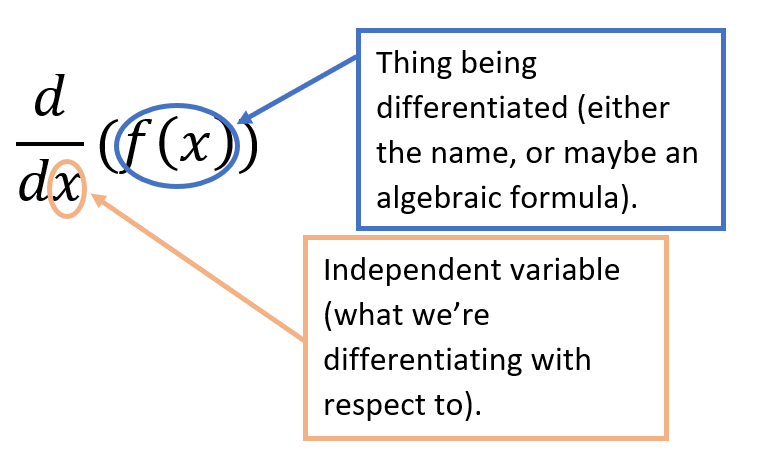
Because we also need to evaluate derivatives, we need a way to write the derivative at a particular value of $x$ when using this notation. If we want to evaluate the derivative at $x=a,$ all of the following are equivalent: $$f'(a) = y'\Big|_{x=a} = \frac{df}{dx}\Big|_{x=a} = \frac{dy}{dx}\Big|_{x=a}$$
Note as well that on occasion we will drop the $(x)$ part on the function to simplify the notation somewhat. In these instances, the following are equivalent: $$f'(x) = f'.$$
Examples
Now let's use the definition to compute some derivatives.
Find the derivative of the following function using the definition of the derivative: $$f(x) = 2x^2 - 16x +35$$
To find the derivative, we just need to put the given function into the definition and do some algebra to simplify the resulting expression before taking the limit. While at times the algebra can become somewhat complicated, keep in mind that this is algebra that you already know how to do. There is nothing special about the fact that it's showing up while we're computing a derivative.
First we substitute the function into the definition of the derivative to obtain \begin{align*} f'(x) &= \lim_{h\to 0} \frac{f(x+h) - f(x)}{h}\\ &= \lim_{h\to 0}\frac{2(x+h)^2 - 16(x+h) + 35 - (2x^2 - 16x +35)}{h}\\ \end{align*} Be careful in this step, and be sure to use parentheses around the expression for $f(x)$ in the second term.
We know from our previous work on limits that we cannot just replace $h$ with zero here, as this will result in division by zero (in fact, it will give us 0/0). Instead, we multiply everything out (and remember to distribute the minus sign on the second term). Doing this gives us \begin{align*} f'(x) &= \lim_{h\to 0} \frac{2x^2+4xh+2h^2-16x-16h+35-2x^2+16x-35}{h}\\ &=\lim_{h\to 0}\frac{4xh+2h^2-16h}{h}\\ \end{align*} Notice that every term in the numerator that didn't have an $h$ in it divided out, and we can now factor an $h$ from every term of the numerator. This will then divide with the $h$ in the denominator, allowing us to compute the limit. \begin{align*} f'(x) &= \lim_{h\to 0} \frac{h(4x+2h-16)}{h}\\ &= \lim_{h\to 0} 4x +2h - 16\\ &= 4x-16\\ \end{align*} The derivative is then $f'(x) = 4x-16$.$
Find the derivative of the following function using the definition of the derivative: $$f(x) = x^3+2x-3$$
We begin by substituting the function into the definition of the derivative.
\begin{align*} f'(x) &= \lim_{h\to 0} \frac{f(x+h) - f(x)}{h}\\ &=\lim_{h \to 0} \frac{(x+h)^3 +2(x+h) - 3 - (x^3+2x-3)}{h}\\ \end{align*}As with the first example, we cannot just put $h=0$ into the expression in the limit, so we multiply out and combine terms to simplify until we can divide an h from the numerator with the h in the denominator.
\begin{align*} f'(x) &=\lim_{h\to 0} \frac{x^3+3x^2h+3xh^2+h^3 +2x +2h -3 -x^3 -2x +3}{h}\\ &= \lim_{h\to 0} \frac{3x^2h+3xh^2+h^3+2h}{h}\\ &=\lim_{h\to 0} 3x^2 +3xh+h^2+2\\ &= 3x^2 + 2\\ \end{align*}The derivative is then $$f'(x) = 3x^2 + 2$$
Find the derivative of the following function using the definition of the derivative: $$g(t) = \frac{t}{t+1}$$
This one works in exactly the same way as the first two examples, except that the algebra will be a little messier. First, substitute the function into the definition of the derivative
\begin{align*} g'(t) &= \lim_{h\to 0} \frac{g(t+h) - g(t)}{h}\\ &= \lim_{h\to 0} \frac{1}{h} \left(\frac{t+h}{t+h+1} - \frac{t}{t+1}\right)\\ \end{align*}Note that we changed all the variables in the definition to match those in the given function. Also note that we wrote the overall fraction in a much more compact way. This will make it easier to see what's going on with the algebra.
As with the previous examples, we cannot just put $h=0$ into the expression in the limit, so we will need to simplify a little. In this case we need to combine the two fractions in parentheses into a single rational expression as follows:
\begin{align*} g'(t) &= \lim_{h\to 0} \frac{1}{h}\left(\frac{(t+h)(t+1) -t(t+h+1)}{(t+h+1)(t+1)}\right)\\ &=\lim_{h\to 0}\frac{1}{h}\left(\frac{t^2+t+th+h - (t^2+th+t)}{(t+h+1)(t+1)}\right)\\ &=\lim_{h\to 0}\frac{1}{h}\left(\frac{h}{(t+h+1)(t+1)}\right)\\ \end{align*}Before we finish, let's note a couple of things. First, we didn't multiply out the denominator. Multiplying out the denominator just overly complicates things, so we left it alone. Next, as with the first example, after the simplification we only have terms with h's in them left in the numerator, which we can now divide with the $h$ in the denominator. Then we can evaluate the limit and find the derivative.
\begin{align*} g'(t) &= \lim_{h\to 0}\frac{1}{(t+h+1)(t+1)}\\ &= \frac{1}{(t+1)(t+1)}\\ &=\frac{1}{(t+1)^2}\\ \end{align*}The derivative is therefore $$g'(t) = \frac{1}{(t+1)^2}$$
Find the derivative of the following function using the definition of the derivative: $$R(z) = \sqrt{5z-8}$$
As in the previous examples, we first put the function into the definition of the derivative.
\begin{align*} R'(z) &= \lim_{h\to 0}\frac{R(z+h)-R(z)}{h}\\ &= \lim_{h\to 0}\frac{\sqrt{5(z+h)-8}-\sqrt{5z-8}}{h}\\ \end{align*}To simplify this expression, we are going to need to rationalize the numerator. In an algebra class, you may have only rationalized denominators, but we can use the exact same procedure to rationalize a numerator. That is, we multiply both the numerator and denominator by the conjugate of the numerator. Recall that the conjugate of an expression is the same as the original expression, but with the sign between the two terms changed. Here's what it looks like for this problem:
\begin{align*} R'(z) &= \lim_{h\to 0} \frac{\left(\sqrt{5(z+h)-8}-\sqrt{5z-8}\right)}{h} \frac{\left(\sqrt{5(z+h)-8}+\sqrt{5z-8}\right)}{\left(\sqrt{5(z+h)-8}+\sqrt{5z-8}\right)}\\ &=\lim_{h\to 0} \frac{5z+5h-8-(5z-8)}{h\left(\sqrt{5(z+h)-8}+\sqrt{5z-8}\right)}\\ &=\lim_{h\to0} \frac{5h}{h\left(\sqrt{5(z+h)-8}+\sqrt{5z-8}\right)}\\ &=\lim_{h\to0} \frac{5}{\sqrt{5(z+h)-8}+\sqrt{5z-8}}\\ &=\frac{5}{2\sqrt{5z-8}}\\ \end{align*}Therefore the derivative is $$R'(z) = \frac{5}{2\sqrt{5z-8}}$$
Higher-Order Derivatives
Consider the function $f(x) = x^3 +2x -3$ from Example 2. There, we found that its derivative is $$f'(x) = 3x^2 + 2$$ Now, this is also a function, so we should be able to find its derivative as well.
Find the derivative of the function $$f'(x) = 3x^2 + 2$$
First we note that we are taking the derivative of a derivative here. To acknowledge that, we will denote this new derivative as $f''(x).$ As with all of our examples so far, we first substitute into the definition of the derivative. Then we multiply everything out and simplify until we can divide an h from the numerator with the h in the denominator. At that point we take the limit.
\begin{align*} f''(x) &= \lim_{h \to 0} \frac{3(x+h)^2 + 2 - (3x^2 +2)}{h}\\ &= \lim_{h\to 0} \frac{3(x^2+2xh+h^2) +2 - (3x^2+2)}{h}\\ &=\lim_{h\to 0} \frac{3x^2 + 6xh + 3h^2 + 2 - 3x^2 - 2}{h}\\ &=\lim_{h\to 0} \frac{6xh + 3h^2}{h}\\ &=\lim_{h\to 0} 6x+3h\\ &= 6x\\ \end{align*}The derivative of $f'(x)$ is then $$f''(x) = 6x$$
The derivative we found in the last example is called the second derivative of the function $f$ and $f'(x)$ is now called the first derivative. You have probably noticed that the second derivative is again a function, and we should be able to differentiate it. This will be called the third derivative and is denoted $f'''(x) = (f''(x))'.$ You can verify, using the definition of the derivative, that $f'''(x) = 6$ in this example.
As long as the result of differentiation is again a function, we can continue this process. The next derivative is called the fourth derivative and so on. At this point, we are going to change the notation, though. The fourth derivative is denoted $$f^{(4)}(x) = (f'''(x))'$$
In general, derivatives above the third derivative will be denoted this way. We will need to be careful with this numbered notation for derivatives, though. Consider each of the following:
\begin{align*} f^{(2)}(x) &= f''(x)\\ f^2(x) &= [f(x)]^2\\ \end{align*}The presence of parentheses in the exponent denotes differentiation while the absence of parentheses denotes exponentiation.
We can also use Leibniz notation for higher-order derivatives. Given $y = f(x),$ all of the following are equivalent and represent the second derivative of $f(x)$ with respect to $x$:
$$f''(x) = y'' = \frac{d^2y}{dx^2}$$The exponents in this notation indicate that we are taking the second derivative of $y$ with respect to $x$ twice. If you go on to work with functions of more than one variable, this will be a very useful way to keep track of the variables in derivatives.
Similarly we can write a general derivative as $$f^{(n)}(x) = \frac{d^n y}{dx^n}$$
Higher-Order Derivatives
Given a continuous function $f(x),$ its higher-order derivatives are the successive derivatives of the function (when they exist). For a positive integer $n,$ we denote the $n^{\text{th}}$ derivative of $f(x)$ by $$f^{(n)}(x) = \frac{d^n y}{dx^n}$$As a final note, if all we are working with is the first derivative, we will often still just call it "the derivative."
Differentiability of Functions
Let's start this section with one more example. This one is a little different, but it makes a point that needs to be made.
Determine $f'(0)$ for $f(x) = |x|.$ This problem is asking us to find the derivative at a particular point. We have the option to find the derivative function as in our previous examples, then substitute $x=0$ into the result. In this problem, though, it's going to be easier to use the specific point $x=0$ from the start. So, we substitute into the definition and simplify, replacing $x$ with $0$ everywhere. We saw a situation like this back when we were looking at limits involving infinity. As in that section, we cannot just divide the h's. First recall that Keeping this definition of absolute value in mind, we look at the two one-sided limits. In approaching zero from the left, $h$ is negative, so $|h| = -h$; similarly, in approaching zero from the right, $h$ is positive and thus $|h| = h.$ So and The two one-sided limits are different, and so the limit $$\lim_{h\to 0}\frac{|h|}{h}$$ doesn't exist. But this is the limit that gives us the derivative that we are after. If the limit doesn't exist, neither does the derivative. Therefore $f'(0)$ does not exist.
In this last example, we saw a function for which the derivative does not exist at a point. This is a fact of life that we have to be aware of: derivatives do not always exist. Note as well that this doesn't say anything about whether or not the derivative exists anywhere else. In fact, the derivative of the absolute value function exists at every point except the one we just looked at, $x=0.$
The preceding discussion leads to the following definition:
Definition: Differentiable Functions
A function $f(x)$ is called differentiable at $x = a$ if $f'(a)$ exists. A function $f(x)$ is called differentiable on an interval if the derivative exists at each point in that interval.The next theorem shows us a very nice relationship between functions that are continuous and those that are differentiable.
Theorem
If $f(x)$ is differentiable at $x=a,$ then $f(x)$ is continuous at $x=a.$Proof
Let $f$ be a function that is differentiable at $x = a.$ Then by definition of differentiable, we know that the derivative $f'(a)$ exists. That is, the limit $$f'(a) = \lim_{x\to a} \frac{f(x) - f(a)}{x-a}$$ exists.
Recall that when we take a limit as $x$ approaches $a,$ $x$ does not equal $a.$ So we may assume that $x\neq a$ and write $$f(x) - f(a) = \frac{f(x) - f(a)}{x-a}(x-a)$$
Basic properties of limits now tell us that we have
\begin{align*} \lim_{x\to a} (f(x) - f(a)) &= \lim_{x\to a} \left [\frac{f(x)-f(a)}{x-a} (x-a)\right]\\ &=\lim_{x\to a}\frac{f(x)-f(a)}{x-a} \lim_{x\to a} (x-a)\\ \end{align*}The first limit in this last line is just $f'(a)$ as we noted above, and the second limit is zero. So we have $$\lim_{x\to a}(f(x) - f(a)) = f'(a)\cdot 0 = 0$$ We will use this fact in a little bit.
Looking back at the statement we are proving, we know we need to show that $f(x)$ is continuous at $x=a.$ That is, we need to show that $\displaystyle\lim_{x\to a} f(x) = f(a).$ To do this, let's start with $$\lim_{x\to a} f(x) = \lim_{x\to a}[f(x) + f(a) - f(a)]$$
Note that we've just added zero in the form of $f(a) - f(a).$ A little rewriting and the use of limit properties gives us
\begin{align*} \lim_{x\to a} f(x)&= \lim_{x\to a} [f(a) +f(x)-f(a)]\\ &=\lim_{x\to z} f(a) + \lim_{x\to a} [f(x) - f(a)]\\ \end{align*}Above, we proved that $\displaystyle\lim_{x\to a} (f(x) - f(a))=0$ and because $f(a)$ is a constant, we also know that $\displaystyle\lim_{x\to a} f(a) = f(a).$ So we have $$\lim_{x\to a} f(x) = \lim_{x\to a} f(a) + 0 = f(a)$$ Or, in other words, $$\lim_{x\to a} f(x) = f(a)$$ So $f(x)$ is continuous at $x=a.$
Therefore, if $f(x)$ is differentiable at $x=a,$ then $f(x)$ is also continuous at $x=a.$
Another way to read the theorem above (called its contrapositive) is that if a function is not continuous, then it is not differentiable. In other words, continuity is a requirement for the derivative to exist.
Note also that the converse of this theorem is not true (that is, the theorem does not work in reverse). There are functions that are continuous at $x=a$ but not differentiable at $x=a.$
Consider $f(x) = |x|.$ We can easily see that $$\lim_{x\to 0} f(x) = \lim_{x\to 0} |x| = 0 = f(0).$$ So $f(x) = |x|$ is continuous at $x=0.$ But we just showed above in Example 4 that $f(x) = |x|$ is not differentiable at $x=0.$
Let's take a look at the graph of $f(x) = |x|.$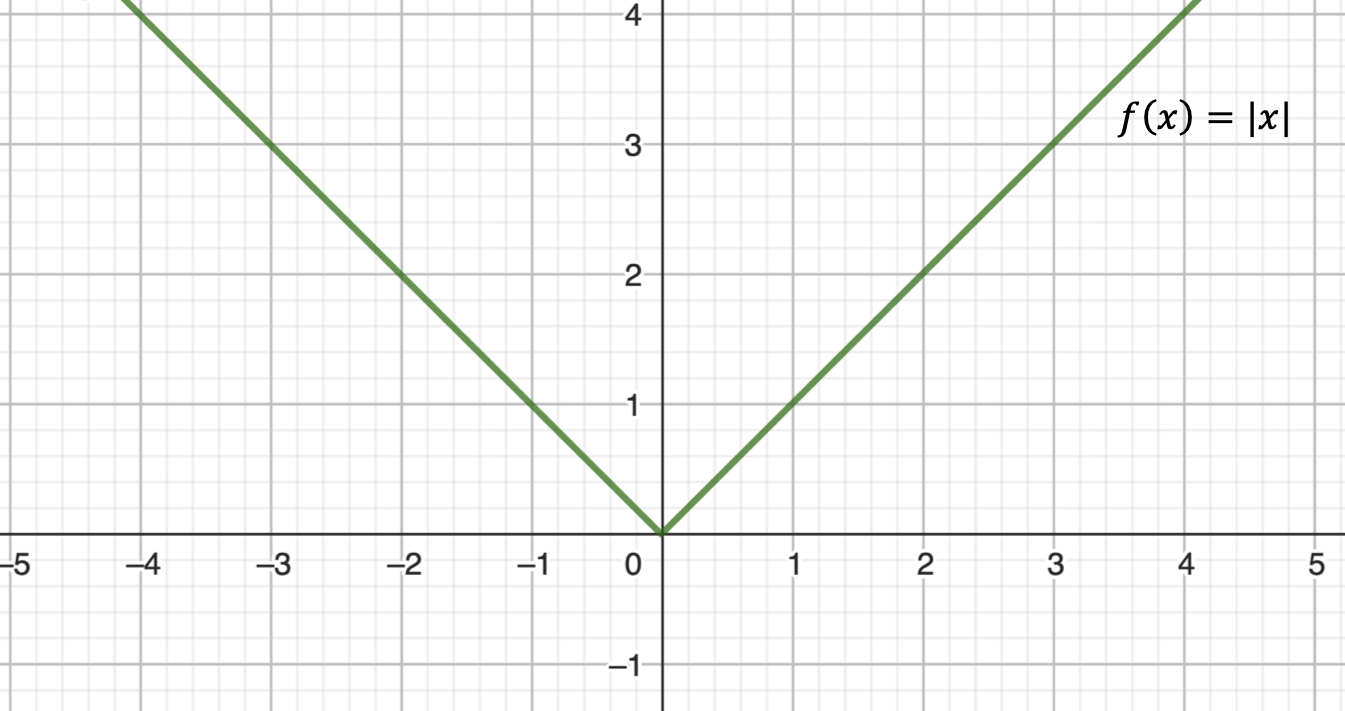
The tangent line to a straight line is just the line itself. So in this graph, we can clearly see that the tangent line to any point with $x\lt 0$ has slope equal to $-1,$ while the tangent line to any point with $x \gt 0$ has slope equal to $1.$ At $(0,0),$ there is no clearly defined tangent line. The sharp corner or cusp we see on this graph is a signal that the derivative fails to exist at that point.
Access for free at https://openstax.org/books/calculus-volume-1/pages/1-introduction.

Let's consider some additional situations in which a continuous function fails to be differentiable. Consider the function $f(x) = \sqrt[3]{x}.$ Its derivative at $x=0$ is
$$f'(0) = \lim_{x\to 0} \frac{\sqrt[3]{x} - 0}{x-0} = \lim_{x\to 0} \frac{1}{\sqrt[3]{x^2}} = \infty$$ Thus $f'(0)$ does not exist. A quick look at the graph of $f(x) = \sqrt[3]{x}$ clarifies the situation. At $x=0$, the $y$-axis is tangent to the graph, so the function has a vertical tangent line at $x=0.$

The function $f(x) = \left\{\begin{array}{ll} x\sin\left(\frac{1}{x}\right) & \text{if } x\neq 0\\ 0 & \text{if } x=0\\ \end{array}\right.$ also has a derivative that exhibits interesting behavior at $x=0.$ We see that $$f'(0) = \lim_{x\to 0} \frac{x\sin(1/x) - 0}{x-0} = \lim_{x\to 0} \sin\left(\frac{1}{x}\right).$$ This limit does not exist, essentially because the slopes of the secant lines continuously change direction as $x$ approaches zero.

Note: The following content is adapted from Paul's Online Math Notes, with permission, and is not shared under the Creative Commons license.
Summary
- We observed that if a function is not continuous, it cannot be differentiable, since every differentiable function must be continuous. However, if a function is continuous, it can still fail to be differentiable.
- We saw that $f(x)=|x|$ failed to be differentiable at $x=0$ because the limit of the slopes of the tangent lines on the left and the right were not the same. Visually, this resulted in a sharp corner on the graph of the function at $(0,0).$ From this we conclude that in order to be differentiable at a point, a function must be "smooth" at that point.
- As we saw in the example of $f(x)=\sqrt[3]{x},$ a function fails to be differentiable at a point where there is a vertical tangent line.
- As we saw with $f(x) = \left\{\begin{array}{ll} x\sin\left(\frac{1}{x}\right) & \text{if } x\neq 0\\ 0 & \text{if } x=0\\ \end{array}\right.$ a function may fail to be differentiable at a point in more complicated ways as well.
Conclusion
As a final note in this section, we will acknowledge that computing most derivatives directly from the definition is a fairly complex process filled with opportunities to make mistakes. In a couple of sections we'll start developing formulas and properties that will help us to take the derivative of many of the common functions, so that we won't need to resort to the definition of the derivative too often.
This does not mean however that it isn't important to know the definition of the derivative! There are some functions whose derivative we cannot find any other way, so it is an important definition that we should always know and keep in the back of our minds.
Practice Problems
In problems 1 - 11, use the definition of the derivative to find the first derivative of the function.
- $f(x) = 6$
When we substitute the function into the definition of the derivative, we see that for this problem, the difference quotient simplifies really nicely:
$$f'(x) = \lim_{h\to 0} \frac{f(x+h)-f(x)}{h} = \lim_{h\to 0} \frac{6 - 6}{h} = \lim_{h\to 0} \frac{0}{h} = \lim_{h\to 0} (0) = 0$$The derivative is then $$f'(x) = 0$$
- $V(t) = 3 - 14t$
First we put the function into the definition of the derivative.
$$V'(t) = \lim_{h\to 0} \frac{V(t+h)-V(t)}{h} = \lim_{h\to 0} \frac{3-14(t+h)-(3-14t)}{h}$$Make sure that you evaluate $V(t+h)$ correctly. Not putting the "$t+h$" in the right places is one of the more common errors that people make with these problems.
Also watch for the parentheses around the function after the subtraction. Since you are subtracting the whole function, you need to make sure that you deal with the minus sign properly, and distribute it through. This is another very common error and is one that will often make the problem impossible to complete.
Now all we need to do is some simplification and we'll be done.
$$V'(t) = \lim_{h\to 0} \frac{3-14t-14h-3+14t}{h} = \lim_{h\to 0}\frac{-14h}{h} = \lim_{h\to 0} (-14) = -14$$The derivative is then $$V'(t) = -14$$
- $g(x) = x^2$
We first put the function into the definition of the derivative. Make sure that you properly evaluate $g(x+h).$ This is a place where people commonly make mistakes with these problems.
All we need to do then is some quick algebra before taking the limit.
\begin{align*} g'(x) = \lim_{h\to 0} \frac{g(x+h) - g(x)}{h} &= \lim_{h\to 0}\frac{(x+h)^2 - x^2}{h}\\ = \lim_{h\to 0} \frac{x^2+2xh+h^2-x^2}{h} &= \lim_{h\to 0} \frac{h(2x+h)}{h}\\ &= \lim_{h\to 0} (2x+h)\\ &= 2x\\ \end{align*}The derivative is then $$g'(x) = 2x$$
- $Q(t) = 10 + 5t -t^2$
First we put the function into the definition of the derivative.
$$Q'(t) = \lim_{h\to 0} \frac{Q(t+h)-Q(t)}{h} = \lim_{h\to 0} \frac{10+5(t+h)-(t+h)^2 - (10+5t-t^2)}{h}$$Make sure that you evaluate $Q(t+h)$ correctly. Also watch for the parentheses around the function after the subtraction. Since you are subtracting the whole function, you need to make sure that you deal with the minus sign properly, and distribute it through. This is another very common error and is one that will often make the problem impossible to complete.
Now all we need to do is some algebra (it might be a little messy here, but that is somewhat common with these types of problems) and we'll be done.
\begin{align*} Q'(t) &= \lim_{h\to 0} \frac{10 + 5t + 5h - t^2 - 2th - h^2 -10 -5t +t^2}{h}\\ &= \lim_{h\to 0} \frac{h(5-2t-h)}{h} = \lim_{h\to 0} (5-2t-h) = 5-2t\\ \end{align*}The derivative is then $$Q'(t) = 5-2t$$
- $W(z) = 4z^2 - 9z$
First we put the function into the definition of the derivative.
$$W'(z) = \lim_{h\to 0} \frac{W(z+h)-W(z)}{h} = \lim_{h\to 0} \frac{4(z+h)^2 - 9(z+h) - (4z^2 - 9z)}{h}$$Make sure that you evaluate $W(z+h)$ correctly. Also watch for the parentheses around the function after the subtraction. Since you are subtracting the whole function, you need to make sure that you deal with the minus sign properly, and distribute it through. This is another very common error and is one that will often make the problem impossible to complete.
Now all we need to do is some algebra (it might be a little messy here, but that is somewhat common with these types of problems) and we'll be done.
\begin{align*} W'(z) &= \lim_{h\to 0} \frac{4(z^2 + 2zh + h^2) - 9z-9h - 4z^2 +9z}{h}\\ &= \lim_{h\to 0} \frac{4z^2 + 8zh + 4h^2 - 9z - 9h - 4z^2 +9z}{h}\\ &= \lim_{h\to 0} \frac{h(8z+4h-9)}{h} = \lim_{h\to 0} (8z+4h-9) = 8z-9\\ \end{align*}The derivative is then $$W'(z) = 8z-9$$
- $f(x) = 2x^3 - 1$
First we put the function into the definition of the derivative.
$$f'(x) = \lim_{h\to 0} \frac{f(x+h)-f(x)}{h} = \lim_{h\to 0} \frac{2(x+h)^3-1-(2x^3 - 1)}{h}$$Make sure that you evaluate $f(x+h)$ correctly. Also watch for the parentheses around the function after the subtraction. Since you are subtracting the whole function, you need to make sure that you deal with the minus sign properly, and distribute it through. This is another very common error and is one that will often make the problem impossible to complete.
Now all we need to do is some algebra (it might be a little messy here, but that is somewhat common with these types of problems) and we'll be done.
\begin{align*} f'(x) &= \lim_{h\to 0} \frac{2(x^3 + 3x^2h + 3xh^2 + h^3) -1 -2x^3 +1}{h}\\ &= \lim_{h\to 0} \frac{2x^3 + 6x^2h +6xh^2 + 2h^3 -1 -2x^3 +1}{h}\\ &= \lim_{h\to 0} \frac{h(6x^2 + 6xh +2h^2)}{h} = \lim_{h\to 0} (6x^2 + 6xh + 2h^2) = 6x^2\\ \end{align*}The derivative is then $$f'(x) = 6x^2$$
- $g(x) = x^3 -2x^2 +x -1$
First we put the function into the definition of the derivative.
$$g'(x) = \lim_{h\to 0} \frac{g(x+h)-g(x)}{h} = \lim_{h\to 0} \frac{(x+h)^3 - 2(x+h)^2 + x+h - 1 - (x^3 -2x^2 +x-1)}{h}$$Make sure that you evaluate $g(x+h)$ correctly. Also watch for the parentheses around the function after the subtraction. Since you are subtracting the whole function, you need to make sure that you deal with the minus sign properly, and distribute it through. This is another very common error and is one that will often make the problem impossible to complete.
Now all we need to do is some algebra (it might be a little messy here, but that is somewhat common with these types of problems) and we'll be done.
\begin{align*} g'(x) &= \lim_{h\to 0} \frac{x^3 +3x^2h+3xh^2 +h^3 -2(x^2+2xh+h^2)+x+h-1-(x^3-2x^2+x-1)}{h}\\ &= \lim_{h\to 0} \frac{x^3 + 3x^2h +3xh^2 + h^3 -2x^2 -4xh -2h^2 +x +h-1-x^3 +2x^2 -x+1}{h}\\ &= \lim_{h\to 0} \frac{h(3x^2+3xh+h^2-4x-2h+1)}{h}\\ &= \lim_{h\to 0} (3x^2+3xh+h^2-4x-2h+1) = 3x^2-4x+1\\ \end{align*}The derivative is then $$g'(x) = 3x^2-4x+1$$
- $R(z) = \displaystyle\frac5z$
First we put the function into the definition of the derivative.
$$R'(z) = \lim_{h\to 0} \frac{R(z+h)-R(z)}{h} = \lim_{h\to 0} \frac1h\left (\frac{5}{z+h}-\frac5z\right)$$Make sure that you evaluate $R(z+h)$ correctly. Also note that we wrote the overall fraction in a much more compact way. This will make it easier to see what's going on with the algebra.
Next we need to combine the two fractions in the parentheses into a single rational expression.
$$R'(z) = \lim_{h\to 0} \frac1h\left (\frac{5z-5(z+h)}{z(z+h)}\right)$$Now all we need to do is some algebra.
$$R'(z) = \lim_{h\to 0} \frac1h\left(\frac{5z-5z-5h}{z(z+h)}\right) = \lim_{h\to 0}\frac1h\left(\frac{-5h}{z(z+h)}\right) = \lim_{h\to 0} \frac{-5}{z(z+h)} = -\frac{5}{z^2}$$The derivative is then $$R'(z) = -\frac{5}{z^2}$$
- $V(t) = \displaystyle\frac{t+1}{t+4}$
First we put the function into the definition of the derivative.
$$V'(t) = \lim_{h\to 0} \frac{V(t+h)-V(t)}{h} = \lim_{h\to 0} \frac1h\left (\frac{t+h+1}{t+h+4}-\frac{t+1}{t+4}\right)$$Make sure that you evaluate $V(t+h)$ correctly. Also note that we wrote the overall fraction in a much more compact way. This will make it easier to see what's going on with the algebra.
Next we need to combine the two fractions in the parentheses into a single rational expression.
$$V'(t) = \lim_{h\to 0} \frac1h\left (\frac{(t+h+1)(t+4)-(t+1)(t+h+4)}{(t+h+4)(t+4)}\right)$$Now all we need to do is some algebra (and it will get a little messy here, but that is somewhat common with these types of problems) and we'll be done.
\begin{align*} V'(t) &=\lim_{h\to 0} \frac1h\left(\frac{t^2+th+5t+4h+4-(t^2+th+5t+h+4)}{(t+h+4)(t+4)}\right)\\ &=\lim_{h\to 0} \frac1h\left(\frac{t^2+th+5t+4h+4-t^2-th-5t-h-4}{(t+h+4)(t+4)}\right)\\ &=\lim_{h\to 0} \frac1h\left(\frac{3h}{(t+h+4)(t+4)}\right) = \lim_{h\to 0}\frac{3}{(t+h+4)(t+4)} = \frac{3}{(t+4)^2}\\ \end{align*}The derivative is then $$V'(t) = \frac{3}{(t+4)^2}$$
- $Z(t) = \sqrt{3t-4}$
First we need to put the function into the definition of the derivative.
$$Z'(t) = \lim_{h\to 0} \frac{Z(t+h)-Z(t)}{h} = \lim_{h\to 0}\frac{\sqrt{3(t+h)-4}-\sqrt{3t-4}}{h}$$Make sure that you evaluate $Z(t+h)$ correctly. This is a place where people commonly make mistakes with these problems.
Next we need to rationalize the numerator.
$$Z'(t) = \lim_{h\to 0} \frac{\left(\sqrt{3(t+h)-4}-\sqrt{3t-4}\right)}{h} \frac{\left(\sqrt{3(t+h)-4}+\sqrt{3t-4}\right)}{\left(\sqrt{3(t+h)-4}+\sqrt{3t-4}\right)}$$Now all that we need to do is some algebra (and it will get a little messy here, but that is pretty common with these types of problems) and we'll be done.
\begin{align*} Z'(t) &= \lim_{h\to 0}\frac{3(t+h)-4-(3t-4)}{h\left(\sqrt{3(t+h)-4}+\sqrt{3t-4} \right)} = \lim_{h\to 0}\frac{3t+3h-4-3t+4}{h\left(\sqrt{3(t+h)-4}+\sqrt{3t-4} \right)}\\ &=\lim_{h\to 0}\frac{3h}{h\left(\sqrt{3(t+h)-4}+\sqrt{3t-4} \right)}=\lim_{h\to 0}\frac{3}{\sqrt{3(t+h)-4}+\sqrt{3t-4}}\\ &=\frac{3}{2\sqrt{3t-4}}\\ \end{align*}Be careful when multiplying out the numerator in the first step here. It is easy to lose track of the minus sign (or parentheses for that matter) on the second term.
The derivative is then $$Z'(t) = \frac{3}{2\sqrt{3t-4}}$$
- $f(x) = \sqrt{1 - 9x}$
First we put the function into the definition of the derivative: $$f'(x) = \lim_{h\to 0} \frac{f(x+h)-f(x)}{h} = \lim_{h\to 0}\frac{\sqrt{1-9(x+h)}-\sqrt{1-9x}}{h}$$ Make sure that you evaluate $f(x+h)$ correctly. This is a place where people commonly make mistakes with these problems.
Next we rationalize the numerator: $$f'(x) = \lim_{h\to 0} \frac{\left(\sqrt{1-9(x+h)}-\sqrt{1-9x}\right)}{h} \frac{\left(\sqrt{1-9(x+h)} +\sqrt{1-9x}\right)}{\left(\sqrt{1-9(x+h)} +\sqrt{1-9x}\right)}$$
Now all we need to do is some algebra (which can be a little messy, but that is common with these problems).
\begin{align*} f'(x) &= \lim_{h\to 0}\frac{1-9(x+h)-(1-9x)}{h\left(\sqrt{1-9(x+h)}+\sqrt{1-9x}\right)} = \lim_{h\to 0}\frac{1-9x-9h-1+9x}{h\left(\sqrt{1-9(x+h)}+\sqrt{1-9x}\right)}\\ &= \lim_{h\to 0}\frac{-9h}{h\left(\sqrt{1-9(x+h)}+\sqrt{1-9x}\right)} = \lim_{h\to 0} \frac{-9}{\sqrt{1-9(x+h)}+\sqrt{1-9x}} = \frac{-9}{2\sqrt{1-9x}}\\ \end{align*}Be careful when multiplying out the numerator in the first step here. It is easy to lose track of the minus sign (or parentheses for that matter) on the second term.
The derivative is then $$f'(x) = \frac{-9}{2\sqrt{1-9x}}$$
- Find the second and third derivatives of the function from Problem 3, $g(x) = x^2.$
We found in Problem 3 that the first derivative of $g(x)$ is $g'(x) = 2x.$ The second derivative is then $g''(x) = (g'(x))'.$ To make the notation easier, let's name $g'(x),$ $d(x).$ That is, $d(x) = 2x,$ and we wish to find $d'(x).$
As always, the first step is to substitute into the definition of the derivative: $$g''(x) = d'(x) = \lim_{h\to 0} \frac{d(x+h) - d(x)}{h} = \lim_{h\to 0}\frac{2(x+h)-2x}{h}$$
All we need now is a little algebra and we're done:
$$g''(x) = d'(x) = \lim_{h\to 0} \frac{2x+2h-2x}{h} = \lim_{h\to 0}\frac{2h}{h} = \lim_{h\to 0} (2) = 2$$The second derivative of $g$ is then $$g''(x) = 2$.$
Now we need to find the derivative of this function. Again, let's simplify the notation by renaming $g''(x)$ as $f(x).$ Then $f(x) = 2$ and $g'''(x) = (g''(x))'=f'(x).$
As with the other problems, we substitute into the definition of the derivative, then do some algebra. In this case, the algebra is not too bad: $$\lim_{h\to 0} \frac{f(x+h)-f(x)}{h} = \lim_{h\to 0}\frac{2 - 2}{h} = \lim_{h\to 0}\frac0h = \lim_{h\to 0} (0) = 0$.$
The derivative is then $$g'''(x) = f'(x) = 0$$
- Find the second derivative of the function from Problem 6, $f(x) = 2x^3 - 1.$
In Problem 6, we found that the first derivative is $$f'(x) = 6x^2$$ Now we need to find the derivative of this function, $f''(x) = (f'(x))'.$ To make the notation easier, let's rename $f'(x)$ as $d(x)$ and find $f''(x) = d'(x).$
We first substitute into the definition of the derivative: $$f''(x) = d'(x) = \lim_{h\to 0}\frac{d(x+h)-d(x)}{h} = \lim_{h\to 0}\frac{6(x+h)^2 - 6x^2}{h}$$
Be sure you evaluate $d(x+h)$ correctly. This is a place where errors often occur.
Now all we need to do is some algebra and we're done: \begin{align*} f''(x) = d'(x) &= \lim_{h\to 0} \frac{6(x^2 + 2xh +h^2) - 6x^2}{h} = \lim_{h\to 0}\frac{6x^2 + 12xh + 6h^2 - 6x^2}{h}\\ &= \lim_{h\to 0} \frac{12xh + 6h^2}{h} = \lim_{h\to 0}(12x + 6h) = 12x\\ \end{align*}
The derivative is then $$f''(x) = 12x$$
Assignment Problems
In problems 1 - 24, use the definition of the derivative to find the derivatives of the functions.
- $g(x)=10$
- $T(y) = -8$
- $f(x)=5x+7$
- $Q(t) = 1 - 12t$
- $f(z) = z^2 + 3$
- $R(w) = w^2-8w+20$
- $V(t)=6t-t^2$
- $Q(t) = 2t^2-8t+10$
- $g(z) = 1+10z-7z^2$
- $f(x) = 5x-x^3$
- $Y(t) = 2t^3+9t+5$
- $Z(x) = 2x^3-x^2-x$
- $f(t) = \displaystyle\frac{2}{t-3}$
- $g(x) = \displaystyle\frac{x+2}{1-x}$
- $Q(t) = \displaystyle\frac{t^2}{t+2}$
- $f(w) = \sqrt{w+8}$
- $V(t) = \sqrt{14+3t}$
- $G(x) = \sqrt{2-5x}$
- $Q(t)=\sqrt{1+4t}$
- $f(x) = \sqrt{x^2+1}$
- $W(t) = \displaystyle\frac{1}{\sqrt{t}}$
- $g(x) = \displaystyle\frac{4}{\sqrt{1-x}}$
- $f(x) = x+\sqrt{x}$
- $f(x) = x+\displaystyle\frac{1}{x}$
Note: The following content is adapted from OpenStax and is licensed under a Creative Commons Attribution-NonCommercial-ShareAlike 4.0 International License.
Access for free at https://openstax.org/books/calculus-volume-1/pages/1-introduction.
For the functions in problems 25 - 28, (a) sketch the graph, and (b) use the definition of the derivative to show that the function is not differentiable at $x=1.$
- $f(x) = \left\{\begin{array}{ll} 2\sqrt{x} & 0\leq x\leq 1\\ 3x-1 & x\gt 1\\ \end{array}\right.$
- $f(x) = \left\{\begin{array}{ll} 3 & x\lt 1\\ 3x & x\geq 1\\ \end{array}\right.$
- $f(x) = \left\{\begin{array}{ll} -x^2 + 2 & x\leq 1\\ x & x\gt 1\\ \end{array}\right.$
- $f(x) = \left\{\begin{array}{ll} 2x & x\leq 1\\ \frac{2}{x} & x\gt 1\\ \end{array}\right.$
For the graphs in problems 29 and 30,
- determine for which values of $x=a$ the limit $\lim\limits_{x\to a} f(x)$ exists but $f$ is not continuous at $x = a.$
- determine for which values of $x=a$ the function is continuous but not differentiable at $x=a.$


- Use the graph below to evaluate the following derivatives, if they exist: (a) $f'(-0.5),$ (b) $f'(0),$ (c) $f'(1),$ (d) $f'(2),$ (e) $f'(3).$

For the following functions, use $f''(x) = \lim\limits_{h\to 0} \displaystyle\frac{f'(x+h)-f'(x)}{h}$ to find $f''(x).$
- $f(x) = 2-3x$
- $f(x) = 4x^2$
- $f(x) = x + \frac{1}{x}$
Determine whether each of the following statements is true or false. Justify your answer.
- Every function has a derivative.
- A continuous function has a continuous derivative.
- A continuous function has a derivative.
- If a function is differentiable, it is continuous.