Interpretations of the Derivative
Click here for a printable version of this page.Rate of Change
The most important physical interpretation of the derivative is that it is a rate of change: if $f(x)$ represents some quantity, then the derivative $f'(a)$ represents the instantaneous rate of change of $f(x)$ at $x = a.$
Suppose that the amount of water (in gallons) in a holding tank at $t$ minutes is given by $V(t) = 2t^2 - 16t + 35.$ Determine each of the following:
- Is the volume of water in the tank increasing or decreasing at $t=1$ minute?
- Is the volume of water in the tank increasing or decreasing at $t=5$ minutes?
- Is the volume of water in the tank changing faster at $t = 1$ or at $t = 5$ minutes?
- Is the volume of water in the tank ever not changing? If so, when?
In the solution to this example, we will use both notations for the derivative. This is so you can become familiar with the different notations.
In order to answer the questions, we need the derivative of the volume function. This is because the derivative will give us a formula for the rate of change of the volume, at any time $t.$ Notice that the function giving the volume of water in the tank is the same function that we saw in Example 1 in the section on the definition of the derivative, except that the variable is now $t$ instead of $x.$ Since the name of the variable in a function doesn't change the derivative of the function, we can just use the answer from that example with an appropriate change in letters.
So the derivative is: $V'(t) = 4t-16$ OR $\displaystyle\frac{dV}{dt} = 4t-16.$
Recall from our work in the first section on limits that if the rate of change is positive, then the quantity is increasing, and if the rate of change is negative, then the quantity is decreasing.
We can now work the problem.
-
We need the rate of change of the volume at $t=1.$ In symbols, this is $V'(1) = 4(1)-16 = -12$ gallons per minute OR $\displaystyle\frac{dV}{dt}\Big |_{t=1} = -12$ gallons per minute.
At $t=1,$ since the rate of change is negative, the volume must be decreasing at this time.
-
This time, we need the rate of change when $t=5.$
$V'(5) = 4$ OR $\displaystyle\frac{dV}{dt}\Big|_{t=5} = 4$ gallons per minute At $t=5,$ since the derivative is positive, the volume of the water must be increasing at this time.
-
To answer this question, we look at the size of the rate of change (that is, its absolute value) and ignore its sign. The larger the absolute value, the faster the change. So in this case, the volume is changing faster at $t=1$ than at $t=5.$
-
The volume will not be changing if the rate of change of volume is zero. This means that the volume is not changing when the derivative is zero. To answer the question, then, we need to solve
$V'(t) = 0$ OR $\displaystyle\frac{dV}{dt} = 0$ So we find $$4t-16=0\Rightarrow t=4$$
So at $t = 4$ the volume is not changing. All this is saying is that the volume is not changing for that one brief instant. It doesn't mean that at this point the volume will quit changing permanently.
In fact, if we look back at our answers to parts (a) and (b), we can gain some insight into what is happening. At $t=1$ the volume is decreasing, and at $t=5$ it is increasing. So at some point in time between $t=1$ and $t=5,$ the volume needs to switch from decreasing to increasing. That point in time is $t=4.$
One of the more common mistakes that people make in answering this type of question is that they try to determine increasing/decreasing from the function values rather than the derivative values.
For the volume function in the example, if we find the function values at $t=0,$ $t=1$ and $t=5,$ we find $$V(0) = 35\hspace{.2in}V(1)=21\hspace{.2in}V(5)=5$$ Clearly, as we look from $t=0$ to $t=1,$ we see that the volume has decreased. We might be tempted to say that AT $t=1$ the volume is decreasing, but we can't just say that. All the function values show is that between $t=0$ and $t=1$ the volume has decreased. The only way to know what is happening at the instant when $t=1$ is to compute $V'(1)$ and look at its sign. In this case, $V'(1)$ is negative, so the volume really is decreasing at $t=1.$
So if we had tried to answer the question of whether the function is increasing or decreasing at $t=1$ by putting $t=0$ and $t=1$ into the function, we would have gotten the right answer, but our reasoning would have been wrong. It's important to not let this give you the idea that this will always be the case. It just happens to work out in the case of $t=1.$
To see that looking at function values won't always work, let's consider $t=5.$ If we put $t=1$ and $t=5$ into the volume function we can again see that as time goes from $t=1$ to $t=5$ the volume decreases. Again, all this says is that over this time period the volume has decreased. It does NOT say that the volume is decreasing at $t=5.$ In fact, $V'(5)$ is positive which says that the volume is actually increasing at $t=5.$
So be careful! When asked to determine if a function is increasing or decreasing at a point, be sure to look at the derivative. It is the only certain way to find the correct answer.
Slope of a Tangent Line
The next major interpretation of the derivative is finding the slope of a tangent line to the graph of a function. As we saw in the previous section, the slope of the tangent line to $f(x)$ at the point where $x=a$ is $f'(a),$ the derivative at the point. Using the slope-intercept form of the equation of a line, we then see that the equation of the tangent line is given by
$$y=f(a) + f'(a)(x-a)$$Find the tangent line to the following function at $z=3$:
$$R(z) = \sqrt{5z-8}$$First we need the derivative of $R(z).$ In Example 4 of the last section, we found that $$R'(z) = \displaystyle\frac{5}{2\sqrt{5z-8}}$$ Now all we need are the function value and the value of the derivative (for the slope) at $z=3.$ $$R(3) = \sqrt{7}\hspace{.25in} m=R'(3)=\displaystyle\frac{5}{2\sqrt{7}}$$ The equation of the tangent line is then $$y=\sqrt{7} + \displaystyle\frac{5}{2\sqrt{7}}(z-3)$$
Velocity and Acceleration
Recall that velocity can be thought of as a special case of the rate of change interpretation. If the position of an object is given by $s(t)$ after $t$ units of time, then the velocity of the object at $t=a$ is given by $s'(a).$
Suppose that the position of an object after $t$ hours is given by $$g(t) = \displaystyle\frac{t}{t+1}.$$ Answer the following questions about this object.
- Is the object moving to the right or to the left at $t = 10$ hours?
- Is the object ever at rest?
-
The object is moving to the right if its velocity is positive, and it is moving to the left if its velocity is negative. So we need to find the derivative at $t=10.$ $$g'(10) = \displaystyle\frac{1}{121}$$ The velocity at $t=10$ is positive, so the object is moving to the right at $t=10.$
-
The object will be at rest if it has stopped moving, even for an instant. This happens at any time where the velocity is zero. However, the only way a rational expression will equal zero is if the numerator is zero. Since the numerator of the derivative is a nonzero constant (it is 1), it is never zero.
Therefore, this object is never at rest.
In fact, we can say that the object will always be moving to the right since its velocity is always positive.
Once again, we need the derivative, which we found in Example 3 in the last section.$$g'(t) = \displaystyle\frac{1}{(t+1)^2}$$
We can also interpret the second derivative physically. If the position of an object at time $t$ is given by $s(t),$ the first derivative is the velocity function of the object. The second derivative is then the rate of change of the velocity. We call this rate of change the acceleration function. At a particular time $t = a,$ $s''(a)$ is the acceleration of the object at that time.
Suppose that the position in miles of an object after $t$ hours is given by $$g(t) = \displaystyle\frac{t}{t+1}.$$ Find the acceleration of the object at $t = 2.$
We will need the second derivative of the function. In Example 3 above, we saw that the first derivative is $$g'(t) = \frac{1}{(t+1)^2}$$ To find the second derivative, we will substitute this function into the definition of the derivative. First, let's rename $g'(t)$ as $G(t)$ to simplify the notation.
\begin{align*} g''(t) = G'(t) &= \lim_{h\to 0} \frac{G(t+h)-G(t)}{h} = \lim_{h\to 0}\frac{\frac{1}{((t+h)+1)^2}-\frac{1}{(t+1)^2}}{h}\\&=\lim_{h\to 0} \frac1h \left(\frac{1}{((t+h)+1)^2} - \frac{1}{(t+1)^2}\right)\\ \end{align*}Note that we have written the overall fraction in an equivalent, but easier to read, form.
The next step is to simplify the expression inside the limit. The algebra can get messy here, but that is typical of this kind of problem.
\begin{align*} g''(t) = G'(t) &= \lim_{h\to 0} \frac1h \left(\frac{(t+1)^2 - ((t+h)+1)^2}{((t+h)+1)^2(t+1)^2}\right)\\ &= \lim_{h\to 0} \frac1h \left( \frac{t^2+2t+1 - ((t+h)^2 + 2(t+h) + 1)}{((t+h)+1)^2(t+1)^2}\right)\\ &= \lim_{h\to 0} \frac1h \left( \frac{t^2+2t+1 - (t^2+2th+h^2 + 2(t+h) + 1)}{((t+h)+1)^2(t+1)^2}\right)\\ &= \lim_{h\to 0} \frac1h \left( \frac{t^2+2t+1 - t^2-2th-h^2 -2t -2h - 1}{((t+h)+1)^2(t+1)^2}\right)\\ &= \lim_{h\to 0} \frac1h \left( \frac{-2th-h^2-2h}{((t+h)+1)^2(t+1)^2}\right)\\ &= \lim_{h\to 0} \frac{-2t-h-2}{((t+h)+1)^2(t+1)^2} = \frac{-2(t+1)}{(t+1)^2(t+1)^2}=\frac{-2}{(t+1)^3}\\ \end{align*}Notice that after combining the two fractions in the first step, we never touched the denominator after that. There is no need to do anything with the denominator, so it is best to leave it alone.
The derivative is then $$g''(t) = \frac{-2}{(t+1)^3}$$ After all that algebra, it might be easy to forget what we were asked to find! This derivative is the second derivative of the position function of an object, so it gives the acceleration of the object. We were asked to find the object's acceleration when $t=2,$ so evaluating, we find
Another note here is that the units on the acceleration look a little strange. That is because acceleration is a rate of change of a rate of change.
Conclusion
We've now seen three major interpretations of the derivative. You will need to remember these, especially the rate of change, as they will show up continually throughout this course.
Before we leave this section let's work one more example that encompasses some of the ideas discussed here. It's also just a nice example to work!
Below is the sketch of a function $f(x).$ Sketch the graph of the derivative of this function, $f'(x).$

At first glance this seems to be an all but impossible task. However, if you have some basic knowledge of the interpretations of the derivative, you can create a sketch of the derivative. It will not be a perfect graph of the derivative, but you should be able to show most of the basic features of the derivative in the sketch.
Let's look at the sketch of the function again, with a couple of additions.
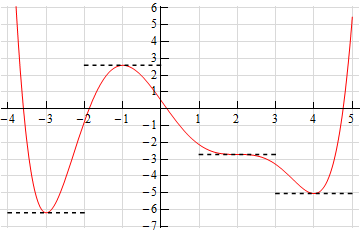
Notice that at $x=-3,$ $x=-1,$ $x=2$ and $x=4,$ the tangent line to the graph is horizontal. This means that the slope of the tangent line must be zero. Well, we know that the slope of the tangent line at a particular point is also the value of the derivative of the function at that point. Therefore, we now know that $$f'(-3) = 0\hspace{.25in}f'(-1)=0\hspace{.25in}f'(2)=0\hspace{.25in}f'(4)=0$$ This is a good starting point for us. It gives us a few points on the graph of the derivative. It also breaks the domain of the function into intervals where the function is increasing and where it is decreasing. We know from our discussions above that if the function is increasing at a point, then the derivative must be positive at that point. Likewise, we know that if the function is decreasing at a point, then the derivative must be negative at that point.
We can now give the following information about the derivative:
$$\begin{array}{lcc} \hspace{1.1cm}x<-3 & & f'(x)<0\\ -3\lt x\lt-1 & & f'(x)>0\\ -1\lt x\lt 2 & & f'(x)<0\\ \hspace{.39cm}2 \lt x\lt 4 & & f'(x)<0\\ \hspace{1.1cm} x>4 & & f'(x)>0\\ \end{array}$$Remember that we are giving the signs of the derivatives here and these are solely dependent on whether the function is increasing or decreasing. The sign of the function itself is completely immaterial here and will not in any way affect the sign of the derivative.
This may still seem like we don't have enough information to create a sketch, but we can get a little more information about the derivative from the graph of the function. In the interval $x\lt -3$ we know that the derivative must be negative, however we can see that the derivative also needs to be increasing in this interval. It is negative until we reach $x=-3$ and at this point the derivative must be zero. The only way for the derivative to be negative to the left of $x=-3$ and zero at $x=-3$ is for the derivative to increase as we increase $x$ towards $x=-3.$
Now, in the interval $-3\lt x\lt -1,$ we know that the derivative must be zero at the endpoints and positive in between the two endpoints. Directly to the right of $x=-3$ the derivative must also be increasing (because it starts at zero and then becomes positive; therefore it must be increasing). So the derivative in this interval must start out increasing and must eventually get back to zero at $x=-1.$ Now, we have to be careful because this is just general behavior here at the two endpoints. We won't know where the derivative goes from increasing to decreasing and it may well change between increasing and decreasing several times before we reach $x=-1.$ All we can really say is that immediately to the right of $x=-3$ the derivative will be increasing and immediately to the left of $x=-1$ the derivative will be decreasing.
Next, for the intervals $-1\lt x\lt 2$ and $2\lt x\lt 4,$ we know that the derivative will be zero at the endpoints and negative in between. Also, following the type of reasoning given above, we can see in each of these intervals that the derivative will be decreasing just to the right of the lefthand endpoint and increasing just to the left of the righthand endpoint.
Finally, in the last interval, $x>4,$ we know that the derivative is zero at $x=4$ and positive to the right of $x=4.$ Once again, following the reasoning above, the derivative must also be increasing on this interval.
Putting everything we found together (and always taking the simplest choices for increasing and/or decreasing information) gives us the following sketch for the derivative.

Note that this sketch is a graph of the actual derivative, and so it is in fact accurate. Any sketch you do will probably not look quite the same. The "humps" in each of the regions may be at different places and/or different heights, for example. Also, note that we left off the vertical scale because, given the information we have at this point, there was no real way to know this information. The only $y$-values of the derivative that we know for sure are that it is zero at the $x$-values listed above.
However, this doesn't mean that we can't use the graph of the function to estimate other points on the derivative. To see how, let's take a look at the graph of the function again.

At $x=-2$ and $x=3$ we've sketched in a couple of tangent lines. We can use the basic rise over run slope concept to estimate the value of the derivative at these points.
Let's start at $x=3.$ We've marked two points on the line here, one at $x=2$ and one at $x = 3,$ so the "run," or change in $x,$ is one. We can see that each point seems to be about one quarter of the way off the grid line in the $y$ direction. So, taking that into account, together with the fact that the line passes through one complete grid, we can see that the "rise," or change in $y,$ is about $-1.5.$ Hence the derivative at $x=3$ is approximately $-1.5.$
On the tangent line at $x=-2$ we've marked two points again, with a "run" of one. It looks like the second point is about 6.5 grids above the first point, so the slope is approximately 6.5.
Finally, here is the sketch of the derivative with the vertical scale included. From this we can see that in fact our estimates are pretty close to reality.
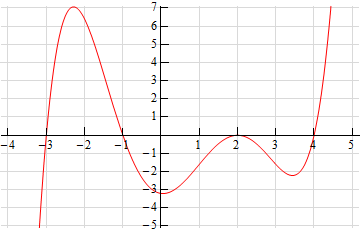
Note that this process of estimating values of derivatives can be a tricky process, and requires a fair amount of approximating based on an underlying grid. So while this method can be used to get a rough estimate, you need to be careful with it.
We'll close out this section by noting that while we're not going to include an example here, we could also use the graph of the derivative to give us a sketch of the function itself. In fact, in the next chapter where we discuss some applications of the derivative, we will be doing this.
Practice Problems
- Use the graph of the function $f(x)$ shown to estimate the value of the derivative $f'(a)$ for the given values of $a.$
-
Since one of the interpretations of the derivative is that it is the slope of the tangent line to the function at a particular point, let's first sketch a tangent line at the point on the graph.

The function is clearly decreasing here, so we know that the derivative at this point will be negative. From the sketch, it looks like the tangent line goes down 4 units from $x=-2$ to $x=-1$ (a "run" of 1), so we can estimate that $$f'(-2) = -4$$
-
Since one of the interpretations of the derivative is that it is the slope of the tangent line to the function at a particular point, let's first sketch a tangent line at the point on the graph.
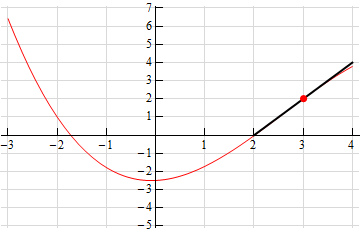
The function is clearly increasing here, so we know that the derivative at this point will be positive. From the sketch, it looks like the tangent line goes up 2 units from $x=2$ to $x=3$ (a "run" of 1), so we can estimate that $$f'(3) = 2$$
- Use the graph of the function $f(x)$ shown to estimate the value of the derivative $f'(a)$ for the given values of $a.$
-
Since one of the interpretations of the derivative is that it is the slope of the tangent line to the function at a particular point, let's first sketch a tangent line at the point on the graph.
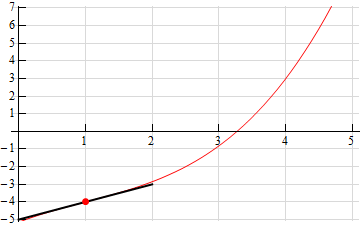
The function is clearly increasing here, so we know that the derivative at this point will be positive. From the sketch, it looks like the tangent line goes up 1 unit from $x=1$ to $x=2$ (a "run" of 1), so we can estimate that $$f'(1) = 1$$
-
Since one of the interpretations of the derivative is that it is the slope of the tangent line to the function at a particular point, let's first sketch a tangent line at the point on the graph.
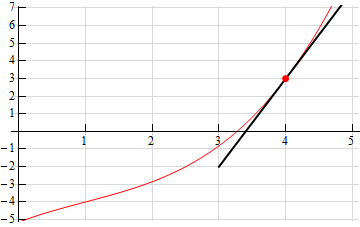
The function is clearly increasing here, so we know that the derivative at this point will be positive. From the sketch, it looks like the tangent line goes up 5 units from $x=3$ to $x=4$ (a "run" of 1), so we can estimate that $$f'(4) = 5$$
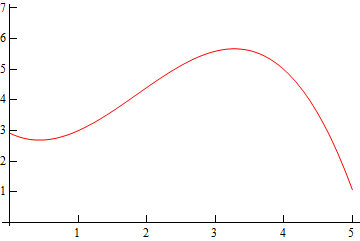
- Sketch the graph of a function that satisfies the conditions $$f(1)=3, f'(1)=1, f(4)=5, f'(4)=-2.$$
- Sketch the graph of a function that satisfies the conditions $$f(-3)=5, f'(-3)=-2, f(1)=2, f'(1)=0, f(4)=-2, f'(4)=-3.$$
- Use the graph of the function $f(x)$ below to sketch the graph of the derivative, $f'(x).$
- Use the graph of the function $f(x)$ below to sketch the graph of the derivative, $f'(x).$
- Answer the following questions about the function $W(z)=4z^2-9z.$
- Is the function increasing or decreasing at $z=-1$?
- Is the function increasing or decreasing at $z=2$?
- Is the function ever not changing? If yes, at what value(s) of $z$ does that happen?
-
Since the derivative of a function at a point tells us the rate of change of the function at that point, we first need the derivative of this function. This was done in Practice Problem 5 of the previous section, so we won't show the work here. The derivative is $$W'(z) = 8z-9$$
Now we just need to substitute $z=-1$ into the derivative: $W'(-1) = -17.$ Since this is negative, the rate of change of the function is negative, and so we know that the function is decreasing at $z=-1.$
-
Again, all we need to do is substitute $z=2$ into the derivative $W'(z) = 8z-9.$ When we do, we find that $W'(2) = 7.$ Since this is positive, the rate of change is positive and we know that the function is increasing at $z=2.$
-
Here, all we are asking is whether the derivative is ever zero. To answer this, we need to solve $$W'(z)=0 \Leftrightarrow 8z-9=0 \Leftrightarrow z = \frac98$$
The function is not changing at $z=\frac98.$
- What is the equation of the tangent line to the graph of the function $f(x) = 3-14x$ at $x=8$?
- The position of an object at any time $t$ is given by $s(t) = \displaystyle\frac{t+1}{t+4}.$
- Determine the velocity of the object at any time $t.$
- Is this object ever at rest? If yes, at what time(s)?
-
Because the derivative of a position function gives the velocity of the object, we first need to find the derivative $s'(t).$ This was done in Practice Problem 9 of the previous section (with a different variable), so we won't show the work here. The derivative is $$s'(t) = \displaystyle\frac{3}{(t+4)^2}$$
This function gives the velocity of the object at any time $t.$
-
The object will stop moving whenever its velocity is zero. So to answer the question, we solve $$s'(t) = \displaystyle\frac{3}{(t+4)^2} = 0$$
In this case, the derivative is a rational expression whose numerator will never be zero. Therefore, the derivative will never be zero, telling us that the object never stops moving.
- What is the equation of the tangent line to the graph of $f(x) = \displaystyle\frac5{x}$ at $x=\frac12$?
- Determine where, if anywhere, the function $g(x) = x^3-2x^2+x-1$ is not changing.
- Determine if the function $h(t) = \sqrt{3t-4}$ is increasing or decreasing at the given points.
- $t=5$
- $t=10$
- $t=300$
-
We know that the derivative at a point gives us the rate of change of the function at that point, so we first need the derivative of this function. This was done in Practice Problem 10 of the previous section, so we won't show the work here. The derivative is $$h'(t) = \displaystyle\frac{3}{2\sqrt{3t-4}}$$
Now all we need is to compute $h'(5) = \displaystyle\frac{3}{2\sqrt{11}}.$ This number is positive, so we know that the function must be increasing at $t=5.$
-
Again, all we need to do is evaluate the derivative, $h'(t) = \displaystyle\frac{3}{2\sqrt{3t-4}},$ this time at $t=10.$
The evaluation is $h'(10) = \displaystyle\frac{3}{2\sqrt{26}}.$ Since this number is positive, we know that the function must be increasing at $t=10.$
-
Once again, all we need to do is evaluate the derivative, $h'(t) = \displaystyle\frac{3}{2\sqrt{3t-4}},$ now at $t=300.$
The evaluation is $h'(300) = \displaystyle\frac{3}{2\sqrt{896}}.$ Since this number is positive, we know that the function must be increasing at $t=300.$
- Suppose that the volume of water in a tank over the time period $0\leq t\leq 6$ is given by $Q(t) = 10+5t-t^2.$
- Is the volume of water increasing or decreasing at $t=0$?
- Is the volume of water increasing or decreasing at $t=6$?
- Are there any times at which the volume of the water is not changing? If yes, at what time(s)?
-
We know that the derivative at a point gives us the rate of change of the function at that point, so we first need the derivative of this function. This was done in Practice Problem 4 of the previous section, so we won't show the work here. The derivative is $$Q'(t) = 5-2t$$
Now all we need is to compute $Q'(0) = 5.$ This number is positive, so we know that the volume of water in the tank must be increasing at $t=0.$
-
Again, all we need to do is evaluate the derivative, $Q'(t) = 5-2t,$ this time at $t=6.$
The evaluation is $Q'(6) = -7.$ Since this number is negative, we know that the volume of water in the tank is decreasing at $t=6.$
-
Here all we're really asking is whether the derivative is ever zero. So we need to solve $$Q'(t)=0 \Leftrightarrow 5-2t=0 \Leftrightarrow t=\frac52$$
So the volume of water is not changing at $t=\frac52.$
- Suppose that the position in meters of an object after $t$ minutes is given by $s(t) = 2t^3 - 1.$ Find the acceleration of the object after 3 minutes.
(a) $a = -2$ (b) $a = 3$
(a) $a = 1$ (b) $a = 4$

First we recall that one of the interpretations of the derivative is that it is the slope of the tangent line to the function at a particular point. Let's start with a graph that just has the given points on it and a sketch of a tangent line at these points whose slope is the given value of the derivative at the point.
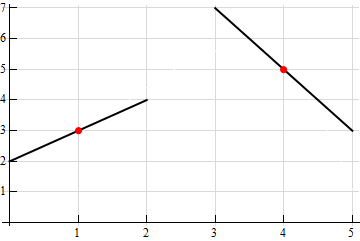
Now all we need to do is sketch in a graph that passes through the indicated points and at the same time touches the tangent lines in the sketch. There are many possible sketches that we can make here, so don't worry if your sketch is not the same as the one here. This is just one possible sketch that meets the given conditions.
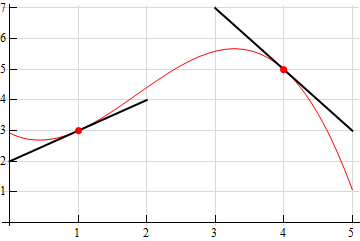
While it's not really needed, here is a sketch of the function without all the extra bits that we put in to help create the sketch.
First we recall that one of the interpretations of the derivative is that it is the slope of the tangent line to the function at a particular point. Let's start with a graph that just has the given points on it and a sketch of a tangent line at these points whose slope is the given value of the derivative at the point.

Now all we need to do is sketch in a graph that passes through the indicated points and at the same time touches the tangent lines in the sketch. There are many possible sketches that we can make here, so don't worry if your sketch is not the same as the one here. This is just one possible sketch that meets the given conditions.
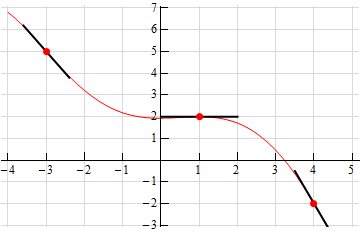
While it's not really needed, here is a sketch of the function without all the extra bits that we put in to help create the sketch.


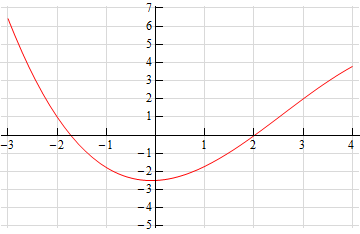
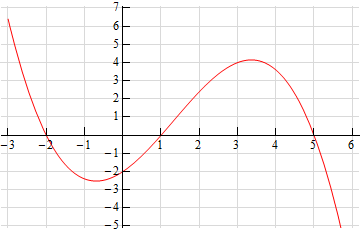
From the graph of the function it is pretty clear that we will have horizontal tangent lines at $x=-2, x=1$ and $x=5.$ Because we will have horizontal tangents, we also know that the derivative at these points must be zero. Therefore, we know the following: $$f'(-2)=0\hspace{.25in} f'(1)=0\hspace{.25in} f'(5)=0$$
The points we found above break the $x$-axis into intervals on which the function is increasing and decreasing. Recall that if the derivative is positive, then the function is increasing, and if the derivative is negative, then the function is decreasing. Using these ideas, we can identify the sign of the derivative on each of the intervals. Doing this yields
$$\begin{array}{lcc} \hspace{1.3cm}x<-2 & & f'(x)>0\\ -2\lt x\lt 1 & & f'(x)<0\\ \hspace{.4cm}1\lt x\lt 5 & & f'(x)>0\\ \hspace{1.3cm} x>5 & & f'(x)<0\\ \end{array}$$On the interval $x\lt -2,$ we know that the derivative must be positive, and that it must be zero at $x=-2.$ So it makes sense that just to the left of $x=-2,$ the derivative must be decreasing.
On the interval $-2\lt x\lt 1,$ we know that the derivative must be negative, and that it will be zero at the endpoints of the interval. So, to the right of $x=-2,$ the derivative will have to be decreasing (goes from zero to a negative number). Likewise, to the left of $x=1,$ the derivative will have to be increasing (goes from a negative number to zero).
Note that we don't really know just how the derivative will behave everywhere in this range, but we can use the general behavior near the endpoints and go with the simplest way to connect the two to get an idea of what the derivative should look like.
Following similar reasoning, we can see that the derivative should be increasing just to the right of $x=1$ (goes from zero to a positive number), decreasing just to the left of $x=5$ (goes from a positive number to zero) and decreasing just to the right of $x=5$ (goes from zero to a negative number).
So, putting all of this together, here is a sketch of the derivative. Note that we included the scale on the vertical axis if you would like to try to estimate some specific values of the derivative as we did in Example 4 of this section.
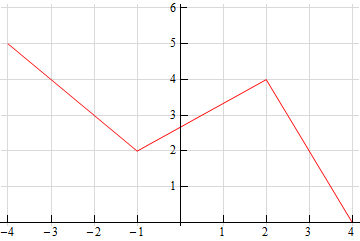
Because the three pieces of the function are actually lines and the tangent line to a line is just the line itself, we can easily compute the derivative on each piece of the graph.
We can use the grid included on the graph to compute the slope of each piece. Knowing the slope of the graph on each piece will in turn tell us the slope of the tangent line for each piece. This in turn tells us that the derivative on each of the three pieces is then $$\begin{array}{lcc} \hspace{1.3cm}x<-1 & & f'(x)=-1\\ -1\lt x\lt 2 & & f'(x)=\frac23\\ \hspace{1.3cm} x>2 & & f'(x)=-2\\ \end{array}$$
Recall Example 6 from the previous section. In that example, we showed that the derivative of the absolute value function does not exist at $x=0.$ We saw that the limits we use to find the slopes of the tangent lines to the left and right of $x=0$ were different, and this told us that the overall limit does not exist. This in turn told us that the derivative doesn't exist at that point.
Here we have the same problem. We'll leave it to you to verify that the right and left-hand limits of the difference quotients at $x=-1$ are not the same. So the derivative does not exist at $x=-1.$ Likewise, the derivative does not exist at $x=2.$ There will therefore be open dots on the graph at these two points.
Here is a sketch of the derivative of this function.

Since the derivative at a point tells us the slope of the tangent line to the graph of the function at that point, we first need the derivative of this function. This was done in Practice Problem 2 of the previous section (with a different variable), so we won't show the work here. The derivative is $$f'(x) = -14$$
This tells us that the slope of the tangent line at $x=8$ is $m=f'(8) = -14.$The point on the tangent line at $x=8$ is $(8,f(8)) = (8,-109).$ The equation of the tangent line is then $$y=-109 - 14(x-8) = 3-14x$$
Note that in this case, the tangent line is the same as the function. This should not be surprising, however, as the function is a line. It is its own tangent line.
Since the derivative at a point tells us the slope of the tangent line to the graph of the function at that point, we first need the derivative of this function. This was done in Practice Problem 8 of the previous section (with a different variable), so we won't show the work here. The derivative is $$f'(x) = \displaystyle -\frac{5}{x^2}$$
This tells us that the slope of the tangent line at $x=\frac12$ is $m=f'(\frac12) = -20.$The point on the tangent line at $x=\frac12$ is $(\frac12,f(\frac12)) = (\frac12,10).$ The equation of the tangent line is then $$y=10-20\left(x-\frac12\right)=20-20x$$
We know that the derivative at a point gives us the rate of change of the function at that point, so we first need the derivative of this function. This was done in Practice Problem 7 of the previous section (with a different variable), so we won't show the work here. The derivative is $$g'(x)=3x^2-4x+1$$
If the function is not changing at a point, then the derivative will be zero at that point. So, to determine whether the function is ever not changing, we need to solve $$\begin{align*} g'(x) &= 0\\ 3x^2-4x+1 &= 0\\ (3x-1)(x-1) &= 0 \Rightarrow x=\frac13, x=1\\ \end{align*}$$
The function is not changing at $x=\frac13$ and at $x=1.$
Acceleration is given by the second derivative of position, so we need the second derivative of the function $s(t).$ In Practice Problem 13 of the last section, we found that $s''(t) = 12t.$ All we need now is to evaluate at $t = 3$: $$s''(3) = 36$$
The acceleration is then $36$ meters per minute per minute.
Assignment Problems
For problems 1 - 3, use the given graph of the function $y=f(x)$ to estimate the value of $f'(a)$ for the given values of $a.$
- (a) $a=-5$ (b) $a=1$

- (a) $a=-2$ (b)$a=3$

- (a) $a=-3$ (b) $a=4$

For problems 4 - 6, sketch the graph of a function that satisfies the given conditions.
- $f(-7) = 5, f'(-7) = -3, f(4) = -1, f'(4) = 1$
- $f(1)=2, f'(1)=4, f(6)=2, f'(6) = 3$
- $f(-1) = -9, f'(-1)=0, f(2)=-1, f'(2)=3, f(5)=4, f'(5)=-1$
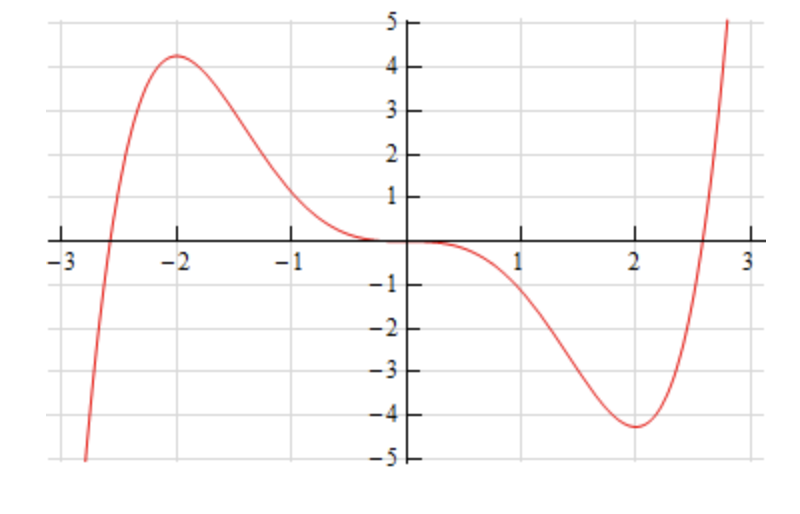
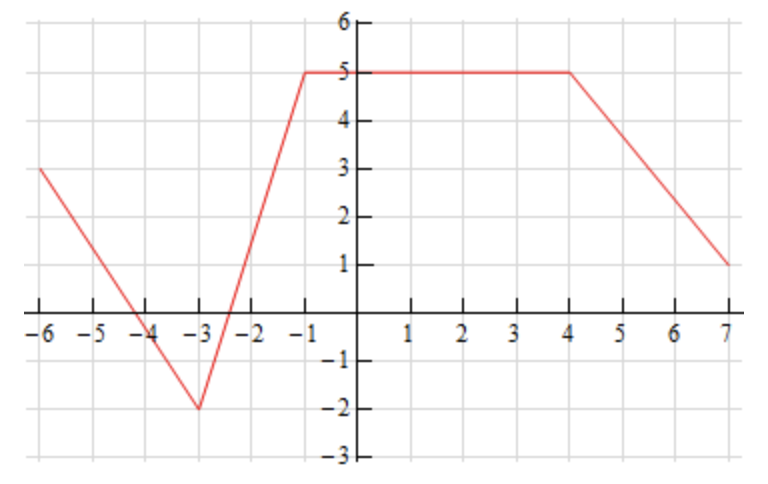
For problems 7 - 9, the graph of a function $y=f(x)$ is given. Use the graph to sketch a graph of the derivative, $y=f'(x).$

- Answer the following questions about the function $g(z) = 1+10z-7z^2.$
- Is the function increasing or decreasing at $z=0$?
- Is the function increasing or decreasing at $z=2$?
- Is this function ever not changing? If yes, at what value(s) of $z$ does that happen?
- What is the equation of the tangent line to $f(x) = 5x-x^3$ at $x=1$?
- The position (in meters) of an object at any time $t$ (in seconds) is given by $s(t) = 2t^2-8t+10.$
- Determine the velocity of the object at any time $t.$
- Is the object moving to the right or left at $t=1$?
- Is the object moving to the right or left at $t=4$?
- Is this object ever at rest? If so, at what time(s)?
- Determine the acceleration of the object at any time $t.$
- Is the function $R(w)=w^2-8w+20$ ever not changing? If yes, at what value(s) of $w$ does this happen?
- Suppose that the volume of air in a balloon is given by $V(t) = 6t-t^2,$ over the interval $0\leq t\leq 6.$
- Is the volume of air increasing or decreasing at $t=2$?
- Is the volume of air increasing or decreasing at $t=5$?
- Is the volume of air ever not changing? If yes, at what time(s) does this happen?
- What is the equation of the tangent line to $f(x) = 5x+7$ at $x=-4$?
- Answer the following questions about the function $Z(x) = 2x^3-x^2-x.$
- Is the function increasing or decreasing at $x=-1$?
- Is the function increasing or decreasing at $x=2$?
- Is the function ever not changing? If yes, at what value(s) of $x$ does this happen?
- Determine if the function $V(t) = \sqrt{14+3t}$ is increasing or decreasing at the given values of $t.$
- $t=0$
- $t=5$
- $t=100$
- Suppose that the volume of water in a tank is given by $Q(t) = \displaystyle\frac{t^2}{t+2},$ for $t\geq 0.$
- Is the volume of water increasing or decreasing at $t=0$?
- Is the volume of water increasing or decreasing at $t=3$?
- Is the volume of water ever not changing? If so, at what time(s) does this happen?
- What is the equation of the tangent line to $g(x) = 10$ at $x=16$?
- The position (in feet) of an object at any time $t$ (in minutes) is given by $Q(t) = \sqrt{1+4t}.$
- Determine the velocity of the object at any time $t.$
- Is this object ever at rest? If so, at what time(s) does that happen?
- Determine the acceleration of the object at any time $t.$
- What is the acceleration of the object after 3 minutes?
- Is the function $Y(t) = 2t^3 + 9t +5$ ever not changing? If yes, at what value(s) of $t$ does that happen?
- If $f(2) = 4$ and $f'(2) = 6$, the function is increasing at $x=2$.
- If $f(2) = 4$ and $f'(2) = -6$, the function is increasing at $x=2$.
- If $f(2) = -4$ and $f'(2) = 6$, the function is increasing at $x=2$.
- If $f(2) = 4$ and $f'(2) = -6$, the derivative is decreasing at $x=2$.
Determine whether the following statements are true or false. Justify your answer.