Infinite Limits
Click here for a printable version of this page.In this section we will take a look at limits whose value is infinity or minus infinity. These kinds of limit will show up fairly regularly in later sections and in other courses and so you’ll need to be able to deal with them when you run across them.
We'll lead with an example to get an idea of what we're trying to do here.
$$\lim_{x\to 0^+}\frac{1}{x}$$
Now, there are several ways we could proceed here to get values for this limit. One way is to plug in some points and see what value the function is approaching. In the preceding section we said that we were no longer going to do this, but in this case it is a good way to illustrate just what’s going on with this function.
So, here is a table of values of $x$'s which approach 0 from the right.
$$\begin{array}{|c|c|} x & \frac{1}{x} \\ \hline 0.1 & 10\\ 0.01 & 100\\ 0.001 & 1000\\ 0.0001 & 10000\\ \end{array}$$These calculations are sometimes counterintuitive to students, so let's take a look at the last row from this table in more detail. When $x = 0.0001$, our function value is $\frac{1}{0.0001}$. We're dividing by a very tiny number (a number very close to 0). As a fraction, that 0.0001 is $\frac{1}{10,000}$, so the function value is $\frac{1}{\frac{1}{10,000}} = 1\cdot\frac{10,000}{1} = 10,000$.
This is why the table ends up showing us that as we make $x$ smaller and smaller, the function $\frac{1}{x}$ gets larger and larger. In fact, as we choose $x$-values closer to 0, this trend will continue, and the function value will "blow up" to larger and larger numbers. In this case, we will say that the limit value is $\infty$.
Another way to see the value of the one sided limit here is to graph the function. Again, in the previous section we mentioned that we won’t do this too often as most functions are not something we can just quickly sketch out as well as the problems with accuracy in reading values off the graph. In this case however, it’s not too hard to sketch a graph of the function and, in this case as we’ll see accuracy is not really going to be an issue.
The graph of $f(x) = \frac{1}{x}$ is shown in blue. Drage the slider to the left to move the x-value of the orange point closer to $x=0$. As that point gets closer to the x-value of 0, what happens to the height (the y-value)? It grows larger and larger. So, we can see from this graph that the function does behave much as we predicted that it would from our table values. The closer $x$ gets to zero from the right the larger (in the positive sense) the function gets.
Infinite Limits
We say $$\lim_{x\to a}f(x) = \infty$$ if we can make $f(x)$ as large as we want by choosing values of $x$ that are close enough to $x = a$, from both sides, without actually letting $x=a$. That is, $f(x)$ grows without bound as $x$ gets closer to $a$.
We say $$\lim_{x\to a}f(x) = -\infty$$ if we can make $f(x)$ as negative and large as we want by choosing values of $x$ that are close enough to $x = a$, from both sides, without actually letting $x=a$. That is, $f(x)$ grows without bound as $x$ gets closer to $a$.
These definitions can be appropriately modified for the one-sided limits as well. To see a more precise and mathematical definition of this kind of limit see the The Definition of the Limit section at the end of this chapter. That is, $f(x)$ grows without bound in the negative direction as $x$ gets closer to $a$.
Let's continue to look at the function $f(x) = \frac{1}{x}$ while we make sense of this concept.
$$\lim_{x\to 0^-}\frac{1}{x}~~~~~~~~~~~~\lim_{x\to 0}\frac{1}{x}$$
Once again, let's use a table of values to investigate $\lim\limits_{x\to 0^-}\frac{1}{x}$.
$$\begin{array}{|c|c|} x & \frac{1}{x} \\ \hline -0.1 & -10\\ -0.01 & -100\\ -0.001 & -1000\\ -0.0001 & -10000\\ \end{array}$$This time, the function values grow without bound in the negative direction as $x$ gets closer to 0 from the left hand side, so we say $$\lim\limits_{x\to 0^-}\frac{1}{x} = -\infty.$$
The graph is again helpful for visualizing what's happening. Drag the slider to the right to move the orange point closer to the place where $x = 0$, and see what happens to the height of the function.
Now, consider $\lim\limits_{x\to 0}\frac{1}{x}$. Since the $\lim\limits_{x\to 0^-}\frac{1}{x} = -\infty$ is not the same as $\lim\limits_{x\to 0^+}\frac{1}{x} = \infty$, we must say that $\lim\limits_{x\to 0}\frac{1}{x}$ does not exist.
An important theme has emerged from these two examples: something special happens if we divide a constant by an increasingly small number:
We'll use this idea as we continue to work on reasoning our way through more limit examples, so we don't always have to rely on testing values and grabbing our calculators. In fact, for most of the remaining examples in this section we’ll attempt to “talk our way through” each limit. This means that we’ll see if we can analyze what should happen to the function as we get very close to the point in question without actually plugging in any values into the function. For most of the following examples this kind of analysis shouldn’t be all that difficult to do. We’ll also verify our analysis with a quick graph.
So let's do a couple more examples.
As with the previous example let’s start off by looking at the two one-sided limits. Once we have those we’ll be able to determine a value for the normal limit.
So, let’s take a look at the right-hand limit first and as noted above let’s see if we can figure out what each limit will be doing without actually plugging in any values of $x$ into the function. As we take smaller and smaller values of $x$, while staying positive, squaring them will only make them smaller (recall squaring a number between zero and one will make it smaller) and of course it will stay positive. So, we have a positive constant divided by an increasingly small positive number. Roughly, here's what we're thinking: $$\lim_{x\to 0^+}\frac{6}{x^2} \Rightarrow \frac{6}{(\text{very small positive number close to zero})^2}$$ $$\Rightarrow \frac{6}{\text{extremely small positive number close to zero}} \Rightarrow \text{very huge positive number}$$ In more technical terms, then, $$\lim_{x\to 0^+}\frac{6}{x^2} = \infty.$$
Now, let’s take a look at the left-hand limit. In this case we’re going to take smaller and smaller values of $x$, while staying negative this time. When we square them they’ll get smaller, but upon squaring the result is now positive. So, we have a positive constant divided by an increasingly small positive number. The result, as with the right-hand limit, will be an increasingly large positive number. Roughly, here's what we're thinking: $$\lim_{x\to 0^-}\frac{6}{x^2} \Rightarrow \frac{6}{(\text{very small negative number close to zero})^2}$$ $$\Rightarrow \frac{6}{\text{extremely small positive number close to zero}} \Rightarrow \text{very huge number}$$ In more technical terms, then, $$\lim_{x\to 0^-}\frac{6}{x^2} = \infty.$$
Now, in this example, unlike the first one, the normal limit will exist and be infinity since the two one-sided limits both exist and have the same value. So, in summary here are all the limits for this example as well as a quick graph verifying the limits.
$$\begin{array}{ccc} \lim\limits_{x\to0^+}\frac{6}{x^2} = \infty & \lim\limits_{x\to0^-}\frac{6}{x^2} = \infty & \lim\limits_{x\to0}\frac{6}{x^2} = \infty \end{array}$$
With this next example we’ll move away from just an $x$ in the denominator, but as we’ll see in the next couple of examples they work pretty much the same way.
Let’s again start with the right-hand limit. With the right-hand limit we know that we have, $$x\gt -2 ~~~~~~\Rightarrow ~~~~~~x+2 \gt 0$$ Also, as $x$ gets closer and closer to -2 then $x+2$ will be getting closer and closer to zero, while staying positive as noted above. So, for the right-hand limit, we’ll have a negative constant divided by an increasingly small positive number. The result will be an increasingly large and negative number. So, it looks like the right-hand limit will be negative infinity. Here's a way we might reason this out in our written work: $$\lim_{x\to -2^+}\frac{-4}{x+2} ~~~~\text{Test a value of x close to -2, but greater than -2, like } x = -1.99$$ $$\Rightarrow \frac{-4}{-1.99+2} \Rightarrow \frac{\text{negative constant}}{\text{very small positive number close to 0}}$$ So, as we take a negative constant, and divide it by very small positive numbers which are growing closer to 0, the end result gets very large and negative, so we say $$\lim_{x\to -2^+} \frac{-4}{x+2} = -\infty.$$
From the left hand side, we similarly have, $$x \lt -2 ~~~~~~~~~~\Rightarrow ~~~~~~x+2 \lt 0$$ and $x+2$ will get closer and closer to zero (and be negative) as $x$ gets closer and closer to -2. In other words, in our written work we might write: $$\lim_{x\to -2^-}\frac{-4}{x+2} ~~~~\text{Test a value of x close to -2, but less than -2, like } x = -2.01$$ $$\Rightarrow \frac{-4}{-2.01+2} \Rightarrow \frac{\text{negative constant}}{\text{very small negative number close to 0}} \Rightarrow \infty$$ therefore $$\lim_{x\to -2^-}\frac{-4}{x+2} = \infty.$$
Finally, since two one sided limits are not the same the normal limit won’t exist. $$\lim_{x\to -2}\frac{-4}{x+2} \text{ DNE}$$
Here is the graph for reference.

Vertical Asymptotes
At this point we should briefly acknowledge the idea of vertical asymptotes. Each of the three previous graphs have had one. Recall from an Algebra class that a vertical asymptote is a vertical line (the dashed line at $x=-2$ in the previous example) in which the graph will go towards infinity and/or minus infinity on one or both sides of the line.
In an Algebra class they are a little difficult to define other than to say pretty much what we just said. Now that we have infinite limits under our belt we can easily define a vertical asymptote as follows,
Vertical Asymptotes
The function $f(x)$ will have a vertical asymptote at $x=a$ if we have any of the following limits at $x=a$.
$$\lim\limits_{x\to a^-}f(x) = \pm \infty ~~~~~~~~\lim\limits_{x\to a^+}f(x) = \pm \infty ~~~~~~~~\lim\limits_{x\to a}f(x) = \pm \infty$$Note only one of the above limits is required for a function to have a vertical asymptote at $x=a$.
Using this definition we can see that the first two examples had vertical asymptotes at $x=0$ while the third example had a vertical asymptote at $x=2.$
Let's look at a couple of graphs to help us connect with this definition.

If we hop onto the graph on the left side of $x=2$ and head in the direction of $x=2$, we see that the height of the graph approaches that open circle. The height there is 2, so $$\lim_{x\to 2^-}f(x) = 2.$$
Now, if we hop onto the graph on the right side of $x=2$ and head in the direction of $x=2$, the height rockets downward. In fact, the closer $x$ gets to 2, the bigger the negative height gets. In other words, we see that there is a vertical asymptote at $x=2$. So $$\lim_{x\to 2^+}f(x) = -\infty.$$
Since the previous two limits are not the same, $$\lim_{x\to 2}f(x) \text{ doesn't exist}.$$
Let’s now take a look at a couple more examples of infinite limits that can cause some problems on occasion.
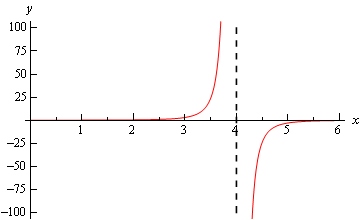
We'll start with the right-hand limit. If $x$ approaches 4 from the right, then we want to think about numbers that are very close to 4, but slightly larger than 4 ($x \gt 4$). That would be values like 4.1, 4.01, and 4.001. Now, as $x$ gets closer and closer to 4, in the denominator, our $4-x$ expression will be negative and very close to 0. So we have the following: $$\lim_{x\to 4^+} \frac{3}{(4-x)^3} \Rightarrow \frac{3}{\text{(very small negative)}^3} \Rightarrow \frac{3}{\text{very, very small negative}}.$$
So, we have a positive constant divided by an increasingly small negative number. The results will be an increasingly large negative number and so it looks like the right-hand limit will be negative infinity.
Simlarly, for the left hand limit, since $x \lt 4$, we have $$\lim_{x\to 4^-}\frac{3}{(4-x)^3} \Rightarrow \frac{3}{(\text{very small positive})^3} \Rightarrow \frac{3}{\text{very, very small positive}} \Rightarrow \infty.$$
Since the two one-sided limits are not the same, $\lim\limits_{x\to 4}\frac{3}{(4-x)^3}$ will not exist. The offical final answers to this example are then, $$\lim_{x\to 4^+}\frac{3}{(4-x)^3} =-\infty ~~~~~ \lim_{x\to 4^-}\frac{3}{(4-x)^3}=\infty ~~~~~\lim_{x\to 4}\frac{3}{(4-x)^3} \text{ DNE} $$
Using these limits, then, we know that there is a vertical asymptote at $x = 4$, and we can make the following rough sketch of the function:
All the examples to this point have had a constant in the numerator and we should probably take a quick look at an example that doesn’t have a constant in the numerator.
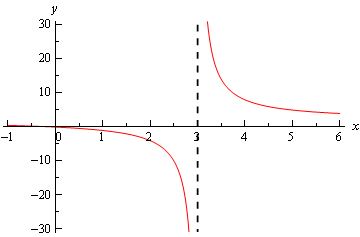
Let’s take a look at the right-handed limit first. For this limit, since $x \gt 3$, we'll have $$\lim_{x\to 3^+}\frac{2x}{x-3} \Rightarrow \frac{2(\text{very close to 3})}{\text{very small positive}}.$$
This means that we’ll have a numerator that is getting closer and closer to a non-zero and positive constant (6) divided by an increasingly smaller positive number, and so the result should be an increasingly larger positive number. The right-hand limit should then be positive infinity.
For the left-hand limit we’ll have $x \lt 3$, so $$\lim_{x\to 3^-}\frac{2x}{x-3} \Rightarrow \frac{2(\text{very close to 3})}{\text{very small negative}}.$$ The main difference in this case is that the denominator will now be negative. So, we’ll have a numerator that is approaching a positive, non-zero constant (6) divided by an increasingly small negative number. The result will be an increasingly large and negative number.
The formal answers for this example are then, $$\lim_{x\to 3^+}\frac{2x}{x-3} = \infty ~~~~~~~~~~~\lim_{x\to 3^-}\frac{2x}{x-3} = -\infty~~~~~~~~~~~\lim_{x\to 3}\frac{2x}{x-3} \text{ doesn't exist}$$
As with most of the examples in this section the overall limit does not exist since the two one-sided limits are not the same.
We can use this limit information to conclude that there is a vertical asymptote at $x = 3$ and sketch the following graph:
Infinite Limits with Special Functions
So far all we’ve done is look at limits of rational expressions, let’s do a couple of quick examples with some different functions.
First, notice that we can only evaluate the right-handed limit here. We know that the domain of any logarithm is only the positive numbers and so we can’t even talk about the left-handed limit because that would necessitate the use of negative numbers. Likewise, since we can’t deal with the left-handed limit then we can’t talk about the normal limit.
This limit is pretty simple to get from a quick sketch of the graph.
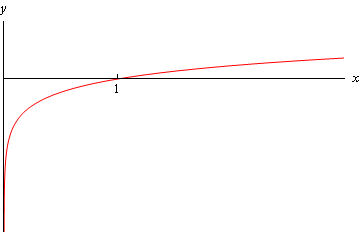
From this we can see that, $$\lim_{x\to 0^+}\ln(x) = -\infty$$
Here’s a quick sketch of the graph of the tangent function.

From this we can see that we have the following values for each of these limits:
$$\lim_{x\to \frac{\pi}{2}^+} \tan(x) = -\infty ~~~~~~~\lim_{x\to \frac{\pi}{2}^-} \tan(x) = \infty.$$Note that the normal limit will not exist because the two one-sided limits are not the same.
More Limit Properties
We'll leave this section with a few properties involving infinite limits.
Limit Properties Involving $\infty$
Given the functions $f(x)$ and $g(x)$ suppose we have, $$\lim_{x\to c}f(x) = \infty ~~~~~~~~~ \lim_{x\to c}g(x) = L$$ for some real numbers $c$ and $L$. Then,
- $\lim\limits_{x\to c}[f(x)\pm g(x)] = \infty$
- If $L\gt 0$, then $\lim\limits_{x\to c}[f(x)g(x)] = \infty$
- If $L \lt 0$, then $\lim\limits_{x\to c}[f(x)g(x)] = -\infty$
- $\lim\limits_{x\to c}\frac{g(x)}{f(x)} = 0$
To see the proof of this set of facts see the Proof of Various Limit Properties section in the Extras chapter.
Note as well that the above set of facts also holds for one-sided limits. They will also hold if $\lim\limits_{x\to c}f(x) = -\infty$, with a change of sign on the infinities in the first three parts. The proofs of these changes to the facts are nearly identical to the proof of the original facts and so are left to the you.
Practice Problems
For problems 1-4, evaluate the indicated limits, if they exist. Use the information to sketch a picture of the graph of the function.
- For $f(x) = \frac{9}{(x-3)^5}$ evaluate,
- For $h(t) = \frac{2t}{6+t}$ evaluate,
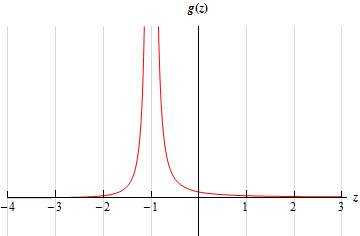
- For $g(z) = \frac{z+3}{(z+1)^2}$ evaluate,
- For $g(x) = \frac{x+7}{x^2-4}$ evaluate,
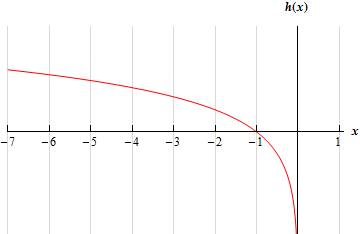
- For $h(x) = \ln(-x)$, evaluate,
- For $R(y) = \tan(y)$, evaluate,
a. $\lim\limits_{y\to \frac{3\pi}{2}^-}R(y)$b. $\lim\limits_{y\to \frac{3\pi}{2}^+}R(y)$c. $\lim\limits_{y\to \frac{3\pi}{2}}R(y)$
The easiest way to do this problem is from the graph of the tangent function so here is a quick sketch of the tangent function over several periods.
From the sketch we can see that (a) $\lim\limits_{y\to \frac{3\pi}{2}^-} \tan(y) = \infty$, (b) $\lim\limits_{y\to \frac{3\pi}{2}^+}\tan(y) = -\infty$ and therefore (c) $\lim\limits_{y\to \frac{3\pi}{2}}\tan(y)$ doesn't exist.
For the following questions, sketch a single function with all of the indicated features.
- $\lim\limits_{x\to-1^-}f(x) = 0, \lim\limits_{x\to-1^+}f(x) = \infty, \lim\limits_{x\to 2} f(x) = -\infty$
- Since $\lim\limits_{x\to-1^-}f(x) = 0$, the function must approach a height of 0 as the x-values get closer to -1 from the left.
- Since $\lim\limits_{x\to-1^+}f(x) = \infty$, there is a vertical asymptote at $x=-1$.
- Since $\lim\limits_{x\to 2} f(x) = -\infty$, there is a vertical asymptote at $x=2$.
- $\lim\limits_{x\to 0}f(x) = 4, f(0) = -3, \lim\limits_{x\to 3^-}f(x) = \infty, \lim\limits_{x\to 3^+}f(x) = -\infty$
- Since $\lim\limits_{x\to 0}f(x) = 4$, the function must approach a height of 4 as the x-values get closer to 0 from the either direction.
- However, since $f(0)=-3$ the actual function value must occur at $(0,-3)$.
- Since $\lim\limits_{x\to 3^-}f(x) = \infty$ and $\lim\limits_{x\to 3^+}f(x) = -\infty$, there is a vertical asymptote at $x=3$.
- $f(x) = \frac{7x}{(10-3x)^4}$
- $g(x) = \frac{-8}{(x+5)(x-9)}$
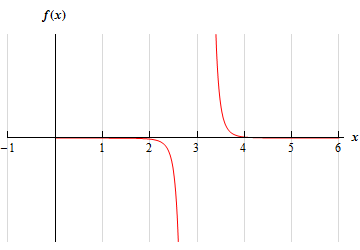
We start by acknowledging that for $x\to 3^-$, we know $x \lt 3$. Therefore, $$x - 3 \lt 0.$$ The numerator is approaching a value of positive 9, and we can see that the denominator is approaching 0 from the negative side. So we have $$\lim_{x\to 3^-}\frac{9}{(x-3)^5} \Rightarrow \frac{\text{positive 9}}{\text{very small negative close to 0}} \Rightarrow -\infty$$
b. $\lim\limits_{x\to 3^+} f(x)$
We start by acknowledging that for $x\to 3^+$, we know $x \gt 3$. Therefore, $$x - 3 \gt 0.$$ The numerator is approaching a value of positive 9, and we can see that the denominator is approaching 0 from the positive side. So we have $$\lim_{x\to 3^+}\frac{9}{(x-3)^5} \Rightarrow \frac{\text{positive 9}}{\text{very small positive close to 0}} \Rightarrow +\infty$$
c. $\lim\limits_{x\to 3} f(x)$
Since the right and left hand limits were not the same, we have $$\lim_{x\to 3}f(x) \text{ doesn't exist}.$$
From parts a and b, we know that the graph of $f(x)$ has a vertical asymptote at $x = 3$, so here is a rough sketch of the function:
We start by acknowledging that for $t\to -6^-$, we know $t \lt -6$. Therefore, $$t +6 = 6+t \lt 0.$$ The numerator is approaching a value of negative 12, and we can see that the denominator is approaching 0 from the negative side. So we have $$\lim_{t\to -6^-}\frac{2t}{6+t} \Rightarrow \frac{\text{negative 12}}{\text{very small negative close to 0}} \Rightarrow \infty.$$
b. $\lim\limits_{t\to -6^+} h(t)$
We start by acknowledging that for $t\to -6^+$, we know $t \gt -6$. Therefore, $$t +6 = 6+t \gt 0.$$ The numerator is approaching a value of negative 12, and we can see that the denominator is approaching 0 from the positive side. So we have $$\lim_{t\to -6^-}\frac{2t}{6+t} \Rightarrow \frac{\text{negative 12}}{\text{very small positive close to 0}} \Rightarrow -\infty.$$
c. $\lim\limits_{t\to -6} h(t)$
Since the right and left hand limits were not the same, we have $$\lim_{t\to -6}h(t) \text{ doesn't exist}.$$
From parts a and b, we know that the graph of $h(t)$ has a vertical asymptote at $t=-6$, so here is a rough sketch of the function:

Here, since $z\to -1^-$, we have $z \lt -1$. Therefore $z+1 \lt 0$. This means, in the denominator, the $z+1$ approaches 0 and remains negative. Roughly, then, we have $$\frac{\text{approaches }-1 + 3 \to 2}{(\text{very small negative near 0})^2} \Rightarrow \frac{2}{\text{very small positive near 0}}.$$ Note that in the denominator, when we square our very small negative number, it becomes an even smaller, but positive number. When we divide by such a small number, the result "blows up", so our limit value is $$\lim_{z\to -1^-}\frac{z+3}{(z+1)^2} = \infty.$$
b. $\lim\limits_{z\to -1^+}g(z)$
Here, since $z\to -1^+$, we have $z \gt -1$. Therefore $z+1 \gt 0$. This means, in the denominator, the $z+1$ approaches 0 and remains positive. Roughly, then, we have $$\frac{\text{approaches }-1 + 3 \to 2}{(\text{very small positive near 0})^2} \Rightarrow \frac{2}{\text{very very small positive near 0}}.$$ Note that in the denominator, when we square our very small positive number, it becomes an even smaller, but positive number. When we divide by such a small number, the result "blows up", so our limit value is $$\lim_{z\to -1^+}\frac{z+3}{(z+1)^2} = \infty.$$
c. $\lim\limits_{z\to -1}g(z)$
Finally, since the left and right side limits are the same (both $\infty$), we say that $$\lim_{z\to -1}g(z) = \infty.$$ There is a vertical asymptote at $z = -1$, so we can make a rough sketch of the function like this:
We'll look at the denominator first. Since $x\to 2^-$, we know $x \lt 2$. We know that if we square a number less than 2 (and greater than -2, which it is safe to assume we have here because we’re doing the limit and so looking at $x$ values getting closer to 2) we will get a number that is less than 4. That means that $x^2 - 4$ will be negative, but very near 0 as we let $x$ get very near 2. In terms of the limit then, we have something like $$\lim_{x\to 2^-}\frac{x+7}{x^2-4} \Rightarrow \frac{\text{a value close to } 2 + 7 \to 9}{\text{a very small negative number, near 0}}$$ $$\Rightarrow -\infty.$$
b. $\lim\limits_{x\to 2^+}g(x)$
We'll look at the denominator first. Since $x\to 2^+$, we know $x \gt 2$. We know that if we square a number greater than 2 we will get a number that is greater than 4. That means that $x^2 - 4$ will be positive, but very near 0 as we let $x$ get very near 2. In terms of the limit then, we have something like $$\lim_{x\to 2^+}\frac{x+7}{x^2-4} \Rightarrow \frac{\text{a value close to } 2 + 7 \to 9}{\text{a very small positive number, near 0}}$$ $$\Rightarrow \infty.$$
c. $\lim\limits_{x\to 2}g(x)$
Since the previous two limits were not the same, this limit does not exist.
In this case, we can only make a very rough sketch of the function. There is actually a second vertical asymptote at $x = -2$ in addition to the one we have detected at $x = 2$, but we wouldn't expect you to sketch that part based solely on the limits above.

For problems 5 & 6, evaluate the indicated limits, if they exist.
Okay, let's start off by acknowledging that for $x\to 0^-$, we know that $x \lt 0$ and so $-x \gt 0$. What this means for us is that this limit does make sense! We know that we can’t have negative arguments in a logarithm, but because of the negative sign in this particular logarithm that means that we can use negative $x$’s in this function (positive $x$’s on the other hand will now cause problems of course…).
By Example 6 in the notes for this section we know that as the argument of a logarithm approaches zero from the right (as ours does in this limit) then the logarithm will approach $-\infty$. Therefore, the anwer for this part is $$\lim_{x\to 0^-}\ln(-x) = -\infty.$$
b. $\lim\limits_{x\to 0^+} h(x)$
In this part, we know that for $x \to 0^+$, we have $x \gt 0$ and so $-x \lt 0$. At this point we can stop. We know that we can’t have negative arguments in a logarithm and for this limit that is exactly what we’ll get and so $\lim\limits_{x\to 0^+}h(x)$ does not exist.
c. $\lim\limits_{x\to 0} h(x)$
Since the limits from part a and b are not the same, this limit does not exist.
Here is a quick sketch of the function.
There is some variety to how we could sketch this function, but we must have the following features:

There is some variety to how we could sketch this function, but we must have the following features:

For the following questions, find all the vertical asymptotes of the function.
Recall that vertical asymptotes will occur at $x=a$ if any of the limits (one-sided or overall limit) at $x=a$ are plus or minus infinity.
From previous examples we can see that for rational expressions vertical asymptotes will occur where there is division by zero. Therefore, it looks like the only possible vertical asymptote will be at $x = \frac{10}{3}$.
Now let’s verify that this is in fact a vertical asymptote by evaluating the two one-sided limits,
$$\lim_{x\to \frac{10}{3}^-}\frac{7x}{(10-3x)^4}~~~~\text{ and } ~~~~\lim_{x\to \frac{10}{3}^+}\frac{7x}{(10-3x)^4}.$$In either case, as $x\to \frac{10}{3}$ (from both left and right), the numerator approaches $\frac{70}{3}$.
For the one-sided limits, we have the following trails of information:
$$\begin{array}{ccccccc} x\to \frac{10}{3}^- &\Rightarrow& x \lt \frac{10}{3} & \Rightarrow & \frac{10}{3}-x \gt 0 &\Rightarrow & 10-3x\gt 0\\ x\to \frac{10}{3}^+ &\Rightarrow& x \gt \frac{10}{3} & \Rightarrow & \frac{10}{3}-x \lt 0 &\Rightarrow & 10-3x\lt 0\\ \end{array}$$Now, because of the exponent on the denominator is even we can see that for either of the one-sided limits we will have, $$(10-3x)^4 \to 0^+$$ because no matter whether the $\frac{10}{3}-x$ is approaching 0 from the positive or the negative side, when we raise those very small numbers to the fourth power, they will turn into very small positive numbers. So, in either case, in the limit, the numerator approaches a fixed positive number and the denominator is positive and increasingly small. Therefore, we will have, $$\lim_{x\to \frac{10}{3}^-}\frac{7x}{(10-3x)^4} = \infty ~~~~\lim_{x\to \frac{10}{3}^+}\frac{7x}{(10-3x)^4} = \infty ~~~~\lim_{x\to \frac{10}{3}}\frac{7x}{(10-3x)^4}=\infty.$$
Any of these limits indicate that there is in fact a vertical asymptote at $x = \frac{10}{3}$.
Recall that vertical asymptotes will occur at $x=a$ if any of the limits (one-sided or overall limit) at $x=a$ are plus or minus infinity.
From previous examples we can see that for rational expressions vertical asymptotes will occur where there is division by zero. Therefore, it looks like the only possible vertical asymptote will be at $x = -5$ and $x = 9$.
Now let’s verify that these are in fact vertical asymptotes by evaluating the two one-sided limits for each of them.
Let's start with $x = -5$. We'll need to evaluate, $$\lim_{x\to -5^-}\frac{-8}{(x+5)(x-9)}~~~~\text{ and }~~~~\lim_{x\to-5^+}\frac{-8}{(x+5)(x-9)}.$$
In either case, as $x\to -5$, the numerator approaches -8.
For the one-sided limits, we have the following trails of information:
$$\begin{array}{ccccc} x\to -5^- & \Rightarrow & x \lt -5 &\Rightarrow & x+5 \lt 0\\ x\to -5^+ & \Rightarrow & x \gt -5 &\Rightarrow & x+5 \gt 0\\ \end{array}$$Also, note that for $x$'s close enough to -5 (which because we're looking at $x \to -5$ is safe enough to assume), we will have $x - 9 \lt 0$. So, in the left-hand limit, the numerator is a fixed negative number and the denominator is negative (a product of a positive and negative number) and increasingly small. That is, in the left-hand limit, we have roughly the following: $$\lim_{x\to -5^-}\frac{-8}{(x+5)(x-9)} \Rightarrow \frac{\text{negative 8}}{(\text{very small negative near 0})(\text{negative number near -14})}$$ $$\Rightarrow \frac{\text{negative}}{\text{very small positive number near 0}} \to -\infty$$
Likewise, for the right-hand limit, the denominator is negative (a product of a positive and negative number) and increasingly small. So we have roughly the following: $$\lim_{x\to -5^+}\frac{-8}{(x+5)(x-9)} \Rightarrow \frac{\text{negative 8}}{(\text{very small positive near 0})(\text{negative number near -14})}$$ $$\Rightarrow \frac{\text{negative}}{\text{very small negative number near 0}} \to +\infty$$
Now for $x=9$. Again, the numerator is a constant -8. We also have, $$\begin{array}{ccccc} x\to 9^- & \Rightarrow & x \lt 9 &\Rightarrow & x-9 \lt 0\\ x\to 9^+ & \Rightarrow & x \gt 9 &\Rightarrow & x-9 \gt 0\\ \end{array}$$
Finally, for $x$'s close enough to 9, we will have $x + 5 \gt 0$.
So, in the left-hand limit, the numerator is a fixed negative number and the denominator is negative (a product of a positive and negative number) and increasingly small. Likewise, for the right-hand limit, the denominator is positive (a product of two positive numbers) and increasingly small. Therefore, we will have, $$\lim_{x\to 9^-}\frac{-8}{(x+5)(x-9)} = \infty ~~~~\text{and}~~~~\lim_{x\to 9^+}\frac{-8}{(x+5)(x-9)} = -\infty$$
So, as all of these limits show we do in fact have vertical asymptotes at $x=-5$ and $x=9$.
Assignment Problems
For the following problems, evaluate the indicated limits, if they exist.
- For $g(x) = \frac{-4}{(x-1)^2}$, evaluate,
- For $h(z) = \frac{17}{(4-z)^3}$, evaluate,
- For $g(t) = \frac{4t^2}{(t+3)^7}$, evaluate,
- For $f(x) = \frac{1+x}{x^3+8}$, evaluate,
- For $f(x) = \frac{x-1}{(x^2-9)^4}$, evaluate,
- For $W(t)=\ln(t+8)$, evaluate,
- For $h(z)=\ln(|z|)$, evaluate,
- For $R(y)=\cot(y)$, evaluate,
- $\lim\limits_{x\to-2^-}f(x)=-3, \lim\limits_{x\to -2^+}f(x) = \infty, f(-2)=5, \lim\limits_{x\to4^-}f(x) = \infty, \lim\limits_{x\to 4^+}f(x) = -\infty$
- $\lim\limits_{x\to 0}f(x) = \infty, \lim\limits_{x\to 3^-}f(x) = -\infty, \lim\limits_{x\to 3^+}f(x) = -1, \lim\limits_{x\to 5}f(x) = 3$
- $\lim\limits_{x\to -4}f(x) = -\infty, \lim\limits_{x\to 0^-}f(x) = 3, \lim\limits_{x\to 0^+}f(x) = 4, \lim\limits_{x\to 2^-}f(x) =\infty, \lim\limits_{x\to 2^+}f(x) = -\infty$
- $h(x) = \frac{-6}{9-x}$
- $f(x) = \frac{x+8}{x^2(5-2x)^3}$
- $g(t)=\frac{5t}{t(t+7)(t-12)}$
- $g(z)=\frac{z^2+1}{(z^2-1)^5(z+15)^6}$
- If $\lim\limits_{x\to a}f(x)$ does not exist, then it must be either $\infty$ or $-\infty$.
- If $\lim\limits_{x\to a^-}f(x) = 2$, there may be a vertical asymptote at $x=a$.
- If $\lim\limits_{x\to a}f(x) = 3$ and $\lim\limits_{x\to a}g(x) = 0$, the graph of $f(x)$ must have a vertical asymptote at $x = a$.
- If $\lim\limits_{x\to a}f(x) = 0$ and $\lim\limits_{x\to a}g(x) = 0$, the graph of $f(x)$ may have a vertical asymptote at $x = a$.
For the following problems, sketch the graph of a single function which satisfies all of the stated conditions.
For the following problems, find all the vertical asymptotes of the given function. Use limits to verify the locations of your proposed asymptotes.
Determine whether the following statements are true or false. Justify your answer.