Optimization
Click here for a printable version of this page.In this section we are going to look at optimization problems. In optimization problems we are looking for the largest value or the smallest value that a function can take; that is, we want to maximize or minimize some value. We saw how to solve one kind of optimization problem in the Absolute Extrema section where we found the largest and smallest value that a function would take on an interval.
In this section we are going to look at another type of optimization problem. Here we will be looking for the largest or smallest value of a function subject to some kind of constraint. The constraint will be some condition (that can usually be described by some equation) that must absolutely, positively be true no matter what our solution is. On occasion, the constraint will not be easily described by an equation, but in these problems it will be easy to deal with as we’ll see.
This section is generally one of the more difficult for students taking a Calculus course. One of the main reasons for this is that a subtle change of wording can completely change the problem. There is also the problem of identifying the quantity that we’ll be optimizing and the quantity that is the constraint and writing down equations for each.
The first step in all of these problems should be to very carefully read the problem. Once you’ve done that the next step is to identify the quantity to be optimized and the constraint.
In identifying the constraint remember that the constraint is the quantity that must be true regardless of the solution. In almost every one of the problems we’ll be looking at here one quantity will be clearly indicated as having a fixed value and so must be the constraint. Once you’ve got that identified the quantity to be optimized should be fairly simple to get. It is however easy to confuse the two if you just skim the problem so make sure you carefully read the problem first!
Let’s start the section off with a simple problem to illustrate the kinds of issues we will be dealing with here.
We need to enclose a rectangular field with a fence. We have 500 feet of fencing material and a building is on one side of the field and so won’t need any fencing. Determine the dimensions of the field that will enclose the largest area.
In all of these problems we will have two functions. The first is the function that we are actually trying to optimize and the second will be the constraint. Sketching the situation will often help us to arrive at these equations so let’s do that.
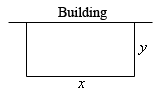
In this problem we want to maximize the area of a field and we know that will use 500 ft of fencing material. So, the area will be the function we are trying to optimize and the amount of fencing is the constraint. The two equations for these are,
$$\begin{align*} {\mbox{Maximize : }} & A = xy \\ {\mbox{Constraint : }} & 500 = x + 2y. \end{align*}$$Note that all of these variables were chosen arbitrarily as the original problem does not specify. You may use whatever variables you see fit, but make sure you know what they represent. In the end, answers tend to be numerical values (with units) and so the choice of variables is irrelevant.
Okay, we know how to find the largest or smallest value of a function provided it’s only got a single variable. The area function (as well as the constraint) has two variables in it and so what we know about finding absolute extrema won’t work. However, if we solve the constraint for one of the two variables we can substitute this into the area and we will then have a function of a single variable.
So, let’s solve the constraint for $x$. Note that we could have just as easily solved for $y$ but that would have led to fractions and so, in this case, solving for $x$ will probably be best.
$$x=500-2y$$Substituting this into the area function gives a function of $y$.
$$A\left( y \right) = \left( {500 - 2y} \right)y = 500y - 2{y^2}$$Now we want to find the largest value this will have on the interval $[0,250]$. The limits in this interval corresponds to taking $y=0$ (i.e. no sides to the fence) and $y=250$ (i.e. only two sides and no width, also if there are two sides each must be 250 ft to use the whole 500ft).
Note that the endpoints of the interval won’t make any sense from a physical standpoint if we actually want to enclose some area because they would both give zero area. They do, however, give us a set of limits on $y$ and so the Extreme Value Theorem (LINK!!!) tells us that we will have a maximum value of the area somewhere between the two endpoints. Having these limits will also mean that we can use the process we discussed in the Finding Absolute Extrema (LINK!!!) section earlier in the chapter to find the maximum value of the area.
So, recall that the maximum value of a continuous function (which we’ve got here) on a closed interval (which we also have here) will occur at critical points and/or end points. As we’ve already pointed out the end points in this case will give zero area and so don’t make any sense. That means our only option will be the critical points. So, let’s get the derivative and find the critical points.
$$A'\left( y \right) = 500 - 4y$$Setting this equal to zero and solving gives a lone critical point of $y=125$. Plugging this into the area gives an area of $A(125)=31250\,\text{ft}^2$. So according to the method from Absolute Extrema section this must be the largest possible area, since the area at either endpoint is zero.
Finally, let’s not forget to get the value of $x$ and then we’ll have the dimensions since this is what the problem statement asked for. We can get the $x$ by plugging in our $y$ into the constraint.
$$x = 500 - 2\left( {125} \right) = 250$$The dimensions of the field that will give the largest area, subject to the fact that we used exactly 500 ft of fencing material, are 250 ft by 125 ft.
Don’t forget to actually read the problem and give the answer that was asked for. These types of problems can take a fair amount of time/effort to solve and it’s not hard to sometimes forget what the problem was actually asking for.
In the previous problem we used the method from the Finding Absolute Extrema section to find the maximum value of the function we wanted to optimize. However, as we’ll see in later examples it will not always be easy to find endpoints. Also, even if we can find the endpoints we will see that sometimes dealing with the endpoints may not be easy either. Not only that, but this method requires that the function we’re optimizing be continuous on the interval we’re looking at, including the endpoints, and that may not always be the case.
So, before proceeding with any more examples let’s spend a little time discussing some methods for determining if our solution is in fact the absolute minimum/maximum value that we’re looking for. In some examples all of these will work while in others one or more won’t be all that useful.
❗Note❗
We will always need to use some method for making sure that our answer is in fact that optimal value that we’re after.
Absolute Extrema Method
This is the method used in the first example above. Recall that in order to use this method the interval of possible values of the independent variable in the function we are optimizing, let’s call it $I$, must have finite endpoints. Also, the function we’re optimizing (once it’s down to a single variable) must be continuous on $I$, including the endpoints. If these conditions are met then we know that the optimal value, either the maximum or minimum depending on the problem, will occur at either the endpoints of the range or at a critical point that is inside the range of possible solutions.
There are two main issues that will often prevent this method from being used however. First, not every problem will actually have a range of possible solutions that have finite endpoints at both ends. We’ll see at least one example of this as we work through the remaining examples. Also, many of the functions we’ll be optimizing will not be continuous once we reduce them down to a single variable and this will prevent us from using this method.
Let's see some examples where this method does work.
We have a piece of cardboard that is 14 inches by 10 inches and we’re going to cut out the corners as shown below and fold up the sides to form a box, also shown below. Determine the height of the box that will give a maximum volume.

Let’s let the height of the box be $h$. So, the width/length of the corners being cut out is also $h$ and so the vertical side will have a "new" height of $10−2h$ and the horizontal side will have a "new" width of $14−2h$. Here is a sketch with all this information put in,

In this example, for the first time, we’ve run into a problem where the constraint doesn’t really have an equation. The constraint is simply the size of the piece of cardboard and has already been factored into the figure above. This will happen on occasion and so don’t get excited about it when it does. This just means that we have one less equation to worry about. In this case we want to maximize the volume. Here is the volume, in terms of $h$ and its first derivative.
$$V\left( h \right) = h\left( {14 - 2h} \right)\left( {10 - 2h} \right) = 140h - 48{h^2} + 4{h^3}\hspace{0.25in}\hspace{0.25in}V'\left( h \right) = 140 - 96h + 12{h^2}$$Setting the first derivative equal to zero and solving gives the following two critical points.
$$h = \frac{{12 \pm \sqrt {39} }}{3} \approx 1.9183,\,\,\,\,6.0817$$We now have an apparent problem. We have two critical points and we’ll need to determine which one is the value we need. The fact that we have two critical points means that neither the first derivative test or the second derivative test can be used here as they both require a single critical point. This isn’t a real problem however. Go back to the figure at the start of the solution and notice that we can quite easily find limits on $h$. The smallest $h$ can be is $h=0$ even though this doesn’t make much sense as we won’t get a box in this case. Also, from the 10 inch side we can see that the largest $h$ can be is $h=5$ although again, this doesn’t make much sense physically.
So, knowing that whatever $h$ is it must be in the range $0\le h\le 5$ we can see that the second critical point is outside this range and so the only critical point that we need to worry about is 1.9183.
Finally, since the volume is defined and continuous on $0\le h\le 5$ all we need to do is plug in the critical points and endpoints into the volume to determine which gives the largest volume. Here are those function evaluations.
$$V\left( 0 \right) = 0\hspace{0.25in}\hspace{0.25in}V\left( \frac{{12 - \sqrt {39} }}{3}\right) =\frac{432+104\sqrt{39}}{9} \approx 120.1644\hspace{0.25in}\hspace{0.25in}V\left( 5 \right) = 0$$So, if we take $h=\frac{{12 \pm \sqrt {39} }}{3}\approx1.9183$ we get a maximum volume.
Determine the area of the largest rectangle that can be inscribed in a circle of radius 4.
Huh? This problem type of problem never seems to make sense originally. What we want to do is maximize the area of the largest rectangle that we can fit inside a circle and have all of its corners touching the circle.
To do this problem it’s easiest to assume that the circle (and hence the rectangle) is centered at the origin of a standard $xy$ axis system.

The equation of the circle is given by $x^2+y^2=16$. Alternatively, you can imagine a line from the origin to the point $(x,y)$ creating a right triangle in quadrant 1. The base of the triangle will have length $x$ and the height $y$. The hypotenuse has length 4 as it is also the radius of the circle. Thus the Pythagorean Theorem gives the equation $x^2+y^2=16$. Either way, we will need this equation.
This means that the width of the rectangle will be $2x$ and the height of the rectangle will be $2y$ as shown above. The area of the rectangle will then be,
$$A = \left( {2x} \right)\left( {2y} \right) = 4xy.$$So, we’ve got the function we want to maximize (the area), but what is the constraint? Well since the coordinates of the upper right corner must be on the circle we know that $x$ and $y$ must satisfy the equation of the circle. In other words, the equation of the circle is the constraint. The first thing to do then is to solve the constraint for one of the variables.
$$y = \pm \sqrt {16 - {x^2}}$$Since the point that we’re looking at is in the first quadrant we know that $y$ must be positive and so we can take the “+” part of this. Plugging this into the area and computing the first derivative gives,
$$\begin{align*} A\left( x \right) & = 4x\sqrt {16 - {x^2}} \\ A'\left( x \right) & = 4\sqrt {16 - {x^2}} - \frac{{4{x^2}}}{{\sqrt {16 - {x^2}} }} = \frac{{64 - 8{x^2}}}{{\sqrt {16 - {x^2}} }}. \end{align*}$$Before getting the critical points let’s notice that we can limit $x$ to the range $0\le x\le 4$ since we are assuming that $x$ is in the first quadrant and must stay inside the circle. Now the four critical points we get (two from the numerator and two from the denominator) are,
$$\begin{array}{lll} 16 - {x^2} = 0 & \hspace{0.5in} \Rightarrow \hspace{0.5in} & x = \pm 4\\ 64 - 8{x^2} = 0 & \hspace{0.5in} \Rightarrow \hspace{0.5in} & x = \pm 2\sqrt 2 . \end{array}$$We only want critical points that are in the range of possible optimal values so that means that we have two critical points to deal with: $x=2\sqrt{2}$ and $x=4$. Notice however that the second critical point is also one of the endpoints of our interval. Now, area function is continuous and we have an interval of possible solution with finite endpoints so,
$$A\left( 0 \right) = 0\hspace{0.5in}A\left( {2\sqrt 2 } \right) = 32\hspace{0.5in}A\left( 4 \right) = 0.$$So, we can see that we’ll get the maximum area if $x=2\sqrt{2}$ and the corresponding value of $y$ is,
$$y = \sqrt {16 - {{\left( {2\sqrt 2 } \right)}^2}} = \sqrt 8 = 2\sqrt 2.$$It looks like the maximum area will be found if the inscribed rectangle is in fact a square, whose area is $32$.
First Derivative Test Method
In this method, we will use a variant of the First Derivative Test. As seen before, the First Derivative Test helps determine relative extrema. But for optimization problems, we want to know the absolute maximum or minimum. Let's walk through how we can adapt the First Derivative Test to help us with absolute extrema.
In this method we also will need an interval of possible values of the independent variable in the function we are optimizing, $I$. However, in this case, unlike the previous method the endpoints do not need to be finite. Also, we will need to require that the function be continuous on the interior of the interval $I$ and we will only need the function to be continuous at the end points if the endpoint is finite and the function actually exists at the endpoint. We’ll see several problems where the function we’re optimizing doesn’t actually exist at one of the endpoints. This will not prevent this method from being used.
For the First Derivative Test, we can have an open interval for our function, and the function need only be continuous at the endpoints if the endpoint is finite and exists.
Let’s suppose that $x=c$ is a critical point of the function we’re trying to optimize, $f(x)$. We already know from the First Derivative Test that if $f'(x)> 0$ immediately to the left of $x=c$ (i.e. the function is increasing immediately to the left) and if $f'(x)<0$ immediately to the right of $x=c$ (i.e. the function is decreasing immediately to the right) then $x=c$ will be a relative maximum for $f(x)$.
Now, this does not mean that the absolute maximum of $f(x)$ will occur at $x=c$. However, suppose that we knew a little bit more information. Suppose that in fact we knew that $f'(x)>0$ for all $x$ in $I$ such that $x<c$. Likewise, suppose that we knew that $f'(x)<0$ for all $x$ in $I$ such that $x>c$. Notice that this does mean $x=c$ is our only critical value in $I$. In this case we know that to the left of $x=c$, provided we stay in $I$ of course, the function is always increasing and to the right of $x=c$, again staying in $I$, we are always decreasing. In this case we can say that the absolute maximum of $f(x)$ in $I$ will occur at $x=c$.
Similarly, if we know that to the left of $x=c$ the function is always decreasing and to the right of $x=c$ the function is always increasing then the absolute minimum of $f(x)$ in $I$ will occur at $x=c$. Again, this also means that $x=c$ is the only critical value in $I$.
Before we give a summary of this method let’s discuss the continuity requirement a little. Nowhere in the above discussion did the continuity requirement apparently come into play. We require that the function we’re optimizing to be continuous in $I$ to prevent the following situation.
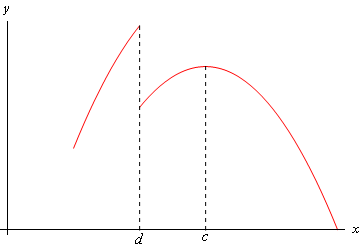
In this case, a relative maximum of the function clearly occurs at $x=c$. Also, the function is always decreasing to the right and is always increasing to the left. However, because of the discontinuity at $x=d$, we can clearly see that $f(d)>f(c)$ and so the absolute maximum of the function does not occur at $x=c$. Had the discontinuity at $x=d$ not been there this would not have happened and the absolute maximum would have occurred at $x=c$. Here is a summary of this method.
First Derivative Test for Absolute Extrema
Let $I$ be the interval of all possible values of $x$ in $f(x)$, the function we want to optimize, and further suppose that $f(x)$ is continuous on $I$ , except possibly at the endpoints. Finally suppose that $x=c$ is the only critical point of $f(x)$ which is in $I$. Then,
- If $f'(x)>0$ for all $x<c$ in $I$ and if $f'(x)<0$ for all $x>c$ in $I$ then $f(c)$ will be the absolute maximum value of $f(x)$ on the interval $I$.
- If $f'(x)<0$ for all $x<c$ in $I$ and if $f'(x)>0$ for all $x>c$ in $I$ then $f(c)$ will be the absolute minimum value of $f(x)$ on the interval $I$.
Let's see some examples where this method is used.
We want to construct a box with a square base and we only have $10\, m^2$ of material to use in construction of the box. Assuming that all the material is used in the construction process determine the maximum volume that the box can have.
In this case we want to optimize the volume and the constraint this time is the amount of material used. Note that the amount of material used is really just the surface area of the box. As always, let’s start off with a quick sketch of the box.
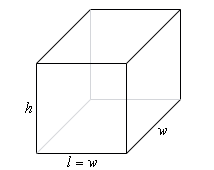
Now, as mentioned above we want to maximize the volume and the amount of material is the constraint so here are the equations we’ll need.
$$\begin{align*} {\mbox{Maximize : }} & V = lwh = {w^2}h\\ {\mbox{Constraint :}} & 10 = 2lw + 2wh + 2lh\, = 2{w^2} + 4wh \end{align*}$$We’ll solve the constraint for $h$, as it is easier than solving for $w$, and plug this into the equation for the volume.
$$h = \frac{{10 - 2{w^2}}}{{4w}} = \frac{{5 - {w^2}}}{{2w}}\hspace{0.25in}\hspace{0.25in} \Rightarrow \hspace{0.25in}\,\,\,\,\,\,\,V\left( w \right) = {w^2}\left( {\frac{{5 - {w^2}}}{{2w}}} \right) = \frac{1}{2}\left( {5w - {w^3}} \right)$$Here is the first derivative of the volume function.
$$V'\left( w \right) = {{1 \over 2}}\left( {5 - 3{w^2}} \right)$$Setting the first derivative equal to zero and solving gives us the two critical points,
$$w = \pm \,\sqrt {\frac{5}{3}}.$$In this case we can exclude the negative critical point since we are dealing with a length of a box and we know that these must be positive. Do not however get into the habit of just excluding any negative critical point. There are problems where negative critical points are perfectly valid possible solutions.
Noted that if $0<w<\sqrt {\frac{5}{3}}$ then $V'(w)>0$ (using a test point we have $V'(1)=1>0$) and likewise if $w>\sqrt {\frac{5}{3}}$ then $V'(w)<0$ (using a test point we have $V'(2)=−72<0$) and so if we are to the left of the critical point the volume is always increasing and if we are to the right of the critical point the volume is always decreasing and so by the First Derivative Test method we can see that the single critical point must give the absolute maximum of the volume.
Computing that volume, as asked, we get,
$$V\left(\sqrt{\frac{5}{3}}\right)=\frac{5\sqrt{15}}{9}\approx 2.1517\, m^3.$$Even though these weren’t asked for here are the dimension of the box that gives the maximum volume.
$$l = w = \sqrt{\frac{5}{3}}\hspace{1.0in}h = \frac{{5 - {{\sqrt{\frac{5}{3}}}^2}}}{{2\left( \sqrt{\frac{5}{3}} \right)}} = \sqrt{\frac{5}{3}}$$So, it looks like in this case we actually have a perfect cube.
A manufacturer needs to make a cylindrical can that will hold 1.5 liters of liquid. Determine the dimensions of the can that will minimize the amount of material used in its construction.
Before starting the solution let’s first address the fact that we are using liters for volume. Because we want length measurements for the radius and height we’ll also need the volume to in terms of a length measurement. We can easily do this using the fact that 1 Liter = $1000\, cm^3$ and so we can convert 1.5 liters into $1500\, cm^3$. This will in turn give a radius and height in terms of centimeters.
In this problem the constraint is the volume and we want to minimize the amount of material used. This means that what we want to minimize is the surface area of the can and we’ll need to include both the walls of the can as well as the top and bottom “caps”. Here is a quick sketch to get us started off.
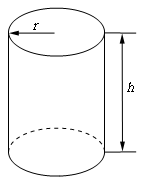
We’ll need the surface area of this can and that will be the surface area of the walls of the can (which is really just a cylinder) and the area of the top and bottom caps (which are just disks, and don’t forget that there are two of them).
Note that if you think of a cylinder of height $h$ and radius $r$ as just a bunch of disks/circles of radius $r$ stacked on top of each other the equations for the surface area and volume are pretty simple to remember. The volume is just the area of each of the disks times the height. So the equation for the volume is given by,
$$V=\pi r^2 h.$$Note that the walls of the cylinder is just a rectangle. Imagine slicing the wall vertically and rolling out the walls to be flat; the shape is a rectangle where the height of the rectangle corresponds to the height of the cylinder, $h$, and the length corresponds to the circumference of the cylinder, $2\pi r$. Thus the surface area of just the walls is $2\pi r h$. We also can’t forget to add in the area of the two caps which are just circles, $\pi r^2$, to the total surface area.
And so we get the following equations needed for the problem.
$$\begin{align*} {\mbox{Minimize : }} & A = 2\pi rh + 2\pi {r^2}\\ {\mbox{Constraint :}} & 1500 = \pi {r^2}h \end{align*}$$In this case it looks like our best option is to solve the constraint for $h$ and plug this into the area function.
$$h = \frac{{1500}}{{\pi {r^2}}}\hspace{0.25in} \Rightarrow \hspace{0.25in}A\left( r \right) = 2\pi r\left( {\frac{{1500}}{{\pi {r^2}}}} \right) + 2\pi {r^2} = 2\pi {r^2} + \frac{{3000}}{r}$$Notice that this formula will only make sense from a physical standpoint if $r>0$ which is a good thing as it is not defined at $r=0$. Next, let’s get the first derivative.
$$A'\left( r \right) = 4\pi r - \frac{{3000}}{{{r^2}}} = \frac{{4\pi {r^3} - 3000}}{{{r^2}}}$$From this we can see that we have one critical point: $r=\sqrt[3]{\frac{750}{\pi}}\approx 6.2035$ (where the derivative is zero). Note that $r=0$ is not a critical point because the area function does not exist there, which makes sense from a physical standpoint as well given that we know that $r$ must be positive in order to actually have a can.
So, we only have a single critical point to deal with here and notice that 6.2035 is the only value for which the derivative will be zero and hence the only place (with $r>0$ of course) that the derivative may change sign. It’s not difficult, using test points, to check that if $0<r<\sqrt[3]{\frac{750}{\pi}}$ then $A'(r)<0$ and likewise if $r>\sqrt[3]{\frac{750}{\pi}}$ then $A'(r)>0$. The variant of the First Derivative Test above then tells us that the absolute minimum value of the area (for $r>0$) must occur at
$$r=\sqrt[3]{\frac{750}{\pi}}\approx 6.2035\, cm.$$All we need to do this is determine height of the can and we’ll be done.
$$h = \frac{{1500}}{{\pi {{\left( \sqrt[3]{\frac{750}{\pi}} \right)}^2}}}=2\sqrt[3]{\frac{750}{\pi}} \approx 12.4070\, cm$$Therefore, if the manufacturer makes the can with a radius of approximately 6.2035 cm and a height of approximately 12.4070 cm the least amount of material will be used to make the can.
As an interesting side problem and extension to the above example you might want to show that for a given volume, $L$, the minimum material will be used if $h=2r$ regardless of the volume of the can.
Second Derivative Test Method
There are actually two ways to use the second derivative to help us identify the optimal value of a function and both use the Second Derivative Test to one extent or another.
The first way to use the second derivative doesn’t actually help us to identify the optimal value. What it does do is allow us to potentially exclude values and knowing this can simplify our work somewhat and so is not a bad thing to do.
Suppose that we are looking for the absolute maximum of a function and after finding the critical points we find that we have multiple critical points. Let’s also suppose that we run all of them through the second derivative test and determine that some of them are in fact relative minimums of the function. Since we are after the absolute maximum we know that a maximum (of any kind) can’t occur at relative minimums and so we immediately know that we can exclude these points from further consideration. We could do a similar check if we were looking for the absolute minimum. Doing this may not seem like all that great of a thing to do, but it can, on occasion, lead to a nice reduction in the amount of work that we need to do in later steps.
The second way of using the second derivative to identify the optimal value of a function is in fact very similar to the second method above. In fact, we will have the same requirements for this method as we did in that method. We need an interval of possible values of the independent variable in function we are optimizing, call it $I$ as before, and the endpoint(s) may or may not be finite. We’ll also need to require that the function, $f(x)$ be continuous everywhere in $I$ except possibly at the endpoints as above.
Now, suppose that $x=c$ is a critical point and that $f''(c)>0$; this means it must be that $f'(c)=0$. The second derivative test tells us that $x=c$ must be a relative minimum of the function. Suppose however that we also knew that $f''(x)>0$ for all $x$ in $I$. In this case, this means the first derivative function is always increasing on $I$; as $f'(c)=0$, it must be that $x=c$ is the only critical value of $f(x)$ on $I$. Now, we would know that the function was concave up in all of $I$ and that would in turn mean that the absolute minimum of $f(x)$ in $I$ would in fact have to be at $x=c$.
Likewise, if $x=c$ is a critical point and $f''(x)<0$ for all $x$ in $I$ then we would know that the function was concave down in $I$ and that the absolute maximum of $f(x)$ in $I$ would have to be at $x=c$.
Here is a summary of this method.
Second Derivative Test for Absolute Extrema
Let $I$ be the interval of all possible values of $x$ in $f(x)$, the function we want to optimize, and suppose that $f(x)$ is continuous on $I$ , except possibly at the endpoints. Finally suppose that $x=c$ is the only critical point of $f(x)$ which is in $I$. Then,
- If $f''(x)>0$ for all $x$ in $I$ then $f(c)$ will be the absolute minimum value of $f(x)$ on the interval $I$.
- If $f''(x)<0$ for all $x$ in $I$ then $f(c)$ will be the absolute maximum value of $f(x)$ on the interval $I$.
Let's see some examples where this method is used.
We want to construct a box whose base length is 3 times the base width. The material used to build the top and bottom cost $10 per $ft^2$ and the material used to build the sides cost $6 per $ft^2$. If the box must have a volume of $50\, ft^3$ determine the dimensions that will minimize the cost to build the box.
First, a quick figure.
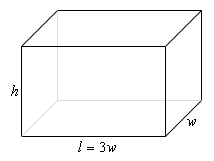
We want to minimize the cost of the materials subject to the constraint that the volume must be $50\, ft^3$. Note as well that the cost for each side is just the area of that side times the appropriate cost. The two functions we’ll be working with here this time are,
$$\begin{align*} {\mbox{Minimize : }} & C = 10\left( {2lw} \right) + 6\left( {2wh + 2lh} \right)\, = 60{w^2} + 48wh\\ {\mbox{Constraint :}}& 50 = lwh = 3{w^2}h. \end{align*}$$It will definitely be easier to solve the constraint for $h$ so let’s do that and plug it into the cost.
$$h = \frac{{50}}{{3{w^2}}}$$ $$C\left( w \right) = 60{w^2} + 48w\left( {\frac{{50}}{{3{w^2}}}} \right) = 60{w^2} + \frac{{800}}{w}$$Now, let’s get the first and second derivatives,
$$C'\left( w \right) = 120w - 800{w^{ - 2}} = \frac{{120{w^3} - 800}}{{{w^2}}}\hspace{0.25in}\hspace{0.25in}C''\left( w \right) = 120 + 1600{w^{ - 3}}.$$Now we need the critical point(s) for the cost function. First, notice that $w=0$ is not a critical point. Clearly the derivative does not exist at $w=0$ but then neither does the function and remember that values of $w$ will only be critical points if the function also exists at that point. Note that there is also a physical reason to avoid $w=0$. We are constructing a box and it would make no sense to have a zero width of the box.
So it looks like the only critical point will come from determining where the numerator is zero.
$$120{w^3} - 800 = 0\hspace{0.25in} \Rightarrow \hspace{0.25in}\,\,w = \sqrt[3]{{\frac{{800}}{{120}}}} = \sqrt[3]{{\frac{{20}}{3}}} \approx 1.8821$$So, we’ve got a single critical point and we now have to verify that this is in fact the value that will give the absolute minimum cost. In this case we can’t use the regular finding absolute extrema method from above. First, the function is not continuous at one of the endpoints, $w=0$, of our interval of possible values, i.e. $w>0$. Secondly, there is no theoretical upper limit to the width that will give a box with volume of $50\, ft^3$. If $w$ is very large then we would just need to make $h$ very small.
The first derivative test method listed above would work here, but that’s going to involve some calculations, not difficult calculations, but more work nonetheless.
The second derivative test method however, will work quickly and simply here. First, we know that whatever the value of $w$ that we get it will have to be positive and we can see second derivative above that provided $w>0$ we will have $C''(w)>0$ and so in the interval of possible optimal values the cost function will always be concave up and so $w=\sqrt[3]{\frac{20}{3}}\approx 1.8821$ must give the absolute minimum cost.
All we need to do now is to find the remaining dimensions.
$$\begin{align*} w & = \sqrt[3]{\frac{20}{3}} \approx 1.8821\\ l & = 3w = 3\sqrt[3]{\frac{20}{3}} \approx 5.6463\\ h & = \frac{{50}}{{3{w^2}}} = \frac{{50}}{{3{{\left( \sqrt[3]{\frac{20}{3}} \right)}^2}}}=\frac{5}{2}\sqrt[3]{\frac{20}{3}} \approx 4.7050 \end{align*}$$Also, even though it was not asked for, the minimum cost is $C\left(\sqrt[3]{\frac{20}{3}}\right)\approx\$ 637.60$.
A printer needs to make a poster that will have a total area of $200\, in^2$ and will have 1 inch margins on the sides, a 2 inch margin on the top and a 1.5 inch margin on the bottom as shown below. What dimensions will give the largest printed area?

This problem is a little different from the previous problems. Both the constraint and the function we are going to optimize are areas. The constraint is that the overall area of the poster must be $200\, in^2$ while we want to optimize the printed area (i.e. the area of the poster with the margins taken out).
Let’s define the height of the poster to be $h$ and the width of the poster to be $w$. Here is a new sketch of the poster and we can see that once we’ve taken the margins into account the width of the printed area is $w−2$ and the height of the printer area is $h−3.5$.
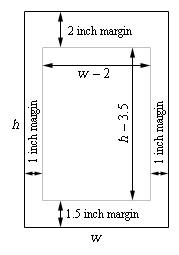
Here are the equations that we’ll be working with.
$$\begin{align*} {\mbox{Maximize : }} & A = \left( {w - 2} \right)\left( {h - 3.5} \right)\\ {\mbox{Constraint :}} & 200 = wh \end{align*}$$Solving the constraint for $h$ and plugging into the equation for the printed area gives,
$$A\left( w \right) = \left( {w - 2} \right)\left( {\frac{{200}}{w} - 3.5} \right) = 207 - 3.5w - \frac{{400}}{w}.$$The first and second derivatives are,
$$A'\left( w \right) = - 3.5 + \frac{{400}}{{{w^2}}} = \frac{{800 - 7{w^2}}}{{{2w^2}}}\hspace{0.25in}\hspace{0.25in}A''\left( w \right) = - \frac{{800}}{{{w^3}}}.$$From the first derivative we have the following two critical points ($w=0$ is not a critical point because the area function does not exist there).
$$w=\pm20\sqrt{\frac{2}{7}}\approx \pm 10.6904$$However, since we’re dealing with the dimensions of a piece of paper we know that we must have $w>0$ and so only $20\sqrt{\frac{2}{7}}$ will make sense.
Also notice that provided $w>0$ the second derivative will always be negative and so in the range of possible optimal values of the width the area function is always concave down and so we know that the maximum printed area will be at $w=20\sqrt{\frac{2}{7}}\approx 10.6904$ inches.
The height of the paper that gives the maximum printed area is then,
$$h=\frac{200}{20\sqrt{\frac{2}{7}}}=10\sqrt{\frac{7}{2}}\approx 18.7084\,\text{inches}.$$More Examples
As we work through examples we will use each of these methods as needed in the examples. In some cases, the method we use will be the only method we could use, in others it will be the easiest method to use and in others it will simply be the method we chose to use for that example. It is important to realize that we won’t be able to use each of the methods for every example. With some examples one method will be easiest to use or may be the only method that can be used, however, each of the methods described above will be used at least a couple of times through out all of the examples.
It is also important to be aware that some problems don’t allow any of the methods discussed above to be used exactly as outlined above. We may need to modify one of them or use a combination of them to fully work the problem. There is an example where none of the methods above work easily, although we do also present an alternative solution method in which we can use at least one of the methods discussed above.
Next, the vast majority of the examples will only have a single critical point. Problems with more than one critical point are often difficult to know which critical point(s) give the optimal value. There are a couple of examples with more than one critical point in which none of the methods discussed above easily work. In that example you can see some of the ideas you might need to do in order to find the optimal value.
Finally, in all of the methods above we referenced an interval $I$. This was done to make the discussion a little easier. However, in all of the examples we will never explicitly say "this is the interval $I$". Just remember that the interval $I$ is just the largest interval of possible values of the independent variable in the function we are optimizing.
Before jumping into the examples, we give a useful fact that might help us in certain problems. This can also be used anytime you see fit, just make sure that the conditions are satisfied.
Proposition
Suppose $f(x)$ is a positive and differentiable function on and interval $I$. Then $f(x)$ and $g(x)=\left[f(x)\right]^2$ have the same critical values and their relative extrema will occur at the same values of $x$. That is, if $f(x)$ has a local maximum at $x=c$ then $g(x)$ has a local maximum at $x=c$ and vice versa.
Suppose $x=c$ is a critical value of $f(x)$ in $I$. As $f(x)$ is differentiable, then $f'(c)=0$. Following the chain rule,
$$\begin{align*} g'(x) &= 2f(x)f'(x) \\ g'(c) &= 2f(c)f'(c) \\ &= 2f(c)\cdot0 \\ &= 0. \end{align*}$$Thus $x=c$ is a critical value of $g(x)$. Now suppose $x=c$ is a critical value of $g(x)$. As $f(x)$ is differentiable on $I$, so is $g(x)$. Thus $g'(c)=0$. Using the derivative of $g(x)$ from before, $0 = 2f(c)f'(c)$. As $f(x)$ is positive, this means that $f(c)$ is positive and so, more importantly here, nonzero. Thus $f'(c)=\frac{0}{2f(c)}=0$ and so $x=c$ is a critical value of $f(x)$.
Thus $f$ and $g$ have the same critical values.
Now suppose $f(x)$ has a local maximum at $x=c$. So for $a<c<b$ in $I$ where no other critical values of $f$ lie between $a$ and $b$, we have $f'(a)>0$ and $f'(b)<0$; this is the first derivative test. Now we have that
$$\begin{align*} g'(a) &= 2f(a)f'(a) \\ g'(b) &= 2f(b)f'(b). \end{align*}$$Since $f'(a)$ and $f(a)$ are both positive, then $g'(a)>0$. And as $f'(b)$ is negative and $f(b)$ is positive, then $g'(b)<0$. Thus $g$ also has a local maximum at $x=c$. A similar argument can be made for minimums.
Now suppose $g$ has a local maximum at $x=c$. So for $a<c<b$ in $I$ where no other critical values of $g$ lie between $a$ and $b$, we have $f'(a)>0$ and $f'(b)<0$; this is the first derivative test again. Now we have that
$$\begin{align*} f'(a) &= \frac{g'(a)}{2f(a)} \\ f'(b) &= \frac{g'(b)}{2f(b)}. \end{align*}$$Since $g'(a)$ and $f(a)$ are both positive, then $f'(a)>0$. And as $g'(b)$ is negative and $f(b)$ is positive, then $f'(b)<0$. Thus $f$ also has a local maximum at $x=c$. A similar argument can be made for minimums.
So, now that we have that out of the way let’s work some more examples. Do not forget the various methods for verifying that we have the optimal value that we looked at. In this section we may use them without acknowledging so make sure you understand them and can use them.
Determine the point(s) on $y=x^2+1$ that are closest to $(0,2)$.
Here’s a quick sketch of the situation.
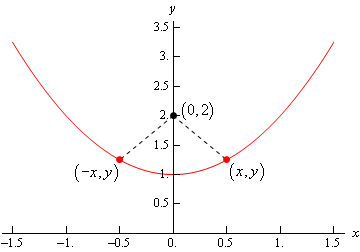
So, we’re looking for the shortest length of the dashed line. Notice as well that if the shortest distance isn’t at $x=0$ there will be two points on the graph, as we’ve shown above, that will give the shortest distance. This is because the parabola is symmetric to the $y$-axis and the point in question is on the $y$-axis. This won’t always be the case of course so don’t always expect two points in these kinds of problems.
In this case we need to minimize the distance between the point $(0,2)$ and any point that is one the graph $(x,y)$. Or,
$$d = \sqrt {{{\left( {x - 0} \right)}^2} + {{\left( {y - 2} \right)}^2}} = \sqrt {{x^2} + {{\left( {y - 2} \right)}^2}}.$$As noted above and since this function must always be positive (the point $(0,2)$ is not on the graph and so any distance is strictly positive), we can use the square of the function to find the corresponding critical values and local extrema. So the function we are going to minimize now is,
$$D = {d^2} = {x^2} + {\left( {y - 2} \right)^2}.$$The constraint in this case is the function itself since the point must lie on the graph of the function.
At this point there are two methods for proceeding. One of which will require significantly more work than the other. Let’s take a look at both of them.
Solution 1:
In this case we will use the constraint in probably the most obvious way. We already have the constraint solved for $y$ so let’s plug that into the square of the distance and get the derivatives.
$$\begin{align*} D\left( x \right) & = {x^2} + {\left( {{x^2} + 1 - 2} \right)^2} = {x^4} - {x^2} + 1\\ D'\left( x \right) & = 4{x^3} - 2x = 2x\left( {2{x^2} - 1} \right)\\ D''\left( x \right) & = 12{x^2} - 2 \end{align*}$$So, it looks like there are three critical points for the square of the distance and notice that this time, unlike pretty much every previous example we’ve worked, we can’t exclude zero or negative numbers. They are perfectly valid possible optimal values this time.
$$x = 0,\hspace{0.25in}x = \pm \frac{1}{{\sqrt 2 }}$$Before going any farther, let’s check these in the second derivative to see if they are all relative minimums.
$$D''\left( 0 \right) = - 2 < 0\hspace{0.25in}D''\left( {\frac{1}{{\sqrt 2 }}} \right) = 4\hspace{0.5in}D''\left( { - \frac{1}{{\sqrt 2 }}} \right) = 4$$So, $x=0$ is a relative maximum and so can’t possibly be the minimum distance. That means that we’ve got two critical points. The question is how we verify that these give the minimum distance and yes we did mean to say that both will give the minimum distance. Recall from our sketch above that if $x$ gives the minimum distance then so will $–x$ and so if gives the minimum distance then the other should as well.
None of the methods we discussed in the previous section will really work here. We don’t have an interval of possible solutions with finite endpoints and both the first and second derivative change sign. In this case however, we can still verify that they are the points that give the minimum distance.
First, let’s see what we have if we are working on the interval $\left[−\frac{1}{\sqrt{2}},\frac{1}{\sqrt{2}}\right]$. On this interval we can try to use the first method of finding absolute extrema discussed in the previous section. That says to evaluate the function at the endpoints and the critical points and in this case, even though we’ve excluded it we’ll need to include $x=0$ since it is a critical point in the region. Doing this gives,
$$D\left( { - \frac{1}{\sqrt{2}}} \right) = {\frac{3}{4}}\hspace{0.5in}D\left( 0 \right) = 1\hspace{0.5in}D\left( \frac{1}{\sqrt{2}} \right) = {\frac{3}{4}}.$$So, we can see that the absolute minimum in the interval must occur at $x=\pm\frac{1}{\sqrt{2}}$.
Next, we can see that if $x < - \frac{1}{\sqrt{2}}$ then $D'\left( x \right) < 0$. Or in other words, if $x < - \frac{1}{\sqrt{2}}$ the function is decreasing until it hits $x=-\frac{1}{\sqrt{2}}$ and so must always be larger than the function at $x=-\frac{1}{\sqrt{2}}$.
Similarly, if $x>\frac{1}{\sqrt{2}}$ then $D'(x)>0$ and so the function is always increasing to the right of $x=\frac{1}{\sqrt{2}}$ and so must be larger than the function at $x=\frac{1}{\sqrt{2}}$.
So, putting all of this together tells us that we do in fact have an absolute minimum at $x=\pm\frac{1}{\sqrt{2}}$.
All that we need to do is to find the value of $y$ for these points.
$$\begin{array}{ll} x = \displaystyle \frac{1}{{\sqrt 2 }} & :\hspace{0.25in}y = \displaystyle \frac{3}{2}\\ x = - \displaystyle \frac{1}{{\sqrt 2 }} & :\hspace{0.25in}y = \displaystyle \frac{3}{2} \end{array}$$So, the points on the graph that are closest to $(0,2)$ are,
$$\left( {\frac{1}{{\sqrt 2 }},\frac{3}{2}} \right)\hspace{0.25in}\text{and}\hspace{0.25in}\left( { - \frac{1}{{\sqrt 2 }},\frac{3}{2}} \right).$$This solution method shows how tricky it can be to know that we have absolute extrema when there are multiple critical points and none of the methods discussed in the last section will work. Luckily for us, there is another, easier, method we could have done instead.
Solution 2:
The first solution that we worked was actually the long solution. There is a much shorter, and easier, solution to this problem. Instead of plugging $y$ into the square of the distance let’s plug in $x$. From the constraint we get,
$${x^2} = y - 1$$and notice that the only place $x$ show up in the square of the distance it shows up as $x^2$ and so let’s just plug this into the square of the distance. Doing this gives,
$$\begin{align*} D\left( y \right) & = y - 1 + {\left( {y - 2} \right)^2} = {y^2} - 3y + 3\\ D'\left( y \right) & = 2y - 3\\ D''\left( y \right) & = 2 \end{align*}$$There is now a single critical point, $y=\frac{3}{2}$, and since the second derivative is always positive we know that this point must give the absolute minimum. So, all that we need to do at this point is find the value(s) of $x$ that go with this value of $y$.
$${x^2} = \frac{3}{2} - 1 = \frac{1}{2}\hspace{0.5in} \Rightarrow \hspace{0.5in}x = \pm \frac{1}{{\sqrt 2 }}$$The points are then,
$$\left( {\frac{1}{{\sqrt 2 }},\frac{3}{2}} \right)\hspace{0.25in}\text{and}\hspace{0.25in}\left( { - \frac{1}{{\sqrt 2 }},\frac{3}{2}} \right).$$So, for significantly less work we got exactly the same answer.
Two poles, one 6 meters tall and one 15 meters tall, are 20 meters apart. A length of wire is attached to the top of each pole and it is also staked to the ground somewhere between the two poles. Where should the wire be staked so that the minimum amount of wire is used?
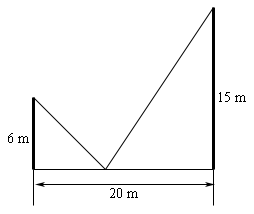
As always let’s start off with a sketch of this situation with some more information added.
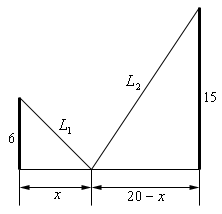
The total length of the wire is $L=L_1+L_2$ and we need to determine the value of $x$ that will minimize this. The constraint in this problem is that the poles must be 20 meters apart and that $x$ must be in the range $0\le x\le 20$. The first thing that we’ll need to do here is to get the length of wire in terms of $x$, which is fairly simple to do using the Pythagorean Theorem.
$${L_{\,1}} = \sqrt {36 + {x^2}} \hspace{0.5in}{L_{\,2}} = \sqrt {225 + {{\left( {20 - x} \right)}^2}} \hspace{0.5in}L = \sqrt {36 + {x^2}} + \sqrt {625 - 40x + {x^2}}$$Not the nicest function we’ve had to work with but there it is. Note however, that it is a continuous function and we’ve got an interval with finite endpoints and so finding the absolute minimum won’t require much more work than just getting the critical points of this function. So, let’s do that. Here’s the derivative.
$$L' = \frac{x}{{\sqrt {36 + {x^2}} }} + \frac{{x - 20}}{{\sqrt {625 - 40x + {x^2}} }}$$Setting this equal to zero gives,
$$\begin{align*} \frac{x}{{\sqrt {36 + {x^2}} }} + \frac{{x - 20}}{{\sqrt {625 - 40x + {x^2}} }} & = 0\\ x\sqrt {625 - 40x + {x^2}} & = - \left( {x - 20} \right)\sqrt {36 + {x^2}} \end{align*}$$It’s probably been quite a while since you’ve been asked to solve something like this. To solve this, we’ll need to square both sides to get rid of the roots, but this will cause problems as well soon see. Let’s first just square both sides and solve that equation.
$$\begin{align*} {x^2}\left( {625 - 40x + {x^2}} \right) & = {\left( {x - 20} \right)^2}\left( {36 + {x^2}} \right)\\ 625{x^2} - 40{x^3} + {x^4} & = 14400 - 1440x + 436{x^2} - 40{x^3} + {x^4}\\ 189{x^2} + 1440x - 14400 & = 0\\ 9\left( {3x + 40} \right)\left( {7x - 40} \right) & = 0\hspace{0.5in} \Rightarrow \hspace{0.5in}x = - \frac{40}{3} ,\,\,\,\,\,x = \frac{40}{7} \end{align*}$$One major issue arises here. If you were to plug $x=−\frac{40}{3}$ into the derivative you would not get zero and so is not even a critical point. How is this possible? It is a "solution" after all. We’ll recall that we squared both sides of the equation above and it was mentioned at the time that this would cause problems. We’ll we’ve hit those problems. In squaring both sides we’ve inadvertently introduced a new "solution" to the equation. When you do something like this you should ALWAYS go back and verify that the solutions that you get are in fact solutions to the original equation. "Solutions" which do not satisfy the original equation are called extraneous solutions and must be ignored.
So, if we go back and do a quick verification we can in fact see that the only critical point is $x=\frac{40}{7}\approx 5.7143$ and this is nicely in our range of acceptable solutions, $0\le x\le 20$.
Now all that we need to do is plug this critical point and the endpoints of the wire into the length formula and identify the one that gives the minimum value.
$$L\left( 0 \right) = 31\hspace{0.5in}L\left( \frac{40}{7} \right) = 29\hspace{0.5in}L\left( {20} \right) \approx 35.8806$$So, we will get the minimum length of wire if we stake it to the ground $\frac{40}{7}$ feet from the smaller pole.
A piece of pipe is being carried down a hallway that is 10 feet wide. At the end of the hallway the there is a right-angled turn and the hallway narrows down to 8 feet wide. What is the longest pipe that can be carried (always keeping it horizontal) around the turn in the hallway?
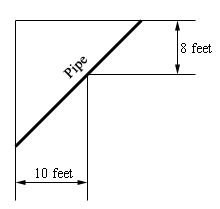
Let’s start off with a sketch of the situation adding in some more information so we can get a grip on what’s going on and how we’re going to have to go about solving this.
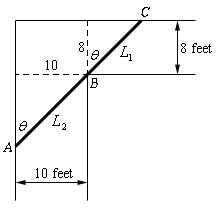
The largest pipe that can go around the turn will do so in the position shown above. One end will be touching the outer wall of the hall way at $A$ and $C$ and the pipe will touch the inner corner at $B$. Let’s assume that the length of the pipe in the small hallway is $L_1$ while $L_2$ is the length of the pipe in the large hallway. The pipe then has a length of $L=L_1+L_2$.
Now, if $\theta=0$ then the pipe is completely in the wider hallway and we can see that as $\theta\to0$ the point $A$ will move down the vertical wall and the point $C$ will move along the horizontal wall closer and closer to the corner and as this happens $L$ lengthens and so $L\to\infty$ as $\theta\to0$.
Likewise, if $\theta=\frac{\pi}{2}$ the pipe is completely in the narrow hallway and as $\theta\to\frac{\pi}{2}$ we also have $L\to\infty$ by a similar line of reasoning above for $\theta\to0$.
So, because $L\to\infty$ as we near the ends of the interval of possible angles somewhere in the interior of the interval, $0<:\theta<\frac{\pi}{2}$, is an angle that will minimize $L$ and oddly enough that is the length that we’re after. The largest pipe that will fit around the turn will in fact be the minimum value of $L$.
The constraint for this problem is not so obvious and there are actually two of them. The constraints for this problem are the widths of the hallways. We’ll use these to get an equation for $L$ in terms of $\theta$ and then we’ll minimize this new equation. So, using basic right triangle trig we can see that,
$${L_{\,1}} = 8\sec \theta \hspace{0.5in}{L_{\,2}} = 10\csc \theta \hspace{0.5in} \Rightarrow \hspace{0.5in}L = 8\sec \theta + 10\csc \theta.$$Differentiating $L$ gives,
$$L' = 8\sec \theta \tan \theta - 10\csc \theta \cot \theta.$$Setting this equal to zero and solving gives,
$$\begin{align*} 8\sec \theta \tan \theta & = 10\csc \theta \cot \theta \\ \frac{{\sec \theta \tan \theta }}{{\csc \theta \cot \theta }} & = \frac{{10}}{8}\\ \frac{{\sin \theta {{\tan }^2}\theta }}{{\cos \theta }} & = \frac{5}{4}\hspace{0.5in} \Rightarrow \hspace{0.5in}{\tan ^3}\theta = \frac{5}{4}. \end{align*}$$Solving for $\theta$ gives,
$$\,\tan \theta = \sqrt[3]{\frac{5}{4}}\hspace{0.5in} \Rightarrow \hspace{0.25in}\theta = {\tan ^{ - 1}}\left( {\sqrt[3]{\frac{5}{4}}} \right) \approx 0.8226.$$As our only critical value (in the range of $0<:\theta<\frac{\pi}{2}$), we not that $\frac{\pi}{6}<0.8226<\frac{\pi}{3}$ and so we can use $\frac{\pi}{6}$ and $\frac{\pi}{3}$ as test values for the first derivative test.
$$L'\left(\frac{\pi}{6}\right)\approx-29.31<0\hspace{0.25in}L'\left(\frac{\pi}{3}\right)\approx 21.05>0$$Thus $L$ is decreasing to the left of $\theta\approx 0.8226$ and increasing to the right of $\theta\approx 0.8226$. As our only critical value in the given domain, $\theta\approx 0.8226$ must given us the absolute minimum value of $L$. So the largest pipe that can be carried around the turn has length
$$L \approx 8\sec \left( {0.8226} \right) + 10\csc \left( {0.8226} \right) \approx 25.4033{\mbox{ feet}}$$See if you can do some problems on your own.
Practice Problems
- Find two positive numbers whose sum is 300 and whose product is a maximum.
The first step is to write down equations describing this situation. Let’s call the two numbers $x$ and $y$ and we are told that the sum is 300 (this is the constraint for the problem) or,
$$x + y = 300.$$We are being asked to maximize the product,
$$A=xy.$$We now need to solve the constraint for $x$ or $y$ (and it really doesn’t matter which variable we solve for in this case) and plug this into the product equation.
$$y = 300 - x\hspace{0.5in} \Rightarrow \hspace{0.5in}A\left( x \right) = x\left( {300 - x} \right) = 300x - {x^2}$$The next step is to determine the critical points for this equation.
$$A'\left( x \right) = 300 - 2x\hspace{0.5in} \to \hspace{0.5in}300 - 2x = 0\hspace{0.5in} \to \hspace{0.5in}x = 150$$Now for the step many neglect as unnecessary. Just because we got a single value we can’t just assume that this will give a maximum product. We need to do a quick check to see if it does give a maximum. As discussed in notes there are several methods for doing this, but in this case we can quickly see that,
$$A''\left( x \right) = - 2.$$From this we can see that the second derivative is always negative and so $A(x)$ will always be concave down and so the single critical point we got must be a relative maximum and hence must be the value that gives a maximum product.
Finally, let’s actually answer the question. We need to give both values. We already have $x$ so we need to determine $y$ and that is easy to do from the constraint.
$$y = 300 - 150 = 150$$The final answer is then,
$$x = 150\hspace{0.5in}y = 150.$$- Find two positive numbers whose product is 750 and for which the sum of one and 10 times the other is a minimum.
The first step is to write down equations describing this situation. Let’s call the two numbers $x$ and $y$ and we are told that the product is 750 (this is the constraint for the problem) or,
$$xy=750.$$We are then being asked to minimize the sum of one and 10 times the other,
$$S=x+10y.$$Note that it really doesn’t worry which is $x$ and which is $y$ in the sum so we simply chose the $y$ to be multiplied by 10.
We now need to solve the constraint for $x$ or $y$ (and it really doesn’t matter which variable we solve for in this case) and plug this into the product equation.
$$x = \frac{{750}}{y}\hspace{0.5in} \Rightarrow \hspace{0.5in}S\left( y \right) = \frac{{750}}{y} + 10y$$The next step is to determine the critical points for this equation.
$$S'\left( y \right) = - \frac{{750}}{{{y^2}}} + 10\hspace{0.5in} \to \hspace{0.5in} - \frac{{750}}{{{y^2}}} + 10 = 0\hspace{0.5in} \to \hspace{0.5in}y = \pm \sqrt {75} = \pm5\sqrt 3$$Because we are told that $y$ must be positive we can eliminate the negative value and so the only value we really get out of this step is: $y=\sqrt{75}=5\sqrt{3}$.
Now for the step many neglect as unnecessary. Just because we got a single value we can’t just assume that this will give a minimum sum. We need to do a quick check to see if it does give a minimum. As discussed in notes there are several methods for doing this, but in this case we can quickly see that,
$$S''\left( y \right) = \frac{{1500}}{{{y^3}}}.$$From this we can see that, provided we recall that $y$ is positive, then the second derivative will always be positive. Therefore, $S(y)$ will always be concave up and so the single critical point must be a relative minimum and hence must be the value that gives a minimum sum.
Finally, let’s actually answer the question. We need to give both values. We already have $y$ so we need to determine $x$ and that is easy to do from the constraint.
$$x = \frac{{750}}{{5\sqrt 3 }} = 50\sqrt 3$$The final answer is then,
$$x = 50\sqrt{3} \hspace{0.5in}y = 5\sqrt{3}$$- Let $x$ and $y$ be two positive numbers such that $x+2y=50$ and $(x+1)(y+2)$ is a maximum.
In this case we were given the constraint in the problem,
$$x + 2y = 50.$$We are also told the equation to maximize,
$$f = \left( {x + 1} \right)\left( {y + 2} \right).$$So, let’s just solve the constraint for $x$ or $y$ (we’ll solve for $x$ to avoid fractions) and plug this into the product equation.
$$x = 50 - 2y\hspace{0.25in} \Rightarrow \hspace{0.25in}f\left( y \right) = \left( {50 - 2y + 1} \right)\left( {y + 2} \right) = \left( {51 - 2y} \right)\left( {y + 2} \right) = 102 + 47y - 2{y^2}$$The next step is to determine the critical points for this equation.
$$f'\left( y \right) = 47 - 4y\hspace{0.25in} \to \hspace{0.25in}47 - 4y = 0\hspace{0.5in} \to \hspace{0.5in}y = \frac{{47}}{4}$$Now for the step many neglect as unnecessary. Just because we got a single value we can’t just assume that this will give a maximum product. We need to do a quick check to see if it does give a maximum.
As discussed in notes there are several methods for doing this, but in this case we can quickly see that $f''(y)=-4$. From this we can see that the second derivative is always negative and so $f(y)$ will always be concave down and so the single critical point we got must be a relative maximum and hence must be the value that gives a maximum.
Finally, let’s actually answer the question. We need to give both values. We already have $y$ so we need to determine $x$ and that is easy to do from the constraint.
$$x = 50 - 2\left( {\frac{{47}}{4}} \right) = \frac{{53}}{2}$$The final answer is then,
$$x = \frac{{53}}{2}\hspace{0.5in}y = \frac{{47}}{4}.$$- We are going to fence in a rectangular field. If we look at the field from above the cost of the vertical sides are $10 per ft, the cost of the bottom is $2 per ft and the cost of the top is $7 per ft. If we have $700 determine the dimensions of the field that will maximize the enclosed area.
The first step is to do a quick sketch of the problem. We could probably skip the sketch in this case, but that is a really bad habit to get into. For many of these problems a sketch is really convenient and it can be used to help us keep track of some of the important information in the problem and to "define" variables for the problem. Here is the sketch for this problem.
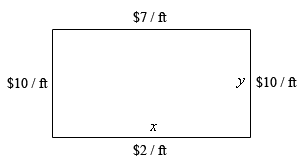
Next, we need to set up the constraint and equation that we are being asked to optimize. We are told that we have $700 to spend and so the cost of the material will be the constraint for this problem. The cost for the material is then,
$$700 = 10y + 2x + 10y + 7x = 20y + 9x.$$We are being asked to maximize the area so that equation is,
$$A=xy.$$Now, let’s solve the constraint for $y$ (that looks like it will only have one fraction in it and so may be "easier").
$$y = 35 - \frac{9}{20}x$$Plugging this into the area formula gives,
$$A\left( x \right) = x\left( {35 - \frac{9}{20}x} \right) = 35x - \frac{9}{20}{x^2}.$$Finding the critical point(s) for this shouldn’t be too difficult at this point so here is that work.
$$A'\left( x \right) = 35 - \frac{9}{10}x\hspace{0.5in} \to \hspace{0.5in}35 - \frac{9}{10}x = 0\hspace{0.5in} \to \hspace{0.5in}x = \frac{350}{9}$$The second derivative of the area function is,
$$A''\left( x \right) = - \frac{9}{10}.$$From this we can see that the second derivative is always negative and so $A(x)$ will always be concave down and so the single critical point we got in Step 4 must be a relative maximum and hence must be the value that gives a maximum area. Now, let’s finish the problem by getting the second dimension.
$$y = 35 - \frac{9}{20}\left( \frac{350}{9} \right) = \frac{35}{2}$$The final dimensions are then,
$$x = \frac{350}{9}\,\text{ft}\hspace{0.5in}y = \frac{35}{2}\,\text{ft}.$$- We have $45\, m^2$ of material to build a box with a square base and no top. Determine the dimensions of the box that will maximize the enclosed volume.
Here is a quick sketch of the problem.
Next, we need to set up the constraint and equation that we are being asked to optimize. We are told that we have $45\, m^2$ of material to build the box and so that is the constraint. The amount of material that we need to build the box is then,
$$45 = lw + 2\left( {lh} \right) + 2\left( {wh} \right) = {w^2} + 2wh + 2wh = {w^2} + 4wh.$$Note that because there is no top the first term won’t have the 2 that the second and third term have. Be careful with this kind of thing it is easy to miss if you aren’t paying attention. We are being asked to maximize the volume so that equation is,
$$V = lwh = {w^2}h.$$Note as well that we went ahead and used fact that $l=w$ in both of these equations to reduce the three variables in the equation down to two variables. Now, let’s solve the constraint for $h$ (that will allow us to avoid dealing with roots, plus there is only one $h$ in the constraint so it will simply be easier to deal with).
$$h = \frac{{45 - {w^2}}}{{4w}}$$Plugging this into the volume formula gives,
$$V\left( w \right) = {w^2}\left( {\frac{{45 - {w^2}}}{{4w}}} \right) = \frac{1}{4}w\left( {45 - {w^2}} \right) = \frac{1}{4}\left( {45w - {w^3}} \right).$$Finding the critical point(s) for this shouldn’t be too difficult at this point so here is that work.
$$V'\left( w \right) = {\frac{1}{4}}\left( {45 - 3{w^2}} \right)\hspace{0.5in} \to \hspace{0.5in}\,{\frac{1}{4}}\left( {45 - 3{w^2}} \right) = 0\hspace{0.5in} \to \hspace{0.5in}w = \pm \sqrt {\frac{45}{3}} = \pm \sqrt {15}$$Because we are dealing with the dimensions of a box the negative width doesn’t make any sense and so the only critical point that we can use here is $w=\sqrt{15}$. Be careful here and do not get into the habit of just eliminating the negative values. The only reason for eliminating it in this case is for physical reasons. If we had just given the equations without any physical reasoning it would have to be included in the rest of the work!
The second derivative of the volume function is,
$$V''\left( w \right) = - \frac{3}{2}w.$$From this we can see that the second derivative is always negative for positive $w$ (which we will always have for this case since $w$ is the width of a box). Therefore, provided $w$ is positive, $V(w)$ will always be concave down and so the single critical point we got must be a relative maximum and hence must be the value that gives a maximum volume. Now, let’s finish the problem by getting the remaining dimensions.
$$l = w = \sqrt {15} \approx 3.8730\hspace{0.5in}h = \frac{{45 - 15}}{{4\sqrt {15} }} \approx 1.9365$$The final dimensions are then,
$$l = w = \sqrt {15} \approx 3.8730\,\text{m}\hspace{0.5in}h = \frac{{45 - 15}}{{4\sqrt {15} }} \approx 1.9365\,\text{m}.$$- We want to build a box whose base length is 6 times the base width and the box will enclose 20 $in^3$. The cost of the material of the sides is $3 per $in^2$ and the cost of the top and bottom is $15 per $in^2$. Determine the dimensions of the box that will minimize the cost.
Here is a quick sketch of the problem.
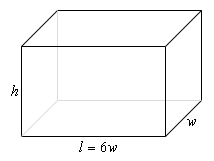
Next, we need to set up the constraint and equation that we are being asked to optimize. We are told that the volume of the box must be $20\, in^3$ and so this is the constraint.
$$20 = lwh = 6{w^2}h$$We are being asked to minimize the cost and the cost function is,
$$C = 3\left[ {2\left( {lh} \right) + 2\left( {wh} \right)} \right] + 15\left[ {2\left( {lw} \right)} \right] = 3\left[ {12wh + 2wh} \right] + 15\left[ {12{w^2}} \right] = 42wh + 180{w^2}.$$Note as well that we went ahead and used fact that $l=6w$ in both of these equations to reduce the three variables in the equation down to two variables. Now, let’s solve the constraint for $h$ (that will allow us to avoid dealing with roots).
$$h = \frac{{10}}{{3{w^2}}}$$Plugging this into the cost function gives,
$$C\left( w \right) = 42w\left( {\frac{{10}}{{3{w^2}}}} \right) + 180{w^2} = \frac{{140}}{w} + 180{w^2}.$$Finding the critical point(s) for this shouldn’t be too difficult at this point. Here is the derivative.
$$C'\left( w \right) = - \frac{140}{w^2} + 360w = \frac{{360{w^3} - 140}}{{{w^2}}}$$From this it looks like the only critical point is $w = \sqrt[3]{\frac{7}{18}} \approx 0.7299$. Note that $w=0$ can’t be a critical point because the function does not exist there. The second derivative of the volume function is,
$$C''\left( w \right) = \frac{{280}}{{{w^3}}} + 360.$$From this we can see that the second derivative is always positive for positive $w$ (which we will always have for this case since $w$ is the width of a box). Therefore, provided $w$ is positive, $C(w)$ will always be concave up and so the single critical point we got must be a relative minimum and hence must be the value that gives a minimum cost. Now, let’s finish the problem by getting the remaining dimensions.
$$l = 6w =6\sqrt[3]{\frac{7}{18}} \approx 4.3794\hspace{0.5in}h = \frac{{10}}{{3{{\left( \sqrt[3]{\frac{7}{18}} \right)}^2}}} = \frac{60}{7}\sqrt[3]{\frac{7}{18}}\approx 6.2568$$The final dimensions are then,
$$w =\sqrt[3]{\frac{7}{18}}\approx 0.7299\,\text{in}\hspace{0.5in}\,l =6\sqrt[3]{\frac{7}{18}}\approx 4.3794\,\text{in}\hspace{0.5in}\,h =\frac{60}{7}\sqrt[3]{\frac{7}{18}}\approx 6.2568\,\text{in}.$$- We want to construct a cylindrical can with a bottom but no top that will have a volume of 30 $cm^3$. Determine the dimensions of the can that will minimize the amount of material needed to construct the can.
Here is a quick sketch of the problem.
Next, we need to set up the constraint and equation that we are being asked to optimize. We are told that the volume of the can must be $30\, cm^3$ and so this is the constraint.
$$30 = \pi {r^2}h$$We are being asked to minimize the amount of material needed to construct the can,
$$A = 2\pi rh + \pi {r^2}.$$Recall that the can will have no top and so the second term will only be for the area of the bottom of the can. Now, let's solve the constraint for $h$ (that will allow us to avoid dealing with roots).
$$h = \frac{{30}}{{\pi {r^2}}}$$Plugging this into the amount of material function gives,
$$A\left( r \right) = 2\pi r\left( {\frac{{30}}{{\pi {r^2}}}} \right) + \pi {r^2} = \frac{{60}}{r} + \pi {r^2}.$$Finding the critical point(s) for this shouldn’t be too difficult at this point. Here is the derivative.
$$A'\left( r \right) = - \frac{{60}}{{{r^2}}} + 2\pi r = \frac{{2\pi {r^3} - 60}}{{{r^2}}}$$From this it looks like the only critical point is $r = \sqrt[3]{\frac{30}{\pi}} \approx 2.1216$. Note that $r=0$ can’t be a critical point because the function does not exist there. Be careful here and do not get into the habit of just eliminating the zero as a critical point. The only reason for eliminating it in this case is for physical reasons. If we had just given the equations without any physical reasoning it would have to be included in the rest of the work! The second derivative of the volume function is,
$$A''\left( r \right) = \frac{{120}}{{{r^3}}} + 2\pi.$$From this we can see that the second derivative is always positive for positive $r$ (which we will always have for this case since $r$ is the radius of a can). Therefore, provided $r$ is positive, $A(r)$ will always be concave up and so the single critical point we got must be a relative minimum and hence must be the value that gives a minimum amount of material. Now, let’s finish the problem by getting the height of the can.
$$h = \frac{{30}}{{\pi {{\left( \sqrt[3]{\frac{30}{\pi}} \right)}^2}}}=\sqrt[3]{\frac{30}{\pi}} \approx 2.1216$$The final dimensions are then,
$$r=\sqrt[3]{\frac{30}{\pi}}\approx2.1216\,\text{cm}\hspace{.25in}h=\sqrt[3]{\frac{30}{\pi}}\approx2.1216\,\text{cm}.$$- We have a piece of cardboard that is 50 cm by 20 cm and we are going to cut out the corners and fold up the sides to form a box. Determine the height of the box that will give a maximum volume.
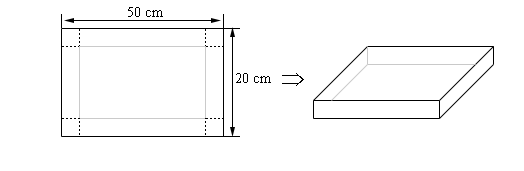
The first step is to do a quick sketch of the problem.
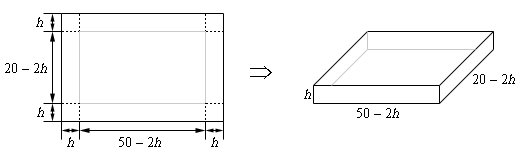
As with the problem like this in the notes the constraint is really the size of the box and that has been taken into account in the figure so all we need to do is set up the volume equation that we want to maximize.
$$V\left( h \right) = h\left( {50 - 2h} \right)\left( {20 - 2h} \right) = 4{h^3} - 140{h^2} + 1000h$$Finding the critical point(s) for this shouldn’t be too difficult at this point so here is that work,
$$V'\left( h \right) = 12{h^2} - 280h + 1000\hspace{0.75in}h = \frac{35 \pm 5\sqrt {19}}{3} \approx 4.4018,\,\,18.9315.$$From the figure above, we can see that the limits on $h$ must be $h=0$ and $h=10$ (the largest $h$ could be is half the smaller side). Note that neither of these really make physical sense but they do provide limits on $h$. So, we must have $0\le h\le 10$ and this eliminates the second critical point and so the only critical point we need to worry about is $h=\frac{35 + 5\sqrt {19}}{3}\approx4.4018$.
Because we have limits on $h$ we can quickly check to see if we have maximum by plugging in the volume function.
$$V\left( 0 \right) = 0\hspace{0.75in}V\left( \frac{35 + 5\sqrt {19}}{3} \right) \approx 2030.34\hspace{0.75in}V\left( {10} \right) = 0$$So, we can see then that the height of the box will have to be $h=\frac{35 + 5\sqrt {19}}{3}\approx4.4018\,\text{cm}$ in order to get a maximum volume.
- We want to construct a window whose middle is a rectangle and the top and bottom of the window are semi-circles. If we have 50 meters of framing material what are the dimensions of the window that will let in the most light?
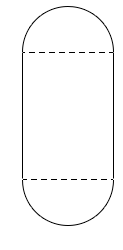
Let’s start with a quick sketch of the window.
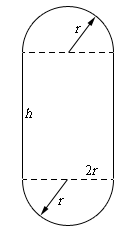
Next, we need to set up the constraint and equation that we are being asked to optimize. We are told that we have 50 meters of framing material (i.e. the perimeter of the window) and so that will be the constraint for this problem.
$$50 = 2h + 2\left( {\pi r} \right) = 2h + 2\pi r$$We are being asked to maximize the amount of light being let in and that is simply the enclosed area or,
$$A = h\left( {2r} \right) + 2\left( {{\frac{1}{2}}\pi {r^2}} \right) = 2hr + \pi {r^2}.$$With both of these equations we were a little careful with the last term. In each case we needed either the perimeter or area of each semicircle and there were two of them. The end result of course is the equation of the perimeter/area of a whole circle, but we really should be careful setting these equations up and note just where everything is coming from. Now, let’s solve the constraint for $h$ and plug it into the area function.
$$h = 25 - \pi r$$ $$A\left( r \right) = 2\left( {25 - \pi r} \right)r + \pi {r^2} = 50r - \pi {r^2}$$Finding the critical point(s) for this shouldn’t be too difficult at this point. Here is the derivative.
$$A'\left( r \right) = 50 - 2\pi r$$From this it looks like we get a single critical point: $r=\frac{25}{\pi}\approx 7.9577$.
The second derivative of the volume function is,
$$A''\left( r \right) = - 2\pi.$$From this we can see that the second derivative is always negative. Therefore $A(r)$ will always be concave down and so the single critical point we got must be a relative maximum and hence must be the value that allows in the maximum amount of light. Now, let’s finish the problem by getting the height of the rectangle.
$$h = 25 - \pi \left( \frac{25}{\pi} \right) = 0$$Okay, what this means is that in fact the most light will come from not even having a rectangle between the semicircles and just having a circular window of radius $r=\frac{25}{\pi}\approx 7.9577$ m.
- Determine the area of the largest rectangle that can be inscribed in a circle of radius 1.
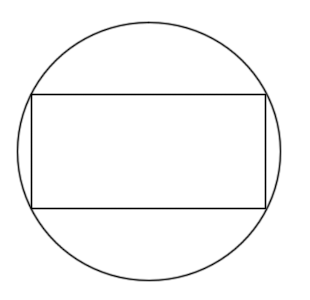
Let’s start with a quick sketch of the circle and rectangle. Also, in order to make the work a little easier we went ahead and assumed that the circle was centered at the origin of the standard $xy$-coordinate system. We’ve also defined a point $(x,y)$ in the first quadrant. This is the point that we will be attempting to find when we get into the problems. If we know the coordinates of this point then the rectangle defined by the point, as shown in the figure, will be the one with the largest area.
Next, we need to set up the constraint and equation that we are being asked to optimize. Given our graph above we can easily determine the equation of the circle. This will also be the constraint of the problem because the corners of the rectangle must be on the circle.
$$x^2=y^2=1$$Also note that from the figure or equation we can clearly see that $−1\leq x\leq 1$ and $−1\leq y\leq 1$. One or both of these limits will be useful later on in the problem. We are being asked to maximize the amount of the rectangle and using the definitions we see in the figure above the area is,
$$A = \left( {2x} \right)\left( {2y} \right) = 4xy.$$We can solve the constraint for $x$ or $y$. Either will lead to essentially the same work so we’ll solve for $x$.
$$x = \pm \sqrt {1 - {y^2}}$$Because we’ve defined the point on the circle to be in the 1st quadrant we will use the '+" portion of this. Plugging this into the area function gives,
$$A\left( y \right) = 4y\sqrt {1 - {y^2}}.$$Finding the critical point(s) for this shouldn’t be too difficult at this point. Here is the derivative.
$$A'\left( y \right) = 4\sqrt {1 - {y^2}} - \frac{{4{y^2}}}{{\sqrt {1 - {y^2}} }} = \frac{{4 - 8{y^2}}}{{\sqrt {1 - {y^2}} }}$$From this it looks like, from the numerator, we get the critical points,
$$y = \pm \sqrt {{\frac{1}{2}}} = \pm \frac{1}{\sqrt{2}} \approx \pm 0.7071.$$From the denominator we get the critical points: $y=\pm 1$ and yes these are critical points because the function will exist at these points. Before proceeding to the next step let’s notice that because our point is in the first quadrant we know that $y$ must be positive. This fact along with the limits on $y$ we discussed earlier tells us that we must have: $0\leq y\leq 1$. This in turn tells us that the only two critical points that we need to worry about are,
$$y = \frac{1}{\sqrt{2}} \approx 0.7071\hspace{0.5in}y = 1.$$Because we’ve got a range for possible critical points all we need to do to determine the maximum area is plug the end points and critical points into the area.
$$A\left( 0 \right)\hspace{0.5in}A\left( \frac{1}{\sqrt{2}} \right) = 2\hspace{0.5in}A\left( 1 \right) = 0$$So, the area of the largest rectangle that can be inscribed in the circle is 2 units$^2$.
- Find the point(s) on $x=3−2y^2$ that are closest to $(−4,0)$.
Let’s start with a quick sketch of this situation. Below is a sketch of the graph of the function as well as the point $(−4,0)$. As we can see we can expect to get two points as answers with the only difference being the sign on the $y$-coordinate.
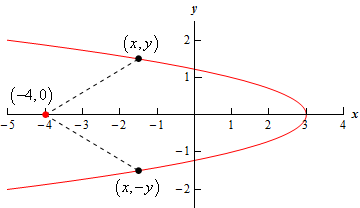
Next, we need to set up the constraint and equation that we are being asked to optimize. In this case the constraint is simply the equation we are given. The point must lie on the graph and so must also satisfy the equation.
$$x=3-2y^2$$We are being asked to minimize the distance between a point (or points) on the graph and the point $(−4,0)$. We can do this by looking at the distance between $(−4,0)$ and $(x,y)$. The distance between these two points is,
$$d = \sqrt {{{\left( {x + 4} \right)}^2} + {y^2}}.$$As we discussed in the notes for this section the point that minimizes the square of the distance will also minimize the distance itself and so to avoid dealing with the root we will minimize the square of the distance or,
$${d^2} = {\left( {x + 4} \right)^2} + {y^2}.$$Now we have two choices on how to proceed from this point. The first option is to plug the equation we are given into the $x$ in the distance squared and get a 4th degree polynomial for $y$ that we’ll need to work with. The second is to solve the equation for $y^2$ and plug that into the distance squared and get a 2nd degree polynomial for $x$ that we’ll need to work with. The second option gives a "nicer" polynomial to work with so we’ll do that.
$${y^2} = {\frac{1}{2}}\left( {3 - x} \right) = {\frac{3}{2}} - {\frac{1}{2}}x$$Plugging this into the distance squared gives,
$$f\left( x \right) = {d^2} = {\left( {x + 4} \right)^2} + {\frac{3}{2}} - {\frac{1}{2}}x = {x^2} + {\frac{15}{2}}x + {\frac{35}{2}}.$$Finding the critical point(s) for this shouldn’t be too difficult at this point. Here is the derivative.
$$f'\left( x \right) = 2x + {\frac{15}{2}}$$From this it looks like we get a single critical point: $x=−\frac{15}{4}=−3.75$. The second derivative of the distance squared function is,
$$f''(x)=2.$$From this we can see that the second derivative is always positive. Therefore, the distance squared will always be concave up and so the single critical point we got must be a relative minimum and hence must be the value of $x$ that gives the points that are closest to $(−4,0)$. Finally, we just need to determine the values $y$ that give the actual points.
$${y^2} = {\frac{3}{2}} - {\frac{1}{2}}\left( { - {\frac{15}{4}}} \right) = {\frac{27}{8}}\hspace{0.5in} \Rightarrow \hspace{0.5in}y = \pm \sqrt {{\frac{27}{8}}} \approx \pm 1.8371$$So, the two points on the graph that are closest to $(−4,0)$ are,
$$\left( { - {\frac{15}{4}},\sqrt {{\frac{27}{8}}} } \right)\hspace{0.5in} \text{AND} \hspace{0.5in}\left( { - {\frac{15}{4}}, - \sqrt {{\frac{27}{8}}} } \right).$$- An 80 cm piece of wire is cut into two pieces. One piece is bent into an equilateral triangle and the other will be bent into a rectangle with one side 4 times the length of the other side. Determine where, if anywhere, the wire should be cut to maximize the area enclosed by the two figures.
Before we do a sketch we’ll need to do a little setup. Let’s suppose we cut the wire so that the length of the piece of wire that goes to the rectangle is $x$. This means that the length of the piece of wire going to the triangle is $80−x$.
We know that the length of each side of the triangle are equal and so must have length $\frac{1}{3}(80-x)$. A bit of trigonometry also tells us that the interior angles of the triangle are $\frac{\pi}{3}$ and so the height of the triangle is ${\frac{1}{3}}\left( {80 - x} \right)\sin \left( {{\frac{\pi}{3}}} \right) = \frac{\sqrt{3}}{6} \left( {80 - x} \right)$.
For the rectangle let’s suppose that the length of the smaller side is $L$ and so the length of the larger side is $4L$. Next, we know that the total perimeter of the rectangle is $x$ and so we must have,
$$x = 2\left( L \right) + 2\left( {4L} \right) = 10L\hspace{0.5in} \to \hspace{0.5in}L = \frac{x}{10}.$$The length of the larger side must then be $4L=4\left(\frac{x}{10}\right)=\frac{2x}{5}$. Now that we have all the various lengths of the figures in terms of $x$ (which will make the work here a little easier) let’s summarize everything up with the following figure.
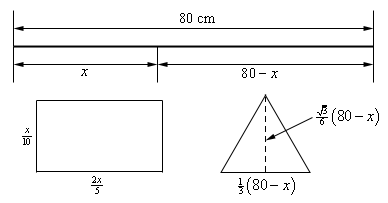
Next, we need to set up the constraint and equation that we are being asked to optimize. This is one of those cases where we really don’t have a constraint equation to work with. The constraint is the length of the wire (80 cm), but we took that into account when we set up our figure above so there isn’t anything to do with that in this case. We are being asked to maximize the enclosed area of the two figures and so here is the total area of the enclosed figures.
$$A\left( x \right) = \left( \frac{x}{10} \right)\left( \frac{2x}{5} \right) + {\frac{1}{2}}\left[ {{\frac{1}{3}}\left( {80 - x} \right)} \right]\left[ \frac{\sqrt{3}}{6} {\left( {80 - x} \right)} \right] = \frac{x^{2}}{25} + \frac{\sqrt{3}}{36} {\left( {80 - x} \right)^2}$$Finding the critical point(s) for this shouldn’t be too difficult at this point (although the algebra will be a little messy). Here is the derivative.
$$A'\left( x \right) = \frac{2x}{25} - \frac{\sqrt{3}}{18} \left( {80 - x} \right)$$From this it looks like we get a single critical point,
$$x=\frac{\frac{40\sqrt{3}}{9}}{\frac{2}{25}+\frac{\sqrt{3}}{18}}=\frac{2000\sqrt{3}}{36+25\sqrt{3}}\approx 43.6828.$$The second derivative of the area function is,
$$A''\left( x \right) = \frac{2}{25} + \frac{\sqrt{3}}{18}.$$From this we can see that the second derivative is always positive. Therefore $A(x)$ will always be concave up and so the single critical point we got must be a relative minimum and hence must be the value of $x$ (i.e. the cut point) that will give the minimum enclosed area.
This is a problem however as we were asked for the maximum enclosed area. This is the reason for this step being in every problem that we’ve worked over the last couple of sections. Far too often students get to this point, get a single answer and then just assume that it must be the correct answer and don’t bother doing any kind of checking to verify if it is the correct answer.
After all there was a single value so there is no choice for it to be correct. Right? Well, no. As we’ll seen here it in fact is not the correct answer.
So, what to do? We’ll recall for the problem statement that we were asked to, "Determine where, if anywhere, the wire should be cut to maximize the area enclosed by the two figures." The "if anywhere" portion seems to suggest that we may not want to cut it at all. Maybe all of the wire should go to the rectangle (corresponding to $x=80$ above) or maybe all of the wire should to the triangle (corresponding to $x=0$ above). Really, this gives us bounds for the value of $x$: $0\leq x\leq 80$.
So, all we need to do is plug $x=80$ and $x=0$ into the area function and determine which will give the largest area.
$$\begin{align*} A\left( 0 \right) &\approx 307.92 & \hspace{0.75in} & {\mbox{All wire goes to triangle.}}\\ A\left( {43.6828} \right) &\approx 139.785&\hspace{0.75in} & {\mbox{Wire goes to both triangle and rectangle.}}\\ A\left( {80} \right) & = 256 & \hspace{0.75in} & {\mbox{All wire goes to rectangle}} \end{align*}$$Note that we included the critical point above just to make it really clear that it will not in fact give the maximum area. We didn’t really need to include it here as we already knew it wouldn’t work for us.
From the function evaluations above it looks like we’ll need to take all of the wire and bend it into an equilateral triangle in order to get the maximum area.
- A line through the point $(2,5)$ forms a right triangle with the $x$-axis and $y$-axis in the 1st quadrant. Determine the equation of the line that will minimize the area of this triangle.
This problem may seem a little tricky at first. Here is a sketch of a line that goes through the point $(2,5)$, has an $x$-intercept of $(a,0)$ and a $y$-intercept of $(0,b)$.
Note that the only way we can get a triangle with the line, $x$-axis and $y$-axis as sides is to require that $a> 2$ and $b> 5$. If either of those are not true we will not have the triangle that we want.
Next, we need to set up the constraint and equation that we are being asked to optimize. We are being asked to minimize the area of the triangle shown above. In terms of the quantities given on the graph it is easy enough to get an equation for the area. The base length of the triangle is $a$ and the height of the triangle is $b$. We don’t have values for either of these but that isn’t a problem. Here is the area of the triangle.
$$A=\frac{1}{2}ab$$The constraint in this case is the equation of the line since that will define the hypotenuse of the triangle and hence also give both the base and height of the triangle. We need to write down the equation of the line, but we have three points on the line that we can use. Note however, that we really should use $(2,5)$ as one of the points because the line does need to go the point and using this point to write down the equation will give us that without any extra work.
The real question then is whether we should use the $x$ or $y$-intercept for the second point when determining the slope of the line. It really doesn’t matter which point that you use. The work will be slightly different for each point but there will be no real difference in the difficulty of the problem. We are going to use $(a,0)$ for the second point. The slope of the line using this point is,
$$m = \frac{5}{{2 - a}}.$$We already know that $b$ is the $y$-intercept and so the equation of the line through the point is,
$$y = \frac{5}{{2 - a}}x + b.$$Note that we definitely seem to have a problem here. Normally at this point we’ve got two equation and two unknowns. In this case we appear to have four unknowns: $a$, $b$, $x$, and $y$. This isn’t a problem as well see.
We now need to solve the constraint for one of the unknowns in the area function, i.e. either $a$ or $b$. However, as we noted above we also have an $x$ and $y$ in the equation that will cause problems if they stay in the equation. The point of this step is to get the area function down to a single variable. If we leave the $x$ and $y$ in the equation of the line we will end up with an area function with not one variable but three and that won’t work for us.
What we really need is an equation involving only $a$ and $b$ that we can solve for one or the other and plug into the area function. Luckily this is easy to get. All we need to do is plug the $x$-intercept into the equation of the line to get,
$$0 = \frac{5}{{2 - a}}a + b.$$Do you see why we couldn’t have used the $y$-intercept here? If not, plug it in and you’ll very quickly see why it won’t work. At this point we can easily solve the equation for $b$ to get,
$$b = - \frac{{5a}}{{2 - a}} = \frac{{5a}}{{a - 2}}.$$To eliminate one of the minus signs we took the minus sign in front of the quotient and applied it to the denominator and simplified. This doesn’t need to be done, but it does eliminate one of them.
Note that if we had used the $y$-intercept to determine the slope we would have found it to be easier at this step to solve for $a$ instead. That is the only real difference in which point you use to find the slope. Okay, let’s put all this together. We know the value of $b$ in terms of $a$ so plug that into the area function to get,
$$A\left( a \right) = \frac{1}{2}\left( a \right)\left( {\frac{{5a}}{{a - 2}}} \right) = \frac{5}{2}\frac{{{a^2}}}{{a - 2}}.$$Here is the derivative of the area function.
$$A'\left( a \right) = \frac{5}{2}\frac{{{a^2} - 4a}}{{{{\left( {a - 2} \right)}^2}}} = \frac{5}{2}\frac{{a\left( {a - 4} \right)}}{{{{\left( {a - 2} \right)}^2}}}$$From this it looks like we get a three potential critical points: $a=0$, $a=2$, and $a=4$. We can’t use $a=0$ as the critical point because that will no longer form a triangle with both the $x$-axis and the $y$-axis as the problem asks for as noted in the first step. We also can’t use $a=2$ for two reasons. First, it isn’t actually a critical point because the area function doesn’t exist at $a=2$. This shouldn’t be surprising given that if we used this point we wouldn’t have a triangle anyway (again as we noted in the first step) and that is also the second reason for not using it.
This leaves only $a=4$ as a critical point that we can use.
The second derivative of the area function (after a little simplification) is,
$$A''\left( a \right) = \frac{{20}}{{{{\left( {a - 2} \right)}^3}}}.$$From this we can see that the second derivative is always positive provided we have $a> 2$. However, as we noted in the before, this is required in order even work the problem. Therefore, the second derivative will always be positive for the range of $a$ that we are working on. The area function will then will always be concave up for the range of $a$ and $a=4$ must give a minimum area.
Now that we know the value of $a$ we know that the slope and $y$-intercept are,
$$m = \frac{5}{{2 - 4}} = - \frac{5}{2}\hspace{0.5in}\hspace{0.5in}b = \frac{{5\left( 4 \right)}}{{4 - 2}} = 10.$$The equation of the line is then,
$$y = - \frac{5}{2}x + 10.$$- Two 10 meter tall poles are 30 meters apart. A length of wire is attached to the top of each pole and it is staked to the ground somewhere between the two poles. Where should the wire be staked so that the minimum amount of wire is used?
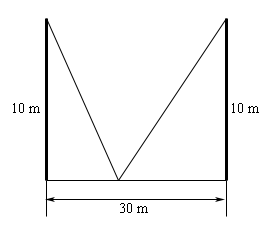
Let’s start with a quick of the situation with some more information added in.
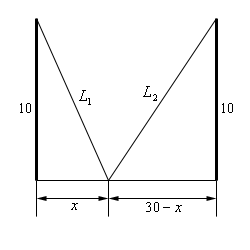
Next, we need to set up the constraint and equation that we are being asked to optimize. We want to minimize the amount of wire and so the equation we need to minimize is,
$$L = {L_1} + {L_2}.$$The constraint here is that the poles must be 30 meters apart. We can use this to determine the lengths of the individual wires in terms of $x$. Doing this gives,
$${L_1} = \sqrt {100 + {x^2}} \hspace{0.5in}{L_2} = \sqrt {100 + {{\left( {30 - x} \right)}^2}}.$$Note that as well can also see that we need to require that $0\leq x\leq 30$. All we need to do here is plug the lengths of the individual wires in the total length to get a function in terms of $x$ that we can minimize.
$$L\left( x \right) = \sqrt {100 + {x^2}} + \sqrt {100 + {{\left( {30 - x} \right)}^2}}$$The derivative of the length function is,
$$L'\left( x \right) = \frac{x}{{\sqrt {100 + {x^2}} }} + \frac{{x - 30}}{{\sqrt {{x^2} - 60x + 1000} }}.$$Solving for the critical point(s) is going to be messy so here it goes.
$$\begin{align*} \frac{x}{{\sqrt {100 + {x^2}} }} + \frac{{x - 30}}{{\sqrt {{x^2} - 60x + 1000} }} & = 0\\ \frac{x}{{\sqrt {100 + {x^2}} }} & = - \frac{{x - 30}}{{\sqrt {{x^2} - 60x + 1000} }}\\ x\sqrt {{x^2} - 60x + 1000} & = - \left( {x - 30} \right)\sqrt {100 + {x^2}} \\ {x^2}\left( {{x^2} - 60x + 1000} \right) & = {\left( {x - 30} \right)^2}\left( {100 + {x^2}} \right)\\ {x^4} - 60{x^3} + 1000{x^2} & = {x^4} - 60{x^3} + 1000{x^2} - 6000x + 90000\\ 0 & = - 6000x + 90000\\ x & = 15 \end{align*}$$A quick check by plugging this back into the derivative shows that we do indeed get $L'(15)=0$ and so this is a critical point and it is in the acceptable range of $x$. Recall that because we squared both sides of the equation above it is possible to end up with answers that in fact are not solutions and so we have to go back and check in the original equation to make sure that they are solutions.
Since we have a range of $x$'s and the distance function is continuous in the range all we need to do is plug in the endpoints and the critical point to identify the minimum distance.
$$L\left( 0 \right) \approx 41.6228\hspace{0.5in}L\left( 15 \right) \approx 36.0555\hspace{0.5in}L\left( {30} \right) \approx 41.6228$$The wire should be staked midway between the poles, at 15 m, to minimize the amount of wire used.
Assignment Problems
- Find two positive numbers whose sum of six times one of them and the second is 250 and whose product is a maximum.
- Find two positive numbers whose sum of twice the first and seven times the second is 600 and whose product is a maximum.
- Let $x$ and $y$ be two positive numbers whose sum is 175 and $(x+3)(y+4)$ is a maximum. Determine $x$ and $y$.
- Find two positive numbers such that the sum of the one and the square of the other is 200 and whose product is a maximum.
- Find two positive numbers whose product is 400 and such that the sum of twice the first and three times the second is a minimum.
- Find two positive numbers whose product is 250 and such that the sum of the first and four times the second is a minimum.
- Let $x$ and $y$ be two positive numbers such that $y(x+2)=100$ and whose sum is a minimum. Determine $x$ and $y$.
- Find a positive number such that the sum of the number and its reciprocal is a minimum.
- We are going to fence in a rectangular field and have 200 feet of material to construct the fence. Determine the dimensions of the field that will enclose the maximum area.
- We are going to fence in a rectangular field. Starting at the bottom of the field and moving around the field in a counter clockwise manner the cost of material for each side is $6 per ft, $9 per ft, $12 per ft, and $14 per ft respectively. If we have $1000 to buy fencing material determine the dimensions of the field that will maximize the enclosed area.
- We are going to fence in a rectangular field that encloses 75 ft$^2$. Determine the dimensions of the field that will require the least amount of fencing material to be used.
- We are going to fence in a rectangular field that encloses 200 m$^2$. If the cost of the material for of one pair of parallel sides is $3 per m and cost of the material for the other pair of parallel sides is $8 per m, determine the dimensions of the field that will minimize the cost to build the fence around the field.
- Show that a rectangle with a fixed area and minimum perimeter is a square.
- Show that a rectangle with a fixed perimeter and a maximum area is a square.
- We have 350 m$^2$ of material to build a box whose base width is four times the base length. Determine the dimensions of the box that will maximize the enclosed volume.
- We have $1000 to buy the materials to build a box whose base length is seven times the base width and has no top. If the material for the sides cost $10/cm2 and the material for the bottom cost $15 per cm$^2$ determine the dimensions of the box that will maximize the enclosed volume.
- We want to build a box whose base length is twice the base width and the box will enclose 80 ft$^3$. The cost of the material of the sides is $0.5 per ft$^2$ and the cost of the top/bottom is $3 ft$^2$. Determine the dimensions of the box that will minimize the cost.
- We want to build a box whose base is a square, has no top and will enclose 100 m$^3$. Determine the dimensions of the box that will minimize the amount of material needed to construct the box.
- We want to construct a cylindrical can with a bottom but no top that will have a volume of 65 in$^3$. Determine the dimensions of the can that will minimize the amount of material needed to construct the can.
- We want to construct a cylindrical can whose volume is 105 mm$^3$. The material for the wall of the can costs $3 per mm$^2$, the material for the bottom of the can costs $7 per mm$^2$ and the material for the top of the can costs $2 per mm$^2$. Determine the dimensions of the can that will minimize the cost of the materials needed to construct the can.
- We have a piece of cardboard that is 30 cm by 16 cm and we are going to cut out the corners and fold up the sides to form a box. Determine the height of the box that will give a maximum volume.
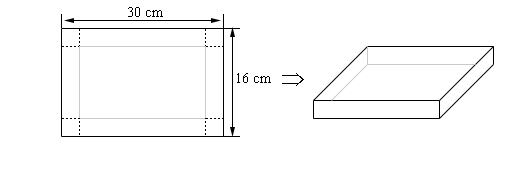
- We have a piece of cardboard that is 5 in by 20 in and we are going to cut out the corners and fold up the sides to form a box. Determine the height of the box that will give a maximum volume.
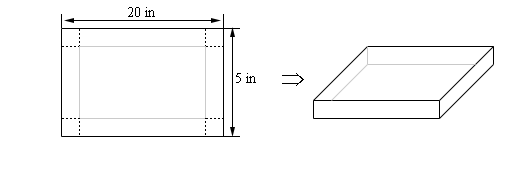
- A printer needs to make a poster that will have a total of 500 cm$^2$ that will have 3 cm margins on the sides and 2 cm margins on the top and bottom. What dimensions of the poster will give the largest printed area?
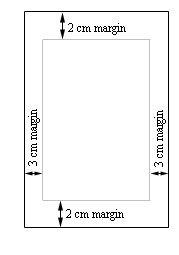
- A printer needs to make a poster that will have a total of 125 in$^2$ that will have $1/2$ inch margin on the bottom, 1 inch margin on the right, 2 inch margin on the left and 4 inch margin on the top. What dimensions of the poster will give the largest printed area?
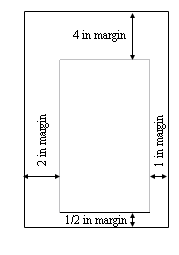
- We want to construct a window whose bottom is a rectangle and the top of the window is an equilateral triangle. If we have 75 inches of framing material what are the dimensions of the window that will let in the most light?
- We want to construct a window whose middle is a rectangle and the top and bottom of the window are equilateral triangles. If we have 4 feet of framing material what are the dimensions of the window that will let in the most light?
- We want to construct a window whose middle is a rectangle, the top of the window is a semicircle and the bottom of the window is an equilateral triangle. If we have 1500 cm of framing material what are the dimensions of the window that will let in the most light?
- Determine the area of the largest rectangle that can be inscribed in a circle of radius 5.
- Determine the area of the largest rectangle whose base is on the $x$-axis and the top two corners lie on semicircle of radius 16.
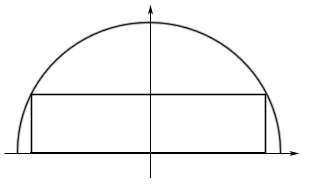
- Determine the area of the largest rectangle whose base is on the $x$-axis and the top two corners lie $y=4−x^2$.
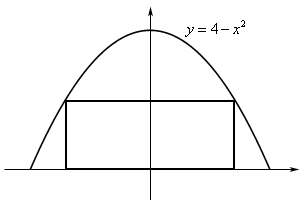
- Find the point(s) on $\displaystyle \frac{{{x^2}}}{4} + \frac{{{y^2}}}{{36}} = 1$ that are closest to $(0,1)$.
- Find the point(s) on $x=y^2-8$ that are closest to $(5,0)$.
- Find the point(s) on $y=2-x^2$ that are closest to $(0,-3)$.
- A 6 ft piece of wire is cut into two pieces. One piece is bent into an equilateral triangle and the other will be bent into a rectangle with one side twice the length of the other side. Determine where, if anywhere, the wire should be cut to minimize the area enclosed by the two figures.
- A 250 cm piece of wire is cut into two pieces. One piece is bent into an equilateral triangle and the other will be bent into circle. Determine where, if anywhere, the wire should be cut to maximize the area enclosed by the two figures.
- A 250 cm piece of wire is cut into two pieces. One piece is bent into an equilateral triangle and the other will be bent into circle. Determine where, if anywhere, the wire should be cut to minimize the area enclosed by the two figures.
- A 4 m piece of wire is cut into two pieces. One piece is bent into a circle and the other will be bent into a rectangle with one side three times the length of the other side. Determine where, if anywhere, the wire should be cut to maximize the area enclosed by the two figures.
- A line through the point $(−4,1)$ forms a right triangle with the $x$-axis and $y$-axis in the 2nd quadrant. Determine the equation of the line that will minimize the area of this triangle.

- A line through the point $(3,3)$ forms a right triangle with the $x$-axis and $y$-axis in the 1st quadrant. Determine the equation of the line that will minimize the area of this triangle.
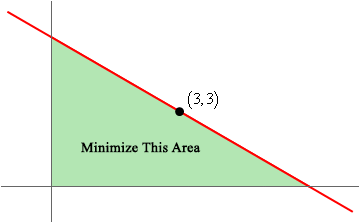
- A piece of pipe is being carried down a hallway that is 14 feet wide. At the end of the hallway there is a right-angled turn and the hallway narrows down to 6 feet wide. What is the longest pipe (always keeping it horizontal) that can be carried around the turn in the hallway?
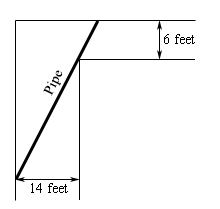
- A piece of pipe is being carried down a hallway that is 9 feet wide. At the end of the hallway there is a right-angled turn and the hallway widens up to 25 feet wide. What is the longest pipe (always keeping it horizontal) that can be carried around the turn in the hallway?

- Two poles, one 15 meters tall and one 10 meters tall, are 40 meters apart. A length of wire is attached to the top of each pole and it is staked to the ground somewhere between the two poles. Where should the wire be staked so that the minimum amount of wire is used?
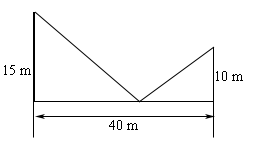
- Two poles, one 2 feet tall and one 5 feet tall, are 3 feet apart. A length of wire is attached to the top of each pole and it is staked to the ground somewhere between the two poles. Where should the wire be staked so that the minimum amount of wire is used?
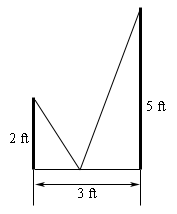
- Two poles, one 15 meters tall and one 10 meters tall, are 40 meters apart. A length of wire is attached to the top of each pole and it is staked to the ground somewhere between the two poles. Where should the wire be staked so that the angle formed by the two pieces of wire at the stake is a maximum?
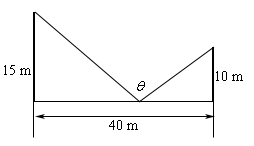
- Two poles, one 34 inches tall and one 17 inches tall, are 3 feet apart. A length of wire is attached to the top of each pole and it is staked to the ground somewhere between the two poles. Where should the wire be staked so that the angle formed by the two pieces of wire at the stake is a maximum?
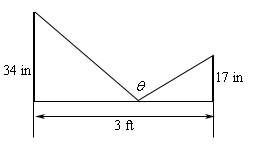
- A trough for holding water is to be formed as shown in the figure below. Determine the angle $\theta$ that will maximize the amount of water that the trough can hold.
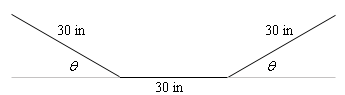
- A trough for holding water is to be formed as shown in the figure below. Determine the angle $\theta$ that will maximize the amount of water that the trough can hold.
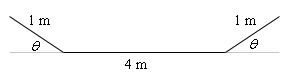
- Find two positive numbers whose product is 750 and for which the sum of one and 10 times the other is a minimum.