Minimum and Maximum Values
Click here for a printable version of this page.Definitions
Many of the applications in this chapter involve the minimum and maximum values of a function. While we can all visualize minimum and maximum values on a graph, there are some subtleties that we need to pay attention to when talking about them. In particular, we want to differentiate between what we will call relative and absolute minimum and maximum points.
Before we state the definitions, here is a quick note on terminology. The plurals of "minimum" and "maximum" are "minima" and "maxima," respectively. Also, we will call all of the minimum and maximum points of a function the extrema of the function. So "relative extrema" will refer to the relative minima and maxima, while "absolute extrema" will refer to the absolute minima and maxima. A single extreme point is called an "extremum" of the function.
Extrema
- We say that $f(x)$ has an absolute (or global) maximum at $x=c$ if $f(x)\leq f(c)$ for every $x$ in the domain in which we're working.
- We say that $f(x)$ has a relative (or local) maximum at $x=c$ if $f(x)\leq f(c)$ for every $x$ in some open interval around $x=c.$
- We say that $f(x)$ has an absolute (or global) minimum at $x=c$ if $f(x)\geq f(c)$ for every $x$ in the domain in which we're working.
- We say that $f(x)$ has a relative (or local) minimum at $x=c$ if $f(x)\geq f(c)$ for every $x$ in some open interval around $x=c.$
When we say an "open interval around $x=c$" in the definition, we mean that we can find some interval $(a,b)$ that does not include the endpoints and such that $a\lt c\lt b.$ That is, $c$ is in the interval but is not one of the endpoints.
So what is the difference between relative and absolute extrema? This can be a little subtle.
A function may have an absolute maximum (or minimum) at $x=c$ provided that $f(c)$ is the largest (or smallest) value that the function will ever take on the domain that we're working on. When we say, "the domain we are working on," we mean the set of $x$ values we have chosen to work with in a given problem. It may not be the entire domain of the function because we may have chosen to restrict the domain for some reason.
The situation with a relative maximum or minimum is slightly different. To be a relative maximum (or minimum), a point just needs to be the largest (or smallest) value of the function in some open interval of $x$ values that contains $x=c.$ There may be larger (or smaller) values of the function at some other place, but $f(c)$ is the largest (or smallest) "in its neighborhood."
Note as well that in order for a point to be a relative extremum, we must be able to look at function values at $x$'s on both sides of $x=c.$ This means that relative extrema do not occur at the endpoints of a domain. This will be discussed in a little more detail at the end of the section.
To get a feel for the definitions, let's look at the graph below.

The function shown in this graph has relative maxima at $x=b$ and $x=d.$ Both of these points are relative maxima because they are interior to the domain being considered and their $y$ values are the largest on the graph in some interval around the corresponding $x$ values.
The graph also has a relative minimum at $x=c$ since this point is interior to the domain under consideration and its $y$ value is the lowest on the graph in an interval around its $x$ value.
This function has an absolute maximum at $x=d$ and an absolute minimum at $x=a.$ The $y$ values at these two points are the largest and smallest that the function will ever be on the domain shown. We'll observe here that the absolute extrema for a function will occur at either the endpoints of the domain or at relative extrema. This idea will be important for us later in the chapter.
Finally, we observe that the point at $x=e$ on the graph is not a relative minimum because it is not interior to the domain under consideration, it occurs at an endpoint.
Examples
Let's take a look at some examples to make sure that we have the definitions of absolute extrema and relative extrema straight.
Identify the absolute extrema and relative extrema for the function $f(x)=x^2$ on the domain $[-1,2].$
Let's take a look at the graph. Since the domain is restricted to $[-1,2],$ that is all we'll include. We will use dots at the ends of the graph to indicate that the graph ends at those points.

We can now identify the extrema from the graph. There is a relative and absolute minimum of zero at $x=0$ and an absolute maximum of four at $x=2.$
Note that there is not a relative maximum at $x=-1$ since this is an endpoint of the domain interval. This function does not have any relative maxima.
This example shows us that functions do not have to have any relative extrema.
Identify the absolute extrema and relative extrema for the function $f(x) = x^2$ on the domain $[-2,2].$
Here is the graph of this function on this domain.

In this case there is still a relative and absolute minimum of zero at $x=0,$ and there is still an absolute maximum of four. However, for this graph, the absolute maximum occurs at both $x=2$ and $x=-2.$
Again, the function does not have any relative maxima.
As this example has shown, there can only be a single absolute maximum and a single absolute minimum value, but those can occur at more than one place in the domain.
Identify the absolute extrema and relative extrema for the function $f(x) = x^2.$
This time, we were not given a domain interval, so we will take the largest possible domain. For this function, that is all real numbers. Here is the graph:

In this case the graph increases at both ends without stopping, so there are no maxima of either kind for this function. In other words, no matter which point we choose on the graph, there will be a point that is higher than it on one side or the other.
There is still a relative and absolute minimum value of zero at $x=0.$
So, some graphs have a minimum but no maximum. Others might have a maximum but no minimum.
Identify the absolute extrema and relative extrema for the function $f(x) = x^3$ on the domain $[-2,2].$
Here is the graph of this function on this domain:

This function has an absolute maximum of eight at $x=2$ and an absolute minimum of negative eight at $x=-2.$ This function has no relative extrema.
Identify the absolute extrema and relative extrema for the function $f(x) = x^3.$
There is no restriction on the domain, so we will consider the function on its entire domain, all real numbers. Here is the graph:

This function has no relative extrema or absolute extrema.
This last example shows that a function may have no extrema of any kind.
Identify the absolute extrema and relative extrema for the function $f(x) = \cos(x).$
There is no restriction on the domain for this function, so we will use its entire domain, all real numbers. Here is the graph:
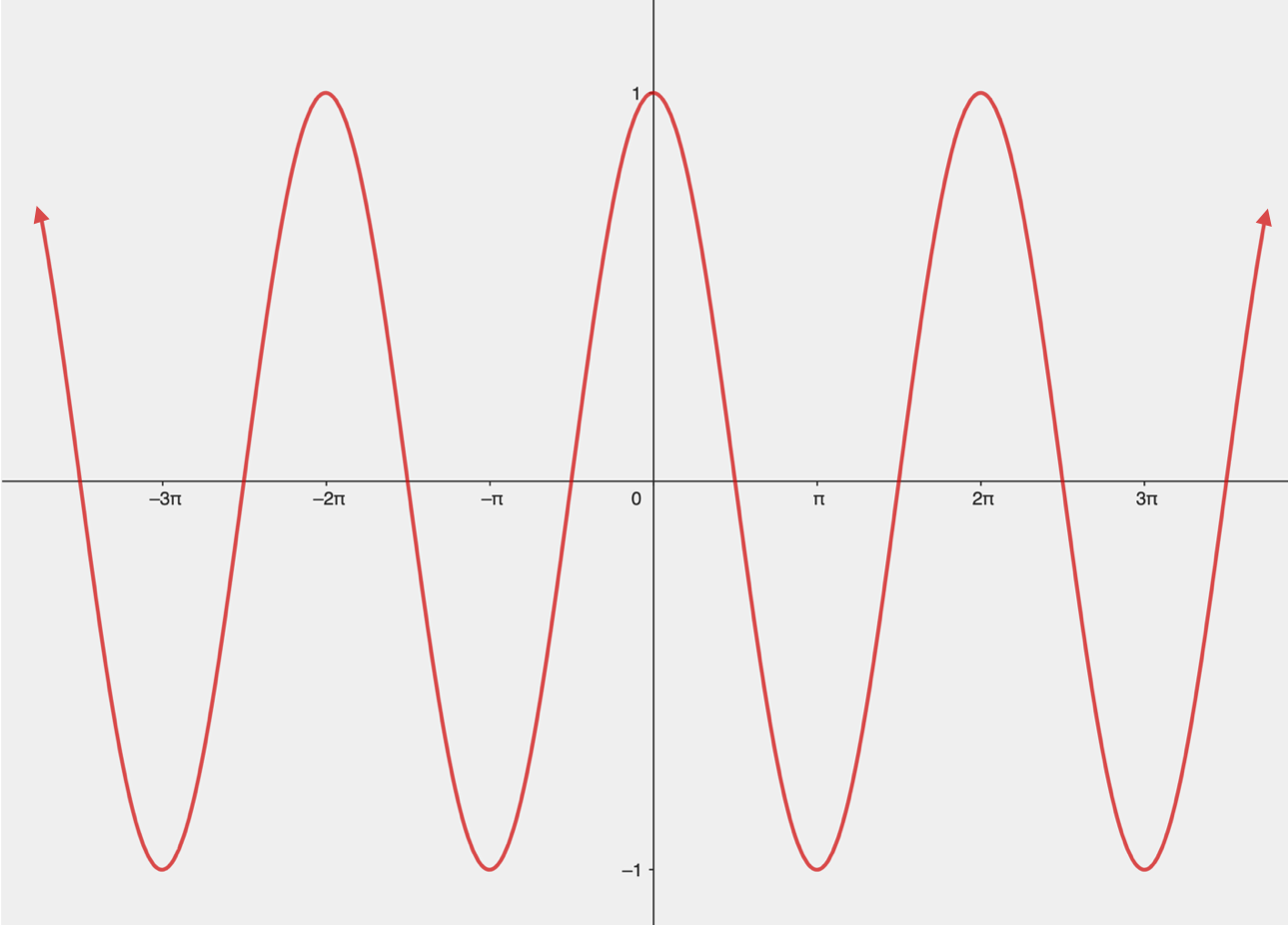
Cosine has both relative and absolute maxima of one at $x=...-4\pi, -2\pi, 0, 2\pi, 4\pi, ...$
Cosine also has both relative and absolute minima of negative one at $x=...-3\pi, -\pi, \pi, 3\pi,...$
This example shows that a function can have extrema at a large number of points (infinitely-many, in this case).
The Extreme Value Theorem
We've worked quite a few examples now, and we can use these examples to see a nice fact about absolute extrema, which we'll state as a theorem in a moment. First notice that all the functions in the examples above were continuous functions. Next notice that every time the domain was restricted to a closed interval (that is, an interval that contains its endpoints), the function had absolute maxima and absolute minima on that interval. Finally, in only one of the three examples in which the domain was not restricted did we find both an absolute maximum and an absolute minimum.
These observations lead us to the following theorem:
Extreme Value Theorem
If $f(x)$ is continuous on the closed interval $[a,b],$ then there are two numbers $c$ and $d$ with $a\leq c\leq b$ and $a\leq d\leq b$ such that $f(c)$ is an absolute maximum and $f(d)$ is an absolute minimum for the function.This theorem guarantees that if we have a function that is continuous on a closed interval $[a,b],$ then we will be able to find both an absolute maximum and an absolute minimum for the function somewhere in the interval. The theorem doesn't tell us where they will occur or if they will occur more than once, but at least it tells us that they do exist somewhere. We will develop a strategy for finding the absolute extrema in the next part of this section.
This theorem also doesn't say anything about absolute extrema if we are not working on a closed interval. In fact, we saw examples of functions above that had both kinds of absolute extrema, had just one absolute extremum, or had no absolute extrema when we didn't restrict the domain to an interval.
EVT:
A function that is continuous on a closed, bounded interval will have an absolute maximum and absolute minimum.The requirement that the function be continuous is necessary for us to use the theorem. Let's look at an example to see why.
Consider the graph of $f(x)=\displaystyle\frac{1}{x^2}$ on the interval $[-1,1].$
![Graph of 1 over x-squared on the domain [-1,1] with dots at the points (-1,1) and (1,1) to indicate that the graph does not extend past these two points. There is also a gap as the graph approaches the y-axis to indicate that the graph has a vertical asymptote at the y-axis.” width=](img/secminandmaxvaluesgraph2.png)
We can see on the graph that there is no absolute maximum for this function on this interval since the function approaches infinity as $x$ approaches zero from either side. It does have an absolute minimum, though. It occurs twice, at both $x=1$ and at $x=-1.$ Since this function has a discontinuity at $x=0,$ and since $x=0$ is contained in the interval $[-1,1],$ the function does not meet the hypothesis of the theorem.
Consider the same function on the interval $\left [\frac12,1\right].$ This function has both absolute extrema. Since this interval doesn't contain the point of discontinuity, the theorem applies to the function over this domain.
We should also point out that just because a function is not continuous at a point doesn't mean that it won't have both absolute extrema in an interval that contains that point. As an example, consider the graph below.

This function is not continuous at $x=c,$ yet it has both an absolute maximum (at $x=b$) and an absolute minimum (at $x=c$). In this example, one of the absolute extrema occurs at the point of discontinuity, but it could appear anywhere in the domain or at one of the endpoints.
These graphs illustrate a point that can be made about all theorems, especially the Extreme Value Theorem. We can only draw the conclusion stated by the theorem if all of its hypotheses are met and we should be careful not to misinterpret what happens if the hypotheses are not met.
In order to use the Extreme Value Theorem, we must have an interval that includes its endpoints (a closed interval), and the function must be continuous everywhere on that interval. If we don't have a closed interval and/or if the function is not continuous on the interval, then the function may or may not have absolute extrema.
Fermat's Theorem
We need to discuss one final topic before moving onto the first major application of the derivative that we'll look at in this chapter.
Fermat's Theorem
If $f(x)$ has a relative extremum at $x=c$ and if $f'(c)$ exists, then $x=c$ is a critical number of $f(x).$ In fact, it will be a critical number such that $f'(c)=0.$Proof
Suppose that $f(x)$ has a relative extremum at $x=c$ and that $f'(c)$ exists. Without loss of generality, we may assume that the extremum is a relative maximum. The proof for a relative minimum is nearly identical.
Since $f$ has a relative maximum at $x=c,$ we know that $f(c)\geq f(x)$ for all $x$ in an open interval that contains $c.$ Another way to say this is that $f(c)\geq f(x)$ for all $x$ that are "close" to $c.$ In particular, if $h$ is a number (positive or negative) that is close enough to zero so that $h+c$ is in the open interval containing $c,$ then $$f(c)\geq f(c+h)$$
Rewriting this a little, we can say that $$f(c+h)-f(c)\leq 0$$
Suppose that $h>0.$ Dividing both sides of the above inequality by $h,$ we have $$\frac{f(c+h)-f(c)}{h}\leq 0$$
Because we have assumed that $h>0,$ we can take the limit as $h$ approaches zero from the right.
$$\lim_{h\to 0^{+}} \frac{f(c+h)-f(c)}{h}\leq \lim_{h\to 0^{+}} 0 = 0$$Recall that if a limit exists, it must be equal to both one-sided limits. Since $f'(c)$ exists, the overall limit exists and is equal to the limit above. That is,
$$f'(c) = \lim_{h\to 0}\frac{f(c+h)-f(c)}{h}=\lim_{h\to 0^{+}}\frac{f(c+h)-f(c)}{h}\leq 0$$Thus we have shown that $f'(c)\leq 0.$
Now let's suppose that $h<0$ and divide the inequality $f(c+h)-f(c)\leq 0$ by $h.$ This gives
$$\frac{f(c+h)-f(c)}{h}\geq 0$$Remember that since $h<0,$ the inequality symbol reverses when we divide by $h.$ Using an argument similar to the one we gave above, we can say that
$$f'(c)=\lim_{h\to 0}\frac{f(c+h)-f(c)}{h}=\lim_{h\to 0^{-}}\frac{f(c+h)-f(c)}{h}\geq \lim_{h\to 0^{-}} 0 = 0$$In the above statement, we used the limit as $h$ approaches zero from the left since $h<0.$ Thus we now have $f'(c)\geq 0.$
We have now shown that $f'(c)\leq 0$ and $f'(c)\geq 0.$ The only way these can both be true is to have $f'(c) = 0.$ Thus $x=c$ is a critical number of $f.$
As we noted above, if $f(x)$ has a relative minimum at $x=c,$ then the argument is nearly identical. We would just reverse the inequality symbol at the beginning.
This theorem tells us that there is a nice relationship between relative extrema and critical numbers. In fact, it allows us to create a list of all possible relative extrema. Since a relative extremum must occur at a critical number, the list of all critical numbers gives us a list of all possible relative extrema.
To illustrate this, consider the function $f(x)=x^2.$ We saw that this function has a relative minimum at $x=0$ in several of our earlier examples. According to Fermat's Theorem, $x=0$ should be a critical number. Since the derivative is $$f'(x)=2x$$ it is clear that $x=0$ is indeed a critical number.
As with every theorem, we have to be careful that we are using this one correctly. It says that every relative extremum occurs at a critical number. It does not say that every critical number will correspond to a relative extremum.
To see this, consider the function $f(x) = x^3.$ Its derivative is $f'(x) = 3x^2,$ and clearly $x=0$ is a critical number. However, we saw in an earlier example that this function has no relative extrema of any kind. Thus $x=0$ is a critical number that does not correspond to a relative extremum.
We note further that Fermat's Theorem says nothing about absolute extrema. An absolute extremum may or may not occur at a critical number.
Before we move on, there are two more points we need to make.
First, Fermat's Theorem only applies to values $x=c$ at which $f'(c)$ exists. This doesn't mean, though, that relative extrema won't occur at critical numbers where the derivative does not exist. To see this, consider $f(x)=|x|.$ This function has a relative minimum at $x=0$ and yet in the section on the definition of the derivative, we showed in an example that $f'(0)$ does not exist.
❗Note❗
To locate relative extrema we only need to look at the critical numbers, as those are the only places where relative extrema may exist.
Finally, recall that at the beginning of this section we stated that if the domain is an interval, relative extrema cannot be located at the endpoints of the interval. If we allowed relative extrema to occur at endpoints, this may well (and frequently does) violate Fermat's Theorem. There is no reason to expect the endpoints of intervals to be critical numbers of either kind.
Finding Absolute Extrema
Our first major application of the derivative in this chapter is to determine the absolute extrema of a function that is continuous on a closed interval. First, let's observe that this is exactly the kind of function that the Extreme Value Theorem applies to, so we know that the absolute extrema exist.
Next, we saw above that absolute extrema can occur at endpoints or at relative extrema. We also know that the list of critical numbers is a list of all possible relative extrema. So, the endpoints plus the list of critical numbers is a list of all possible absolute extrema.
Now we just need to recall that the absolute extrema are simply the largest and smallest values that a function will take. Putting this all together gives us the following strategy for finding absolute extrema.
Finding Absolute Extrema of $f(x)$ on $[a,b]$
- Verify that the function is continuous on the interval $[a,b].$
- Find all critical numbers of $f(x)$ that are in the interval $[a,b].$
- Evaluate the function at the critical numbers found in step 2, and at the end points.
- Compare the values found in the previous step and identify the absolute maxima and absolute minima.
It's worth emphasizing step 2 before we do any examples. Since we are only interested in the function over the interval $[a,b],$ any critical numbers we find that are not in this interval can and should be ignored.
Determine the absolute extrema for the following function on the given interval.
First we notice that this function is a polynomial, and is therefore continuous everywhere. Therefore, it is continuous on the given interval.
We need to find the critical numbers of this function, so we need its derivative: $$g'(t) = 6t^2+6t-12=6(t+2)(t-1)$$ Since the derivative is a polynomial, there are no points at which it is undefined. We see from the factored form of $g'(t)$ that there are two values of $t$ for which the derivative is zero: $t=-2$ and $t=1.$ To find the absolute extrema of a function on a given interval, we only need to consider critical numbers that fall in the interval. In this case, both critical numbers are in the given interval, so we will consider both of them.
Now we evaluate the function at the critical numbers and at the endpoints of the interval.
\begin{align*} g(-2) &= 24\hspace{1in} &g(1) &= -3\\ g(-4) &= -28\hspace{1in} & g(2) &= 8\\ \end{align*}These four points are the only points in the interval where the absolute extrema can occur. From this list, we see that the absolute maximum of $g(t)$ on this interval is $24$ and it occurs at $t=-2$ (a critical number). The absolute minimum of $g(t)$ on this interval is $-28$ and it occurs at $t=-4$ (an endpoint).
In this example, we saw that absolute extrema can and will occur at both endpoints and at critical numbers. One of the mistakes students frequently make on this kind of problem is to forget to check the endpoints of the interval.
Determine the absolute extrema for the following function on the given interval.
This example is almost identical to the last example, we've only changed the interval. This small change will completely change the answer, though. Notice that this interval excludes both of the answers from the last example.
Again, we need the derivative and the critical numbers. Recall that $$g'(t) = 6(t+2)(t-1)$$ and that the critical numbers of $g$ are $t=-2$ and $t=1.$ Since we only consider critical numbers that fall in the interval, we will only consider $t=1$ this time.
Now evaluate the function at this one critical number and the two endpoints.
$$g(1)=-3\hspace{.5in} g(0)=4\hspace{.5in} g(2)=8$$From this list of function values, we see that the absolute maximum of $g(t)$ on this interval is $8$ and it occurs at $t=2$ (an endpoint). The absolute minimum is $-3$ and it occurs at $t=1$ (a critical number).
As we saw in this last example, a simple change in the interval can completely change the answer. It also has shown us that we do need to be careful to exclude critical numbers that are not in the interval. Had we forgotten this and included $t=-2,$ we would have found the wrong absolute maximum!
Suppose that the population (in thousands) of a certain kind of insect after $t$ months is given by the function $$P(t)=3t+\sin(4t)+100$$ Determine the minimum and maximum population in the first 4 months.
We are being asked to find the absolute extrema of $P(t)$ on the interval $[0,4].$ Since this function is continuous everywhere, the Extreme Value Theorem tells us that we can do this.
We need the critical numbers of the function, so let's find the derivative. $$P'(t) = 3 + 4\cos(4t)$$ The derivative exists everywhere, so we just need to determine where the derivative is zero.
\begin{align*} 3+4\cos(4t) &= 0\\ \cos(4t) &= -\frac34\\ \end{align*}The solutions to this equation are
$$\begin{array}{llcll} 4t \approx 2.4189 + 2\pi n, & n=0,\pm 1,\pm 2, ... & & t\approx 0.6047 + \displaystyle\frac{\pi n}{2}, & n=0,\pm 1, \pm 2, ...\\ & & \Rightarrow & &\\ 4t\approx 3.8643 + 2\pi n, & n=0,\pm 1,\pm 2, ... & & t\approx 0.9661 + \displaystyle\frac{\pi n}{2}, & n=0,\pm 1, \pm 2, ...\\ \end{array}$$So there are the critical numbers of the function. We need to determine which of these fall in the interval $[0,4],$ though. The easiest way to do this is to start listing values of $t$ for different $n$ until we find all the ones we need.
$n=0$:
$$t\approx 0.6047\hspace{.5in} t\approx 0.9661$$Both of these are in the interval.
$n=1$:
$$t\approx 0.6047 + \displaystyle{\pi}{2} \approx 2.1755\hspace{.5in} t\approx 0.9661+\displaystyle\frac{\pi}{2}\approx 2.5359$$These are as well.
$n=2$:
$$t\approx 0.6047 +\pi\approx 3.7463\hspace{.5in} t\approx 0.9661+\pi\approx 4.1077$$The first of these is in the interval, but the second falls outside of it. So there are five critical numbers in the interval. They are (approximately)
$$0.6047, 0.9661, 2.1755, 2.5369, 3.7463$$To determine the absolute minimum and maximum population in the first four months, we evaluate $P(t)$ at these values and at the two endpoints.
\begin{align*} P(0) &= 100.0 \hspace{.5in} &P(4) &\approx 111.7121\\ P(0.6047) &\approx 102.4756 \hspace{.5in} &P(0.9661) &\approx 102.2368\\ P(2.1755) &\approx 107.1880 \hspace{.5in} &P(2.5369) &\approx 106.9492\\ P(3.7463) &\approx 111.9004 & &\\ \end{align*}From this list, we see that the minimum population is $100,000$ (remember that $P$ gives the population in thousands) and it occurs at $t=0.$ In other words, the minimum population is the starting population. The maximum population is about $111,900$ and it occurs at $t\approx 3.7463.$
This example illustrates the importance of solving trigonometric equations correctly. If we had forgotten the $2\pi n,$ we would have missed the last three critical numbers in the interval and hence would have missed the correct absolute maximum.
Also, we should be careful with rounding answers. If we had rounded to the nearest integer, for instance, it would have appeared that the maximum population occurred at two different times instead of only one.
Suppose that the amount of money in a bank account after $t$ years is given by $$A(t) = 2000-10t\text{e}^{5-\frac{t^2}{8}}$$ Determine the minimum and maximum amount of money in the account during the first 10 years that it is open.
We are being asked to find the absolute extrema of $A(t)$ on the interval $[0,10].$ This function is continuous everywhere, so the Extreme Value Theorem guarantees that these values exist.
First we'll need the derivative so that we can find the critical numbers.
\begin{align*} A'(t) &= -10\text{e}^{5-\frac{t^2}{8}} - 10t\text{e}^{5-\frac{t^2}{8}}\left(-\frac{t}{4}\right)\\ &= 10\text{e}^{5-\frac{t^2}{8}}\left(-1+\frac{t^2}{4}\right)\\ \end{align*}This derivative exists everywhere, so we just need to determine where it equals zero. The exponential function is never zero, so the derivative is only zero where
$$-1+\frac{t^2}{4} = 0\hspace{.25in}\Rightarrow\hspace{.25in} t^2 = 4\hspace{.25in} \Rightarrow\hspace{.25in} t=\pm 2$$There are two critical numbers, however only $t=2$ is in the interval, so that is the only critical number we'll use.
Let's evaluate the function at this critical number and the two endpoints.
$$A(0) = 2000 \hspace{.25in} A(2)\approx 199.66 \hspace{.25in} A(10)\approx 1999.94$$So, the maximum amount in the account is $\$2000,$ which occurs at $t=0,$ and the minimum amount in the account will be $\$ 199.66$ which occurs at the two-year mark.
There are two important things to note about this example. First, if we had included the second critical number, we would have found an incorrect value for the maximum amount. It's worth repeating: we need to be careful with which critical numbers we include and which we exclude.
All of the examples we have done to this point had derivatives that existed everywhere, so the only critical numbers we needed to look for were those at which the derivative is zero. This will be the case with many problems, but not all of them. Don't forget to look for both types of critical numbers.
Let's work one more example to make this point.
Determine the absolute extrema of the following function on the given interval.
Again, since this function is continuous on the given interval, the Extreme Value Theorem tells us that it has an absolute minimum and an absolute maximum value.
To find the critical numbers, let's first take the derivative and simplify it to make the algebra easier.
\begin{align*} Q'(y) &= 3(y+4)^{\frac23} + 3y\left(\frac23\right) (y+4)^{-\frac13}\\ &= 3(y+4)^{\frac23}+\frac{2y}{(y+4)^{\frac13}}\\ &= \frac{3(y+4)+2y}{(y+4)^{\frac13}}\\ &= \frac{5y+12}{(y+4)^{\frac13}}\\ \end{align*}So it looks like we have two critical numbers:
\begin{align*} (y+4)^{\frac13} &= 0 &\Rightarrow y &= -4 \hspace{.45in} \text{(The derivative does not exist here.)}\\ 5y+12 &= 0 &\Rightarrow y &= -\frac{12}{5} \hspace{.25in} \text{(The derivative is zero here.})\\ \end{align*}Both of these fall within the given interval, $[-5,-1],$ so we will evaluate the function at these points and at the two endpoints.
\begin{align*} Q(-4) &= 0 & Q\left(-\frac{12}{5}\right) &\approx -9.85\\ Q(-5) &= -15 & Q(-1) &\approx -6.24\\ \end{align*}This function has an absolute maximum of zero at $y=-4$ and an absolute minimum of $-15$ at $y=-5.$
Practice Problems
- Below is the graph of a function, $y=f(x).$ Use the graph to identify all of the relative and absolute extrema of the function.

Recall that the absolute extrema are the highest and lowest points on the graph, and they may occur at the endpoints or in the interior of the graph. Relative extrema, on the other hand, are the "bumps" or "spikes" in the graph where, in the region around that point, the "bump" or "spike" is a maximum or a minimum. Relative extrema only occur in the interior of the graph, and not at the endpoints of the interval.
Recall as well that a relative extremum may also be an absolute extremum. So, we have the following extrema:
Absolute maximum: $(4,5)$
Absolute minimum: $(2,-6)$
Relative maxima: $(-1,2)$ and $(4,5)$
Relative minima: $(-3,-2)$ and $(2,-6)$
- Below is the graph of a function, $y=f(x).$ Use the graph to identify all of the relative and absolute extrema of the function.

Recall that the absolute extrema are the highest and lowest points on the graph, and they may occur at the endpoints or in the interior of the graph. Relative extrema, on the other hand, are the "bumps" or "spikes" in the graph where, in the region around that point, the "bump" or "spike" is a maximum or a minimum. Relative extrema only occur in the interior of the graph, and not at the endpoints of the interval.
Recall as well that a relative extremum may also be an absolute extremum. So, we have the following extrema:
Absolute maximum: $(6,8)$
Absolute minimum: $(9,-6)$
Relative maxima: $(1,3)$ and $(6,8)$
Relative minima: $(-2,-1)$ and $(2,-4)$
- Sketch the graph of the function $g(x) = x^2 - 4x,$ then use the graph to identify all the relative and absolute extrema of the function on each of the following intervals.
- $(-\infty,\infty)$
Here is the graph of the function on the interval:

Since the graph increases without bound on both the left and the right sides, there is no absolute maximum. Also, there are no relative maxima because there are no peaks on the graph at all. Both a relative minimum and an absolute minimum occur at the point $(2,-4).$
- $[-1,4]$
Here is the graph of the function on this interval:

The point $(2,-4)$ is again both a relative minimum and an absolute minimum, and there are still no relative maxima. However, because we are now working on a closed interval (and the function is continuous on this interval), there is an absolute maximum. We can see that the absolute maximum occurs at the point $(-1,5).$
- $[1,3]$
Here is the graph of the function on this interval:

The point $(2,-4)$ is again both a relative minimum and an absolute minimum, and there are still no relative maxima. However, because we are now working on a closed interval (and the function is continuous on this interval), there is an absolute maximum. We can see that the graph has an absolute maximum value that occurs at the points $(1,-3)$ and $(3,-3).$
Recall that while there can be only one absolute maximum (or absolute minimum) value of a function, it can occur at more than one point.
- $[3,5]$
Here is the graph of the function on this interval:

On this graph, we do not have any peaks or valleys at $x$ values in the interior of the interval. So there are no relative extrema of the function on this interval. However, since we are working on a closed interval, there is both an absolute minimum and an absolute maximum, and we can see that they occur at the points $(3,-3)$ and $(5,5),$ respectively.
- $(-1, 5]$
Here is the graph of the function on this interval:
![Graph of the function x-squared minus 4 x on the interval (-1,5].” width=](img/secminandmaxvaluespp3esoln.png)
The point $(2,-4)$ is both a relative minimum and an absolute minimum. There are no relative minima.
We need to be a little careful with the absolute maximum on this one. We can see that there is an absolute maximum value of 5 that occurs at the point $(5,5)$ on the graph. While it may appear that the absolute maximum value also occurs at the point $(-1,5)$, it does not. Because the $x$ value $x=-1$ is not included in the interval, the point $(-1,5)$ is not actually a point on the graph.
Therefore, the only absolute maximum occurs at the point $(5,5).$
- $(-\infty,\infty)$
- Sketch the graph of the function $h(x) = -(x+4)^3,$ then use the graph to identify all the relative and absolute extrema of the function on each of the following intervals.
- $(-\infty,\infty)$
Here is the graph of the function on the interval:

Note that to graph this function, we start with the graph of $y=x^3,$ then reflect it over the $x$-axis and shift it four units to the left.
We can see that there are no absolute extrema, since this graph increases without bound on the left side and decreases without bound on the right. Also, since there are no peaks or valleys (no "bumps"), there are no relative extrema either.
Don't be alarmed if you don't find any extrema of either kind. There are all sorts of graphs that do not have absolute or relative extrema, and this is one of them.
- $[-5.5,-2]$
Here is the graph of the function on the interval:

As in part (a), we have no relative extrema. However, because we are now working on a closed interval, the function does have absolute extrema on the interval.
The absolute maximum occurs at the point $(-5.5, 3.375)$ and the absolute minimum occurs at the point $(-2,-8).$
- $[-4,-3)$
Here is the graph of the function on the interval:

There are still no relative extrema for this function. In fact, if the function has no relative extrema when graphed on its entire domain, it will not have any relative extrema on any interval.
Because we are including the lefthand endpoint in the interval, we can see that there is an absolute maximum at the point $(-4,0).$
We need to be careful with the right endpoint, though. It may look like there is an absolute minimum at that point, but because $x=-3$ is not included in the interval, this graph has no absolute minimum. The function values approach $-1$ as $x$ approaches $-3,$ so for any $y$ value on this graph, we can find another $y$ value on the graph that is less than it. This means that there is no lowest $y$ value for the points on this graph, and hence no absolute minimum.
- $[-4,-3]$
Here is the graph of the function on the interval:

Note that the only difference between the graph in this part and the graph in part (c) is that we are now including the right endpoint in the interval. Because of this, most of the answers for this graph are identical to those for part (c).
There are no relative extrema and there is an absolute maximum at the point $(-4,0).$
Since $x=-3$ is now included in the interval, the point $(-3,-1)$ is a point on the graph. So this graph has an absolute minimum at $(-3,-1).$
- $(-\infty,\infty)$
- Sketch the graph of a function on the interval $[1,6]$ that has an absolute maximum at $x=6$ and an absolute minimum at $x=3.$
We are asked to provide the graph of a function that satisfies the given conditions, but we do not need to provide the function itself. So all we need to do is sketch a graph on the interval $[1,6]$ that has its absolute minimum at $x=3$ and its absolute maximum at $x=6.$
We have seen enough sketches of graphs by now to know what an absolute minimum that is not at one of the endpoints looks like. So we can sketch any kind of "valley" at $x=3.$
Next, we need to have the absolute maximum occur at the right endpoint of the interval. So we sketch a curve from the absolute minimum point up and to the right, ending at some point that has $x$-coordinate $x=6.$ We just have to make sure that the point on the graph at $x=6$ is higher than every other point on the graph.
To finish the graph to the left of the absolute minimum, we sketch pretty much anything until we reach a point with $x$-coordinate $x=1.$ We just need to make sure that the graph never goes below the absolute minimum or above the absolute maximum.
There is literally an infinite number of graphs that satisfy these conditions. Here is one that is about as simple as we can make it:
![Graph of a function on the interval [1,6] that starts at the point (1, 2.5) on the left, travels down to a valley at (3,.5), then goes up to the point (6,5).” width=](img/secminandmaxvaluespp5soln.png)
- Sketch the graph of a function on the interval $[-4,3]$ that has an absolute maximum at $x=-3$ and an absolute minimum at $x=2.$
We are asked to provide the graph of a function that satisfies the given conditions, but we do not need to provide the function itself. So all we need to do is sketch a graph on the interval $[-4,3]$ that has its absolute minimum at $x=2$ and its absolute maximum at $x=-3.$
We have seen enough sketches of graphs by now to know what an absolute minimum or absolute maximum that is not at one of the endpoints looks like. We can sketch any kind of "valley" at $x=2$ and any kind of "peak" at $x=-3.$ There are many ways we could sketch the graph between these two points, but the easiest thing to do is connect them with a short, smooth curve.
Now, because the absolute extrema occur interior to the interval, the graph at the endpoints of the interval must fall somewhere between the absolute minimum and absolute maximum values. This means that as we sketch the graph from the absolute maximum to the left endpoint and from the absolute minimum to the right endpoint, we can sketch anything as long as the graph never rises above the absolute maximum value or descends below the absolute minimum value.
There is literally an infinite number of graphs that satisfy these conditions. Here is one that is about as simple as we can make it:
![Graph of a function on the interval [-4,3] that starts at the point (-4,4) on the left, travels up to a peak at (-3,5), then goes down in a simple curve to a valley at (2,-5). From there, it goes up to the point (3,-3.5), where the graph ends.” width=](img/secminandmaxvaluespp6soln.png)
- Sketch the graph of a function that meets the following conditions:
- It is continuous.
- It has two relative minima.
- One of the relative minima is also an absolute minimum and the other relative minimum is not an absolute minimum.
- It has one relative maximum.
- It has no absolute maximum.
We are asked to provide the graph of a function that satisfies the given conditions, but we do not need to provide the function itself. Also, since we were not given an interval as one of the conditions, we may assume that the interval is $(-\infty,\infty).$
The first condition says that we cannot have any holes, breaks or vertical asymptotes in the graph. The next two conditions are related to each other, so we'll consider those together. To have two relative minima, we need to have two valleys. Also, one of them must be the lowest point on the graph, since it is the absolute minimum, and the other must be higher because it is not an absolute minimum.
Next, we need to think about how to connect the two relative minima. This is related to the first condition, that the function be continuous, and the fourth condition, that it have a relative maximum.
Starting at the leftmost relative minimum, the graph must increase as it moves to the right. However, since we also need to reach the other minimum, which is to the right, the graph will have to, at some point, start decreasing again. If you think about it, though, this is exactly what must happen at a relative maximum: the graph increases before the maximum point, then decreases after.
So in moving from the lefthand relative minimum to the righthand relative minimum, there must be a relative maximum between them. Thus the fourth condition is met automatically.
Note that if the function isn't required to be continuous, then it is possible to get from one relative minimum to the other without there being a relative maximum between them. For example, if there were an infinite discontinuity (a vertical asymptote) between the two relative minima, and if the graph approached positive infinity on both sides of it, then the graph would not need to have a relative maximum between the relative minima.
Now let's deal with the final condition. In order for the graph to have no absolute maximum, we need to make sure that the graph increases without bound somewhere. Since the function is continuous, this must happen in the "end behavior" of the function.
The graph must increase as it moves left from the lefthand relative minimum, so we may as well have it increase to infinity on that side. Likewise, moving right from the righthand relative minimum, the graph must increase, so again, we can have the graph increase to infinity on that side as well.
There is literally an infinite number of graphs that satisfy these conditions. Here is one that is about as simple as we can make it:

In each of the following problems, determine the absolute extrema of the given function on the specified interval.
- $f(x)=8x^3+81x^2-42x-8$ on $[-8,2]$
First we notice that the function is a polynomial and is therefore continuous everywhere. The Extreme Value Theorem tells us that this function has both an absolute minimum and an absolute maximum on the given closed interval.
The first step is to find the critical numbers for the function. Recall that to do that, we find the derivative, then identify where the derivative is undefined or zero.
For this function, we have
$$f'(x) = 24x^2+162x-42=6(4x-1)(x+7) = 0 \hspace{.2in} \Rightarrow\hspace{.2in} x=-7, x=\frac14$$The next step is to evaluate the function at the critical numbers and the endpoints of the interval. Here are those values:
$$f(-8)=1416\hspace{.25in} f(-7) = 1511\hspace{.25in} f\left(\frac14\right) = -13.3125\hspace{.25in} f(2) = 296$$Don't forget to evaluate the function at the critical numbers and the endpoints. This is one of the biggest mistakes that can be made on this kind of problem.
To finish the problem, we identify the absolute extrema:
$$\require{bbox} \bbox[2pt,border:2px solid green]{\begin{array}{lrl}\text{Absolute Maximum}:& 1511,& \text{at } x = -7\\ \text{Absolute Minimum}:& -13.3125,& \text{at } x= \frac14\\ \end{array}}$$ - $f(x) = 8x^3+81x^2-42x-8$ on $[-4,2]$
First we notice that the function is a polynomial and is therefore continuous everywhere. The Extreme Value Theorem tells us that this function has both an absolute minimum and an absolute maximum on the given closed interval.
The first step is to find the critical numbers for the function. Recall that to do that, we find the derivative, then identify where the derivative is undefined or zero.
For this function, we have
$$f'(x) = 24x^2 +162x -42=6(4x-1)(x+7) = 0 \hspace{.2in} \Rightarrow\hspace{.2in}x=-7, x=\frac14 $$Recall that we only need to consider critical numbers that are in the given interval. So in this problem the only critical number is
$$x=\frac14$$The next step is to evaluate the function at the critical number and at the endpoints. Here are those values:
$$f(-4) = 944 \hspace{.25in} f\left(\frac14\right) = -13.3125 \hspace{.25in} f(2) = 296$$The final step is to identify the absolute extrema:
$$\require{bbox} \bbox[2pt,border:2px solid green]{\begin{array}{lrl}\text{Absolute Maximum}:& 944,& \text{at } x = -4\\ \text{Absolute Minimum}:& -13.3125,& \text{at } x= \frac14\\ \end{array}}$$ - $R(t)=1+80t^3+5t^4-2t^5$ on $[-4.5,4]$
First we notice that the function is a polynomial and is therefore continuous everywhere. The Extreme Value Theorem tells us that this function has both an absolute minimum and an absolute maximum on the given closed interval.
The first step is to find the critical numbers for the function. Recall that to do that, we find the derivative, then identify where the derivative is undefined or zero.
For this function, we have
$$R'(t) = 240t^2 +20t^3 -10t^4 = -10t^2(t-6)(t+4) = 0 \hspace{.2in} \Rightarrow\hspace{.2in} t=-4, t=0, t=6 $$Recall that we only need to consider critical numbers that are in the given interval. So in this problem the critical numbers are
$$t=-4, t=0$$The next step is to evaluate the function at the critical numbers and at the endpoints. Here are those values:
$$R(-4.5) = -1548.125 \hspace{.25in} R(-4) = - 1791 \hspace{.25in} R(0) = 1 \hspace{.25in} R(4) = 4353$$The final step is to identify the absolute extrema:
$$\require{bbox} \bbox[2pt,border:2px solid green]{\begin{array}{lrl}\text{Absolute Maximum}:& 4353,& \text{at } t=4\\ \text{Absolute Minimum}:& -1791,& \text{at } t=-4\\ \end{array}}$$Note the importance of paying attention to the interval with this problem. Had we neglected to exclude $t=6$ from the list of critical values, we would have given the wrong absolute maximum.
- $R(t)=1+80t^3+5t^4-2t^5$ on $[0,7]$
First we notice that the function is a polynomial and is therefore continuous everywhere. The Extreme Value Theorem tells us that this function has both an absolute minimum and an absolute maximum on the given closed interval.
The first step is to find the critical numbers for the function. Recall that to do that, we find the derivative, then identify where the derivative is undefined or zero.
For this function, we have
$$R'(t) = 240t^2 +20t^3 -10t^4 = -10t^2(t-6)(t+4) = 0 \hspace{.2in} \Rightarrow\hspace{.2in} t=-4, t=0, t=6 $$Recall that we only need to consider critical numbers that are in the given interval. So in this problem the critical numbers are
$$t=0, t=6$$Notice that one of the critical numbers is also one of the endpoints of the interval. This will happen on occasion.
The next step is to evaluate the function at the critical numbers and at the endpoints. Here are those values:
$$R(0) = 1 \hspace{.25in} R(6) = 8209 \hspace{.25in} R(7) = 5832$$The final step is to identify the absolute extrema:
$$\require{bbox} \bbox[2pt,border:2px solid green]{\begin{array}{lrl}\text{Absolute Maximum}:& 8209,& \text{at } t=6\\ \text{Absolute Minimum}:& 1,& \text{at } t=0\\ \end{array}}$$Note the importance of paying attention to the interval with this problem. Had we neglected to exclude $t=-4$, we would have given an incorrect absolute minimum.
- $h(z) = 4z^3-3z^2+9z+12$ on $[-2,1]$
First we notice that the function is a polynomial and is therefore continuous everywhere. The Extreme Value Theorem tells us that this function has both an absolute minimum and an absolute maximum on the given closed interval.
The first step is to find the critical numbers for the function. Recall that to do that, we find the derivative, then identify where the derivative is undefined or zero.
For this function, we have
$$h'(z) = 12z^2-6z+9=0 \hspace{.2in} \Rightarrow\hspace{.2in} z=\frac{6\pm\sqrt{-396}}{24} = \frac{1\pm\sqrt{11}i}{4}$$Recall that we only consider real number values for critical numbers. Since both of the numbers found above are complex, there are no critical numbers for this function.
The next step is to evaluate the function at the endpoints. Here are those values:
$$h(-2) = -50 \hspace{.25in} h(1)=22$$The final step is to identify the absolute extrema:
$$\require{bbox} \bbox[2pt,border:2px solid green]{\begin{array}{lrl}\text{Absolute Maximum}:& 22,& \text{at } z=1\\ \text{Absolute Minimum}:& -50,& \text{at } z=-2\\ \end{array}}$$Note that if we hadn't remembered to evaluate the function at the endpoints, we would not have found an answer for this problem!
- $g(x) = 3x^4-26x^3+60x^2-11$ on $[1,5]$
First we notice that the function is a polynomial and is therefore continuous everywhere. The Extreme Value Theorem tells us that this function has both an absolute minimum and an absolute maximum on the given closed interval.
The first step is to find the critical numbers for the function. Recall that to do that, we find the derivative, then identify where the derivative is undefined or zero.
For this function, we have
$$g'(x) = 12x^3-78x^2+120x = 6x(x-4)(2x-5)=0 \hspace{.2in} \Rightarrow\hspace{.2in} x = 0, x=\frac52, x=4.$$Recall that we only consider critical numbers that are in the given interval. For this problem, then, the critical numbers are
$$x=\frac52, x=4$$The next step is to evaluate the function at the critical numbers and at the endpoints. Here are those values:
$$g(1) = 26 \hspace{.25in} g\left(\frac52\right) = 74.9375 \hspace{.25in} g(4) = 53\hspace{.25in} g(5) = 114$$The final step is to identify the absolute extrema:
$$\require{bbox} \bbox[2pt,border:2px solid green]{\begin{array}{lrl}\text{Absolute Maximum}:& 114,& \text{at } x=5\\ \text{Absolute Minimum}:& 26,& \text{at } x=1\\ \end{array}}$$Note that if we hadn't remembered to evaluate the function at the endpoints, we would have given incorrect answers for both absolute extrema!
- $Q(x) = (2-8x)^4(x^2-9)^3$ on $[-3,3]$
First we notice that the function is a polynomial and is therefore continuous everywhere. The Extreme Value Theorem tells us that this function has both an absolute minimum and an absolute maximum on the given closed interval.
The first step is to find the critical numbers for the function. Recall that to do that, we find the derivative, then identify where the derivative is undefined or zero.
For this function, we have
\begin{align*} Q'(x) &= 4(-8)(2-8x)^3(x^2-9)^3 + 3(2x)(2-8x)^4(x^2-9)^2\\ &= -4(2-8x)^3(x^2-9)^2(20x^2-3x-72)\\ \end{align*}We need to set each factor above equal to zero and solve for $x$. Note that in order to solve the third equation, we will use the Quadratic Formula. The zeroes of the derivative are:
$$x=\frac14, x=\pm 3, x=\frac{3\pm\sqrt{5769}}{40} \approx -1.8239, 1.9739$$All five of these numbers lie in the given interval, so they are all critical numbers for this problem. We notice that two of these critical numbers are also the endpoints of the interval. This is a good thing because it reduces the number of computations required in the next step!
The next step is to evaluate the function at the critical numbers (which includes the endpoints, in this case). Here are those values:
$$\begin{array}{lll} Q(-3) = 0 & Q(-1.8239)\approx -1.38\times 10^7 & Q\left(\frac14\right)= 0\\ & Q(1.9739)\approx -4.81\times 10^6 & Q(3) = 0\\ \end{array}$$The final step is to identify the absolute extrema:
$$\require{bbox} \bbox[2pt,border:2px solid green]{\begin{array}{lrl}\text{Absolute Maximum}:& 0,& \text{at } x=-3, x=\frac14, x=3\\ \text{Absolute Minimum}:& -1.38\times 10^7,& \text{at } x\approx -1.8239\\ \end{array}}$$Recall that while we can only have one largest possible value, it may occur at more than one point (three points, in this case).
- $h(w) = 2w^3(w+2)^5$ on $\left[-\frac52,\frac12\right]$
First we notice that the function is a polynomial and is therefore continuous everywhere. The Extreme Value Theorem tells us that this function has both an absolute minimum and an absolute maximum on the given closed interval.
The first step is to find the critical numbers for the function. Recall that to do that, we find the derivative, then identify where the derivative is undefined or zero.
For this function, we have
\begin{align*} h'(w) &= 6w^2(w+2)^5 + 10w^3(w+2)^4\\ &= 4w^2(w+2)^4(4w+3)=0\\ &\Rightarrow w=0, w=-\frac34, w=-2\\ \end{align*}All three of these numbers lie in the given interval, so they are all critical numbers for this problem.
The next step is to evaluate the function at the critical numbers and the endpoints. Here are those values:
$$\begin{array}{lll} h\left(-\frac52\right) \approx 0.9766 & h(-2) = 0 & h\left(-\frac34\right)\approx -2.5749\\ & h(0)=0 & h\left(\frac12\right)\approx -24.4141\\ \end{array}$$The final step is to identify the absolute extrema:
$$\require{bbox} \bbox[2pt,border:2px solid green]{\begin{array}{lrl}\text{Absolute Maximum}:& 24.4141,& \text{at } w=\frac12\\ \text{Absolute Minimum}:& -2.5749,& \text{at } w=-\frac34\ \end{array}}$$ - $f(z) = \displaystyle\frac{z+4}{2z^2+z+8}$ on $[-10,0]$
First, notice that this is a rational function, meaning that both its numerator and denominator are polynomials and are therefore continuous everywhere. We note further that the denominator has no real zeros (use the Quadratic Formula to check this!), so the rational function is defined everywhere. This means that the function is continuous on the given interval, and this is important because the Extreme Value Theorem then guarantees that this function has both absolute extrema on the interval.
The first step is to find the critical numbers for the function. Recall that to do that, we find the derivative, then identify where the derivative is undefined or zero.
For this function, we have
\begin{align*} f'(z) &= \frac{(1)(2z^2+z+8) - (z+4)(4z+1)}{(2z^2+z+8)^2}\\ &= \frac{-2(z^2+8z-2)}{(2z^2+z+8)^2} = 0\\ &\Rightarrow z=\frac{-8\pm\sqrt{72}}{2} = -4\pm 3\sqrt{2} \approx -8.2426, 0.2426\\ \end{align*}Note that the denominator of the derivative is the same as the original denominator, and we have already seen that this polynomial has no real zeroes. So this derivative is defined everywhere and we only needed to find where it equals zero.
Recall also that we only need to consider critical numbers that are in the given interval. So in this problem the critical number is
$$z=-4-3\sqrt{2}\approx -8.2426$$The next step is to evaluate the function at the critical number and the endpoints. Here are those values:
$$f(-10) = -\frac{1}{33} \approx -0.0303 \hspace{.25in} f(-8.2426) \approx -0.03128 \hspace{.25in} f(0) = \frac12$$The final step is to identify the absolute extrema:
$$\require{bbox} \bbox[2pt,border:2px solid green]{\begin{array}{lrl}\text{Absolute Maximum}:& \frac12,& \text{at } z=0\\ \text{Absolute Minimum}:& -0.03128,& \text{at } z=-4-3\sqrt{2}\ \end{array}}$$Note the importance of paying attention to the interval in this problem. Had we neglected to exclude $z=-4+3\sqrt{2}$ from the list of critical numbers, we would have given the wrong answer for the absolute maximum.
This problem also shows that we need to be very careful about how much we round the answers. Had we rounded down to two decimal places, for example, we would have said that the absolute minimum occurs at two places, when in fact one of those two points is slightly lower than the other.
- $A(t) = t^2(10-t)^{\frac23}$ on $(2,10.5]$
First we notice that this function is the product of a polynomial and a cube root function. Both are continuous everywhere, so the function is also continuous everywhere. The Extreme Value Theorem then tells us that this function has both an absolute minimum and an absolute maximum on the given closed interval.
The first step is to find the critical numbers for the function. Recall that to do that, we find the derivative, then identify where the derivative is undefined or zero.
For this function, we have
\begin{align*} A'(t) &= 2t(10-t)^{\frac23} +t^2 \left(\frac23\right) (-1)(10-t)^{-\frac13}\\ &= 2t(10-t)^{\frac23} - \frac{2t^2}{3(10-t)^{\frac13}}\\ &= \frac{6t(10-t)-2t^2}{3(10-t)^{\frac13}} = \frac{60t-8t^2}{3(10-t)^{\frac13}}\\ &= \frac{4t(15-2t)}{3(10-t)^{\frac13}} = 0\\ &\Rightarrow t=0, t=\frac{15}{2}, t=10\\ \end{align*}Notice that $t=10$ comes from setting the denominator equal to zero to find where the derivative doesn't exist. Don't forget about this type of critical number!
Recall that we only consider those numbers that fall in the given interval. In this problem, the critical numbers are $$t=\frac{15}{2}, t = 10$$
The next step is to evaluate the function at the critical numbers and the endpoints. Here are those values:
$$\begin{array}{lll} A(2) = 16 & A\left(\frac{15}{2}\right) \approx 103.613\\ A(10)=0 & A(10.5)\approx 69.4531\\ \end{array}$$The final step is to identify the absolute extrema:
$$\require{bbox} \bbox[2pt,border:2px solid green]{\begin{array}{lrl}\text{Absolute Maximum}:& 103.613,& \text{at } t=\frac{15}{2}\\ \text{Absolute Minimum}:& 0,& \text{at } t= 10\\ \end{array}}$$Note the importance of paying attention to the interval in this problem. Had we neglected to exclude $t = 0$ from the list of critical numbers, we would have said that the absolute minimum occurs at two places instead of (correctly) giving only the single location that lies inside the given interval.
- $f(y) = \sin\left(\displaystyle\frac{y}{3}\right) + \displaystyle\frac{2y}{9}$ on $[-10,15]$
Since sine functions are continuous everywhere, this function is continuous on the given interval. The Extreme Value Theorem then tells us that the function has both an absolute minimum and an absolute maximum on the given closed interval.
The first step is to find the critical numbers for the function. Recall that to do that, we find the derivative, then identify where the derivative is undefined or zero.
For this function, we have
\begin{align*} f'(y) &= \frac13\cos\left(\frac{y}{3}\right) + \frac29 = 0\\ &\Rightarrow \cos\left(\frac{y}{3}\right) = -\frac23\\ &\Rightarrow \frac{y}{3} = \arccos\left(-\frac23\right) \approx 2.3005\\ \end{align*}We'll use the unit circle to find a second solution to the equation, then find all values of $y$ for which $\cos\left(\frac{y}{3}\right)=-\frac23$:
$$\begin{array}{lcll} \frac{y}{3} \approx 2.3005 + 2\pi n & & y \approx 6.9016 + 6\pi n &\\ &\Rightarrow& & n=0, \pm 1, \pm 2, ...\\ \frac{y}{3} \approx 3.9827 + 2\pi n & & y \approx 11.9481 + 6\pi n &\\ \end{array}$$Recall that we only consider those numbers that fall in the given interval. In this problem, the critical numbers are $$y\approx -6.9016, y\approx 6.9016, y\approx 11.9481$$
The next step is to evaluate the function at the critical numbers and the endpoints. Here are those values:
$$\begin{array}{lll} f(-10)\approx -2.0317 & f(-6.9016)\approx -2.2790 & f(6.9016) \approx 2.2790\\ f(11.9481)\approx 1.9098 & f(15) \approx 2.3744 &\\ \end{array}$$The final step is to identify the absolute extrema:
$$\require{bbox} \bbox[2pt,border:2px solid green]{\begin{array}{lrl}\text{Absolute Maximum}:& 2.3744,& \text{at } y=15\\ \text{Absolute Minimum}:& -2.2790,& \text{at } y\approx -6.9016\\ \end{array}}$$Note the importance of paying attention to the interval in this problem. Without the closed interval, we would have had infinitely-many critical numbers to check. Also, (as a quick look at the graph of the function shows), without limiting the domain to the closed interval, there are no absolute extrema at all.
- $g(w) = \text{e}^{w^3-2w^2-7w}$ on $\left[-\displaystyle\frac12, \displaystyle\frac52\right]$
First we notice that the function is an exponential function with a polynomial in the exponent. Since the exponent is continuous everywhere, so is the exponential function. The Extreme Value Theorem then guarantees that this function has both an absolute minimum and an absolute maximum on the given closed interval.
The first step is to find the critical numbers for the function. Recall that to do that, we find the derivative, then identify where the derivative is undefined or zero.
For this function, we have
\begin{align*} g'(w) &= (3w^2-4w-7)\text{e}^{w^3-2w^2-7w}\\ &= (w+1)(3w-7)\text{e}^{w^3-2w^2-7w} = 0 &\Rightarrow w=-1, w=\frac73\\ \end{align*}Recall that we only consider critical numbers that are in the given interval. For this problem, then, the critical number is
$$w=\frac73$$The next step is to evaluate the function at the critical numbers and at the endpoints. Here are those values:
$$g\left(-\frac12\right) = \text{e}^{\frac{23}{8}} \hspace{.25in} g\left(\frac73\right) = \text{e}^{-\frac{392}{27}} \hspace{.25in} g\left(\frac52\right) = \text{e}^{-\frac{115}{8}}$$The final step is to identify the absolute extrema:
$$\require{bbox} \bbox[2pt,border:2px solid green]{\begin{array}{lrl}\text{Absolute Maximum}:& \text{e}^{\frac{23}{8}},& \text{at } w=-\frac12\\ \text{Absolute Minimum}:& \text{e}^{-\frac{392}{27}},& \text{at } w=\frac73\\ \end{array}}$$Notice the importance of paying attention to the interval in this problem. Had we neglected to exclude $w=-1$, we would have given an incorrect absolute maximum.
Also note that we needed to be careful with rounding in this problem. Both of the exponentials with negative exponents are very small, and rounding could cause some real issues. Instead, we remember that the more negative an exponent is, the smaller the value of the exponential will be.
So, because $\frac{392}{27} \gt \frac{115}{8},$ we have $\text{e}^{-\frac{392}{27}} \lt \text{e}^{-\frac{115}{8}}.$
- $R(x) = \ln(x^2+4x+14)$ on $[-4,2]$
First we notice that the function is a logarithm function whose argument is a polynomial that is continuous and positive everywhere on the interval. Thus the function is continuous everywhere as well, and the Extreme Value Theorem guarantees that this function has both an absolute minimum and an absolute maximum on the given closed interval.
The first step is to find the critical numbers for the function. Recall that to do that, we find the derivative, then identify where the derivative is undefined or zero.
For this function, we have
$$R'(x) = \frac{2x+4}{x^2+4x+14} \hspace{.5in} \Rightarrow \hspace{.5in} x=-2$$Note that the denominator of the derivative has no real zeroes, so this derivative is defined everywhere and we only needed to find where it equals zero.
The next step is to evaluate the function at the critical number and at the endpoints. Here are those values:
$$R(-4)\approx 2.6391 \hspace{.25in} R(-2)\approx 2.3026 \hspace{.25in} R(2)\approx 3.2581$$The final step is to identify the absolute extrema:
$$\require{bbox} \bbox[2pt,border:2px solid green]{\begin{array}{lrl}\text{Absolute Maximum}:& 3.2581,& \text{at } x=2\\ \text{Absolute Minimum}:& 2.3026,& \text{at } x=-2\\ \end{array}}$$
Assignment Problems
- Below is the graph of some function, $f(x).$ Identify all of the relative and absolute extrema of the function.

- Below is the graph of some function, $f(x).$ Identify all of the relative and absolute extrema of the function.

- Below is the graph of some function, $f(x).$ Identify all of the relative and absolute extrema of the function.

- Below is the graph of some function, $f(x).$ Identify all of the relative and absolute extrema of the function.

- Sketch the graph of $f(x) = 3-\frac12 x$ and identify all the relative and absolute extrema on each of the following intervals.
- $(-\infty,\infty)$
- $[-3,2]$
- $[-4,1)$
- $(0,5)$
- Sketch the graph of $g(x) = (x-2)^2+1$ and identify all the relative and absolute extrema on each of the following intervals.
- $(-\infty,\infty)$
- $[0,3]$
- $[-1,5]$
- $[-1,1]$
- $[1,3)$
- $(2,4)$
- Sketch the graph of $h(x)=\text{e}^{3-x}$ and identify all the relative and absolute extrema on each of the following intervals.
- $(-\infty,\infty)$
- $[-1,3]$
- $[-6,-1]$
- $(1,4]$
- Sketch the graph of $h(x) = \cos(x)+2$ and identify all the relative and absolute extrema on each of the following intervals.
- $(-\infty,\infty)$
- $[-\frac{\pi}{3},\frac{\pi}{4}]$
- $[-\frac{\pi}{2}, 2\pi]$
- $[\frac12,1]$
- Sketch the graph of a function on the interval $[3,9]$ that has an absolute maximum at $x=5$ and an absolute minimum at $x=4.$
- Sketch the graph of a function on the interval $[0,10]$ that has an absolute minimum at $x=5$ and absolute maxima at $x=0$ and $x=10.$
- Sketch the graph of a function on the interval $(-\infty,\infty)$ that has a relative minimum at $x=-7,$ a relative maximum at $x=2$ and no absolute extrema.
- Sketch the graph of a function that meets the following conditions:
- Has at least one absolute maximum.
- Has one relative minimum.
- Has no absolute minimum.
- Sketch the graph of a function that meets the following conditions:
- Is graphed on the interval $[2,9].$
- Has a discontinuity at some point interior to the interval.
- Has an absolute maximum at the discontinuity in part (b).
- Has an absolute minimum at the discontinuity in part (b).
- Sketch the graph of a function that meets the following conditions:
- Is graphed on the interval $[-4,10].$
- Has no relative extrema.
- Has an absolute maximum at one endpoint.
- Has an absolute minimum at the other endpoint.
- Sketch the graph of a function that meets the following conditions:
- Has a discontinuity at some point.
- Has an absolute minimum and an absolute maximum.
- Neither absolute extremum occurs at the discontinuity.