The Shape of a Graph, part 1
Click here for a printable version of this page.The First Derivative and the Shape of a Graph
In the previous section, we used the derivative to determine the absolute maximum and absolute minimum values of a function. However, we needed the graph of the function to be able to locate its relative extrema. We'd like to turn this around and use the function itself (really its first derivative) to locate all of the relative extrema, and to give us some detailed information about the graph.
Suppose that we have a function, $f(x).$ We know that the first derivative, $f'(x),$ gives the rate of change of the function at any point in the domain, and that we can use this information to identify where the function is increasing, decreasing or constant (not changing).
Before reviewing these ideas, let's write down the formal definitions of "increasing" and "decreasing." While we all know what increasing and decreasing look like on a graph, in order to use these ideas to build a method for analyzing a function's behavior, and to know that the method will work for any function, we need to have mathematical definitions for these terms.
Definition of Increasing/Decreasing
Given an interval $I$ and any two values $x_1, x_2$ in the interval with $x_1\lt x_2.$
- If $f(x_1)\leq f(x_2),$ then $f(x)$ is increasing on $I.$
- If $f(x_1)\lt f(x_2),$ then $f(x)$ is strictly increasing on $I.$
- If $f(x_1)\geq f(x_2),$ then $f(x)$ is decreasing on $I.$
- If $f(x_1)\gt f(x_2),$ then $f(x)$ is strictly decreasing on $I.$
In the definition, we are making a distinction between just "increasing" or "decreasing" and "strictly increasing" or "strictly decreasing." We can see the difference between these in the two graphs below:
![This image shows two graphs. The graph of y = x^3 over the interval [-2,2] is on the left. On the right is the graph of a function over the interval [-2,4] that follows x^3 from x=-2 to x=0, is flat from x=0 to x=2 and is then (x-2)^3 from x=2 to x=4.](img/secshapeofagraphpt1def1.png)
The graph on the left is strictly increasing over the interval $[-2,2]$. The graph on the right is increasing on the interval $[-2,4]$, but is not strictly increasing on that interval.
We won't worry too much about this distinction in this class. When we use the terms "increasing" or "decreasing," we will usually mean strictly increasing or decreasing. If we need to distinguish between the two kinds of increasing or decreasing behavior, we will be sure to say so.
Recall that in the previous chapter, we said that if the derivative of a function is positive at a point, then the function is increasing at that point, and that if the derivative is negative at a point, then the function is decreasing at that point. We also said that if the derivative of a function is zero at a point, then the function is not changing at that point. We then used these ideas to identify the intervals over which a function is increasing, decreasing or constant.
These ideas are summarized below. We are stating these facts as a theorem, but it is really a corollary (a kind of theorem that follows immediately from another theorem) to the Mean Value Theorem. We will discuss the Mean Value Theorem fully in a later section, and will provide a proof of these ideas there. In the proof of the statement below, all we need is the conclusion of the Mean Value Theorem.
Theorem
- If $f'(x)\gt 0$ for every $x$ in some interval $I,$ then $f(x)$ is increasing on $I.$
- If $f'(x)\lt 0$ for every $x$ in some interval $I,$ then $f(x)$ is decreasing on $I.$
- If $f'(x)=0$ for every $x$ in some interval $I,$ then $f(x)$ is constant on $I.$
Proof of statement 1
Suppose that $f$ is a function with $f'(x)\gt 0$ for every $x$ in the interval, $I.$ Let $x_1$ and $x_2$ be in $I$ and suppose that $x_1\lt x_2.$
By hypothesis, $f'(x)\gt 0$ for every $x$ in $[x_1,x_2].$ This implies that $f$ is differentiable on $[x_1,x_2],$ so the Mean Value Theorem applies to $f$ on the interval $[x_1,x_2].$ This means that there is a $c$, with $x_1\lt c\lt x_2,$ such that $$f(x_2)-f(x_1) = f'(c)(x_2-x_1).$$ Now because $x_1\lt c\lt x_2,$ and $x_1$ and $x_2$ are in $I,$ $c$ must be in $I$. Therefore, $f'(c)\gt 0.$ Further, since $x_1\lt x_2,$ $x_2-x_1 \gt 0.$ Thus $f'(c)(x_2-x_1)\gt 0,$ making $f(x_2)-f(x_1)\gt 0$ as well.
Rewriting this gives $$f(x_1)\lt f(x_2)$$ and so, by definition of increasing, $f(x)$ is increasing on $(x_1,x_2).$
But $x_1$ and $x_2$ were two arbitrary numbers in $I,$ so $f(x)$ must be increasing on $I.$
Here we'll just make the note that we've actually proved that $f$ is strictly increasing on $I.$
Proof of statement 2
This proof is nearly identical to the proof of the first statement.
Suppose that $f$ is a function with $f'(x)\lt 0$ for every $x$ in the interval, $I.$ Let $x_1$ and $x_2$ be in $I$ and suppose that $x_1\lt x_2.$
By hypothesis, $f'(x)\lt 0$ for every $x$ in $[x_1,x_2].$ This implies that $f$ is differentiable on $[x_1,x_2],$ so the Mean Value Theorem applies to $f$ on the interval $[x_1,x_2].$ This means that there is a $c$, with $x_1\lt c\lt x_2,$ such that $$f(x_2)-f(x_1) = f'(c)(x_2-x_1).$$ Now because $x_1\lt c\lt x_2,$ $c$ must be in $I$. Therefore, $f'(c)\lt 0.$ Further, since $x_1\lt x_2,$ $x_2-x_1 \gt 0.$ Thus $f'(c)(x_2-x_1)\lt 0,$ making $f(x_2)-f(x_1)\lt 0$ as well.
Rewriting this gives $$f(x_1)\gt f(x_2)$$ and so, by definition of decreasing, $f(x)$ is decreasing on $(x_1,x_2).$
But $x_1$ and $x_2$ were two arbitrary numbers in $I,$ so $f(x)$ must be decreasing on $I.$
Proof of statement 3
This proof is nearly identical to the proofs of the two previous statements, and is actually a little simpler.
Suppose that $f$ is a function with $f'(x)=0$ for every $x$ in the interval, $I.$ Let $x_1$ and $x_2$ be in $I$ and suppose that $x_1\lt x_2.$
By hypothesis, $f'(x)=0$ for every $x$ in $[x_1,x_2].$ This implies that $f$ is differentiable on $[x_1,x_2],$ so the Mean Value Theorem applies to $f$ on the interval $[x_1,x_2].$ This means that there is a $c$ between $x_1$ and $x_2$ such that $$f(x_2)-f(x_1) = f'(c)(x_2-x_1).$$ Now since $c$ is between $x_1$ and $x_2$, $c$ is also in $I$. Therefore, $f'(c)=0,$ and so $$f(x_1)-f(x_2)=0.$$
Rewriting this gives $$f(x_1)= f(x_2)$$ and so, since $x_1$ and $x_2$ were two arbitrary numbers in $I,$ $f$ is constant on $I.$
Examples
Let's look at a couple of examples now. This first example has two purposes: first, it will remind us about the increasing/decreasing problems we did in the last chapter, and second, it incorporates the idea of a critical number into the solution. When we did this type of problem before, we didn't know what critical numbers were, but if you look back at those examples, you will see that the first step in almost every increasing/decreasing problem is to find the critical numbers of the function.
Determine all intervals over which the function is increasing, and those on which it is decreasing. $$f(x) = -x^5+\frac52x^4+\frac{40}{3}x^3+5$$
We first need the derivative:
\begin{align*} f'(x) &= -5x^4+10x^3+40x^2\\ &= -5x^2(x^2-2x-8)\\ &= -5x^2(x-4)(x+2)\\ \end{align*}From the factored form of the derivative, we see that we have three critical numbers: $x=-2, x=0,$ and $x=4.$
Next, we need to determine where the derivative is positive and where it is negative. Since the derivative is a polynomial, it is continuous. So we know that the only place the derivative can change sign is at a point where it is zero.
In other words, the only place where the derivative might change its sign is at a critical number of the function. So, we'll build a number line, use the critical numbers to divide it into intervals, then choose a test value from each interval and use them to see if the derivative is positive or negative in each interval.

Be sure to test the points in the derivative. One of the more common mistakes in this type of problem is to test points in the function instead!
So the intervals of increase and decrease for this function are:
$$\require{bbox} \bbox[2pt,border:2px solid green]{\begin{array}{rccc} \text{Increase:} & -2\lt x\lt 0 & \text{and} & 0\lt x\lt 4\\ \text{Decrease:} & -\infty\lt x\lt -2 & \text{and} & 4\lt x\lt \infty\\ \end{array}}$$In this example, we used the fact that the only place that a derivative can change sign is at a critical number. The only critical numbers for this function were those numbers at which the derivative was zero. However, the sign of the derivative can also change at critical numbers where the derivative does not exist.
In fact, any function (not just a derivative) can change its sign at a point where it is zero or does not exist. For example, consider the function $f(x) = \frac{1}{x}.$ This function does not exist at $x=0,$ is negative when $x<0$ and is positive when $x>0.$ So this function does change sign at the point where it does not exist.
Be careful not to assume that this will always be true, though. As an example, consider $f(x) = \frac{1}{x^2}.$ This function does not exist at $x=0$, but is positive on both sides of $x=0.$ Here are the graphs of $y=\frac{1}{x}$ and $y=\frac{1}{x^2}$ for comparison:

So, to repeat it one more time: any function, regardless of whether it is a derivative or not, may (but is not guaranteed to) change sign at a point where it is zero or undefined.
Now let's look at a new application of critical numbers. Once we know the intervals of increase and decrease, we can use this information to create a sketch of the graph of the function. At this point, the sketch may not be (and usually isn't) an accurate representation of the curvature of the graph, but it will have the correct basic shape. To show the curvature of the graph, or how sharply it curves at any point, requires information that we can obtain from the second derivative. We will add this step in the next section.
In this next example, we will use the information we have from the first derivative to create a rough sketch of the graph of the function from the first example.
Sketch the graph of the function $$f(x) = -x^5+\frac52x^4+\frac{40}{3}x^3+5$$
Whenever we sketch a graph, it's nice to have a few points on the graph as a starting place. Let's find the function values at the critical numbers that we found in the last example. Recall that we call these values the critical values of the function, and the points on the graph at the critical numbers are called the critical points of the function.
Here are the critical values for this function:
$$f(-2) = -\frac{89}{3} \approx -29.67 \hspace{.25in} f(0) = 5 \hspace{.25in} f(4) = \frac{1423}{3}\approx 474.33$$After plotting these points, we use the increasing and decreasing information to sketch the curve between the critical points. As a reminder, the intervals of increase and decrease for this function are
$$\begin{array}{rccc} \text{Increase:} & -2\lt x\lt 0 & \text{and} & 0\lt x\lt 4\\ \text{Decrease:} & -\infty\lt x\lt -2 & \text{and} & 4\lt x\lt \infty\\ \end{array}$$As noted above, we won't be able to predict the exact shape at every point on this graph, but we will have a pretty accurate sketch of the basic shape of the graph.
To create this sketch, start at the very left. We know the graph is decreasing for all $x$ values below and up to $x=-2,$ so we sketch a curve coming down to the critical point at $(-2,-29.67).$ From there, the function increases all the way to $x=4.$ In this interval of increasing, though, the graph passes through the critical point at $x=0.$ Since this critical point is a place where the derivative is zero, the graph has to "flatten" there. What this means is that as we draw the curve from $(-2,-29.67)$ to $(4, 474.33),$ we make the graph horizontal as it passes through $(0,5).$
Finally, the graph decreases after $x=4.$ We also note that since the derivative is zero at each of the critical points, the graph is horizontal as it passes through each one.
Here is the graph of the function. Since this sketch was created with Geogebra, it is the exact graph. However, aside from some fine tuning of the shape, if you followed the increasing/decreasing information and had all the critical points plotted first, your graph should look very similar to this one.

The First Derivative Test
Recall from the Minimum and Maximum Values section that all relative extrema of a function come from the list of critical points. We see this on the graph from the last example: it has two relative extrema, and both occur at critical points. That function also has a critical point, at $x=0,$ that is not a relative extremum. Remember that, while every relative extremum has to occur at a critical point, not every critical point has to be a relative extremum. This is essentially what Fermat's Theorem says.
Here is the graph again:

On this graph, we can see that to the left of $x=-2$ the graph is decreasing, and to the right of $x=-2,$ it is increasing. We also see that there is a relative minimum at $x=-2.$ So the graph is behaving on either side of $x=-2$ just as it needs to in order for there to be a minimum at $x=-2.$
Similarly, we see a relative maximum at $x=4$ on the graph, and notice that the graph is increasing on the left and decreasing on the right of this point, exactly as it must in order for there to be a maximum at $x=4.$
We also see that the graph is increasing on both sides of $x=0,$ and so this critical point cannot be a minimum or a maximum.
If we generalize these patterns, we arrive at a way to test any critical point to see if it is a relative minimum, a relative maximum or neither. If $x=c$ is a critical number and the function is decreasing on its left and increasing on its right, then the critical point at $x=c$ is a relative minimum of the function. Likewise, if the function is increasing on the left and decreasing on the right of $x=c,$ then the critical point must be a relative maximum of the function. Finally, if the function is increasing on both sides of $x=c$ or if it is decreasing on both sides of $x=c,$ then the critical point is neither a relative minimum nor a relative maximum of the function.
This is summarized in the following test:
The First Derivative Test
Suppose that $x=c$ is a critical number of the function $f(x).$ Then- If $f'(x)\gt 0$ to the left of $x=c$ and $f'(x)\lt 0$ to the right of $x=c,$ then there is a relative maximum at $x=c.$
- If $f'(x)\lt 0$ to the left of $x=c$ and $f'(x)\gt 0$ to the right of $x=c,$ then there is a relative minimum at $x=c.$
- If $f'(x)$ is the same sign on both sides of $x=c,$ then there is neither a relative minimum nor a relative maximum at $x=c.$
The diagram below is a visual summary of the statement of the First Derivative Test.

It is important to note here that the First Derivative Test only classifies critical points as relative extrema and not as absolute extrema. As we recall from the part of the Minimum and Maximum Values section where we discussed Finding Absolute Extrema, absolute extrema are the points where the function is at its largest and smallest values. These points may not exist on a given graph, or they may not be critical points if they do exist.
The First Derivative Test is exactly that, a test that uses the first derivative. It never uses the value of the function, and so no conclusions can be drawn from the test about the relative "size" of the function at the critical points, which we would need in order to identify absolute extrema. The First Derivative Test can't even begin to address the fact that absolute extrema may not occur at critical numbers.
Further Examples
Note: The following content is adapted from OpenStax and is licensed under a Creative Commons Attribution-NonCommercial-ShareAlike 4.0 International License.
Access for free at https://openstax.org/books/calculus-volume-1/pages/1-introduction.

Use the First Derivative Test to find the location of all relative extrema for the function $$f(x) = x^3 - 3x^2 - 9x - 1$$ then create a sketch of the graph of $f.$
First we will need the derivative:
\begin{align*} f'(x) &= 3x^2-6x-9\\ &= 3(x^2-2x-3)\\ &= 3(x-3)(x+1)\\ \end{align*}Therefore, the critical numbers are $x=3$ and $x=-1.$ Since $f'$ is a polynomial, it is continuous, and can only change sign at a point where it is zero. So we will use the critical numbers to divide the interval $(-\infty,\infty)$ into smaller intervals, choose a test point in each interval, and use it to determine the sign of $f'$ in each interval. Here is the numberline:

Since the derivative changes sign from positive to negative at $x=-1,$ the function has a relative maximum at $x=-1.$ Since the derivative changes sign from negative to positive at $x=3,$ the function has a relative minimum at $x=3.$
To sketch the graph, we should find the function values at the two critical numbers. These are
$$f(-1) = 4, f(3) = -28$$Next, plot the two critical points, then start at the left and use the fact that $f$ is increasing before $x=-1$ to sketch the curve up to the maximum at $(-1,4).$ We make the graph horizontal as it passes through the critical point, then sketch a decreasing curve to the critical point at $(3,-28).$ The curve is horizontal as it passes through this minimum, then turns and increases for $x>3.$ Here is the graph, as generated by Geogebra:

Note: The following content is adapted from Paul's Online Math Notes, with permission, and is not shared under the Creative Commons license.
Find and classify all the critical points of the following function. State the intervals on which the function is increasing and those on which it is decreasing.
$$g(t) = t\sqrt[3]{t^2-4}$$First we need to find the critical numbers, so we need the derivative. We also want to simplify the derivative as much as possible to make finding the critical numbers easier.
\begin{align*} g'(t) &= (t^2-4)^{\frac13}+\frac23 t^2(t^2-4)^{-\frac23}\\ &= (t^2-4)^{\frac13} + \frac{2t^2}{3(t^2-4)^{\frac23}}\\ &= \frac{3(t^2-4)+2t^2}{3(t^2-4)^{\frac23}}\\ &= \frac{5t^2-12}{3(t^2-4)^{\frac23}}\\ \end{align*}Setting the numerator equal to zero yields two critical numbers where the derivative is zero, and setting the denominator equal to zero yields two critical numbers where the derivative is undefined. So the four critical numbers are
\begin{align*} t &= \pm\sqrt{\frac{12}{5}} \approx \pm 1.549 & \text{The derivative is zero here.}\\ t &= \pm 2 & \text{The derivative does not exist here.}\\ \end{align*}In order to use the First Derivative Test, we need to find the intervals of increase and decrease of the function, so let's do that next. Here is the number line with the critical numbers, test values and results.

So we have the following intervals of increase and decrease:
$$\require{bbox} \bbox[2pt,border:2px solid green]{\begin{array}{rl} \text{Increase:} & -\infty\lt t\lt -2, -2\lt t\lt -\sqrt{\frac{12}{5}}, \sqrt{\frac{12}{5}}\lt t \lt 2, 2\lt t\lt \infty\\ \text{Decrease:} & -\sqrt{\frac{12}{5}}\lt t\lt \sqrt{\frac{12}{5}} \end{array}}$$Now the First Derivative Test tells us that there is a relative maximum at $t=-\sqrt{\frac{12}{5}}$ because the function is increasing to the left and decreasing to the right of this critical point. We also see that there is a relative minimum at $t=\sqrt{\frac{12}{5}}$ because the function is decreasing to the left and increasing to the right of it.
Finally, the critical points at $t=-2$ and $t=2$ are neither relative minima nor relative maxima since the function is increasing on both sides of them.
The graph of the function is shown below, even though we were not asked to sketch it. Note that this graph is a bit trickier to sketch by hand, based only on the increasing and decreasing information. This graph is worth including here, though, because we can see how it behaves at the two critical points that are not relative extrema. The critical numbers $t=-2$ and $t=2$ are the places where the derivative does not exist, and we can see that the graph becomes vertical at these two points, indicating that the slope of the tangent lines at those points is infinite.
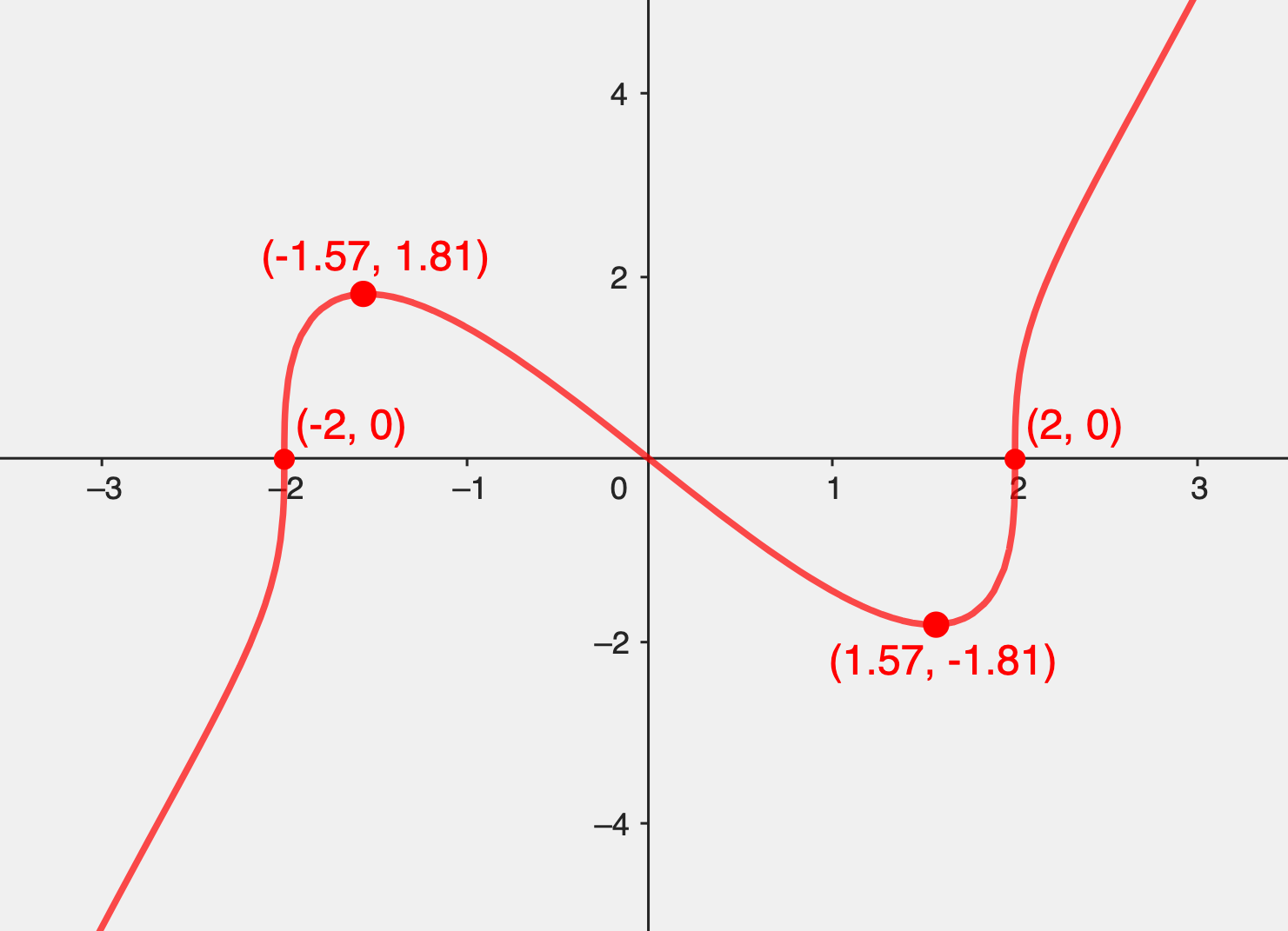
In the previous example, the two critical numbers where the derivative did not exist ended up not being relative extrema. Don't read too much into this, as they often will be relative extrema. Check out Example 11 in the Minimum and Maximum Values section to see an example of one such critical point.
The next two examples are other applications of the ideas from this section.
Suppose that the elevation above sea level of a road is given by the following function:
$$E(x) = 500 + \cos\left(\frac{x}{4}\right) + \sqrt{3}\sin\left(\frac{x}{4}\right)$$where $x$ is in miles. Assume that if $x$ is positive, we are to the east of the initial point of measurement, and if $x$ is negative, we are to the west of the initial point of measurement.
If we start 25 miles to the west of the initial point of measurement and drive until we are 25 miles east of the initial point, for how many miles of the drive were we driving up an incline?
This question is really just asking us to find the intervals of increase and decrease for the function on the interval $[-25,25].$ So, we first need the derivative of the function:
$$E'(x) = -\frac14\sin\left(\frac{x}{4}\right) + \frac{\sqrt{3}}{4}\cos\left(\frac{x}{4}\right)$$Setting this equal to zero gives
\begin{align*} -\frac14\sin\left(\frac{x}{4}\right)+ \frac{\sqrt{3}}{4}\cos\left(\frac{x}{4}\right) &= 0\\ \frac{\sqrt{3}}{4}\cos\left(\frac{x}{4}\right) &= \frac14\sin\left(\frac{x}{4}\right)\\ \tan\left(\frac{x}{4}\right) &= \sqrt{3}\\ \end{align*}The solutions to this equation (and hence the critical numbers) over the interval $(-\infty,\infty)$ are
$$\begin{array}{lcl} \frac{x}{4} \approx 1.0472 + 2\pi n, n=0, \pm 1, \pm 2, ... & & x\approx 4.1888 + 8\pi n, n=0, \pm 1, \pm 2, ...\\ &\Rightarrow &\\ \frac{x}{4} \approx 4.1888 + 2\pi n, n=0, \pm 1, \pm 2, ... & & x\approx 16.7552 + 8\pi n, n=0, \pm 1, \pm 2, ...\\ \end{array}$$Among these, there are four that fall in the interval $[-25,25].$ Their approximate values are (and you should check this!)
$$-20.9439, -8.3775, 4.1888, 16.7552$$Here is the number line with the critical values, test values and results:
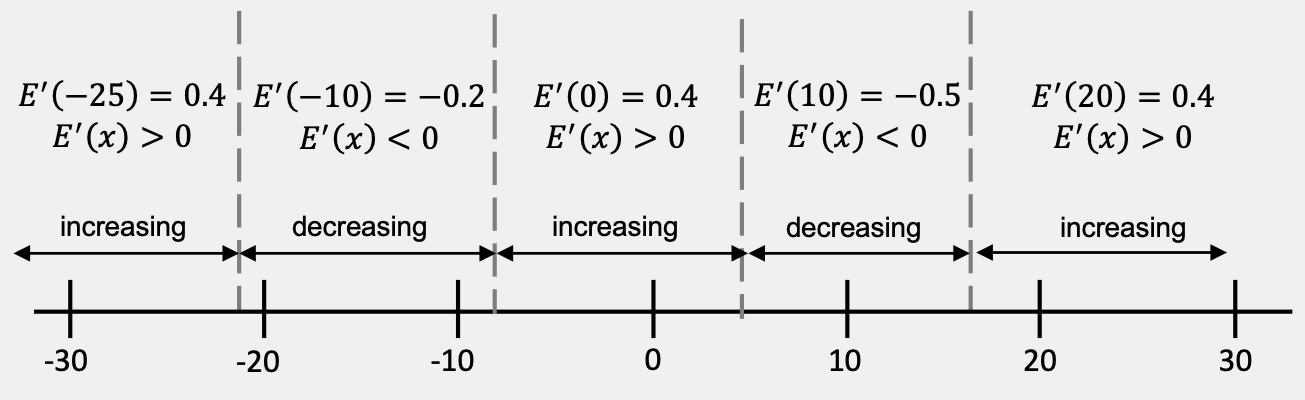
So we have the following intervals of increase and decrease:
$$\require{bbox} \bbox[2pt,border:2px solid green]{\begin{array}{rl} \text{Increase:} & -25\lt x\lt -20.9439, -8.3775\lt x\lt 4.1888, 16.7552\lt x\lt 25\\ \text{Decrease:} & -20.9439\lt x\lt -8.3775, 4.1888\lt x\lt 16.7552 \end{array}}$$Notice that we ended the intervals at $-25$ and $25,$ since we limited our investigation to the closed interval $[-25,25]$ and cannot really say anything about the function outside of this interval.
Even though we weren't asked to do so, we can now easily classify the critical points in the interval $[-25,25]$ using the First Derivative Test. We have relative minima at $x\approx-8.3775$ and $x\approx 16.7552$, and relative maxima at $x\approx -20.9439$ and $x\approx 4.1888.$
To answer the question that was asked, we just need the combined lengths of the intervals of increase. So the total number of miles for which we drove on an incline is
\begin{align*} \text{Distance} &\approx (-20.9439 - (-25)) + (4.1888 - (-8.3775)) + (25 - 16.7552)\\ &\approx 24.8652 \text{ miles}\\ \end{align*}The population of rabbits (in hundreds) after $t$ years in a certain area is given by the following function:
$$P(t) = t^2\ln(3t) + 6$$Determine whether the population ever decreases in the first two years.
To answer this question, we just need the intervals of increase and decrease in the time interval $(0,2].$ Note that the function is not defined at $t=0$, so we do not include that endpoint in the interval.
In Example 6 of the Critical Points section, we found the derivative of this function to be $$P'(t) = t(2\ln(3t)+1)$$ and that the only critical number is $$t=\frac{1}{3\sqrt{\text{e}}}\approx 0.202.$$
Since the derivative is continuous for $t\gt 0,$ we know that it can only change sign at the critical number. Here is the number line, with the test points and conclusions for this function:
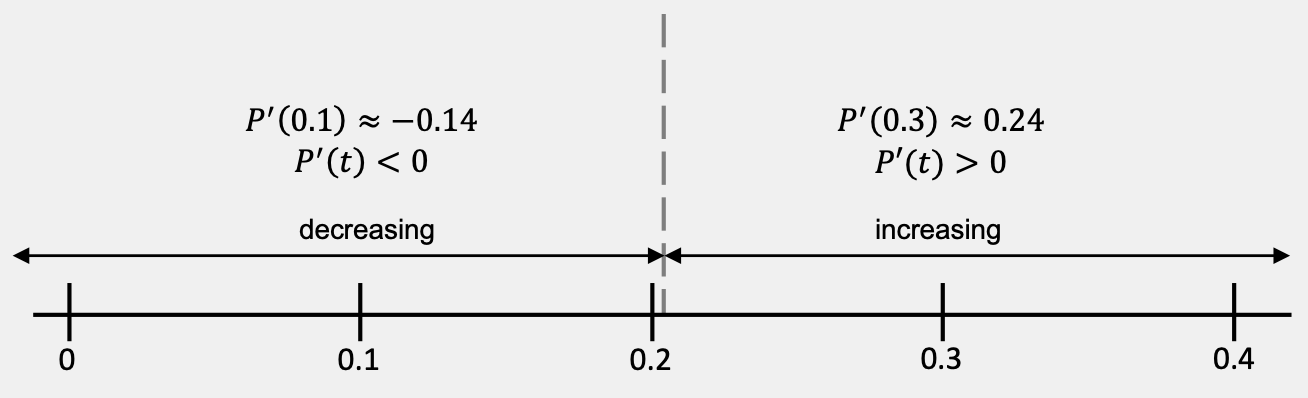
So the population will decrease for a short period (about two and a half months), then will increase forever after that.
Also, we can see that this critical point is a relative minimum.
In this section, we have seen how the first derivative can be used to gain information about the shape of the graph of a function, and how we can use increasing/decreasing information to determine the location of relative extrema using the First Derivative Test. Information about where a function is increasing or decreasing is extremely useful in many contexts, as we will see.
Practice Problems
In problems 1 and 2, use the given graph to determine the intervals on which the function increases and those on which it decreases.


Below is the graph of the derivative of a function. Use the graph to determine the intervals on which the function increases and those on which it decreases.
Suppose that $f(x)$ is a function that exists everywhere, and suppose that the know the following information about its derivative:
$$\begin{array}{lcccc} f'(-5)=0 & f'(-2) = 0 & f'(4) = 0 & f'(8) = 0 &\\ f'(x)\lt 0 & \text{on} & (-5,-2), & (-2,4), & (8,\infty)\\ f'(x)\gt 0 & \text{on} & (-\infty,-5), & (4,8) &\\ \end{array}$$ Find the following information:- Identify the critical numbers of the function.
- Determine the intervals on which the function is increasing and those on which it's decreasing.
- Classify each critical point as a relative minimum, a relative maximum or neither.
Let's first recall the definition of a critical number: A critical number is any value of the independent variable at which the function exists and the derivative is either zero or does not exist.
We are given that the function exists everywhere, which means that every potential critical number we find is actually a critical number.
Looking at the given information about the derivative, we see that the derivative is either zero, positive or negative for every $x$. That is, the derivative exists for all real numbers.
So the critical numbers of the function are all the $x$ values at which the derivative is zero.
Therefore, the critical numbers of this function are
$$\require{bbox} \bbox[2pt,border:2px solid green]{x=-5, x=-2, x=4, x=8}$$By definition, the function is increasing on any interval where the derivative is positive and is decreasing on the intervals where the derivative is negative. This information is clearly listed in the given information. $$\require{bbox} \bbox[2pt,border:2px solid green]{\text{Increasing: } (-\infty,-5)\hspace{.1in} \& \hspace{.1in}(4,8) \hspace{.5in} \text{Decreasing: } (-5,-2), (-2,4), \hspace{.1in}\& \hspace{.1in} (8,\infty)}$$
Recall the First Derivative Test: a critical point is a relative maximum if the function is increasing to its left and decreasing to its right, and it is a relative minimum if the derivative is decreasing to its left and increasing to its right.
We can then use the increasing/decreasing information we listed above in part (b) to classify the critical points. The easiest way to see the changes from increasing to decreasing, etc is on a number line:

So we can classify the critical points as follows:
$$\require{bbox} \bbox[2pt,border:2px solid green]{\begin{array}{ll} x=-5: & \text{Relative Maximum}\\ x=-2: & \text{Neither}\\ x=4: & \text{Relative Minimum}\\ x=8: & \text{Relative Maximum}\\ \end{array}}$$
There really isn't much to this problem. We can see on the graph that it is increasing on the intervals $(-3,1)$ and $(7,\infty),$ and decreasing on the intervals $(-\infty, -3)$ and $(1,7).$
There really isn't much to this problem. We can see on the graph that it is increasing on the intervals $(-\infty,1), (4,8)$ and $(8,\infty),$ and decreasing on the interval $(1,4).$ Note that the function is constant at $x=8,$ which is why we did not include $x=8$ in the interval of increase.

We have to be careful not to do this problem as we did the first two. The given graph is the graph of the derivative of a function and not the function itself. So, we don't want to just state the intervals on which the given graph is increasing or decreasing.
Instead we need to recall that the sign of the derivative is what tells us whether the function is increasing or decreasing. If the derivative is positive (i.e. its graph is above the $x$-axis), then the function is increasing. If the derivative is negative (i.e. its graph is below the $x$-axis), then the function is decreasing. At the places where the derivative is zero, the function is constant (so neither increasing nor decreasing).
The intervals of increase and decrease for the original function are then
$$\require{bbox} \bbox[2pt,border:2px solid green]{\begin{array}{rl} \text{Increase:} & -7\lt x\lt -2, -2\lt x\lt 5\\ \text{Decrease:} & -\infty\lt x\lt -7, 5\lt x\lt \infty \end{array}}$$Again, we note that since the derivative is zero at $x=-7, x=-2$, and $x=5,$ the function is neither increasing nor decreasing at those points and these values are not included in the stated intervals.
For problems 5 - 12, do each of the following:
- Identify the critical numbers of the function.
- Determine the intervals on which the function is increasing and the intervals on which it is decreasing.
- Use the First Derivative Test to classify each critical point as a relative minimum, relative maximum or neither.
$f(x) = 2x^3-9x^2-60x$
$h(t) = 50+40t^3-5t^4-4t^5$
$y=2x^3-10x^2+12x-12$
$p(x)=\cos(3x)+2x$ on $\left[-\frac32,2\right]$
$R(z) = 2-5z-14\sin\left(\frac{z}{2}\right)$ on $[-10,7]$
$h(t) = t^2 \sqrt[3]{t-7}$
$f(w) = w\text{e}^{2-\frac12 w^2}$
$g(x) = x-2\ln(1+x^2)$
For some function $f(x),$ it is known that there is a relative maximum at $x=4.$ Answer each of the following questions about this function.
- What is the simplest form for the derivative of this function? Note: There are many possible forms of the derivative, so to make the rest of this problem as easy as possible, you will want to use the simplest form of the derivative that you can come up with.
- Using your answer to part (a), determine the most general form of the function $f(x).$
- Given that $f(4)=1,$ find a specific function that will have a relative maximum at $x=4.$ Note: You should be able to use your answer from (b) to do this part.
As we noted above, there are many (many!) forms the derivative can take, and this can make the problem seem very difficult. But we are looking for the simplest form of the derivative, so we will keep things as simple as possible.
The first thing we'll do is assume that the derivative exists everywhere. Making assumptions in math is usually a bad idea, but in this case, we're just looking for a starting point. If we are not able to find a derivative that exists everywhere and has a relative maximum at $x=4,$ then we will go back and change this assumption. For now, though, let's see where this leads us.
Recall what Fermat's Theorem says: if there is a relative extremum at $x=c$ and if the derivative exists at $x=c$, then $x=c$ is a critical number of $f.$ For us, this means that since we assumed the derivative exists at $x=4$ and we know that there is a relative maximum at $x=4,$ then $x=4$ has to be a critical number of the function. This is one of the reasons we assumed that the derivative exists everywhere.
Now, Fermat's Theorem also tells us that $f'(4)=0$ because $x=4$ is a critical number and the derivative exists at $x=4.$ So we're looking for a function that has a zero at $x=4.$ Again, there are a lot of these, but the simplest is probably $$f'(x) = x-4$$
Is this the derivative we need? Unfortunately, no. While it is true that $f'(4)=0,$ it is also the case that when $x<4,$ $f'(x)<0$ and when $x>4,$ $f'(x)>0.$ (We can check this with test points on either side of $x=4:$ $f'(3) = -1,$ and $f'(5) = 1,$ for example.) This means that the function with this derivative has a relative minimum at $x=4,$ and not a relative maximum as we need.
Lucky for us, though, this is pretty straightforward to fix. The problem is that the signs of the derivative are the opposite of what we need them to be on either side of $x=4.$ To switch these signs, we just multiply the function by $-1.$ So we have $$f'(x) = 4-x$$
For this function, it is still true that $f'(4)=0,$ but now $f'(x)>0$ when $x<4,$ and $f'(x)<0$ when $x>4.$ So there is a relative maximum at $x=4,$ as required.
As noted above, there are many possible answers to this question. We will be working with the one given above in the next two parts. However, here is a sampling of some of the other derivative functions that come from a function with a relative maximum at $x=4.$
$$\begin{array}{ll} f'(x) = 16-x^2 & f'(x) = 24+18x-6x^2\\ f'(x) = \text{e}^{4-x}-1 & f'(x) = \sin(2\pi - \pi x)\\ \end{array}$$After working the rest of this problem with $f'(x) = 4-x,$ you might want to come back and see if you can repeat the problem with one or more of these functions.
In part (a), we chose the derivative function $f'(x) = 4-x.$ Our job now is to "undo" the differentiation to determine the general form of the function that has $4-x$ as its derivative.
Before doing this, let's recall some of the derivative rules. First, let's recall the power rule: $$\frac{d}{dx}(x^n) = nx^{n-1}$$
When we take the derivative of a power function, the power decreases by one. So, what would the original function need to be for its derivative to be just $x$? Well, since the exponent on the derivative is $1,$ the exponent on the original function needs to be $2.$ However, since the derivative of $x^2$ is $2x,$ if we want the result to be just $x,$ we also need to multiply by $\frac12.$ In other words, if we differentiate $\frac12 x^2,$ the result is $x.$
Now recall that $$\frac{d}{dx}(kx) = k$$
So, in order to have $4$ in the derivative, there needs to be a $4x$ in the original function.
When we put these two together, we see that if $$f(x) = 4x-\frac12 x^2,$$ then $$f'(x) = 4-x.$$
So $f(x) = 4x-\frac12 x^2$ is one function whose derivative is $4-x.$ This is not the most general possible such function, though. Recall that the derivative of a constant is zero, so we can add any constant to this function and create a different function with the same derivative.
Since any specific constant that we add will give us a function with the same derivative, the general form of the function with derivative $4-x$ is $$f'(x) = 4x-\frac12 x^2 +c,$$ where the "$c$" stands for any constant.
Our answer to part (b) is a family of functions, all of which have a relative maximum at $x=4.$ What we need to do now is choose the one member of this family that takes on the value $1$ when $x=4.$ That is, if we substitute $x=4$ into the function, we want the result to be one.
So we'll substitute $x=4$ into our answer from part (b) and set the result equal to $1.$ This will result in an equation that we can then solve for $c.$ Here is the work for this part:
\begin{align*} 1 &= f(4) = 4(4) - \frac12 (4)^2 +c = 8+c\\ 1 &= 8+c\\ &\Rightarrow c = -7\\ \end{align*}So one function that has a relative maximum at $x=4$ and for which $f(4) = 1$ is $$f(x) = 4x-\frac12 x^2 -7$$
Here is the graph of this function, where we can see that it does have a relative maximum at $(4,1).$

Suppose that $f(x)$ and $g(x)$ are functions that are increasing everywhere. Define $h(x) = f(x) + g(x)$ and show that $h(x)$ is also increasing everywhere.
Let $f(x)$ be a function that is increasing everywhere and define $h(x) = [f(x)]^2.$ Will $h(x)$ also be an increasing function? If yes, prove that $h(x)$ is increasing everywhere. If not, can you determine any other conditions needed on the function $f(x)$ that will guarantee that $h(x)$ will also be increasing?
Solution to (a)
First we find the derivative and simplify it:
$$f'(x) = 6x^2-18x-60 = 6(x^2-3x-10) = 6(x-5)(x+2)$$This derivative is a polynomial and therefore it exists everywhere. So we find the critical numbers by setting the derivative equal to zero and solving for $x.$ Doing this, we find:
$$\require{bbox} \bbox[2pt,border:2px solid green]{x=-2, x=5}$$Solution to (b)
Since the derivative is continuous, we can test values to either side of each critical number to determine the sign of the derivative on each interval. Here is the number line:

From this, we find the following increasing/decreasing information for the function:
$$\require{bbox} \bbox[2pt,border:2px solid green]{\text{Increasing: } (-\infty,-2), (5,\infty) \hspace{.5in} \text{Decreasing: } (-2,5)}$$Solution to (c)
Let's add the increasing/decreasing information to the number line:

And now we can use the First Derivative Test to classify the critical points as follows:
$$\require{bbox} \bbox[2pt,border:2px solid green]{\begin{array}{ll} x=-2:& \text{Relative Maximum}\\ x=5: & \text{Relative Minimum}\\ \end{array}}$$Solution to (a)
First we find the derivative and simplify it:
$$h'(t) = 120t^2-20t^3-20t^4 = -20t^2(t^2+t-6) =-20t^2(t+3)(t-2)$$This derivative is a polynomial and therefore it exists everywhere. So we can find the critical numbers by setting the derivative equal to zero and solving for $t.$ Doing this, we find:
$$\require{bbox} \bbox[2pt,border:2px solid green]{t=-3, t=0, t=2}$$Solution to (b)
Since the derivative is continuous, we can test values to either side of each critical number to determine the sign of the derivative on each interval. Here is the number line:

From this, we find the following increasing/decreasing information for the function:
$$\require{bbox} \bbox[2pt,border:2px solid green]{\text{Increasing: } (-3,0), (0,2) \hspace{.5in} \text{Decreasing: } (-\infty,-3), (2,\infty)}$$Solution to (c)
Let's add the increasing/decreasing information to the number line:
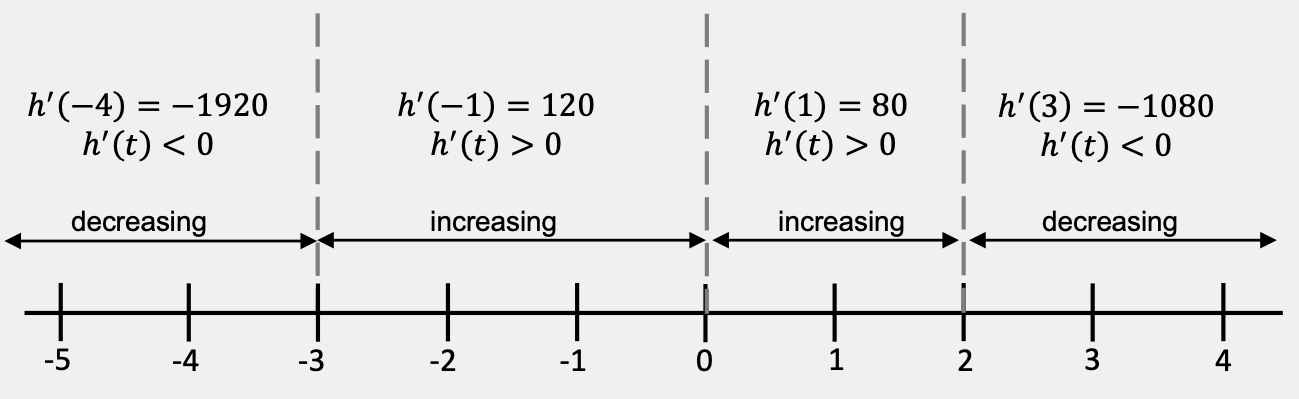
And now we can use the First Derivative Test to classify the critical points as follows:
$$\require{bbox} \bbox[2pt,border:2px solid green]{\begin{array}{ll} t=-3:& \text{Relative Minimum}\\ t=0: & \text{Neither}\\ t=2: & \text{Relative Maximum}\\ \end{array}}$$Solution to (a)
We need the first derivative to find the critical numbers, so let's find that first. The resulting quadratic doesn't factor, so we just have
$$\frac{dy}{dx} = 6x^2-20x+12=2(3x^2-10x+6)$$This derivative is a polynomial and therefore it exists everywhere. So we can find the critical numbers by setting the derivative equal to zero and solving for $x.$ Doing this with the quadratic formula, we find:
$$\require{bbox} \bbox[2pt,border:2px solid green]{x=\frac{5\pm\sqrt{7}}{3}\Rightarrow x\approx 0.78475, x\approx 2.54858}$$Solution to (b)
Since the derivative is continuous, we can test values to either side of each critical number to determine the sign of the derivative on each interval. Here is the number line:
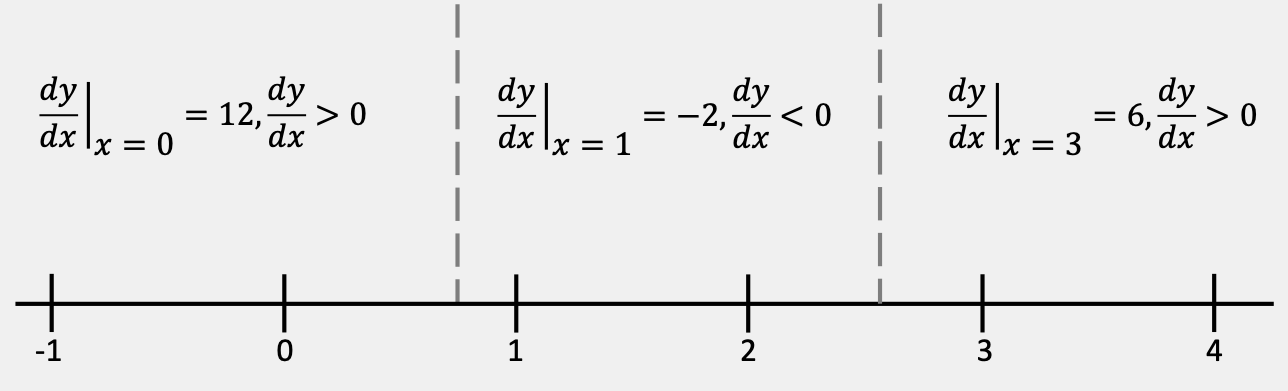
From this, we find the following increasing/decreasing information for the function:
$$\require{bbox} \bbox[2pt,border:2px solid green]{\text{Increasing: } \left(-\infty,\frac{5-\sqrt{7}}{3}\right), \left(\frac{5+\sqrt{7}}{3},\infty\right) \hspace{.5in} \text{Decreasing: } \left(\frac{5-\sqrt{7}}{3},\frac{5+\sqrt{7}}{3}\right)}$$Solution to (c)
Let's add the increasing/decreasing information to the number line:
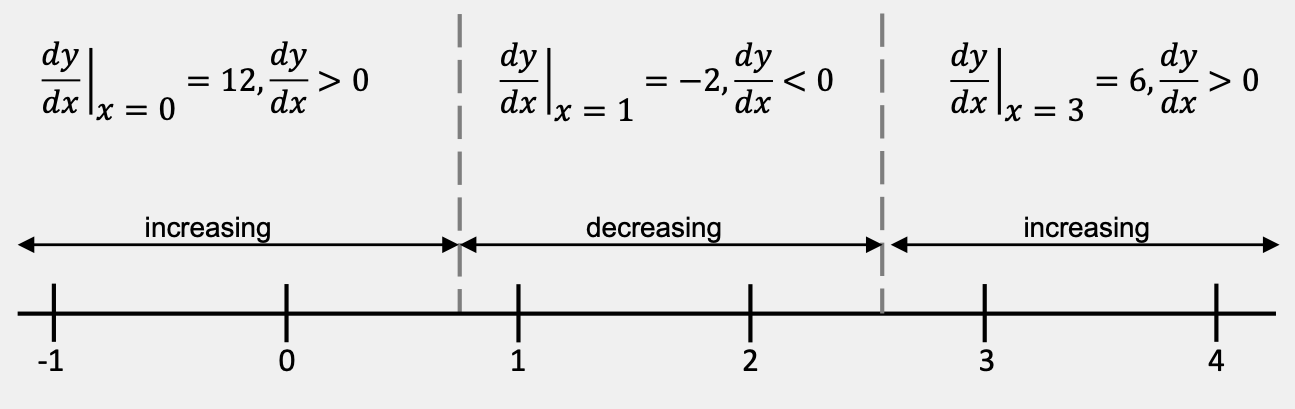
And now we can use the First Derivative Test to classify the critical points as follows:
$$\require{bbox} \bbox[2pt,border:2px solid green]{\begin{array}{ll} x=\frac{5-\sqrt{7}}{3}\approx 0.78475:& \text{Relative Maximum}\\ x=\frac{5+\sqrt{7}}{3}\approx 2.54858: & \text{Relative Minimum}\\ \end{array}}$$Solution to (a)
To find the critical numbers, we need the derivative, so let's do that first.
$$p'(x) = -3\sin(3x)+2$$Since the sine function exists everywhere, this derivative also exists everywhere. So we can find the critical numbers by setting the derivative equal to zero and solving for $x.$ For this function, we need to use the unit circle to find the first two solutions of the trigonometric equation $$\sin(3x) = \frac23.$$ Then we can write the set of all solutions:
$$\begin{array}{ll} x\approx 0.2432 +\frac{2\pi}{3}n & \\ & n=0,\pm 1, \pm 2, \pm 3, ...\\ x\approx 0.8040 + \frac{2\pi}{3}n &\\ \end{array}$$Substituting values of $n$ until we isolate the solutions that fall within the interval, we find the following three critical numbers:
$$\require{bbox} \bbox[2pt,border:2px solid green]{x\approx -1.2904, x\approx 0.2432, x\approx 0.8040}$$Solution to (b)
Since the derivative is continuous, we can test values to either side of each critical number to determine the sign of the derivative on each interval. Here is the number line:

From this, we find the following increasing/decreasing information for the function:
$$\require{bbox} \bbox[2pt,border:2px solid green]{\text{Increasing: } (-1.2904, 0.2432), (0.8040,2] \hspace{.5in} \text{Decreasing: } [-3/2, -1.2904), (0.2432,0.8040)}$$Be careful with the endpoints of these intervals! Since we are working on the interval $\left[-\frac32,2\right],$ we cannot say anything about what happens outside of this interval.
Solution to (c)
Let's add the increasing/decreasing information to the number line:
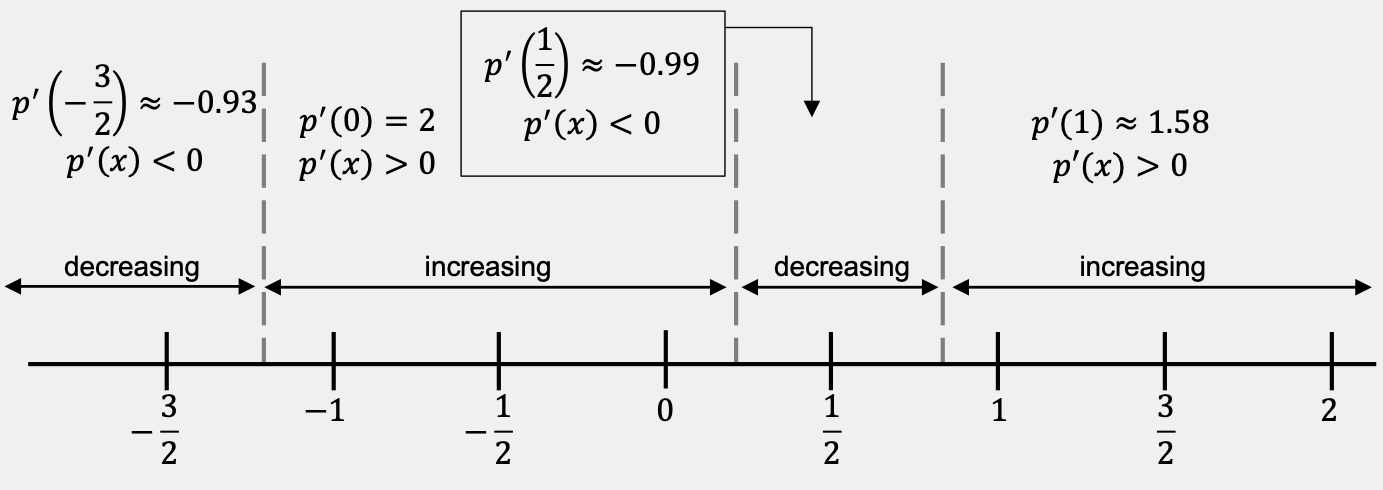
And now we can use the First Derivative Test to classify the critical points as follows:
$$\require{bbox} \bbox[2pt,border:2px solid green]{\begin{array}{ll} x\approx -1.2904:& \text{Relative Minimum}\\ x\approx 0.2432: & \text{Relative Maximum}\\ x\approx 0.8040: & \text{Relative Minimum}\\ \end{array}}$$As in the part (b), we need to keep in mind that we are only working on the interval $\left[-\frac32,2\right].$ The classifications given here are only for the critical points whose $x$-coordinate falls in the interval. There are, of course, an infinite number of critical points outside of this interval, and each of them could be classified as a relative maximum, relative minimum or neither, provided that we do the work required to apply the First Derivative Test for each one of them.
Solution to (a)
To find the critical numbers, we need the derivative, so let's do that first.
$$R'(z) = -5-7\cos\left(\frac{z}{2}\right)$$Since the cosine function exists everywhere, this derivative also exists everywhere. So we can find the critical numbers by setting the derivative equal to zero and solving for $z.$ For this function, we need to use the unit circle to find the first two solutions of the trigonometric equation $$\cos\left(\frac{z}{2}\right)=-\frac57.$$ Then we can write the set of all solutions:
$$\begin{array}{ll} z\approx 4.7328 +4\pi n & \\ & n=0,\pm 1, \pm 2, \pm 3, ...\\ z\approx 7.8336 + 4\pi n &\\ \end{array}$$Substituting values of $n$ until we isolate the solutions that fall within the interval, we find the following three critical numbers:
$$\require{bbox} \bbox[2pt,border:2px solid green]{z\approx -7.8336, z\approx -4.7328, z\approx 4.7328}$$Solution to (b)
Since the derivative is continuous, we can test values to either side of each critical number to determine the sign of the derivative on each interval. Here is the number line:
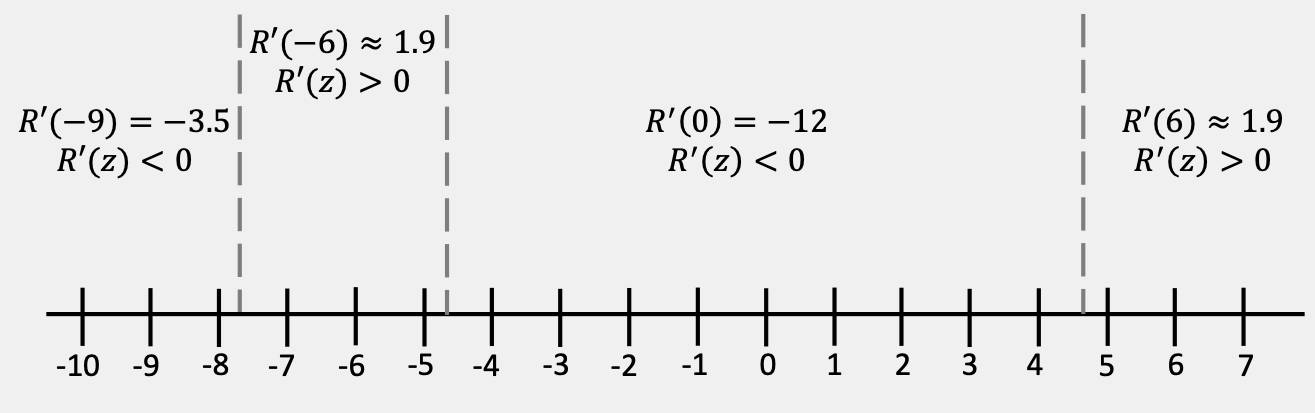
From this, we find the following increasing/decreasing information for the function:
$$\require{bbox} \bbox[2pt,border:2px solid green]{\text{Increasing: } (-7.8336,-4.7328), (4.7328,7] \hspace{.5in} \text{Decreasing: } [-10,-7.8336), (-4.7328,4.7328)}$$Be careful with the endpoints of these intervals! Since we are working on the interval $[-10,7],$ we cannot say anything about what happens outside of this interval.
Solution to (c)
Let's add the increasing/decreasing information to the number line:

And now we can use the First Derivative Test to classify the critical points as follows:
$$\require{bbox} \bbox[2pt,border:2px solid green]{\begin{array}{ll} z\approx -7.8336:& \text{Relative Minimum}\\ z\approx -4.7328: & \text{Relative Maximum}\\ z\approx 4.7328: & \text{Relative Minimum}\\ \end{array}}$$As in part (b), we need to keep in mind that we are only working on the interval $[-10,7].$ The classifications given here are only for the critical points whose $z$-coordinate falls in the interval. There are, of course, an infinite number of critical points outside of this interval, and each of them could be classified as a relative maximum, relative minimum or neither, provided that we do the work required to apply the First Derivative Test for each one of them.
Solution to (a)
First we find the derivative and simplify it:
\begin{align*} h'(t) &= 2t(t-7)^{\frac13} + t^2 \left(\frac13\right) (t-7)^{-\frac23} = 2t(t-7)^{\frac13}+\frac{t^2}{3(t-7)^{\frac23}}\\ &= \frac{6t(t-7)+t^2}{3(t-7)^{\frac23}} = \frac{7t^2-42t}{3(t-7)^{\frac23}}=\frac{7t(t-6)}{3(t-7)^{\frac23}}\\ \end{align*}First note that the function is defined for all values of $t.$ Now recall that critical numbers occur at numbers in the domain of the function where the derivative is zero or does not exist. Since we simplified the derivative as much as possible, we can clearly see that the derivative does not exist at $t=7$ and that the derivative equals zero at $t=0$ and $t=6.$ And since the function is defined at all of these values, these are the critical numbers.
$$\require{bbox} \bbox[2pt,border:2px solid green]{t=0, t=6, t=7}$$Solution to (b)
Since the derivative can only change sign at a critical number, we can test values to either side of each critical number to determine the sign of the derivative on each interval. Here is the number line:

From this, we find the following increasing/decreasing information for the function:
$$\require{bbox} \bbox[2pt,border:2px solid green]{\text{Increasing: } (-\infty,0), (6,7), (7,\infty) \hspace{.5in} \text{Decreasing: } (0,6)}$$Solution to (c)
Let's add the increasing/decreasing information to the number line:

And now we can use the First Derivative Test to classify the critical points as follows:
$$\require{bbox} \bbox[2pt,border:2px solid green]{\begin{array}{ll} t=0:& \text{Relative Maximum}\\ t=6: & \text{Relative Minimum}\\ t=7: & \text{Neither}\\ \end{array}}$$Solution to (a)
First we find the derivative and simplify it:
$$f'(w) = \text{e}^{2-\frac12w^2} - w^2\text{e}^{2 - \frac12w^2} = \text{e}^{2-\frac12w^2}(1-w^2) = \text{e}^{2-\frac12w^2}(1-w)(1+w)$$Because we simplified the derivative as much as possible, we can see that it exists for all $w$ (it is the product of functions that exist everywhere). So we find the critical numbers by setting the derivative equal to zero and solving for $w.$ Doing this, we find:
$$\require{bbox} \bbox[2pt,border:2px solid green]{w=-1,w=1}$$Solution to (b)
Since the derivative is continuous, we can test values to either side of each critical number to determine the sign of the derivative on each interval. Here is the number line:
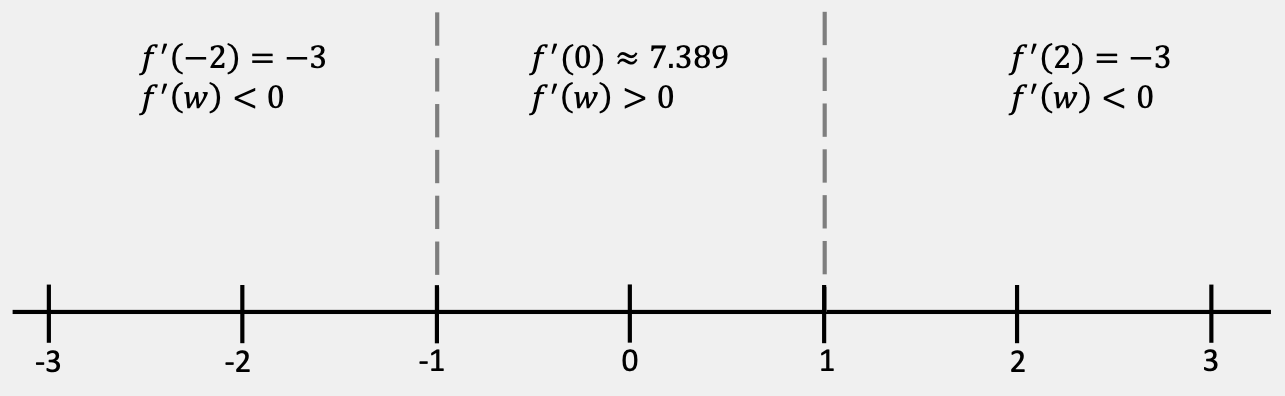
From this, we find the following increasing/decreasing information for the function:
$$\require{bbox} \bbox[2pt,border:2px solid green]{\text{Increasing: } (-1,1) \hspace{.5in} \text{Decreasing: } (-\infty,-1), (1,\infty)}$$Solution to (c)
Let's add the increasing/decreasing information to the number line:

And now we can use the First Derivative Test to classify the critical points as follows:
$$\require{bbox} \bbox[2pt,border:2px solid green]{\begin{array}{ll} w=-1:& \text{Relative Minimum}\\ w=1: & \text{Relative Maximum}\\ \end{array}}$$Solution to (a)
First we find the derivative and simplify it:
$$g'(x) = 1-2\frac{2x}{1+x^2}=\frac{1-4x+x^2}{1+x^2}$$Recall that critical numbers are the numbers in the domain of the function where the derivative either doesn't exist or equals zero. Because we simplified the derivative as much as possible, we can see clearly that the derivative exists everywhere (because the denominator is not zero for any real numbers). So the only critical numbers are values at which the derivative is zero. Using the quadratic formula to find where the numerator is zero, we find the critical numbers to be
$$\require{bbox} \bbox[2pt,border:2px solid green]{x=2\pm \sqrt{3} \Rightarrow x\approx 0.2679, x\approx 3.7321}$$Solution to (b)
Since the derivative can only change sign at its critical numbers, we can test values to either side of each critical number to determine the sign of the derivative on each interval. Here is the number line:

From this, we find the following increasing/decreasing information for the function:
$$\require{bbox} \bbox[2pt,border:2px solid green]{\text{Increasing: } (-\infty,0.2679), (3.7321,\infty) \hspace{.5in} \text{Decreasing: } (0.2679, 3.7321)}$$Solution to (c)
Let's add the increasing/decreasing information to the number line:
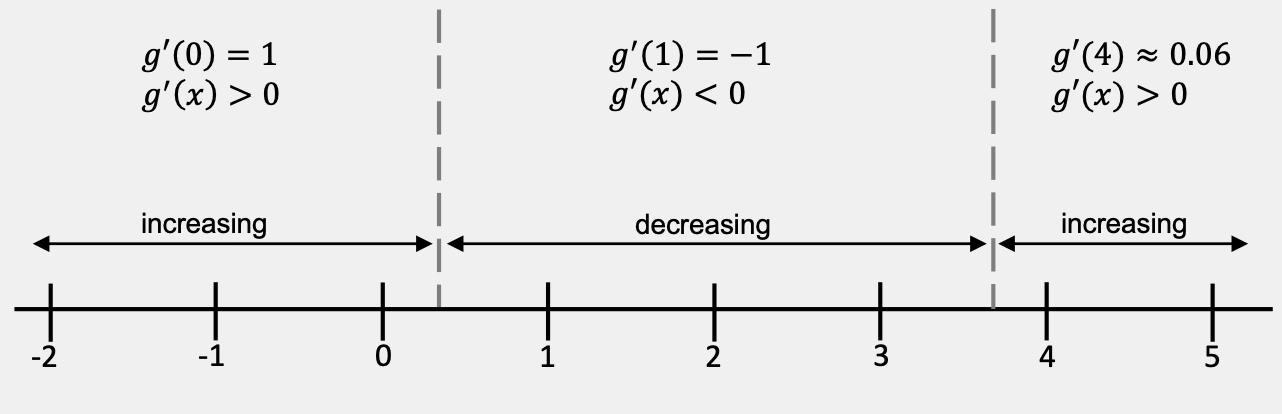
And now we can use the First Derivative Test to classify the critical points as follows:
$$\require{bbox} \bbox[2pt,border:2px solid green]{\begin{array}{ll} x=2-\sqrt{3}\approx 0.2679:& \text{Relative Maximum}\\ x=2+\sqrt{3}\approx 3.7321: & \text{Relative Minimum}\\ \end{array}}$$The important thing to remember here is the connection between increasing behavior and the derivative: if a function is increasing, then its derivative is positive and if the derivative of a function is positive, then the function is increasing.
We have used this connection in many examples already to determine where a given function is increasing. But here we only have the names of functions, we don't know what any of the functions are. That doesn't mean that we can't write down a formula for $h'(x),$ though. Since $$h(x) = f(x) + g(x),$$ we can say that $$h'(x) = f'(x) + g'(x)$$ using the sum/difference rule of derivatives.
We also know that $f(x)$ and $g(x)$ are both increasing functions, so we can say that $f'(x)>0$ and $g'(x)>0$ for all values of $x.$
So $h'(x)$ is the sum of two functions that are always positive. Since the sum of two positive numbers is also a positive number, this means that $$h'(x)>0$$ for all $x$ as well.
Therefore, $h(x)$ is an increasing function.
Figuring out how to approach a problem like this can be fairly daunting, especially when the statement we are being asked to show seems fairly obvious to us, as is the case here. Intuitively, the sum of two increasing functions should be increasing. The problem is that we need to prove that this is true and not just say, "well, it makes sense, so it must be true."
What we want to discuss here is not the argument itself (that is given above), but the thought process that went into constructing the argument. So if you haven't read the solution to this problem yet, do that before continuing to read this discussion.
The first step is to really look at what we are being asked to show. This means not just reading the statement, but reading the statement and relating what we are being asked to prove to something we already know.
In this case, we are being asked to show that a general function is increasing. What we already know is how to show that a specific function is increasing by showing that its derivative is positive.
This leads us to write the derivative of the general function, $h(x)$ in this case. We used a rule of derivatives to do this.
At this point, we have a formula for the derivative and we know we need to show that it is positive. So we need to think about the information we were given. Assumptions that are given are given for a reason. What do the assumptions tell us? How can we relate them to what we are being asked to prove?
In this problem, the given information told us that the derivatives of $f$ and $g$ were positive. And in this problem, it wasn't particularly difficult to relate this given information to what we needed to show. In other problems this may take some work, though.
At this point, what we have done is work "backwards" from what we need to show to arrive at a concrete goal: show that $h'(x)>0.$ We have also worked "forwards" from what we were given to state two facts that we can use: $f'(x)>0$ and $g'(x)>0.$
Finally, we need to put these two processes together. Again, for this problem, it wasn't particularly difficult, we just needed to remember that if two numbers are positive, then their sum is also positive.
But this is often a fairly tricky step. If you haven't had a lot of practice reading and writing "mathematical logic/proofs," it can be daunting to put all of the information together. Often you will need to try various ways to make connections between what is given and what needs to be shown before something "clicks" and you see how to proceed. You may also need to go back to the previous step and see if there is something about the assumptions that you may have missed.
The key thing to remember is to be patient and persevere. Try not to become discouraged if something you try doesn't work. You may have to back up and try something different. Also, don't become so wrapped up in the process that you forget to take breaks occasionally. If you run into roadblocks, then step away for a while and come back to it later. Sometimes this is all it takes to get a fresh idea.
Another thing that students often have difficulty with at first is in writing down statements and facts mathematically so that they can be manipulated and connected to other statements. In your mind, you may be able to see all the logic involved in the proof, but don't see how to write it down. If that's the case, the best thing to do is to just start writing things down without worrying yet about how they will all connect.
For instance, you may know that you need the derivative of a function, so write that down. If you don't have a specific function to differentiate, can you at least symbolically write the derivative as we did here?
Look at all the "characters" and write down what you know about them, whether you can see how to use the information yet or not. For example, we needed the fact that $f'(x)>0,$ so we wrote that down. Even if you don't end up using the thing you wrote, it can really help with the process. Once you have everything written down where you can see it, you will be more likely to see how to make connections and express them with words or equations in order to prove what you want to prove.
We need to decide whether $h(x)$ is increasing or not, so we need its derivative. Don't worry about the fact that we don't know what function $f(x)$ is. We can write the derivative of $h$ symbolically using the chain rule, as follows:
$$h'(x) = 2[f(x)]^1f'(x) = 2f(x)f'(x)$$A function is increasing if its derivative is positive, so the question we need to answer is: does the fact that $f(x)$ is increasing guarantee that $h'(x)>0$?
The given assumption that $f(x)$ is increasing can be expressed as $f'(x)>0.$
Now let's see what $h'(x)$ tells us. We see that $h'(x)$ is the product of a number and two functions. Since the number two is positive, the sign of $h'(x)$ comes from the signs of $f(x)$ and $f'(x).$
By the hypothesis that $f$ is increasing, we know that $f'(x)$ is positive. However, this does not guarantee that the product is always positive. For that, we need to know that $f(x)$ itself is positive.
For example, consider $f(x) = x.$ Clearly, $f'(x) = 1>0,$ and $f(x)$ is an increasing function. Now, $f(x)f'(x) = (x)(1) = x.$ But $x$ is not always positive, so the product $f(x)f'(x)$ is not always positive. Hence, we may not conclude in this example that $h(x)$ is an increasing function. In fact, given that $f(x) = x,$ we have $$h(x) = [f(x)]^2 = x^2$$ which is not increasing everywhere.
On the other hand, if we let $f(x) = \text{e}^x$, we have $f'(x) = \text{e}^x>0,$ so $f$ is always increasing. Now $h'(x) = f(x)f'(x) = (\text{e}^x)(\text{e}^x) = \text{e}^{2x} >0$. So in this case, $h(x)$ is also an increasing function everywhere.
From these two examples, we see that we can find increasing functions $f(x)$ for which $[f(x)]^2$ may or may not be increasing.
What is the difference between these two examples?
In the first example, $f(x) = x$ is not always positive, so the product $f(x)f'(x)$ is not always positive. In the second example, though, the function $f(x) = \text{e}^x$ is always positive and so the product of the function and its derivative is also always positive.
This is the condition that we need in order to guarantee that $h(x)$ will be increasing.
Here is a statement, then, that we can show is true:
If $f(x)$ is a function that is increasing and positive for all $x,$ then the function $h(x) = [f(x)]^2$ is an increasing function.
Assignment Problems
For problems 1 - 4, the graph of a function is given. For each function, determine the intervals on which it increases and the intervals on which it decreases.
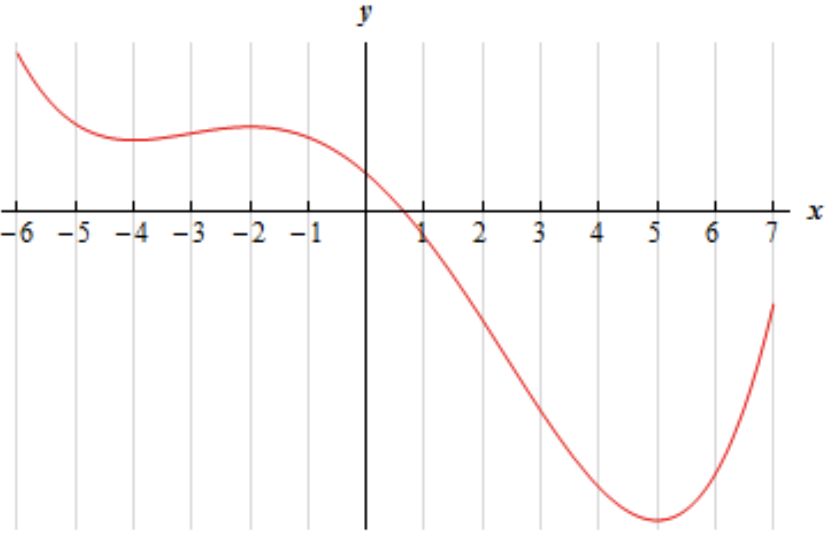


For problems 5 - 7, the graph of the derivative of a function is given. Use this graph to determine the intervals on which the function is increasing and the intervals on which it is decreasing.

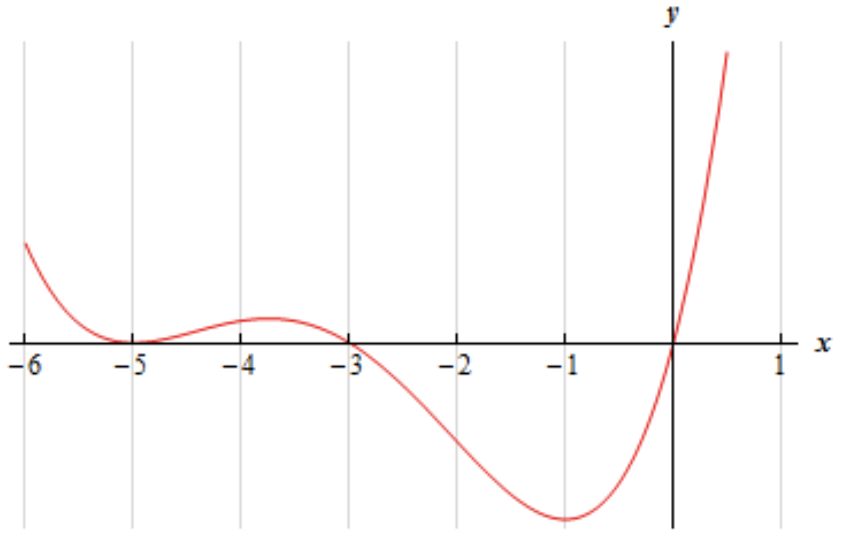
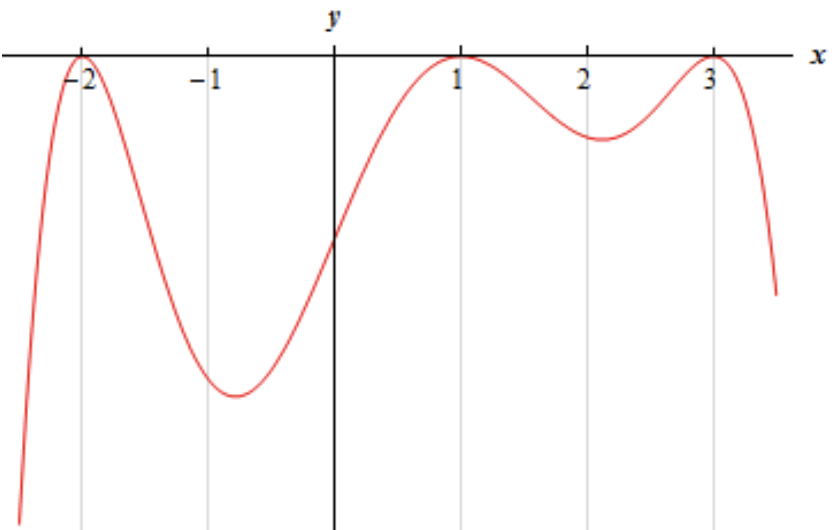
In problems 8 - 10, information about the derivative of a function is given. Use this information to find the following information about each function:
- Identify the critical numbers of the function.
- Determine the intervals on which the function increases and those on which it decreases.
- Use the First Derivative Test to classify each critical point as a relative minimum, a relative maximum or neither.
$f'(1) = 0 \hspace{.25in} f'(3) = 0 \hspace{.25in} f'(8) = 0$
$f'(x) \lt 0 \hspace{.2in} \text{on} \hspace{.2in} (-\infty,1), (3,8)$
$f'(x)\gt 0 \hspace{.2in} \text{on} \hspace{.2in} (1,3), (8,\infty)$
$g'(-2) = 0 \hspace{.25in} g'(0) = 0 \hspace{.25in} g'(3) = 0 \hspace{.25in} g'(6)=0$
$g'(x) \lt 0 \hspace{.2in} \text{on} \hspace{.2in} (0,3), (6,\infty)$
$g'(x)\gt 0 \hspace{.2in} \text{on} \hspace{.2in} (-\infty,-2), (-2,0), (3,6)$
$h'(-1) = 0 \hspace{.25in} h'(2) = 0 \hspace{.25in} h'(5) = 0$
$h'(x) \lt 0 \hspace{.2in} \text{on} \hspace{.2in} (-\infty,-1), (-1,2)$
$h'(x)\gt 0 \hspace{.2in} \text{on} \hspace{.2in} (2,5), (5,\infty)$
For each of the functions in problems 11 - 28, find the following information:
- Identify the critical numbers of the function.
- Determine the intervals on which the function increases and those on which it decreases.
- Use the First Derivative Test to classify each critical point as a relative minimum, a relative maximum or neither.
- $f(t) = t^3-15t^2+63t+3$
- $g(x) = 20+8x^2+4x^3-x^4$
- $Q(w) = 8w^3-18w^2-24w-10$
- $f(x) = x^5+\frac54x^4-20x^3-7$
- $P(x) = 5-4x-9x^2-3x^3$
- $R(z) = z^5+z^4-6z^3+5$
- $h(z) = 1-12z^2-9z^3-2z^4$
- $Q(t) = 7-t+\sin(4t)$ on $\left[-\frac32,\frac32\right]$
- $f(z) = 6z-20\cos\left(\frac{z}{2}\right)$ on $[0,22]$
- $g(x) = 24\cos\left(\frac{x}{3}\right)+8x+2$ on $[-30,25]$
- $h(w) = 9w-5\sin(2w)$ on $[-5,0]$
- $h(x) = \sqrt[5]{x}(x+7)$
- $W(z) = (10-z^2)(z+2)^{\frac23}$
- $f(t) = (t^2-8)\sqrt[3]{t^2-4}$
- $f(x) = \text{e}^{\frac13x^3-x^2-3x}$
- $h(z) = (z^2-8)\text{e}^{3-z}$
- $A(t) = \ln(t^2+5t+8)$
- $g(x) = x-3+\ln(1+x+x^2)$
- What is the minimum degree of a polynomial that has exactly one relative extremum?
- What is the minimum degree of a polynomial that has exactly two relative extrema?
- What is the minimum degree of a polynomial that has exactly three relative extrema?
- What is the minimum degree of a polynomial that has exactly $n$ relative extrema?
- For some function $f(x),$ it is known that there is a relative minimum at $x=-4.$ Answer each of the following questions about this function.
- What is the simplest form for the derivative of this function? Note: There are many possible forms of the derivative, so to make the rest of this problem as easy as possible, you will want to use the simplest form of the derivative that you can come up with.
- Using your answer to part (a), determine the most general form that the function $f(x)$ can take.
- Given that $f(-4)=6,$ find a specific function that will have a relative minimum at $x=-4.$ Note: There are many possible answers here. Just give one of them.
- For some function $f(x),$ it is known that there is a relative maximum at $x=-1.$ Answer each of the following questions about this function.
- What is the simplest form for the derivative of this function? Note: There are many possible forms of the derivative, so to make the rest of this problem as easy as possible, you will want to use the simplest form of the derivative that you can come up with.
- Using your answer to part (a), determine the most general form that the function $f(x)$ can take.
- Given that $f(-1)=3,$ find a specific function that will have a relative maximum at $x=-1.$ Note: There are many possible answers here. Just give one of them.
- For some function $f(x),$ it is known that there is a critical point at $x=3$ that is neither a relative minimum nor a relative maximum. Answer each of the following questions about this function.
- What is the simplest form for the derivative of this function? Note: There are many possible forms of the derivative, so to make the rest of this problem as easy as possible, you will want to use the simplest form of the derivative that you can come up with.
- Using your answer to part (a), determine the most general form that the function $f(x)$ can take.
- Given that $f(3)=2,$ find a specific function that will have a critical point at $x=3$ that is neither a relative maximum nor a relative minimum. Note: There are many possible answers here. Just give one of them.
- For some function $f(x),$ it is known that there is a relative maximum at $x=1$ and a relative minimu at $x=4.$ Answer each of the following questions about this function.
- What is the simplest form for the derivative of this function? Note: There are many possible forms of the derivative, so to make the rest of this problem as easy as possible, you will want to use the simplest form of the derivative that you can come up with.
- Using your answer to part (a), determine the most general form that the function $f(x)$ can take.
- Given that $f(1)=6$ and $f(4)=-2,$ find a specific function that will have a relative maximum at $x=1$ and a relative minimum at $x=4.$ Note: There are many possible answers here. Just give one of them.
- Suppose that $f(x)$ and $g(x)$ are both functions that are increasing everywhere. Does $h(x) = f(x)-g(x)$ have to be an increasing function as well? If so, prove that $h(x)$ is increasing everywhere. If not, find increasing functions $f(x)$ and $g(x)$ such that $h(x)$ is a decreasing function, and then find a different pair of increasing functions $f(x)$ and $g(x)$ for which $h(x)$ is an increasing function.
- Let $f(x)$ be a function that is increasing everywhere. There are several possible conditions that we can impose on $g(x)$ so that $h(x) = f(x) - g(x)$ is also an increasing function. Find as many of these possible conditions as you can.
- Determine a set of conditions on a function $f(x)$, different from those given in $\#15$ in the practice problems, for which $h(x) = [f(x)]^2$ will be an increasing function.
- Give one condition on a function $f(x)$ for which $h(x) = [f(x)]^3$ will be an increasing function.
- Let $f(x)$ and $g(x)$ be positive functions. Determine a set of conditions on them for which $h(x) = f(x)g(x)$ will be an increasing function. Note: There are several possible sets of conditions that will work here, but try to find the least complicated set of conditions.
- Repeat problem 38 for $h(x)maximum = \displaystyle\frac{f(x)}{g(x)}.$
- Given that $f(x)$ and $g(x)$ are increasing functions, prove that $h(x) = f(g(x))$ is also an increasing function.