The Mean Value Theorem
Click here for a printable version of this section
In the last two sections, we saw several theorems about the shapes of graphs whose proofs needed the Mean Value Theorem. The Mean Value Theorem provides the connection between the derivative (which at heart is a physical concept, the rate of change of a function) and applications of the derivative to geometry (the shape of graphs). It is one of the major theorems of calculus.
Before we can state and prove the Mean Value Theorem, we need to look at another theorem, called Rolle's Theorem.
Note: The following content is adapted from OpenStax and is licensed under a Creative Commons Attribution-NonCommercial-ShareAlike 4.0 International License.
Access for free at https://openstax.org/books/calculus-volume-1/pages/1-introduction.

Rolle's Theorem
Informally, Rolle's Theorem states that if the outputs of a differentiable function $f$ are equal at the endpoints of an interval, then there must be a point $c$ in the interior of the interval where $f'(c) = 0.$ The figures below illustrate this theorem.

Rolle's Theorem
Let $f$ be a function that is continuous over the closed interval $[a,b]$ and differentiable over the open interval $(a,b).$ Also suppose that $f(a) = f(b).$ Then there exists at least one number $c$ with $a\lt c\lt b$ such that $f'(c) = 0.$
Suppose that $f(x)$ is a function that satisfies the conditions given in the statement of the theorem. Let $k = f(a) = f(b).$
The function is either constant on the entire interval, or it is not. If it is not constant, then at some point in the interval, there is a $d$ at which $f(d)\neq k.$ In this case, either $f(d)\gt k$ or $f(d)\lt k.$ Thus we see that there are three cases to consider.
Case 1: If $f(x) = k$ for all $x\in (a,b),$ then the graph of $f(x)$ is a horizontal line and $f'(x)=0$ for all $x\in (a,b).$ We can take $c$ to be any number in the interval $(a,b).$
Case 2: There is some number $d$ in $(a,b)$ such that $f(d)\gt k.$
Since $f$ is a continuous function over the closed, bounded interval $[a,b],$ by the Extreme Value Theorem, it has an absolute maximum. Also, since there is a number $d \in (a,b)$ such that $f(d)\gt k,$ the absolute maximum value is greater than $k.$ Therefore, the absolute maximum does not occur at either endpoint of the interval. As a result, the absolute maximum must occur at an interior point $c\in (a,b).$
Because $f$ has a maximum at an interior point $c,$ and $f$ is differentiable at $c,$ by Fermat's Theorem, $f'(c) = 0.$
Case 3: There is some number $d$ in $(a,b)$ such that $f(d)\lt k.$
This case is analogous to Case 2, with "maximum" replaced by "minimum."
An important point about Rolle's theorem is that the differentiability of the function $f$ is critical. If $f$ is not differentiable, even at a single point, the result may not hold. For example, the function $f(x) = |x| - 1$ is continuous over the interval $[-1,1]$ and $f(-1) = 0 = f(1),$ but $f'(c)\neq 0$ for all $c\in (-1,1).$ In other words, there is no point on the graph at which the tangent line is horizontal. This is shown in the following figure:

Notice that the theorem only states that some value $c$ exists, but does not tell us what that number is. Let's now consider functions that satisfy the conditions of Rolle's theorem and calculate explicitly the points $c$ where $f'(c) = 0.$
For each of the following functions, verify that the function satisfies the criteria stated in Rolle's theorem and find all values $c$ in the given interval where $f'(c)=0.$
- $f(x) = x^2 + 2x$ over $[-2,0]$
- $f(x) = x^3-4x$ over $[-2,0]$
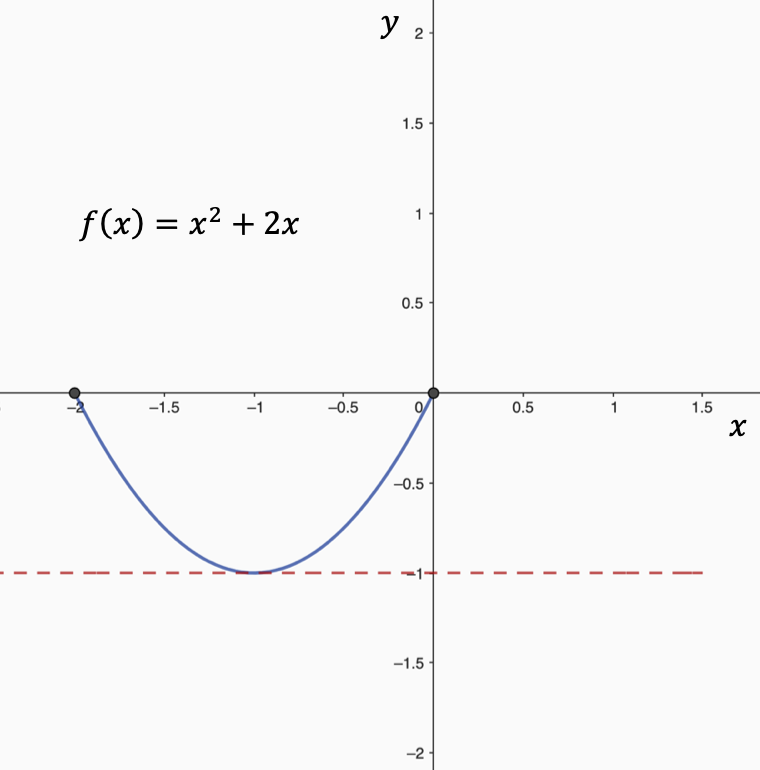
Since $f$ is a polynomial, it is continuous and differentiable everywhere. In addition, $f(-2) = 0 = f(0).$ Therefore, $f$ satisfies the criteria of Rolle's theorem. We conclude that there exists at least one value $c\in(-2,0)$ such that $f'(c) = 0.$
Since $f'(x) = 2x+2 = 2(x+1),$ we see that $f'(c) = 2(c+1)=0$ implies that $c = -1.$ This is shown in the graph below.
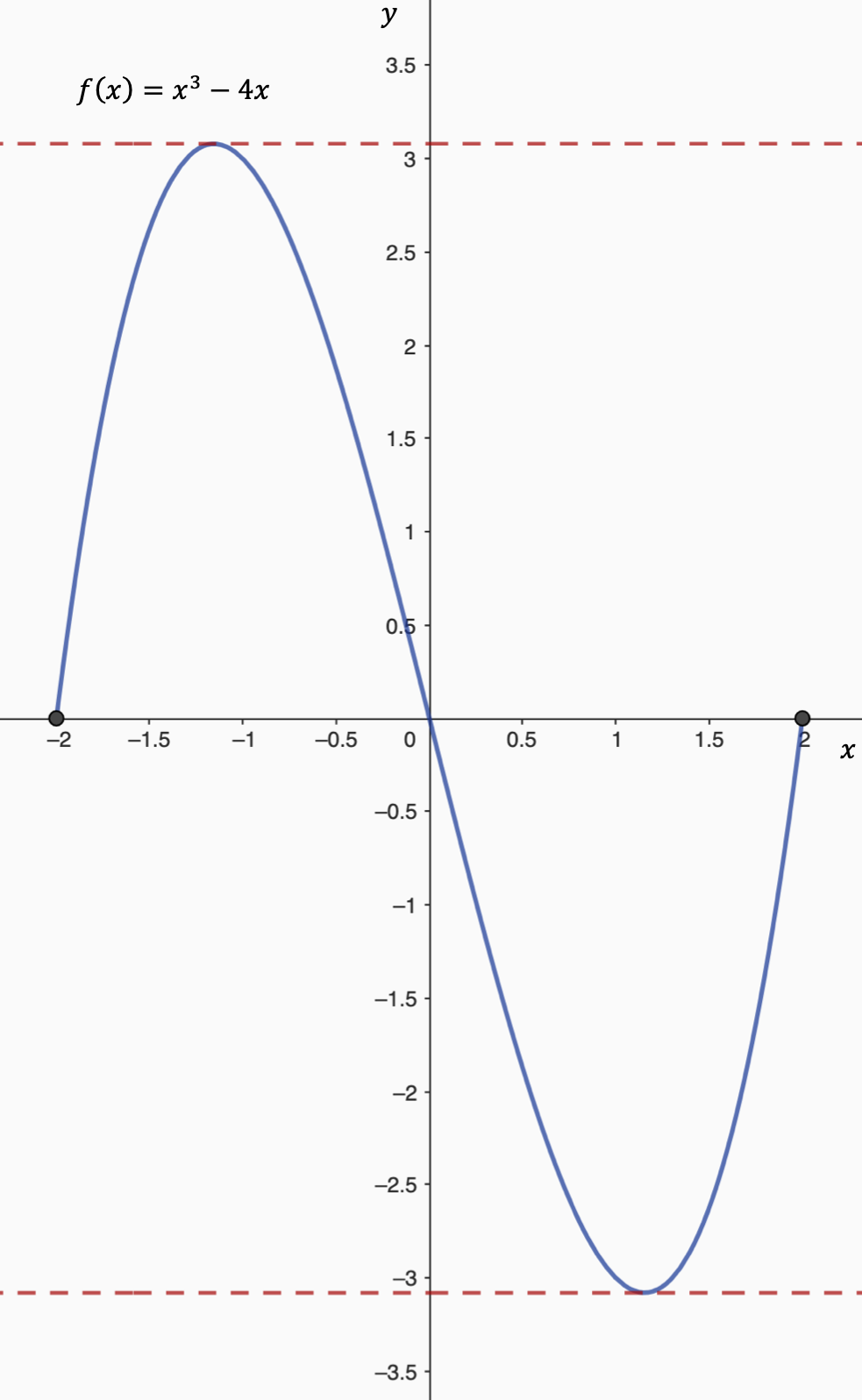
As in part a, $f$ is a polynomial and is therefore continuous and differentiable everywhere. Also, $f(-2)=0=f(2).$ That said, $f$ satisfies the criteria of Rolle's theorem.
Differentiating, we find that $f'(x) = 3x^2-4.$ Therefore, $f'(c)=0$ when $x=\pm\frac{2}{\sqrt{3}}$.
Both values are in the interval $[-2,2],$ and therefore both numbers satisfy the conclusion of Rolle's theorem as shown in the graph below.
Note: The following content is adapted from Paul's Online Math Notes, with permission, and is not shared under the Creative Commons license.
Show that $f(x) = 4x^5 + x^3 + 7x -2$ has exactly one real root.
Using a principle from algebra (called the Fundamental Theorem of Algebra), we know that since $f(x)$ is a $5$th degree polynomial, it will have five roots. We are being asked to show that only one of those roots is a real number (meaning that the other four must be complex numbers).
First, we need to show that the function has at least one real root. To do this, note that $f(0) = -2$ and $f(1) = 10.$ So we can see that $f(0) \lt 0\lt f(1).$ Now, because $f(x)$ is a polynomial, we know that it is continuous everywhere, and so by the Intermediate Value Theorem there is a number $c$ such that $0\lt c\lt 1$ and $f(c) = 0.$ In other words, $f(x)$ has at least one real root.Now we need to show that this is in fact the only real root. To do this, we will use an argument style that is called "proof by contradiction." We will assume that $f(x)$ has two real roots. This means that we can find real numbers $a$ and $b$ (there might be more, but all we need for this argument is two) such that $f(a) = f(b) = 0.$ But if we do this, then Rolle's Theorem tells us that there must be some number $c$ between $a$ and $b$ such that $f'(c) = 0.$
This is a problem, though. The derivative of this function is $$f'(x) = 20x^4 + 3x^2 + 7$$ Now because the exponents on the first two terms of $f'(x)$ are even and their coefficients are positive, the first two terms must always be greater than or equal to zero. Adding $7$ then means that $f'(x)$ is never less than $7.$ But this contradicts the statement above that says there must be a number $c$ such that $f'(c) = 0.$
We reached these contradictory statements by assuming that $f(x)$ has at least two real roots. Since this assumption leads to a contradiction, the assumption must be false. Therefore, we conclude that $f(x)$ has at most one real root.
Combining the facts that $f(x)$ has at least one real root and that it has at most one real root, we have shown that $f(x)$ has exactly one real root.
The Mean Value Theorem
The Mean Value Theorem is very similar to Rolle's theorem, but does not require that the function have equal value at the endpoints of the interval. So it allows us to consider functions over many more intervals. One reason we introduced Rolle's theorem is that it is needed in the proof of the Mean Value Theorem.
Mean Value Theorem
Suppose that $f$ is a function that is continuous over the closed interval $[a,b]$ and differentiable over the open interval $(a,b).$ Then there is at least one number $c$ such that $a\lt c\lt b$ and $$f'(c) = \frac{f(b)-f(a)}{b-a}.$$ Or $$f(b)-f(a) = f'(c)(b-a).$$
For illustration purposes, let's suppose that the graph of $f$ is the one shown below.

The graph of $f$ may not look exactly like this, but the sketch gives us something to refer to that can make it easier to see what we're talking about in the proof.
The strategy in this proof is to define a new function $g(x)$ that is the difference between the function $f(x)$ and the secant line between the points $(a,f(a))$ and $(b,f(b)),$ and to show that $g$ satisfies the hypotheses of Rolle's Theorem. The conclusion of the Mean Value Theorem will then come from applying Rolle's Theorem to $g.$
So, the first thing we need is the equation of the secant line that passes through the two points $A = (a,f(a))$ and $B=(b,f(b))$ as shown in the sketch. Using the coordinates of the two points, we find that the slope of the secant line is $$m = \frac{f(b)-f(a)}{b-a}.$$ The equation of the secant line is then $$y=f(a) + \frac{f(b)-f(a)}{b-a}(x-a).$$
We now define the new function $g(x)$ as
\begin{align} g(x) &= f(x) - \left(f(a) + \frac{f(b)-f(a)}{b-a}(x-a)\right)\\ &= f(x) - f(a) - \frac{f(b)-f(a)}{b-a}(x-a)\\ \end{align}
Now $g(x)$ is the difference between $f(x),$ which we assumed to be continuous on $[a,b],$ and a linear function, which is continuous everywhere, so $g(x)$ must also be continuous on $[a,b].$
Similarly, since $f(x)$ is differentiable on $(a,b)$ and linear functions are differentiable everywhere, $g(x)$ is also differentiable on $(a,b).$
To verify the third hypothesis of Rolle's Theorem, we find $g(a)$ and $g(b):$
\begin{align} g(a) &= f(a) - f(a) - \frac{f(b)-f(a)}{b-a} (a-a) = f(a) - f(a) = 0\\ g(b) &= f(b) - f(a) - \frac{f(b) - f(a)}{b-a}(b-a) = f(b) - f(a) - (f(b) - f(a)) = 0\\ \end{align}We have established that $g(x)$ satisfies the three conditions of Rolle's Theorem, so we may conclude that there is a number $c$ such that $a\lt c\lt b$ and $$0=g'(c) = f'(c) - \frac{f(b)-f(a)}{b-a}.$$ This implies that $$f'(c) = \frac{f(b)-f(a)}{b-a},$$ which is what we set out to show.
The Mean Value Theorem may seem a bit abstract right now. We will see some applications of this theorem in the examples, but first let's think about what the theorem means geometrically.
Suppose $f$ is a function that satisfies the two hypotheses of the theorem, and define the points $A = (a,f(a))$ and $B = (b,f(b))$ to be the points on $f$ that correspond to the endpoints of the interval. The theorem says that there is a $c$ such that $a\lt c\lt b$ and that $$f'(c) = \frac{f(b)-f(a)}{b-a}.$$
Now, the secant line connecting the points $A$ and $B$ has slope $$\frac{f(b)-f(a)}{b-a}.$$ Also, from the definition of the derivative at a point, we know that the slope of the tangent line to the graph of $f$ at $x=c$ is $f'(c).$
What the Mean Value Theorem tells us is that these two slopes are equal, or that the secant line connecting $A$ and $B$ and the tangent line at $x=c$ must be parallel. We can see this in the following sketch.

Note: The following content is adapted from OpenStax and is licensed under a Creative Commons Attribution-NonCommercial-ShareAlike 4.0 International License.
Access for free at https://openstax.org/books/calculus-volume-1/pages/1-introduction.
It is also worth noting that the theorem guarantees at least one point on the graph where the tangent line is parallel to the secant line. There may be more than one such point, as shown in this sketch:

Note: The following content is adapted from Paul's Online Math Notes, with permission, and is not shared under the Creative Commons license.
Examples
Just as with Rolle's theorem, the Mean Value Theorem only tells us about the existence of the number $c.$ In this example, we will see how to find the value(s) of $c$ guaranteed by the theorem.
Given the function $f(x) = x^3 + 2x^2 - x.$
- Verify that the Mean Value Theorem applies to $f$ on the interval $[-1,2].$
- Find the average rate of change of $f$ on this interval. That is, find $$\frac{f(b)-f(a)}{b-a}.$$
- Determine all of the numbers $c$ that satisfy the conclusion of the theorem.
- Since $f$ is a polynomial, it is both continuous and differentiable everywhere, so the theorem applies to this function on any interval.
- To find the average rate of change of $f$ on this interval, we'll just substitute and simplify: $$\frac{f(b)-f(a)}{b-a} = \frac{f(2)-f(-1)}{3} = \frac{14 - 2}{3} = 4$$
- To find the number(s) that satisfy the conclusion of the theorem, we need to first find the derivative of $f.$
$$f'(x) = 3x^2+4x-1$$
To find $c$, we need to solve the quadratic equation $$3c^2+4c-1 = 4,$$ or $$3c^2+4c-5 = 0.$$ Using the quadratic formula, we find that $$c = \frac{-4\pm\sqrt{16-4(3)(-5)}}{6} = \frac{-4\pm\sqrt{76}}{6}.$$ Thus, there are two values of $c$:
$c=\frac{-4+\sqrt{76}}{c}\approx 0.7863\hspace{.5in} c=\frac{-4-\sqrt{76}}{6}\approx -2.1196$ Notice that only one of these is actually in the interval given in the problem. Excluding the second value, then, we have $$c\approx 0.7863.$$
Suppose that $f$ is differentiable (and therefore continuous) on the interval $[6,15].$ Let's also suppose that $f(6) = -2$ and that $f'(x)\leq 10.$ What is the largest possible value for $f(15)$?
Since $f$ satisfies the hypotheses of the Mean Value Theorem, we know that the conclusion of the theorem holds. So there is a number $c\in (6,15)$ such that $$f(15)-f(6) = f'(c)(15-6).$$ Rearranging and substituting the known values gives us $$f(15) = f(6)+f'(c)(15-6) = -2+9f'(c).$$ Now, we know that $f'(x)\leq 10,$ so $f'(c)\leq 10$ as well. This gives us
\begin{align*} f(15) &= -2+9f'(c)\\ &\leq -2+(9)10\\ &= 88\\ \end{align*}We replaced $f'(c)$ with its largest possible value, so $88$ is the largest possible value of $f(15).$
Suppose that $f$ is a function that is continuous and differentiable everywhere. Suppose also that $f$ has two roots. Show that $f'(x)$ must have at least one root.
Since we know that $f$ has two roots, let's call them $a$ and $b.$ Now, by assumption, $f$ is continuous and differentiable everywhere, so it is continuous on $[a,b]$ and differentiable on $(a,b).$
Therefore, by the Mean Value Theorem, there is a number $c$ between $a$ and $b$ such that $$f'(c) = \frac{f(b)-f(a)}{b-a}.$$ But since $a$ and $b$ are roots of $f,$ $f(a)=0$ and $f(b)=0.$ We then have $$f'(c) = \frac{0-0}{b-a} = 0.$$
In other words, $f'(x)$ has a root at $x=c.$
It is important to note that we don't have a value for $c,$ we have only shown that it exists. We also haven't said anything about $c$ being the only root. It is possible for $f'(x)$ to have more than one root.
It is possible to generalize the previous example significantly. For instance, if we know that $f$ is continuous and differentiable everywhere and that it has three roots, we can show that not only will $f'$ have at least two roots, but $f''$ will have at least one root. We will leave it to you to verify this, but the ideas involved are identical to those in the previous example.
Note: The following content is adapted from OpenStax and is licensed under a Creative Commons Attribution-NonCommercial-ShareAlike 4.0 International License.
Access for free at https://openstax.org/books/calculus-volume-1/pages/1-introduction.
The next example provides an application of the Mean Value Theorem to moving objects. For example, suppose that we drive a car for one hour down a straight road with an average velocity of $45$ mph. Let $s(t)$ and $v(t)$ denote the position and velocity of the car, respectively, for $0\leq t\leq 1.$ Assuming that the position function $s(t)$ is differentiable, we can apply the Mean Value Theorem to conclude that, at some time $c\in (0,1),$ the speed of the car was exactly
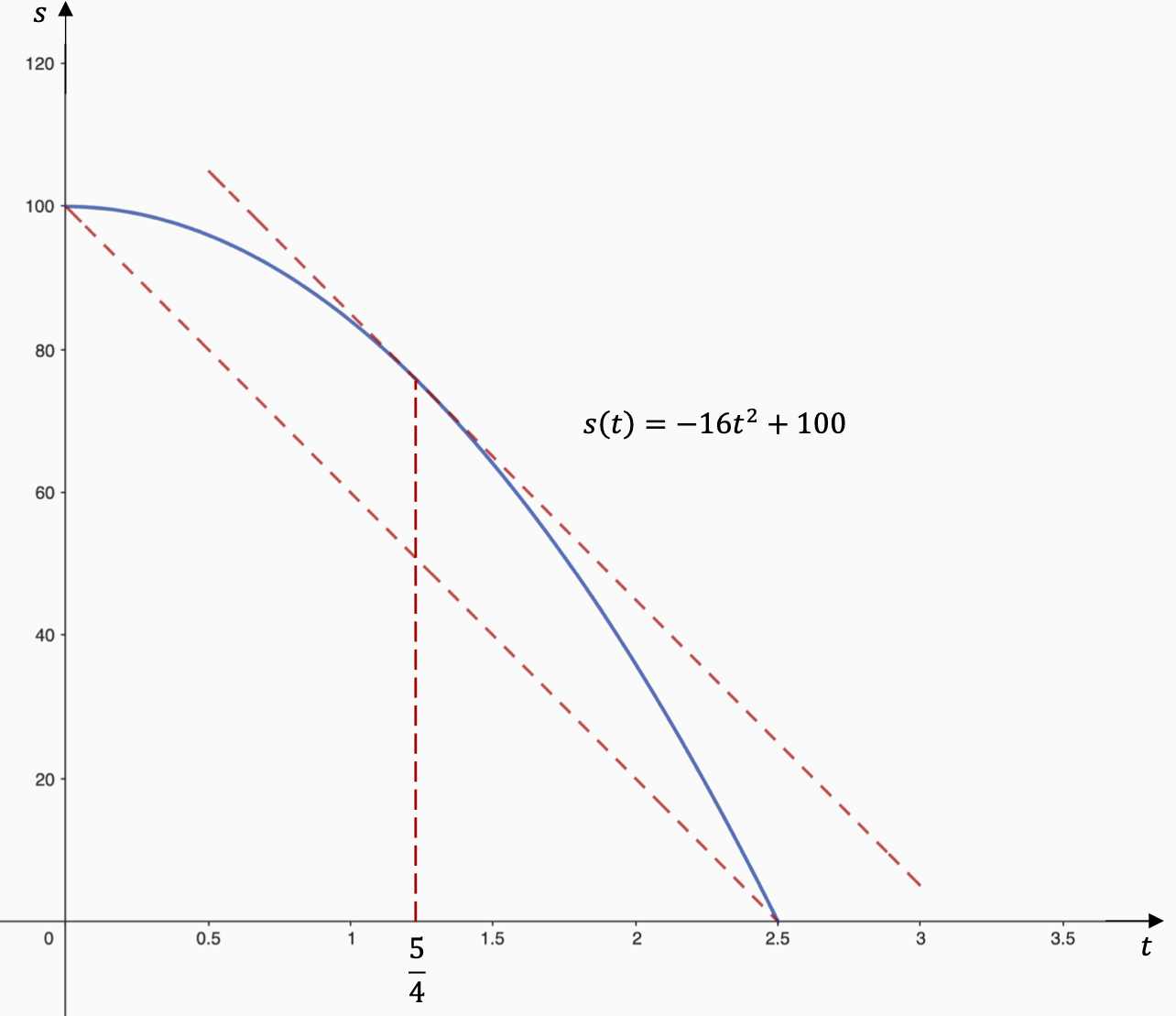
If a rock is dropped from a height of $100$ ft, its position $t$ seconds after it is dropped until it hits the ground is given by the function $s(t) = -16t^2+100.$
- Determine how long it takes before the rock hits the ground.
- Find the average velocity $v_{avg}$ of the rock over the interval between when the rock is released and when it hits the ground.
- Find the time $t$ guaranteed by the Mean Value Theorem at which the instantaneous velocity of the rock is $v_{avg}.$
- When the rock hits the ground, its position is $s(t) = 0.$ Solving the equation $$-16t^2+100=0$$ for $t,$ we find that $t=\pm\frac52$ seconds. Since in this problem we only consider $t\geq 0,$ the ball will hit the ground two and a half seconds after it is dropped.
- The average velocity is given by
$v_{avg} = \displaystyle\frac{s(5/2) - s(0)}{5/2 - 0} = \displaystyle\frac{0-100}{5/2} = -40$ ft/sec. The instantaneous velocity is given by the derivative of the position function. Therefore, we need to find a time $t$ such that $v(t) = s'(t) = v_{avg} = -40$ ft/sec. Since $s$ is continuous over the interval $\left[0,\frac52\right]$ and differentiable over the interval $\left(0,\frac52\right),$ by the Mean Value Theorem, there is guaranteed to be a number $c\in \left(0,\frac52\right)$ such that $$s'(c) =\frac{s(5/2)-s(0)}{5/2 - 0} = -40.$$ Taking the derivative of the position function $s,$ we find that $s'(t) = -32t.$ Therefore, the equation reduces to $s'(c) = -32c =-40.$ Solving this equation for $c,$ we have $c=\frac54.$
Therefore, $\frac54$ seconds after the rock is dropped, the instantaneous velocity equals the average velocity of the rock during its fall: $-40$ ft/sec.
Corollaries to the Mean Value Theorem
We are now going to look at three corollaries of the Mean Value Theorem. These results have important consequences, which we will use in upcoming sections.
At this point, we know that the derivative of any constant is zero. The Mean Value Theorem allows us to conclude that the converse of this statement is also true: if $f'(x)=0$ for all $x$ in some interval $I,$ then $f(x)$ is constant over that interval. This result may seem intuitively obvious, but it has important implications that are not obvious, and we will discuss these shortly.
Corollary 1: Functions with a Derivative of Zero
Let $f$ be a function that is differentiable over an interval $I.$ If $f'(x) = 0$ for all $x\in I,$ then $f(x)$ is constant for all $x\in I.$
Since $f$ is differentiable over $I,$ $f$ must be continuous over $I.$ Suppose that $f(x)$ is not constant for all $x$ in $I.$ Then there are $a,b\in I$ where $a\neq b$ and $f(a)\neq f(b).$ Since one of $a$ or $b$ is larger than the other (but it doesn't matter which), we choose the notation so that $a\lt b.$ Therefore,
$$\frac{f(b)-f(a)}{b-a}\neq 0.$$Since $f$ is a differentiable function, by the Mean Value Theorem, there exists $c\in (a,b)$ such that
$$f'(c) = \frac{f(b)-f(a)}{b-a}.$$Therefore, there is some $c$ in $I$ such that $f'(c)\neq 0,$ which contradicts the hypothesis that $f'(x) = 0$ for all $x\in I.$ See the assumption that $f(x)$ is not constant for all $x\in I$ led to a contradiction, this assumption is incorrect, and $f(x)$ is, in fact, constant for all $x$ in $I.$
Note that we previously proved this corollary as a theorem in a previous section. The proof above is slightly different.
Corollary 2: Constant Difference Theorem
If $f$ and $g$ are functions that are differentiable over an interval $I$ and $f'(x) = g'(x)$ for all $x\in I,$ then $f(x) = g(x) + C$ for some constant $C.$
Let $h(x) = f(x) - g(x).$ Then $h'(x) = f'(x) - g'(x) = 0$ for all $x\in I.$ By Corollary 1, there is a constant $C$ such that $h(x) = C$ for all $x\in I.$ Therefore, $f(x) = g(x) + C$ for all $x\in I.$
Corollary 3: Increasing and Decreasing Functions
Let $f$ be a function that is continuous over the closed interval $[a,b]$ and differentiable over the open interval $(a,b).$ Then
- If $f'(x)\gt 0$ for all $x\in (a,b),$ then $f$ is an increasing function over $[a,b].$
- If $f'(x)\lt 0$ for all $x\in (a,b),$ then $f$ is a decreasing function over $[a,b].$
Note that we previously proved this corollary as a theorem in a previous section. We give a slightly different proof of statement (i) here. The proof of statement (ii) can be done in a similar way.
Suppose that $f$ is not an increasing function on $I.$ Then there exist $a$ and $b$ in $I$ such that $a\lt b,$ but $f(a)\gt f(b).$ Since $f$ is a differentiable function over $I,$ by the Mean Value Theorem there exists $c\in (a,b)$ such that $$f'(c) = \frac{f(b)-f(a)}{b-a}.$$
Since $f(a) \gt f(b),$ we know that $f(b)-f(a)\lt 0.$ Also, $a\lt b$ tells us that $b-a\gt 0.$ We conclude that $$f'(c) = \frac{f(b)-f(a)}{b-a}\lt 0.$$
However, $f'(x)\gt 0$ for all $x\in I.$ This is a contradiction, and therefore $f$ must be an increasing function over $I.$
Note: The following content is adapted from Paul's Online Math Notes, with permission, and is not shared under the Creative Commons license.
Practice Problems
For problems 1 and 2, determine all the number(s) $c$ that satisfy the conclusion of Rolle's theorem for the given function and interval.
$f(x) = x^2-2x-8$ on $[-1,3]$
Before we can look for the number(s) $c$ that satisfy the conclusion of Rolle's theorem, we need to verify that the hypotheses of the theorem are satisfied.
The function is a polynomial, and polynomials are continuous and differentiable everywhere. So this function is continuous on $[-1,3]$ and differentiable on $(-1,3).$
Next, we see that $f(-1) = f(3) =-5$ by evaluating the function at these numbers.
Therefore, the conditions for Rolle's theorem are met.
It may seem a little silly to check conditions, but it is a good idea to get into the habit. If you are not in the habit of checking them, you could inadvertently use Rolle's theorem on a function on which it can't be used, and then get an incorrect answer.
Remember that to use any theorem, you have to first be sure that its conditions are met.
Now that we know that Rolle's theorem can be used, we need to take the derivative: $$f'(x) = 2x-2$$ and then solve $f'(c) = 0:$ $$2c-2 = 0 \Rightarrow c = 1.$$
We have found a single value, and it is in the interval So this is the value we want.
$$\require{bbox} \bbox[2pt,border:2px solid green]{c=1}$$$g(t) = 2t-t^2-t^3$ on $[-2,1]$
The first thing we need to do is verify that Rolle's theorem can be used here.
The function is a polynomial, and polynomials are continuous and differentiable everywhere. So this function is continuous on $[-2,1]$ and differentiable on $(-2,1).$
Next, evaluating the function at the two endpoints tells us that $g(-2) = g(1) = 0.$ So the three conditions for Rolle's theorem are met.
Next we need to take the derivative: $$g'(t) = 2-2t-3t^2$$ and then solve $g'(c) = 0$ for $c$: $$-3c^2-2c+2=0\Rightarrow c=\frac{1\pm\sqrt{7}}{-3}\approx -1.2153, 0.5486.$$
We have found two values, and they are both in the interval. So the values we want are $$\require{bbox} \bbox[2pt,border:2px solid green]{c=\frac{1\pm\sqrt{7}}{-3}\approx -1.2153, 0.5486}$$
For problems 3 and 4, determine all the number(s) $c$ that satisfy the conclusion of the Mean Value Theorem for the given function and interval.
$h(z) = 4z^3-8z^2+7z-2$ on $[2,5]$
Before we can find the value(s) of $c$ given by the conclusion of the Mean Value Theorem, we need to verify that the conditions of the theorem are met by this function.
The function is a polynomial, and polynomials are continuous and differentiable everywhere. So this function is continuous on $[2,5]$ and differentiable on $(2,5).$
Now that we know the hypotheses of the theorem are met, we may use the conclusion of the theorem, that there is at least one value $c$ in the interval for which $$h'(c) = \frac{h(b)-h(a)}{b-a}.$$
So the next step is to evaluate $h(2)$ and $h(5),$ and to find the derivative:
$$h(2) = 12 \hspace{.5in} h(5) = 333\hspace{1.5in} h'(z) = 12z^2-16z+7$$Now we substitute into the formula from the Mean Value Theorem and solve for $c$:
\begin{align*} 12c^2-16c+7 &= \frac{333-12}{5-2} = 107\Rightarrow 12c^2-16c-100=0\\ c&=\frac{2\pm\sqrt{79}}{3}\approx -2.2961, 3.6294\\ \end{align*}We found two values, but only the second one is in the interval. So that is the value we want.
$$\require{bbox} \bbox[2pt,border:2px solid green]{c=\frac{2+\sqrt{79}}{3}\approx 3.6294}$$$A(t) = 8t+\text{e}^{-3t}$ on $[-2,3]$
Before we can find the value(s) of $c$ given by the conclusion of the Mean Value Theorem, we need to verify that the conditions of the theorem are met by this function.
The function is the sum of a polynomial and an exponential function, and both of these types of function are continuous and differentiable everywhere. This means that the sum is also continuous and differentiable everywhere. So the function will be continuous on $[-2,3]$ and differentiable on $(-2,3).$
Now that we know the hypotheses of the theorem are met, we may use the conclusion of the theorem, that there is at least one value $c$ in the interval for which $$A'(c) = \frac{A(b)-A(a)}{b-a}.$$
So the next step is to evaluate $A(-2)$ and $A(3),$ and to find the derivative:
$$A(-2) = -16+\text{e}^{6} \hspace{.5in} A(3)=24+\text{e}^{-9}\hspace{1.5in} A'(t) = 8-3\text{e}^{-3t}$$Now we substitute into the formula from the Mean Value Theorem and solve for $c$:
\begin{align*} 8-3\text{e}^{-3c} &= \frac{24+\text{e}^{-9} - (-16+\text{e}^{6})}{3-(-2)}\approx -72.6857\\ 3\text{e}^{-3c}&\approx 80.6857\\ \text{e}^{-3c}&\approx 26.8952\\ -3c&\approx \ln(26.8952)\approx 3.29195\\ c&\approx -1.0973\\ \end{align*}We found a single value, and it is in the interval. So that is the value we want.
$$\require{bbox} \bbox[2pt,border:2px solid green]{c\approx -1.0973}$$
Note: The following content is adapted from OpenStax and is licensed under a Creative Commons Attribution-NonCommercial-ShareAlike 4.0 International License.
Access for free at https://openstax.org/books/calculus-volume-1/pages/1-introduction.
For problems 5 and 6, determine over what intervals (if any) the Mean Value Theorem applies to the given function. Justify your answer.
$f(x) = \displaystyle\frac{1}{x^3}$
The Mean Value Theorem applies to $f$ on any closed interval such that $f$ is continuous on the whole interval and differentiable on the interior. Recall from the section on continuity that a rational function is continuous everywhere except where its denominator is zero.
So $f(x)$ is continuous on the intervals $(-\infty,0)$ and $(0,\infty).$
The derivative of $f$ is $$f'(x) = \frac{-3}{x^4}$$ which exists everywhere but at $x=0.$
So the Mean Value Theorem applies on any closed interval that is within $(-\infty,0)$ or $(0,\infty).$
$f(x) = \sqrt{x^2-4}$
A square root function is continuous everywhere that the expression under the square root is positive or zero. So we need to solve the inequality $$x^2-4\geq 0.$$
To solve this quadratic inequality, we must first solve the corresponding equation
\begin{align*} x^2 - 4 &= 0\\ (x-2)(x+2) &= 0\\ x&= 2, -2\\ \end{align*}We use these values to break the real number line into intervals, then test for the sign of the expression in each interval. Here is the sign chart:
$$\begin{array}{|c|c|c||c|} \hline \text{Region} & x-2 & x+2 & x^2-4 \\ \hline x \lt -2 &- & - & +\\ \hline -2 \lt x \lt 2 & - & + & -\\ \hline x \gt 2 & + & + & + \\ \hline \end{array}$$We see that the expression $x^2-4$ is non-negative on the two intervals $(-\infty,-2]$ and $[2,\infty).$ So the function $f(x)$ is continuous on these intervals. (Note that $f(x) = \sqrt{x^2-4}$ is not defined outside of these intervals, so it is only continuous from the right at $x=2$ and from the left at $x=-2.$)
The derivative of $f$ is $$f'(x) = \frac{x}{\sqrt{x^2-4}}$$ which exists everywhere that the denominator is defined and non-zero. Based on the sign chart above, $f$ is differentiable on the open intervals $(-\infty,-2)$ and $(-2,\infty).$
So the Mean Value Theorem applies on any closed interval that is contained within $(-\infty,-2)$ or $(2,\infty).$
Let $f(x) = \left|x-\frac12\right|.$ Show that there is no $c$ such that $f(1)-f(-1)=2f'(c).$ Explain why the Mean Value Theorem does not apply over the interval $[-1,1].$
Let's first evaluate $f(1) - f(-1)$:
$$f(1) = \left|1 - \frac12\right| = \frac12\hspace{.25in} f(-1) = \left|-1-\frac12\right|=\frac32\hspace{.25in}\Rightarrow\hspace{.25in} f(1)-f(-1) = -1$$To find the derivative, let's take a look at the graph of $f$:
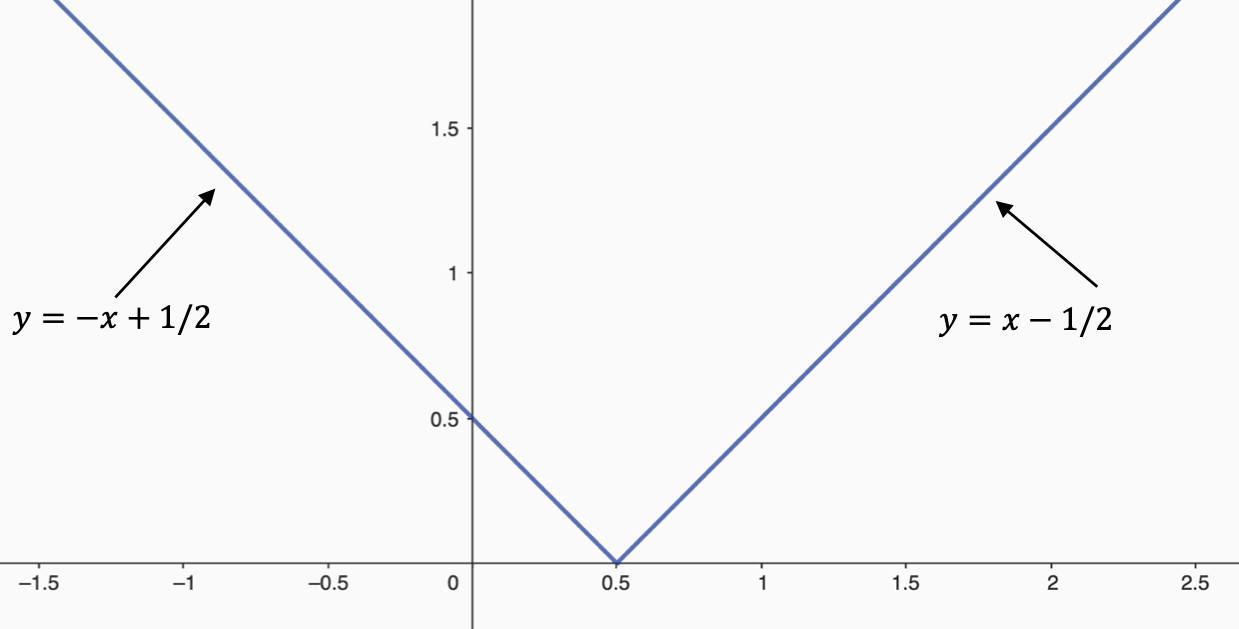
So the derivative is a piecewise-defined function:
$$f'(x) = \left\{ \begin{array}{ll} -1 & -\infty\lt x\lt \frac12\\ 1 & \frac12 \lt x\lt \infty\\ \end{array} \right.$$Now $$f(1)-f(-1) = 2f'(c) \Rightarrow f'(c) = -\frac12.$$ Since the derivative is either $1$ or $-1$ at all $x,$ there is no $c$ for which $f(1) - f(-1) = 2f'(c).$
Also, since $f$ is not differentiable at $x=\frac12,$ it is not differentiable on the open interval $(-1,1)$, as required by the Mean Value Theorem.
Note: The following content is adapted from Paul's Online Math Notes, with permission, and is not shared under the Creative Commons license.
Suppose we know that $f(x)$ is continuous and differentiable on the interval $[-7,0],$ that $f(-7)=-3$ and that $f'(x)\leq 2.$ What is the largest possible value for $f(0)$?
We were told that the function (whatever it is) satisfies the conditions of the Mean Value Theorem. So let's start with the formula from the conclusion of the theorem, and substitute in any known values:
\begin{align*} f(b)-f(a) &= f'(c)(b-a)\\ f(0)-f(-7) &=f'(c)(0-(-7))\\ &\Rightarrow f(0)+3 = 7f'(c)\\ \end{align*}We were also told that the maximum value of the derivative is $2.$ So putting the maximum possible value of the derivative for $f'(c)$ will, in this case, give us the maximum value of $f(0).$ Doing this, we find
$$f(0) = 7f'(c)-3 \leq 7(2)-3 = 11$$So, the largest possible value for $f(0)$ is $11.$ Writing this as an inequality, we say $$\require{bbox} \bbox[2pt,border:2px solid green]{f(0)\leq 11}$$
Show that $f(x) =x^3-7x^2+25x+8$ has exactly one real root.
Recall what the Intermediate Value Theorem says: for a function that is continuous on a closed interval, the function attains every value between its values at the endpoints. We want to find a number $c$ such that $f(c) = 0,$ so if $f$ is positive at some point and negative at some other point, the IVT tells us that it has to be zero somewhere in between. Note that since $f$ is a polynomial, it is continuous everywhere, so the IVT applies on any interval.
Notice that $f(0)=8.$ If we can now find a function value that is negative, we can then apply the Intermediate Value Theorem to show that the function has at least one real root.
The largest power of $x$ in the function is $3,$ so the function should be negative for a negative value of $x$ that is "large" enough (i.e. far enough from zero in the negative direction). We should be able to find such an $x$ by trial and error. In fact, we don't need to do much, as $f(-1) = -25.$
So, since $f(-1) = -25 \lt 0$ and $f(0) = 8 \gt 0,$ the Intermediate Value Theorem says that the function must equal zero somewhere in the interval $(-1,0).$ So we now know that the function has at least one real root (we don't know what it is, but that doesn't matter).
We wish to show that there is exactly one real root. If we assume that there is more than one and derive a contradiction, we will have done that. So let's assume that the function has more than one real root. That means that there must be (at least) two numbers, say $a$ and $b$ such that $$f(a)=f(b)=0.$$
Next, because $f$ is a polynomial and is therefore continuous and differentiable everywhere, we can use Rolle's theorem to say that there must be some value $c$ such that $$f'(c) = 0.$$
Note that Rolle's theorem tells us that $c$ must be between $a$ and $b$. Since both $a$ and $b$ are real numbers, $c$ is also a real number.
But since $f$ is a polynomial, we can easily take its derivative and find out where it equals zero. Doing that, we find
$$f'(x) = 3x^2-14x+25 \hspace{.25in}\Rightarrow\hspace{.25in} 3c^2-14c+25 = 0 \hspace{.25in}\Rightarrow \hspace{.25in}c=\frac{7\pm\sqrt{26}i}{3}$$So we see that the only two places where the derivative of $f$ is zero are complex numbers, not real numbers. This contradicts the conclusion from Rolle's theorem, so the assumption that there were two numbers $a$ and $b$ with $f(a) = f(b) = 0$ was incorrect. Therefore, it is not possible for there to be more than one real root.
Putting everything together, we first showed that there was at least one real root. Then we showed that there cannot be more than one real root. In other words, there is at most one real root. Therefore, there must be exactly one real root.
Assignment Problems
For problems 1 - 4 determine all the number(s) $c$ that satisfy the conclusion of Rolle's theorem for the given function and interval.
- $f(x) = x^3 -4x^2 + 3$ on $[0,4]$
- $Q(z) = 15+2z-z^2$ on $[-2,4]$
- $h(t)=1-\text{e}^{t^2-9}$ on $[-3,3]$
- $g(w)=1+\cos(\pi w)$ on $[5,9]$
For problems 5 - 8 determine all the number(s) $c$ that satisfy the conclusion of the Mean Value Theorem for the given function and interval.
- $f(x) = x^3-x^2+x+8$ on $[-3,4]$
- $g(t)=2t^3+t^2+7t-1$ on $[1,6]$
- $P(t)=\text{e}^{2t}-6t-3$ on $[-1,0]$
- $h(x)=9x-8\sin\left(\frac{x}{2}\right)$ on $[-3,-1]$
Note: The following content is adapted from OpenStax and is licensed under a Creative Commons Attribution-NonCommercial-ShareAlike 4.0 International License.
Access for free at https://openstax.org/books/calculus-volume-1/pages/1-introduction.
For problems 9 - 11, determine over which intervals (if any) the Mean Value Theorem applies. Justify your answer.
- $f(x) = \sin(\pi x)$
- $f(x) = \sqrt{4-x^2}$
- $f(x) = \ln(3x-5)$
For problems 12 and 13, show that there is no $c$ such that $f(1)-f(-1)=2f'(c).$ Explain why the Mean Value Theorem does not apply over the interval $[-1,1].$
- $f(x) = \frac{1}{x^2}$
- $f(x) = \sqrt{|x|}$
Note: The following content is adapted from Paul's Online Math Notes, with permission, and is not shared under the Creative Commons license.
- Suppose we know that $f(x)$ is continuous and differentiable on the interval $[-2,5],$ that $f(5) = 14$ and that $f'(x)\leq 10.$ What is the smallest possible value for $f(-2)$?
- Suppose we know that $f(x)$ is continuous and differentiable on the interval $[-6,-1],$ that $f(-6) = -23$ and that $f'(x)\geq -4.$ What is the smallest possible value for $f(-1)$?
- Suppose we know that $f(x)$ is continuous and differentiable on the interval $[-3,4],$ that $f(-3)=7$ and that $f'(x)\leq -17.$ What is the largest possible value for $f(4)$?
- Suppose we know that $f(x)$ is continuous and differentiable on the interval $[1,9],$ that $f(9) = 0$ and that $f'(x)\geq 8.$ What is the largest possible value for $f(1)$?
- Show that $f(x) = x^7 +2x^5 + 3x^3 + 14x + 1$ has exactly one real root.
- Show that $f(x) = 6x^3-2x^2+4x-3$ has exactly one real root.
- Show that $f(x) = 20x - \text{e}^{-4x}$ has exactly one real root.
Note: The following content is adapted from OpenStax and is licensed under a Creative Commons Attribution-NonCommercial-ShareAlike 4.0 International License.
Access for free at https://openstax.org/books/calculus-volume-1/pages/1-introduction.
- At 10:17 a.m., you drive past a police car on the side of the freeway. You pass a second police car at 10:53 a.m. At both times you note that your speed is 55 mph. If the second police car is located 39 miles from the first police car and if the speed limit is 60 mph, can you be cited for speeding? Explain.
- Two cars drive from one stoplight to the next, leaving at the same time and arriving at the same time. Is there ever a time when they are going the same speed? Justify your answer.
- Show that $y=\sec^2 x$ and $y=\tan^2 x$ have the same derivative. What can you say about $y=\sec^2x - \tan^2 x$?
- Why do we need continuity to apply the Mean Value Theorem? Construct an example that shows that the conclusion of the Mean Value Theorem need not hold for a function that is not continuous.
- Why do we need differentiability to apply the Mean Value Theorem? Find an example that shows that the conclusion of the Mean Value Theorem need not hold for a function that is not differentiable.
- When are Rolle's theorem and the Mean Value Theorem equivalent?
- If $f$ is a function with a discontinuity, is it still possible to have $f'(c)(b-a) = f(b) - f(a)?$ Draw such an example or explain why it is not possible.