Rates of Change, revisited
Click here for a printable version of this page.The purpose of this section is to remind us of one of the most important applications of derivatives: the fact that $f'(x)$ represents the rate of change of $f(x)$. We saw this application repeatedly in the last chapter, so we won't do a lot with it in this chapter, but you will see it occasionally.
To make sure we keep this application at our fingertips, though, here are a few examples that focus on the rate of change as an application of the derivative.
Determine all the points where the following function is not changing.
$$g(x) = 5-6x-10\cos(2x)$$
First, we need to take the derivative of $g$: $$g'(x) = -6+20\sin(2x)$$
When the rate of change of the function is zero, the function is not changing. So we need to determine the $x$-values at which the derivative is zero.
$$-6+20\sin(2x) = 0 \hspace{.25in}\Rightarrow\hspace{.25in} \sin(2x) = \frac{6}{20}=0.3$$Solving this equation, we find
\begin{alignat}{4} 2x \approx & 0.3047 + 2\pi n & & \hspace{0.5in}{\mbox{OR}}\hspace{0.5in} & 2x \approx & 2.8369 + 2\pi n & & \hspace{0.25in}n = 0, \pm 1, \pm 2, \ldots \\ x \approx & 0.1524 + \pi n & & \hspace{0.5in}{\mbox{OR}}\hspace{0.5in} & x \approx & 1.4185 + \pi n & & \hspace{0.25in}n = 0, \pm 1, \pm 2, \ldots \end{alignat}Determine where the following function is increasing and where it is decreasing.
$$A(t) = 27t^5-45t^4-130t^3+150$$
Again, we need to take the derivative of the function: $$A'(t) = 135t^4-180t^3-390t^2 = 15t^2(9t^2-12t-26)$$
Next, we need to find the values of $t$ at which the derivative is zero. These will be the times at which the function is not changing. Setting the derivative equal to zero and using the Quadratic Formula yields three values of $t$:
\begin{align} t &= 0\\ t &= \frac{12\pm \sqrt{144-4(9)(-26)}}{18}=\frac{12\pm\sqrt{1080}}{18} = \frac{12\pm 6\sqrt{30}}{18} = \frac{2\pm \sqrt{30}}{3}\\ &\approx -1.159, 2.492\\ \end{align}Now, to determine where the function is increasing or decreasing, we find the intervals over which the derivative is positive and those over which it is negative. (Recall that if the derivative is positive, then the function is increasing, and if the derivative is negative, then the function is decreasing.)
The following number line gives the information we need:
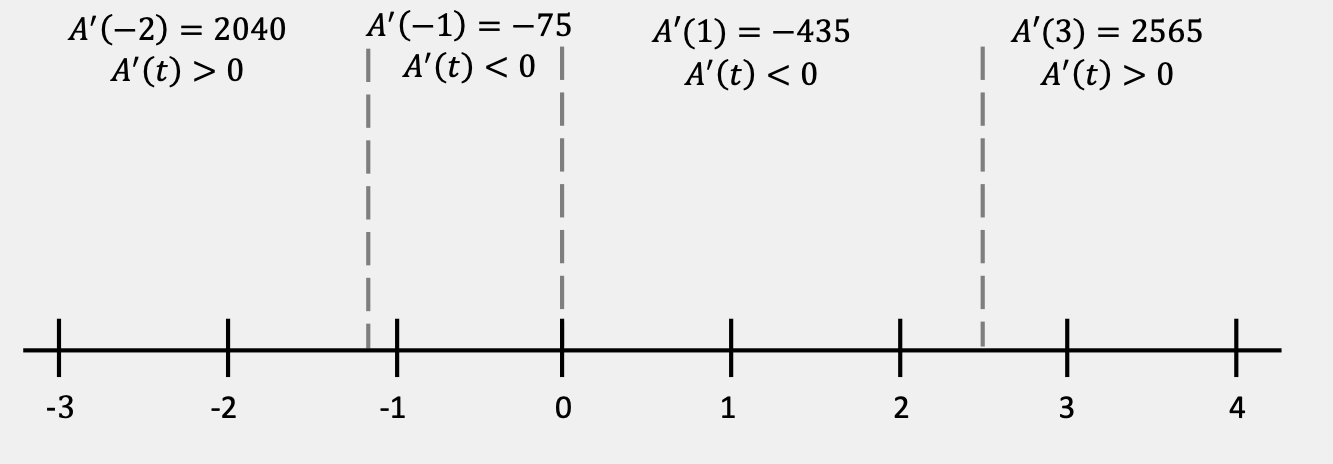
Using this number line, we can see that we have the following increasing and decreasing information:
Increasing on the intervals $-\infty\lt t\lt -1.159$ and $2.492\lt t\lt\infty$
Decreasing on the intervals $-1.159\lt t\lt 0$ and $0\lt t\lt 2.492$
Finally, we can't forget about Related Rates problems.
Two cars start out 500 miles apart. Car A is to the west of Car B, and starts driving to the east (i.e. towards Car B) at 35 mph at the same time that Car B starts driving south at 50 mph. After 3 hours of driving, at what rate is the distance between the two cars changing? Is the distance increasing or decreasing?
Let's first create a sketch of the situation.

In this figure, $y$ represents the distance driven by Car B, and $x$ represents the distance separating Car A from Car B's initial position. We use $z$ to represent the distance separating the two cars. After 3 hours driving time, we have the following values of $x$ and $y$:
$$x=500-35(3) = 395\hspace{.25in} y=50(3) = 150$$We can use the Pythagorean theorem to find $z$ at this time as follows:
$$z^2 = 395^2 +150^2 = 178,525 \hspace{.25in}\Rightarrow\hspace{.25in} z=\sqrt{178,525} \approx 422.5222$$To answer the question posed, we will need to find $\frac{dz}{dt}$, given that $\frac{dx}{dt} = -35$ and $\frac{dy}{dt} = 50$. Do you agree with the signs on these two derivatives? Remember that a rate is negative if the quantity is decreasing, and positive if the quantity is increasing.
We can use the Pythagorean theorem again to write down a relationship among $x$, $y$ and $z$. We then use Implicit Differentiation.
$$z^2 = x^2 + y^2 \hspace{.25in}\Rightarrow\hspace{.25in} 2zz' = 2xx'+2yy'$$Finally, we need to substitute the known quantities, simplify, and solve for $z'$.
$$z'(422.5222) = (395)(-35)+(150)(50)\hspace{.25in}\Rightarrow\hspace{.25in} z'\approx\frac{-6325}{422.5222}\approx -14.9696$$After three hours, the distance between the cars is decreasing at a rate of approximately $14.9696 $ mph.
In this section we covered three "standard" problems that use the idea that the derivative of a function gives the rate of change of the function. The rest of this chapter will be focusing more on other applications of the derivative, but we don't want to forget this very important one.
Practice Problems
As noted above, this section is only included to remind you of certain applications of the derivative that we learned in the previous chapter. There are no new practice problems for this section; instead, here are links to the sections in the previous chapter in which we dealt with rates of change. Look at the Practice Problems in each of these sections for review.
Derivatives of Exponential & Logarithm Functions
In addition, related rates problems can be found in the Related Rates section.
Assignment Problems
Here are a few problems for additional practice in using the derivative as the rate of change of a function.
Note: The following content is adapted from OpenStax and is licensed under a Creative Commons Attribution-NonCommercial-ShareAlike 4.0 International License.
Access for free at https://openstax.org/books/calculus-volume-1/pages/1-introduction.

- The function $s(t) = 2t^3 - 3t^2 - 12t+8$ represents the position of a particle traveling along a horizontal line.
- Find the velocity and acceleration functions.
- Determine the time intervals in which the particle is slowing down or speeding up.
- The function $s(t) = \displaystyle\frac{t}{1+t^2}$ represents the position of a particle traveling along a horizontal line.
- Find the velocity and acceleration functions.
- Determine the time intervals in which the particle is slowing down or speeding up.
- A ball is thrown downward with a speed of 8 ft/s from the top of a 64-foot-tall building. After $t$ seconds, its height above the ground is given by $s(t) = -16t^2 -8t+64.$
- When does the ball hit the ground?
- What is the velocity of the ball as it hits the ground?
- The position of a hummingbird flying along a straight line after $t$ seconds is given by $s(t) = 3t^3 - 7t$ meters.
- Determine the velocity of the bird at $t=1$ second.
- Determine the acceleration of the bird at $t=1$ second.
- Determine the acceleration of the bird when the velocity equals 0.
- The position function $s(t) = t^3-8t$ gives the position in miles of a freight train where east is the positive direction and $t$ is measured in hours.
- Determine the direction the train is traveling when $s(t) = 0.$
- Determine the direction the train is traveling when its acceleration is zero.
- Determine the time intervals over which the train is slowing down or speeding up.
- The following graph shows the position $y=s(t)$ of an object moving along a straight line.

- Use the graph of the position function to determine the time intervals over which the velocity is positive, negative, or zero.
- Sketch the graph of the velocity function.
- Use the graph of the velocity function to determine the time intervals over which the acceleration is positive, negative or zero.
- Determine the time intervals over which the object is speeding up or slowing down.
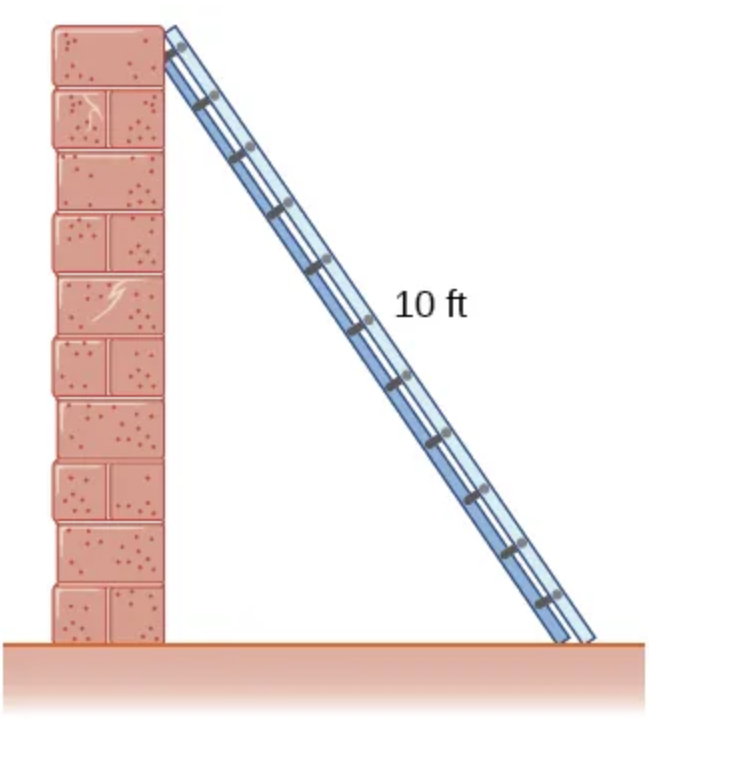
- A 10-ft ladder is leaning against a wall. If the top of the ladder slides down the wall at a rate of 2 ft/sec, how fast is the bottom of the ladder moving along the ground when it is 5 feet from the wall?
- You and a friend are riding your bikes to a restaurant that you think is east; your friend thinks the restaurant is north. You both leave from the same point, with you riding at 16 mph east and your friend riding 12 mph north. After you have traveled 4 miles, at what rate is the distance between you changing?
- A helicopter starting on the ground is rising directly into the air at a rate of 25 ft/sec. Starting directly under the helicopter, you run along the ground at a rate of 10 ft/sec. Find the rate of change of the distance between the helicopter and yourself after 5 seconds.
- Using the previous problem, find the rate at which the distance between you and the helicopter is changing when the helicopter is 60 feet in the air. Assume that the helicopter was initially 30 feet above you.
- The side of a cube increases at a rate of 1/2 m/sec. Find the rate at which the volume of the cube increases when the side of the cube measures 4 meters.
- The base of a triangle is shrinking at a rate of 1 cm/min, and the height of the triangle is increasing at a rate of 5 cm/min. Find the rate at which the area of the triangle is changing when the height is 22 cm and the base is 10 cm.