Mobile Systems, Intelligent Networks, and Data Science (MINDS) Laboratory
 |
Director: Dr. Omid Semiari Address: 1420 Austin Bluffs Pkwy, ENGR Building, Colorado Springs, CO 80918 |
Members
PhD Students
Arian Ahmadi
Fatemeh Lotfi
Justice Obrey
Master's Students
Addison Carrick
Ray Decker
Undergraduate REU Students
Jason Cuthbert
Alumni
Md Mostofa Kamal Tareq, MSEE, graduated in 2019. Md Mostofa is with Qualcomm now.
Ethan Sherman, BSEE, graduated in 2021.
Chris Weber, BSEE, graduated in 2021.
Research Areas
 |
|
Sample Projects
Towards Joint Mobile Broadband and Ultra-Reliable Low-Latency Communications in Wireless Cellular Networks
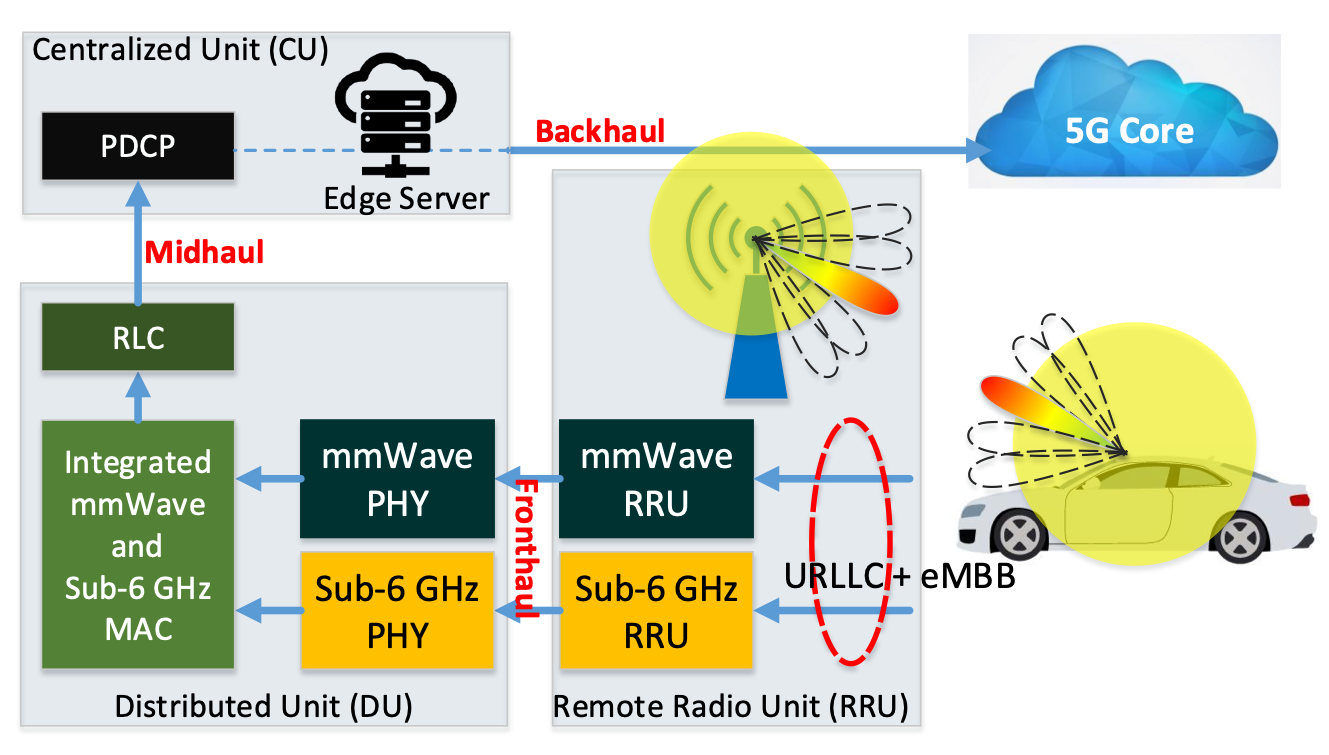 |
Emerging wireless services such as connected and autonomous vehicles (CAVs), autonomous platoons, virtual reality (VR), and unmanned aerial vehicles (UAV) applications require next-generation wireless networks to support ultra-reliable and low-latency communication (URLLC), while also guaranteeing high data rates. For example, CAVs rely both on URLLC services (e.g., emergency braking) and enhanced mobile broadband (eMBB) applications (e.g., high-definition maps). Existing wireless networks that solely rely on the scarce sub-6 GHz, microwave (µW) frequency bands will be unable to meet the low-latency, high capacity requirements of future wireless services due to spectrum scarcity. Meanwhile, operating at high-frequency millimeter wave (mmWave) and terahertz (THz) bands is seen as an attractive solution, primarily due to the bandwidth availability and possibility of large-scale multi-antenna communication. |
However, even though leveraging the large bandwidth at mmWave and THz frequencies can potentially boost the wireless capacity and reduce the transmission delay for low-latency applications; mmWave and THz communications are inherently unreliable due to their susceptibility to blockage, high path loss, and channel uncertainty. In addition, while communications at high frequencies tend to be noise-limited, mmWave and THz links are prone to strong shot-like interference which can severely impact their performance. Establishing directional links at high-frequency bands will also introduce a substantial delay over the medium access control (MAC) layer, making mmWave and THz communications less attractive for low-latency applications. Due to these unique limitations and complementary features of the mmWave, THz, and sub-6 GHz frequency ranges, there is a need for an integrated wireless cellular system that can dynamically manage its heterogeneous traffic over these frequency ranges. The goal of this project is to address these challenges and enable seamless integration of cellular communications across those frequency bands to support both URLLC and eMBB applications.
Extended Reality Over Wireless Networks
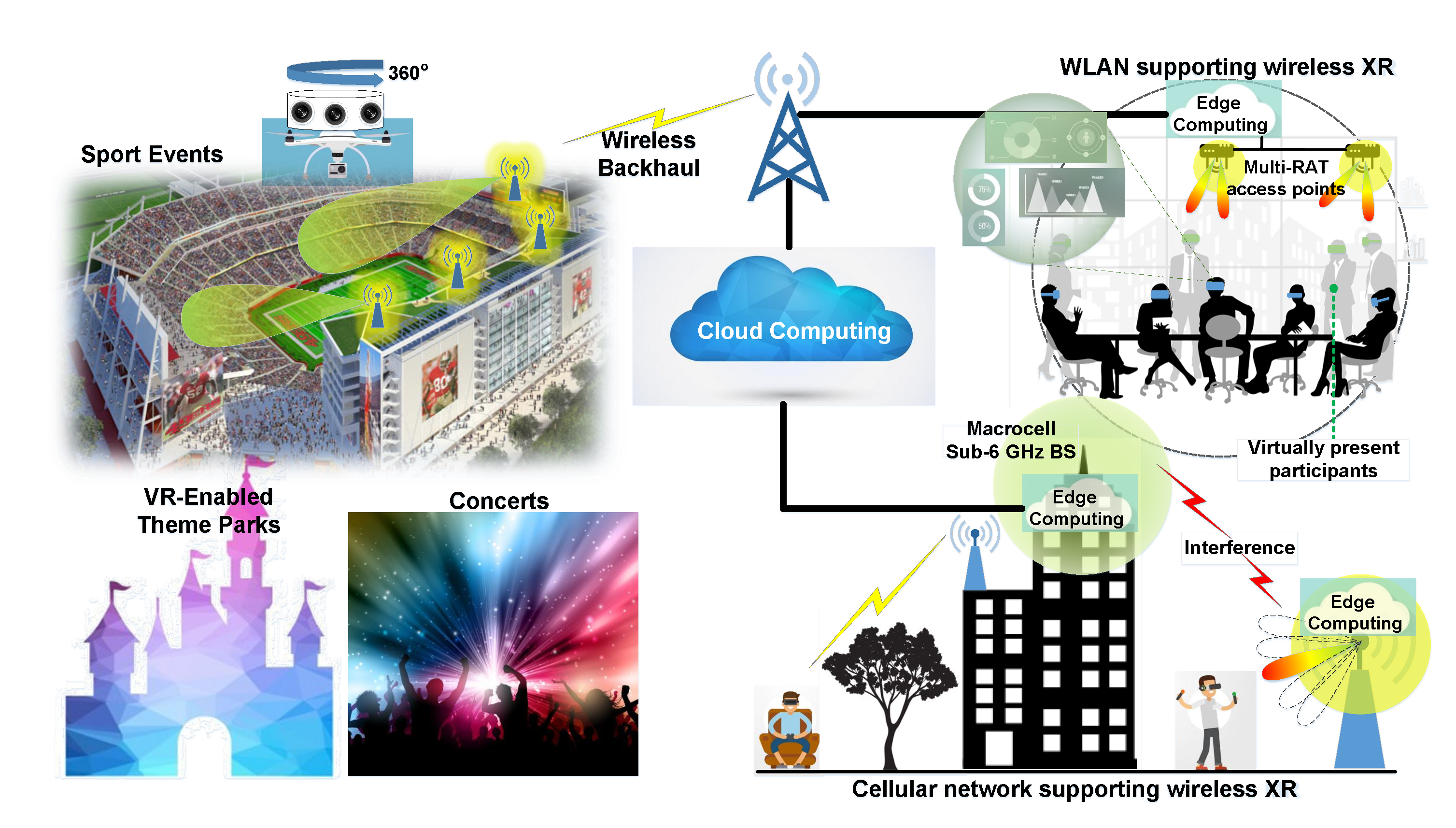 |
Extended reality (XR) technologies, encompassing virtual reality, augmented reality, and mixed reality, will immerse users in virtual worlds with unprecedented interactivity across multiple domains ranging from gaming to sports and entertainment. However, to date, XR technologies have mostly relied on wired connectivity which restricts their use to small spaces and narrows their application domains. In contrast, this research seeks to unleash the potential of XR technologies by marrying them with seamless wireless connectivity. As a result, this research will potentially enable individuals to use XR applications on-the-go without being confined to indoor environments and having to carry cumbersome cable-connected XR equipment. |
This goal is achieved by developing a holistic framework for enabling XR over wireless networks by symbiotically integrating rigorous theory with real-world communication system design considerations. A key component of this framework is the development of precise quality-of-experience metrics that combine objective wireless quality-of-service indicators with subjective XR user experience measures using tools from utility theory. These metrics are then integrated into novel resource management algorithms that merge concepts from reinforcement learning and reservoir computing to guarantee seamless XR quality-of-experience and adapt the network to XR user dynamics. The developed solutions are validated in realistic environments using a combination of simulations and user experiments.
Facilities and Equipment
The laboratory is equipped with high-end test equipment, software, and computers available for research and experimentation. Among the available facilities and equipment include:
Deep Learning Server: Ubuntu 18.04 Deep Learning Server with i9-9920X X-series CPU (3.5 GHz 12-core), 128GB DDR4 memory, two Quadro RTX 6000 GPUs plus NVLink, and 2TB SATA SSD storage. The server has pre-installed TensorFlow, PyTorch, Caffe, Keras, CUDA, and cuDNN.
5G and MIMO Simulation Software: The lab has a Permanent License for Wireless Insite MIMO package from Remcom Inc. This is a powerful ray tracing simulator that supports advance features such as Massive MIMO beamforming and diversity techniques, as well as channel modeling over millimeter wave frequency bands.
Software-Defined Radios: Several SDR platforms, including USRP X310, are available for wireless protocol design and over-the-air (OTA) testing.
Wireless Edge Devices: The lab includes different types of wireless devices including Android smartphones and Microsoft HoloLens 2.0 for wireless XR research.
Measurement Equipment: The lab is equipped with several oscilloscopes and spectrum analyzers from Keysight Technologies.
Collaborators
Dr. Walid Saad, Virginia Tech, VA, USA
Dr. Mérouane Debbah, Huawei Research Labs/CentraleSupélec, Paris, France
Dr. Mehdi Bennis, University of Oulu, Oulu, Finland
Dr. Mingzhe Chen, Princeton University, NJ, USA
Dr. Behrouz Maham, Nazarbayev University, Astana, Kazakhstan
Dr. Mohsen Amini Salehi, University of Louisiana Lafayette, LA, USA
Sponsors
 |
Acknowledgment
We would like to thank our sponsors, collaborators, and colleagues for their contributions and continued support to our research program.